Karnataka 1st PUC Model Question Paper 2027 for Physics (Paper 2)
Finished viewing? Save it for later —
Download Karnataka 1st PUC Model Question Paper 2027 for Physics (Paper 2) (PDF · 4 pages)About Karnataka 1st PUC Model Question Paper 2027 for Physics (Paper 2)
Karnataka 1st PUC Model Question Paper 2027 for Physics (Paper 2) is available here for free download. Published by Karnataka Board for Class 11, this sample paper can be viewed online or downloaded as a PDF (4 pages). Candidates preparing for Class 11 can use Karnataka 1st PUC Model Question Paper 2027 for Physics (Paper 2) to understand the exam pattern, the type of questions asked, and the overall difficulty level.
Frequently Asked Questions
How can I download Karnataka 1st PUC Model Question Paper 2027 for Physics (Paper 2)?
Open this page and click the Download button to save Karnataka 1st PUC Model Question Paper 2027 for Physics (Paper 2) as a PDF. It is completely free on AglaSem Docs.
Is Karnataka 1st PUC Model Question Paper 2027 for Physics (Paper 2) free to download?
Yes. Karnataka 1st PUC Model Question Paper 2027 for Physics (Paper 2) can be viewed online and downloaded as a PDF free of cost on AglaSem Docs.
How many pages does Karnataka 1st PUC Model Question Paper 2027 for Physics (Paper 2) have?
Karnataka 1st PUC Model Question Paper 2027 for Physics (Paper 2) contains 4 pages, which you can read online or download together as a single PDF.
Where can I find more Class 11 study material?
You can find more Class 11 question papers, sample papers, syllabus, and answer keys on AglaSem Docs.
Karnataka 1st PUC Model Question Paper 2027 for Physics (Paper 2) – Text
Read the full text of this sample paper below — useful to quickly search, copy and reference the content online without downloading the PDF.
📄 View text version (5 pages)
Page 1
Karnataka 1st PUC
Model Question Paper
2027 for Physics
(Paper 2)
EXAM YEAR TYPE SUBJECT
Karnataka Class 11 2027 Sample Paper Physics
Notes · Sample Papers · Previous Year Papers · Mock Tests
Page 2
m .co
c. o
e m
em l a s
s a g
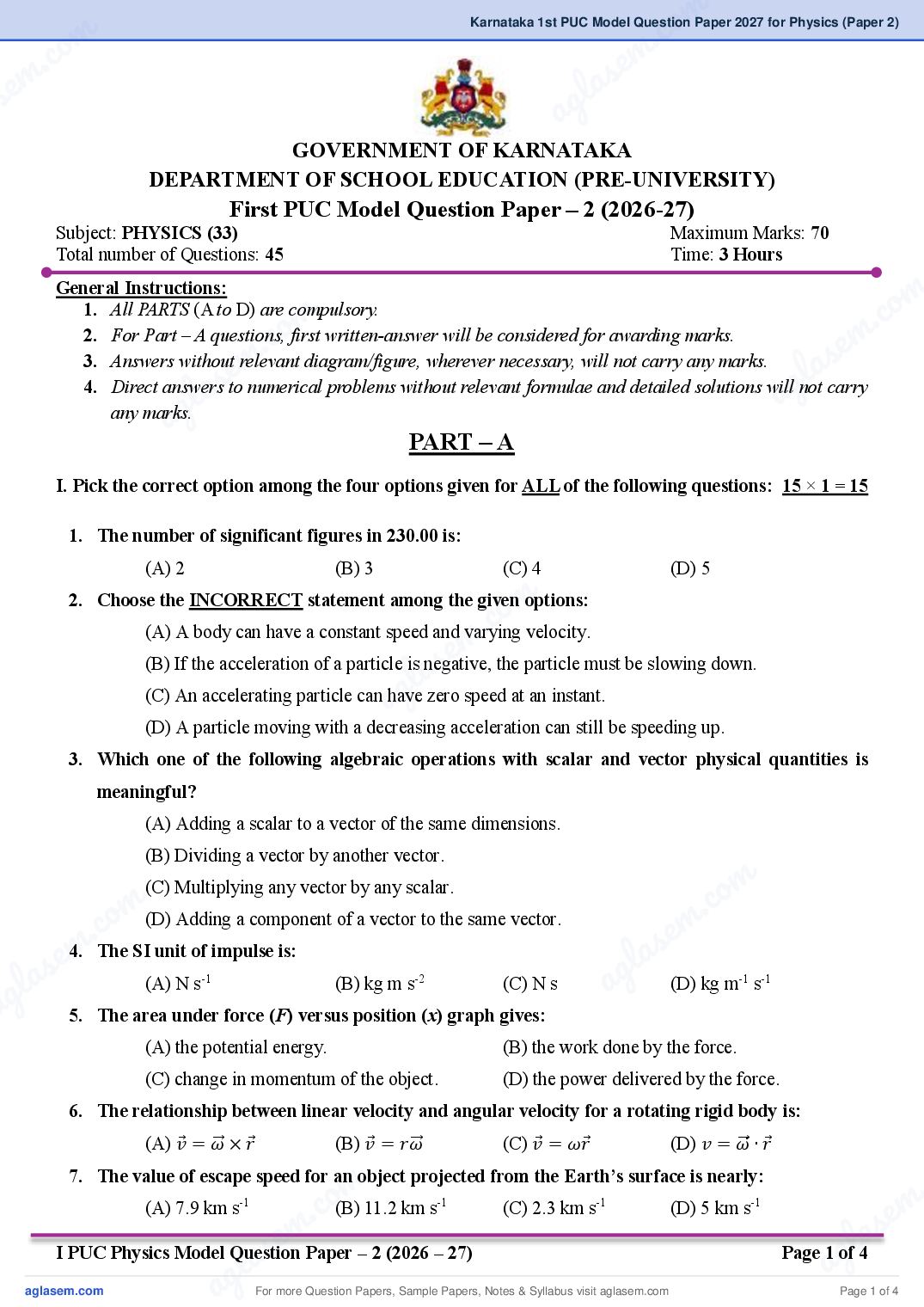
GOVERNMENT OF KARNATAKA
DEPARTMENT OF SCHOOL EDUCATION (PRE-UNIVERSITY)
First PUC Model Question Paper – 2 (2026-27)
Subject: PHYSICS (33) Maximum Marks: 70
Total number of Questions: 45 Time: 3 Hours
m
c. o
General Instructions:
m
co m
1. All PARTS (A to D) are compulsory.
m .
2. For Part – A questions, first written-answer will be considered for awarding marks.
s e
s e
3. Answers without relevant diagram/figure, wherever necessary, will not carry any marks.
a g la
l a
ag
4. Direct answers to numerical problems without relevant formulae and detailed solutions will not carry
any marks.
PART – A
I. Pick the correct option among the four options given for ALL of the following questions: 15 × 1 = 15
1. The number of significant figures in 230.00 is:
(A) 2 (B) 3 (C) 4 (D) 5
o m
c
. velocity.
2. Choose the INCORRECT statement among the given options:
m
e the particle must be slowing down.
(A) A body can have a constant speed and varying
s
lazero speed at an instant.
g
(B) If the acceleration of a particle is negative,
a
(C) An accelerating particle can have
(D) A particle moving with a decreasing acceleration can still be speeding up.
3. Which one of the following algebraic operations with scalar and vector physical quantities is
meaningful?
(A) Adding a scalar to a vector of the same dimensions.
m
(B) Dividing a vector by another vector.
m
(C) Multiplying any vector by any scalar.
.co
c. o (D) Adding a component of a vector to the same vector. se
m
s e4.m The SI unit of impulse is: g la (D) kg m s
gla a
a
-1 -2 -1 -1
(A) N s (B) kg m s (C) N s
5. The area under force (F) versus position (x) graph gives:
(A) the potential energy. (B) the work done by the force.
(C) change in momentum of the object. (D) the power delivered by the force.
6. The relationship between linear velocity and angular velocity for a rotating rigid body is:
(A) 𝑣⃗ = 𝜔
⃗⃗ × 𝑟⃗ (B) 𝑣⃗ = 𝑟𝜔
⃗⃗ (C) 𝑣⃗ = 𝜔𝑟⃗ (D) 𝑣 = 𝜔
⃗⃗̇ ∙ 𝑟⃗
m .
c. o(B) 11.2 km s
7. The value of escape speed for an object projected from the Earth’s surface is nearly:
e m
m s
(A) 7.9 km s-1 -1
(C) 2.3 km s-1 (D) 5 km s-1
se Paper – 2 (2026 – 27) l a
g l a
I PUC Physics Model Question
ag 4
Page 1 of
a For more Question Papers, Sample Papers, Notes & Syllabus visit Page 1 of 4
Page 3
(A) Modulus of elasticity and strain (B) Elastic energy and stress
(C) Stress and elastic energy density (D) Young’s modulus and Poisson’s ratio
9. Consider an incompressible non-viscous fluid under streamline flow in a horizontal tube of varying
cross-sectional area as shown in the figure. Then:
(A) 𝑣1 is greater than 𝑣2 but the flow rate through 𝐴1 and 𝐴2 is the same.
(B) 𝑣2 is greater than 𝑣1 but the flow rate through 𝐴1 and 𝐴2 is the same.
(C) 𝑣1 is equal to 𝑣2 but the flow rate through 𝐴2 is greater than that through 𝐴1 .
(D) 𝑣2 is greater than 𝑣1 and flow rate through 𝐴2 is greater than that through 𝐴1 .
10. Water is used as a coolant in automobile radiators because it has:
(A) high specific heat capacity. (B) high density.
(C) high conductivity. (D) low boiling point.
11. Identify the extensive thermodynamic variable among the given quantities:
(A) Pressure (B) Temperature (C) Density (D) Internal energy
12. For an isochoric process (symbols have usual meanings):
(A) 𝛥𝑄 = 𝛥𝑈 − 𝛥𝑊 (B) Δ𝑄 = Δ𝑊
(C) 𝛥𝑄 = 𝛥𝑈 (D) Δ𝑈 + Δ𝑊 = 0
13. In the table given below, match COLUMN – I with appropriate option in COLUMN – II.
COLUMN – I COLUMN – II
𝟓
(a) For He gas molecule (p) 𝑪𝑽 = 𝑹
𝟐
𝟓
(b) For 𝑵𝟐 gas molecule (q) 𝑪𝐏 = 𝑹
𝟐
(c) For 𝑯𝟐 𝑶 molecule (r) 𝜸 ≈ 𝟏. 𝟑
(A) (a) → (p); (b) → (q); (c) → (r) (B) (a) → (q); (b) → (p); (c) → (r)
(C) (a) → (r); (b) → (q); (c) → (p) (D) (a) → (q); (b) → (r); (c) → (p)
14. The frequency (f) of small oscillations of a spring-mass system depends on the mass (m) as:
1 1
(A) 𝑓 ∝ 𝑚 (B) 𝑓 ∝ √𝑚 (C) 𝑓 ∝ 𝑚 (D) 𝑓 ∝
√𝑚
15. Select the non-mechanical wave from the list:
(A) X - rays (B) Water waves
(C) Ultrasonic waves (D) Seismic waves
I PUC Physics Model Question Paper – 2 (2026 – 27) Page 2 of 4
For more Question Papers, Sample Papers, Notes & Syllabus visit Page 2 of 4
Page 4
m .co
c. II.o Fill in the blanks by choosing the appropriate answer given inside
e the brackets for ALL of them
m la s
se following questions.
a g 5×1=5
(coefficient of viscosity, shear modulus, pressure, interference, acceleration, angular momentum)
16. If the external torque about an axis acting on a system is zero, the ______ about the axis remains constant.
17. The ratio of shearing stress to the strain rate is called ___________.
18. Absolute zero is the temperature at which ___________ of an ideal gas becomes zero.
m
19. At the extreme position of the oscillations of a simple pendulum, ________ of the bob is maximum.
m c. o
co
20. The phenomenon of beats arises due to ________ of sound waves.
. e m
em
PART – B
la s
l a s a g
g
III. Answer ANY FIVE of the following questions: 5 × 2 = 10
a
21. What are derived physical quantities? Give an example.
22. A particle in a uniform circular motion has a linear speed of 5 m s-1 and angular speed of 2 rad/s. What
is the magnitude of its acceleration?
23. State and explain Newton’s third law of motion.
24. Define power. Express power (P) in terms of force 𝐹⃗ and velocity 𝑣⃗.
m
c. o
25. Draw the stress - strain curve for a metal wire. Indicate the important points on the curve.
m
emotion.
26. Why do drops and bubbles have a spherical shape? Explain.
s
la wave on a stretched string depends.
27. Mention two characteristics of simple harmonic
a g
28. List the factors on which the speed of a transverse
PART – C
IV. Answer ANY FIVE of the following questions: 5 × 3 = 15
29. Derive the expression for the magnitude of resultant of two concurrent vectors.
30. What is static friction? Explain why static friction is called a self-adjusting force.
o m
m c
. centre of gravity is
31. Prove the work-energy theorem for a constant force.
32. Aocar
c.1.05 mweighs m
eon each front wheel (take
1800 kg. The distance between its front and back axles is 1.8 m. Its
em l a s
s g
behind the front axle. Determine the force exerted by the level ground
l a a
ag 33. Derive the relationship between the acceleration due to gravity (g) and the universal gravitational
-2
g = 10 m s ).
constant (G).
34. Mention any three properties of thermal radiation.
1
35. Using the expression for pressure of an ideal gas, 𝑃 = 3 𝑚𝑛𝑣̅ 2 , show that the average kinetic energy of
a molecule is proportional to the absolute temperature of the gas.
m .
co
36. A particle undergoes Simple Harmonic Motion (SHM) starting from an extreme position. Write the
. e m
m s
expressions for its kinetic energy, potential energy, and total energy as a function of time.
se Paper – 2 (2026 – 27) l a
g l a
I PUC Physics Model Question
ag 4
Page 3 of
a For more Question Papers, Sample Papers, Notes & Syllabus visit Page 3 of 4
Page 5
V. Answer ANY THREE of the following questions: 3 × 5 = 15
37. Show that the path of a projectile is a parabola.
38. Illustrate the conservation of total mechanical energy of a body falling freely under gravity.
39. (i) Define centre of mass of a system of particles. [1]
(ii) Starting with the expression for the velocity of the centre of mass of a system, derive the equation of
motion of the centre of mass, 𝑀𝐴⃗ = 𝐹⃗ext . [4]
40. (i) Consider a solid cube that expands uniformly in all directions when its temperature is increased by a
small amount. Derive the relationship between the coefficient of linear expansion and the coefficient of
volume expansion for the solid. [3]
(ii) State and explain the principle of calorimetry. [2]
41. Obtain the expression for the natural frequencies of an open organ pipe. Show that all the harmonics are
present in this case.
VI. Answer ANY TWO of the following questions: 2 × 5 = 10
42. A hot air balloon is ascending vertically at a constant speed of 10 m s-1. As it reaches a height of 175 m
above the ground, a packet is dropped from it. (Take acceleration due to gravity, g = 10 m s-2, and ignore
air resistance). Find:
(i) the total time taken by the packet to hit the ground.
(ii) the velocity with which the packet strikes the ground.
43. Block A of mass 2 kg is sliding to the right with a velocity of 10 m s-1 on a rough, horizontal surface
where the coefficient of kinetic friction (μk) is 0.2. It collides head-on with a stationary block B of mass
3 kg. Immediately after the collision, the two blocks stick together and slide as a single unit before
coming to a stop. (Take g = 10 m s-2)
(i) Calculate the velocity of the combined system immediately after the collision.
(ii) What is the acceleration of the blocks during their motion over the surface?
44. A remote-sensing satellite of mass 200 kg is revolving around the Earth in a circular orbit at a height of
3.6 × 10⁶ m above the surface of the Earth. Calculate:
(i) the orbital speed of the satellite.
(ii) the total energy of the satellite in its orbit.
(Given: Mass of the Earth = 6 × 1024 kg; Radius of the Earth = 6.4 × 10³ km; universal gravitational
constant, G = 6.67 × 10⁻¹¹ N m2 kg-2).
45. A Carnot engine absorbs 5 × 10⁴ calories of heat energy from a source at a temperature of 227 °C during
each operating cycle. It performs useful mechanical work and rejects the remaining energy to a sink kept
at 127 °C. Determine:
(i) the efficiency of the engine.
(ii) the heat rejected to the sink by the engine per cycle in joules.
I PUC Physics Model Question Paper – 2 (2026 – 27) Page 4 of 4
For more Question Papers, Sample Papers, Notes & Syllabus visit Page 4 of 4
Document Details
| Board / Org | Karnataka Board |
| Exam | Class 11 |
| Type | Sample Paper |
| Pages | 4 |
| Updated | 13 Nov 2026 |