MBOSE Class 12 Question Paper 2019 for Economics
Finished viewing? Save it for later —
Download MBOSE Class 12 Question Paper 2019 for Economics (PDF · 11 pages)About MBOSE Class 12 Question Paper 2019 for Economics
MBOSE Class 12 Question Paper 2019 for Economics is available here for free download. Published by Meghalaya Board for Class 12, this question paper can be viewed online or downloaded as a PDF (11 pages). Candidates preparing for Class 12 can use MBOSE Class 12 Question Paper 2019 for Economics to understand the exam pattern, the type of questions asked, and the overall difficulty level.
Frequently Asked Questions
How can I download MBOSE Class 12 Question Paper 2019 for Economics?
Open this page and click the Download button to save MBOSE Class 12 Question Paper 2019 for Economics as a PDF. It is completely free on AglaSem Docs.
Is MBOSE Class 12 Question Paper 2019 for Economics free to download?
Yes. MBOSE Class 12 Question Paper 2019 for Economics can be viewed online and downloaded as a PDF free of cost on AglaSem Docs.
How many pages does MBOSE Class 12 Question Paper 2019 for Economics have?
MBOSE Class 12 Question Paper 2019 for Economics contains 11 pages, which you can read online or download together as a single PDF.
Where can I find more Class 12 study material?
You can find more Class 12 question papers, sample papers, syllabus, and answer keys on AglaSem Docs.
MBOSE Class 12 Question Paper 2019 for Economics – Text
Read the full text of this question paper below — useful to quickly search, copy and reference the content online without downloading the PDF.
📄 View text version (11 pages)
Page 1
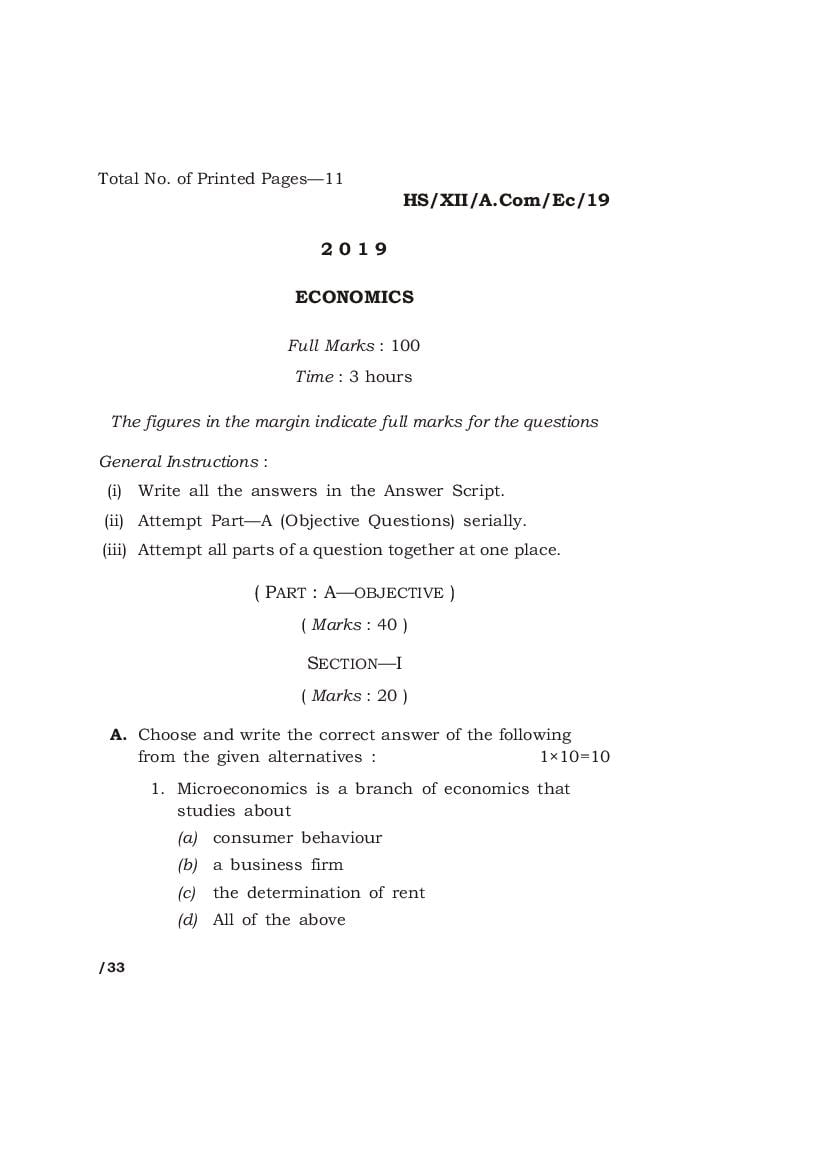
HS/XII/A.Com/Ec/19
2019
ECONOMICS
Full Marks : 100
Time : 3 hours
The figures in the margin indicate full marks for the questions
General Instructions :
(i) Write all the answers in the Answer Script.
(ii) Attempt Part—A (Objective Questions) serially.
(iii) Attempt all parts of a question together at one place.
( PART : A—OBJECTIVE )
( Marks : 40 )
SECTION—I
( Marks : 20 )
A. Choose and write the correct answer of the following
from the given alternatives : 1×10=10
1. Microeconomics is a branch of economics that
studies about
(a) consumer behaviour
(b) a business firm
(c) the determination of rent
(d) All of the above
/33
Page 2
2. The utility derived from the consumption of the
last unit of a commodity is called
(a) total utility
(b) average utility
(c) marginal utility
(d) negative utility
3. All the following curves are U-shaped, except
(a) AC curve
(b) AVC curve
(c) MC curve
(d) AFC curve
4. Perfect knowledge of market conditions is a
feature of
(a) monopolistic competition
(b) perfect competition
(c) oligopoly
(d) monopoly
Page 3
5. According to Prof. Knight, profit arises due to
(a) unforeseen risk
(b) innovation
(c) foreseeable risk
(d) None of the above
6. Which of the following is not correct?
(a) GNP – Depreciation = NNP
(b) GNP + Net factor income from abroad = GDP
(c) Personal income – Personal taxes
= Disposable personal income
(d) NNP – Depreciation = GNP
Page 4
7. The difference between the value of import of
goods and export of goods is called
(a) current account
(b) balance of payments
(c) capital account
(d) balance of trade
8. Agriculture comes under the
(a) secondary sector
(b) primary sector
(c) tertiary sector
(d) public sector
Page 5
9. Which of the following is a major import item of
India?
(a) Capital goods
(b) Crude oil and petroleum products
(c) Fertilizers
(d) Food grains
10. Which of the following is the period of the 12th
Five-Year Plan?
(a) 2012–2017
(b) 2002–2007
(c) 1997–2002
(d) 2007–2012
Page 6
B. Fill in the blanks with appropriate word(s) : 1×10=10
1. In a two-sector economy, there is the household
sector and the _____ sector.
2. The responsiveness of supply to a change in
price is called _____ of supply.
3. Under monopoly, a firm’s marginal revenue
curve lies _____ the average revenue curve.
4. According to David Ricardo, rent is a _____
surplus.
5. National income is a _____ of goods and services,
which becomes available to a nation in a given
period, normally a year.
6. A tax whose impact and incidence falls on the
same person is called _____ tax.
7. A tax is a compulsory contribution imposed by a
_____ on the citizens of a country.
8. The share of agriculture in India’s national
income is _____.
Page 7
9. Cottage and small-scale industries are _____
intensive industries.
10. _____ goods are important non-traditional export
items of India.
SECTION—II
( Marks : 20 )
C. Answer any ten of the following in 2 or 3 sentences
each : 2×10=20
1. State the three basic problems of an economy.
2. Complete the following table :
Number of Apples Total Utility Marginal Utility
1 10 _____
2 18 _____
3 24 _____
4 28 _____
5 28 _____
6 25 _____
3. Mention two factors affecting supply of a
commodity.
Page 8
4. Mention the conditions of the equilibrium of a
firm.
5. Give the economic meaning of the word ‘market’.
6. What is real wage?
7. What is gross domestic product?
8. Mention two sources of public revenue.
9. Give two distinctions between public finance
and private finance.
10. Explain two reasons for international trade.
11. What are the components of the Green
Revolution?
12. Why is Industrial Policy, 1956 considered
superior to the Industrial Policy, 1948?
13. Give two measures to increase agricultural
production in India.
14. Name three key words associated with economic
reforms.
Page 9
( PART : B—DESCRIPTIVE )
( Marks : 60 )
Answer ten questions, taking four from Section—I and
three each from Section—II and Section—III
SECTION—I
1. Explain with the help of a diagram the law of
diminishing marginal utility. 6
2. What is elasticity of demand? Measure elasticity of
demand with the help of geometric method. 1+5=6
3. Distinguish between fixed cost and variable cost. 6
4. How is the equilibrium price and output determined
under conditions of monopoly? 6
5. Define interest. Distinguish between gross interest
and net interest. 1+5=6
6. Explain Ricardian theory of rent under extensive
cultivation. 6
Page 10
SECTION—II
7. Explain the circular flow of income in a two-sector
model with the help of a diagram. 5+1=6
8. Define public debt. Discuss the need for public debt.
1+5=6
9. Distinguish between direct and indirect taxes. What
are the merits of indirect taxes? 2+4=6
10. Give an account of the increase in public expenditure
in recent times. 6
11. Distinguish between domestic trade and
international trade. 6
SECTION—III
12. Define infrastructure. Explain the types of
infrastructure. 2+4=6
13. Discuss the need and types of agricultural finance.
3+3=6
Page 11
14. What are the problems faced by small-scale and
cottage industries? Give measures to tackle these
problems. 3+3=6
15. Discuss the composition of India’s foreign trade. 6
16. Examine the main features of economic reforms
introduced in India in 1991. 6
HHH
HS/XII/A.Com/Ec/19/33 K9—20710
Document Details
| Board / Org | Meghalaya Board |
| Exam | Class 12 |
| Type | Question Paper |
| Pages | 11 |
| Updated | 15 Jul 2026 |