CBSE Class 9 Class 10 Syllabus 2023-24 Elements of Book Keeping and Accountancy
Finished viewing? Save it for later —
Download CBSE Class 9 Class 10 Syllabus 2023-24 Elements of Book Keeping and Accountancy (PDF · 4 pages)About CBSE Class 9 Class 10 Syllabus 2023-24 Elements of Book Keeping and Accountancy
CBSE Class 9 Class 10 Syllabus 2023-24 Elements of Book Keeping and Accountancy is available here for free download. Published by CBSE for Class 10, this syllabus can be viewed online or downloaded as a PDF (4 pages). Candidates preparing for Class 10 can use CBSE Class 9 Class 10 Syllabus 2023-24 Elements of Book Keeping and Accountancy to understand the exam pattern, the type of questions asked, and the overall difficulty level.
Frequently Asked Questions
How can I download CBSE Class 9 Class 10 Syllabus 2023-24 Elements of Book Keeping and Accountancy?
Open this page and click the Download button to save CBSE Class 9 Class 10 Syllabus 2023-24 Elements of Book Keeping and Accountancy as a PDF. It is completely free on AglaSem Docs.
Is CBSE Class 9 Class 10 Syllabus 2023-24 Elements of Book Keeping and Accountancy free to download?
Yes. CBSE Class 9 Class 10 Syllabus 2023-24 Elements of Book Keeping and Accountancy can be viewed online and downloaded as a PDF free of cost on AglaSem Docs.
How many pages does CBSE Class 9 Class 10 Syllabus 2023-24 Elements of Book Keeping and Accountancy have?
CBSE Class 9 Class 10 Syllabus 2023-24 Elements of Book Keeping and Accountancy contains 4 pages, which you can read online or download together as a single PDF.
Where can I find more Class 10 study material?
You can find more Class 10 question papers, sample papers, syllabus, and answer keys on AglaSem Docs.
CBSE Class 9 Class 10 Syllabus 2023-24 Elements of Book Keeping and Accountancy – Text
Read the full text of this syllabus below — useful to quickly search, copy and reference the content online without downloading the PDF.
📄 View text version (4 pages)
Page 1
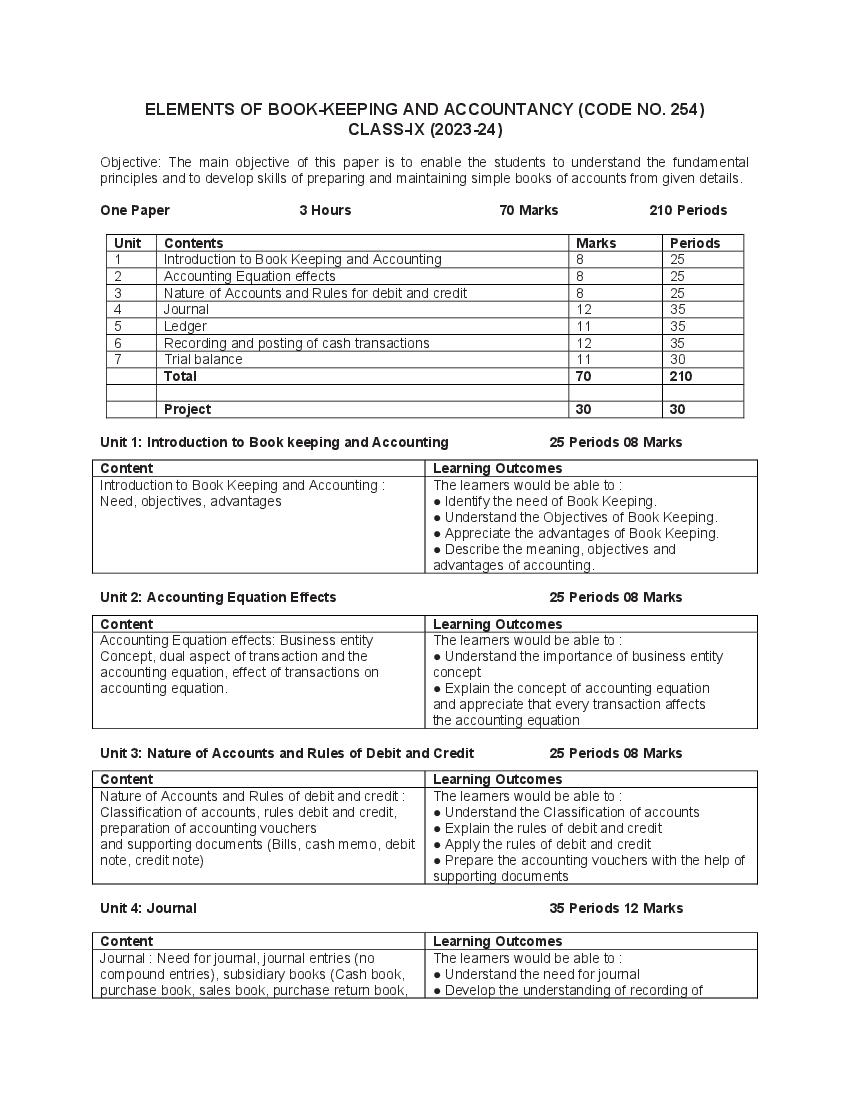
principles and to develop skills of preparing and maintaining simple books of accounts from given details.
Unit Contents Marks Periods
1 Introduction to Book Keeping and Accounting 8 25
2 Accounting Equation effects 8 25
3 Nature of Accounts and Rules for debit and credit 8 25
4 Journal 12 35
5 Ledger 11 35
6 Recording and posting of cash transactions 12 35
7 Trial balance 11 30
Total 70 210
Project 30 30
Unit 1: Introduction to Book keeping and Accounting 25 Periods 08 Marks
Introduction to Book Keeping and Accounting : The learners would be able to :
Need, objectives, advantages ● Identify the need of Book Keeping.
● Understand the Objectives of Book Keeping.
● Appreciate the advantages of Book Keeping.
● Describe the meaning, objectives and
advantages of accounting.
Unit 2: Accounting Equation Effects 25 Periods 08 Marks
Accounting Equation effects: Business entity The learners would be able to :
Concept, dual aspect of transaction and the ● Understand the importance of business entity
accounting equation, effect of transactions on concept
accounting equation. ● Explain the concept of accounting equation
and appreciate that every transaction affects
the accounting equation
Unit 3: Nature of Accounts and Rules of Debit and Credit 25 Periods 08 Marks
Nature of Accounts and Rules of debit and credit : The learners would be able to :
Classification of accounts, rules debit and credit, ● Understand the Classification of accounts
preparation of accounting vouchers ● Explain the rules of debit and credit
and supporting documents (Bills, cash memo, debit ● Apply the rules of debit and credit
note, credit note) ● Prepare the accounting vouchers with the help of
supporting documents
Unit 4: Journal 35 Periods 12 Marks
Journal : Need for journal, journal entries (no The learners would be able to :
compound entries), subsidiary books (Cash book, ● Understand the need for journal
purchase book, sales book, purchase return book, ● Develop the understanding of recording of
Page 2
● Explain the importance of preparing subsidiary
books.
Unit 5: Ledger 35 Periods 11 Marks
Ledger : Definition and importance, relation The learners would be able to :
between journal and ledger. Meaning of posting, ● Explain the concept of ledger and its importance
guiding rules procedure of posting transactions in accounting process.
from journal to ledger and balancing of accounts. ● Appreciate the relationship between journal and
ledger.
● Develop the understanding for posting of
transactions and balancing of accounts.
● Explain the meaning of ledger posting
● Understand the procedure of ledger posting
Unit 6: Recording and Posting of Cash Transactions 35 Periods 12 Marks
Recording and posting of cash transactions : The learners would be able to :
Necessity of cash book and its preparation. Simple ● Explain the purpose of maintaining a cash book
cash book and cash book with cash and discount ● Develop the skill of preparing the format of
column. Petty cash book with imprest system. different types of cash books
● Understand the method of recording cash
transactions in simple cash book, double column
cash book (cash book with cash and discount
column) and petty cash book
● Understand the concept of imprest system
● Develop the skill of maintaining petty cash book
on imprest system
Unit 7: Trial Balance 30 Periods 11 Marks
Trial Balance : Purpose and Preparation (Only The learners would be able to :
Balance Method; No suspense Account) ● State the need and objective of preparing trial
balance
● Develop the skill of preparing trial balance by
balance method
Project – I 15 Periods 15 Marks
Prepare a pictorial/verbal dictionary of accounting terms
Or
Prepare subsidiary books
Or
Diagrammatic presentation of principles of accounting
(Or any other topic related to the course content)
Project – II 15 Periods 15 Marks
Preparation of a Cash Book of;
i. Your pocket money
ii. Help your parent to maintain one month cash statement
Page 3
principles and develop skills of preparing and maintaining simple books of accounts from given details.
Unit Contents Marks Periods
1 Capital and Revenue 8 25
2 Depreciation 12 35
3 Bank Reconciliation Statement 14 45
4 Bills of Exchange 10 25
5 Final Accounts 14 45
6 Accounting from Incomplete Records 12 35
Total 70 210
Project 30 30
Unit 1: Capital and Revenue 25 Periods 08 Marks
Capital and revenue : Capital and revenue receipts, The learners would be able to :
capital and revenue expenditure and deferred ● Recapitulate the meaning of the terms ‘Capital’
revenue expenditure and ‘Revenue’
● Appreciate the difference between capital and
revenue receipts and capital and revenue
expenditure
● Acquire the knowledge about deferred revenue
Expenditure
Unit 2: Depreciation 35 Periods 12 Marks
Depreciation : Need and methods of charging The learners would be able to :
depreciation-straight line and Diminishing balance ● Explain the necessity of providing depreciation on
method (no change in the method) fixed assets
● Develop the skill of using the different methods
i.e. straight line and diminishing balance for
computing depreciation
● Prepare fixed assets accounting using straight
line and diminishing balance method of charging
depreciation
Unit 3: Bank Reconciliation Statement 45 Periods 14 Marks
Bank Reconciliation Statement : Meaning The learners would be able to :
Preparation of BRS with the given cash book / pass ● Understand the concept of bank reconciliation
book balance statement
● Appreciate the need of preparing bank
reconciliation statement
● Develop understanding of preparing bank
reconciliation Statement
Page 4
Bill of Exchange : Nature and use of Bills of The learners would be able to :
Exchange, Terms used in Bills of Exchange. ● Acquire the knowledge of using bills of exchange
Simple transactions related to bills of exchange (No for financing business transactions
dishonour, retiring & renewal of the bill) ● Understand the need of Bills of exchange in
business
● State the meaning of different terms used in bills
of exchange and their implication in accounting
● Develop in the skill of journalising simple bill
transactions in the book of creditor and debtor
Unit 5: Final Accounts 45 Periods 14 Marks
Final Accounts : Preparation of Trading and Profit & The learners would be able to :
loss Account and Balance Sheet of Sole trader. ● State the meaning of financial statements & the
Adjustment for closing stock only. [amount of purpose they serve for a sole proprietor.
closing stock to be given] ● Develop the skill of preparing Trading Account
and calculating gross profit.
● Develop the skill of preparing Profit & Loss
Account and calculating the net profit
● Explain the need for preparing ‘Balance Sheet’.
● Understand the techniques of preparing the
‘Balance Sheet’.
● Develop the understanding to the simple
adjustment for closing stock
Unit 6: Accounting from Incomplete Records 35 Periods 12 Marks
Accounting from Incomplete Records : Meaning; The learners would be able to :
preparation of statement of Profit, statement of ● State the meaning of incomplete records
affairs. [statement of affairs method only] ● Understand the uses and limitations of
incomplete records
● Develop the skill of computation of profit / loss by
preparing Statement of Profit
● Develop the skill of preparing ‘Statement of
Affairs’ and ascertain the position of the business
on a particular date.
Project – I 15 Periods 15 Marks
Identify 20 items and classify them as capital and revenue receipts, capital and revenue expenditure and
deferred revenue expenditure
Project –II 15 Periods 15 Marks
Make a statement of affairs for incomplete records of a small shop.
Document Details
| Board / Org | CBSE |
| Exam | Class 10 |
| Type | Syllabus |
| Pages | 4 |
| Updated | 15 Jul 2026 |