MBOSE Class 12 Question Paper 2023 for Geology
Finished viewing? Save it for later —
Download MBOSE Class 12 Question Paper 2023 for Geology (PDF · 8 pages)About MBOSE Class 12 Question Paper 2023 for Geology
MBOSE Class 12 Question Paper 2023 for Geology is available here for free download. Published by Meghalaya Board for Class 12, this question paper can be viewed online or downloaded as a PDF (8 pages). Candidates preparing for Class 12 can use MBOSE Class 12 Question Paper 2023 for Geology to understand the exam pattern, the type of questions asked, and the overall difficulty level.
Frequently Asked Questions
How can I download MBOSE Class 12 Question Paper 2023 for Geology?
Open this page and click the Download button to save MBOSE Class 12 Question Paper 2023 for Geology as a PDF. It is completely free on AglaSem Docs.
Is MBOSE Class 12 Question Paper 2023 for Geology free to download?
Yes. MBOSE Class 12 Question Paper 2023 for Geology can be viewed online and downloaded as a PDF free of cost on AglaSem Docs.
How many pages does MBOSE Class 12 Question Paper 2023 for Geology have?
MBOSE Class 12 Question Paper 2023 for Geology contains 8 pages, which you can read online or download together as a single PDF.
Where can I find more Class 12 study material?
You can find more Class 12 question papers, sample papers, syllabus, and answer keys on AglaSem Docs.
MBOSE Class 12 Question Paper 2023 for Geology – Text
Read the full text of this question paper below — useful to quickly search, copy and reference the content online without downloading the PDF.
📄 View text version (8 pages)
Page 1
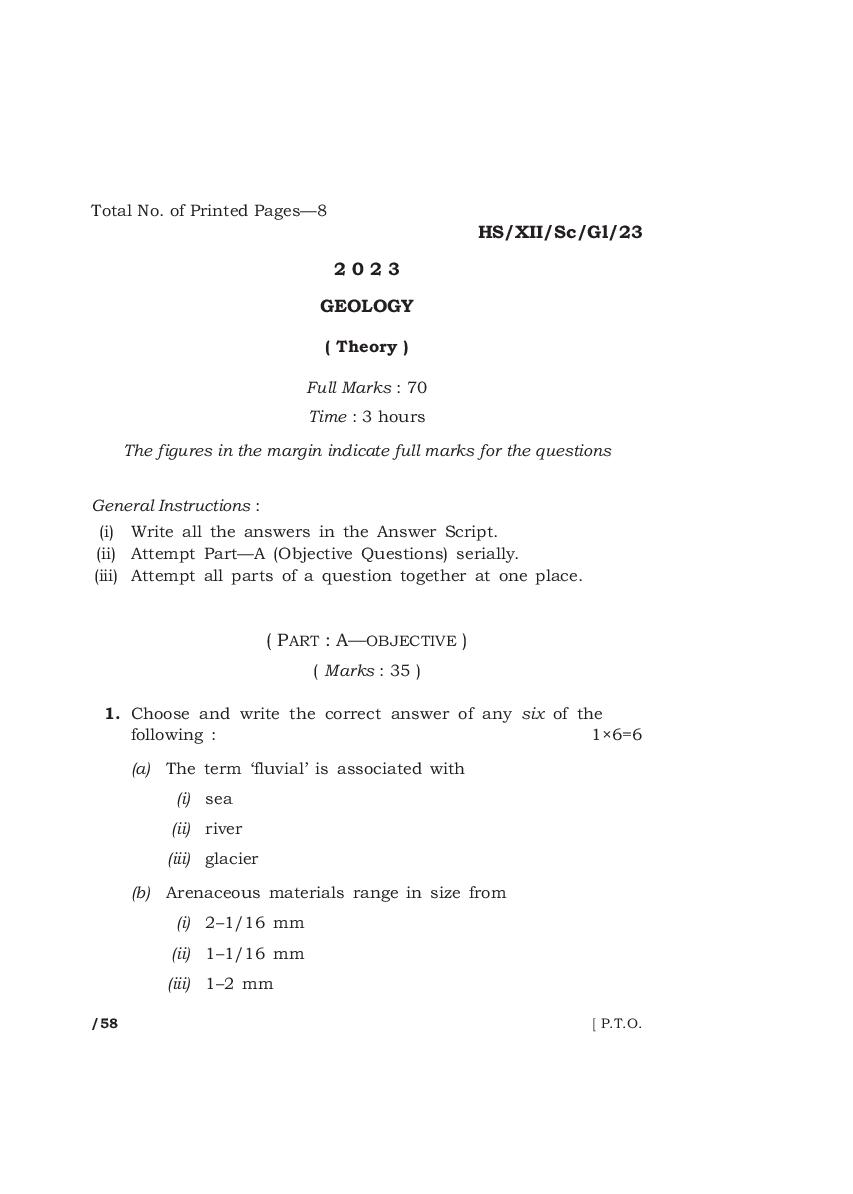
HS/XII/Sc/Gl/23
2023
GEOLOGY
( Theory )
Full Marks : 70
Time : 3 hours
The figures in the margin indicate full marks for the questions
General Instructions :
(i) Write all the answers in the Answer Script.
(ii) Attempt Part—A (Objective Questions) serially.
(iii) Attempt all parts of a question together at one place.
( PART : A—OBJECTIVE )
( Marks : 35 )
1. Choose and write the correct answer of any six of the
following : 1×6=6
(a) The term ‘fluvial’ is associated with
(i) sea
(ii) river
(iii) glacier
(b) Arenaceous materials range in size from
(i) 2–1/16 mm
(ii) 1–1/16 mm
(iii) 1–2 mm
/58 [ P.T.O.
Page 2
(c) The low quality coal is
(i) peat
(ii) bituminous
(iii) anthracite
(d) The upper surface of groundwater is called
(i) vadose water
(ii) water table
(iii) capillary water
(e) The term ‘epigenetic’ means
(i) earlier than
(ii) at the same time
(iii) later than
(f) Muth quartzites are observed in
(i) Vindhyan rocks of Sone Valley
(ii) Cretaceous rocks of Meghalaya
(iii) Paleozoic rocks of Spiti
(g) Chalcopyrite is an ore of
(i) Cu
(ii) Pb
(iii) both Cu and Pb
(h) Choose the odd one out from the following.
(i) Dharwars of Karnataka
(ii) Vindhyans of Sone Valley
(iii) Tertiaries of Assam
HS/XII/Sc/Gl/23/58 [ Contd.
Page 3
2. State whether the following statements are ‘True’
or ‘False’ (any six) : 1×6=6
(a) Tipams are younger than the Surmas.
(b) Lithification promotes diagenesis.
(c) An unconformity separates the Dharwar rocks from
overlying igneous intrusives.
(d) Minerals with valuable metals in them are called
tenor.
(e) Dams must be constructed over rocks that dip
upstream.
(f) Planktonic organisms live on the sea bottom.
(g) Rains promote landslides.
(h) The Khasi group is of Tertiary Age.
3. Fill in the blanks (any six) : 1×6=6
(a) The Tertiaries of North-East are rich in petroleum and
_____.
(b) Closepet granite is observed within the _____
supergroup.
HS/XII/Sc/Gl/23/58 [ P.T.O.
Page 4
(c) Petroleum is of _____ origin.
(d) Further movement of petroleum movement is stopped
by _____ rocks.
(e) The angle of repose for a stable slope is less than
_____º.
(f) _____ is the ore of aluminium.
(g) Radiometric dating methods help in _____ of rocks of
two different areas.
(h) The natural movement of water in its various forms
around the earth is called the _____.
4. Express each of the following lines in 1 (one) word (any
five) : 1×5=5
(a) Wavy structures on the top of sediments
(b) Water-bearing formation
(c) Space where organisms live
(d) An association of closely related groups in a
stratigraphic succession
(e) Hollows in rocks after the entire fossil is taken away
in solution
(f) Sedimentary rocks of physical/mechanical origin
HS/XII/Sc/Gl/23/58 [ Contd.
Page 5
5. Match Column—A with Column—B and write the
corresponding numbers : 1×6=6
Column—A Column—B
(a) Suture (i) Early magmatic deposits
(b) Oxidation and (ii) Gastropod
supergene deposits
(c) Mechanical (iii) Spiti
concentration
(d) Meekoceras zone (iv) Assam
(e) Uplift pressure (v) Dam
(f) Thin layers (vi) Placer deposits
(vii) Lamination
(viii) Water table
(ix) Cephalopod
6. Write on the following 1 (one) or 2 (two) line(s) (any six) : 1×6=6
(a) Bed
(b) Petrification
(c) Transitional environment
(d) Umbo
(e) Correlation
(f) Early magmatic deposits
(g) Dihing group
(h) Cap rock
HS/XII/Sc/Gl/23/58 [ P.T.O.
Page 6
( PART : B—DESCRIPTIVE )
( Marks : 35 )
Answer five questions, selecting one from each Group
GROUP—A
( Sedimentology )
7. Write brief notes on the various processes of
disintegration and decomposition of rocks. 7
8. Write short notes on any two of the following : 3½×2=7
(a) Current bedding and graded bedding
(b) Marine environment
(c) Chemical sedimentary structures
9. Explain elaborately the concept of sediment grain size and
grain shape as textural parameters. 7
GROUP—B
( Paleontology )
10. Outline the morphology of a typical gastropod shell with a
neat labelled sketch. 6+1=7
11. Write short notes on any two of the following : 3½×2=7
(a) Dentition in Lamellibranchs
(b) Gondwana plant fossils
(c) Fossils and paleogeography and paleoclimate
12. Define fossils. Briefly explain the different modes of
preservation of organisms. 1+6=7
HS/XII/Sc/Gl/23/58 [ Contd.
Page 7
GROUP—C
( Stratigraphy )
13. Write the lithostratigraphy of the Vindhyan supergroup of
Sone valley in tabular form with very brief petrographic
notes on each unit. 7
14. Write short notes on any two of the following : 3½×2=7
(a) Tipam group
(b) Jaintia group
(c) Lower Dharwars
15. Write notes on the fossils found in the Triassic rocks of
Spiti. 7
GROUP—D
( Energy and Mineral Resources )
16. Explain the different processes of formation of economic
mineral deposits by sedimentary processes. 7
17. Write short notes on any two of the following : 3½×2=7
(a) Types of coal
(b) Oilfields of NE India
(c) Genetic classification of economic mineral deposits
18. Explain the processes of migration and accumulation of
petroleum. 7
HS/XII/Sc/Gl/23/58 [ P.T.O.
Page 8
GROUP—E
( Engineering Geology, Groundwater, Environment
and Disaster Studies )
19. Explain the environmental impacts of opencast and
underground mining. 7
20. Write short notes on any two of the following : 3½×2=7
(a) Behaviour of different rocks as dam foundation
(b) Porosity and permeability
(c) Geological considerations in dam construction
21. List and explain the remedial measures for mitigation of
landslides. 7
HHH
HS/XII/Sc/Gl/23/58 K23—80
Document Details
| Board / Org | Meghalaya Board |
| Exam | Class 12 |
| Type | Question Paper |
| Pages | 8 |
| Updated | 22 Jul 2026 |