MBOSE Class 12 Question Paper 2023 for History
Finished viewing? Save it for later —
Download MBOSE Class 12 Question Paper 2023 for History (PDF · 12 pages)About MBOSE Class 12 Question Paper 2023 for History
MBOSE Class 12 Question Paper 2023 for History is available here for free download. Published by Meghalaya Board for Class 12, this question paper can be viewed online or downloaded as a PDF (12 pages). Candidates preparing for Class 12 can use MBOSE Class 12 Question Paper 2023 for History to understand the exam pattern, the type of questions asked, and the overall difficulty level.
Frequently Asked Questions
How can I download MBOSE Class 12 Question Paper 2023 for History?
Open this page and click the Download button to save MBOSE Class 12 Question Paper 2023 for History as a PDF. It is completely free on AglaSem Docs.
Is MBOSE Class 12 Question Paper 2023 for History free to download?
Yes. MBOSE Class 12 Question Paper 2023 for History can be viewed online and downloaded as a PDF free of cost on AglaSem Docs.
How many pages does MBOSE Class 12 Question Paper 2023 for History have?
MBOSE Class 12 Question Paper 2023 for History contains 12 pages, which you can read online or download together as a single PDF.
Where can I find more Class 12 study material?
You can find more Class 12 question papers, sample papers, syllabus, and answer keys on AglaSem Docs.
MBOSE Class 12 Question Paper 2023 for History – Text
Read the full text of this question paper below — useful to quickly search, copy and reference the content online without downloading the PDF.
📄 View text version (12 pages)
Page 1
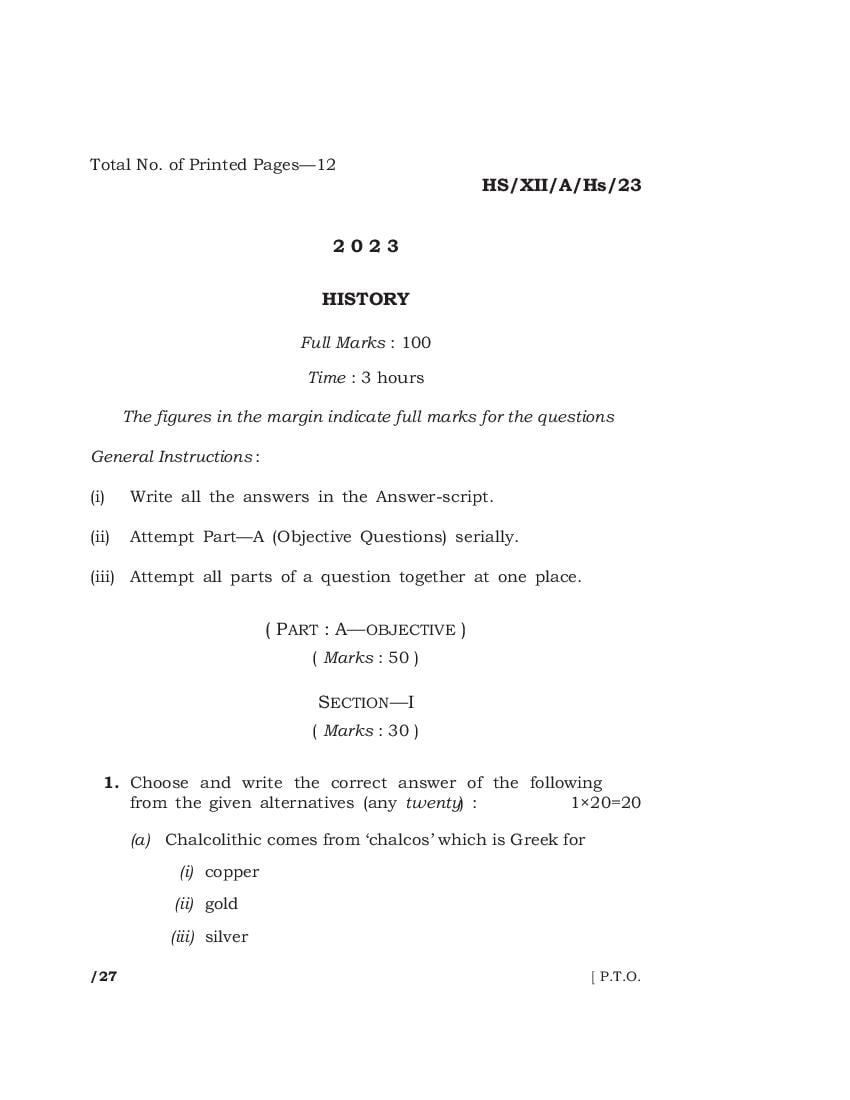
HS/XII/A/Hs/23
2023
HISTORY
Full Marks : 100
Time : 3 hours
The figures in the margin indicate full marks for the questions
General Instructions :
(i) Write all the answers in the Answer-script.
(ii) Attempt Part—A (Objective Questions) serially.
(iii) Attempt all parts of a question together at one place.
( PART : A—OBJECTIVE )
( Marks : 50 )
SECTION—I
( Marks : 30 )
1. Choose and write the correct answer of the following
from the given alternatives (any twenty) : 1×20=20
(a) Chalcolithic comes from ‘chalcos’ which is Greek for
(i) copper
(ii) gold
(iii) silver
/27 [ P.T.O.
Page 2
(b) John Marshall announced the discovery of a new
civilization, the Harappan Civilization in the Indus
Valley, to the world in
(i) 1921
(ii) 1924
(iii) 1925
(c) Who was the founder of the Mauryan dynasty?
(i) Ashoka
(ii) Chandragupta Maurya
(iii) Samudragupta
(d) The punch-marked coins were in circulation during
the sixth century BCE were made up of
(i) silver and gold
(ii) copper and gold
(iii) silver and copper
(e) The Dharmasutras acknowledged as many as
(i) eight forms of marriage
(ii) ten forms of marriage
(iii) twelve forms of marriage
HS/XII/A/Hs/23/27 [ Contd.
Page 3
(f) Satavahana rulers were identified through the names
derived from that of the
(i) father
(ii) mother
(iii) clan
(g) The Great Stupa at Sanchi is located in the former
native State of
(i) Delhi
(ii) Varanasi
(iii) Bhopal
(h) The rock-cut temple architecture at Mahabalipuram
are the architectural accomplishments of
(i) Pallava
(ii) Chalukya
(iii) Chola
(i) Vijayanagar Empire was founded by
(i) Vijayalaya
(ii) Rajendra I
(iii) Harihara and Bukka
HS/XII/A/Hs/23/27 [ P.T.O.
Page 4
(j) The village headman was known as
(i) Muqaddam
(ii) Patwari
(iii) Mazdur
(k) The last of the great Mughal kings was
(i) Shah Jahan
(ii) Aurangzeb
(iii) Akbar
(l) The language of the Mughal Court was
(i) Persian
(ii) Turkish
(iii) Hindi
(m) The Alvars were the saints devoted to Lord
(i) Shiva
(ii) Vishnu
(iii) Krishna
HS/XII/A/Hs/23/27 [ Contd.
Page 5
(n) The Kitab-al-Hind was a book about
(i) Indian religion
(ii) Indian thought and society
(iii) Indian flora and fauna
(o) “A gift of betel is a far greater honour than a gift of
gold and silver.” Who said these words?
(i) Ibn Batuta
(ii) Francois Bernier
(iii) Al-Biruni
(p) In 1793, Lord Cornwallis introduced the
(i) Ryotwari Settlement
(ii) Permanent Settlement
(iii) Mahalwari Settlement
(q) The first among the European nations to establish
port in India was
(i) the Dutch
(ii) the British
(iii) the Portuguese
HS/XII/A/Hs/23/27 [ P.T.O.
Page 6
(r) The East India Company exported opium to China
through
(i) Bombay
(ii) Calcutta
(iii) Madras
(s) Following the outbreak of the first Anglo-Burmese
War in 1824, the British invaded
(i) Burma
(ii) Assam
(iii) Tibet
(t) Who was popularly known as Danka Shah?
(i) Maulavi Ahmadullah Shah
(ii) Shah Mal
(iii) Kunwar Singh
(u) ‘The Relief of Lucknow’ is a painting which depicts the
seize of Lucknow was drawn by
(i) Joseph Noel Paton
(ii) Colin Campbell
(iii) Thomas Jones Barker
HS/XII/A/Hs/23/27 [ Contd.
Page 7
(v) On 20th July 1905, the province of Bengal was
divided into two parts by
(i) Lord Hastings
(ii) Lord Curzon
(iii) Lord Canning
(w) In 1918, Mahatma Gandhi intervened in a dispute
between the workers and mill owners of
(i) Ahmedabad
(ii) Champaran
(iii) Kheda
(x) The system of separate electorates for the Muslims
was introduced by the
(i) Government of India Act, 1935
(ii) Government of India Act, 1919
(iii) Indian Councils Act, 1909
(y) As early as 1930’s the Hindustani was accepted as a
national language by the
(i) Muslim League
(ii) Hindu Mahasabha
(iii) Congress
HS/XII/A/Hs/23/27 [ P.T.O.
Page 8
2. Write whether the following statements are True or False
(any ten) : 1×10=10
(a) The longest Harappan Inscription contains only
about 26 signs.
(b) The Sri Lankan Chronicle, Mahavamsa, established
that Ashoka, the Maurya monarch, was the
Devanampiya Piyadassi of the Inscriptions.
(c) The Rigveda was translated into English by James
Princep.
(d) Jaina ideas were in circulation in North India before
the birth of Vardhamana.
(e) The Dravida was prevalent in the territory between
the Vindhayas and the Krishna.
(f) The Mughals applied lower rates of assessment on
the crops raised on irrigated lands.
(g) Calligraphy is the art of handwriting.
(h) Kabir is believed to be Muslim by birth but brought
up in a Brahman family.
(i) Francois Bernier was associated with the Mughal
Court as a physician of Prince Dara Shukoh.
(j) The Paharias were ideal settlers willing to clear
forests and ploughing the land with vigour.
HS/XII/A/Hs/23/27 [ Contd.
Page 9
(k) Civil lines created by the British symbolized filth and
disease.
(l) The British found that Assam Valley was ‘surrounded
North, East and South by numerous savage and
warlike tribes’.
(m) The chief organizer of the Revolt of 1857 in Kanpur
was Rani Lakshmi Bai.
(n) In November 1928, the British Government appointed
the Indian Statutory Commission called as the Simon
Commission.
(o) The Muslim League announced 16th August, 1946
as ‘Direct Action Day’.
SECTION—II
( Marks : 20 )
3. Answer any ten questions in 2 or 3 sentences each :
2×10=20
(a) Write about Harappan pottery.
(b) What was Ashoka’s Dhamma ?
(c) Mention the four Varnas.
(d) What is hagiography?
HS/XII/A/Hs/23/27 [ P.T.O.
Page 10
(e) Mention the three significant features of the rock-cut
caves in Badami.
(f) What were the composition of the village Panchayat in
the Mughal agrarian society?
(g) Write about the Diwan-i-Am and Diwan-i-Khas in the
Mughal Court.
(h) What are the Five Pillars of Islam?
(i) What are the major characteristics of Bernier’s
description of India?
(j) What was the ‘stick and carrot’ policy?
(k) Differentiate between the ‘White town’ and the
‘Black town’.
(l) Write about the pre-colonial society in the
North-East.
(m) Write what you know about Enfield Rifle and Greased
Cartridges.
(n) What was the Rowlatt Act?
(o) What is communalism?
HS/XII/A/Hs/23/27 [ Contd.
Page 11
( PART : B—DESCRIPTIVE )
( Marks : 50 )
4. Answer Question No. (j) and any three from the rest :
(a) Trace the roots of the Harappan Civilization. What
was its extent and expanse? 6+6=12
(b) Describe the life and teachings of Gautama Buddha.
4+8=12
(c) Describe the distinguishing features of the Chola
architecture. 12
(d) What is a Chronicle? Describe the main features of
the Mughal Chronicles. 2+10=12
(e) Who was Al-Biruni? Give an account of his
description of India. 4+8=12
(f) Explain how the British land revenue policies
changed the life of the artisans. 12
(g) Describe the role of the Baptist Missionaries in
promoting local languages and modern education in
North-East India. 12
(h) How did the Revolt of 1857 start and spread? 12
(i) Give an account of the Khilafat Movement and the
Non-Cooperation Movement. 12
HS/XII/A/Hs/23/27 [ P.T.O.
Page 12
(j) Write short notes on any two of the following : 7×2=14
(i) Mauryan administration
(ii) The Mahabharata
(iii) Village artisans during the Mughal agrarian
society
(iv) Guru Nanak
(v) Architectural style of colonial period
(vi) The Struggling Mahatma—Local movement and
localized leadership
(vii) Partition—A holocaust
HHH
HS/XII/A/Hs/23/27 K23—17550
Document Details
| Board / Org | Meghalaya Board |
| Exam | Class 12 |
| Type | Question Paper |
| Pages | 12 |
| Updated | 22 Jul 2026 |