TIFR GS 2024 Question Paper Physics IPhD
Finished viewing? Save it for later —
Download TIFR GS 2024 Question Paper Physics IPhD (PDF · 40 pages)About TIFR GS 2024 Question Paper Physics IPhD
TIFR GS 2024 Question Paper Physics IPhD is available here for free download. Published by TIFR for TIFR GS, this question paper can be viewed online or downloaded as a PDF (40 pages). Candidates preparing for TIFR GS can use TIFR GS 2024 Question Paper Physics IPhD to understand the exam pattern, the type of questions asked, and the overall difficulty level.
Frequently Asked Questions
How can I download TIFR GS 2024 Question Paper Physics IPhD?
Open this page and click the Download button to save TIFR GS 2024 Question Paper Physics IPhD as a PDF. It is completely free on AglaSem Docs.
Is TIFR GS 2024 Question Paper Physics IPhD free to download?
Yes. TIFR GS 2024 Question Paper Physics IPhD can be viewed online and downloaded as a PDF free of cost on AglaSem Docs.
How many pages does TIFR GS 2024 Question Paper Physics IPhD have?
TIFR GS 2024 Question Paper Physics IPhD contains 40 pages, which you can read online or download together as a single PDF.
Where can I find more TIFR GS study material?
You can find more TIFR GS question papers, sample papers, syllabus, and answer keys on AglaSem Docs.
TIFR GS 2024 Question Paper Physics IPhD – Text
Read the full text of this question paper below — useful to quickly search, copy and reference the content online without downloading the PDF.
📄 View text version (40 pages)
Page 1
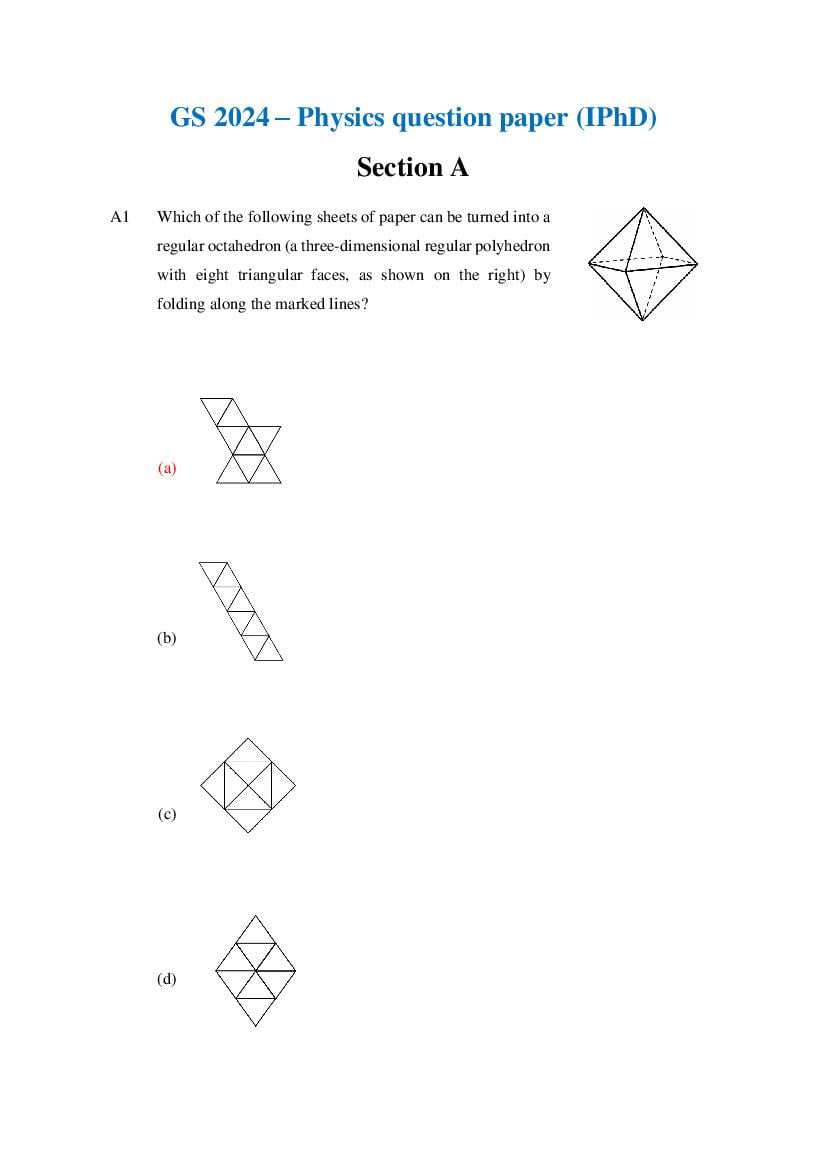
Section A
A1 Which of the following sheets of paper can be turned into a
regular octahedron (a three-dimensional regular polyhedron
with eight triangular faces, as shown on the right) by
folding along the marked lines?
(a)
(b)
(c)
(d)
Page 2
2𝑥 3 𝑧 + 4𝑦 2 𝑧 + 3𝑧 2 = 81
Which of the following is a vector tangential to it at the point on the surface with
coordinates (𝑥, 𝑦, 𝑧) = (1,2,3)?
(a) 2𝑖̂ − 3𝑗̂ + 3 𝑘̂
(b) 18𝑖̂ + 48𝑗̂ + 36 𝑘̂
(c) −3𝑖̂ + 2𝑗̂ + 6 𝑘̂
(d) −3𝑖̂ − 2𝑗̂ + 6 𝑘̂
Page 3
𝑑𝑥 𝑑𝑦
= 𝑎𝑦(𝑡) , =𝑎
𝑑𝑡 𝑑𝑡
where 𝑎 is a positive constant. The solutions to these equations define a family of
curves in the x,y plane. What are these curves?
(a) Parabolas
(b) Circles
(c) Hyperbolas
(d) Ellipses
Page 4
below.
A
𝜃
𝜃 𝑚
B
A
The spring constant of spring A is 𝑘𝐴 , and that of spring B is 𝑘𝐵 . The springs are shown
in a relaxed position, and the angle 𝜃 in this position is 𝜋⁄3. The mass is displaced
horizontally by a small distance. What is the angular frequency of small oscillations of
m? (Ignore gravity and friction.)
(a) √(3𝑘𝐴 𝑘𝐵 )/[𝑚(2𝑘𝐵 + 3𝑘𝐴 )]
(b) √(𝑘𝐴 𝑘𝐵 )/[𝑚(𝑘𝐵 + 𝑘𝐴 )]
(c) √(2𝑘𝐴 𝑘𝐵 )/[𝑚(𝑘𝐵 + 2𝑘𝐴 )]
(d)
√(√3 𝑘𝐴 𝑘𝐵 )/[𝑚(𝑘𝐵 + √3 𝑘𝐴 )]
Page 5
force, 𝑅, given by 𝑅 = 𝑏𝑣, where 𝑣 is the speed and 𝑏 is a constant. If the object is
dropped from rest (𝑣 = 0 at 𝑡 = 0), the distance traversed by the object at 𝑡 = 𝑚/𝑏
is:
𝑚2 𝑔 1
(a) ( 2 )( )
𝑏 𝑒
𝑚2 𝑔 1
(b) ( 2 ) (1 − )
𝑏 𝑒
𝑚2 𝑔
(c) ( 2 ) (𝑒 − 1)
𝑏
𝑚2 𝑔 1
(d) ( 2 ) (2 − )
𝑏 𝑒
Page 6
points A and B that are at equal height as shown below. The angle made by the line
joining the centre to point A (line CA) with the vertical is 𝜋/3.
What is the magnitude of the force exerted by point A on the disk?
(a)
(b)
(c)
(d)
Page 7
1
𝑘𝑥 2 for 𝑥 > 0
𝑉(𝑥) = { 2
∞ for 𝑥 ≤ 0
In a quantum mechanical treatment, what is the ground state energy of the particle?
(a) 3 𝑘
ℏ√
2 𝑚
(b) 1 𝑘
ℏ√
2 𝑚
(c) 𝑘
ℏ√
𝑚
(d) 5 𝑘
ℏ√
2 𝑚
Page 8
harmonic oscillator in dimensionless units (𝑚 = ℏ = 𝜔 = 1) is
2
𝜓𝑎 (𝑥 ) = (2𝑥 3 − 3𝑥)𝑒 −𝑥 /2
Which of the following are two other (un-normalized) eigenfunctions which are closest
in energy to 𝜓𝑎 ?
2 2
(a) (2𝑥 2 − 1)𝑒 −𝑥 /2 ; (4𝑥 4 − 12𝑥 2 + 3)𝑒 −𝑥 /2
2 2
(b) 𝑒 −𝑥 /2 ; (2𝑥 2 − 1)𝑒 −𝑥 /2
2 2
(c) 𝑥 𝑒 −𝑥 /2 ; (4𝑥 5 − 20𝑥 3 + 15𝑥 )𝑒 −𝑥 /2
2 2
(d) (2𝑥2 − 1) 𝑒 −𝑥 /2 ; (4𝑥 5 + 20𝑥 3 + 15𝑥 )𝑒 −𝑥 /2
Page 9
described by the normalized wave function
𝛼 5/2 2 2 2
𝜓(𝑥, 𝑦, 𝑧) = 𝑧𝑒 −𝛼√𝑥 +𝑦 +𝑧
√𝜋
For this state what are the angular quantum number ℓ, 𝐿2 and 𝐿𝑍 respectively?
(a)
(b)
(c)
(d)
Page 10
is cut symmetrically into two pieces. What is the electrostatic force between the two
halves?
𝜋 𝜎 2 𝑅2
(a)
2 𝜖0
(b) 𝜋 𝜎 2 𝑅2
4 𝜖0
(c) 𝜎 2 𝑅2
𝜋
𝜖0
(d) 𝜎 2 𝑅2
2𝜋
𝜖0
Page 11
(𝑥, 𝑦, 𝑧) = (0,0, 𝑑), (ii) a charge +𝛼𝑞 placed at the origin and (iii) a charge −𝛽𝑞
placed at the point (𝑥, 𝑦, 𝑧) = (0,0, −𝑑).
𝑧
−𝑞
𝛼𝑞 𝑦
𝑥
−𝛽𝑞
The values of 𝛼 and 𝛽 are such that the monopole and dipole terms vanish in the
multipole expansion of the electrostatic potential.
What is the quadrupole term of the potential at a point (𝑥, 𝑦, 0)?
(a) 𝑞 𝑑2
4𝜋𝜖0 (𝑥 2 + 𝑦 2 )3/2
(b) 𝑞 𝑑2
2𝜋𝜖0 (𝑥 2 + 𝑦 2 )3/2
(c) 0
(d) 𝑞 1
4𝜋𝜖0 (𝑥 + 𝑦 2 )1/2
2
Page 12
respectively. The gas has density 𝜌𝑔 < 𝜌 . The centres of the bubbles are separated by
a distance 𝑅 ≫ 𝑟1 , 𝑟2 . If the space has no other forces than gravity, the bubbles will:
(a) Move towards each other due to an attractive gravitational force
4𝜋 2 𝑟13 𝑟23
2
𝐹 = 𝐺(𝜌 − 𝜌𝑔 ) ( )
3 𝑅2
(b) Move towards each other due to an attractive gravitational force
2 4𝜋 𝑟13 𝑟23
𝐹 = 𝐺(𝜌 − 𝜌𝑔 ) ( ) 2
3 𝑅
(c) Move away from each other due to a repulsive gravitational force
4𝜋 2 𝑟13 𝑟23
2
𝐹 = 𝐺(𝜌 − 𝜌𝑔 ) ( )
3 𝑅2
(d) Move away from each other due to a repulsive gravitational force
2 4𝜋 𝑟13 𝑟23
𝐹 = 𝐺(𝜌 − 𝜌𝑔 ) ( ) 2
3 𝑅
Page 13
with an equal mass of water at temperature 𝑇𝑏 . The specific heat of water at constant
pressure is 𝐶𝑝 . What is the entropy change (Δ𝑆) of the system?
(𝑇𝑎 − 𝑇𝑏 )2
(a) Δ𝑆 = 𝑀𝐶𝑝 ln {1 + }
4𝑇𝑎 𝑇𝑏
(𝑇𝑎 + 𝑇𝑏 )2
(b) Δ𝑆 = 𝑀𝐶𝑝 ln {1 − }
4𝑇𝑎 𝑇𝑏
4𝑇𝑎 𝑇𝑏
(c) Δ𝑆 = 𝑀𝐶𝑝 ln {1 + }
(𝑇𝑎 − 𝑇𝑏 )2
𝑇𝑎 + 𝑇𝑏
(d) Δ𝑆 = 𝑀𝐶𝑝 ln { }
√𝑇𝑎 𝑇𝑏
Page 14
beads. When one of the red beads is replaced by a blue one, the entropy of the given
system changes from 𝑆 to 𝑆 + 𝑘𝐵 ln 2. All configurations of the beads are equally
probable. What is the value of n ?
(a) 6
(b) 2
(c) 4
(d) 8
Page 15
This small typographical error has been fixed. The question and the correct
answer were clear from the text.]
An ideal gas on the Pressure (𝑃)-Volume (𝑉) diagram can be taken from point K to
point N along three different paths, as shown below. K → L → N, K → N, and K →
M → N. Which of the following options is a true statement?
(a) The change in internal energy is the same along each path
(b) The same work is done along each path
(c) The same amount of heat is added to each the gas along each path
(d) There is no work done along the path K → N
Page 16
is drawn. Based on the shown timing diagram (binary values at pins 1, 2, 3, 4, 5 as a
function of time) measured by the technician, identify the fault in the instrument.
(a) An AND gate is used where an OR gate should have been used
(b) Input inverter acts like an OR gate
(c) Pin 4 shorted to ground
(d) Output inverter is faulty
Page 17
𝐴̅𝐵 + 𝐶̅ from three inputs 𝐴, 𝐵 and 𝐶 is:
(a) 3
(b) 7
(c) 4
(d) 6
Page 18
with a Geiger counter. In the laboratory notebook, the student records the following
number of decays every 10 seconds:
158, 146, 145, 163, 154, 163, 160, 160, 152, 157, 154, 156, 149, 168, 152
The teacher suspects that the experiment was not done properly and the student
created the numbers manually.
Why would the teacher have such a suspicion?
(a) The variance is much less than the mean, unlike what is expected for a
Poisson distribution.
(b) The standard deviation is much less than the variance, as expected for a
Poisson distribution.
(c) The median is less than the mean, unlike what is expected for a Poisson
distribution.
(d) The median is greater than the mean, as expected for a Poisson distribution.
Page 19
arranged one behind the other. The first polariser has its transmission axis at +55 0
with respect to the vertical and the second polariser has its transmission axis at +1000
with respect to the vertical. What is the intensity of the transmitted light?
(a) 50 W/m2
(b) 100 W/m2
(c) 1.98 W/m2
(d) 3.01 W/m2
Page 20
microphone M at a distance 1.5 m away from the centre of the line AB, in the
perpendicular direction as shown in the sketch below.
A
M
B
The following sound intensity pattern was observed as a function of the position of the
microphone as it is moved parallel to AB.
The dips in the signal were repeated at the interval of 14.5 cm. The speed of sound in
the experiment’s background condition is 343 m/s. What can we conclude from this
information?
(a) The two loudspeakers are vibrating at frequency 23.65 kHz and they are out of
phase.
(b) The two loudspeakers are vibrating at frequency 23.65 kHz and they are in
phase.
(c) The two loudspeakers are vibrating at frequency 47.3 kHz and they are in
phase.
(d) The two loudspeakers are vibrating at frequency 47.3 kHz and they are out of
phase.
Page 21
1.673 × 10⁻²⁷ kg, the mass of an electron is 9.109 × 10⁻³¹ kg and the mass of the
D nucleus is 3.344 × 10⁻²⁷ kg, the ionization potential of the D atom is given by:
(a) 13.602 eV
(b) 13.594 eV
(c) 13.598 eV
(d) 27.188 eV
Page 22
speed 𝑣𝑥 relative to an inertial reference frame F as shown in the figure. In S, a light
bulb is placed at the left end (point A) and a detector is placed at the right end (point
B). What is the time taken for light to travel from A to B in the reference frame F?
𝐿 1 + 𝑣𝑥 ⁄𝑐
(a) √
𝑐 1 − 𝑣𝑥 /𝑐
𝐿 𝑣2
(b) √1 − 𝑥
𝑐 𝑐2
𝐿 1 − 𝑣𝑥 ⁄𝑐
(c) √
𝑐 1 + 𝑣𝑥 /𝑐
𝐿 1
(d) 𝑐 √1 − 𝑣𝑥2 ⁄𝑐 2
Page 23
density of Cadmium is 𝜌 = 8.6 g cm−3 . The absorption cross-section of neutrons on
Cadmium nuclei is 2.5 × 10⁻²⁰ cm2 . The atomic weight of Cadmium is known to be
112.40 g/mol. You may take 𝑁𝐴 = 6.02 × 10²³ .
At what depth is the intensity of the beam reduced by a factor 1⁄𝑒 ?
(a) 9 𝜇m
(b) 9 fm
(c) 9 nm
(d) 900 fm
Page 24
length of the side of this square is unknown, but it is seen that the electron jumps to the
first excited energy state by absorbing electromagnetic radiation of wavelength 4,040
nm. What is the length of one side of the square well?
(a) 1.91 nm
(b) 1.68 nm
(c) 2.55 nm
(d) 3.82 nm
Page 25
face-centered cubic (fcc) structure. The conduction band minimum of this
semiconductor lies at all momentum points equivalent to 𝑘⃗ = (0.5, 0,0) 𝜋/𝑎. How
many conduction band minimum points are inside the first Brillouin zone?
(a) 6
(b) 4
(c) 3
(d) 1
Page 26
B1 The following series
∞
1
𝑆 = ∑(−1)1+𝑛
𝑛 24𝑛
𝑛=1
has the sum
17
(a) 𝑆 = ln (16)
17
(b) 𝑆=√
16
(c) 𝑆 is not convergent
1
𝑆=
(d) 1
1 + √16
Page 27
Consider a particle of mass m orbiting around a central potential 𝑉 (𝑟) = − 𝑟 − 𝑟 3
with 𝑎, 𝑏 > 0 . What is the smallest angular momentum it must have to be in a stable
orbit?
(a) (12𝑎𝑏𝑚2 )1/4
(b) (4𝑎𝑏𝑚2 )1/4
(c) (3𝑎𝑏𝑚2 )1/4
(d) (6𝑎𝑏𝑚2 )1/4
Page 28
set in a uniform circular motion with speed 𝑣𝑖 at a radius 𝑟𝑖 on top of a table while the
second mass hangs vertically on the string which passes through a hole in the centre of
the table (C), as shown in the figure below.
The system is released with this initial configuration and the second mass starts falling.
What is the net speed of the first mass when the second mass has fallen a height ℎ
(smaller than 𝑟𝑖 )?
(Assume that there is no friction and that the string always remains tight.)
1 𝑟𝑖2
(a) √𝑔ℎ + 𝑣𝑖2 [1 + ]
2 (𝑟𝑖 − ℎ)2
1 𝑟𝑖
(b) √𝑔ℎ + 𝑣𝑖2 [1 + ]
2 (𝑟𝑖 − ℎ)
1 (𝑟𝑖 − ℎ)2
(c) √𝑔ℎ + 𝑣𝑖2 [1 + ]
2 𝑟𝑖2
1 (𝑟𝑖 − ℎ)
(d) √𝑔ℎ + 𝑣𝑖2 [1 + ]
2 𝑟𝑖
Page 29
length L between points A and B. In a quantum-mechanical treatment, the particle is
in the ground state with an energy 𝐸𝑔 . The wall at B is suddenly shifted to B’ where
AB’ has length 2L. If we measure the energy again, what is the most probable result?
(a) 𝐸𝑔
(b) 𝐸𝑔 /4
(c) 4𝐸𝑔
(d) 9𝐸𝑔 /4
Page 30
satisfies the momentum-space Schrödinger equation
𝑝2 𝜕
( ⃗ 2𝑝 ) 𝜙(𝑝, 𝑡) = 𝑖ℏ 𝜙(𝑝, 𝑡)
− 𝑎∇
2𝑚 𝜕𝑡
where 𝑎 is a real constant and
𝜕2 𝜕2 𝜕2
⃗ 2𝑝 =
∇ + +
𝜕𝑝𝑥2 𝜕𝑝𝑦2 𝜕𝑝𝑧2
It follows that 𝐹 (𝑟) =
2𝑎
(a) − 𝑟
ℏ2
2𝑎
(b) 𝑟
ℏ2
𝑟
(c) −𝑎ℏ2
𝑟3
𝑟
(d) 𝑎ℏ2
𝑟3
Page 31
infinite straight wire as shown in the figure. The infinite wire carries a current I in the
x direction as shown. If one now pulls the loop directly away from the wire in the y
direction at a constant speed 𝑣, what is the generated EMF in the loop? In what
direction (clockwise or counterclockwise) does the current flow in the loop?
𝑎 2 𝑣𝐼𝜇0
(a) 2𝜋(𝑎𝑠+𝑠 2 )
, anticlockwise
𝑎 2 𝑣𝐼𝜇0
(b) 2𝜋(𝑎𝑠+𝑠 2 )
, clockwise
𝑎 𝑣𝐼𝜇0
(c) 2𝜋(𝑎+𝑠 )
, anticlockwise
𝑎 𝑣𝐼𝜇0
(d) 2𝜋(𝑎+𝑠 )
, clockwise
Page 32
sheet in the xy plane at a distance d from it in the z direction as shown below. The
centre of the dipole (C) is fixed to a pivot but the dipole is free to rotate about the x
axis (coming out of the page).
What is the magnitude of the torque on the dipole when the angle between the dipole
and the positive z axis is (𝜋 − 𝜃) as shown?
(a) 𝑝2
𝜏= sin(2𝜃)
(64𝜋𝜖0 𝑑3 )
(b) 𝑝2
𝜏= cos(2𝜃)
(16𝜋𝜖0 𝑑3 )
(c) 𝑝2
𝜏= cos(𝜃)
(64𝜋𝜖0 𝑑3 )
(d) 𝑝2
𝜏= sin(𝜃)
(16𝜋𝜖0 𝑑3 )
Page 33
temperature 𝑇. Which of the following curves accurately represent the temperature
dependence of specific heat of the system?
(a)
(b)
(c)
(d)
Page 34
(𝑆) at a temperature 𝑇𝑆 to a heater (𝐻) kept at a constant temperature 𝑇𝐻 . Here 𝛽 is a
constant. What is the power consumption of the heat pump?
𝛽(𝑇𝐻 − 𝑇𝑆 )2
(a)
𝑇𝐻
(b) 𝛽 (𝑇𝐻 − 𝑇𝑆 )
𝛽(𝑇𝐻 − 𝑇𝑆 )2
(c)
𝑇𝑆
𝛽(𝑇𝐻 − 𝑇𝑆 )𝑇𝐻
(d)
𝑇𝑆
Page 35
if the input voltage Vi is
The output waveform would be
(a) (b)
(c) (d)
Page 36
accelerates ions through an electric potential 𝑉, which is followed by a box carrying a
uniform magnetic field 𝑩 of magnitude 0.2 Tesla (coming out of the page as shown).
+𝑉
This setup is used to separate two isotopes of Uranium:
235
𝑈 (mass = 3.93 × 10⁻²⁵ kg)
238
𝑈 (mass = 3.98 × 10⁻²⁵ kg)
Singly charged ions (charge ) of the two isotopes are created at the plate A and pass
without energy loss through plate B into the box. In order to separate the isotopes, their
radii of curvature in the box must differ by 2 mm. What is the approximate 𝑉 through
which the ions must be accelerated in order to achieve this?
(a) 800 Volts
(b) 8000 Volts
(c) 80 Volts
(d) 8 Volts
Page 37
differential acceleration (Δ𝑔) which is the difference between the gravitational
acceleration at B and C due to the moon (see figure below).
If 𝑅 and 𝑀 are the radius and mass of Earth, 𝑑 the distance of separation of the centre
of Earth and the moon, and 𝑚 the mass of moon, which of the following answers is
closest to the magnitude of Δ𝑔?
(a) 2𝐺𝑚𝑅
𝑑3
(b) 4𝐺𝑚𝑅
𝑑3
(c) 𝐺𝑚𝑅
2𝑑 3
(d) 𝐺𝑚𝑅2
𝑑4
Page 38
ethyl alcohol (𝑛𝑎 = 1.36) and this reflection is found to be completely linearly
polarised. Find the angle at which the incident light would be transmitted through
the plate.
(a) 39.50
(b) 31.60
(c) 50.50
(d) 69.30
Page 39
What would be the speed of the second particle in the center-of-mass frame after the
collision?
(a) 𝑐 ⁄2
(b) 2 𝑐 ⁄5
(c) 𝑐 ⁄√2
(d) 2√2 𝑐 ⁄5
Page 40
spacing 𝑎 is given by,
𝐸(𝑘) = 𝐸0 (1 − cos 𝑘𝑎)
where 𝑘 ∈ (− 𝜋⁄𝑎 , +𝜋/𝑎] . Suppose that each site contributes one conduction electron
to the conduction band. What is the Fermi energy of the system?
(a) 𝐸0
(b) 𝐸0
2
(c) 2𝐸0
(d) 𝐸0
4
Document Details
| Board / Org | TIFR |
| Exam | TIFR GS |
| Type | Question Paper |
| Pages | 40 |
| Updated | 23 Oct 2026 |