PSEB Syllabus 2021-22 for Class 11 Economics
Finished viewing? Save it for later —
Download PSEB Syllabus 2021-22 for Class 11 Economics (PDF · 3 pages)About PSEB Syllabus 2021-22 for Class 11 Economics
PSEB Syllabus 2021-22 for Class 11 Economics is available here for free download. Published by Punjab Board for Class 11, this syllabus can be viewed online or downloaded as a PDF (3 pages). Candidates preparing for Class 11 can use PSEB Syllabus 2021-22 for Class 11 Economics to understand the exam pattern, the type of questions asked, and the overall difficulty level.
Frequently Asked Questions
How can I download PSEB Syllabus 2021-22 for Class 11 Economics?
Open this page and click the Download button to save PSEB Syllabus 2021-22 for Class 11 Economics as a PDF. It is completely free on AglaSem Docs.
Is PSEB Syllabus 2021-22 for Class 11 Economics free to download?
Yes. PSEB Syllabus 2021-22 for Class 11 Economics can be viewed online and downloaded as a PDF free of cost on AglaSem Docs.
How many pages does PSEB Syllabus 2021-22 for Class 11 Economics have?
PSEB Syllabus 2021-22 for Class 11 Economics contains 3 pages, which you can read online or download together as a single PDF.
Where can I find more Class 11 study material?
You can find more Class 11 question papers, sample papers, syllabus, and answer keys on AglaSem Docs.
PSEB Syllabus 2021-22 for Class 11 Economics – Text
Read the full text of this syllabus below — useful to quickly search, copy and reference the content online without downloading the PDF.
📄 View text version (3 pages)
Page 1
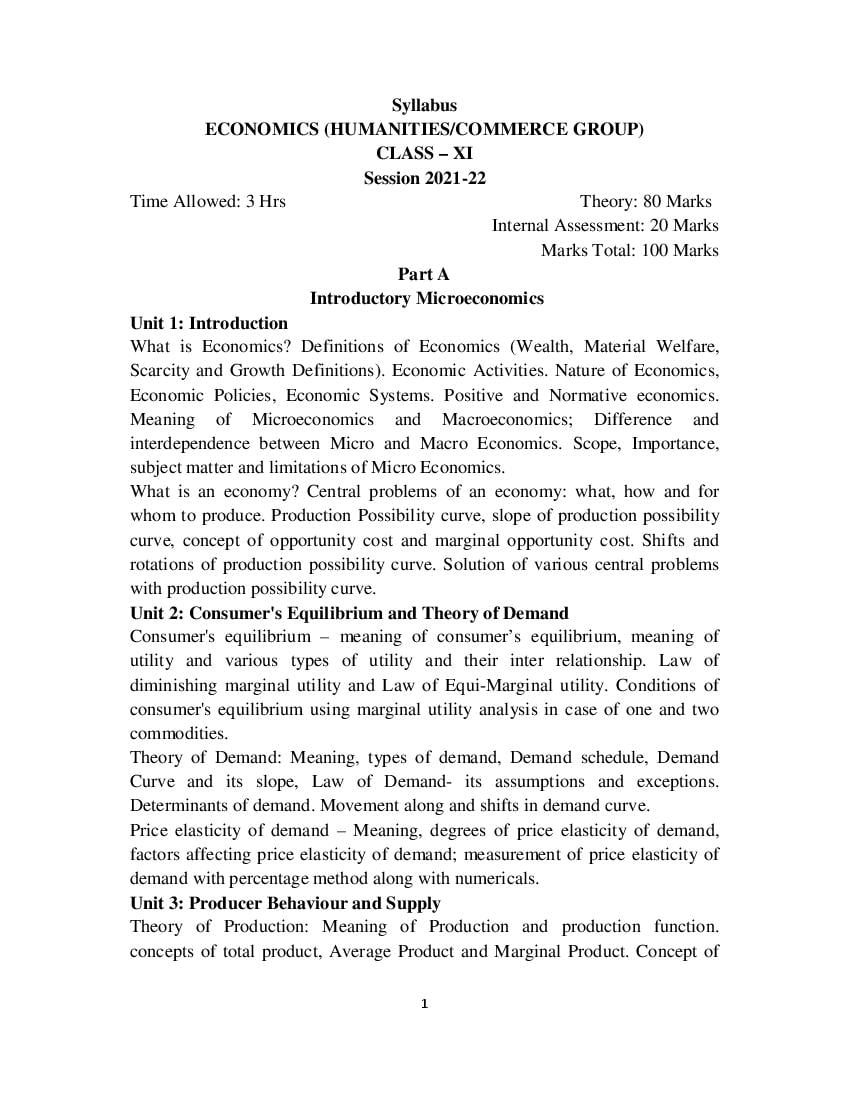
ECONOMICS (HUMANITIES/COMMERCE GROUP)
CLASS – XI
Session 2021-22
Time Allowed: 3 Hrs Theory: 80 Marks
Internal Assessment: 20 Marks
Marks Total: 100 Marks
Part A
Introductory Microeconomics
Unit 1: Introduction
What is Economics? Definitions of Economics (Wealth, Material Welfare,
Scarcity and Growth Definitions). Economic Activities. Nature of Economics,
Economic Policies, Economic Systems. Positive and Normative economics.
Meaning of Microeconomics and Macroeconomics; Difference and
interdependence between Micro and Macro Economics. Scope, Importance,
subject matter and limitations of Micro Economics.
What is an economy? Central problems of an economy: what, how and for
whom to produce. Production Possibility curve, slope of production possibility
curve, concept of opportunity cost and marginal opportunity cost. Shifts and
rotations of production possibility curve. Solution of various central problems
with production possibility curve.
Unit 2: Consumer's Equilibrium and Theory of Demand
Consumer's equilibrium – meaning of consumer’s equilibrium, meaning of
utility and various types of utility and their inter relationship. Law of
diminishing marginal utility and Law of Equi-Marginal utility. Conditions of
consumer's equilibrium using marginal utility analysis in case of one and two
commodities.
Theory of Demand: Meaning, types of demand, Demand schedule, Demand
Curve and its slope, Law of Demand- its assumptions and exceptions.
Determinants of demand. Movement along and shifts in demand curve.
Price elasticity of demand – Meaning, degrees of price elasticity of demand,
factors affecting price elasticity of demand; measurement of price elasticity of
demand with percentage method along with numericals.
Unit 3: Producer Behaviour and Supply
Theory of Production: Meaning of Production and production function.
concepts of total product, Average Product and Marginal Product. Concept of
1
Page 2
return to scale. Economies and Diseconomies of scale.
Theory of Cost: Meaning and types of cost. Short run costs - total cost, total
fixed cost, total variable cost; Average cost; Average fixed cost, average
variable cost and marginal cost. Relationship between various types of cost.
Long run cost curves.
Theory of Supply: Meaning and types. Supply schedule and Supply Curve and
its slope. Determinants of supply. Movements along and shifts in supply curve.
Price elasticity of supply; measurement of price elasticity of supply with
percentage method. Factors affecting price elasticity of supply.
Concepts of Revenue – Meaning and types of revenue. Total, average and
marginal revenue - meaning and their relationship. Revenue curves under
different market situations.
Producer's equilibrium-meaning and its conditions in terms of marginal revenue
and marginal cost approach. Concept of Gross profits and Net profits.
Unit 4: Forms of Market and Price Determination under Perfect
Competition
Forms of Market: Meaning and features of a Market. Forms of Market: Perfect
Competition, Monopoly and Monopolistic Competition and their features.
Price Determination under Perfect competition- Determination of equilibrium
through market forces and effect of shifts in demand and supply curves on
equilibrium price and equilibrium quantity.
Part B
Statistics for Economics
In this course, the learners are expected to acquire skills in collection,
organisation and presentation of quantitative and qualitative information
pertaining to various simple economic aspects systematically. It also intends to
provide some basic statistical tools to analyse, and interpret any economic
information and draw appropriate inferences. In this process, the learners are
also expected to understand the behaviour of various economic data.
Unit 5: Introduction
Statistics in Economics: Meaning, scope, functions, nature, limitations and
importance of statistics in Economics. Concept of statistics in singular and
plural sense with their characteristics.
Unit 6: Collection, Organisation and Presentation of data
Collection of data - sources of data - primary and secondary data: their meaning,
difference between primary and secondary data, methods for collection primary
2
Page 3
Some important sources of secondary data: Census of India and National
Sample Survey Organisation.
Theory of Census and Sampling: Meaning of census and sample method along
with their suitability, merits and demerits. Method of sampling: Random
sampling, Stratified sampling, Systematic sampling, Quota sampling,
Convenient sampling and Purposive sampling. Sampling and Non-Sampling
errors.
Organisation of Data: Meaning and types of variables; Meaning and types of
series: Individual, Discrete and Continuous series (various types of continuous
series). Various concepts related with the formation of series.
Presentation of Data: Tabular Presentation and Diagrammatic Presentation of
Data: (i) Geometric forms (bar diagrams and pie diagrams), (ii) Frequency
diagrams (histogram, polygon and ogive) and (iii) Arithmetic line graphs (time
series graph).
Unit 7: Measures of Central Tendency and Dispersion
Measures of Central Tendency: Meaning of Central Tendency, Features,
Arithmetic Mean (simple), Median and other positional averages (Quartile,
Decile and Percentile) and Mode (by inspection method only). Relationship
between various measures of central tendency and choice of best measure of
central tendency.
Measures of Dispersion: Meaning, Absolute measures of Dispersion (Range,
Quartile’s Range, Quartile Deviation, Mean Deviation, Standard Deviation).
Relative measures of Dispersion (Co-efficient of range, co-efficient of quartile-
deviation, Coefficient of Mean deviation, Coefficient of Standard Deviation and
Coefficient of variation). Lorenz Curve.
Part C
Punjab Economy
Unit 8: An Overview of Punjab Economy
Physical Resources of Punjab, Manpower Resources of Punjab, Agriculture
Development of Punjab since 1966, Industrial Development of Punjab and
Financial System of Punjab.
3