MAHA SET 2019 Question Paper 2 Economics
Finished viewing? Save it for later —
Download MAHA SET 2019 Question Paper 2 Economics (PDF · 48 pages)About MAHA SET 2019 Question Paper 2 Economics
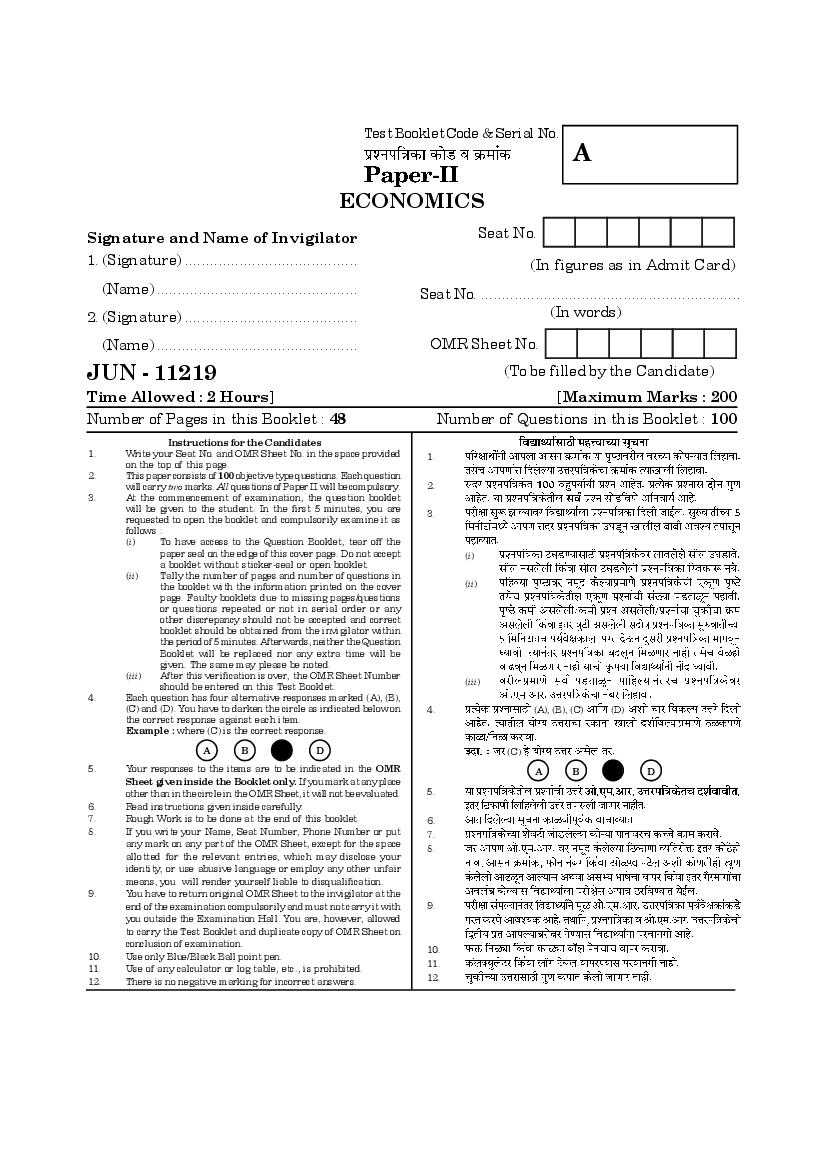
MAHA SET 2019 Question Paper 2 Economics is available here for free download. Published by Maharashtra Exams for Maharashtra State Eligibility Test, this question paper can be viewed online or downloaded as a PDF (48 pages). Candidates preparing for Maharashtra State Eligibility Test can use MAHA SET 2019 Question Paper 2 Economics to understand the exam pattern, the type of questions asked, and the overall difficulty level.
Frequently Asked Questions
How can I download MAHA SET 2019 Question Paper 2 Economics?
Open this page and click the Download button to save MAHA SET 2019 Question Paper 2 Economics as a PDF. It is completely free on AglaSem Docs.
Is MAHA SET 2019 Question Paper 2 Economics free to download?
Yes. MAHA SET 2019 Question Paper 2 Economics can be viewed online and downloaded as a PDF free of cost on AglaSem Docs.
How many pages does MAHA SET 2019 Question Paper 2 Economics have?
MAHA SET 2019 Question Paper 2 Economics contains 48 pages, which you can read online or download together as a single PDF.
Where can I find more Maharashtra State Eligibility Test study material?
You can find more Maharashtra State Eligibility Test question papers, sample papers, syllabus, and answer keys on AglaSem Docs.
MAHA SET 2019 Question Paper 2 Economics – Text
Read the full text of this question paper below — useful to quickly search, copy and reference the content online without downloading the PDF.
📄 View text version (48 pages)
Page 1
A
ECONOMICS
Signature and Name of Invigilator Seat No.
1. (Signature) ......................................... (In figures as in Admit Card)
(Name) ................................................ Seat No. ..............................................................
2. (Signature) ......................................... (In words)
(Name) ................................................ OMR Sheet No.
JUN - 11219 (To be filled by the Candidate)
Time Allowed : 2 Hours] [Maximum Marks : 200
Number of Pages in this Booklet : 48 Number of Questions in this Booklet : 100
Instructions for the Candidates
1. Write your Seat No. and OMR Sheet No. in the space provided 1.
on the top of this page.
2. This paper consists of 100 objective type questions. Each question
will carry two marks. All questions of Paper II will be compulsory. 2.
3. At the commencement of examination, the question booklet
will be given to the student. In the first 5 minutes, you are 3.
requested to open the booklet and compulsorily examine it as
follows :
(i) To have access to the Question Booklet, tear off the
paper seal on the edge of this cover page. Do not accept (i)
a booklet without sticker-seal or open booklet.
(ii) Tally the number of pages and number of questions in
the booklet with the information printed on the cover (ii)
page. Faulty booklets due to missing pages/questions
or questions repeated or not in serial order or any
other discrepancy should not be accepted and correct
booklet should be obtained from the invigilator within
the period of 5 minutes. Afterwards, neither the Question
Booklet will be replaced nor any extra time will be
given. The same may please be noted.
(iii) After this verification is over, the OMR Sheet Number
(iii)
should be entered on this Test Booklet.
4. Each question has four alternative responses marked (A), (B),
(C) and (D). You have to darken the circle as indicated below on 4. (A), (B), (C) (D)
the correct response against each item.
Example : where (C) is the correct response.
A B D (C)
5. Your responses to the items are to be indicated in the OMR A B D
Sheet given inside the Booklet only. If you mark at any place
other than in the circle in the OMR Sheet, it will not be evaluated. 5.
6. Read instructions given inside carefully.
7. Rough Work is to be done at the end of this booklet. 6.
8. If you write your Name, Seat Number, Phone Number or put 7.
any mark on any part of the OMR Sheet, except for the space
8.
allotted for the relevant entries, which may disclose your
identity, or use abusive language or employ any other unfair
means, you will render yourself liable to disqualification.
9. You have to return original OMR Sheet to the invigilator at the
end of the examination compulsorily and must not carry it with 9.
you outside the Examination Hall. You are, however, allowed
to carry the Test Booklet and duplicate copy of OMR Sheet on
conclusion of examination.
10.
10. Use only Blue/Black Ball point pen.
11.
11. Use of any calculator or log table, etc., is prohibited.
12. There is no negative marking for incorrect answers. 12.
Page 2
Page 3
Paper II
II
Time Allowed : 120 Minutes] [Maximum Marks : 200
Note : This Paper contains Hundred (100) multiple choice questions. Each question
carrying Two (2) marks. Attempt All questions.
(100) (2)
1. Consider the pair of goods X and Y. 1.
It is observed that when price of Y
falls the demand for X rises. Which
one of the following options would
you choose regarding the nature of
these goods ? (A)
(A) They are complementary goods
(B)
(B) They are substitute goods
(C)
(C) They are giffen goods
(D) They are inferior goods (D)
2. Read the following statements and 2.
find out if they are correct or
incorrect :
(i)
(i) When average total cost in the
short run is at its minimum, the
corresponding marginal cost is
also minimum. (ii)
(ii) The average fixed cost during
the short run is U shaped curve.
(A)
(A) Both are correct
(B) (i) (ii)
(B) (i) is correct, (ii) is incorrect
(C) Both are incorrect (C)
(D) (i) is incorrect, (ii) is correct (D) (i) (ii)
3 [P.T.O.
Page 4
estimation of costs, revenues and
hence the ...............
(A) profits of the firm (A)
(B) decisions of the firm (B)
(C) investments of the firm (C)
(D) insurance policy of the firm (D)
4. A ........... game is one in which it is 4.
not possible to commit to strategies.
(A) Co-operative (A)
(B) Non-co-operative (B)
(C) Zero sum (C)
(D) Competitive (D)
5. Under Cournot duopoly model, the 5.
equilibrium price is ................
(A) indeterminate (A)
(B) equal to competitive price (B)
(C) equal to monopoly price (C)
(D) more than competitive price (D)
and less than monopoly price
4
Page 5
supply curve of labour is caused
by :
(A) cost of labour (A)
(B) attitude of individuals towards (B)
work and leisure
(C) demand for labour (C)
(D) factor market (D)
7. According to Dorfman, Samuelson 7.
and Solow, general equilibrium
analysis becomes .................... if it is
not known whether an economic
system can attain a general
equilibrium.
(A)
(A) Practically useless
(B)
(B) Practically useful
(C)
(C) Perfectly applicable
(D) Impossible (D)
5 [P.T.O.
Page 6
compensation criterion, a change in
economic policy leads to an
improvement in social welfare if
...........
(A)
(A) The losers do not oppose the
change
(B) The gainers can just (B)
compensate the losers
(C) The gainers can compensate the
(C)
losers for their loss and still
remain better-off themselves
than before
(D) The gainers and losers get
(D)
compensation from the
government
9. Moral hazards are also a result 9.
of ...................
(A) Symmetric information (A)
(B) Lack of information (B)
(C) Asymmetric information (C)
(D) Perfect information (D)
6
Page 7
introduced by :
(A) Adam Smith (A)
(B) Joan Robinson (B)
(C) Nicholas Kaldor (C)
(D) Bergson (D)
11. Which of the following is neither a 11. IS LM
determinant of the slope of IS curve
nor of the LM curve ?
(A) Elasticity of interest rates to
investment (A)
(B) Elasticity of money demand to
(B)
income
(C) Elasticity of demand to interest
rate (C)
(D) Elasticity of income to
(D)
investment
12. To achieve a rise in income of ` 500 12. ` 500
crores given that the marginal 0.2
propensity to save (MPS) as 0.2, how
much autonomous investments are
needed in the Keynesian model ?
(A) ` 100
(A) ` 100 crores
(B) ` 1000
(B) ` 1000 crores
(C) ` 400
(C) ` 400 crores
(D) ` 500 crores (D) ` 500
7 [P.T.O.
Page 8
is equal to :
(A) Monetary liabilities of central
(A) +
bank + government money
(B) Monetary liabilities of central
bank – government money (B) –
(C) Monetary liabilities of central
bank + foreign exchange
(C) +
reserves
(D) Monetary liabilities of central
(D) –
bank – foreign exchange
reserves
14. According to the Rational 14.
Expectations Hypothesis, there is no
trade off between inflation and
unemployment because :
(A)
(A) Wages are rigid downwards
(B)
(B) Prices are rigid downwards
(C)
(C) People anticipate changes in
money supply and accordingly
adjust the prices and wages
(D) People make biased forecasts (D)
about the future of economy
based on available information
8
Page 9
Domestic Product + .............. +
(A) Depreciation (A)
(B) Inflation (B)
(C) Net factor incomes from abroad (C)
(D) Factor costs (D)
16. The Non-Accelerating Inflation Rate 16.
of Unemployment (NAIRU) is (NAIRU)
defined as :
(A)
(A) Inflation rate is always zero
(B)
(B) Actual inflation rate exceeds the
expected inflation rate
(C)
(C) Actual inflation rate is less than
the expected inflation rate
(D) Actual inflation rate equals the (D)
expected inflation rate
9 [P.T.O.
Page 10
the total income is known as ..........
(A) Average propensity to consume (A)
(B) Marginal propensity to consume (B)
(C) Marginal propensity to save (C)
(D) Average propensity to save (D)
18. Stagflation is a period of ............ 18.
(A) High inflation and high
unemployment
(A)
(B) High inflation
(B)
(C) High unemployment
(C)
(D) Low inflation and high
unemployment (D)
19. If the economy is in expansaionary 19.
phase of business cycle, aggregate
demand is likely to be ..............,
unemployment is likely to be ............,
inflation is likely to be ............ and
the current account balance of
payments likely to be moving
towards .............. (A)
(A) rising, falling, rising, deficit
(B)
(B) static, low, rising, deficit
(C)
(C) falling, falling, falling, surplus
(D) falling, rising, falling, surplus (D)
10
Page 11
shows the relationship between the
following two variables :
(A)
(A) Investment and consumption
(B) Consumption and interest rate (B)
(C) Investment and interest rate
(C)
(D) Investment and demand for
goods (D)
21. Logit and Probit models are used to 21.
analyze data that are :
(A) Binary
(A)
(B) Continuous
(B)
(C) Missing
(C)
(D) Used to analyze business cycles
exclusively (D)
22. If X1, X2, .........., Xn is a random 22. X1, X2, ............, Xn µ
sample from a normally distributed 2
population with mean µ and variance
2 , then the following follows a
standard normal distribution :
(Standard normal)
X u
(A) 2
X u
(A) 2
2
(X u)
(B) 2
(X u)2
(B) 2
2
2
(C)
(X u)2 (C)
(X u)2
X u X u
(D) (D)
/ n / n
11 [P.T.O.
Page 12
regression model. Goldfeld-Quandt
test is a test of :
(A) Autocorrelation
(A)
(B) Data mistakes
(B)
(C) Heteroscedasticity
(C)
(D) Correlation between X and Y
(D) X
24. The following is the formula for 24.
Pearson’s coefficient of correlation :
Covariance(X, Y) Covariance(X, Y)
(A)
X Y (A)
X Y
Covariance(X, Y) Covariance(X, Y)
(B) 2 2
(B)
X Y 2 2
X Y
2
X 2
(C) 2
Covariance(X, Y) X
Covariance(X, Y)
Y (C) 2
Y
2 2
(D) Covariance(X, Y) 2 2
X Y (D) X Covariance(X, Y) Y
25. If Y1 Xi ei is a linear
25. Y1 Xi ei
regression model and there is serial
correlation among the error terms,
then :
(A) ˆ ˆ
(A) OLS estimators are unbiased
and efficient
(B) OLS estimators are unbiased ˆ
(B) ˆ
but not efficient
(C) OLS estimators are wrong
(C) ˆ ˆ
(D) OLS estimators cannot be
(D) ˆ ˆ
calculated
12
Page 13
26. Let y . What is the limit 26. y y
( x2 1) (x2 1)
of y as x 1 ? x 1
(A) 2 (A) 2
(B) 0 (B) 0
(C) 1 (C) 1
(D) 3 (D) 3
2 1 2 1
27. If A = , what would be the 27. A= ,
0 2 0 2
value of determinant A ?
(A) 4 (A) 4
(B) 2 (B) 2
(C) 0 (C) 0
(D) 1 (D) 1
28. In a static optimization problem 28.
with an equality constraint, the
Lagrange multiplier, is :
(A)
(A) Always less than zero
(B)
(B) Greater than zero
(C)
(C) Always zero
(D) All the above (D)
13 [P.T.O.
Page 14
29. Suppose A= 0 2 0 while 29. A= 0 2 0 ,
1 1 1 1 1 1
2 0 1 2 0 1
B= 0 0 1 . Then what would B= 0 0 1 A – B
0 1 1 0 1 1
be A – B ?
0 1 1 0 1 1
(A) 0 2 1 (A) 0 2 1
1 0 0 1 0 0
2 0 0 2 0 0
(B) 1 1 1 (B) 1 1 1
1 0 1 1 0 1
2 1 1 2 1 1
(C) 1 2 1 (C) 1 2 1
1 0 0 1 0 0
2 0 0 2 0 0
(D) 0 1 0 (D) 0 1 0
0 0 0 0 0 0
14
Page 15
30. If A = 30. A= A
, the characteristic
,
1 2 1 2
(Characteristic roots)
roots of A are :
(A) (1, 1)
(A) (1, 1)
(B) (1, 3) (B) (1, 3)
(C) (–1, –3) (C) (–1, –3)
(D) (–1, –1) (D) (–1, –1)
31. Let y K L be the Cobb-Douglas 31. y K L
production function. Then,
measures :
(A)
(A) Elasticity of output with respect
to labour (B)
(B) Elasticity of output w.r.t. capital
(C) Marginal product of labour (C)
(D) Marginal product of capital (D)
32. Identify the non-tariff barrier from 32.
the following :
(A) Ad valorem duty (A)
(B) Specific duty (B)
(C) Compound duty (C)
(D) Voluntary export restraint (D)
15 [P.T.O.
Page 16
country with ................
(A) High priced goods (A)
(B) Low priced goods (B)
(C) Specialized goods (C)
(D) Monopoly goods (D)
34. The managed float was formally 34.
recognized in ...............
(A) Geneva Accord (A)
(B) Jamaica Accord (B)
(C) Washington Accord (C)
(D) London Accord (D)
35. Tariff on agricultural and industrial 35.
goods imposed by US during great
depression is commonly known as :
(A)
(A) The Smoot-Hawley Tariff
(B)
(B) The Smith-Hawley Tariff
(C)
(C) Herbert-Hoover Tariff
(D)
(D) The Johnson-Hawley Tariff
16
Page 17
propounded by Heckscher states that
factor prices in two countries get
equalized in the long-term due
to ..................
(A) difference in opportunity cost (A)
(B) comparative advantage
(B)
(C) free trade based on comapara-
(C)
tive advantages
(D) absolute advantage (D)
37. Mercantilism was based on the 37.
ideology of ................
(A) Rapid industrialization (A)
(B) Economic nationalism (B)
(C) Free trade (C)
(D) Economic expansionism (D)
17 [P.T.O.
Page 18
with a given quantity of exports, the
terms of trade are said to be ...............
(A) deteriorating terms of trade (A)
(B) improving terms of trade (B)
(C) income terms of trade (C)
(D) double factor terms of trade (D)
39. Converting your local financial 39.
assets into foreign financial assets
at the market determined exchange
rate is called ............
(A) Reserve Account (A)
(B) American Depository Receipts (B)
(C) Capital Account Convertibility (C)
(D) Current Account Convertibility (D)
40. IMF’s changed outlook on putting 40.
back the controls on capital account
came after :
(A)
(A) The subprime crisis
(B)
(B) Greece debt crisis
(C) South-East Asian Crisis (C)
(D) Oil crisis (D)
18
Page 19
the intersection of :
(A) two individuals trading two
(A)
different goods
(B) two individuals trading one
(B)
good
(C)
(C) one individual trading two
different goods
(D) two countries trading two sets (D)
containing several goods
42. To service public debt .............. must 42.
be paid.
(A) fees (A)
(B) fine (B)
(C) interest (C)
(D) tax (D)
19 [P.T.O.
Page 20
43. A domestically held public debt is
the debt that ............... (A)
(A) we owe to the World Bank
(B)
(B) we owe to the Central Bank
(C) we owe to Government (C)
(D) we owe to ourselves (D)
44. Public debt accumulation may be so 44.
drastic as to lead to ............
(A) fiscal breakdown (A)
(B) loss of profit in the public sector (B)
(C) loss of revenue (C)
(D) break-even point (D)
45. According to the principle of 45.
intergenerational equity, the burden
of today’s public expenditures must
be borne by ............
(A)
(A) Present Generation
(B)
(B) Government
(C)
(C) Future Generation
(D) Central Bank (D)
20
Page 21
ethical principle of .............. while
resorting to public debt.
(A)
(A) Frugality
(B)
(B) Equality
(C)
(C) Efficiency
(D) Intergenerational equity (D)
47. Ideally public capital formation 47.
should be financed with the help
of :
(A)
(A) loan
(B)
(B) borrowing from foreign markets
(C) borrowing from IMF (C)
(D) Tax collected (D)
48. Rising public expenditure leads to 48.
increase in the rate of interest
resulting in :
(A)
(A) Crowding out of private
investment
(B)
(B) Crowed in of private investment
(C) Market failure (C)
(D) Government failure (D)
21 [P.T.O.
Page 22
utility ?
(A) Water supply (A)
(B) Electricity (B)
(C) Entertainment (C)
(D) Energy (D)
50. The counterpart of benefit 50.
externalities is ...........
(A)
(A) average costs
(B)
(B) total costs
(C) internal costs (C)
(D) external costs (D)
51. Efficiency in production requires 51.
that :
(A)
(A) marginal rates of substitution
are unequal to all consumers
(B) marginal rates of technical (B)
substitution are unequal to all
firms
(C) marginal rates of substitution (C)
are equal to all consumers
(D) marginal rates of technical
(D)
substitution are equal to all
firms
22
Page 23
52.
power in the product market and
monopolistic power in the input
market then the factor is paid a
price ..................
(A) Equal to its Marginal Revenue
Product (MRP) (A)
(B) Less than its Marginal Revenue
Product (MRP) (B)
(C) Greater than its Marginal
Revenue Product (MRP) (C)
(D) Equal to its Value of Marginal
(D)
Product (VMP)
53. The concept of revenue neutral rate 53.
of tax becomes relevant in the case
of :
(A)
(A) change in tax base
(B)
(B) a new tax replacing an existing
one
(C) an old tax being discarded (C)
(D) change in tax structure (D)
23 [P.T.O.
Page 24
included in the ................ schedule of
the Reserve Bank Act and they are
expected to keep cash reserves of
equal to .............. percent of their
deposit liabilities.
(A) , 3
(A) Seventh, 3
(B) , 3
(B) Second, 3
(C) , 2
(C) Seventh, 2
(D) Third, 5 (D) ,5
55. The Origin of Development Banks 55.
can be found in .......... in the year ..........
(A) France, 1789 (A) , 1789
(B) U.S.A., 1776 (B) , 1776
(C) Germany, 1832 (C) , 1832
(D) Belgium, 1822 (D) , 1822
56. Indian Monetary Policy based on 56.
monetary targeting was
recommended by ............
(A)
(A) Rangarajan Committee
(B) R. Gandhi Committee (B)
(C) Khusro Committee (C)
(D) Chakravarty Committee (D)
24
Page 25
Credit Authorization Scheme
practised by RBI in 1965 ?
(A) It led to industrial monopolies (A)
(B) It resulted into more industrial
(B)
sickness
(C)
(C) It led to credit starvation
(D)
(D) It led to huge administrative
delays
58. One of the major differences between 58.
Bills of Exchange and Promissory
Note is that :
(A) Bills of Exchange are for short- (A)
term while Promissory Note is
for long-term
(B) Bill of Exchange has three (B)
parties while Promissory Note
has only two parties
(C) Bills of Exchange are issued by (C)
central bank while Promissory
Notes are issued by commercial
banks
(D) Bills of Exchange are illegal (D)
while Promissory Notes are
legal in nature
25 [P.T.O.
Page 26
of mortgage ?
(A)
(A) Simple mortgage
(B)
(B) English mortgage
(C)
(C) Partial mortgage
(D) Anomalous mortgage (D)
60. The RBI appointed a committee 60.
under the chairmanship of S.S.
Tarapore to seek recommendations
on which of the following ?
(A)
(A) Restructuring of SBI
(B)
(B) Recovery of NPAs
(C) Convertibility of rupee (C)
(D) Implementation of Basel norms (D)
61. Basel III conditions, as applied to 61. III
Indian banks deal with :
(A) Bank capital structure (A)
(B) NPAs of banks (B)
(C) Profitability of banks (C)
(D) Aggregate bank loans (D)
26
Page 27
correct :
(A) 1949
(A) RBI was nationalized in 1949
(B) C.D. Deshmukh was the first
(B)
Indian to hold the post of
Governor of RBI
(C) RBI is the custodian of Foreign (C)
Exchange Reserves of India
(D) Raghuram Rajan succeeded
(D)
Urjit Patel as the Governor of
RBI
63. SARFAESI Act (2002) in India deals 63. SARFAESI (2002)
with which of the following ?
(A) Merger and acquisition of banks
(A)
(B) Restructuring of cooperative
(B)
banks
(C) Bank Recapitalization (C)
(D) Recovery of NPAs. (D)
27 [P.T.O.
Page 28
64. Which of the following statements
about Reserve Bank of India is not
true ? (A)
(A) RBI is the central bank of
India
(B)
(B) RBI moulds the monetary policy
of India
(C)
(C) RBI moulds the fiscal policy of
India
(D) RBI is both the bankers’ bank (D)
and Government’s bank
65. Which of the following is not among 65.
the five associate banks that have
been merged with State Bank of
India ?
(A) State Bank of Bikaner and (A)
Jaipur
(B)
(B) State Bank of Hyderabad
(C)
(C) State Bank of Punjab
(D) State Bank of Mysore (D)
28
Page 29
Nobel Prize Winner
(a) Amartya Sen (a)
(b) Richard Thaler (b)
(c) Paul Krugman (c)
(d) Robert Lucas (d)
Field/Area
(i) Behavioural Economics (i)
(ii) Development Economics (ii)
(iii) Welfare Economics (iii)
(iv) International Trade (iv)
Codes :
(a) (b) (c) (d) (a) (b) (c) (d)
(A) (i) (ii) (iii) (iv) (A) (i) (ii) (iii) (iv)
(B) (ii) (iii) (iv) (i) (B) (ii) (iii) (iv) (i)
(C) (iv) (ii) (i) (iii) (C) (iv) (ii) (i) (iii)
(D) (iii) (i) (iv) (ii) (D) (iii) (i) (iv) (ii)
29 [P.T.O.
Page 30
favourable conditions in the path of
Economic Development are known
as : (A)
(A) Positive factors
(B)
(B) Incentives
(C)
(C) Capital
(D)
(D) Growth agents
68. According to Hicks, a neutral 68.
invention is when :
(A) It increases savings and invest-
(A)
ment in same proportions
(B) It raises marginal productivities
of labour and capital in the (B)
same proportion
(C) It develops agriculture and
(C)
industrial sector simul-
taneously
(D) It does not affect the economy (D)
30
Page 31
as a major difference between
Harrod and Domar growth
models ? (A)
(A) Both have different
(B)
assumptions
(B) Harrod stresses on knife-edge
equilibrium while Domar does
(C)
not
(C) Harrod’s model is for advanced
countries while Domar model
focuses on backward countries
(D)
(D) Both use different notations for
marginal propensity to consume
70. The capital-turnover criterion of 70.
investment is associated with ............
these economists.
(A) Joan Robinson and W.W. (A)
Rostow
(B)
(B) J.J. Polak and N.S. Buchanon
(C) K. Kaldor and Rosenstein- (C)
Rodan
(D)
(D) Ragnar Nurkse and Hirschman
31 [P.T.O.
Page 32
different kinds of .............
(A) Stimulants and shocks
(A)
(B) External economies and
(B)
indivisibilities
(C)
(C) Equilibrium traps
(D)
(D) Growth agents
72. The way income is distributed across 72.
individuals and households is
referred to as :
(A)
(A) Absolute inequality
(B)
(B) Relative inequality
(C) Vertical inequality (C)
(D) Horizontal inequality (D)
32
Page 33
industry is having highest combined
linkage score ?
(A)
(A) Textiles
(B)
(B) Iron and Steel
(C) Energy (C)
(D) Agro-based industries (D)
74. Who has developed the theory of 74.
technological dualism ?
(A) J.H. Boeke (A)
(B) Benjamin Higgins (B)
(C) R.P. Nelson (C)
(D) Charles Kindleberger (D)
75. According to Rostow’s growth model 75.
............... stage is a watershed in the
life of a society ?
(A) Traditional society (A)
(B) Drive to maturity (B)
(C) Take-off (C)
(D) Age of high mass consumption
(D)
33 [P.T.O.
Page 34
have developed New Growth
Theory ?
(A)
(A) Romer, Lucas and Arrow
(B)
(B) Romer, Robinson and Kaldor
(C)
(C) Marx, Schumpeter and Keynes
(D) Romer, Schumpeter and Meade (D)
77. The basic needs approach to 77.
economic development consists of
..........
(A) Basic income and consumption (A)
(B) Provision of Minimum Wage
(B)
(C) Provision of health services,
(C)
education, housing sanitation,
water supply and adequate
nutrition
(D)
(D) Public distribution scheme
34
Page 35
Development Report had the theme
of ‘Challenge of Development’ ?
(A) 1990
(A) 1990
(B) 1991
(B) 1991
(C) 1999
(C) 1999
(D) 2000 (D) 2000
79. Which of the following says that the 79.
per capita income is maximum at a
particular level of population ?
(A) Malthusian Theory of Population
(A)
(B) Theory of Optimum Population
(B)
(C) Theory of Demographic
Transition (C)
(D) Harris-Todaro Model (D)
80. Name the state with the lowest death 80. 2011
rate according to Census 2011.
(A) West Bengal (A)
(B) Haryana (B)
(C) Bihar (C)
(D) Kerala (D)
35 [P.T.O.
Page 36
the principle that energy can neither
be created nor destroyed ?
(A)
(A) Pigouvian Tax
(B)
(B) Coase theorem
(C)
(C) Tradeable permits
(D)
(D) First law of thermodynamics
82. What is the Environmental 82.
Economics ?
(A)
(A) The branch of Economics that
studies how environmental and
natural resources are developed
and managed
(B) The branch of Economics that
(B)
shows how to exploit natural
resources as quickly as possible
(C) The psychological study of
relationships between humans
(C)
and natural resources
(D) The relationship between
Economics and trade
(D)
36
Page 37
83.
transboundry externality ?
(A)
(A) Pollution has an identifiable
source
(B) Pollution emissions in one
(B)
country or several countries
affect other countries without
pollution problems
(C) Pollution which emitted from (C)
many sources and it is
extremely difficult to identify
and monitor
(D) Pollution which can take the (D)
form of chemical substances or
energy such as noise, heat or
light
37 [P.T.O.
Page 38
a long-term objective of 2000
achieving a stable population by
2015.
(ii)
(ii) The Population Policy 2000
aimed at achieving universal
immunization of children 2000
against all vaccine preventable
diseases.
What can you say about the above
statements ?
(A) (i) (ii)
(A) Statement (i) is correct but (ii)
is incorrect
(B) (ii) (i)
(B) Statement (ii) is correct but (i)
is incorrect
(C) Both (i) and (ii) are correct (C) (i) (ii)
(D) Both (i) and (ii) are incorrect (D) (i) (ii)
85. The abbreviation PPM stands for : 85. PPM
(A) Parts per million
(A)
(B) Production per million
(B)
(C) Parts per metric ton
(C)
(D) Production per metric ton
(D)
38
Page 39
voluntarily reduce their pollution ?
(A) Some consumers are willing to (A)
pay more for Green Products
(B) Green investors may prefer to (B)
invest with socially responsible
firms
(C) Industries try to act first before (C)
government passes tougher
environmental laws
(D) All the above statements (D)
87. As per census 2011 data which state 87. 2011
in India has the maximum sex
ratio ?
(A)
(A) Chhattisgarh
(B)
(B) Karnataka
(C)
(C) Kerala
(D)
(D) Odisha
39 [P.T.O.
Page 40
renewable natural resource ?
(A) Fish and livestock (A)
(B) Petroleum (B)
(C) Human Resources (C)
(D) Teakwood plantations (D)
89. Demographic dividend refers to arise 89.
in population between the age group
of ................ years.
(A) 14 59
(A) 14 to 59
(B) 15 59
(B) 15 to 59
(C) 15 64
(C) 15 to 64
(D) 14 to 64 (D) 14 64
90. Which of the following ministries
90.
implements the Mid-day Meal
Scheme (MMS) ?
(A) Ministry of Women and Child
(A)
Development
(B) Department of Food and Public (B)
Distribution
(C)
(C) Planning Commission
(D) Ministry of Human Resource
(D)
Development
40
Page 41
used to define an urban area as per
the census 2011 ?
?
(i) A minimum population of 5000.
(i) 5000
(ii) A density of population of at
(ii) 400
least 400 persons per sq.km.
(iii) At least 75 percent of the male
(iii) 75
working population engaged in
non-agricultural pursuits.
Which of the following is correct
answer using the codes given below :
(A) (i) and (ii) only (A) (i) (ii)
(B) (ii) and (iii) only (B) (ii) (iii)
(C) (i) and (iii) only (C) (i) (iii)
(D) (i), (ii) and (iii) (D) (i), (ii) (iii)
41 [P.T.O.
Page 42
indicator of the multidimensional
Poverty Index ?
(A)
(A) Health
(B)
(B) Education
(C)
(C) Living Standard
(D)
(D) Maternal Mortality
93. Deposit Insurance and Credit 93. (DICGC)
Guarantee Corporation (DICGC)
was established on .............
(A) 1 , 1978
(A) July 1, 1978
(B) 15 , 1978
(B) July 15, 1978
(C) August 15, 1978 (C) 15 , 1978
(D) October 2, 1978 (D) 2 , 1978
42
Page 43
‘Insurance Regulation Authority’ ?
(A) Dandekar Committee (A)
(B) Malhotra Committee (B)
(C) Khusro Committee (C)
(D) Rangarajan Committee (D)
95. Cryptocurrency refers to .............. 95.
(A) Plastic money (A)
(B) Digital/Virtual currency (B)
(C) Digital payments (C)
(D) Both (A) and (B) (D) (A) (B)
96. Arrange the names of the chairmen 96.
of the Finance Commission of India
in the chronological order :
(i)
(i) K.C. Pant
(ii)
(ii) K. Brahmananda Reddy
(iii)
(iii) A.M. Khusro
(iv)
(iv) K. Santhanam
(A) (i), (ii), (iii), (iv)
(A) (i), (ii), (iii), (iv)
(B) (ii), (i), (iii), (iv) (B) (ii), (i), (iii), (iv)
(C) (iv), (ii), (i), (iii) (C) (iv), (ii), (i), (iii)
(D) (iii), (ii), (i), (iv) (D) (iii), (ii), (i), (iv)
43 [P.T.O.
Page 44
Development Programmes by the
year of their implementation
starting from the earliest to the
latest :
(i)
(i) Integrated Development of
(IDSMT)
Small and Medium Towns
(ii)
(IDSMT)
(ii) JNNURM
(iii)
(iii) Mega Cities Programme
(iv)
(iv) Smart Cities Mission
(A) (i), (ii), (iii), (iv)
(A) (i), (ii), (iii), (iv)
(B) (i), (iii), (iv), (ii)
(B) (i), (iii), (iv), (ii)
(C) (i), (iii), (ii), (iv)
(C) (i), (iii), (ii), (iv)
(D) (i), (ii), (iv), (iii)
(D) (i), (ii), (iv), (iii)
44
Page 45
Year
(a) 1981 (a) 1981
(b) 1991 (b) 1991
(c) 2001 (c) 2001
(d) 2011 (d) 2011
Total Work Participation
Rate in India (%)
(i) 37.5 (i) 37.5
(ii) 36.8 (ii) 36.8
(iii) 39.8 (iii) 39.8
(iv) 39.1 (iv) 39.1
Codes :
(a) (b) (c) (d) (a) (b) (c) (d)
(A) (i) (ii) (iii) (iv) (A) (i) (ii) (iii) (iv)
(B) (iv) (iii) (ii) (i) (B) (iv) (iii) (ii) (i)
(C) (ii) (i) (iv) (iii) (C) (ii) (i) (iv) (iii)
(D) (ii) (i) (iii) (iv) (D) (ii) (i) (iii) (iv)
45 [P.T.O.
Page 46
State
(a) Gujarat (a)
(b) Karnataka (b)
(c) Maharashtra (c)
(d) Tamil Nadu (d)
Poverty estimates (2011-12) (2011-12)
(i) 11.3 percent (i) 11.3
(ii) 16.6 percent (ii) 16.6
(iii) 17.4 percent (iii) 17.4
(iv) 20.9 percent (iv) 20.9
Codes :
(a) (b) (c) (d) (a) (b) (c) (d)
(A) (ii) (iii) (i) (iv) (A) (ii) (iii) (i) (iv)
(B) (ii) (iv) (iii) (i) (B) (ii) (iv) (iii) (i)
(C) (i) (ii) (iii) (iv)
(C) (i) (ii) (iii) (iv)
(D) (iv) (i) (ii) (iii)
(D) (iv) (i) (ii) (iii)
46
Page 47
Committees
(a) Alagh Committee (a)
(b) Tendulkar Committee (b)
(c) Lakdawala Committee (c)
(d) Rangarajan Committee (d)
Years
(i) 2012 (i) 2012
(ii) 2009 (ii) 2009
(iii) 1993 (iii) 1993
(iv) 1979 (iv) 1979
Codes :
(a) (b) (c) (d) (a) (b) (c) (d)
(A) (i) (ii) (iii) (iv) (A) (i) (ii) (iii) (iv)
(B) (iv) (iii) (ii) (i) (B) (iv) (iii) (ii) (i)
(C) (iv) (ii) (iii) (i) (C) (iv) (ii) (iii) (i)
(D) (ii) (i) (iv) (iii) (D) (ii) (i) (iv) (iii)
47 [P.T.O.
Page 48
48
Document Details
| Board / Org | Maharashtra Exams |
| Exam | Maharashtra State Eligibility Test |
| Type | Question Paper |
| Pages | 48 |
| Updated | 30 Apr 2026 |