WBCHSE Class 12 Syllabus 2024 Costing and Taxation
Finished viewing? Save it for later —
Download WBCHSE Class 12 Syllabus 2024 Costing and Taxation (PDF · 7 pages)About WBCHSE Class 12 Syllabus 2024 Costing and Taxation
WBCHSE Class 12 Syllabus 2024 Costing and Taxation is available here for free download. Published by West Bengal Board for Class 12, this syllabus can be viewed online or downloaded as a PDF (7 pages). Candidates preparing for Class 12 can use WBCHSE Class 12 Syllabus 2024 Costing and Taxation to understand the exam pattern, the type of questions asked, and the overall difficulty level.
Frequently Asked Questions
How can I download WBCHSE Class 12 Syllabus 2024 Costing and Taxation?
Open this page and click the Download button to save WBCHSE Class 12 Syllabus 2024 Costing and Taxation as a PDF. It is completely free on AglaSem Docs.
Is WBCHSE Class 12 Syllabus 2024 Costing and Taxation free to download?
Yes. WBCHSE Class 12 Syllabus 2024 Costing and Taxation can be viewed online and downloaded as a PDF free of cost on AglaSem Docs.
How many pages does WBCHSE Class 12 Syllabus 2024 Costing and Taxation have?
WBCHSE Class 12 Syllabus 2024 Costing and Taxation contains 7 pages, which you can read online or download together as a single PDF.
Where can I find more Class 12 study material?
You can find more Class 12 question papers, sample papers, syllabus, and answer keys on AglaSem Docs.
WBCHSE Class 12 Syllabus 2024 Costing and Taxation – Text
Read the full text of this syllabus below — useful to quickly search, copy and reference the content online without downloading the PDF.
📄 View text version (7 pages)
Page 1
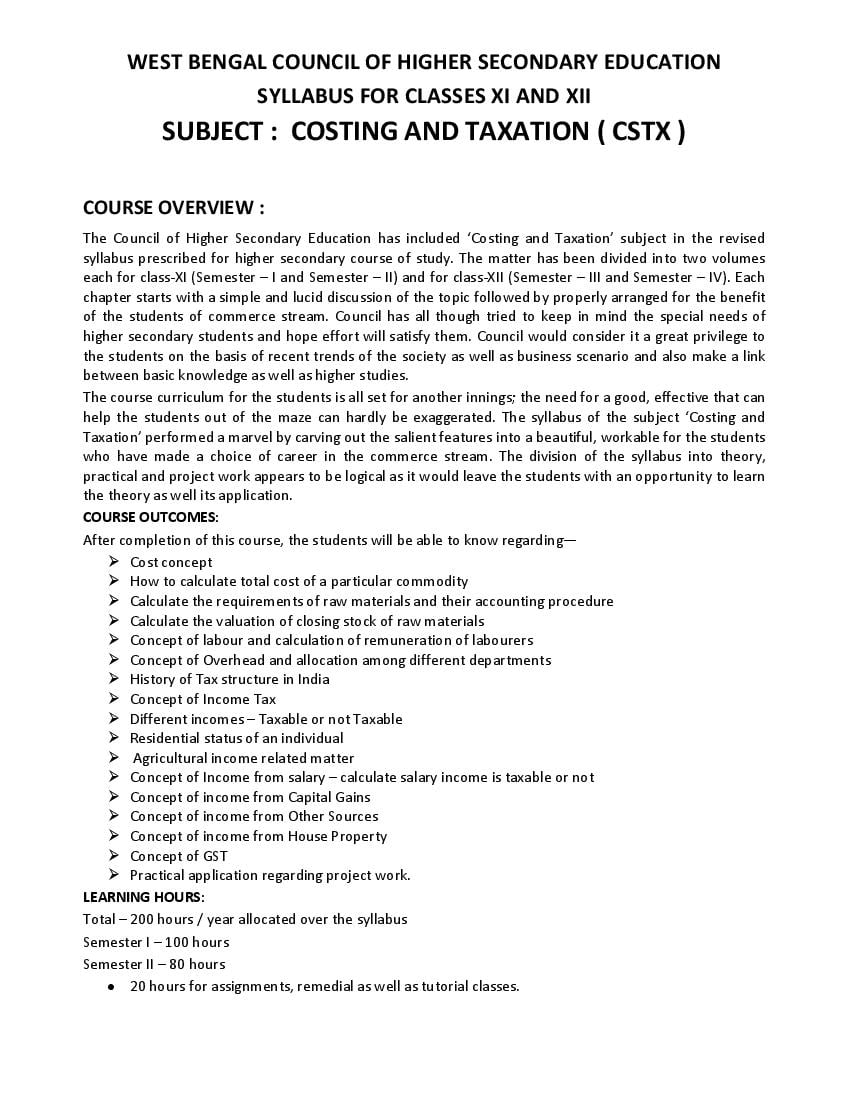
SYLLABUS FOR CLASSES XI AND XII
COURSE OVERVIEW :
The Council of Higher Secondary Education has included ‘Costing and Taxation’ subject in the revised
syllabus prescribed for higher secondary course of study. The matter has been divided into two volumes
each for class-XI (Semester – I and Semester – II) and for class-XII (Semester – III and Semester – IV). Each
chapter starts with a simple and lucid discussion of the topic followed by properly arranged for the benefit
of the students of commerce stream. Council has all though tried to keep in mind the special needs of
higher secondary students and hope effort will satisfy them. Council would consider it a great privilege to
the students on the basis of recent trends of the society as well as business scenario and also make a link
between basic knowledge as well as higher studies.
The course curriculum for the students is all set for another innings; the need for a good, effective that can
help the students out of the maze can hardly be exaggerated. The syllabus of the subject ‘Costing and
Taxation’ performed a marvel by carving out the salient features into a beautiful, workable for the students
who have made a choice of career in the commerce stream. The division of the syllabus into theory,
practical and project work appears to be logical as it would leave the students with an opportunity to learn
the theory as well its application.
COURSE OUTCOMES:
After completion of this course, the students will be able to know regarding—
Cost concept
How to calculate total cost of a particular commodity
Calculate the requirements of raw materials and their accounting procedure
Calculate the valuation of closing stock of raw materials
Concept of labour and calculation of remuneration of labourers
Concept of Overhead and allocation among different departments
History of Tax structure in India
Concept of Income Tax
Different incomes – Taxable or not Taxable
Residential status of an individual
Agricultural income related matter
Concept of Income from salary – calculate salary income is taxable or not
Concept of income from Capital Gains
Concept of income from Other Sources
Concept of income from House Property
Concept of GST
Practical application regarding project work.
LEARNING HOURS:
Total – 200 hours / year allocated over the syllabus
Semester I – 100 hours
Semester II – 80 hours
● 20 hours for assignments, remedial as well as tutorial classes.
Page 2
SEMESTER – I
FULL MARKS : 40 CONTACT HOURS : 100 Hours
UNIT NO. TOPICS MARKS
Unit -1 Introduction
Definition of Cost – Costing – Cost Accounting – Cost Centre – Cost Unit –
Objectives of Cost Accounting – Features of Cost Accounting – Advantages 13 5
of Cost Accounting – Limitations of Cost Accounting – Steps or Factors
necessary for installation of a Costing System.
Unit -2 Classification of Cost
i) Element – Based Classification: Raw Materials Cost – Labour Cost
– Other Expenses – Overhead – Prime Cost.
ii) Function – Based Classification: Factory Cost – Administration
Cost – Selling Cost – Distribution Cost – Research and
Development Cost.
37 15
iii) Behaviour – Based Classification: Fixed Cost – Variable Cost –
Semi-variable / Semi-fixed Cost – Distinctions between Fixed Cost
and Variable Cost.
iv) Preparation of Cost Sheet: Definition of Cost Sheet – Basic
Components of Cost Sheet – Practical Problems on Cost Sheet
(Simple Problems excluding Cost Estimation).
Unit -3 Introduction of Taxation
A : A brief history of Income Tax in India, Tax structure in India – Direct
Tax, Indirect Tax.
B : Basic concepts and definitions under Income Tax Act: - Previous year,
Assessment year, Assessee, Person, Sources of Income, Heads of Income,
Gross Total Income, Total Income.
C : Incomes which do not from part of Total Income: Receipts by a 25 10
member from Hindu Undivided family [Section 10(2)], Share of profit from
a Partnership firm[Section 10(2A)], Sums received under Life Insurance
Policy [Section 10(10D)], Daily Allowance to MPs and MLAs [Section
10(17)], Awards [Section 10(17A)], Income of a Local Authority [Section
10(20)], Income from Dividend [Section 10(34)], Income from Units
[Section 10(35)], Long term Capital Gains from transfer of equity shares or
units [Section 10(38)]
Unit -4 Residential Status and Incidence of Tax of Individual Assessee. 25 10
Page 3
SEMESTER – II
FULL MARKS : 40 CONTACT HOURS : 80 Hours
UNIT NO. TOPICS MARKS
Unit -1 Cost of Materials
A: Storing of Materials
i) Bin Card – Definition and Necessity
ii) Stores Ledger – Definition and Necessity
iii) Centralized Stores and Decentralized Stores
B: Materials Control
i) Necessity of Material Control
ii) Fixation of Stock Levels of Materials: Re-order Stock Level –
Maximum Stock Level – Minimum Stock Level – Average Stock
40 20
Level – Danger Stock Level (with Simple Practical Problems)
iii) Fixation of Economic Order Quantity(EOQ): Definition and
Advantages of EOQ – Simple Problems on Determination of
EOQ(with the help of formula)
C : Methods of Pricing Materials
Methods of Pricing Materials issued from Stores and Preparation of Stores
Ledger Accounts – FIFO Method, LIFO Method, Simple Average Method,
Weighted Average Method – Advantages and Limitations of FIFO Method,
LIFO Method, Simple Average Method and Weighted Average Method.
Unit -2 Agricultural Income: - Definition, Taxability of Income from sale of tea
and coffee grown and manufactured in India. Very common instances of 10 5
agricultural income and non-agricultural incomes.
Unit -3 Income under the head “Salaries”
A : Basis of charge (Section 15), Essential norms of salary income,
Allowances:- Basic Salary, Dearness Allowance, City Compensatory
Allowance, House Rent Allowance [Section 10(13A)], Medical Allowance,
Bonus, Children Education Allowance, Transport Allowance.
B : Perquisites [Section 17(2)]
a) Valuation of rent free unfurnished accommodation provided to
(i) Central and State Government Employee and (ii) Private
30 15
Sector Employees [Rule 3(1)] – Valuation of rent free furnished
accommodation.
b) Valuation of perquisites in respect of (i) Free education to
employee’s children: (ii) Payment of school fees by the
employer, (iii) Education facility in employee’s institute.
c) Very common examples of tax free perquisites.
d) Deduction for professional tax or tax on employment [Section
16(iii)]
Page 4
COURSE CODE : PROJECT
Full Marks : 20
Sub Topics :
1 Visit any manufacturing firm, collect real data and prepare a detailed Cost Sheet.
2 Visit any production unit, collect necessary data regarding raw materials of a particular commodity,
prepare Bin Card and Stores Ledger.
3 Visit any production unit, collect necessary data regarding raw materials of a particular commodity,
calculate Economic Order Quantity / Re-order Quantity for each and every raw material.
4 Collect data from any relative, who is a salaried person and compute his / her income from salary
[excluding perquisites]
5 Visit any agricultural farm, collect data and prepare agricultural income and total income.
6 Meet ten individual persons, collect different information related to staying in India and abroad.
Comment on Residential Status and their tax incidence.
Guidance to the Students regarding Project Work for Class - XI
The Council has included 'Project Design' in the new curriculum keeping in view the practical side of the students
along with the theoretical knowledge. The following points should be arranged in sequence for project
formulation —
On the first page:
(i)Name of project, (ii) Name of project maker, (iii) Name of supervisor i.e. name of the school teacher who
supervised the preparation of project, (iv) Name of school, (v) Roll number, (vi) Class, (vii) Month and year of
submission.
On the second page:
Acknowledgement means thanking all the teachers, parents and elder-friends and all the authoritative books that
helped in shaping the project.
On the third page:
Table of contents / Index
Subject of the project:
(i)Introduction, (ii) Objectives of the project, (iii) Conceptual Framework, (iv) Collection of data for the Project,
(v) Presentation of data collected for the project, (vi) Discussion and analysis of data collected for the project,
(vii) Conclusion and recommendations; Limitations; Future work prospects.
Page 5
SEMESTER – III
FULL MARKS : 40 CONTACT HOURS : 100 Hours
UNIT NO. TOPICS MARKS
Unit -1 Concept of Labour:
A : Cost of Labour
Time Keeping – Methods of Time Keeping (Manual and Mechanical) –
Features of a Good Time Keeping System.
Time Booking – Methods of Time Booking Idle Time – Causes of Idle Time.
B : Methods of Remuneration - I
50 20
i) Time Rate Wage – Advantages and Limitations.
ii) Straight Piece Wages and Simple Problems, Limitations
iii) Differential Piece Wage Rate: Taylor’s Differential Piece Wage
Rate – Advantages and Simple Problems, Limitation. Merrick’s
Differential Piece Wage Rate Method – Concept and Simple
Problems.
Unit -2 Income from “Capital Gains”
Basis of charge [Section 45(1)], Meaning of Capital Asset [Section 2(14)],
Examples of Assets not treated as Capital Asset, Short term Capital Asset 25 10
[Section 2(42A)], Long term Capital Asset [Section 2(29A)], Transfer of
Capital Asset [Section 2(47)] – Simple problems on Capital Gains.
Unit -3 Income from Other Sources 25 10
Basis of charge (Section 56), Some Examples of income generally taxable
under this head, Tax treatment of winning from lotteries, horse race, card
games, cross word puzzles [Section 56(2)i(b)], Interest on Securities
[Section 56(2)i(d)]
Page 6
SEMESTER – IV
FULL MARKS : 40 CONTACT HOURS : 80 Hours
UNIT NO. TOPICS MARKS
Unit -1 Methods of Remuneration - II
Halsey and Rowan Premium Bonus Schemes – Concepts and Simple 20 10
Problems.
Unit -2 Basic Concept of Overhead
A : Definition of Overhead – Importance of Overhead – Classification of
Overhead (only element – based, function – based and behavior – based
classification) – Distinctions between Overhead and Prime Cost. 20 10
B : Distribution of cost among different departments. Distinction between
Allocation and Apportionment, Bases of primary distribution commonly
used, Primary distribution of cost – Simple problems.
Unit -3 Income from “House Property”
i) Chargeability – essential conditions (Section 22), Property income
exempt from tax on Annual Value [Section 23(1)]
ii) Computation of income from let out house property: adjustment
30 15
of vacancy period, standard deduction under section 24(a),
Interest on borrowed capital under section 24(b) (excluding
interest for pre-construction period)
iii) Computation of income from one self occupied house.
Unit -4 Goods and Service Tax (GST)
Concept, Historical background of GST, Indirect Tax structure during pre-
GST period, Indirect Tax structure after introduction of GST.
10 5
Objectives, Structure, Types of GST, Salient features of GST, Benefits of
GST for business and industry, Central and State Govts, Consumers.
GST rules on goods and GST rules on services. GSTIN and GSTN.
Page 7
COURSE CODE : PROJECT
Full Marks : 20
Sub Topics :
1 Select any manufacturing unit, Observe the wage payment system followed there and prepare a report on
your observation.
2 Collect employees’ remuneration data from a production unit – compare between Time rate wage system
and Piece rate wage system – give a suggestion or recommendation.
3 Collect employees’ remuneration data from a production unit – compare Differential Piece rate wage
system between Taylor’s and Merrick’s - give a suggestion or recommendation.
4 Collect employees’ remuneration data from a production unit – compare Bonus premium plan between
Halsey and Rowan - give a suggestion or recommendation.
5 Collect Overhead cost of a particular period of time from a manufacturing / production unit – allocate
these costs among different departments on the basis of primary bases.
6 Select any house having both let out and self occupied units, take the necessary information from the
owner of the house and compute Income from House Property.
Guidance to the Students regarding Project Work for Class - XII
The Council has included 'Project Design' in the new curriculum keeping in view the practical side of the students
along with the theoretical knowledge. The following points should be arranged in sequence for project
formulation —
On the first page:
(i)Name of project, (ii) Name of project maker, (iii) Name of supervisor i.e. name of the school teacher who
supervised the preparation of project, (iv) Name of school, (v) Roll number, (vi) Class, (vii) Month and year of
submission.
On the second page:
Acknowledgement means thanking all the teachers, parents and elder-friends and all the authoritative books that
helped in shaping the project.
On the third page:
Table of contents / Index
Subject of the project:
(i)Introduction, (ii) Objectives of the project, (iii) Conceptual Framework, (iv) Collection of data for the Project,
(v) Presentation of data collected for the project, (vi) Discussion and analysis of data collected for the project,
(vii) conclusion and recommendations; limitations; Future work prospects.
Document Details
| Board / Org | West Bengal Board |
| Exam | Class 12 |
| Type | Syllabus |
| Pages | 7 |
| Updated | 22 Jul 2026 |