CUSAT CAT 2025 Question Paper Statistics
Finished viewing? Save it for later —
Download CUSAT CAT 2025 Question Paper Statistics (PDF · 39 pages)About CUSAT CAT 2025 Question Paper Statistics
CUSAT CAT 2025 Question Paper Statistics is available here for free download. Published by Cochin University for CUSAT Common Admission Test, this question paper can be viewed online or downloaded as a PDF (39 pages). Candidates preparing for CUSAT Common Admission Test can use CUSAT CAT 2025 Question Paper Statistics to understand the exam pattern, the type of questions asked, and the overall difficulty level.
Frequently Asked Questions
How can I download CUSAT CAT 2025 Question Paper Statistics?
Open this page and click the Download button to save CUSAT CAT 2025 Question Paper Statistics as a PDF. It is completely free on AglaSem Docs.
Is CUSAT CAT 2025 Question Paper Statistics free to download?
Yes. CUSAT CAT 2025 Question Paper Statistics can be viewed online and downloaded as a PDF free of cost on AglaSem Docs.
How many pages does CUSAT CAT 2025 Question Paper Statistics have?
CUSAT CAT 2025 Question Paper Statistics contains 39 pages, which you can read online or download together as a single PDF.
Where can I find more CUSAT Common Admission Test study material?
You can find more CUSAT Common Admission Test question papers, sample papers, syllabus, and answer keys on AglaSem Docs.
CUSAT CAT 2025 Question Paper Statistics – Text
Read the full text of this question paper below — useful to quickly search, copy and reference the content online without downloading the PDF.
📄 View text version (39 pages)
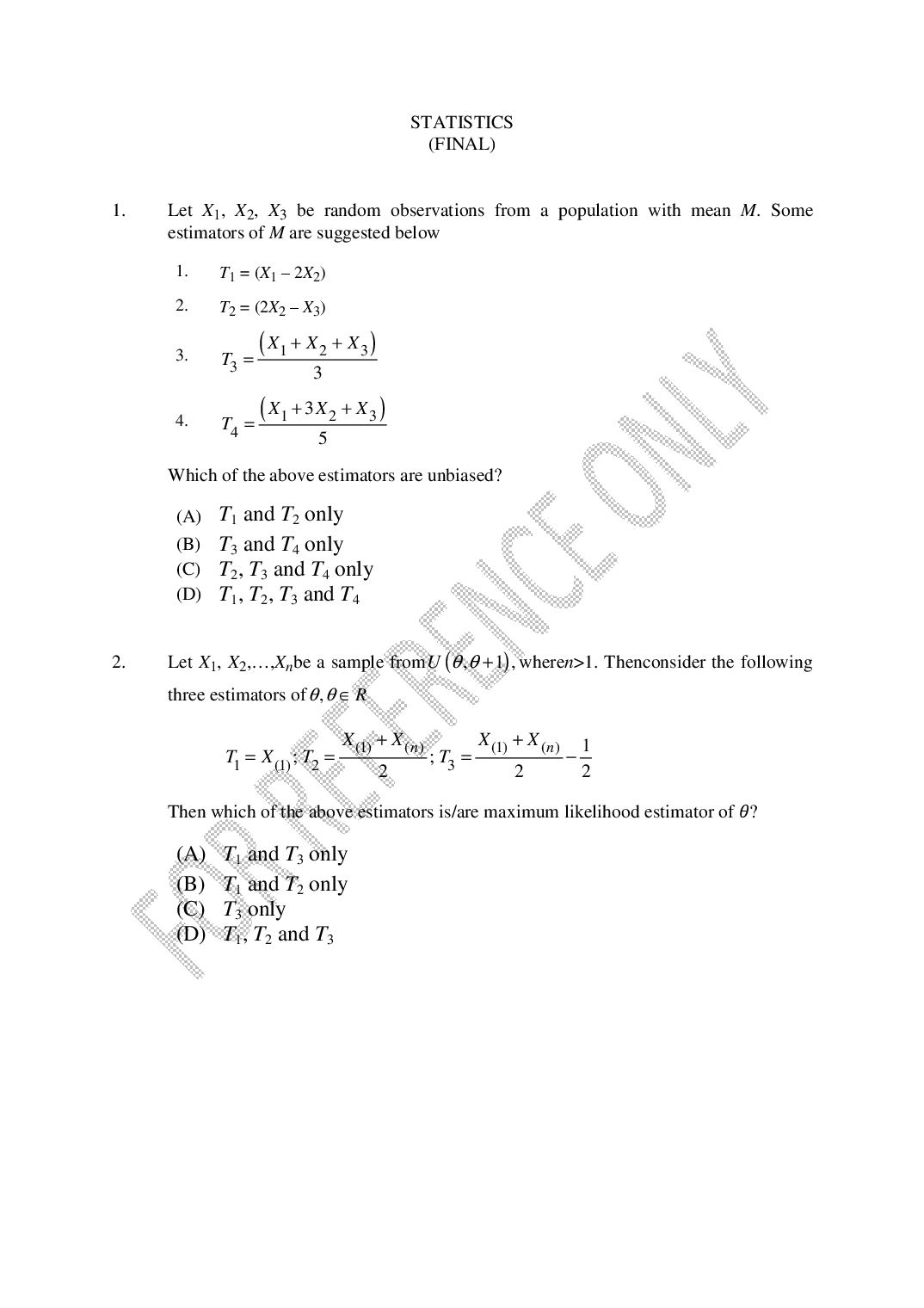
Page 1
(FINAL)
1. Let X1, X2, X3 be random observations from a population with mean M. Some
estimators of M are suggested below
1. T1 = (X1 – 2X2)
2. T2 = (2X2 – X3)
3. T3 =
( X1 + X 2 + X 3 )
3
4. T4 =
( X1 + 3 X 2 + X 3 )
5
Which of the above estimators are unbiased?
(A) T1 and T2 only
(B) T3 and T4 only
(C) T2, T3 and T4 only
(D) T1, T2, T3 and T4
2. Let X1, X2,…,Xnbe a sample from U (θ ,θ + 1) , wheren>1. Thenconsider the following
three estimators of θ , θ ∈ R
X (1) + X ( n) X (1) + X ( n ) 1
T1 = X (1) ; T2 = ; T3 = −
2 2 2
Then which of the above estimators is/are maximum likelihood estimator of ?
(A) T1 and T3 only
(B) T1 and T2 only
(C) T3 only
(D) T1, T2 and T3
Page 2
X1 = X , X 2 = θ X1 , X 3 = θ X 2 ,..., X n = θ X n −1 . Then corr ( X1 , X n ) is
(A) 1
(B) −1
(C) θ n−2
(D) θ n −3
4. Let X1, X2, …., Xn(n>1)be a sample from exp(1). Then the distribution of 2nX is
1
(A) exp
2
(B) exp(2n)
(C) χ n2
2
(D) χ 2n
5. Let X be a random variable having probability density function
α xα
0
α +1 , if x > x0
f ( x; x0 , α ) = x
0, if x ≤ x0
x
Where α , x0 > 0. If Y = log then P (Y > 3) is
x
0
(A) exp(−3α x0 )
(B) 1 − exp( −3α x0 )
(C) 1 − exp( −3α )
(D) e −3α
Page 3
6. Let the random variable X~ binomial (3, θ), 0<θ< 1. A test of hypothesis H 0 : θ =
4
1
against H1 : θ = reject H 0 if X ≤ 1. Then the test has
4
5 27
(A) size = , power =
32 32
5 18
(B) size = , power =
32 32
15 27
(C) size = , power =
32 32
1 31
(D) size = , power =
32 32
7. Let X1, X2, …., X20be a random sample from a distribution having the variance 5. Let
20 2
X denote the mean of the given sample and S = ∑ i =1 ( X i − X ) . Then the value of
E(S) is
(A) 5
(B) 95
(C) 0.25
(D) 100
8. Four identical fair dice are thrown independently. Let S denote the
number of dice showing odd number on their upper faces. Then the
variance of the random variable S is
1
(A)
2
3
(B)
2
(C) 1
(D) 2
Page 4
exp( − x ) if 0 ≤ y ≤ x < ∞
f ( x, y ) =
0 otherwise
Then E(X) is
(A) 0.5
(B) 1
(C) 2
(D) 6
10. Let X be a continuous random variable with pdf symmetric about 0, that is
f ( − x ) = f ( x ), ∀x ∈ R. If V ( X ) < ∞, then which of the following statement is TRUE?
(A) E ( X ) = E( X )
(B) V ( X ) = V (X )
(C) V ( X ) < V (X )
(D) V ( X ) > V ( X )
11. Let X1, X2, …., XmandY1, Y2, …., Ynbe iid N(0, 1) random variables. Then
2
W=
( m
) has
n ∑ i =1 X i
2
m ( ∑ j =1Yi )
n
(A) χ m2 + n distribution
(B) tn distribution
(C) Fm,n distribution
(D) F1,1 distribution
Page 5
pairs of random variables are independent?
(A) ( X1 + X 2 , X 2 + X 3 )
(B) ( X1 , X1 + X 3 )
(C) ( X1 + X 2 , X 3 )
(D) ( X 2 , X1 + X 2 + X 3 )
13. Let X1, X2, …., Xnbe a random sample of size n from ( ,16) population. If a 95%
confidence interval for is X − 0.98, X + 0.98 , then the value of n is
(A) 4
(B) 16
(C) 32
(D) 64
14. Let the random variable X follows binomial distribution with parameters n and p, then
X n− X
cov , equals to
n n
(A) npq
(B) − pq
pq
(C)
n
pq
(D) −
n
15. Let X follows the geometric distribution with parameter p, then consider the following
statements for non-negative integers a, b:
1. P ( X ≥ a + b | X ≥ a ) = P ( X ≥ b)
2. P ( X = a + b | X ≥ a ) = P ( X = b)
Which of the above statements is/are TRUE?
(A) 1 only
(B) 2 only
(C) 1 and 2
(D) neither 1 nor 2
Page 6
16. Let the random variable X ~ χ n2 .Then the distribution of U = , for large n is
2n
(A) N (0,1)
(B) χ n2−1
(C) χ n2− 2
1
(D) N 1,
2
17. Let X1, X2be a random sample from N(0, 1) and Y1, Y2 another sample from a different
distribution N(1, 1). Then the distribution of X + Y is
(A) N (1, 2)
1
(B) N 1,
2
(C) N (1,1)
(D) N (1, 2)
n
18. Let X1, X2, …., Xnbe iid exp(1) random variables and Sn = ∑ i =1 X i . Using the central
limit theorem, the value of lim P ( Sn > n ) is
n→∞
(A) 0
1
(B)
2
1
(C)
3
(D) 1
Page 7
8
V = ∑ i =1 X i . The correlation coefficient between U and V is
1
(A)
8
1
(B)
4
3
(C)
4
1
(D)
2
20. Two coins with probability of head u and v, respectively, are tossed independently. If
P (both coins show up tails) = P (both coins show up head), then u+v equals
1
(A)
4
1
(B)
2
3
(C)
4
(D) 1
21. The observed value of mean of a random sample from N (θ ,1) distribution is 2.3. If the
parameter space isΘ={0,1,2,3}, then the maximum likelihood estimate of θ is
(A) 1
(B) 2
(C) 2.3
(D) 3
Page 8
m such that P ( X − µ < m ) ≥ 0.99 is
(A) 90
(B) 90
100
(C)
11
(D) 30
23. The skewness of binomial distribution B ( n, p ) becomes 0 when
1
(A) p>
2
1
(B) p=
2
1
(C) p<
2
(D) p<q
24. Let t follows Student’s t distribution with n degrees of freedom, then t 2 follows
2
(A) χ(1)
(B) χ (2n)
(C) F (1, n)
(D) F (2, n)
Page 9
the following is NOT a consistent estimator of θ ?
1
(A) + nX
n
nX + 1
(B)
n+5
1 nX
(C) +
n( n + 1) n + 1
1
(D) X+
n
26. Let X1 , X 2 be a random sample from a N (0, θ ) distribution where θ > 0. Then the value
X2 + X2
of K, for which the interval 0, 1 2 is 95% confidence interval of θ , equals
K
(A) − log e (0.95)
(B) −2 log e (0.95)
1
(C) − log e (0.95)
2
(D) 2
27. Let the random vector ( X , Y ) have a bivariate normal distribution with parameter
µ x = 0, µ y = 0, σ x2 = 1, σ y2 = 1 and corr ( X , Y ) = ρ , then V ( X − Y ) is equal to
(A) 2ρ 2
(B) 2 (1 + ρ )
(C) 2 (1 − ρ )
(D) (
2 1− ρ 2 )
Page 10
8 X − 10Y + 66 = 0 and 40 X − 18Y = 214
Then means of X and Y, respectively are
4 9
(A) ,
5 20
(B) (8,10)
(C) (40,18)
(D) (13,17)
29. From the frequency distribution with open-end class interval at the end,
we can calculate
1. Mean
2. Median
3. Mode
Choose your answer from the following
(A) 1 and 2
(B) 2 and 3
(C) 1 and 3
(D) 1, 2 and 3
30. If the regression line of Y on X is Y + 0.8X = 25 and the standard
deviations of X and Y, respectively are 3 and 8. Then the value of
correlation coefficient r is
(A) −0.3
(B) −0.4
(C) 0.3
(D) 0.4
Page 11
P(X+Y<3) is
(A) e −3
(B) 3e −3
(C) 4e −3
(D) 8.5e −3
32. Which one of the following is/are true for independent random variables
X and Y?
(i) X ~ B(5,0.2), Y ~ B(5, 0.4) then X + Y ~ B(10, 0.6)
(ii) X~P(5), Y~P(7), then X+Y~P(12)
Choose your answer from the following:
(A) Both (i) and (ii) are true
(B) (i) is true but (ii) is false
(C) (i) is false but (ii) is true
(D) Both (i) and (ii) are false
2 2
33. Let X~N(µ, σ ) both µ and σ be unknown. Let 0be a known constant. Consider the
null hypothesis H 0 : µ ≤ µ0 , σ 2 > 0 and the alternative hypothesis H1 : µ > µ0 , σ 2 > 0
, then
(A) both null and alternative hypotheses are simple
(B) both null and alternative hypotheses are composite
(C) null is simple and alternative hypothesis is composite
(D) null is composite and alternative hypothesis is simple
34. Let E, F and G be three events such that the events E and F are mutually exclusive,
1 7
P ( E ∪ F ) = 1, P ( E ∩ G ) = and P (G ) = . Then P ( F ∩ G ) equals
4 12
1
(A)
12
1
(B)
4
5
(C)
12
Page 12
(D)
3
1 2 0 2
−1 −2 1 1
35. Let P = . Then rank of P equals
1 2 −3 −7
1 2 −2 −4
(A) 4
(B) 3
(C) 2
(D) 1
1 0 1+ x 1+ x
0 1 1 1
36. Let P = . Then the determinant of matrix P is
1 1+ x 0 1+ x
1 1+ x 1+ x 0
(A) 3( x + 1)3
(B) 3( x + 1)2
(C) 3( x + 1)
(D) ( x + 1)(2 x + 3)
1 2 3
37. The Matrix M = 0 4 5
0 0 6
(A) is an elementary matrix
(B) can be written as a product of elementary matrices
(C) does NOT have linearly independent eigenvectors
(D) is a nilpotent matrix
38. In the Neyman-Pearson set up,if α and β denote probabilities of Type I and Type II
errors, then we
(A) minimize both α and β
(B) minimize α for fixed β
(C) fix α and maximize β
(D) fix α and maximize (1− β )
Page 13
(A) R. A. Fisher
(B) Irvin Fisher
(C) Neyman
(D) C.R. Rao
40. Which one of the following is not a basic principle of design of
experiment?
(A) Randomization
(B) Local control
(C) Test of significance
(D) Replication
41. The correct relationship between AM, GM and HM is
(A) AM ≥ GM ≥ HM
(B) AM ≤ GM ≤ HM
(C) GM ≤ HM ≤ AM
(D) GM ≤ AM ≤ HM
42. In a population of size 50, a systematic sample of size 5 is drawn. If a unit
selected in the sample is 17, then the other units of the sample will be,
(A) (7,15,25,35)
(B) (7, 27, 37, 47)
(C) (7, 20, 18, 27)
(D) (17, 18, 25, 27)
43. If T is an estimator of parameter θ, then
(A) MSE(T) = V(T)
(B) V(T) = MSE(T) + Bias(T)
(C) MSE(T) = V(T) + (Bias(T))2
(D) V(T) = MSE(T) + (Bias(T))2
44. Power of the test is the probability of
(A) Rejecting H 0 when H 0 is true
Page 14
(C) Rejecting H 0 when H1 is true
(D) Rejecting H1 when H1 is true
1 1 1 1
45. The infinite sum of − + − + ... is equal to which of the following?
3 9 27 81
(A) 1
1
(B)
2
1
(C)
3
1
(D)
4
1 1 1 1
46. Given the infinite series 1 − + − + − ... ., which of the following is true?
2 3 4 5
(A) The series converges
(B) The series diverges to infinity
(C) The series oscillates
(D) The series does not converge
1
47. For the infinite sum of from n = 1 to infinity, where n! denotes the factorial of
( n !)
n, which of the following is NOT true?
(A) The infinite sum converges to 0
(B) The partial sum sequence of the infinite sum converges
(C) The n-th term of the infinite sum converges to 0 as n tends to
infinity
(D) The infinite sum converges to e – 1
48. Given a real valued function f of a real variable, which of the following
need NOT be true?
(A) If fis continuous at a point x, then f is differentiable at the point x
(B) If fis differentiable at a point x, then f is continuous at the point x
(C) If fis continuous at a point x, then f need not be differentiable at
that point x
Page 15
not differentiable
49. For a real valued functionf of a real variable, if f ( A) is the image set of A containing
all f ( x ) , x in A, which of the following is the image set of the open interval (−1,1),
given that f ( x) = x 2 ?
(A) The open interval (−1, 1)
(B) The open interval (−1, 0)
(C) The open interval (0,1)
(D) The union of the open interval (0,1) and the singleton {0}
50. If f ( x ) = log x, x > 0 , and g ( x ) = exp( x ), x any real number, log to base e and exp is
the exponential function, what is f ( g (0) ) + g ( f (1) ) ?
(A) 0
(B) 1
(C) 2
(D) e
51. If f ( x) = x + x , − 1 < x < 1, which of the following is NOT true?
(A) f is a continuous function in (−1,1)
(B) f is a differentiable function in (−1,1)
(C) f is a differentiable function in (−1,1) except at 0
(D) f is a nonnegative function in (−1,1)
52. If f ( x ) = exp( x ), x < 0, where exp(.) is the exponential function, what is integral of
f ( x ) dx over – infinity to 0?
(A) 0
(B) Integral does not exist
(C) – Infinity
(D) 1
53. If f is a strictly increasing and continuous function, which of the
following is true?
(A) f has a unique inverse function
Page 16
(C) Inverse of f need not be continuous
(D) Inverse of f is not unique
π π
54. If f ( x ) = modulus of (sin x ), − <x< , what is the minimum value of f ( x ) in its
2 2
domain?
(A) 0
(B) −1
(C) 1
1
(D)
2
55. If f ( x ) = minus modulus of (x), −1 <x< 1, what is integral of f ( x ) dx from x = −1 to
x = 1?
(A) 1
1
(B)
2
1
(C) −
2
(D) −1
56. If f ( x ) = ln( x ), x > 0, where ln is the natural logarithm to base e, what is the integral
of f ( x ) dx over 1 to e ?
(A) 0
(B) 1
(C) e
(D) −1
n
1
57. What is lim 1 − ?
n→∞ n
(A) e
(B) 0
(C) 1
1
(D)
e
Page 17
58. What is lim ?
n→∞ 1 + n
(A) 0
1
(B)
2
(C) 1
(D) −1
1 1 1
59. What is lim 1 + + + ... + ?
n→∞ 2 3 n
(A) Limit is not finite
(B) 1
(C) e
(D) 0
60. Which of the following is NOT true with reference to the series
1 1 1
1 + 3 + 3 + 3 + ... ?
2 3 4
(A) The series converges
(B) The series diverges to infinity
(C) The n-th term of the series converges to 0 as n tends to infinity
(D) The series neither oscillates nor diverges
2
− x
0 e 2
61. What is the value ∫ dx ?
−∞ 2π
(A) 1
(B) 0
1
(C)
2
(D) Infinity
62. If A is a real, square matrix, which of the following statements need NOT be true?
(A) Square of A is defined
Page 18
(C) AAT is symmetric matrix
(D) Rank of A is equal to trace of A
63. Given that real, square matrix A has determinant equal to 0, which of the
following is true?
(A) A is a singular matrix
(B) A is a non-singular matrix
(C) Inverse of A exists
(D) A has full row rank
64. Given that A is a real and orthogonal matrix, which of the following is
NOTtrue?
(A) Inverse of A is equal to transpose of A
(B) Determinant of A is not equal to 0
(C) A has full row rank
(D) Determinant of A is equal to 0
65. Which of the following should be satisfied for existence of inverse of a
real matrix A?
(A) A should have non-zero rows
(B) A should have non-zero columns and non-zero rows
(C) Determinant of A should be non-zero
(D) Determinant of A should be zero
66. Which of the following is an idempotent matrix?
(A) Any square matrix
(B) Any symmetric matrix
(C) Any identity matrix
(D) Any singular matrix
67. Given that R = rank of a matrix A, which of the following is NOT true?
(A) R remains unchanged if rows of A are interchanged
(B) R remains unchanged if any column of A is multiplied by a non-
zero scalar
Page 19
(D) R remains unchanged if the rows and columns of A are
interchanged
68. Given a vector space V, which of the following is NOT true?
(A) V has a zero vector
(B) V is closed under vector addition
(C) V is closed under scalar multiplication
(D) V is closed under vector multiplication
1 1 1
69. For two events A and B with P(A)= , P(B) = , P(A given B) = , which of the
2 4 3
following gives the value of P(A union B)?
5
(A)
12
(B) 1
2
(C)
3
(D) 0
70. For two independent events A and B, which of the following need NOT
be true?
(A) P(A) = P(A given B)
(B) P( (complement of A) intersection B) = P(B).P(complement of A)
(C) P(A) is less than or equal to P(B given A)
(D) P( (complement of A) intersection (complement of B) ) =
P(complement of A).P(complement of B).
71. Given that every outcome in event A is in event B, which of the following
is NOT true?
(A) P(complement of A) is greater than or equal to P(complement of B)
(B) P(intersection of A and B) = P(A)
(C) P(intersection of A and B) = P(B)
(D) P(A) is less than or equal to P(B)
Page 20
following is true?
(A) P(union of A and B) = P(A) + P(B)
(B) P(union of A and B) is less than or equal to P(A) + P(B)
(C) P(union of A and B) is greater than or equal to P(A) + P(B)
(D) P(intersection of A and B) = 0
73. Given the set of numbers {0.1, 0.3, 0.4, 0.2}, which of the following
statements is true?
(A) The set can be the probability mass function of a random variable
assuming 4 values
(B) The set cannot be the probability mass function of any random
variable
(C) The numbers in the set cannot be assumed to be probabilities
(D) The numbers in the set are probabilities of a continuous real valued
random variable realizing four values
74. Given that A is the event of observing first a Head and then a Tail in two
independent throws of a fair coin, what is P(A)?
1
(A)
4
1
(B)
2
3
(C)
4
1
(D)
3
Page 21
throw of a fair coin which is thrown independently repeatedly?
1
(A)
2
1
(B)
10
1
(C)
32
1
(D)
64
76. What is the probability that the sum of numbers facing up in two fair
dice, thrown simultaneously, is an odd number, when each dice has six
faces with the numbers 1 to 6 on its six faces?
1
(A)
2
1
(B)
3
1
(C)
4
1
(D)
12
77. Which of the following is true given that X is a random variable with
1
P(X = 0) = = 1−P(X=1)?
3
2 1
(A) Expected value of X is Variance of X is
3 9
2 2
(B) Expected value of X is Variance of X is
3 9
1 1
(C) Expected value of X is Variance of X is
3 9
1 2
(D) Expected value of X is Variance of X is
3 9
Page 22
variance equal to 1, what is expected value of square of X?
(A) 0
(B) 1
(C) 2
(D) 4
79. What is the standard deviation of the random variable X given that P(X = k) is equal
1 2
to times to the power of k, k = 0, 1, 2, ….?
3 3
(A) 2
(B) 2
(C) 6
(D) 8
80. Given that random variable X has Binomial distribution with parameters n = 10 and
1
p = , what is the coefficient of variation of X?
2
1
(A)
10
1
(B)
100
1
(C)
50
1
(D)
10
81. Given that X and Y are independent Poisson random variables with mean
1, which of the following is NOT true?
(A) X + Y has Poisson distribution with mean 2
(B) X + Y has Poisson distribution with variance 2
(C) X + Y has Poisson distribution with variance 1
(D) X + Y has Poisson distribution with mean 2 and square of
coefficient of variation equal to one half
Page 23
which of the following is true?
(A) Expected value of (2X – 4Y) is 0 and Variance of (2X – 4Y) is 20
(B) Expected value of (2X – 4Y) is –2 and Variance of (2X – 4Y) is 10
(C) Expected value of (2X – 4Y) is –2 and Variance of (2X – 4Y) is 20
(D) Expected value of (2X – 4Y) is 0 and Variance of (2X – 4Y) is 10
83. Given that X is a standard exponential random variable, what is the coefficient of
variation of (X+1)?
1
(A) 2
1
(B) 4
(C) 0
(D) 1
84. Which of the following is true if X is the uniform random variable over
the interval (0, 1)?
(A) Expected value of X is 1
1
(B) Variance of X is equal to
12
1
(C) Variance of X is equal to
10
1
(D) Variance of X is equal to
2
85. Given that X has uniform distribution over (0, 1), which of the following
is true, where ln denotes the natural logarithm to base e?
(A) −ln(X) has standard exponential distribution
(B) −ln(X) has standard normal distribution
(C) −ln(X) has chi-square distribution
(D) −ln(X) has gamma distribution
Page 24
standard normal distribution, what is the distribution of their sum (X1 +
...+ X9)?
(A) Standard normal distribution
(B) Normal distribution with mean 0 and variance 10
(C) Normal distribution with mean 9 and variance 9
(D) Normal distribution with mean 0 and variance 9
87. Which of the following is the moment generating function of the standard
normal distribution?
(A) e raised to the power of (t divided by 2), t real.
(B) e raised to the power of ((square of t) divided by 2), t real
(C) Reciprocal of square root of pi times e raised to the power of
((square of t) divided by 2), t real
(D) Reciprocal of square root of (twice pi) times e raised to the power
of ((square of t) divided by 2), t real
88. Given that P(s), s in the closed interval [0, 1], is the probability
generating function of a random variable X taking values 0, 1, 2, …,
which of the following is true?
(A) P(0) = Probability that X takes the value 0 and P(1) = 1
(B) P(0) = 0 and P(1) is the Probability that X takes the value 1
(C) P(0) = Probability that X takes the value 0 and P(1) = 0
(D) P(0) = 1 and P(1) = Probability that X takes the value 1
89. Given a completely randomized design with total number of observations
equal to 45 and total number of treatments equal to 10, which of the
following gives the degrees of freedom for the error?
(A) 34
(B) 35
(C) 36
(D) 450
90. Which of the following is not related to design of statistical experiments?
(A) Design matrix
(B) Least squares estimates
Page 25
(D) Replication
91. Given a completely randomized design model, which of the following is
true?
(A) The yield of interest depends on one source of heterogeneity
(B) The yield of interest depends on two sources of heterogeneity
(C) The yield of interest depends on three sources of heterogeneity
(D) The yield does not depend on any source of heterogeneity
92. Which of the following is the null hypothesis in the omnibus hypothesis
related to treatment effects in a completely randomized design?
(A) Inequality of all treatment effects
(B) Equality of the mean effect with a treatment effect
(C) Inequality of the mean effect and treatment effects
(D) Equality of all treatment effects
93. Which of the following is the distribution of the likelihood ratio test
statistic pertaining to an analysis of variance model?
(A) Standard normal distribution
(B) Standard chi-square distribution
(C) The F distribution
(D) Student's t distribution
94. In simple linear regression, if c denotes the product-moment correlation
coefficient between the variables and r denotes the regression coefficient,
which of the following is NOT true?
(A) c and r have the same sign
(B) Ratio of c to r is ratio of the two standard deviations
(C) c and r have opposite sign
(D) c = r if the two standard deviations are equal
95. In a simple linear regression model of Y on X, which of the following is
equal to the regression coefficient?
Page 26
(B) Vertical intercept of the line
(C) Horizontal intercept of the line
(D) Angle which the line makes with the horizontal axis
96. Which of the following is the mode of convergence in the central limit
theorem?
(A) Convergence in distribution
(B) Convergence in probability
(C) Convergence in first mean
(D) Convergence in second mean
97. For the central limit theorem to hold for a sequence of independent
random variables with the same non-degenerate probability distribution,
which of the following condition should be satisfied by the sequence?
(A) The random variables should be non-negative
(B) The random variables should have first moment finite
(C) The random variables should have infinite first moment
(D) The random variables should have finite second moment
98. Given a sequence of independent random variables X1, X2, … having
Uniform probability distribution over the interval (0, 1), which of the
following is NOT true?
(A) 1 – X1 has Uniform probability distribution over the interval (0,1)
(B) Central limit theorem holds for the sequence
(C) 1 – X2 has Uniform probability distribution over the interval (– 1,
0)
(D) The random variables in the sequence have finite second moments
99. Given that X and Y are independent standard exponential random
variables, which of the following is true?
(A) X + Y has Exponential distribution with mean 2
(B) X + Y has Uniform distribution over the interval (0, 1)
(C) X + Y has Gamma distribution
(D) X + Y has normal distribution
Page 27
is 20 and their difference is 4, which of the following is NOT true?
(A) The inter-quartile range is 4
(B) The first quartile is 8 and the third quartile is 12
(C) The first quartile is 12 and the third quartile is 16
(D) The difference between the first and third quartiles is 4
101. Given that variance of a random variable is zero, which of the following
is true?
(A) The random variable takes only one value
(B) The random variable takes values −1 and 1 with equal probability
(C) The random variable takes at least two values of the form c and −c
with equal probabilities, where c is any positive number
(D) The random variable is a continuous random variable taking values
in a non-empty interval
102. Given that probability of event A is less than probability of an event B,
which of the following is NOT true?
(A) Probability of union of events A and B is greater than or equal to
probability of A
(B) Probability of union of events A and B is greater than or equal to
probability of B
(C) Probability of union of events A and B is greater than or equal to
probability of intersection of events A and B
(D) Probability of union of events A and B is less than or equal to
probability of intersection of events A and B
103. Given that X and Y are independent random variables with E(X) = E(Y) =
0, standard deviation of X equal to twice the standard deviation of Y, and
standard deviation of Y equal to 2, which of the following is NOT true?
(A) Variance of (X – Y) is equal to 20
(B) Variance of (X + Y) is equal to 20
(C) Variance of (X – Y) is equal to 12
(D) Variance of (X + 2Y) is equal to 32
Page 28
events, which of the following is NOT true?
(A) Probability of A is equal to probability of A conditioned on B
(B) Probability of B is equal to probability of B conditioned on A
(C) Probability of A intersection B is equal to product of probability of
A and probability of B
(D) Probability of A union B is equal to sum of probability of A and
probability of B
105. When was the last Census held in India?
(A) 2010
(B) 2011
(C) 2022
(D) 2020
106. With reference to Simple Random Sampling (SRS), which of the
following is NOT true?
(A) Probability of selecting a population unit in a simple random
sample is the same for all the population units
(B) Probability of selecting a population unit in a simple random
sample is not the same for all the population units
(C) SRS is an equal probability sampling
(D) All simple random samples are equal probability samples but not
all equal probability samples are samples from simple random
sampling
107. Which of the following is ISI, the premier institute established by
Professor P.C.Mahalanobis?
(A) Indian Science Institute
(B) Indian Statistical Institute
(C) International Statistical Institute
(D) Indian Statistics Institution
108. Which of the following does NOT refer to a type of systematic sample?
(A) Linear systematic sample
Page 29
(C) Systematic random sample
(D) Proportional systematic sample
109. Which of the following is NOT a property of an estimator?
(A) Unbiasedness
(B) Sufficiency
(C) Maximizing the likelihood
(D) Parsimony
110. Given a random sample from standard Bernoulli distribution with
probability of success equal to p and probability of failure equal to (1 –
p), 0 <p< 1, which of the following is NOT true?
(A) Sample mean is an unbiased estimator of p
(B) Sample mean is a consistent estimator of p
(C) There are estimators of p other than the sample mean
(D) Sample mean is the only consistent estimator of p
111. Given a random sample from Poisson distribution with parameter lambda,
which of the following is NOT true?
(A) Sample mean is unbiased estimator of lambda
(B) Sample variance is unbiased estimator of lambda
(C) Half of sum of sample mean and sample variance is unbiased
estimator of lambda
(D) One third of sum of sample mean and sample variance is unbiased
estimator of lambda
112. Which of the following is true with reference to a likelihood function?
(A) It is a function of the data given the parameters
(B) It is a function of the parameters given the data
(C) It is neither a function of parameters nor a function of data
(D) It is function of the data and the parameters
113. Which of the following depicts income distribution in a population?
(A) Lorenz curve
Page 30
(C) Rao curve
(D) Neyman curve
114. Which of the following is a statistical measure of income inequality in a
population?
(A) Pearson coefficient
(B) Goldman coefficient
(C) Anderson coefficient
(D) Gini coefficient
115. Which of the following is termed as the ideal price index?
(A) Sen's price index
(B) Wilks' price index
(C) Fisher's price index
(D) Rao's price index
116. Which of the following is used to represent statistical data graphically?
(A) Root-and-Stem diagram
(B) Root-and-Flower diagram
(C) Stem-and-Flower diagram
(D) Stem-and-Leaf diagram
117. Which of the following is a method of estimation in Statistics?
(A) Least squares
(B) Least means
(C) Least coefficient of variation
(D) Least kurtosis
118. Which of these relate to confidence interval estimation?
(A) Confidence intervals are intervals involving a probability
(B) Confidence intervals are deterministic intervals not involving
probability
(C) Confidence intervals are unbounded intervals always
(D) Confidence intervals cannot contain negative numbers
Page 31
(A) Maximum value minus minimum value
(B) Difference between the third quartile and the first quartile
(C) Difference between mean and median
(D) Mean of sum total of squared deviations of observations from the
mean
120. Which of the following is the ministry responsible for Statistics in the
Central Government of India?
(A) Ministry of Statistics and Programme Implementation
(B) Ministry of Government Statistics and Programme Implementation
(C) Ministry of Statistics and Programme Identification
(D) Ministry of Niti Aayog
121. Which of the following is NOT true for the infinite sum 1 – 1 + 1 – 1 + 1
– 1 + .... ?
(A) The infinite sum does not converge
(B) The infinite sum converges to 0
(C) The limit of the partial sum sequence of the infinite sum does not
exist
(D) The partial sum sequence is oscillating
122. Which of the following is NOT a vector space?
(A) The set of all real numbers
(B) The set of all possible pairs of real numbers
(C) The set of all unit vectors in two dimensions
(D) The set containing only the null vector of a vector space
Page 32
(A) Rank of a matrix is equal to the number of non-zero rows in the
matrix
(B) Rank of a matrix is equal to the number of linearly independent
rows in the matrix
(C) Rank of a matrix is equal to the number of linearly dependent rows
in the matrix
(D) Rank of a matrix is equal to the number of null rows in the matrix
124. Given that F(x), x in the set of all real numbers, is the probability distribution function
of a random variable X, which of the following is NOT true?
(A) F is defined on the set of all real numbers and takes values in the closed
interval [0,1]
(B) F times F is a probability distribution function
(C) F can be a step function or a continuous function
1
(D) F = 0
2
125. Given that F ( x ) , x in the set of all real numbers, is the probability distribution
function of independent random variables X and Y, which of the following is NOT
true?
(A) F times F is the probability distribution function of maximum of X and Y
(B) (1 – F) times (1 – F) is the probability distribution function of minimum of X
and Y
(C) One minus ( (1 – F) times (1 – F) ) is the probability distribution function of
minimum of X and Y
(D) (1 – F) is not a probability distribution function
iπ
126. e 2 is equal to
(A) 0
(B) 1
(C) i
1
(D)
2
Page 33
(A) 1
1
(B)
2
(C) 1.5
(D) 0
128. lim e −iπ n is
n→∞
(A) 1
(B) −∞
(C) 0
(D) not converging
1+ i
129. If Z = , where i = −1 , then Z is
1− i
(A) 2
(B) 1
1
(C)
2
3
(D)
2
130. The distribution function F ( x ) of the random variable X ~ U (0,1) is
(A) continuous and differentiable everywhere
(B) differentiable everywhere
(C) differentiable but not continuous everywhere
(D) continuous but not differentiable everywhere
131. If X ~ N (0,1) and Y = X 4 , then correlation between X and Y is
1
(A)
4
(B) 1
(C) 0
Page 34
(D)
2
132. If 1, 3 are the eigen values of a square matrix A of order 2, then eigen
values of A4 are
(A) 1 and 4
(B) 1 and 12
(C) 1 and 81
(D) 1 and 6
133. If moment generating function of the random variable X is given by
1 1 1
M (t ) = + e −3t + e 4t , the n p ( X ≥ 0) is
3 6 2
1
(A)
3
2
(B)
3
5
(C)
6
1
(D)
2
1
134. Type-I beta distribution B (m, n) is symmetric about if
2
(A) m=n
(B) m>n
(C) m<n
(D) m = 2 and n = 3
135. If X1 and X 2 are independent N (0,1) variates, then P ( X1 > 2 X 2 ) is
1
(A)
2
1
(B)
4
(C) 1
1
(D)
3
Page 35
(A) 1
(B) 6
(C) 2
(D) 0
137. If −3, − 7, 4, 2 is a random sample from u ( −θ , θ ) , θ > 0 then MLE of θ is
(A) 4
(B) 2
(C) 7
(D) 1
138. If X follows Standard Cauchy distribution, then P ( X > 1) is
1
(A)
2
(B) 1
1
(C)
4
1
(D)
3
139. If X1 , X 2 ,... X1000 are independently and identically distributed random variables
1 1000
with E ( X1 ) = 1, V ( X1 ) = 2, the P ∑
1000 j =1
X j ≥ 1 is approximately equal to
(A) 1
1
(B)
2
1
(C)
1000
1
(D)
100
Page 36
(A) The only distribution for which mean = variance is the poisson distribution
(B) If mean of a distribution is 10 and variance =0 then P ( X = 10) = 1
1
(C) The only mode of U (0,1) distribution is
2
(D) For t-distribution with 1 degrees of freedom, expectation is zero
141. The harmonic mean of the number 1, 2, 3 is
(A) 2
18
(B)
11
13
(C)
18
11
(D)
18
142. The geometric mean of the observations 2, 4, 1, 8 is
(A) 2
(B) 1
(C) 6
(D) 2 2
143. The weighted mean of n natural numbers with weights are the corresponding numbers
is
n +1
(A)
2
2n + 1
(B)
2
2n + 1
(C)
3
n( n + 1)
(D)
6
Page 37
males is
(A) Mean
(B) median
(C) mode
(D) geometric mean
145. Variance of the numbers 1000, 1001, 1002 is
(A) 1000
2
(B)
3
1
(C)
2
1
(D)
3
1
146. If X is a random variable with P ( X = −1) = P ( X = 1) =
2
( )
, then V X 4 is
(A) 4
(B) 2
1
(C)
2
(D) 0
147. Let X be a Bernoulli random variable taking values 0 and 1. If E ( X ) = 3 var( X ) then
the probability that X = 1 is
1
(A)
3
2
(B)
3
2
(C)
5
3
(D)
5
Page 38
1 n
λ and let X = ∑ X i . Then the maximum likelihood estimate of e−λ is
n i =1
(A) X
n
(B) ∑ Xi
i =1
(C) e− X
n
(D) −∑ X i
e i=1
1
149. If X follows an F-distribution with 5 and 10 degrees of freedom, then follows
X
(A) a chi-square distribution with 15 degrees of freedom
1 1
(B) an F-distribution with and degrees of freedom
5 10
(C) a student-t distribution with 15 degrees of freedom
(D) an F-distribution with 10 and 5 degrees of freedom
150. Given the joint probability density function of X and Y as
4 xy; 0 ≤ x ≤ 1, 0 ≤ y ≤ 1
f ( x, y ) = ,
0 otherwise
P [ 0 < X < 0.5; 0.5 ≤ Y ≤ 1] is equal to
1
(A)
4
5
(B)
16
3
(C)
8
3
(D)
16
Page 39
Subject Name: STATISTICS
SI No. Key SI No. Key SI No. Key SI No. Key SI No. Key
1 C 31 D 61 C 91 A 121 B
2 C 32 C 62 D 92 D 122 C
3 A 33 B 63 A 93 C 123 B
4 D 34 D 64 D 94 C 124 D
5 D 35 C 65 C 95 A 125 B
6 A 36 B 66 C 96 A 126 C
7 B 37 B 67 C 97 D 127 B
8 C 38 D 68 D 98 C 128 D
9 C 39 A 69 C 99 C 129 B
10 C 40 C 70 C 100 C 130 D
11 D 41 A 71 C 101 A 131 C
12 C 42 B 72 B 102 D 132 C
13 D 43 C 73 A 103 C 133 C
14 D 44 C 74 A 104 D 134 A
15 C 45 D 75 C 105 B 135 A
16 A 46 A 76 A 106 B 136 B
17 C 47 A 77 B 107 B 137 C
18 B 48 A 78 B 108 D 138 C
19 D 49 D 79 C 109 D 139 B
20 D 50 B 80 D 110 D 140 B
21 B 51 B 81 C 111 D 141 B
22 D 52 D 82 A 112 B 142 D
23 B 53 A 83 A 113 A 143 C
24 C 54 A 84 B 114 D 144 C
25 A 55 D 85 A 115 C 145 B
26 B 56 B 86 D 116 D 146 D
27 C 57 D 87 B 117 A 147 B
28 D 58 D 88 A 118 A 148 C
29 B 59 A 89 B 119 C 149 D
30 A 60 B 90 C 120 A 150 D
Document Details
| Board / Org | Cochin University |
| Exam | CUSAT Common Admission Test |
| Type | Question Paper |
| Pages | 39 |
| Updated | 24 Sep 2026 |