MBOSE Class 12 Question Paper 2021 for Education
Finished viewing? Save it for later —
Download MBOSE Class 12 Question Paper 2021 for Education (PDF · 11 pages)About MBOSE Class 12 Question Paper 2021 for Education
MBOSE Class 12 Question Paper 2021 for Education is available here for free download. Published by Meghalaya Board for Class 12, this question paper can be viewed online or downloaded as a PDF (11 pages). Candidates preparing for Class 12 can use MBOSE Class 12 Question Paper 2021 for Education to understand the exam pattern, the type of questions asked, and the overall difficulty level.
Frequently Asked Questions
How can I download MBOSE Class 12 Question Paper 2021 for Education?
Open this page and click the Download button to save MBOSE Class 12 Question Paper 2021 for Education as a PDF. It is completely free on AglaSem Docs.
Is MBOSE Class 12 Question Paper 2021 for Education free to download?
Yes. MBOSE Class 12 Question Paper 2021 for Education can be viewed online and downloaded as a PDF free of cost on AglaSem Docs.
How many pages does MBOSE Class 12 Question Paper 2021 for Education have?
MBOSE Class 12 Question Paper 2021 for Education contains 11 pages, which you can read online or download together as a single PDF.
Where can I find more Class 12 study material?
You can find more Class 12 question papers, sample papers, syllabus, and answer keys on AglaSem Docs.
MBOSE Class 12 Question Paper 2021 for Education – Text
Read the full text of this question paper below — useful to quickly search, copy and reference the content online without downloading the PDF.
📄 View text version (11 pages)
Page 1
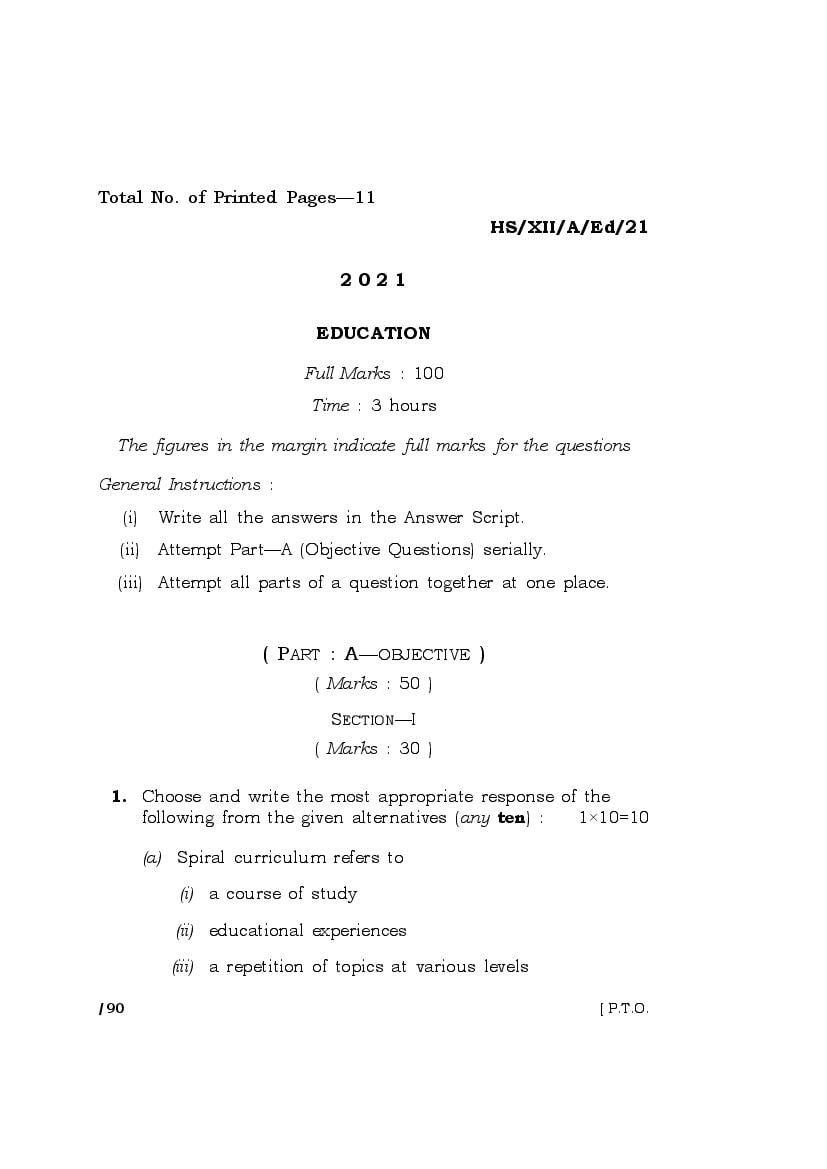
HS/XII/A/Ed/21
2021
EDUCATION
Full Marks : 100
Time : 3 hours
The figures in the margin indicate full marks for the questions
General Instructions :
(i) Write all the answers in the Answer Script.
(ii) Attempt Part—A (Objective Questions) serially.
(iii) Attempt all parts of a question together at one place.
( PART : A—OBJECTIVE )
( Marks : 50 )
SECTION—I
( Marks : 30 )
1. Choose and write the most appropriate response of the
following from the given alternatives (any ten) : 1×10=10
(a) Spiral curriculum refers to
(i) a course of study
(ii) educational experiences
(iii) a repetition of topics at various levels
/90 [ P.T.O.
Page 2
(b) The traditional curriculum is
(i) subject-centred
(ii) activity-centred
(iii) child-centred
(c) Inclusion is a philosophy which
(i) admits the child
(ii) welcomes the child
(iii) provides opportunities
(d) Down syndrome is a
(i) developmental disability
(ii) neurological disorder
(iii) chromosomal abnormality
(e) Sketching and drawing are the forms of
(i) visual art
(ii) performing art
(iii) plastic art
HS/XII/A/Ed/21/90 [ Contd.
Page 3
(f) NCF, 2005 recommends making art education a
compulsory subject up to
(i) class VIII
(ii) class X
(iii) class IX
(g) “Educational technology is concerned with the
application of modern skills and techniques to
the requirements of education and training” was
defined by
(i) G. O. M. Leith
(ii) Robert Glaser
(iii) Derik Unwin
(h) Meta-cognitive abilities signify
(i) one’s ability to do certain types of work
(ii) one’s ability to learn
(iii) one’s ability to think
(i) The first test to measure intelligence was
constructed by
(i) Gardner
(ii) Spearman
(iii) Alfred Binet
HS/XII/A/Ed/21/90 [ P.T.O.
Page 4
(j) The Theory of Primary Mental Abilities was
propounded by
(i) Spearman
(ii) Louis L. Thurstone
(iii) Robert Sternberg
(k) The word ‘personality’ is derived from
(i) Greek word
(ii) Latin word
(iii) German word
(l) Psychoanalysis was founded by
(i) Allport
(ii) Carl Jung
(iii) Sigmund Freud
(m) The act of directing sense organs towards stimulus
source is
(i) overt attention
(ii) covert attention
(iii) selective attention
HS/XII/A/Ed/21/90 [ Contd.
Page 5
(n) Stimuli from the environment are registered in our
(i) short-term memory
(ii) long-term memory
(iii) sensory memory
(o) Forgetting is caused by
(i) registration
(ii) decay
(iii) clarity
2. Write whether the following statements are True
or False (any five) : 1×5=5
(a) Assessment is not a part of evaluation.
(b) Dyspraxia refers to problems related to fine motor
skills.
(c) Poetry, a form of language art, arouses stillness and
calm and deepens human emotions.
(d) Aptitude is synonymous with achievement or
intelligence or interest.
(e) Interest is a feeling or emotion that causes a person
to loose attention.
HS/XII/A/Ed/21/90 [ P.T.O.
Page 6
(f) All our primitive and innate urges are Id.
(g) The human brain is a knot of 1000 billion neurons.
3. Match the word(s) in Column—A relating to the
appropriate word(s) in Column—B : 1×5=5
Column—A Column—B
(a) Retention (i) Visual art
(b) A measure of a person’s (ii) Emotional disturbance
intelligence
(c) Architectural work (iii) Individual difference
(d) Some are bright, average (iv) Memory
and dull
(e) Autism (v) IQ
4. Who stated the following (any five)? 1×5=5
(a) “Without music and the fine arts, a nation lacks its
highest means of national self-expression, and the
people remain inarticulate.”
(b) “No two individuals of the same race are quite alike,
we may compare millions of faces and each will be
distinct.”
HS/XII/A/Ed/21/90 [ Contd.
Page 7
(c) “A man is but the product of his thoughts, what he
thinks he becomes.”
(d) “With a subject matter as broad as life itself, the arts
easily relate to aspects of almost everything else that
is taught.”
(e) “It’s not that I am so smart, it’s just that I stay with
problems longer.”
(f) “Curiosity is as much a parent of attention, as
attention is of memory.”
(g) “Deliberately designed activity of life is education,
deliberately designed portion of education is
schooling, the heart of schooling is curriculum.”
5. Fill in the blanks (any five) : 1×5=5
(a) The word ‘curriculum’ is derived from the Latin
word _____.
(b) The human rights perspective considers _____ as
fundamental for enjoyment of rights by all
individuals.
(c) _____ is the essence of creation and art promotes it.
HS/XII/A/Ed/21/90 [ P.T.O.
Page 8
(d) Blended learning is the combination of _____
approaches to learning.
(e) _____ is the selective act of mind.
(f) Cattell talks about _____ different traits that
constitute a personality.
(g) The school of thought, commonly referred to as _____
supports subject-centred curriculum.
SECTION—II
( Marks : 20 )
6. Answer briefly the following in 2 or 3 sentences
each (any ten) : 2×10=20
(a) What is child-centred curriculum?
(b) What is visual art?
(c) Give the meaning of the term ‘disability’.
(d) State the characteristics of gifted and talented
children.
HS/XII/A/Ed/21/90 [ Contd.
Page 9
(e) State any four characteristics of educational
technology.
(f) What is cognitive style?
(g) Define intelligence.
(h) What is Flynn effect?
(i) Mention the aims of art education stated by
NCF, 2005.
(j) What is locomotor disability?
(k) Define personality.
(l) What is the meaning of lecture-cum-discussion
method?
(m) What is elaborative rehearsal?
(n) Mention the stages of memory.
HS/XII/A/Ed/21/90 [ P.T.O.
Page 10
( PART : B—DESCRIPTIVE )
( Marks : 50 )
Answer Question No. 7 and any two from the rest
7. Write short notes on any three of the following : 6×3=18
(a) Specific Learning Disability (SLD)
(b) Forms of educational technology
(c) Factors leading to individual differences
(d) Allport’s trait theory
(e) Relationship between attention and interest
(f) Brain mapping
8. Define norm-referenced evaluation and criterion-
referenced evaluation. Write on other different types of
evaluation. 6+10=16
9. What is inclusive schooling? Who needs to be included in
inclusive schools? 4+12=16
10. Give the meaning of art education. Briefly explain the
stages and processes of art education as prescribed
by NCERT. 6+10=16
HS/XII/A/Ed/21/90 [ Contd.
Page 11
11. Explain Spearman’s and Thurstone’s Theories of
Intelligence. 8+8=16
12. Mention the different types of attention. Briefly explain
the educational implication of attention for classroom
teaching. 4+12=16
13. What is forgetting? Explain the causes of forgetting.
4+12=16
HS/XII/A/Ed/21/90 11-21—25950
Document Details
| Board / Org | Meghalaya Board |
| Exam | Class 12 |
| Type | Question Paper |
| Pages | 11 |
| Updated | 30 Apr 2026 |