MBOSE Class 12 Question Paper 2021 for Economics
Finished viewing? Save it for later —
Download MBOSE Class 12 Question Paper 2021 for Economics (PDF · 19 pages)About MBOSE Class 12 Question Paper 2021 for Economics
MBOSE Class 12 Question Paper 2021 for Economics is available here for free download. Published by Meghalaya Board for Class 12, this question paper can be viewed online or downloaded as a PDF (19 pages). Candidates preparing for Class 12 can use MBOSE Class 12 Question Paper 2021 for Economics to understand the exam pattern, the type of questions asked, and the overall difficulty level.
Frequently Asked Questions
How can I download MBOSE Class 12 Question Paper 2021 for Economics?
Open this page and click the Download button to save MBOSE Class 12 Question Paper 2021 for Economics as a PDF. It is completely free on AglaSem Docs.
Is MBOSE Class 12 Question Paper 2021 for Economics free to download?
Yes. MBOSE Class 12 Question Paper 2021 for Economics can be viewed online and downloaded as a PDF free of cost on AglaSem Docs.
How many pages does MBOSE Class 12 Question Paper 2021 for Economics have?
MBOSE Class 12 Question Paper 2021 for Economics contains 19 pages, which you can read online or download together as a single PDF.
Where can I find more Class 12 study material?
You can find more Class 12 question papers, sample papers, syllabus, and answer keys on AglaSem Docs.
MBOSE Class 12 Question Paper 2021 for Economics – Text
Read the full text of this question paper below — useful to quickly search, copy and reference the content online without downloading the PDF.
📄 View text version (19 pages)
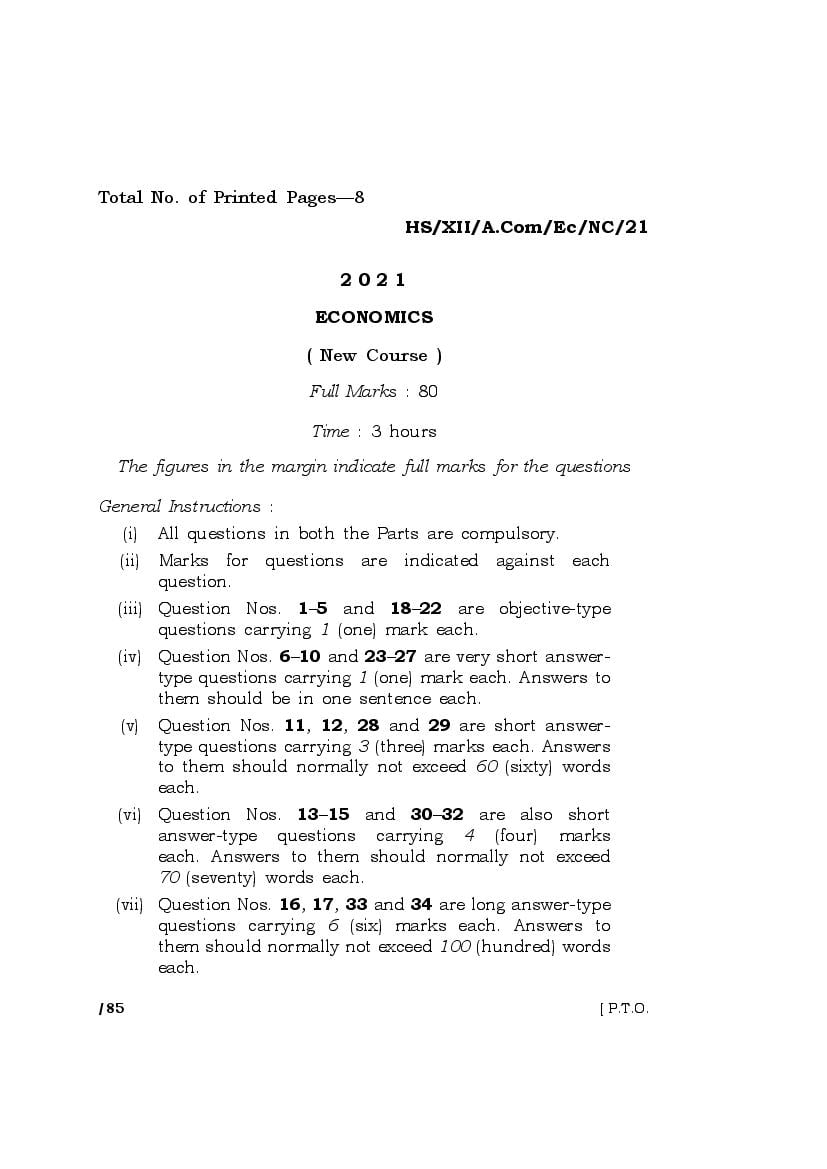
Page 1
HS/XII/A.Com/Ec/NC/21
2021
ECONOMICS
( New Course )
Full Marks : 80
Time : 3 hours
The figures in the margin indicate full marks for the questions
General Instructions :
(i) All questions in both the Parts are compulsory.
(ii) Marks for questions are indicated against each
question.
(iii) Question Nos. 1–5 and 18–22 are objective-type
questions carrying 1 (one) mark each.
(iv) Question Nos. 6–10 and 23–27 are very short answer-
type questions carrying 1 (one) mark each. Answers to
them should be in one sentence each.
(v) Question Nos. 11, 12, 28 and 29 are short answer-
type questions carrying 3 (three) marks each. Answers
to them should normally not exceed 60 (sixty) words
each.
(vi) Question Nos. 13–15 and 30–32 are also short
answer-type questions carrying 4 (four) marks
each. Answers to them should normally not exceed
70 (seventy) words each.
(vii) Question Nos. 16, 17, 33 and 34 are long answer-type
questions carrying 6 (six) marks each. Answers to
them should normally not exceed 100 (hundred) words
each.
/85 [ P.T.O.
Page 2
PART—A
( Introductory Macroeconomics )
( Marks : 40 )
1. Which of the following measures the aggregate
production of final goods and services taking place
within the domestic economy during a year?
(a) Gross Domestic Product at market price
(b) Gross National Product at market price
(c) Net Domestic Product at market price
(d) Net National Product at market price 1
2. Money supply in India is equal to
(a) currency with the public
(b) net demand deposit with the banks
(c) currency with the public + net demand deposit with
the banks
(d) None of the above 1
3. Average Propensity to Consume is equal to
(a) Y – S
C
(b)
Y
C
(c)
Y
Y S
(d) 1
Y
HS/XII/A.Com/Ec/NC/21/85 [ Contd.
Page 3
4. A government budget is prepared for a fiscal year
running from
(a) 1st January to 31st December
(b) 1st April to 31st December
(c) 1st April to 31st March
(d) 1st January to 30th April 1
5. Which of the following is the component of current
account in the balance of payments?
(a) Borrowing and lending
(b) Investment
(c) Export and import of goods and services
(d) All of the above 1
6. What is a Commercial Bank? 1
7. What is average propensity to save? 1
8. Mention the two types of revenue receipts. 1
Or
Given : Fiscal deficit—R 2,500 crore and
Interest payments—R 1,000 crore
Calculate primary deficit.
HS/XII/A.Com/Ec/NC/21/85 [ P.T.O.
Page 4
9. What is balance of payments? 1
10. What is foreign exchange? 1
11. Distinguish between final goods and intermediate goods. 3
Or
Calculate real GDP if nominal GDP is R 500 crore and
Price Index is 120.
12. Distinguish between fixed and flexible rates of
exchange. 3
13. Explain any two of the given functions of Central Bank : 4
(a) Bank of Issue
(b) Government’s Bank
(c) Banker’s Bank
(d) Control of Credit
14. Differentiate between repo rate and reverse repo rate. 4
Or
Calculate the value of Investment Multiplier if—
(a) MPC = 0·8;
(b) MPC = 0·5.
15. What is government budget? Give the meaning of
revenue deficit and fiscal deficit. 2+2=4
HS/XII/A.Com/Ec/NC/21/85 [ Contd.
Page 5
16. Explain the circular flow of income in a two-sector
model. 6
17. Explain the determination of equilibrium level of income
using AD = AS approach. 6
Or
What is meant by propensity to save? Explain the
concept with the help of a suitable diagram. 1+5=6
PART—B
( Indian Economic Development )
( Marks : 40 )
18. LPG stands for
(a) Liberalisation, Production and Global Co-operation
(b) Liberalisation, Privatisation and Globalisation
(c) License, Privatisation and Globalisation
(d) License, Permit and Goods 1
19. Indian system of medicine includes
(a) Ayurveda
(b) Yoga
(c) Homeopathy
(d) All of the above 1
HS/XII/A.Com/Ec/NC/21/85 [ P.T.O.
Page 6
20. The minimum calorie intake in rural areas in defining
poverty line is
(a) 2600 calories
(b) 2400 calories
(c) 2100 calories
(d) 2000 calories 1
21. Diversification in agricultural activities means creating
alternative employment in
(a) non-farm sectors
(b) urban sectors
(c) rural sectors
(d) None of the above 1
22. Which of the following countries introduced one-child
norm in the late 1970’s for controlling population
growth?
(a) India
(b) China
(c) Pakistan
(d) None of the above 1
23. What is land reform? 1
HS/XII/A.Com/Ec/NC/21/85 [ Contd.
Page 7
24. Which programme promises hundred days of guaranteed
wage employment to all rural households who volunteer
to do unskilled manual work? 1
25. What is sustainable development? 1
Or
What is global warming?
26. What was the alternative name of Five Year Plan of
Pakistan in 1956? 1
27. When did India announce its First-Five Year Plan? 1
28. Explain the institutional sources of rural credit. 3
29. What is Green Revolution? Mention any two
achievements of the Green Revolution. 1+2=3
Or
Explain the classification of Industrial Policy
Resolution, 1956. 3
30. Distinguish between : 2+2=4
(a) Physical and Human capital
Or
(b) Social and Economic infrastructure
HS/XII/A.Com/Ec/NC/21/85 [ P.T.O.
Page 8
31. Explain four causes of increasing unemployment in
India. 4
32. Bring out a comparison between India and Pakistan on
the basis of—
(a) population;
(b) sectoral development. 2+2=4
33. What are the features of Indian agriculture on the eve
of independence? Explain. 6
Or
Why was economic reforms needed in India in 1991?
34. What are renewable resources? Explain the factors
contributing to land degradation in India. 1+5=6
HS/XII/A.Com/Ec/NC/21/85 11-21—17100
Page 9
HS/XII/A.Com/Ec/OC/21
2021
ECONOMICS
( Old Course )
Full Marks : 100
Time : 3 hours
The figures in the margin indicate full marks for the questions
General Instructions :
(i) Write all the answers in the Answer Script.
(ii) Attempt Part—A (Objective Questions) serially.
(iii) Attempt all parts of a question together at one place.
( PART : A—OBJECTIVE )
( Marks : 40 )
SECTION—I
( Marks : 20 )
A. Choose and write the correct answer of the following
from the given alternatives (any ten) : 1×10=10
1. Macroeconomics is a branch of Economics that
studies about
(a) consumer behaviour
(b) a business firm
(c) economy as a whole
(d) None of the above
/86 [ P.T.O.
Page 10
2. A demand curve
(a) slopes upward from left to right
(b) slopes downward from left to right
(c) is a horizontal straight line
(d) is a vertical straight line
3. The law of supply states that other things remaining
the same, a rise in price leads to
(a) a fall in supply
(b) a rise in supply
(c) constant supply
(d) None of the above
4. All of the following curves are U-shaped, except
(a) AC curve
(b) AVC curve
(c) MC curve
(d) AFC curve
HS/XII/A.Com/Ec/OC/21/86 [ Contd.
Page 11
5. Differentiated product is a feature of
(a) perfect competition
(b) oligopoly
(c) monopoly
(d) monopolistic competition
6. The price paid for the use of labour is called
(a) rent
(b) wage
(c) interest
(d) profit
7. The uncertainty-bearing theory of profit was
propounded by
(a) F. H. Knight
(b) Hawley
(c) Walker
(d) J. B. Clark
HS/XII/A.Com/Ec/OC/21/86 [ P.T.O.
Page 12
8. Gross National Product ( GNPmp ) is defined as
(a) the total income of all individuals in a country
(b) the total output of a country in a year
(c) the total market value of all imports and exports
made in a year
(d) the total market value of all final goods and
services produced in a year
9. In the case of a direct tax
(a) the impact and incidence fall on the same
person
(b) the impact and incidence fall on different
persons
(c) the burden of the tax can be shifted
(d) None of the above
10. Balance of trade is
(a) same with balance of payments
(b) totally different from balance of payments
(c) a part of balance of payments
(d) None of the above
HS/XII/A.Com/Ec/OC/21/86 [ Contd.
Page 13
11. Development of infrastructure is vital for
(a) reducing poverty
(b) generation of employment
(c) economic development
(d) All of the above
12. Land Development Banks are also known as
(a) Government Banks
(b) Land Mortgage Banks
(c) Central Development Banks
(d) Primary Land Development Banks
HS/XII/A.Com/Ec/OC/21/86 [ P.T.O.
Page 14
B. Fill in the blanks with appropriate word(s) (any ten) :
1×10=10
1. The locus of different combinations of two inputs,
say, labour and capital that give us a given level of
output is called a _____.
2. When all goods demanded just match the goods
supplied, the market is said to be in _____.
3. Under monopoly, a firm’s marginal revenue curve
lies _____ the average revenue curve.
4. _____ wage is that wage which is expressed in terms
of money.
5. Disposable Personal Income is defined as a sum of
consumption expenditure and _____.
6. Borrowing by the State is known as _____ debt.
7. The basic component of Green Revolution is the
introduction of _____ seeds.
8. The share of agriculture in India’s national income
is _____.
HS/XII/A.Com/Ec/OC/21/86 [ Contd.
Page 15
9. Cottage and small-scale industries are _____
intensive.
10. A balance of payments statement consists of _____
account and capital account.
11. The Industrial Policy Resolution of 1948 divided the
industries into _____ categories.
12. _____ goods are important non-traditional export
items of India.
SECTION—II
( Marks : 20 )
C. Answer any ten of the following in 2 or 3 sentences
each : 2×10=20
1. Mention the central economic problems in an
economy.
2. State the law of diminishing marginal utility.
3. What is price elasticity of demand?
4. Distinguish between fixed cost and variable cost.
HS/XII/A.Com/Ec/OC/21/86 [ P.T.O.
Page 16
5. Mention any two assumptions of perfect competition.
6. What is gross interest?
7. Give the meaning of an indirect tax.
8. What is budget deficit?
9. Give two points of difference between internal trade
and international trade.
10. Suggest two measures to increase agricultural
production in India.
11. Give two problems faced by cottage and small-scale
industries in India.
12. Mention the three key words of economic reforms.
13. What is economic planning?
14. Give the full form of any two of the following : 1×2=2
(a) MRTP
(b) FDI
(c) IMF
(d) FERA
HS/XII/A.Com/Ec/OC/21/86 [ Contd.
Page 17
( PART : B—DESCRIPTIVE )
( Marks : 60 )
Answer ten questions, taking four from Section—I and
three each from Section—II and Section—III
SECTION—I
1. Explain the production possibility curve with the help
of a diagram. 6
2. What are the factors affecting demand? 6
3. Bring out the distinction between the following : 3+3=6
(a) Average Cost (AC) and Marginal Cost (MC)
(b) Average Revenue (AR) and Marginal Revenue (MR)
4. How is price determined under monopoly market? 6
5. Explain Ricardian theory of rent under extensive
cultivation. 6
6. Explain the uncertainty-bearing theory of profit. 6
HS/XII/A.Com/Ec/OC/21/86 [ P.T.O.
Page 18
SECTION—II
7. Explain the importance of macroeconomics. 6
8. Explain the circular flow of income in a two-sector model
with the help of a diagram. 6
9. Distinguish between the following : 3+3=6
(a) Plan expenditure and Non-plan expenditure
(b) Development expenditure and Non-development
expenditure
10. Give an account of the increase in public
expenditure. 6
11. Explain why nations trade. 6
SECTION—III
12. What is infrastructure? Distinguish between economic
and social infrastructure with example. 1+5=6
13. Explain the various sources of agricultural finance. 6
HS/XII/A.Com/Ec/OC/21/86 [ Contd.
Page 19
14. Discuss the role of cottage and small-scale industries
in India. 6
15. Explain the direction of India’s foreign trade. 6
16. Discuss the need for economic planning. 6
HS/XII/A.Com/Ec/OC/21/86 11-21—2800
Document Details
| Board / Org | Meghalaya Board |
| Exam | Class 12 |
| Type | Question Paper |
| Pages | 19 |
| Updated | 30 Apr 2026 |