WB ANM GNM 2023 Question Paper
Finished viewing? Save it for later —
Download WB ANM GNM 2023 Question Paper (PDF · 24 pages)About WB ANM GNM 2023 Question Paper
WB ANM GNM 2023 Question Paper is available here for free download. Published by WBJEEB for WB ANM GNM, this question paper can be viewed online or downloaded as a PDF (24 pages). Candidates preparing for WB ANM GNM can use WB ANM GNM 2023 Question Paper to understand the exam pattern, the type of questions asked, and the overall difficulty level.
Frequently Asked Questions
How can I download WB ANM GNM 2023 Question Paper?
Open this page and click the Download button to save WB ANM GNM 2023 Question Paper as a PDF. It is completely free on AglaSem Docs.
Is WB ANM GNM 2023 Question Paper free to download?
Yes. WB ANM GNM 2023 Question Paper can be viewed online and downloaded as a PDF free of cost on AglaSem Docs.
How many pages does WB ANM GNM 2023 Question Paper have?
WB ANM GNM 2023 Question Paper contains 24 pages, which you can read online or download together as a single PDF.
Where can I find more WB ANM GNM study material?
You can find more WB ANM GNM question papers, sample papers, syllabus, and answer keys on AglaSem Docs.
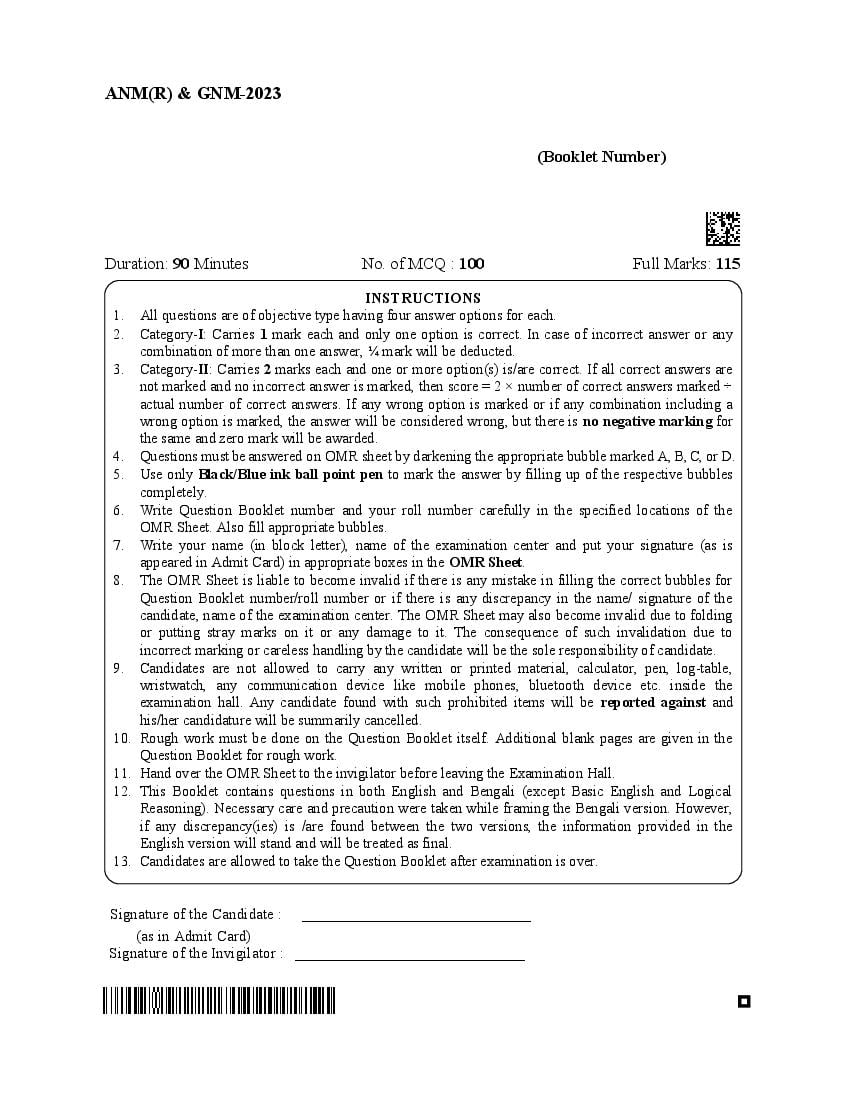
WB ANM GNM 2023 Question Paper – Text
Read the full text of this question paper below — useful to quickly search, copy and reference the content online without downloading the PDF.
📄 View text version (24 pages)
Page 1
Duration: 90 Minutes No. of MCQ : 100 Full Marks: 115
INSTRUCTIONS
1. All questions are of objective type having four answer options for each.
2. Category-I: Carries 1 mark each and only one option is correct. In case of incorrect answer or any
combination of more than one answer, ¼ mark will be deducted.
3. Category-II: Carries 2 marks each and one or more option(s) is/are correct. If all correct answers are
not marked and no incorrect answer is marked, then score = 2 × number of correct answers marked ÷
actual number of correct answers. If any wrong option is marked or if any combination including a
wrong option is marked, the answer will be considered wrong, but there is no negative marking for
the same and zero mark will be awarded.
4. Questions must be answered on OMR sheet by darkening the appropriate bubble marked A, B, C, or D.
5. Use only Black/Blue ink ball point pen to mark the answer by filling up of the respective bubbles
completely.
6. Write Question Booklet number and your roll number carefully in the specified locations of the
OMR Sheet. Also fill appropriate bubbles.
7. Write your name (in block letter), name of the examination center and put your signature (as is
appeared in Admit Card) in appropriate boxes in the OMR Sheet.
8. The OMR Sheet is liable to become invalid if there is any mistake in filling the correct bubbles for
Question Booklet number/roll number or if there is any discrepancy in the name/ signature of the
candidate, name of the examination center. The OMR Sheet may also become invalid due to folding
or putting stray marks on it or any damage to it. The consequence of such invalidation due to
incorrect marking or careless handling by the candidate will be the sole responsibility of candidate.
9. Candidates are not allowed to carry any written or printed material, calculator, pen, log-table,
wristwatch, any communication device like mobile phones, bluetooth device etc. inside the
examination hall. Any candidate found with such prohibited items will be reported against and
his/her candidature will be summarily cancelled.
10. Rough work must be done on the Question Booklet itself. Additional blank pages are given in the
Question Booklet for rough work.
11. Hand over the OMR Sheet to the invigilator before leaving the Examination Hall.
12. This Booklet contains questions in both English and Bengali (except Basic English and Logical
Reasoning). Necessary care and precaution were taken while framing the Bengali version. However,
if any discrepancy(ies) is /are found between the two versions, the information provided in the
English version will stand and will be treated as final.
13. Candidates are allowed to take the Question Booklet after examination is over.
Signature of the Candidate : ______________________________
(as in Admit Card)
Signature of the Invigilator : ______________________________
AA
Page 2
ANM(R) & GNM-2023 2
Page 3
Category-I (Q 1 to 30)
(Carry 1 mark each. Only one option is correct. Negative marks: ̶ ¼)
1. Example of ‘Ex-situ’ conservation is
(A) National Park (B) Reserve forest
(C) Seed bank (D) Sanctuary
H„-¢pV¥ pwlrZl Ec¡qlZ qm
(A) S¡a£u EcÉ¡e (B) pwl¢ra he (C) h£S hÉ¡ˆ (D) Aiu¡lZÉ
2. Leaves of which of the following dicotyledonous plants show parallel venation ?
(A) Mangifera indica (B) Calotropis procera
(C) Calophyllum inophyllum (D) Ixora sp.
¢ejÀ¢m¢Ma L¡e ¢àh£Sfœ£ E¢ácl fœ pj¡¿¹l¡m ¢nl¡¢heÉ¡p k¤š² ?
(A) Mangifera indica (B) Calotropis procera
(C) Calophyllum inophyllum (D) Ixora sp.
3. If heterozygous offspring is crossed with homozygous recessive parent, then this
phenomenon is called
(A) Back cross (B) Test cross
(C) Reciprocal cross (D) Epistasis
k¢c qVl¡S¡CN¡p AfaÉl p‰ q¡j¡S¡CN¡p f˵Ræ S¢ea«l pwLl¡uZ OV¡e¡ qu a¡qm pC
OVe¡L hm¡ qu
(A) hÉ¡L œ²p (B) VØV œ²p (C) l¢pfË¡L¡m œ²p (D) H¢fØV¡¢pp
4. Which of the following molecules is glucose ?
(A) C3H6C3 (B) C3H5OH (C) C6H12O6 (D) C6H10O5
¢ej¢À m¢Ma…¢ml L¡eÚ¢V NÔ¤ L¡S AZ¤ ?
(A) C3H6C3 (B) C3H5OH (C) C6H12O6 (D) C6H10O5
5. To which part of the chromosome nucleolus is attached ?
(A) Chromomere (B) Telomere
(C) Primary constriction (D) Secondary constriction
œ²¡j¡S¡jl L¡e Awn ¢eE¢LÓJm¡p pwk¤š² b¡L ?
(A) œ²¡j¡¢ju¡l (B) Vm¡¢ju¡l (C) fË¡b¢jL My¡S (D) N±Z My¡S
6. ABO blood group of human was discovered by
(A) Carl Woese (B) Karl Landsteiner (C) Karl Fischer (D) Karl Pearson
j¡e¤ol ABO blood group -Hl B¢hú¡lL qme
(A) Carl Woese (B) Karl Landsteiner (C) Karl Fischer (D) Karl Pearson
ANM(R) & GNM-2023 3
Page 4
(A) Analogous structure (B) Homologous structure
(C) Vestigial structure (D) Phylogenetic structure
f¡¢Ml X¡e¡ Hhw fa‰l X¡e¡ qm
(A) pjhªš£u NWe (B) pjpwÙÛ NWe
(C) m¤çfË¡u NWe (D) S¡¢aS¢eNa NWe
8. Filariasis or Elephantiasis is caused by which one of the following organisms ?
(A) Taenia solium (B) Fasciola hepatica
(C) Wuchereria bancrofti (D) Hirudinaria granulosa
¢ejÀ¢m¢Ma L¡e S£h à¡l¡ g¡Cm¢lu¡¢pp h¡ H¢mgÉ¡¢¾Vu¡¢pp pª¢ø qu ?
(A) Taenia solium (B) Fasciola hepatica
(C) Wuchereria bancrofti (D) Hirudinaria granulosa
9. Which one of the following is the complementary base of guanine in DNA ?
(A) Adenine (B) Thymine (C) Cytosine (D) Uracil
¢ej¢À m¢Ma…¢ml L¡eÚ¢V DNA-Hl jdÉ …u¡¢eel f¢lf§lL r¡l ?
(A) AÉ¡X¢ee (B) b¡C¢je (C) p¡CV¡¢pe (D) CEl¡¢pm
10. At which phase of meiosis are homologous chromosomes separated ?
(A) Prophase I (B) Prophase II (C) Anaphase I (D) Anaphase II
¢ju¡¢ppl L¡e cn¡u pjpwÙÛ œ²¡j¡S¡j…¢m fªbL£L«a qu ?
(A) fË¡gS I (B) fË¡gS II (C) AÉ¡e¡gS I (D) AÉ¡e¡gS II
11. Which one of the following is an example of tropic hormone ?
(A) ACTH (B) Gastrin (C) Secretin (D) CCK-PZ
e£Ql L¡e¢V VÊ¢fL qlj¡el Ec¡qlZ ?
(A) ACTH (B) NÉ¡p¢VÊe (C) ¢p¢œ²¢Ve (D) CCK-PZ
12. The book ‘Systema Naturae’ was written by
(A) Charles Darwin (B) Carolus Linnaeus
(C) Robert Harding Whittaker (D) Jean Baptiste Lamarck
‘Systema Naturae’ e¡jL hC¢Vl lQ¢ua¡ qme
(A) Charles Darwin (B) Carolus Linnaeus
(C) Robert Harding Whittaker (D) Jean Baptiste Lamarck
13. Which plant does exhibit hydrophily ?
(A) Hydrilla sp. (B) Pinus sp. (C) Oryza sp. (D) Nelumbo sp.
L¡eÚ E¢ác q¡CX¡Ê ¢g¢m fËc¢nÑa qu ?
(A) Hydrilla sp. (B) Pinus sp. (C) Oryza sp. (D) Nelumbo sp.
ANM(R) & GNM-2023 4
Page 5
(A) Aspartic acid (B) Stearic acid (C) Glutamic acid (D) Ascorbic acid
¢ej¢À m¢Ma…¢ml jdÉ L¡eÚ¢V ¢iV¡¢jel Ec¡qlZ ?
(A) AÉ¡pf¡l¢VL AÉ¡¢pX (B) ¢ØVu¡¢lL AÉ¡¢pX
(C) NÔ¤V¡¢jL AÉ¡¢pX (D) AÉ¡pLl¢hL AÉ¡¢pX
15. Which one of the following is not a steroid hormone ?
(A) Testosterone (B) Progesterone (C) Insulin (D) Estrogen
¢ejÀ¢m¢Ma…¢ml L¡eÚ¢V ØVluX qlj¡e eu ?
(A) Vø¡ØVle (B) fË¡SØVle (C) CeÚp¤¢me (D) CØVÊ¡Se
16. Which of the following is mainly associated with the maintenance of posture ?
(A) Cerebellum (B) Cerebrum (C) Thalamus (D) Pons
¢ej¢À m¢Ma…¢ml L¡eÚ¢V fËd¡ea cqi¢‰ ¢eu¿»Zl p‰ S¢sa ?
(A) p¢lhm¡j (B) p¢lhË¡j (C) bÉ¡m¡j¡p (D) feÚp
17. The complex molecule consisting of a DNA strand and a core of histone octamer is
(A) Centromere (B) Nucleosome (C) Nucleotide (D) Chromosome
DNA a¿¹¥ Hhw ¢qØV¡e Aƒ¡j¡l -Hl pjeÄu N¢Wa S¢Vm AZ¤¢V qm
(A) p¾VÊ¡¢ju¡l (B) ¢eE¢LÓJS¡j (C) ¢eE¢LÓJV¡CX (D) œ²¡j¡S¡j
18. The most abundant lipid in a cell membrane is
(A) Cholesterol (B) Glycolipid (C) Phospholipid (D) Steroid
L¡ofcÑ¡u phQu hn£ fË¡ç ¢m¢fX¢V qm
(A) L¡mølm (B) NÔ¡CL¡¢m¢fX (C) gpg¡¢m¢fX (D) ØVluX
19. Which of the following molecules move regularly from the nucleus to the cytoplasm ?
(A) Glycogen (B) RNA (C) DNA (D) Cholesterol
e£Ql L¡eÚ AZ¤¢V fË¢a¢eua ¢eE¢LÓu¡p bL p¡CV¡fÔ¡Sj ÙÛ¡e¡¿¹¢la qu ?
(A) NÔ¡CL¡Se (B) RNA (C) DNA (D) L¡mØVlm
20. The main function of platelets is to
(A) destroy tumour cells (B) produce antibodies
(C) stop bleeding from cut wounds (D) kill bacteria by phagocytosis
Ae¤Q¢œ²L¡l fËd¡e L¡S qm
(A) ¢VEj¡l L¡o ¢heø Ll¡ (B) AÉ¡¢¾Vh¢X Evfæ Ll¡
(C) L¡V¡ra bL lš²f¡a hå Ll¡ (D) gÉ¡N¡p¡CV¡¢pp à¡l¡ hÉ¡ƒ¢lu¡ dÆwp Ll¡
ANM(R) & GNM-2023 5
Page 6
(A) Glycogen (B) Cholesterol (C) Starch (D) Fat
kL«a Hhw fn£a n¢š² ¢qp¡h p¢’a qu
(A) NÔ¡CL¡Se (B) L¡mØVlm (C) ØV¡QÑ (D) gÉ¡V
22. The acrosome of sperm contains
(A) DNA (B) Mitochondria
(C) Fructose (D) Hydrolytic enzymes
öœ²¡Z¤l AÉ¡œ²¡S¡j Ef¢ÙÛa b¡L
(A) DNA (B) j¡CV¡Le¢XÊu¡
(C) é¥LÚV¡S (D) BâÑ¢hnÔoL EvpQL pj§q
23. Which eukaryotic organisms, among the following do not contain mitochondria ?
(A) Chara vulgaris (B) Monocercomonoides exilis
(C) Monoblepharis laevis (D) Marchantia polymorpha
¢ejÀ¢m¢Ma CELÉ¡¢lJ¢VL S£h…¢ml jdÉ L¡eÚ¢Va j¡CV¡Le¢XÊu¡ Ae¤f¢ÙÛa ?
(A) Chara vulgaris (B) Monocercomonoides exilis
(C) Monoblepharis laevis (D) Marchantia polymorpha
24. In the stomach HC is secreted by
(A) Zymogen cells (B) Kupffer’s cells
(C) Oxyntic cells (D) Mucous cells
f¡LÙÛm£a q¡CXÊ¡LÓ¡¢lL AÉ¡¢pX ¢explZ Ll
(A) S¡Cj¡Se L¡o (B) L¥g¡ll L¡o
(C) A¢„e¢VL L¡o (D) m¡m¡ L¡o
25. Which chamber of the heart has the thickest muscular wall ?
(A) Right atrium (B) Left atrium (C) Right ventricle (D) Left ventricle
q©v¢fäl L¡e fËL¡ù phÑ¡¢dL f¤l¦ fn£l Ù¹l b¡L ?
(A) X¡e A¢m¾c (B) h¡j A¢m¾c (C) X¡e ¢emu (D) h¡j ¢emu
ANM(R) & GNM-2023 6
Page 7
(A) ss DNA (B) ds DNA (C) ss RNA (D) ds RNA
HIV a L¡eÚ dlel ¢eE¢LÓL AÉ¡¢pX Ef¢ÙÛa b¡L ?
(A) ss DNA (B) ds DNA (C) ss RNA (D) ds RNA
27. Which one of the following parts is responsible for absorption of digested food in human
being ?
(A) Oesophagus (B) Liver (C) Pancreas (D) Small intestine
e£Ql L¡eÚ Awn¢V j¡ehcq f¡¢Qa M¡cÉ n¡oZl SeÉ c¡u£ ?
(A) NË¡pe¡m£ (B) kL«v (C) ANÀÉ¡nu (D) r¥â¡¿»
28. In BCG vaccine, the full form of BCG is
(A) Bacillus Calmodulin Guanine (B) Bacillus Calmette Guerin
(C) Bacillus Clostridium Gonococci (D) Bordetella Clostridium Guerin
BCG V£L¡l rœ BCG -l f§ZÑl©f¢V qm
(A) Bacillus Calmodulin Guanine (B) Bacillus Calmette Guerin
(C) Bacillus Clostridium Gonococci (D) Bordetella Clostridium Guerin
29. Which of the following plant hormones is responsible for bolting phenotype ?
(A) Cytokinin (B) Auxin (C) Gibberellin (D) IAA
¢ejÀ¢m¢Ma E¢ác qlj¡e…¢ml L¡e¢V h¡¢ÒVw ge¡V¡Cfl SeÉ c¡u£ ?
(A) p¡CV¡L¡C¢ee (B) A¢„e (C) ¢Sî¡l¢me (D) IAA
30. Which of the following pigments is found in the skin of human body ?
(A) Anthocyanin (B) Cyanidin (C) Melanin (D) Opsin
¢ej¢À m¢Ma l”L…¢ml L¡eÚ¢V j¡ehcql aÆL f¡Ju¡ k¡u ?
(A) AÉ¡eb¡p¡u¡¢ee (B) p¡u¡¢e¢Xe (C) jm¡¢ee (D) AfÚ¢pe
ANM(R) & GNM-2023 7
Page 8
Category-II (Q 31 to 40)
(Carry 2 marks each. One or more options are correct. No negative marks)
31. Which among the following is/are coenzymes ?
(A) FADH (B) Mg2+
(C) Mn2+ (D) Vitamin A
¢ej¢À m¢Ma L¡eÚ¢V/L¡eÚ…¢m coenzymes ?
(A) FADH (B) Mg2+
(C) Mn2+ (D) Vitamin A
32. Which among the following cell types in Xylem tissue is/are dead ?
(A) Tracheids (B) Tracheae
(C) Xylem fibres (D) Xylem parenchyma
S¡Cmj Lm¡l Ad£e ¢ejÀ¢m¢Ma L¡eÚ L¡o / L¡o…¢m jªa ?
(A) VÊ¡L¡CXpÚ (B) VÊ¡¢Lu¡
(C) S¡Cmj a¿¹¥ (D) S¡Cmj fÉ¡leL¡Cj¡
33. In human, deficiency of calciferol leads to
(A) Night-blindness (B) Beri Beri
(C) Rickets (D) Osteomalacia
j¡ehcq LÉ¡m¢pglml üÒfa¡l L¡lZ k¡ pª¢ø qu a¡ qm
(A) Night-blindness (B) Beri Beri
(C) Rickets (D) Osteomalacia
34. Which of the followings is/are viral disease(s) ?
(A) AIDS (B) Tetanus
(C) Influenza (D) Pneumonia
¢ejÀ¢m¢Ma…¢ml jdÉ L¡eÚ¢V/L¡eÚ…¢m i¡Cl¡p O¢Va l¡N
(A) AIDS (B) ¢VVe¡p
(C) CegÓ¥ u”¡ (D) ¢eEj¡¢eu¡
35. The salient features of Phylum Chordata are
(A) Presence of Stomochord
(B) Presence of Notochord
(C) Presence of dorsal hollow tubular nerve cord
(D) Presence of Pharyngial gill slits
LXÑ¡V¡ fhÑl °h¢nø…¢m qm
(A) ØV¡j¡LXÑ Ef¢ÙÛa (B) e¡V¡LXÑ Ef¢ÙÛa
(C) fªù£u gy¡f¡ pÀ¡u¤l‹¤ Ef¢ÙÛa (D) Nm¢hml g¥mL¡ ¢Râ Ef¢ÙÛa
ANM(R) & GNM-2023 8
Page 9
(A) Left-handed helix (B) Formed in high salinity
(C) 12 base pairs per turn (D) Helix pitch 34Å
Z-DNA a ¢ejÀ¢m¢Ma L¡eÚ °h¢nøÉ h¡ °h¢nøÉ…¢m haÑj¡e ?
(A) q¢m„-h¡j¡haÑ (B) EµQ mhe OeaÆ °a¢l qu
(C) HL¢V f§ZÑf¡L 12 ¢V hpS¡s¡ (D) q¢m„ ¢fQÚ 34Å
37. Which of the following white blood cell or cells is/are known as agranulocytes ?
(A) Basophil (B) Monocyte
(C) Neutrophil (D) Lymphocytes
¢ejÀ¢m¢Ma L¡eÚ nÄaL¢ZL¡ h¡ nÄaL¢ZL¡…¢m Ac¡e¡c¡lk¤š² L¡o ¢qp¡h ¢Q¢q²a qu ?
(A) hp¡¢gm (B) je¡p¡CV
(C) ¢eEVÊ¡¢gm (D) ¢mÇg¡p¡CV
38. Which of these are false fruits ?
(A) Banana (B) Tomato
(C) Apple (D) Strawberry
¢ejÀ¢m¢Ma L¡eÚ…¢m j¢L gm ?
(A) Lm¡ (B) VjV¡
(C) Bfm (D) ØVÊh¢l
39. Which of the followings are not present in prokaryotic cell ?
(A) Nucleus (B) Nuclear membrane
(C) Ribosome (D) Nucleoid material
e£Ql L¡eÚ…¢m fË¡LÉ¡¢lJ¢VL L¡o b¡L e¡ ?
(A) ¢eE¢LÓu¡p (B) ¢eE¢LÓJ fcÑ¡
(C) l¡Ch¡S¡j (D) ¢eE¢LÓu hÙ¹¥
40. Which of the following statements are not correct ?
(A) ADH is a peptide hormone.
(B) Thyroxine increases the BMR of the body.
(C) Prolactin helps in digestion.
(D) Somatotropic hormone helps in reproduction.
¢ej¢À m¢Ma E¢š²…¢ml jdÉ L¡eÚ…¢m p¢WL eu ?
(A) ADH HL¢V ffV¡CX qlj¡e
(B) b¡Cl¢„e nl£ll BMR hª¢Ü Ll
(C) fË¡mÉ¡¢ƒe f¡Qe p¡q¡kÉ Ll
(D) p¡j¡V¡VÊ¢fL qlj¡e See p¡q¡kÉ Ll
ANM(R) & GNM-2023 9
Page 10
Category-I (Q 41 to 55)
(Carry 1 mark each. Only one option is correct. Negative marks: ̶ ¼)
41. Which of the following is the main component of baking powder ?
(A) NaHCO3 (B) NaCO3
(C) NaCl (D) HCl
e£Ql L¡e¢V M¡h¡l p¡X¡l j§m Ef¡c¡e ?
(A) NaHCO3 (B) NaCO3
(C) NaCl (D) HCl
42. Which one helps to define force ?
(A) Newton’s 3rd law of motion (B) The theory of relativity
(C) Newton’s 1st law of motion (D) Archimedes’ principle
L¡e p§œ¢V à¡l¡ hml pw‘¡ ¢eZÑu Ll¡ k¡u ?
(A) ¢eEVel 3'u N¢ap§œ (B) A¡f¢rLa¡ ašÄ
(C) ¢eEVel 1'j N¢ap§œ (D) B¢LÑ¢j¢Xpl e£¢a
43. 1 GB memory is approximately ______ times larger than 1 MB memory.
(A) 10 (B) 1000
(C) 100 (D) 2
1 MB jjl£ bL 1 GB jjl£ fË¡u ______ …Z hs z
(A) 10 (B) 1000
(C) 100 (D) 2
44. LPG used as domestic cooking gas is composed mainly of
(A) propane and butane (B) methane
(C) natural gas (D) acetylene
l¡æ¡l NÉ¡pl (LPG) -Hl j§m Ef¡c¡e q'm
(A) fËfe J ¢hEVe (B) ¢jbe
(C) fË¡L«¢aL NÉ¡p (D) AÉ¡¢p¢V¢me
ANM(R) & GNM-2023 10
Page 11
(A) mono-basic (B) di-basic
(C) tri-basic (D) tetra-basic
p¡m¢gE¢lL AÉ¡¢pX qm:
(A) HL-r¡l£u (B) ¢à-r¡l£u
(C) ¢œ-r¡l£u (D) Qa¥x-r¡l£u
46. Which of the following statements is true for H 2S ?
(A) It is a strong base. (B) It is neutral.
(C) It is a mild acid. (D) It is a strong acid.
H2S-Hl rœ e£Ql L¡eÚ E¢š²¢V paÉ ?
(A) H¢V HL¢V n¢š²n¡m£ r¡l (B) H¢V ¢elfr
(C) H¢V HL¢V jªc¤ AÉ¡¢pX (D) H¢V HL¢V n¢š²n¡m£ AÉ¡¢pX
47. The solubility of common salt in water at 100 °C is 40. Approximately how much
common salt is required to make 100 g of saturated solution at 100 °C ?
(A) 28.57 g (B) 40 g
(C) 35 g (D) 20 g
100 °C -H Sm p¡d¡lZ mhZl âhZa¡ 40 qm JC Eo·a¡u 100 g pÇf«š² âhZ °al£ Lla fË¡u
LaV¡ p¡d¡lZ mhZ fËu¡Se ?
(A) 28.57 g (B) 40 g
(C) 35 g (D) 20 g
48. Milk is a
(A) saturated solution (B) supersaturated solution
(C) colloid (D) suspension
c¤d HL¢V
(A) pÇf«š² âhZ (B) A¢afªš² âhZ
(C) LmuX (D) fËmðe
ANM(R) & GNM-2023 11
Page 12
filled to the brim even if it is heated or cooled. What is the coefficient of real expansion
of the liquid if the coefficient of linear expansion of the material of the vessel is ‘α’?
(A) α (B) α/2
(C) 2α (D) 3α
HL¢V f¡œ L¡Z¡u L¡Z¡u f§ZÑ Ll HL¢V alm l¡M¡ BR z cM¡ Nm, f¡œ¢V Ešç h¡ W¡ä¡ LlmJ
phÑc¡C L¡Z¡u L¡Z¡u f§ZÑ b¡L z f¡œl Ef¡c¡el °cOÑÉ fËp¡lZ …Z¡ˆ ‘α’ qm JC alml fËL«a
fËp¡lZ …Z¡ˆ La ?
(A) α (B) α/2
(C) 2α (D) 3α
50.
32
air
glass
air
θ
As shown in the figure, a ray of light coming from air is incident on a parallel glass slab
at an angle of 32° and emerges from the other side at an angle of θ. What is the value of θ
if refracting index of glass with respect of air is 1.5 ?
(A) 32° (B) 48°
(C) 72° (D) 49.5°
fËc¢nÑa ¢Qœl ja¡ HL¢V Bm¡L l¢nÈ h¡u¤ j¡dÉj bL Hp HL¢V pj¡¿¹l¡m Ly¡Ql gmLl
HL¢cL 32° L¡Z Bf¢aa q'm Hhw EÒV¡ ¢cL bL θ L¡Z ¢eNÑa q'm z h¡u¤ p¡fr Ly¡Ql
fË¢apl¡ˆ 1.5 qm θ -Hl j¡e La ?
(A) 32° (B) 48° (C) 72° (D) 49.5°
51. How much heat is required to melt 100 g of ice kept at 0 °C into water and fully convert
it into steam? (Latent heat of melting of ice, specific heat of water and latent heat of
vaporization of water are respectively 80 cal/g, 1 cal/g °C and 540 cal/g)
(A) 72 kcal (B) 10 kcal
(C) 18 kcal (D) 64 kcal
0 °C Eo·a¡u l¡M¡ 100 g hlg N¢mu pÇf¨ZÑ h¡×f£i¨a Lla La f¢lj¡e a¡fl fËu¡Se ? (hlg
Nmel m£ea¡f, Sml Bf¢rL a¡f J Sml h¡×f£ihel m£ea¡f qm kb¡œ²j 80 cal/g,
1 cal/g °C and 540 cal/g)
(A) 72 kcal (B) 10 kcal
(C) 18 kcal (D) 64 kcal
ANM(R) & GNM-2023 12
Page 13
(A) 10–3 meter (B) 10–6 meter
(C) 10–9 meter (D) 10–12 meter
1 eÉ¡e¡¢jV¡l = ?
(A) 10–3 ¢jV¡l (B) 10–6 ¢jV¡l
(C) 10–9 ¢jV¡l (D) 10–12 ¢jV¡l
53. GPS stands for
(A) Global Poles System (B) Global Poly-Silicon Store
(C) Global Positioning System (D) Global Position Structure
GPS nël AbÑ
(A) NÔ¡h¡m f¡mpÚ ¢pØVj (B) NÔ¡h¡m f¢m-¢p¢mLe ØV¡l
(C) NÔ¡h¡m f¢Sp¢ew ¢pØVj (D) NÔ¡h¡m f¢Spe ØVÊ¡LÚQ¡l
54. The principal constituent of the atmosphere of the Earth is
(A) Oxygen (B) Carbon
(C) Hydrogen (D) Nitrogen
fª¢bh£l h¡u¤jäml j§m Awn q'm
(A) A¢„Se (B) L¡hÑe
(C) q¡CXÊ¡Se (D) e¡CVÊ¡Se
55. Product of force and velocity is called
(A) Work (B) Power
(C) Energy (D) Momentum
hm Hhw ®hNl …ZgmL hm¡ qu
(A) L¡S (B) rja¡
(C) n¢š² (D) ilhN
ANM(R) & GNM-2023 13
Page 14
Category-II (Q 56 to 60)
(Carry 2 marks each. One or more options are correct. No negative marks)
56. When a balloon is blown with air and its mouth is tied,
(A) All air molecules inside become fixed in their positions.
(B) There will be empty spaces between those air molecules.
(C) Those air molecules keep moving randomly and often hit the balloon surface from
inside.
(D) The air inside becomes solid.
HL¢V hm¤e q¡Ju¡ ¢cu g¥¢mu j¤M hyd ¢cm
(A) ¢iall pjÙ¹ h¡uh£u AZ¤…¢m ¢eS ¢eS AhÙÛ¡e Aes qu k¡u z
(B) I h¡uh£u AZ¤…¢ml jdÉJ AeL M¡¢m S¡uN¡ fs b¡L z
(C) I h¡uh£u AZ¤…¢m Qa¥¢cÑL kœaœ Qm¡Qm Lla b¡L J fË¡unxC ¢ial bL hm¤el N¡u
BO¡a Lla b¡L z
(D) ¢iall h¡u¤ L¢We hÙ¹¥a f¢lZa qu z
57. Steam causes more severe burn injury than boiling water because,
(A) Steam attacks human body with more force.
(B) Steam contains more heat than boiling water of same mass.
(C) Steam is a vapour.
(D) Steam is hotter than boiling water.
g¥V¿¹ Sml Qu ¢ØVj (Sm£u h¡×f) AeL h¢n SÆme pª¢ø Ll, L¡lZ,
(A) ¢ØVj AeL h¢n S¡l nl£l BO¡a Ll z
(B) HLC f¢lj¡e ¢ØVj g¥V¿¹ Sml Qu AeL h¢n a¡f b¡L z
(C) ¢ØVj HL dlZl h¡×f z
(D) g¥V¿¹ Sml Qu ¢ØVj AeL h¢n Nlj z
58. Which of the following statements are true ?
(A) Liquids and gases have fixed volume but no fixed shape.
(B) Solids have fixed volume and shape.
(C) Solids never diffuse in each other.
(D) Gases do not have any fixed shape.
¢eQl L¡e L¡e E¢š²…¢m p¢WL ?
(A) alm J NÉ¡pl p¢WL Buae b¡L ¢L¿¹¥ L¡e¡ p¢WL BL«¢a b¡L e¡ z
(B) L¢We fc¡bÑl p¢WL Buae J BL«¢a b¡L z
(C) L¢We fc¡bÑ…¢ml jdÉ LMe¡C hÉ¡fe h¡ ¢hrfZ qu e¡ z
(D) NÉ¡p£u fc¡bÑl L¡e¡ p¢WL BL«¢a eC z
ANM(R) & GNM-2023 14
Page 15
45o 45o
If a cracker thrown vertically upward bursts into two pieces; one piece flies to right with
an angle 45° to the vertical; the other piece flies to left with the same angle to the vertical
as shown in the figure. This is primarily due to,
(A) Newton’s 1st law of motion.
(B) Conservation of momentum.
(C) Acceleration due to gravity.
(D) Sound produced by the cracker.
HL¢V h¡¢S p¡S¡ Efll ¢cL ¢cL Ry¥s cJu¡a gV c¤V¥Ll¡ qu HL V¥Ll¡ Eõðl p‰
45 L¡Z X¡e ¢cL Qm Nm Afl Awn¢V Eõðl p‰ HLC 45° L¡Z hy¡ ¢cL Qm k¡h z Hl
j§¤m L¡lZ,
(A) ¢eEVel fËbj N¢ap§œ z
(B) ilhNl pwlrZ z
(C) A¢iLoÑS aÆlZ z
(D) h¡¢S g¡V¡l në z
60. If a ball is released to ground from any height,
(A) When it hits the ground, its potential energy is minimum and kinetic energy is
maximum.
(B) At any point during its fall the total energy remains constant.
(C) At any point during its fall, it has both potential energy and kinetic energy.
(D) When it reaches the ground, its potential energy is maximum.
HL¢V hm L¡e¡ EµQa¡ bL ¢eQ Rs ¢cm
(A) hm¢V kMe i¨¢ja f¡yRh¡l j¤q¨aÑ ¢ÙÛ¢an¢š² phÑ¢ejÀ J N¢an¢š² phÑ¡µQ qu z
(B) faeL¡ml k L¡e¡ AhÙÛ¡e j¡V n¢š² pj¡e qu z
(C) faeL¡ml k L¡e¡ AhÙÛ¡e hm¢Vl ¢ÙÛ¢an¢š² J N¢an¢š² c¤C-C b¡L z
(D) hm¢V kMe i¨¢ja f¡yRh¡l j¤q¨aÑ ¢ÙÛ¢an¢š² phÑ¡µQ qu z
ANM(R) & GNM-2023 15
Page 16
Category-I (Q 61 to 75)
(Carry 1 mark each. Only one option is correct. Negative marks: ̶ ¼)
61. Choose the word, which is opposite in meaning to CHIDE.
(A) Request (B) Criticise
(C) Advocate (D) Praise
62. Pick out the word that has either nearly the same meaning or opposite meaning to
EXONERATE.
(A) Escalate (B) Admit
(C) Accuse (D) Reject
63. Choose the word that can replace both the words in italics in the two given sentences.
I. The management did not find him suitable for the job of a clerk.
II. Akash could not arrange all parts of the machine properly.
(A) fit (B) employ
(C) finish (D) adjust
64. Observe the two italicized words in the following two sentences and give your
observation by choosing any one option below.
I. I am indebted to my friend’s wise councel.
II. Some members of the counsil walked out of the meeting.
(A) Only sentence-I is correct.
(B) Only sentence-II is correct.
(C) Both sentences I and II are correct.
(D) Neither sentence I nor sentence II is correct.
65. Choose the word, which can most appropriately replace the italicized words in the
sentence –
A person can be sentenced to death for killing another human being.
(A) patricide (B) homicide
(C) genocide (D) fratricide
66. Choose the most effective word to fill in the blank to make the sentence meaningfully
complete.
Some people _______ themselves into believing that they are indispensable to the
organization they work for.
(A) force (B) delude (C) keep (D) ask
67. Choose the most effective word to fill in the blank to make the sentence meaningfully
complete.
His _______ of the subject was so good that students had very few questions to raise.
(A) exposition (B) clarity (C) disposing (D) exposure
ANM(R) & GNM-2023 16
Page 17
complete.
Those who have well _______ their transition from village life to city life have
prospered.
(A) managed (B) taken (C) tried (D) finalised
69. Choose the most effective word to fill in the blank to make the sentence meaningfully
complete.
This is the _______ chosen for the school to come up.
(A) site (B) sight (C) plot (D) area
70. Choose the most appropriate pair of words from the options given below to fill in the
blanks in the given sentence in the same order to make the sentence meaningfully
complete.
The _______ imposed for non-payment was too _______ for it to bring in any
improvement.
(A) penalty, low (B) toll, simple
(C) punishment, harsh (D) fine, severe
71. Choose the most appropriate pair of words from the options given below to fill in the
blanks in the given sentence in the same order to make the sentence meaningfully
complete.
We are _______ to have him _______ here to make this function a great success.
(A) pleased, over (B) happy, lie
(C) proud, leave (D) sorry, over
72. Fill in the blank with the most appropriate word/group of words to make the sentence
meaningfully complete.
We should not be indifferent _______ the sufferings of our fellow men.
(A) of (B) to (C) from (D) at
73. Choose the word, which has nearly the same meaning as OBLIGATORY.
(A) Agreeable (B) Required
(C) Stubborn (D) Useful
74. Choose the word, which has nearly the same meaning as EXUDE.
(A) Drop (B) Ooze
(C) Overflow (D) Evaporate
75. Choose the word, which is opposite in meaning to IMPOUND.
(A) Compound (B) Generate
(C) Dollar (D) Release
ANM(R) & GNM-2023 17
Page 18
Category-I (Q 76 to 85)
(Carry 1 mark each. Only one option is correct. Negative marks: ̶ ¼)
76. Ramesh Babu sold a clock at Rs. 300 and incurred a loss of 25%. If he would have to
make a profit of 16% then at how much higher price, he should have sold the clock ?
(A) Rs. 164 (B) Rs. 173
(C) Rs. 185 (D) Rs. 187
ljnh¡h¤ HL¢V O¢s 300 V¡L¡u ¢h¢œ² Lle z Ha ay¡l r¢a qu 25% z ¢a¢e k¢c 16% m¡i Lla
Q¡Cae a¡qm O¢s¢V ay¡L, I ¢hœ²u j§mÉl bL BlJ La h¢n V¡L¡u ¢hœ²u Lla qa ?
(A) 164 V¡L¡ (B) 173 V¡L¡
(C) 185 V¡L¡ (D) 187 V¡L¡
77. Two cubes of edges 4 cm are placed side by side to form a rectangular cube. What is the
length of the diagonal of this larger rectangular cube ?
(A) 4 3 cm (B) 4 6 cm
(C) 12 cm (D) 12 3 cm
4 p¢j °cOÑÉl d¡l ¢h¢nø c¤¢V OeLL f¡n¡f¡¢n lM HL¢V BuaOe °a¢l Ll¡ qm z I pwk¤š²
BuaOeL¢Vl LZÑl °cOÑÉ La ?
(A) 4 3 p¢j (B) 4 6 p¢j
(C) 12 p¢j (D) 12 3 p¢j
78. A pump can fill water in a tank at 2100 liters per hour. Then how many hours does it take
to fill a reservoir at length 7 m, breadth 5 m and height 30 decimeter ?
(A) 5 hours (B) 50 hours
(C) 60 hours (D) 500 hours
HL¢V f¡Çf O¾V¡u 2100 ¢mV¡l Sm i¢aÑ Lla f¡l z a¡qm 7 ¢jV¡l °cOÑÉ J 5 ¢jV¡l fËÙÛ ¢h¢nø
Sm¡d¡l 30 X¢p¢jV¡l EµQa¡u Sm il¡l SeÉ f¡Çf¢VL LarZ Q¡m¡a qh ?
(A) 5 O¾V¡ (B) 50 O¾V¡
(C) 60 O¾V¡ (D) 500 O¾V¡
79. A and B are two solid spheres. The total surface area of B is 4 times of total surface area
of A. Then the ratio of the volume of A and B is
(A) 1:4 (B) 4:1
(C) 1:8 (D) 8:1
A J B c¤¢V ¢elV N¡mL z B -Hl pjNËaml rœgm A -Hl pjNËaml rœgml 4 …Z z
a¡qm A J B Hl Buael Ae¤f¡a La qh ?
(A) 1:4 (B) 4:1
(C) 1:8 (D) 8:1
ANM(R) & GNM-2023 18
Page 19
the transverse height and the radius of the base is
(A) 5:3 (B) 3:5
(C) 7:5 (D) 5:7
HL¢V mðhªš¡L¡l nˆ¥l EµQa¡ J ¢akÑL EµQa¡l Ae¤f¡a 4:5 qm I nˆ¥l ¢akÑL EµQa¡ J i¨¢jl
hÉ¡p¡dÑl Ae¤f¡a La qh ?
(A) 5:3 (B) 3:5
(C) 7:5 (D) 5:7
81. The square root of the product of two roots of the quadratic equation x2 – 6x + 4 = 0 is
(A) 2 (B) 4
(C) 16 (D) 3 + 5
2
x – 6x + 4 = 0 ¢àO¡a pj£LlZl h£S…¢ml …Zgml hNÑj§m La ?
(A) 2 (B) 4
(C) 16 (D) 3 + 5
82. If the difference between two roots of a quadratic equation is 3 and the constant term is 4.
Then the equation is
(A) x2 – 5x + 4 = 0 (B) x2 – 3x + 4 = 0
(C) x2 – 5x – 4 = 0 (D) x2 – 3x – 4 = 0
k¢c HL¢V ¢àO¡a pj£LlZl c¤¢V h£Sl A¿¹l 3 J dËh¤ L fc 4 qu a¡qm pj£LlZ¢V qh
(A) x2 – 5x + 4 = 0 (B) x2 – 3x + 4 = 0
2
(C) x – 5x – 4 = 0 (D) x2 – 3x – 4 = 0
83. The sides of a triangle are 3 cm, 4 cm and 5 cm. Then the area of its circumcircle is
(A) 5 cm2 (B) 14 cm2
275 175
(C) 14 cm2 (D) 7 cm2
HL¢V ¢œi¥Sl h¡ýl °cOÑÉ kb¡œ²j 3 p¢j, 4 p¢j J 5 p¢j z a¡qm ¢œi¥S¢Vl f¢lhªšl
rœgm qh
(A) 5 hNÑ p¢j (B) 14 hNÑ p¢j
275 175
(C) 14 hNÑ p¢j (D) 7 hNÑ p¢j
84. At what rate of simple interest an amount of money will double in 4 years ?
(A) 16% (B) 25% (C) 50% (D) 64%
plm p¤¤cl q¡l La qm L¡e¡ V¡L¡ 4 hRl p¤¤c-Bpm ¢à…Z qh ?
(A) 16% (B) 25% (C) 50% (D) 64%
85. Find simple interest on Rs. 3000 at 6% per annum from 1 st January to 26th May, in 2005.
(A) Rs. 36 (B) Rs. 48 (C) Rs. 60 (D) Rs. 72
2005 p¡ml 1 S¡e¤u¡l£ bL 26 j fkÑ¿¹ h¡¢oÑL 6% plm p¤¤cl q¡l 3000 V¡L¡l p¤¤c La ?
(A) 36 V¡L¡ (B) 48 V¡L¡ (C) 60 V¡L¡ (D) 72 V¡L¡
ANM(R) & GNM-2023 19
Page 20
Category-I (Q 86 to 95)
(Carry 1 mark each. Only one option is correct. Negative marks: ̶ ¼)
86. Fire temple is the place of worship of which of the following religion ?
(A) Buddhism. (B) Shintoism
(C) Christianism. (D) Zoroastrianism (Parsi Religion).
A¢NÀj¢¾cl (Fire temple) L¡eÚ djÑl j¡e¤ol Ef¡pe¡ Nªq ?
(A) h±Ü djÑ (B) ¢n¾V¡ djÑ
(C) MË£ødjÑ (D) Slb¤øÊh¡c (f¡l¢p djÑ)
87. The United Nations Organization has its Headquarters at
(A) Delhi (B) London (C) New York (D) Moscow
l¡ØVÊpwOl fËd¡e L¡kÑ¡mu L¡b¡u Ah¢ÙÛa ?
(A) ¢cõ£ (B) mäe (C) ¢eECuLÑ (D) jú¡
88. Naval staff in a submarine can see objects at the surface of water with a
(A) Stethoscope (B) Periscope (C) Kaleidoscope (D) Telescope
p¡hj¢lel e¡¢hLl¡ Sml Efll hÙ¹¥ cMa f¡u L¡eÚ¢Vl p¡q¡kÉ ?
(A) ØVb¡ú¡f (B) f¢lú¡f (C) LÉ¡mCX¡ú¡f (D) V¢mú¡f
89. Which of the following musical instruments is played by Amjad Ali Khan ?
(A) Veena (B) Tabla (C) Sarod (D) Sitar
e£Ql L¡eÚ h¡cÉk¿»¢V BjS¡c B¢m M¡e h¡S¡e ?
(A) h£Z¡ (B) ahm¡ (C) pl¡c (D) pa¡l
90. The ‘Lady with the Lamp’ was the name given to ?
(A) Sister Nivedita (B) Queen Elizabeth
(C) Florence Nightingale (D) Princess Diana
‘m¢X ECb cÉ¡ mÉ¡Çf’ e¡j L¡L X¡L¡ qu ?
(A) ¢pØV¡l ¢eh¢ca¡ (B) L¥Ce H¢mS¡hb
(C) gÓ¡l¾p e¡C¢VwNm (D) ¢f˾pp X¡u¡e¡
ANM(R) & GNM-2023 20
Page 21
(A) China (B) Australia (C) Ireland (D) Singapore
“NËV h¢lu¡l ¢lg” L¡eÚ cn Ah¢ÙÛa ?
(A) Q£e (B) AØVÊ¢mu¡ (C) Bu¡lmÉ¡ä (D) ¢p‰¡f¤l
92. Of the following diseases which one is caused by insect bite ?
(A) Dengue (B) Scurvy (C) Pneumonia (D) Asthma
e£Ql L¡eÚ l¡N¢V fa‰l L¡jsl gm qu ?
(A) X¢‰ (B) ú¡¢iÑ (C) ¢eEj¡¢eu¡ (D) AÉ¡Sj¡
93. Which of the following is the largest air pollutant ?
(A) Carbon dioxide (B) Carbon monoxide
(C) Sulphur dioxide (D) Hydrocarbons
¢ejÀ¢m¢Ma L¡eÚ¢V ph¡Ñšj h¡u¤c§oZL¡l£ ?
(A) L¡hÑe-X¡C A„¡CX (B) L¡hÑe je¡„¡CX
(C) p¡mg¡l X¡C A„¡CX (D) q¡CX¡Ê L¡hÑe
94. The hottest planet in the solar system ?
(A) Mercury (B) Venus (C) Mars (D) Jupiter
p±lSNal Eo·aj NËql e¡j ¢L ?
(A) h¤d (B) öœ² (C) j‰m (D) hªqØf¢a
95. Exposure to sunlight helps a person improve his health because
(A) resistance power increases.
(B) the infrared light kills bacteria in the body.
(C) the ultraviolet rays convert skin oil into Vitamin - D.
(D) the pigment cells in the skin get stimulated and produce a healthy tan.
p§kÑ¡m¡L j¡e¤ol ü¡ÙÛÉl Eæ¢a OV¡a p¡q¡kÉ Ll L¡lZ -
(A) a¡ fË¢al¡d rja¡ h¡s¡u z
(B) Ceé¡lV Bm¡ nl£ll hÉ¡ƒ¢lu¡ dÆwp Ll z
(C) A¢ah…e£ l¢nÈ aÆLl °amL ¢iV¡¢je-¢X a l©f¡¿¹¢la Ll z
(D) aÆLl l”L LZ¡ Eš¢Sa qu Hhw aÆLL f¡L¡ Ll z
ANM(R) & GNM-2023 21
Page 22
Category-I (Q 96 to 100)
(Carry 1 mark each. Only one option is correct. Negative marks: ̶ ¼)
96. 6, 11, 21, 36, 56, ?
(A) 42 (B) 51
(C) 81 (D) 91
97. Which of the following relations is most analogous to LIGHT : CANDLE ?
(A) Exercise : Strength (B) Car : Engine
(C) Dieting : Overweight (D) Power : Battery
98. How is David’s father’s only daughter-in-law’s son’s wife related to David ?
(A) Daughter (B) Daughter-in-law
(C) Niece (D) Granddaughter
99. 36, 34, 30, 28, 24, ... What number should come next ?
(A) 20 (B) 22
(C) 23 (D) 26
100. Find the missing terms.
5 3 7 5 6 4
19 ? 29
4 6 5
(a) (b) (c)
(A) 25 (B) 37
(C) 41 (D) 47
_____________
ANM(R) & GNM-2023 22
Page 23
ANM(R) & GNM-2023 23
Page 24
¢ecÑn¡hm£
1. HC fËnÀfœ pjÙ¹ fËnC
À AhS¢ƒi fËnÀ Hhw fË¢a¢V fËnÀl Q¡l¢V pñ¡hÉ Ešl cJu¡ BR z
2. Category-I : HL¢V Ešl p¢WL z p¢WL Ešl ¢cm 1 eðl f¡h z i¥m Ešl ¢cm Abh¡ k L¡e
HL¡¢dL Ešl ¢cm ¼ eðl L¡V¡ k¡h z
3. Category-II: HL h¡ HL¡¢dL Ešl p¢WL z ph L¢V p¢WL Ešl ¢cm 2 eðl f¡h z k¢c L¡e i¥m
Ešl e¡ b¡L Hhw p¢WL EšlJ ph L¢V e¡ b¡L a¡qm f¡h 2 k L¢V p¢WL Ešl cJu¡ quR
a¡l pwMÉ¡ Bpm k L¢V Ešl p¢WL a¡l pwMÉ¡ z k¢c L¡e¡ i¥m Ešl cJu¡ qu h¡ HL¡¢dL
Ešll jdÉ HL¢VJ i¥m b¡L a¡qm Ešl¢V i¥m dl eJu¡ qh z ¢L¿¹¥ prœ L¡e¡ eðl L¡V¡
k¡h e¡, AbÑ¡v n§eÉ eðl f¡h z
4. OMR fœ A, B, C, D ¢Q¢q²a p¢WL Ol¢V il¡V Ll Ešl ¢ca qh z
5. OMR fœ Ešl ¢ca öd¤j¡œ L¡m¡ h¡ e£m L¡¢ml hm fu¾V fe hÉhq¡l Llh z
6. OMR fœ ¢e¢cÑø ÙÛ¡e R¡s¡ AeÉ L¡b¡J L¡e c¡N ch e¡ z
7. OMR fœ ¢e¢cÑø ÙÛ¡e fËnf
À œl eðl Hhw ¢eSl l¡m eðl A¢a p¡hd¡ea¡l p¡b ¢mMa qh Hhw
fËu¡Se£u Ol…¢m f§lZ Lla qh z
8. OMR fœ ¢e¢cÑø ÙÛ¡e ¢eSl e¡j J fl£r¡ L¾cÊl e¡j ¢mMa qh Hhw ¢eSl (Admit Card-H
Eõ¢Ma) pÄ¡rl Lla qh z
9. fËnÀfœl eðl h¡ l¡m eðl i¥m ¢mMm Abh¡ i¥m Ol il¡V Llm, fl£r¡bÑ£l e¡j, fl£r¡ L¾cÊl e¡j
h¡ pÄ¡rl L¡e i¥m b¡Lm Ešl fœ h¡¢am qu ka f¡l z OMR fœ¢V i¡yS qm h¡ a¡a
Ae¡hnÉL c¡N fsmJ h¡¢am qu ka f¡l z fl£r¡bÑ£l HC dlel i¥m h¡ ApaÑLa¡l SeÉ
Ešlfœ h¡¢am qm HLj¡œ fl£r¡bÑ£ ¢eSC a¡l SeÉ c¡u£ b¡Lh z
10. j¡h¡Cmg¡e, LÉ¡mL¥mVl, pÔ¡CXl¦m, mNVhm, q¡aO¢s, lM¡¢Qœ, NË¡g h¡ L¡e dlZl a¡¢mL¡
fl£r¡ Lr Be¡ k¡h e¡ z Bem p¢V h¡Su¡ç qh Hhw fl£r¡bÑ£l JC fl£r¡ h¡¢am Ll¡ qh z
11. fËnÀfœ l¡g L¡S Ll¡l SeÉ gy¡L¡ S¡uN¡ cJu¡ BR z AeÉ L¡e L¡NS HC L¡S hÉhq¡l Ll¡ k¡h
e¡ z
12. fl£r¡ Lr R¡s¡l BN OMR fœ AhnÉ C f¢lcnÑLL ¢cu k¡h z
13. HC fËnfÀ œ Cwl¡S£ J h¡wm¡ Eiu i¡o¡aC fËnÀ cJu¡ BR z (Basic English & Logical
Reasoning R¡s¡) h¡wm¡ j¡dÉj fËnÀ °al£l pju fËu¡Se£u p¡hd¡ea¡ J paLÑa¡ Ahmðe Ll¡
quR z a¡ pšJ
Ä k¢c L¡e Ap‰¢a mrÉ Ll¡ k¡u, prœ Cwl¡S£ j¡dÉj cJu¡ fËnÀ ¢WL J Q¨s¡¿¹
hm ¢hh¢Qa qh z
14. fl£r¡ ®no fl£r¡b£Ñl¡ fËnÀfœ¢V ¢eu k¡h z
A
ANM(R) & GNM-2023 24
Document Details
| Board / Org | WBJEEB |
| Exam | WB ANM GNM |
| Type | Question Paper |
| Pages | 24 |
| Updated | 09 Jun 2026 |