MBOSE Class 12 Question Paper 2023 for Music Western
Finished viewing? Save it for later —
Download MBOSE Class 12 Question Paper 2023 for Music Western (PDF · 8 pages)About MBOSE Class 12 Question Paper 2023 for Music Western
MBOSE Class 12 Question Paper 2023 for Music Western is available here for free download. Published by Meghalaya Board for Class 12, this question paper can be viewed online or downloaded as a PDF (8 pages). Candidates preparing for Class 12 can use MBOSE Class 12 Question Paper 2023 for Music Western to understand the exam pattern, the type of questions asked, and the overall difficulty level.
Frequently Asked Questions
How can I download MBOSE Class 12 Question Paper 2023 for Music Western?
Open this page and click the Download button to save MBOSE Class 12 Question Paper 2023 for Music Western as a PDF. It is completely free on AglaSem Docs.
Is MBOSE Class 12 Question Paper 2023 for Music Western free to download?
Yes. MBOSE Class 12 Question Paper 2023 for Music Western can be viewed online and downloaded as a PDF free of cost on AglaSem Docs.
How many pages does MBOSE Class 12 Question Paper 2023 for Music Western have?
MBOSE Class 12 Question Paper 2023 for Music Western contains 8 pages, which you can read online or download together as a single PDF.
Where can I find more Class 12 study material?
You can find more Class 12 question papers, sample papers, syllabus, and answer keys on AglaSem Docs.
MBOSE Class 12 Question Paper 2023 for Music Western – Text
Read the full text of this question paper below — useful to quickly search, copy and reference the content online without downloading the PDF.
📄 View text version (8 pages)
Page 1
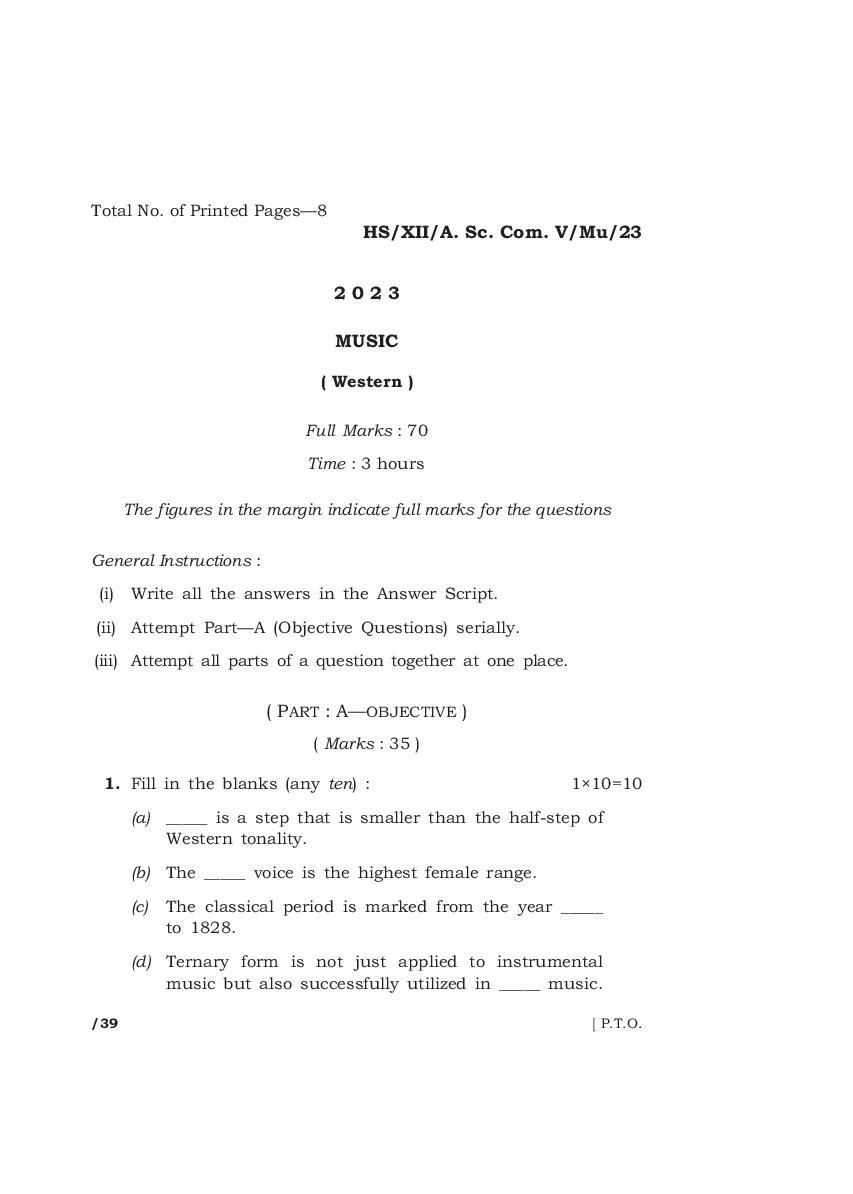
HS/XII/A. Sc. Com. V/Mu/23
2023
MUSIC
( Western )
Full Marks : 70
Time : 3 hours
The figures in the margin indicate full marks for the questions
General Instructions :
(i) Write all the answers in the Answer Script.
(ii) Attempt Part—A (Objective Questions) serially.
(iii) Attempt all parts of a question together at one place.
( PART : A—OBJECTIVE )
( Marks : 35 )
1. Fill in the blanks (any ten) : 1×10=10
(a) _____ is a step that is smaller than the half-step of
Western tonality.
(b) The _____ voice is the highest female range.
(c) The classical period is marked from the year _____
to 1828.
(d) Ternary form is not just applied to instrumental
music but also successfully utilized in _____ music.
/39 [ P.T.O.
Page 2
(e) ‘Poco a poco’ means _____.
(f) The pipe organ is a collection of whistles and _____.
(g) Renaissance means _____.
(h) Pitch, duration, intensity, quality are the _____ of a
musical tone.
(i) Music is a sound ordered in _____.
(j) _____ is the rate of speed at which the beat moves.
(k) In the dynamic notation, _____ means very soft.
(l) _____ is somewhat like a mirrored image of the
original melody.
(m) Literature played a major role in shaping the musical
art of the _____ period.
(n) Fugue, is taken from a Latin word meaning _____.
(o) The word _____ is derived from the Latin word
Suonare.
2. State whether the following statements are True or
False (any ten) : 1×10=10
(a) Franz Joseph Haydn was born in 1712.
(b) During the Romantic period, Opera flourished most
strongly in London.
(c) Triads cannot be constructed on notes of any other
scale.
HS/XII/A. Sc. Com. V/Mu/23/39 [ Contd.
Page 3
(d) The Renaissance can be considered the gateway to
the Medieval period.
(e) Piano means slow and steady.
(f) The xylophone is a pitched idiophone.
(g) A series of measures organized in a repeated pattern
is called meter.
(h) Binary form is represented in diagram as ABBA.
(i) Chamber music is considered ‘music for musicians’.
(j) A call and response is also known as responsorial
texture.
(k) The four members of the violin family are violin, viola,
cello and lute.
(l) GCE is called the 1st inversion of C major chord.
(m) Traditional music is folk music.
(n) The sub-dominant is the 4th Degree of a scale.
3. Choose the correct answer from the choices given
(any five) : 1×5=5
(a) The elements of music are
(i) duration, pitch, timbre and dynamics
(ii) duration, pitch, timbre and beat
(iii) duration, pitch, timbre and rests
(iv) duration, pitch, timbre and intervals
HS/XII/A. Sc. Com. V/Mu/23/39 [ P.T.O.
Page 4
(b) The frequency observed in a sound wave is called
(i) beat
(ii) bar
(iii) pitch
(iv) tone
(c) Presto means
(i) lively
(ii) as fast as possible
(iii) very fast
(iv) fast
(d) The number of diminished chords in a major scale is
(i) one
(ii) two
(iii) three
(iv) None of the above
(e) The common language for musical description is
(i) Latin
(ii) Italian
(iii) English
(iv) None of the above
HS/XII/A. Sc. Com. V/Mu/23/39 [ Contd.
Page 5
(f) Recorders are a type of
(i) oboe
(ii) drum
(iii) guitar
(iv) flute
(g) GBD is a/an
(i) minor triad
(ii) augmented triad
(iii) major triad
(iv) diminished triad
(h) Which of the following is a major triad?
(i) F# A C#
(ii) CE bG
(iii) EGB b
(iv) C# E# G#
4. Answer the following questions (any five) : 2×5=10
(a) What do you understand by ‘Timbre’?
(b) What is a chord? How do you construct a chord?
(c) Define melody.
(d) Name the two style characteristics of the Baroque
period.
(e) What is the meaning of polyphony?
HS/XII/A. Sc. Com. V/Mu/23/39 [ P.T.O.
Page 6
(f) What is metronomic marking?
(g) What do you understand by alto?
(h) What is a chant?
( PART : B—DESCRIPTIVE )
( Marks : 35 )
UNIT—I
Answer Question Nos. either 5 and 6 or 7 and 8
5. Write the following four-part chord progressions in the
key of C major : 1×6=6
I ii46 IV I6 V46 I6
6. Construct a V 7 chord in the key of F major in the bass
clef. 3+2=5
OR
7. Using semibreves, write 3-part diatonic secondary triads
of the following. Use key signature : 3+3=6
(a)
iii cc
iii
In the key of D major scale.
HS/XII/A. Sc. Com. V/Mu/23/39 [ Contd.
Page 7
(b)
vi b
In the key of G major scale.
8. Briefly classify the different types of triads. 5
UNIT—II
Answer Question Nos. either 9 and 10 or 11 and 12
9. What are the different sources of musical sound? How are
musical instruments classified? Cite examples for each
classification. 2+2½+2½=7
10. What is sonata? Briefly explain the different structures of
sonata form. 2+5=7
OR
11. Explain any two of the following : 3½×2=7
(a) Homophony
(b) Impressionism
(c) Gregorian chant
(d) Andante
HS/XII/A. Sc. Com. V/Mu/23/39 [ P.T.O.
Page 8
12. Write short notes on any two of the following : 3½×2=7
(a) Popular music
(b) Postlude
(c) Oratorio
(d) Folk music
UNIT—III
Answer Question Nos. either 13 and 14 or 15 and 16
13. What are the instrumental musical genres prevalent
during the Renaissance period? Explain any one with
example. 2+3=5
14. Write a brief description about the orchestral music
prevalent during the classical period. 5
OR
15. What are the different characteristics of music in
non-western culture? Write a note on diaphony. 2+3=5
16. Name the two vocal genres of the Romantic period. Briefly
explain any one of them. 2+3=5
HHH
HS/XII/A. Sc. Com. V/Mu/23/39 K23—130
Document Details
| Board / Org | Meghalaya Board |
| Exam | Class 12 |
| Type | Question Paper |
| Pages | 8 |
| Updated | 22 Jul 2026 |