MBOSE Class 11 Question Paper 2019 for Biology
Finished viewing? Save it for later —
Download MBOSE Class 11 Question Paper 2019 for Biology (PDF · 4 pages)About MBOSE Class 11 Question Paper 2019 for Biology
MBOSE Class 11 Question Paper 2019 for Biology is available here for free download. Published by Meghalaya Board for Class 11, this question paper can be viewed online or downloaded as a PDF (4 pages). Candidates preparing for Class 11 can use MBOSE Class 11 Question Paper 2019 for Biology to understand the exam pattern, the type of questions asked, and the overall difficulty level.
Frequently Asked Questions
How can I download MBOSE Class 11 Question Paper 2019 for Biology?
Open this page and click the Download button to save MBOSE Class 11 Question Paper 2019 for Biology as a PDF. It is completely free on AglaSem Docs.
Is MBOSE Class 11 Question Paper 2019 for Biology free to download?
Yes. MBOSE Class 11 Question Paper 2019 for Biology can be viewed online and downloaded as a PDF free of cost on AglaSem Docs.
How many pages does MBOSE Class 11 Question Paper 2019 for Biology have?
MBOSE Class 11 Question Paper 2019 for Biology contains 4 pages, which you can read online or download together as a single PDF.
Where can I find more Class 11 study material?
You can find more Class 11 question papers, sample papers, syllabus, and answer keys on AglaSem Docs.
MBOSE Class 11 Question Paper 2019 for Biology – Text
Read the full text of this question paper below — useful to quickly search, copy and reference the content online without downloading the PDF.
📄 View text version (4 pages)
Page 1
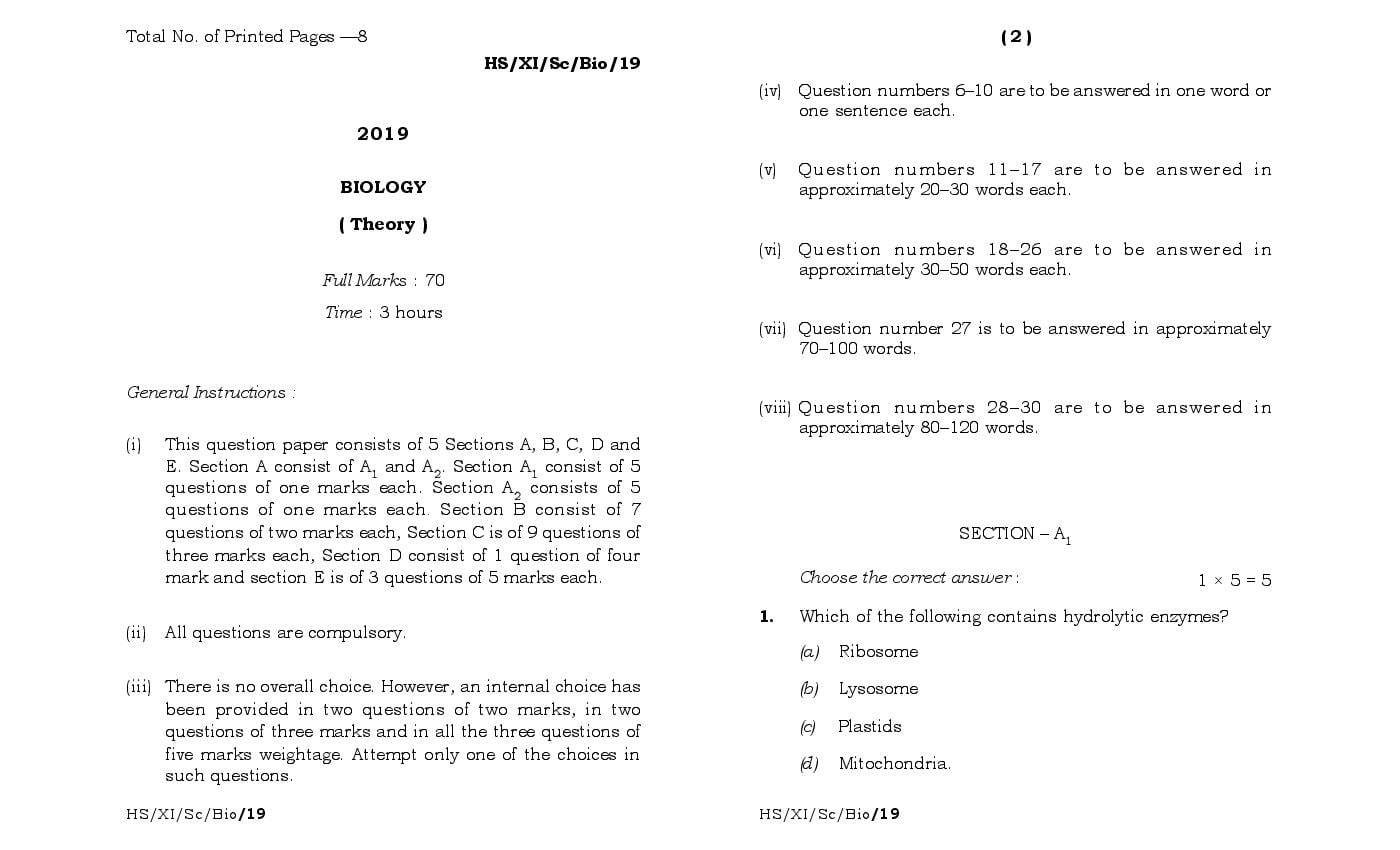
HS/XI/Sc/Bio/19
(iv) Question numbers 6–10 are to be answered in one word or
one sentence each.
2019
(v) Question numbers 11–17 are to be answered in
BIOLOGY approximately 20–30 words each.
( Theory )
(vi) Question numbers 18–26 are to be answered in
approximately 30–50 words each.
Full Marks : 70
Time : 3 hours
(vii) Question number 27 is to be answered in approximately
70–100 words.
General Instructions :
(viii) Question numbers 28–30 are to be answered in
approximately 80–120 words.
(i) This question paper consists of 5 Sections A, B, C, D and
E. Section A consist of A1 and A2. Section A1 consist of 5
questions of one marks each. Section A2 consists of 5
questions of one marks each. Section B consist of 7
questions of two marks each, Section C is of 9 questions of SECTION – A1
three marks each, Section D consist of 1 question of four
mark and section E is of 3 questions of 5 marks each. Choose the correct answer : 1 5=5
1. Which of the following contains hydrolytic enzymes?
(ii) All questions are compulsory.
(a) Ribosome
(iii) There is no overall choice. However, an internal choice has (b) Lysosome
been provided in two questions of two marks, in two
questions of three marks and in all the three questions of (c) Plastids
five marks weightage. Attempt only one of the choices in
(d) Mitochondria.
such questions.
Page 2
2. Synapsis occurs during SECTION – A2
(a) Leptotene (Very short answer) 1 5=5
(b) Zygotene
(c) Pachytene 6. Define Plasmolysis.
(d) Diplotene.
7. What are saprophytes?
3. Which of the following is a modified root ?
(a) Potato 8. Which hormonal deficiency is responsible for diabetes
mellitus?
(b) Sweet potato
(c) Ginger
9. Name any two types of nitrogenous base found in
(d) Onion.
nucleic acids.
4. The Non-Nucleated cell found in blood is
10. Give the scientific name of cockroach.
(a) RBC
(b) WBC
(c) Thrombocytes SECTION – B
(d) All the above. (Short answer – 1) 2 7 = 14
5. The hormone secreted by pineal gland is 11. Either,
(a) Melanin Give the salient features of mosses.
(b) Melatonin Or
(c) Melanocytes
Write down the characteristic features of dinoflagellates.
(d) All the above.
HS/XI/Sc/Bio/19 HS/XI/Sc/Bio/19
Page 3
12. What is inflorescence ? Define racemose inflorescence With the help of a suitable diagram explain the internal
with examples. 1+ 1=2 structure of monocot stem. 1+ 2=3
13. Name any two micronutrients and mention atleast one 19. Describe briefly the four major groups of Protozoa. To
deficiency symtom for each. 1+ 1=2 which group does the malarial parasite belong. 2 + 1 = 3
14. What is a peptide bond? How are they formed? 1 + 1 = 2 20. Give a labelled diagram of a plant cell. Explain the
function of cell membrane. 2+ 1=3
15. Draw a well labelled diagram of a myelinated neuron. 2
21. Explain the electron transport system in the light
16. What is the role of HCl in digestion? 2 reaction of photosynthesis.
17. Either
22. How is a “pull” created during transpiration.
Differentiate between open circulatory system and
closed circulatory system. 2 23. Write three diagnostic characters of chordates.
Or
24. Describe briefly any three factors affecting enzyme
Differentiate between ammonotelic and ureotelic
activity.
excretion. 2
SECTION –– C 25. Draw a labelled diagram of a myofibril of skeletal muscle
3 9 = 27 showing different region.
( Short answer – II )
18. Either 26. Either
Explain different types of simple tissues found in Explain conduction of nerve impulse along a nerve
plants. Give suitable diagrams. 2+ 1=3 fibre.
Or
HS/XI/Sc/Bio/19 HS/XI/Sc/Bio/19
Page 4
Or SECTION – E
Explain the transmission of nerve impulse across a ( Long answer type ) 5 3 = 15
synapse.
28. Either
SECTION – D Explain the process of glycolysis.
Or
27. Value based question 4 1=4
Write a note on C4 pathway.
29. Either
Give an account of Calvin cycle.
Or
Mention the characteristics of phylum Arthropoda.
30. Either
The above figure shows the effect of light on the rate
of photosynthesis. Based on the graph, answer the Describe in detail the digestion of protein as they pass
following questions. through the human digestive system.
Or
(a) At which region(s) (A, B or C) in the curve is light
a limiting factor ? 1 Describe the process of urine formation in humans.
(b) What could be the limiting factor(s) in region A ? 1
(c) What do C and D represent on the curve ? 2
Document Details
| Board / Org | Meghalaya Board |
| Exam | Class 11 |
| Type | Question Paper |
| Pages | 4 |
| Updated | 30 Apr 2026 |