UGC NET Population Studies Question Paper 2018
Finished viewing? Save it for later —
Download UGC NET Population Studies Question Paper 2018 (PDF · 48 pages)About UGC NET Population Studies Question Paper 2018
UGC NET Population Studies Question Paper 2018 is available here for free download. Published by NTA for UGC National Eligibility Test, this question paper can be viewed online or downloaded as a PDF (48 pages). Candidates preparing for UGC National Eligibility Test can use UGC NET Population Studies Question Paper 2018 to understand the exam pattern, the type of questions asked, and the overall difficulty level.
Frequently Asked Questions
How can I download UGC NET Population Studies Question Paper 2018?
Open this page and click the Download button to save UGC NET Population Studies Question Paper 2018 as a PDF. It is completely free on AglaSem Docs.
Is UGC NET Population Studies Question Paper 2018 free to download?
Yes. UGC NET Population Studies Question Paper 2018 can be viewed online and downloaded as a PDF free of cost on AglaSem Docs.
How many pages does UGC NET Population Studies Question Paper 2018 have?
UGC NET Population Studies Question Paper 2018 contains 48 pages, which you can read online or download together as a single PDF.
Where can I find more UGC National Eligibility Test study material?
You can find more UGC National Eligibility Test question papers, sample papers, syllabus, and answer keys on AglaSem Docs.
UGC NET Population Studies Question Paper 2018 – Text
Read the full text of this question paper below — useful to quickly search, copy and reference the content online without downloading the PDF.
📄 View text version (48 pages)
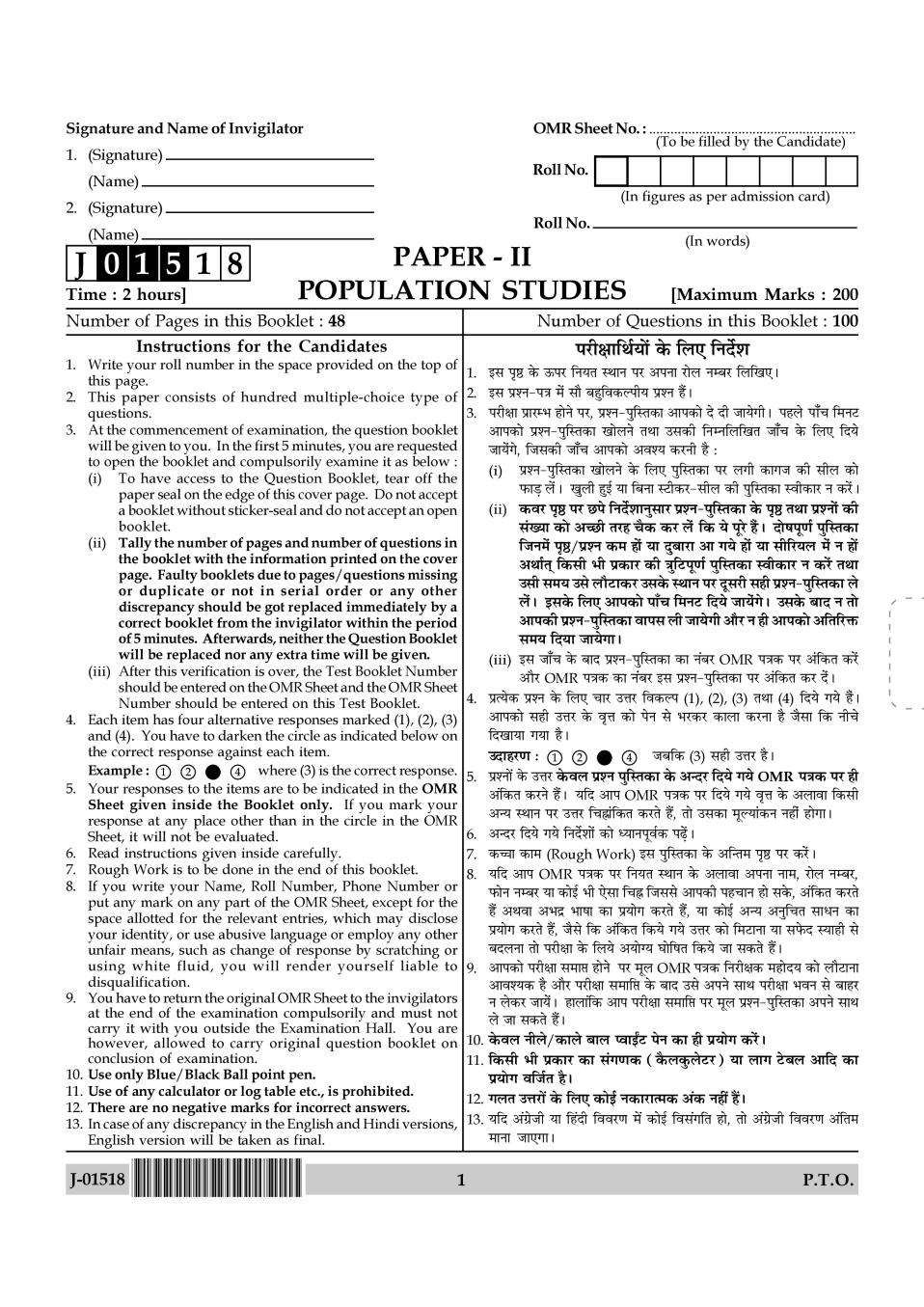
Page 1
(To be filled by the Candidate)
1. (Signature)
Roll No.
(Name)
(In figures as per admission card)
2. (Signature)
Roll No.
(Name) (In words)
J 0 1 5 1 8 PAPER - II
Time : 2 hours] POPULATION STUDIES [Maximum Marks : 200
Number of Pages in this Booklet : 48 Number of Questions in this Booklet : 100
Instructions for the Candidates ¬⁄UˡÊÊÁÕ¸ÿÙ¢ ∑§ Á‹∞ ÁŸŒ¸‡Ê
1. Write your roll number in the space provided on the top of
1. ß‚ ¬ÎDU ∑§ ™§¬⁄U ÁŸÿà SÕÊŸ ¬⁄U •¬ŸÊ ⁄UÙ‹U Ÿê’⁄U Á‹Áπ∞–
this page.
2. This paper consists of hundred multiple-choice type of 2. ß‚ ¬˝‡Ÿ-¬òÊ ◊¢ ‚ÊÒ ’„ÈÁfl∑§À¬Ëÿ ¬˝‡Ÿ „Ò¥–
questions. 3. ¬⁄UˡÊÊ ¬˝Ê⁄êU÷ „ÙŸ ¬⁄U, ¬˝‡Ÿ-¬ÈÁSÃ∑§Ê •Ê¬∑§Ù Œ ŒË ¡ÊÿªË– ¬„‹U ¬UÊ°ø Á◊Ÿ≈U
3. At the commencement of examination, the question booklet •Ê¬∑§Ù ¬˝‡Ÿ-¬ÈÁSÃ∑§Ê πÙ‹Ÿ ÃÕÊ ©‚∑§Ë ÁŸêŸÁ‹Áπà ¡Ê°ø ∑§ Á‹∞ ÁŒÿ
will be given to you. In the first 5 minutes, you are requested ¡Êÿ¢ª, Á¡‚∑§Ë ¡Ê°ø •Ê¬∑§Ù •fl‡ÿ ∑§⁄UŸË „Ò —
to open the booklet and compulsorily examine it as below :
(i) ¬˝‡Ÿ-¬ÈÁSÃ∑§Ê πÙ‹Ÿ ∑§ Á‹∞ ¬ÈÁSÃ∑§Ê ¬⁄U ‹ªË ∑§Êª¡ ∑§Ë ‚Ë‹ ∑§Ê
(i) To have access to the Question Booklet, tear off the
paper seal on the edge of this cover page. Do not accept »§Ê«∏ ‹¢U– πÈ‹Ë „È߸ ÿÊ Á’ŸÊ S≈UË∑§⁄U-‚Ë‹U ∑§Ë ¬ÈÁSÃ∑§Ê SflË∑§Ê⁄U Ÿ ∑§⁄¢U–
a booklet without sticker-seal and do not accept an open (ii) ∑§fl⁄U ¬ÎDU ¬⁄U ¿U¬ ÁŸŒ¸‡ÊÊŸÈ‚Ê⁄U ¬˝‡Ÿ-¬ÈÁSÃ∑§Ê ∑§ ¬ÎDU ÃÕÊ ¬˝‡ŸÙ¢ ∑§Ë
booklet. ‚¢ÅÿÊ ∑§Ù •ë¿UË Ã⁄U„ øÒ∑§ ∑§⁄U ‹¢U Á∑§ ÿ ¬Í⁄U „Ò¢U– ŒÙ·¬Íáʸ ¬ÈÁSÃ∑§Ê
(ii) Tally the number of pages and number of questions in Á¡Ÿ◊¢ ¬ÎDU/¬˝‡Ÿ ∑§◊ „Ù¢ ÿÊ ŒÈ’Ê⁄UÊ •Ê ªÿ „Ù¢ ÿÊ ‚ËÁ⁄Uÿ‹U ◊¢ Ÿ „Ù¢
the booklet with the information printed on the cover •ÕʸØ Á∑§‚Ë ÷Ë ¬˝∑§Ê⁄U ∑§Ë òÊÈÁ≈U¬Íáʸ ¬ÈÁSÃ∑§Ê SflË∑§Ê⁄U Ÿ ∑§⁄¢U ÃÕÊ
page. Faulty booklets due to pages/questions missing
or duplicate or not in serial order or any other ©‚Ë ‚◊ÿ ©‚ ‹Uı≈UÊ∑§⁄U ©‚∑§ SÕÊŸ ¬⁄U ŒÍ‚⁄UË ‚„Ë ¬˝‡Ÿ-¬ÈÁSÃ∑§Ê ‹
discrepancy should be got replaced immediately by a ‹¢– U ß‚∑§ Á‹∞ •Ê¬∑§Ù ¬Ê°ø Á◊Ÿ≈U ÁŒÿ ¡Êÿ¢ª– ©‚∑§ ’ÊŒ Ÿ ÃÙ
correct booklet from the invigilator within the period •Ê¬∑§Ë ¬˝‡Ÿ-¬ÈÁSÃ∑§Ê flʬ‚ ‹Ë ¡ÊÿªË •ı⁄U Ÿ „Ë •Ê¬∑§Ù •ÁÃÁ⁄UQ§
of 5 minutes. Afterwards, neither the Question Booklet ‚◊ÿ ÁŒÿÊ ¡ÊÿªÊ–
will be replaced nor any extra time will be given. (iii) ß‚ ¡Ê°ø ∑§ ’ÊŒ ¬˝‡Ÿ-¬ÈÁSÃ∑§Ê ∑§Ê Ÿ¥’⁄U OMR ¬òÊ∑§ ¬⁄U •¢Á∑§Ã ∑§⁄¢U
(iii) After this verification is over, the Test Booklet Number
•Uı⁄U OMR ¬òÊ∑§ ∑§Ê Ÿ¥’⁄U ß‚ ¬˝‡Ÿ-¬ÈÁSÃ∑§Ê ¬⁄U •¢Á∑§Ã ∑§⁄U Œ¢–
should be entered on the OMR Sheet and the OMR Sheet
Number should be entered on this Test Booklet. 4. ¬˝ àÿ∑§ ¬˝‡Ÿ ∑§ Á‹∞ øÊ⁄U ©ûÊ⁄U Áfl∑§À¬ (1), (2), (3) ÃÕÊ (4) ÁŒÿ ªÿ „Ò¢–
4. Each item has four alternative responses marked (1), (2), (3) •Ê¬∑§Ù ‚„Ë ©ûÊ⁄U ∑§ flÎûÊ ∑§Ù ¬Ÿ ‚ ÷⁄U∑§⁄U ∑§Ê‹Ê ∑§⁄UŸÊ „Ò ¡Ò‚Ê Á∑§ ŸËø
and (4). You have to darken the circle as indicated below on ÁŒπÊÿÊ ªÿÊ „Ò–
the correct response against each item. ©ŒÊ„⁄UáÊ — ¡’Á∑§ (3) ‚„Ë ©ûÊ⁄U „Ò–
Example : where (3) is the correct response. 5. ¬˝‡ŸÊ¥ ∑§ ©ûÊ⁄U ∑§fl‹ ¬˝‡Ÿ ¬ÈÁSÃ∑§Ê ∑§ •ãŒ⁄U ÁŒÿ ªÿ OMRU ¬òÊ∑§ ¬⁄U „Ë
5. Your responses to the items are to be indicated in the OMR •¥Á∑§Ã ∑§⁄UŸ „Ò¥– ÿÁŒ •Ê¬ OMRU ¬òÊ∑§ ¬⁄U ÁŒÿ ªÿ flÎûÊ ∑§ •‹ÊflÊ Á∑§‚Ë
Sheet given inside the Booklet only. If you mark your
response at any place other than in the circle in the OMR •ãÿ SÕÊŸ ¬⁄U ©ûÊ⁄U ÁøqÊ¢Á∑§Ã ∑§⁄Uà „Ò¥, ÃÙ ©‚∑§Ê ◊ÍÀUÿÊ¢∑§Ÿ Ÿ„Ë¢ „٪ʖ
Sheet, it will not be evaluated. 6. •ãŒ⁄U ÁŒÿ ªÿ ÁŸŒ¸‡ÊÙ¢ ∑§Ù äÿÊŸ¬Ífl¸∑§ ¬…∏¢U–
6. Read instructions given inside carefully. 7. ∑§ìÊÊ ∑§Ê◊ (Rough Work) ß‚ ¬ÈÁSÃ∑§Ê ∑§ •ÁãÃ◊ ¬ÎDU ¬⁄U ∑§⁄¢U–
7. Rough Work is to be done in the end of this booklet. 8. ÿÁŒ •Ê¬ OMR ¬òÊ∑§ ¬⁄U ÁŸÿà SÕÊŸ ∑§ •‹ÊflÊ •¬ŸÊ ŸÊ◊, ⁄UÊ‹ Ÿê’⁄U,
8. If you write your Name, Roll Number, Phone Number or »§ÊŸ Ÿê’⁄U ÿÊ ∑§Ê߸ ÷Ë ∞‚Ê Áøq Á¡‚‚ •Ê¬∑§Ë ¬„øÊŸ „Ê ‚∑§, •¥Á∑§Ã ∑§⁄UÃ
put any mark on any part of the OMR Sheet, except for the
space allotted for the relevant entries, which may disclose „Ò¥ •ÕflÊ •÷Œ˝ ÷Ê·Ê ∑§Ê ¬˝ÿʪ ∑§⁄Uà „Ò¥, ÿÊ ∑§Ê߸ •ãÿ •ŸÈÁøà ‚ÊœŸ ∑§Ê
your identity, or use abusive language or employ any other ¬˝ÿʪ ∑§⁄Uà „Ò¥, ¡Ò‚ Á∑§ •¥Á∑§Ã Á∑§ÿ ªÿ ©ûÊ⁄U ∑§Ê Á◊≈UÊŸÊ ÿÊ ‚»§Œ SÿÊ„Ë ‚
unfair means, such as change of response by scratching or ’Œ‹ŸÊ ÃÊ ¬⁄UˡÊÊ ∑§ Á‹ÿ •ÿÊÇÿ ÉÊÊÁ·Ã Á∑§ÿ ¡Ê ‚∑§Ã „Ò¥–
using white fluid, you will render yourself liable to 9. •Ê¬∑§Ù ¬⁄UˡÊÊ ‚◊Ê# „ÙŸ §¬⁄U ◊Í‹ OMR ¬òÊ∑§ ÁŸ⁄UˡÊ∑§ ◊„ÙŒÿ ∑§Ù ‹Uı≈UÊŸÊ
disqualification. •Êfl‡ÿ∑§ „Ò •ı⁄U ¬⁄UˡÊÊ ‚◊ÊÁ# ∑§ ’ÊŒ ©‚ •¬Ÿ ‚ÊÕ ¬⁄UˡÊÊ ÷flŸ ‚ ’Ê„⁄U
9. You have to return the original OMR Sheet to the invigilators Ÿ ‹∑§⁄U ¡Êÿ¢– „Ê‹Ê¥Á∑§ •Ê¬ ¬⁄UˡÊÊ ‚◊ÊÁ# ¬⁄U ◊Í‹ ¬˝‡Ÿ-¬ÈÁSÃ∑§Ê •¬Ÿ ‚ÊÕ
at the end of the examination compulsorily and must not
carry it with you outside the Examination Hall. You are
‹ ¡Ê ‚∑§Ã „Ò¥–
however, allowed to carry original question booklet on 10. ∑§fl‹ ŸË‹/∑§Ê‹ ’Ê‹U åflÊßZ≈U ¬Ÿ ∑§Ê „Ë ¬˝ÿʪ ∑§⁄¢U–
conclusion of examination. 11. Á∑§‚Ë ÷Ë ¬˝∑§Ê⁄U ∑§Ê ‚¢ªáÊ∑§ (∑Ò§‹∑ȧ‹≈U⁄U) UÿÊ ‹Êª ≈U’‹ •ÊÁŒ ∑§Ê
10. Use only Blue/Black Ball point pen. ¬˝ÿÙª flÁ¡¸Ã „Ò–
11. Use of any calculator or log table etc., is prohibited.
12. ª‹Ã ©ûÊ⁄UÊ¥ ∑§ Á‹∞ ∑§Ê߸ Ÿ∑§Ê⁄UÊà◊∑§ •¥∑§ Ÿ„Ë¥ „Ò¥–
12. There are no negative marks for incorrect answers.
13. In case of any discrepancy in the English and Hindi versions, 13. ÿÁŒ •¥ª˝¡Ë ÿÊ Á„¥ŒË Áflfl⁄UáÊ ◊¥ ∑§Ê߸ Áfl‚¥ªÁà „Ê, ÃÊ •¥ª˝¡Ë Áflfl⁄UáÊ •¥ÁÃ◊
English version will be taken as final. ◊ÊŸÊ ¡Ê∞ªÊ–
J-01518 !J-01518-PAPER-II! 1 P.T.O.
Page 2
PAPER - II
Note : This paper contains hundred (100) objective type questions of two (2) marks each. All
questions are compulsory.
Read the paragraph given below carefully and answer the questions (1 to 6) below :
Rural to rural migration is prominent in migration-environment linkages in Africa. In the
United Republic of Tanzania, the spread of cash crops (especially coffee and cotton) was
stimulated by government policy and led to substantial rural-rural migration to the Usangu
plains, depleting their vegetation. The human population of the plains rose fivefold between
1948 and 1988. However, the ecological deterioration was also partly due to insecure land
tenure and the absence of social institutions for regulating resource access and use. In Nigeria,
the Koyfar of the Jos plateau, responding to expanding market opportunities rather than
population pressure, migrated from the fertile Benue plains and changed from being shifting
cultivators in temporarily cleared areas of forest to being permanent and intensive tillers of
family farms in areas cleared of forest.
1. Why people opted out for permanent and intensive tilling instead of shifting cultivation ?
(1) Demand for food was increasing.
(2) Forest clearance was restricted.
(3) Intensive cultivation generates marketable surplus.
(4) To absorb more people in cultivation.
2. Why do you think Koyfar people have migrated out from Benue plains ?
(1) Shifting cultivation led to land depletion.
(2) Population pressure made the area non-livable.
(3) Agricultural land was shrinking.
(4) Market opportunities were more in new areas.
3. Which among the following has not been resulted due to introduction of cash crop cultivation
in Usangu plains ?
(1) Depletion of their natural vegetation
(2) Strong social institution regulating the use of resources
(3) Large scale migration
(4) Rapid increase of population
J-01518 !J-01518-PAPER-II! 2 Paper-II
Page 3
¬˝‡Ÿ¬òÊ - II
ÁŸŒ¸‡Ê — ß‚ ¬˝‡Ÿ-¬òÊ ◊¥ ‚ÊÒ (100) ’„È-Áfl∑§À¬Ëÿ ¬˝‡Ÿ „Ò– ¬˝àÿ∑§ ¬˝‡Ÿ ∑§ ŒÊ (2) •¥∑§ „Ò– ‚÷Ë ¬˝‡Ÿ •ÁŸflÊÿ¸ „Ò¥–
ŸËø Á‹π „Èÿ •ŸÈë¿UŒ ∑§Ê äÿÊŸ ‚ ¬Á…∏ÿ •ÊÒ⁄U ¬˝‡Ÿ ‚¥ÅÿÊ (1 ‚ 6) ∑§ ©ûÊ⁄U ŒËÁ¡ÿ–
ª˝Ê◊ËáÊ ˇÊòÊ ‚ ª˝Ê◊ËáÊ ˇÊòÊ ◊¥ ¬˝fl‚Ÿ •»˝§Ë∑§Ê ◊¥ ¬˝fl‚Ÿ-flÊÃÊfl⁄UáÊ Á‹¥∑§¡ ◊¥ ¬˝’‹ „Ò– ÿÍŸÊß≈U«U Á⁄U¬Áé‹∑§ •ÊÚ»§
Ã¥¡ÊÁŸÿÊ ◊¥ Ÿ∑§ŒË »§‚‹Ê¥ (Áfl‡Ê·∑§⁄U ∑§ÊÚ»§Ë •ÊÒ⁄U ∑§¬Ê‚) ∑§ ¬˝‚Ê⁄U ∑§Ê ‚⁄U∑§Ê⁄UË ŸËÁÃÿÊ¥ m˝Ê⁄UÊ ’…∏ÊflÊ ÁŒÿÊ ªÿÊ •ÊÒ⁄U
ß‚∑§ ¬Á⁄UáÊÊ◊SflM§¬ ÿÈ‚Ê¥ªÈ ∑§ ◊ÒŒÊŸË ÷ʪʥ ◊¥ ª˝Ê◊ËáÊ ˇÊòÊÊ¥ ‚ ª˝Ê◊ËáÊ ˇÊòÊÊ¥ ◊¥ ¬˝fl‚Ÿ „È•Ê Á¡‚‚ fl„Ê° Á∑§ flŸS¬ÁÃÿÊ°
∑§◊ „È߸– fl·¸ 1948 •ÊÒ⁄U 1988 ∑§ ’Ëø ◊ÒŒÊŸË ÷ʪʥ ∑§Ë •Ê’ÊŒË ¬Ê°ø ªÈŸÊ ’…∏Ë– „Ê‹Ê°Á∑§ ¬ÿʸfl⁄UáÊËÿ Áª⁄UÊfl≈U ∑§
∑§Ê⁄UáÊ •¥‡Ê×, •‚È⁄UÁˇÊà ÷ÍÁ◊ ∑§Ê‡Ã∑§Ê⁄UË ÃÕÊ ‚¥‚ÊœŸ Ã∑§ ¬„È°ø •ÊÒ⁄U ©‚∑§ ©¬ÿʪ ∑§Ê ÁflÁŸÿÁ◊à ∑§⁄UŸ flÊ‹Ë
‚Ê◊ÊÁ¡∑§ ‚¥SÕÊ•Ê¥ ∑§Ê •÷Êfl ÷Ë ⁄U„– ŸÊß¡ËÁ⁄UÿÊ ◊¥, ¡Ê‚ ¬∆UÊ⁄U ∑§Ê ∑§Êÿ»§Ê⁄U ©¬¡Ê™§ ◊ÒŒÊŸË ÷ʪ ’ŸÍ ‚ ¬˝fl‚Ÿ
∑§⁄UŸ flÊ‹Ë ¡Ÿ‚¥ÅÿÊ ∑§ Œ’Êfl ∑§ ’¡Êÿ ’…∏à ’Ê$¡Ê⁄U •fl‚⁄UÊ¥ ‚ ¬˝÷ÊÁflà „È•Ê ÃÕÊ ‹Êª flŸ ∑§ •SÕÊÿË M§¬ ‚ ‚Ê»§
Á∑§∞ ª∞ ˇÊòÊÊ¥ ◊¥ SÕÊŸÊ¥ÃÁ⁄Uà ∑ΧÁ· ∑§⁄UŸflÊ‹ Á∑§‚ÊŸ ’ŸŸ ∑§ ’¡Êÿ flŸÊ¥ ∑§Ê ‚Ê»§ ∑§⁄U ÁŒ∞ ª∞ ˇÊòÊÊ¥ ◊¥ ¬Á⁄UflÊ⁄U »§ÊÚ◊ÊZ
∑§ SÕÊÿË •ÊÒ⁄U ª„Ÿ Á∑§‚ÊŸ ’Ÿ ª∞–
1. ‹ÊªÊ¥ Ÿ SÕÊŸÊ¥ÃÁ⁄Uà ∑ΧÁ· ∑§ ’¡Êÿ SÕÊÿË •ÊÒ⁄U ª„Ÿ πÃË ÄÿÊ¥ •¬ŸÊÿÊ?
(1) πÊlÊ㟠∑§Ë ◊Ê¥ª ’…∏ ⁄U„Ë ÕË–
(2) flŸ÷ÍÁ◊ ‚Ê»§ ∑§⁄UŸ ¬⁄U ¬˝ÁÃ’¥œ ÕÊ–
(3) ª„Ÿ πÃË ‚ ’Ê$¡Ê⁄U ◊¥ ’øŸ ÿÊÇÿ •ÁÃÁ⁄UÁÄà ∑ΧÁ· ©à¬ÊŒ ¬ÒŒÊ „ÊÃÊ „Ò–
(4) πÃË ◊¥ •ÊÒ⁄U •Áœ∑§ ‹ÊªÊ¥ ∑§Ê ‡ÊÊÁ◊‹ ∑§⁄UŸ ∑§ ¬˝ÿÊ¡Ÿ ‚–
2. •Ê¬∑§ ÁfløÊ⁄U ◊¥ ∑§Êÿ»§Ê⁄U ∑§ ‹Êª ’ŸÍ ∑§ ◊ÒŒÊŸË ÷ʪʥ ‚ ’Ê„⁄U ÄÿÊ¥ ¬˝fl‚Ÿ ∑§⁄U ª∞ „Ò¥ ?
(1) SÕÊŸÊ¥ÃÁ⁄Uà ∑ΧÁ· ∑§Ë fl¡„ ‚ ÷ÍÁ◊ ˇÊòÊ ÉÊ≈UŸÊ –
(2) ¡Ÿ‚¥ÅÿÊ Œ’Êfl Ÿ ©‚ ˇÊòÊ ∑§Ê ⁄U„Ÿ ÿÊÇÿ Ÿ„Ë¥ ⁄U„Ÿ ÁŒÿÊ–
(3) ∑ΧÁ· ÷ÍÁ◊ Á‚◊≈U ⁄U„Ë ÕË–
(4) Ÿ∞ ˇÊòÊÊ¥ ◊¥ •¬ˇÊÊ∑Χà •Áœ∑§ ’Ê$¡Ê⁄U ∑§ •fl‚⁄U Õ–
3. ÁŸêŸÁ‹Áπà ◊¥ ‚ ∑§ÊÒŸ-‚Ê ÿÈ‚Ê¥ªÈ ◊Ҍʟ ◊¥ Ÿ∑§ŒË »§‚‹ ∑§Ë πÃË ‡ÊÈM§ Á∑§∞ ¡ÊŸ ∑§Ê ¬Á⁄UáÊÊ◊ Ÿ„Ë¥ ÕÊ ?
(1) ©Ÿ∑§Ë ¬˝Ê∑ΧÁÃ∑§ flŸS¬ÁÃÿÊ¥ ◊¥ ∑§◊Ë
(2) ‚¥‚ÊœŸÊ¥ ∑§ ¬˝ÿʪ ∑§Ê ÁflÁŸÿÁ◊à ∑§⁄UŸ flÊ‹ ‚Ȍ΅∏ ‚Ê◊ÊÁ¡∑§ ‚¥SÕÊ
(3) √ÿʬ∑§ ¬Ò◊ÊŸ ¬⁄U ¬˝fl‚Ÿ
(4) ¡Ÿ‚¥ÅÿÊ ◊¥ ÃËfl˝ flÎÁh
J-01518 !J-01518-PAPER-II! 3 Paper-II
Page 4
in United Republic of Tanzania ?
(1) Rural to rural (2) Rural to urban (3) Urban to urban (4) Urban to rural
5. Which among the following has not been identified as a reason for depletion of forest in the
above paragraph ?
(1) Change in method of cultivation.
(2) Change in land tenure system.
(3) Growth of population of forest dwellers.
(4) Increased cattle population.
6. Which among the following correctly describes the nature of the passage ?
(1) Hypothetical (2) Analytical (3) Fictional (4) Factual
7. The first Population Census of England and France was carried out in which among the
following year ?
(1) 1750 (2) 1790 (3) 1801 (4) 1880
8. Match the following propositions in List - II with the List - I with regard to the stages under
demographic transition theory :
List - I List - II
(a) Stage I (i) High birth rates high death rate
(b) Stage II (ii) High birth rates falling death rate
(c) Stage III (iii) Declining birth rates low death rate
(d) Stage IV (iv) Low birth rate low death rate
Code :
(a) (b) (c) (d)
(1) (i) (ii) (iii) (iv)
(2) (ii) (iii) (iv) (i)
(3) (iii) (iv) (i) (ii)
(4) (iv) (i) (ii) (iii)
9. The percentage of Scheduled Tribes to the total population of India according to the 2011
census is around, (percent) :
(1) 6 (2) 8 (3) 10 (4) 12
J-01518 !J-01518-PAPER-II! 4 Paper-II
Page 5
⁄U„Ë „Ò?
(1) ª˝Ê◊ËáÊ ‚ ª˝Ê◊ËáÊ (2) ª˝Ê◊ËáÊ ‚ ‡Ê„⁄UË (3) ‡Ê„⁄UË ‚ ‡Ê„⁄UË (4) ‡Ê„⁄UË ‚ ª˝Ê◊ËáÊ
5. ©¬ÿ¸ÈÄà •ŸÈë¿UŒ ◊¥ ÁŸêŸÁ‹Áπà ◊¥ ‚ Á∑§‚ flŸ ˇÊòÊ ÉÊ≈UŸ ∑§Ê ∑§Ê⁄UáÊ Ÿ„Ë¥ ◊ÊŸÊ ªÿÊ „Ò?
(1) ∑ΧÁ· ¬hÁà ◊¥ ¬Á⁄UfløŸ–
(2) ÷ÍÁ◊ ∑§Ê‡Ã∑§Ê⁄UË ¬˝áÊÊ‹Ë ◊¥ ¬Á⁄UfløŸ–
(3) flŸ flÊÁ‚ÿÊ¥ ∑§Ë ¡Ÿ‚¥ÅÿÊ ◊¥ flÎÁh–
(4) ¬‡ÊÈ•Ê¥ ∑§Ë ’…∏Ë „È߸ ‚¥ÅÿÊ–
6. ÁŸêŸÁ‹Áπà ◊¥ ‚ ∑§ÊÒŸ-‚Ê ©Äà •ŸÈë¿UŒ ∑§Ë ‚„Ë ¬˝∑ΧÁà Œ‡ÊʸÃÊ „Ò?
(1) ∑§ÊÀ¬ÁŸ∑§ (2) Áfl‡‹·áÊÊà◊∑§ (3) ∑§ÕÊà◊∑§ (4) flÊSÃÁfl∑§
7. ߥª‹Ò¥«U •ÊÒ⁄U »˝§Ê¥‚ ∑§Ë ¬„‹Ë ¡ŸªáÊŸÊ ÁŸêŸÁ‹Áπà ◊¥ ‚ Á∑§‚ fl·¸ ∑§Ë ªß¸ ÕË ?
(1) 1750 (2) 1790 (3) 1801 (4) 1880
8. ‚ÍøË - II ◊¥ ÁŸêŸÁ‹Áπà ¬˝SÃÊflÊ¥ ∑§Ê ‚ÍøË - I ◊¥ ¡ŸÊ¥Á∑§∑§Ëÿ ‚¥∑˝§ÊÁãà Á‚hÊãà ∑§ •¥Ãª¸Ã •flSÕÊ•Ê¥ ∑§ ‚ÊÕ
‚È◊Á‹Ã Á∑§Á¡∞ —
‚ÍøË - I ‚ÍøË - II
(a) •flSÕÊ I (i) ©ìÊ ¡ã◊ Œ⁄U, ©ìÊ ◊ÎàÿÈ Œ⁄U
(b) •flSÕÊ II (ii) ©ìÊ ¡ã◊ Œ⁄U, Áª⁄UÃË ◊ÎàÿÈ Œ⁄U
(c) •flSÕÊ III (iii) Áª⁄UÃË ¡ã◊ Œ⁄U, ÁŸêŸ ◊ÎàÿÈ Œ⁄U
(d) •flSÕÊ IV (iv) ÁŸêŸ ¡ã◊ Œ⁄U, ÁŸêŸ ◊ÎàÿÈ Œ⁄U
∑ͧ≈U —
(a) (b) (c) (d)
(1) (i) (ii) (iii) (iv)
(2) (ii) (iii) (iv) (i)
(3) (iii) (iv) (i) (ii)
(4) (iv) (i) (ii) (iii)
9. fl·¸ 2011 ∑§Ë ¡ŸªáÊŸÊ ∑§ •ŸÈ‚Ê⁄U ÷Ê⁄Uà ∑§Ë ∑ȧ‹ ¡Ÿ‚¥ÅÿÊ ∑§Ë ÃÈ‹ŸÊ ◊¥ •ŸÈ‚ÍÁøà ¡Ÿ¡ÊÁà ∑§Ë ¡Ÿ‚¥ÅÿÊ ∑§Ê
Á¬˝ÁÇÊà ‹ª÷ª Á∑§ÃŸÊ (%) ÕÊ–
(1) 6 (2) 8 (3) 10 (4) 12
J-01518 !J-01518-PAPER-II! 5 Paper-II
Page 6
from shifts in a population age-structure.
Reason (R) : A demographic dividend is linked to a demographic transition, which begins
when child and infant death rates decreases in response to increased access
to vaccines, antibiotics, safe water, sanitation and better nutrition.
(1) Both (A) and (R) are true and (R) is correct explanation of (A).
(2) Both (A) and (R) are true, but (R) is not the correct explanation of (A).
(3) (A) is true, but (R) is false.
(4) (A) is false, but (R) is true.
11. How many categories have been recommended for matrital status by United Nation (UN) ?
(1) 4 (2) 5 (3) 6 (4) 7
12. In a study population, ‘P’ is the proportion of cases having a characteristic under study
based on a sample size ‘n’. Which one of the following formula to be used to calculate
co-efficient of variation ‘ρ’, where Q =1−P ?
n PQ P Q
(1) ρ= (2) ρ= (3) ρ= (4) ρ=
PQ n nQ nP
13. Match the significant events in the ‘National Health Programmes’ given in List - I with their
date of initiation given in List - II using the following code :
List - I List - II
(a) Family planning programme was named as ‘Family (i) 2013
Welfare Programme’
(b) Target free approach was adopted in the Family Welfare (ii) 1997
Programme
(c) Reproductive and Child Health Programme was introduced (iii) 1996
(d) National Health Mission was introduced (iv) 1977
Code :
(a) (b) (c) (d)
(1) (iv) (iii) (ii) (i)
(2) (iv) (ii) (iii) (i)
(3) (ii) (iii) (iv) (i)
(4) (i) (ii) (iii) (iv)
J-01518 !J-01518-PAPER-II! 6 Paper-II
Page 7
’Œ‹Êfl ∑§ ∑§Ê⁄UáÊ ©à¬ãŸ „ÊÃË „Ò–
Ã∑¸§ (R) : ¡ŸÊ¥Á∑§∑§Ëÿ ‹Ê÷ ¡ŸÊ¥Á∑§∑§Ëÿ ‚¥∑˝§◊áÊ ‚ ¡È«∏Ê „Ò ¡Ê Ã’ •ÁSÃàfl ◊¥ •ÊÃÊ „Ò ¡’ ≈UË∑§Ê∑§⁄UáÊ,
∞¥≈UË’ÊÿÊÁ≈UÄ‚, ‚È⁄UÁˇÊà ¬ÿ¡‹, Sflë¿UÃÊ •ÊÒ⁄U ’„Ã⁄U ¬Ê·áÊ Ã∑§ ’„Ã⁄U ¬„È°ø ∑§Ë fl¡„ ‚ Á‡Ê‡ÊÈ
◊ÎàÿÈ Œ⁄U •ÊÒ⁄U Ÿfl¡Êà ◊ÎàÿÈ Œ⁄U ÉÊ≈U ¡ÊÃË „Ò¥–
(1) (A) •ÊÒ⁄U (R) ŒÊŸÊ¥ ‚„Ë „Ò¥ ÃÕÊ (R), (A) ∑§Ë ‚„Ë √ÿÊÅÿÊ „Ò–
(2) (A) •ÊÒ⁄U (R) ŒÊŸÊ¥ ‚„Ë „Ò¥ ¬⁄UãÃÈ (R), (A) ∑§Ë ‚„Ë √ÿÊÅÿÊ Ÿ„Ë¥ „Ò–
(3) (A) ‚„Ë „Ò, ¬⁄UãÃÈ (R) ª‹Ã „Ò–
(4) (A) ª‹Ã „Ò, ¬⁄UãÃÈ (R) ‚„Ë „Ò–
11. ‚¥ÿÈÄà ⁄UÊc≈˛U m˝Ê⁄UÊ flÒflÊÁ„∑§ ÁSÕÁà ∑§ Á‹∞ Á∑§ÃŸ flªÊZ ∑§Ê ‚ȤÊÊfl ÁŒÿÊ ªÿÊ ÕÊ ?
(1) 4 (2) 5 (3) 6 (4) 7
12. ¡Ÿ‚¥ÅÿÊ ∑§ •äÿÿŸ ◊¥, ¬˝ÁÃŒ‡Ê¸ •Ê∑§Ê⁄U ‘n’ ¬⁄U •ÊœÊÁ⁄Uà ÁflÁ‡Êc≈U •äÿÿŸ ◊¥ ◊Ê◊‹Ê¥ ∑§Ê •ŸÈ¬Êà ‘P’ „Ò– ¬˝‚⁄UáÊ
ªÈáÊÊ¥∑§ ‘ρ’ ∑§Ë ¬Á⁄UªáÊŸÊ ∑§⁄UŸ ∑§ Á‹∞ ÁŸêŸÁ‹Áπà ◊¥ ‚ Á∑§‚ ‚ÍòÊ ∑§Ê ©¬ÿʪ Á∑§ÿÊ ¡Ê∞ªÊ, ¡„Ê° Q =1−P „Ò?
„Ò ?
n PQ P Q
(1) ρ= (2) ρ= (3) ρ= (4) ρ=
PQ n nQ nP
13. ‚ÍøË - I ◊¥ ŒË ªß¸, “⁄UÊc≈˛UËÿ SflÊSâÿ ∑§Êÿ¸∑˝§◊” ∑§Ë ◊„àfl¬Íáʸ ÉÊ≈UŸÊ•Ê¥ ∑§Ê ‚ÍøË - II ◊¥ ŒË ªß¸, ©Ÿ∑§Ë ‡ÊÈL§•Êà ∑§Ë
ÁÃÁÕ ∑§ ‚ÊÕ ŸËø ÁŒ∞ ª∞ ∑ͧ≈U ∑§Ê ¬˝ÿʪ ∑§⁄Uà „È∞ ‚È◊Á‹Ã ∑§⁄¥U —
‚ÍøË - I ‚ÍøË - II
(a) ¬Á⁄UflÊ⁄U ÁŸÿÊ¡Ÿ ∑§Êÿ¸∑˝§◊ ∑§Ê ŸÊ◊ “¬Á⁄UflÊ⁄U ∑§ÀÿÊáÊ ∑§Êÿ¸∑˝§◊” ⁄UπÊ ªÿÊ– (i) 2013
(b) ¬Á⁄UflÊ⁄U ∑§ÀÿÊáÊ ∑§Êÿ¸∑˝§◊ ∑§ •¥Ãª¸Ã ‹ˇÿ ◊ÈÄà ŒÎÁc≈U∑§ÊáÊ •¬ŸÊÿÊ ªÿÊ– (ii) 1997
(c) Á⁄U¬˝Ê«UÁÄ≈Ufl ∞¥«U øÊßÀ«U „ÀÕ ¬˝Êª˝Ê◊ ‡ÊÈM§ Á∑§ÿÊ ªÿÊ– (iii) 1996
(d) ⁄UÊc≈˛UËÿ SflÊSâÿ Á◊‡ÊŸ ‡ÊÈM§ Á∑§ÿÊ ªÿÊ– (iv) 1977
∑ͧ≈U —
(a) (b) (c) (d)
(1) (iv) (iii) (ii) (i)
(2) (iv) (ii) (iii) (i)
(3) (ii) (iii) (iv) (i)
(4) (i) (ii) (iii) (iv)
J-01518 !J-01518-PAPER-II! 7 Paper-II
Page 8
(1) Directly related to savings and inversely related to the capital/output ratio
(2) Directly related to the capital/output ratio and inversely related to savings
(3) Indirectly related to savings and the capital/output ratio
(4) Directly related to savings and the capital/output ratio
15. Which among the following has been introduced for the first time in NFHS - 4 ?
(1) Stunted children below age 5
(2) Children below age 2 receiving adequate diet
(3) Children breast fed within one hour
(4) Children received measles vaccine
16. If A is peri-natal period, B is neo-natal period and C is post-neonatal period; then which
among the following diagram describes their relationship of stage ?
(1) (2) (3) (4)
17. Which one is the Density of Population of India according to the 2011 census ?
(1) 372/km 2 (2) 382/km 2 (3) 392/km 2 (4) 492/km 2
18. Assertion (A) : Unintended pregnancy is generally high among young women.
Reason (R) : In recent years, young women have high equitable gender role.
Code :
(1) Both (A) and (R) are true and (R) is correct explanation of (A)
(2) Both (A) and (R) are true, but (R) is not the correct explanation of (A)
(3) (A) is true, but (R) is false
(4) (A) is false, but (R) is true
19. What is typical cycle of urbanization according to Kingsley Davis ?
(1) Attenuated S shape (2) Attenuated J shape
(3) Attenuated U shape (4) Attenuated inverse U shape
J-01518 !J-01518-PAPER-II! 8 Paper-II
Page 9
(1) ’øÃÊ¥ ∑§ ‚ÊÕ ‚Ëœ ‚ê’ÁãœÃ •ÊÒ⁄U ¬Í¥¡Ë/©à¬ÊŒŸ •ŸÈ¬Êà ∑§ ‚ÊÕ Áfl¬⁄UËØÿÊ ‚ê’ÁãœÃ
(2) ¬Í¥¡Ë/©à¬ÊŒŸ •ŸÈ¬Êà ∑§ ‚ÊÕ ‚Ëœ ‚ê’ÁãœÃ •ÊÒ⁄U ’øÃÊ¥ ∑§ ‚ÊÕ ¬˝ÁËÊ◊ M§¬ ‚ ‚ê’ÁãœÃ
(3) ’øÃÊ¥ •ÊÒ⁄U ¬Í¥¡Ë/©à¬ÊŒŸ •ŸÈ¬Êà ∑§ ‚ÊÕ •¬˝àÿˇÊ M§¬ ‚ ‚ê’ÁãœÃ
(4) ’øÃÊ¥ •ÊÒ⁄U ¬Í¥¡Ë/©à¬ÊŒŸ •ŸÈ¬Êà ∑§ ‚ÊÕ ‚Ëœ ‚ê’ÁãœÃ
15. ∞Ÿ.∞»§.∞ø.∞‚.-4 ◊¥ ÁŸêŸÁ‹Áπà ◊¥ ‚ Á∑§‚∑§Ê ¬„‹Ë ’Ê⁄U ‡ÊÊÁ◊‹ Á∑§ÿÊ ªÿÊ?
(1) 5 fl·¸ ‚ ∑§◊ ©◊˝ ∑§ L§hÁfl∑§Ê‚ ’ëø
(2) ¬ÿʸåà •Ê„Ê⁄U ‹ŸflÊ‹ 2 fl·¸ ‚ ∑§◊ ©◊˝ ∑§ ’ìÊ
(3) ¡ã◊ ∑§ ∞∑§ ÉÊ¥≈U ∑§ •¥Œ⁄U S߬ʟ ∑§⁄UŸ flÊ‹ ’ìÊ
(4) π‚⁄UÊ ∑§Ê ≈UË∑§Ê ‹ª ’ìÊ
16. ÿÁŒ A “¬Á⁄U-Ÿ≈U‹” •flÁœ „Ò, B “ÁŸÿÊ-Ÿ≈U‹” •flÁœ „Ò ÃÕÊ C “¬ÊS≈U-ÁŸÿÊŸ≈U‹” •flÁœ „Ò ÃÊ ÁŸêŸÁ‹Áπà ◊¥ ‚
∑§ÊÒŸ-‚Ê •Ê⁄Uπ ©Ÿ∑§ ø⁄UáÊ ‚¥’¥œ ∑§Ê Œ‡ÊʸÃÊ „Ò ?
(1) (2) (3) (4)
17. fl·¸ 2011 ∑§Ë ¡ŸªáÊŸÊ ∑§ •ŸÈ‚Ê⁄U ÁŸêŸ ◊¥ ∑§ÊÒŸ ‚Ê ÷Ê⁄Uà ∑§Ë ¡Ÿ‚¥ÅÿÊ ∑§Ê ÉÊŸàfl „Ò?
(1) 372/Á∑§.◊Ë.2 (2) 382/Á∑§.◊Ë.2 (3) 392/Á∑§.◊Ë.2 (4) 492/Á∑§.◊Ë.2
18. •Á÷∑§ÕŸ (A) : •ŸÁ÷¬˝Ã ª÷¸œÊ⁄UáÊ ‚Ê◊ÊãÿÃÿÊ ÿÈflÊ ÁSòÊÿÊ¥ ◊¥ •Áœ∑§ „ÊÃÊ „Ò–
Ã∑¸§ (R) : „Ê‹ „Ë ∑§ fl·ÊZ ◊¥, ÿÈflÊ ÁSòÊÿÊ¥ ∑§Ë ‚◊ÃÈÀÿ ¡¥«U⁄U ÷ÍÁ◊∑§Ê ⁄U„Ë „Ò –
∑ͧ≈U —
(1) (A) •ÊÒ⁄U (R) ŒÊŸÊ¥ ‚àÿ „Ò¥ •ÊÒ⁄U (R), (A) ∑§Ë ‚„Ë √ÿÊÅÿÊ „Ò–
(2) (A) •ÊÒ⁄U (R) ŒÊŸÊ¥ ‚àÿ „Ò¥ ¬⁄UãÃÈ (R), (A) ∑§Ë ‚„Ë √ÿÊÅÿÊ Ÿ„Ë¥ „Ò–
(3) (A) ‚àÿ „Ò, ¬⁄UãÃÈ (R) •‚àÿ „Ò–
(4) (A) •‚àÿ „Ò, ¬⁄UãÃÈ (R) ‚àÿ „Ò–
19. Á∑¥§Ç‚‹ «UÁfl‚ ∑§ •ŸÈ‚Ê⁄U Ÿª⁄UË∑§⁄UáÊ ∑§Ê ¬˝ÊM§Á¬∑§ ø∑˝§ ÄÿÊ „Ò?
(1) ˇÊËáÊ S •Ê∑§Ê⁄U (2) ˇÊËáÊ J •Ê∑§Ê⁄U
(3) ˇÊËáÊ U •Ê∑§Ê⁄U (4) ˇÊËáÊ Áfl¬ÿ¸Sà U •Ê∑§Ê⁄U
J-01518 !J-01518-PAPER-II! 9 Paper-II
Page 10
the 2011 census ?
(1) 54 (2) 64 (3) 74 (4) 84
21. Match the Laws/theories given in List - I along with the scholars given in List - II :
List - I List - II
(a) Dual Labour Market Theory (i) Ravenstein
(b) Laws of Migration (ii) Hugo
(c) Social Networking Theory (iii) Wallerstein
(d) World System Theory (iv) Piore
Code :
(a) (b) (c) (d)
(1) (iii) (iv) (i) (ii)
(2) (i) (ii) (iii) (iv)
(3) (iv) (i) (ii) (iii)
(4) (ii) (iii) (iv) (i)
22. In a Life Table, the proportion of population 75 years and above that live another 10 years is :
10 ∞L 85 10 ∞L 85 10 T85 10 ∞L 85
(1) ∞ S 75 = (2) ∞ S 75 = (3) ∞ S 75 = (4) ∞ S 75 =
T75 ∞L75 ∞L 75 l75
23. Arrange the following bigger states of India in descending order (high to low) in terms of
their crude birth rates according to the latest SRS Bulletin Report (September 2017).
(a) Bihar (b) Uttar Pradesh
(c) Madhya Pradesh (d) Rajasthan
Code :
(1) (a), (b), (c), (d) (2) (b), (c), (d), (a)
(3) (c), (d), (a), (b) (4) (d), (c), (b), (a)
J-01518 !J-01518-PAPER-II! 10 Paper-II
Page 11
(1) 54 (2) 64 (3) 74 (4) 84
21. ‚ÍøË - I ◊¥ ÁŒ∞ ª∞ Á‚hÊ¥ÃÊ¥ ∑§Ê ‚ÍøË - II ◊¥ ÁŒ∞ ª∞ ©Ÿ∑§ ¬˝Áìʌ∑§Ê¥ ∑§ ŸÊ◊ ∑§ ‚ÊÕ ‚È◊Á‹Ã ∑§⁄¥U–
‚ÍøË - I ‚ÍøË - II
(a) ŒÊ„⁄UÊ üÊ◊ ’Ê¡Ê⁄U Á‚hʥà (i) ⁄UÊflã‚≈UËŸ
(b) ¬˝fl‚Ÿ Á‚hʥà (ii) „˜ÿªÈ Ê
(c) ‚ʇʋ Ÿ≈UflÁ∑Z§ª Á‚hʥà (iii) flÊ‹⁄US≈UËŸ
(d) Áfl‡fl ¬˝áÊÊ‹Ë Á‚hʥà (iv) åÿÊ⁄U
∑ͧ≈U —
(a) (b) (c) (d)
(1) (iii) (iv) (i) (ii)
(2) (i) (ii) (iii) (iv)
(3) (iv) (i) (ii) (iii)
(4) (ii) (iii) (iv) (i)
22. ¡ËflŸ ÃÊÁ‹∑§Ê ◊¥, 75 fl·¸ •ÊÒ⁄U ©‚‚ •Áœ∑§ ∑§ fl·ÊZ ∑§Ë ¡Ÿ‚¥ÅÿÊ ¡Ê •Êª 10 fl·¸ •ÊÒ⁄U ¡ËÃË „Ò, ∑§Ê •ŸÈ¬Êà „Ò —
10 ∞L 85 10 ∞L 85 10 T85 10 ∞L 85
(1) ∞ S 75 = (2) ∞ S 75 = (3) ∞ S 75 = (4) ∞ S 75 =
T75 ∞L75 ∞L 75 l75
23. „Ê‹ ∑§ ∞‚.•Ê⁄.U∞‚. ’È‹Á≈UŸ Á⁄U¬Ê≈¸U (Á‚Ã¥’⁄U, 2017) ∑§ •ŸÈ‚Ê⁄U, ÷Ê⁄Uà ∑§ ’«∏ ⁄UÊíÿÊ¥ ∑§Ê ©Ÿ∑§Ë •‡ÊÊÁœÃ ¡ã◊Œ⁄U
∑§ •ÊœÊ⁄U ¬⁄U •fl⁄UÊ„Ë ∑˝§◊ ◊¥ ‚¡Ê∞¥–
(a) Á’„Ê⁄U (b) ©ûÊ⁄U ¬˝Œ‡Ê
(c) ◊äÿ ¬˝Œ‡Ê (d) ⁄UÊ¡SÕÊŸ
∑ͧ≈U —
(1) (a), (b), (c), (d) (2) (b), (c), (d), (a)
(3) (c), (d), (a), (b) (4) (d), (c), (b), (a)
J-01518 !J-01518-PAPER-II! 11 Paper-II
Page 12
work supported these causes are given in List - II. Match List - I with List - II.
List - I List - II
(a) Rise of individualism (i) Desai (1997)
(b) Cost of marriage (ii) Maslow (1954)
(c) Specialization of skills (iii) Desai and Dube (2011)
(d) Gender equality (iv) Becker (1960)
Code :
(a) (b) (c) (d)
(1) (ii) (iv) (iii) (i)
(2) (ii) (iv) (i) (iii)
(3) (ii) (iii) (iv) (i)
(4) (i) (ii) (iii) (iv)
25. Which one of the following concept is not related to fertility studies ?
(1) Natural Fertility (2) Fecundability
(3) Actual Fertility (4) Consensual Union
26. ( 0)
If life expectancy at birth e 0 is 65 years in a population for a particular year. What is the
life Table birth rate ?
(1) 15.4 per thousand (2) 15.9 per thousand
(3) 15.0 per thousand (4) 16.0 per thousand
27. Arrange the following bigger states of India in descending order (high to low) in terms of
their infant mortality rates as per the latest SRS Bulletin, September 2017 :
(a) Assam (b) Madhya Pradesh
(c) Uttar Pradesh (d) Chhatisgarh
Code :
(1) (b), (a), (c), (d) (2) (a), (b), (c), (d)
(3) (c), (a), (b), (d) (4) (d), (b), (a), (c)
J-01518 !J-01518-PAPER-II! 12 Paper-II
Page 13
◊¥ ÁŒ∞ ª∞ „Ò¥– ‚ÍøË - I ∑§Ê ‚ÍøË - II ∑§ ‚ÊÕ ‚È◊Á‹Ã ∑§⁄¥U–
‚ÍøË - I ‚ÍøË - II
(a) √ÿÁÄÃflÊŒ ◊¥ flÎÁh (i) Œ‚Ê߸ (1997)
(b) ÁflflÊ„ ∑§Ë ‹ÊªÃ (ii) ◊Ê‚‹Ê (1954)
(c) ŒˇÊÃÊ•Ê¥ ∑§Ë Áfl‡Ê·ôÊÃÊ (iii) Œ‚Ê߸ •ÊÒ⁄U ŒÈ’ (2011)
(d) Á‹¥ª ‚◊ÊŸÃÊ (iv) ’∑§⁄U (1960)
∑ͧ≈U —
(a) (b) (c) (d)
(1) (ii) (iv) (iii) (i)
(2) (ii) (iv) (i) (iii)
(3) (ii) (iii) (iv) (i)
(4) (i) (ii) (iii) (iv)
25. ÁŸêŸÁ‹Áπà ◊¥ ‚ ∑§ÊÒŸ‚Ë •flœÊ⁄UáÊÊ ¬˝¡ŸŸÃÊ •äÿÿŸ ∑§ ‚ÊÕ ‚ê’ÁãœÃ Ÿ„Ë¥ „Ò?
(1) ¬˝Ê∑ΧÁÃ∑§ ¬˝¡ŸŸ ‡ÊÁÄà (2) ¬˝¡ŸŸ ˇÊ◊ÃÊ
(3) flÊSÃÁfl∑§ ¬˝¡ŸŸ ‡ÊÁÄà (4) ‚„◊Ááãÿ Á◊‹Ÿ
26. ∞∑§ Áfl‡Ê· fl·¸ ◊¥ ¡Ÿ‚¥ÅÿÊ ◊¥ ¡ã◊ ( e00 ) ¬⁄U ¡ËflŸ ¬˝àÿʇÊÊ ÿÁŒ 65 fl·¸ „Ò ÃÊ ‹Êß»§ ≈U’‹ ¡ã◊ Œ⁄U ÄÿÊ „ʪË?
(1) ¬˝Áà „¡Ê⁄U 15.4 (2) ¬˝Áà „¡Ê⁄U 15.9
(3) ¬˝Áà „¡Ê⁄U 15.0 (4) ¬˝Áà „¡Ê⁄U 16.0
27. •lß ∞‚.•Ê⁄U.∞‚. ’È‹Á≈UŸ Á⁄U¬Ê≈¸U (Á‚Ã¥’⁄U, 2017) ∑§ •ŸÈ‚Ê⁄U, ÷Ê⁄Uà ∑§ ’«∏ ⁄UÊíÿÊ¥ ∑§Ê ©Ÿ∑§Ë Á‡Ê‡ÊÈ ◊ÎàÿÈ Œ⁄U ∑§
•ÊœÊ⁄U ¬⁄U •fl⁄UÊ„Ë ∑˝§◊ (©ëø ‚ ÁŸêŸ) ◊¥ ‚¡Ê∞¥ —
(a) •‚◊ (b) ◊äÿ ¬˝Œ‡Ê
(c) ©ûÊ⁄U ¬˝Œ‡Ê (d) ¿UûÊË‚ª…∏
∑ͧ≈U —
(1) (b), (a), (c), (d) (2) (a), (b), (c), (d)
(3) (c), (a), (b), (d) (4) (d), (b), (a), (c)
J-01518 !J-01518-PAPER-II! 13 Paper-II
Page 14
the theory are given in List - I. Match List - I with List - II :
List - I List - II
(a) Gary S. Becker and Gregg H. Lewis (i) “Population growth is an autonomous
factor, which affects agricultural
productivity rather being affected by it.”
(b) Julian L. Simon (ii) “When society does not limit population
growth voluntarily diseases, famine and
wars reduce population size.”
(c) Ester Boserup (iii) In long run, moderate population
growth improves standard of living both
in more and less developed countries.
(d) Thomas Malthus (iv) “Parents may be altruistic towards their
children.”
Code :
(a) (b) (c) (d)
(1) (i) (ii) (iii) (iv)
(2) (iv) (ii) (i) (iii)
(3) (iv) (i) (iii) (ii)
(4) (iv) (iii) (i) (ii)
29. Which one of the following combination of errors of coverage in age data have been obtained
in census return ?
(a) Under-enumeration of young children
(b) Net-count at the older ages
(c) Under-enumeration at the early adult ages
Code :
(1) (a) (2) (a) and (c)
(3) (b) and (c) (4) (a), (b) and (c)
30. Who among the following defined natural fertility as the marital fertility prevailing in a
population in the absence of any deliberate birth control ?
(1) Easterlin (2) Inkeles (3) Louis Henry (4) Lesthaeghe
J-01518 !J-01518-PAPER-II! 14 Paper-II
Page 15
‚ÍøË - I ∑§Ê ‚ÍøË - II ∑§ ‚ÊÕ ‚È◊Á‹Ã ∑§⁄¥U —
‚ÍøË - I ‚ÍøË - II
(a) ª⁄UË ∞‚. ’∑§⁄U ÃÕÊ ª˝ª ∞ø. ‹Áfl‚ (i) ““¡Ÿ‚¥ÅÿÊ flÎÁh ∞∑§ SflÊÿûÊ ∑§Ê⁄U∑§ „Ò ¡Ê ∑ΧÁ· ©à¬ÊŒ∑§ÃÊ
‚ ¬˝÷ÊÁflà „ÊŸ ∑§ ’¡Êÿ ©‚ ¬˝÷ÊÁflà ∑§⁄UÃÊ „Ò–””
(b) ¡ÈÁ‹ÿŸ ∞‹. Á‚◊ÊÚŸ (ii) ¡’ ‚◊Ê¡ SflÒÁë¿U∑§ M§¬ ‚ ¡Ÿ‚¥ÅÿÊ ∑§Ê ‚ËÁ◊à Ÿ„Ë¥
∑§⁄UÃÊ „Ò ÃÊ ⁄Uʪ, •∑§Ê‹ •ÊÒ⁄U ÿÈh ¡Ÿ‚¥ÅÿÊ ◊¥ Áª⁄UÊfl≈U
‹ÊÃ „Ò¥–
(c) ߸S≈U⁄U ’Ê‚⁄U¬ (iii) ŒËÉʸ∑§Ê‹ ◊¥; •Áœ∑§ •ÊÒ⁄U ∑§◊ Áfl∑§Á‚à ŒÊŸÊ¥ „Ë Œ‡ÊÊ¥ ◊¥
‚Ê◊Êãÿ ¡Ÿ‚¥ÅÿÊ flÎÁh ¡ËflŸ SÃ⁄U ◊¥ ‚ÈœÊ⁄U ‹ÊÃË „Ò–
(d) ÕÊÚ◊‚ ◊ÊÀÕ‚ (iv) ““◊ÊÃÊ-Á¬ÃÊ •¬Ÿ ’ìÊÊ¥ ∑§ ¬˝Áà SflÊÕ¸„ËŸ „Ê ‚∑§Ã „Ò¥–””
∑ͧ≈U —
(a) (b) (c) (d)
(1) (i) (ii) (iii) (iv)
(2) (iv) (ii) (i) (iii)
(3) (iv) (i) (iii) (ii)
(4) (iv) (iii) (i) (ii)
29. •ÊÿÈ ‚ê’ãœË •Ê¥∑§«∏Ê¥ ◊¥, ∑§fl⁄U¡ ∑§Ë òÊÈÁ≈UÿÊ¥ ∑§Ë, ÁŸêŸÁ‹Áπà ∑§ ∑§ÊÒŸ ‚ ‚¥ÿÊ¡Ÿ, ¡ŸªáÊŸÊ ◊¥ ¬˝Êåà Á∑§ÿ ¡Êà „Ò¥?
(a) ¿UÊ≈U ’ìÊÊ¥ ∑§Ë •À¬ ªáÊŸÊ
(b) ¬˝ÊÒ…∏ •ÊÿÈ ¬⁄U ÁŸfl‹ ÁªŸÃË
(c) ¬˝Ê⁄UÁê÷∑§ ¬˝ÊÒ…∏ •ÊÿÈ ◊¥ •À¬ ªáÊŸÊ
∑ͧ≈U —
(1) (a) (2) (a) •ÊÒ⁄U (c)
(3) (b) •ÊÒ⁄U (c) (4) (a), (b) •ÊÒ⁄U (c)
30. ÁŸêŸÁ‹Áπà ◊¥ ‚ Á∑§‚Ÿ ¬˝Ê∑ΧÁÃ∑§ ¡ŸŸ ˇÊ◊ÃÊ ∑§Ê Á∑§‚Ë ¡Ÿ‚¥ÅÿÊ ◊¥ Á∑§‚Ë ‚ʌ·ÿ ¡Ÿ‚¥ÅÿÊ ÁŸÿ¥òÊáÊ ∑§ •÷Êfl ◊¥
Áfll◊ÊŸ flÒflÊÁ„∑§ ¡ŸŸ ˇÊ◊ÃÊ ∑§ M§¬ ◊¥ ¬Á⁄U÷ÊÁ·Ã Á∑§ÿÊ „Ò?
(1) ßS≈UÁ‹¸Ÿ (2) ßã∑§À‚ (3) ‹Èß‚ „Ÿ⁄UË (4) ‹SÕªË
J-01518 !J-01518-PAPER-II! 15 Paper-II
Page 16
adolescent girls have an unmet demand for family planning.
Reason (R) : Adolescents, especially those who are not married for more obstacles than
adults in obtaining contraceptives because of restrictive laws and policies,
concerns about confidentiality etc.
Code :
(1) Both (A) and (R) are true and (R) is the correct explanation of (A).
(2) Both (A) and (R) are true, but (R) is not the correct explanation of (A).
(3) (A) is true, but (R) is false.
(4) (A) is false, but (R) is true.
32. According to International Migration Report, 2017 (UN), which of the following countries
has the largest size of diaspora ?
(1) India (2) China (3) Mexico (4) Phillipines
33. Proponents of various demographic concepts are given in List - I and conceptual details are
given in List - II. Match List - I with List - II :
List - I List - II
(a) Coale and Hoover (i) Demographic dividend
(b) Bloom and Williams (ii) Effect of dependency ratio on saving and
investment in India and Mexico
(c) Paul R. Ehrlich and Anne Ehrlich (iii) The Ultimate Resource is the human
imagination coupled to the human spirit
(d) Julian Simon (iv) The Optimum Population Theory
Code :
(a) (b) (c) (d)
(1) (ii) (i) (iii) (iv)
(2) (ii) (iv) (iii) (i)
(3) (ii) (i) (iv) (iii)
(4) (i) (ii) (iii) (iv)
J-01518 !J-01518-PAPER-II! 16 Paper-II
Page 17
¬Á⁄UflÊ⁄U ÁŸÿÊ¡Ÿ ∑§Ë ◊Ê¥ª •¬ÍÁ⁄Uà „Ò–
Ã∑¸§ (R) : flÿS∑§Ê¥ ∑§Ë ÃÈ‹ŸÊ ◊¥ Á∑§‡ÊÊÁ⁄UÿÊ¥ Áfl‡Ê·∑§⁄U •ÁflflÊÁ„à Á∑§‡ÊÊÁ⁄UÿÊ¥ ∑§Ê ÁŸ·œÊà◊∑§ ∑§ÊŸÍŸ •ÊÒ⁄U
ŸËÁÃÿÊ¥, ªÊ¬ŸËÿÃÊ ‚¥’¥œË ÁøãÃÊ•Ê¥ •ÊÁŒ ∑§ ∑§Ê⁄UáÊ ª÷¸ÁŸ⁄UÊœ∑§ ¬˝Êåà ∑§⁄UŸ ∑§„Ë¥ •Áœ∑§
’ʜʕʥ ∑§Ê ‚Ê◊ŸÊ ∑§⁄UŸÊ ¬«∏ÃÊ „Ò–
∑ͧ≈U —
(1) (A) •ÊÒ⁄U (R) ŒÊŸÊ¥ ‚„Ë „Ò¥ ÃÕÊ (R), (A) ∑§Ë ‚„Ë √ÿÊÅÿÊ „Ò–
(2) (A) •ÊÒ⁄U (R) ŒÊŸÊ¥ ‚„Ë „Ò¥, ¬⁄UãÃÈ (R), (A) ∑§Ë ‚„Ë √ÿÊÅÿÊ Ÿ„Ë¥ „Ò–
(3) (A) ‚„Ë „Ò, ¬⁄UãÃÈ (R) ª‹Ã „Ò–
(4) (A) ª‹Ã „Ò, ¬⁄UãÃÈ (R) ‚„Ë „Ò–
32. •¥Ã⁄Uʸc≈˛UËÿ ¬˝fl‚Ÿ Á⁄U¬Ê≈¸U, 2017 (ÿÍ.∞Ÿ.) ∑§ •ŸÈ‚Ê⁄U, ÁŸêŸÁ‹Áπà ◊¥ ‚ Á∑§‚ Œ‡Ê ∑§ ¬Ê‚ ‚flʸÁœ∑§ ‚¥ÅÿÊ ◊¥
“«UÊÿS¬Ê⁄UÊ” „Ò¥ ?
(1) ÷Ê⁄Uà (2) øËŸ (3) ◊ÁÄ‚∑§Ê (4) Á»§‹Ë¬Ëã‚
33. ÁflÁ÷ÛÊ ¡ŸÊ¥Á∑§∑§Ëÿ •flœÊ⁄UáÊÊ•Ê¥ ∑§ ¬˝Áìʌ∑§Ê¥ ∑§ ŸÊ◊ ‚ÍøË - I ◊¥ ÃÕÊ •flœÊ⁄UáÊÊ ∑§Ê éÿÊ⁄UÊ ‚ÍøË - II ◊¥ ÁŒÿÊ ªÿÊ
„Ò– ‚ÍøË - I ∑§Ê ‚ÍøË - II ∑§ ‚ÊÕ ‚È◊Á‹Ã ∑§⁄¥U —
‚ÍøË - I ‚ÍøË - II
(a) ∑§Ê‹ ∞fl¥ „ÍUfl⁄U (i) ¡ŸÊ¥Á∑§∑§Ëÿ ‹Ê÷
(b) é‹Í◊ ∞fl¥ ÁflÁ‹ÿê‚ (ii) ÷Ê⁄Uà •ÊÒ⁄U ◊ÁÄ‚∑§Ê ◊¥ ’øà •ÊÒ⁄U ÁŸfl‡Ê ¬⁄U ÁŸ÷¸⁄UÃÊ •ŸÈ¬ÊÃ
∑§Ê ¬˝÷Êfl
(c) ¬ÊÚ‹ •Ê⁄U. ∞„Á‹¸∑§ ∞fl¥ •Ÿ ∞„Á‹¸∑§ (iii) •¥ÁÃ◊ ‚¥‚ÊœŸ ◊ÊŸflËÿ •Êà◊Ê ∑§ ‚ÊÕ ¡È«∏Ë ◊ŸÈcÿ ∑§Ë
∑§À¬ŸÊ „Ò–
(d) ¡ÈÁ‹ÿŸ ‚Ë◊ÊÚŸ (iv) ßc≈UÃ◊ ¡Ÿ‚¥ÅÿÊ Á‚hÊ¥Ã
∑ͧ≈U —
(a) (b) (c) (d)
(1) (ii) (i) (iii) (iv)
(2) (ii) (iv) (iii) (i)
(3) (ii) (i) (iv) (iii)
(4) (i) (ii) (iii) (iv)
J-01518 !J-01518-PAPER-II! 17 Paper-II
Page 18
source of lightning, type of fuel used) was gathered for the first time from which of the
following census years ?
(1) 1981 (2) 1991 (3) 2001 (4) 2011
35. According to World Health Organisation (WHO)’s the Global Burden of Diseases (GBD)
estimates, which one of the following weight is used in a disabling condition equivalent to
death ?
(1) 0 (2) 0.25 (3) 0.50 (4) 1
36. Match the following International days currently observed by The United Nations given in
List- I with their specified dates given in List - II :
List - I List - II
(a) International Women’s Day (i) 11th October
(b) World Environment Day (ii) 11 th July
(c) World Population Day (iii) 8th March
(d) International Day of The Girl Child (iv) 5th June
Code :
(a) (b) (c) (d)
(1) (i) (ii) (iii) (iv)
(2) (iii) (iv) (ii) (i)
(3) (ii) (iii) (iv) (i)
(4) (iv) (i) (ii) (iii)
37. In a life Table, the probability of surviving from birth to the 65 year is calculated using which
of the expression :
L 65 l 65 L 65 l 65
(1) 65Po = (2) 65Po= l (3) 65Po = (4) 65Po=
Lo o lo Lo
38. Assertion (A) : In high income countries, the source of employment for women are the
health and education factors.
Reason (R) : In low income and lower middle income countries, agriculture remains the
most important source of employment.
Code :
(1) (A) is correct, but (R) is wrong.
(2) Both (A) and (R) are correct.
(3) (A) is wrong, but (R) is correct.
(4) Both (A) and (R) are wrong.
J-01518 !J-01518-PAPER-II! 18 Paper-II
Page 19
SŸÊŸÉÊ⁄U, ¬˝∑§Ê‡Ê ∑§ dÊÃ, ©¬ÿʪ ◊¥ ‹Ê∞ ¡Ê ⁄U„ ßZœŸ ∑§Ê ¬˝∑§Ê⁄U) ‚ ‚¥’¥ÁœÃ ¡ÊŸ∑§Ê⁄UË ∞∑§òÊ ∑§Ë ªß¸ ÕË?U
(1) 1981 (2) 1991 (3) 2001 (4) 2011
35. Áfl‡fl SflÊSâÿ ‚¥ª∆UŸ ∑§ •ŸÈ‚Ê⁄U, ⁄Uʪʥ ∑§ flÒÁ‡fl∑§ ÷Ê⁄U (¡Ë.’Ë.«UË.) ∑§ •Ê∑§‹Ÿ ◊¥ ◊ÎàÿÈ ∑§ ‚◊ÃÈÀÿ •¬¥ª∑§Ê⁄UË
ÁSÕÁà ◊¥ ÁŸêŸÁ‹Áπà ◊¥ ‚ Á∑§‚ ∞∑§ ÷Ê⁄U ∑§Ê ©¬ÿʪ Á∑§ÿÊ ¡ÊÃÊ „Ò?
(1) 0 (2) 0.25 (3) 0.50 (4) 1
36. ‚ÍøË-I ◊¥ ‚¥ÿÈÄà ⁄UÊc≈˛U mÊ⁄UÊ •Ê¡∑§‹ ◊ŸÊ∞ ¡ÊŸ flÊ‹ •¥Ã⁄Uʸc≈˛UËÿ ÁŒfl‚Ê¥ ∑§Ê ‚ÍøË-II ◊¥ ŒË ªß¸ ÁflÁ‡Êc≈U ÁÃÁÕÿÊ¥ ∑§
‚ÊÕ ‚È◊Á‹Ã ∑§ËÁ¡∞ —
‚ÍøË - I ‚ÍøË - II
(a) •¥Ã⁄Uʸc≈˛UËÿ ◊Á„‹Ê ÁŒfl‚ (i) 11 •Ä≈ÍU’⁄U
(b) Áfl‡fl ¬ÿʸfl⁄UáÊ ÁŒfl‚ (ii) 11 ¡È‹Ê߸
(c) Áfl‡fl ¡Ÿ‚¥ÅÿÊ ÁŒfl‚ (iii) 8 ◊Êø¸
(d) ’ÊÁ‹∑§Ê •¥Ã⁄Uʸc≈˛UËÿ ÁŒfl‚ (iv) 5 ¡ÍŸ
∑ͧ≈U —
(a) (b) (c) (d)
(1) (i) (ii) (iii) (iv)
(2) (iii) (iv) (ii) (i)
(3) (ii) (iii) (iv) (i)
(4) (iv) (i) (ii) (iii)
37. ¡ËflŸ ÃÊÁ‹∑§Ê ◊¥, ¡ã◊ ‚ 65 fl·ÊZ Ã∑§ ¡ËÁflà ⁄U„Ÿ ∑§Ë ¬˝ÊÁÿ∑§ÃÊ ∑§Ë ¬Á⁄UªáÊŸÊ ÁŸêŸÁ‹Áπà ◊¥ ‚ Á∑§‚ •Á÷√ÿÁÄÃ
∑§Ê ©¬ÿʪ ∑§⁄U∑§ ∑§Ë ¡ÊÃË „Ò —
L 65 l 65 L 65 l 65
(1) 65Po = (2) 65Po= l (3) 65Po = (4) 65Po=
Lo o lo Lo
38. •Á÷∑§ÕŸ (A) — ©ìÊ •Êÿ flÊ‹ Œ‡ÊÊ¥ ◊¥, ◊Á„‹Ê•Ê¥ ∑§ Á‹∞ ⁄UÊ¡ªÊ⁄U ∑§Ê dÊà SflÊSâÿ •ÊÒ⁄U Á‡ÊˇÊÊ ∑§Ê⁄U∑§ „Ò¥–
Ã∑¸§ ( R) — ∑§◊ •Êÿ flÊ‹ •ÊÒ⁄U ÁŸêŸ ◊äÿ •Êÿ flÊ‹ Œ‡ÊÊ¥ ◊¥, ∑ΧÁ· ⁄UÊ¡ªÊ⁄U ∑§Ê ‚flʸÁœ∑§ ◊„àfl¬Íáʸ dÊà „Ò–
∑ͧ≈U —
(1) (A) ‚„Ë „Ò, ¬⁄UãÃÈ (R) ª‹Ã „Ò–
(2) (A) •ÊÒ⁄U (R) ŒÊŸÊ¥ ‚„Ë „Ò¥–
(3) (A) ª‹Ã „Ò, ¬⁄UãÃÈ (R) ‚„Ë „Ò–
(4) (A) •ÊÒ⁄U (R) ŒÊŸÊ¥ ª‹Ã „Ò¥–
J-01518 !J-01518-PAPER-II! 19 Paper-II
Page 20
represents surgeons. By which letter the ladies who are doctor and surgeon, both are
represented ?
(1) U (2) T (3) S (4) R
40. Which one of the following methods used to compute Mean Age at Marriage (SMAM) from
census data ?
(1) Reverse-Survival method
(2) Census synthetic Cohart method
(3) Conventional method
(4) Reed - Merrel method
41. Assertion (A) : Female babies lack access to critical neo-natal care in India.
Reasoning (R) : Son preference in India is very strong.
Code :
(1) Both (A) and (R) are true and (R) is correct explanation of (A).
(2) Both (A) and (R) are true but (R) is not correct explanation of (A).
(3) (A) is true, but (R) is false.
(4) (A) is false, but (R) is true.
42. If a population increases by 2.5% every year, how many years it will take to double its
population ?
(1) 25 (2) 28 (3) 30 (4) 32
J-01518 !J-01518-PAPER-II! 20 Paper-II
Page 21
Œ‡ÊʸÃÊ „Ò– Á∑§‚ •ˇÊ⁄U ∑§ mÊ⁄UÊ ©Ÿ ◊Á„‹Ê•Ê¥ ∑§Ê Œ‡ÊʸÿÊ ªÿÊ „Ò ¡Ê ÁøÁ∑§à‚∑§ •ÊÒ⁄U ‡ÊÀÿÁøÁ∑§à‚∑§ ŒÊŸÊ¥ „Ò¥ ?
(1) U (2) T (3) S (4) R
40. ¡ŸªáÊŸÊ •Ê°∑§«∏Ê¥ ‚ ÁflflÊ„ ∑§Ë •ÊÒ‚Ã •ÊÿÈ (∞‚.∞◊.∞.∞◊.) ∑§Ë ¬Á⁄UªáÊŸÊ ÁŸêŸÁ‹Áπà ◊¥ ‚ Á∑§‚ ÁflÁœ/¬˝áÊÊ‹Ë
∑§Ê ©¬ÿʪ ∑§⁄U∑§ ∑§Ë ¡ÊÃË „Ò?
(1) ¬˝ÁÃflÃ˸-©ûÊ⁄U¡ËÁflÃÊ ÁflÁœ/¬˝áÊÊ‹Ë
(2) ¡ŸªáÊŸÊ ‚¥‡‹Á·Ã ∑§Ê„Ê≈¸U ¬˝áÊÊ‹Ë
(3) ¬Ê⁄Uê¬Á⁄U∑§ ¬˝áÊÊ‹Ë
(4) ⁄UË«U-◊Ò⁄U‹ ¬˝áÊÊ‹Ë
41. •Á÷∑§ÕŸ (A) — ÷Ê⁄Uà ◊¥ ’ÁìÊÿÊ¥ ∑§Ê ◊„àfl¬Íáʸ Ÿfl¡Êà ¬Á⁄Uøÿʸ ‚◊ÈÁøà M§¬ ◊¥ Ÿ„Ë¥ Á◊‹ ¬ÊÃË „Ò–
Ã∑¸§ (R) — ÷Ê⁄Uà ◊¥ ¬ÈòÊ ∑§Ê ∑§Ê»§Ë ¬˝ÊÕÁ◊∑§ÃÊ ŒË ¡ÊÃË „Ò–
∑ͧ≈U —
(1) (A) •ÊÒ⁄U (R) ŒÊŸÊ¥ ‚„Ë „¥Ò ÃÕÊ (R), (A) ∑§Ë ‚„Ë √ÿÊÅÿÊ „Ò–
(2) (A) •ÊÒ⁄U (R) ŒÊŸÊ¥ ‚„Ë „Ò¥, ¬⁄UãÃÈ (R), (A) ∑§Ë ‚„Ë √ÿÊÅÿÊ Ÿ„Ë¥ „Ò –
(3) (A) ‚„Ë „Ò, ¬⁄UãÃÈ (R) ª‹Ã „Ò–
(4) (A) ª‹Ã „Ò, ¬⁄UãÃÈ (R) ‚„Ë „Ò–
42. ¬˝Áà fl·¸ 2.5% ∑§Ë Œ⁄U ‚ ’…∏ ⁄U„Ë ¡Ÿ‚¥ÅÿÊ ∑§Ê ŒÈªÈŸÊ „ÊŸ ◊¥ Á∑§ÃŸÊ fl·¸ ‹ªªÊ?
(1) 25 (2) 28 (3) 30 (4) 32
J-01518 !J-01518-PAPER-II! 21 Paper-II
Page 22
List - II :
List - I List - II
(a) Intervening opportunity (i) Everett Lee
(b) Expected income (ii) Zelinsky
(c) Mobility transition (iii) Stouffer
(d) Intervening obstacle (iv) Harris and Todaro
Code :
(a) (b) (c) (d)
(1) (i) (iv) (ii) (iii)
(2) (ii) (i) (iii) (iv)
(3) (iv) (iii) (i) (ii)
(4) (iii) (iv) (ii) (i)
44. Which among the following combination best describes the Gender Stereotyping ?
(a) Women are rational
(b) Men are stronger
(c) Women are less committed for public life
Code :
(1) Only (a) and (b) (2) Only (b) and (c)
(3) Only (a) and (c) (4) All (a), (b) and (c)
45. The crude death rate in a life Table is calculated using which of the following expression ?
1 1 1 1
(1) eo (2) To (3) Lo (4) lo
46. Which one of the following is not ‘one of the six’ pillars of intervention under India Newborn
Action Plan (INAP) ?
(1) Aims at attaining single digit neo-natal mortality rate by 2030
(2) Care during labour and child birth
(3) Pre-conception, Antenatal and Postnatal Care
(4) Care beyond newborn survival
J-01518 !J-01518-PAPER-II! 22 Paper-II
Page 23
‚ÍøË - I ‚ÍøË - II
(a) „SÃˇÊ¬∑§Ê⁄UË •fl‚⁄U (i) ∞fl⁄U≈U ‹Ë
(b) •ŸÈ◊ÊÁŸÃ •Êÿ (ii) ¡Á‹ãS∑§Ë
(c) ªÁÇÊË‹ÃÊ ‚¥∑˝§◊áÊ (iii) S≈UÊÚ»§⁄U
(d) „SÃˇÊ¬∑§Ê⁄UË ’ÊœÊ (iv) „Á⁄U‚ ∞fl¥ ≈UÊ«U⁄UÊ
∑ͧ≈U —
(a) (b) (c) (d)
(1) (i) (iv) (ii) (iii)
(2) (ii) (i) (iii) (iv)
(3) (iv) (iii) (i) (ii)
(4) (iii) (iv) (ii) (i)
44. ÁŸêŸÁ‹πà ◊¥ ‚ ∑§ÊÒŸ-‚Ê ÿÈÇ◊ Á‹¥ª M§Á…∏UflÊÁŒÃÊ ∑§Ê ‚flʸÁœ∑§ ‚„Ë M§¬ ◊¥ flÁáʸà ∑§⁄UÃÊ „Ò?
(a) ◊Á„‹Ê∞¥ Áflfl∑§‡ÊË‹ „ÊÃË „Ò¥–
(b) ¬ÈL§· •¬ˇÊÊ∑Χà ◊¡’Íà „Êà „Ò¥–
(c) ◊Á„‹Ê∞¥ ‚Êfl¸¡ÁŸ∑§ ¡ËflŸ ∑§ ¬˝Áà ∑§◊ ¬˝ÁÃ’h „ÊÃË „Ò¥–
∑ͧ≈U —
(1) Á‚»¸§ (a) •ÊÒ⁄U (b) (2) Á‚»¸§ (b) •ÊÒ⁄U (c)
(3) Á‚»¸§ (a) •ÊÒ⁄U (c) (4) (a), (b) •ÊÒ⁄U (c) ‚÷Ë
45. ¡ËflŸ ÃÊÁ‹∑§Ê ◊¥ •‡ÊÊÁœÃ ◊ÎàÿÈ Œ⁄U ∑§Ë ¬Á⁄UªáÊŸÊ ÁŸêŸÊ¥Á∑§Ã ◊¥ ‚ Á∑§‚ •Á÷√ÿÁÄà ∑§Ê ©¬ÿʪ ∑§⁄U∑§ ∑§Ë ¡ÊÃË „Ò?
1 1 1 1
(1) eo (2) To (3) Lo (4) lo
46. ÁŸêŸÁ‹Áπà ◊¥ ‚ ∑§ÊÒŸ-‚Ê ÷Ê⁄Uà Ÿfl¡Êà ∑§Êÿ¸ ÿÊ¡ŸÊ (•Ê߸.∞Ÿ.∞.¬Ë.) ∑§ •¥Ãª¸Ã „SÃˇÊ¬ ∑§ ¿U„ SÃê÷Ê¥ ◊¥ ‚ ∞∑§
Ÿ„Ë¥ „Ò?
(1) fl·¸ 2030 Ã∑§ Ÿfl¡Êà ◊ÎàÿÈ Œ⁄U ∑§Ê ∞∑§ •¥∑§ ◊¥ ‹ÊŸ ∑§Ê ‹ˇÿ ¬˝Êåà ∑§⁄UŸÊ
(2) ¬˝‚fl-¬Ë«∏Ê •ÊÒ⁄U ’ìÊ ∑§ ¡ã◊ ∑§ ŒÊÒ⁄UÊŸ ¬Á⁄Uøÿʸ
(3) œÊ⁄UáʬÍfl¸ (¬˝Ë-∑§ã‚å‡ÊŸ), ¬˝Ê∑˜§¬˝‚fl •ÊÒ⁄U ¬‡ø-¬˝‚fl ¬Á⁄Uøÿʸ
(4) Ÿfl¡Êà ∑§ Á¡ãŒÊ ⁄U„Ÿ ∑§ ’ÊŒ ¬Á⁄Uøÿʸ
J-01518 !J-01518-PAPER-II! 23 Paper-II
Page 24
(1) First and second plan (2) Second and third plan
(3) Third and fourth plan (4) Fourth and fifth plan
48. Match the following theories given in List - I with the proponents of them given in List - II.
List - I List - II
(a) Central Place (i) Harris and Ullman
(b) Concentric Zone (ii) W. Christaller
(c) Multiple Nuclei Theory (iii) Homer Hoyt
(d) Sector Model (iv) E. Burgess
Code :
(a) (b) (c) (d)
(1) (i) (ii) (iii) (iv)
(2) (iii) (i) (ii) (iv)
(3) (ii) (iv) (i) (iii)
(4) (iv) (iii) (i) (ii)
49. In a life Table with a radix of 1,00,000, the median age at death corresponding to lx is :
(1) 30,000 (2) 40,000 (3) 50,000 (4) 60,000
50. Match the following Climate Change Conference in List - I with the year of occurrence in
List - II :
List - I List - II
(a) Marrkech Climate Change Conference (i) 2016
(b) Paris UN Climate Change Conference (ii) 2015
(c) Warsaw Climate Change Conference (iii) 2013
(d) Lima Climate Change Conference (iv) 2014
Code :
(a) (b) (c) (d)
(1) (i) (ii) (iii) (iv)
(2) (iv) (iii) (ii) (i)
(3) (i) (iii) (ii) (iv)
(4) (iii) (iv) (ii) (i)
J-01518 !J-01518-PAPER-II! 24 Paper-II
Page 25
(1) ¬„‹Ë •ÊÒ⁄U ŒÍ‚⁄UË ÿÊ¡ŸÊ (2) ŒÍ‚⁄UË •ÊÒ⁄U ÃË‚⁄UË ÿÊ¡ŸÊ
(3) ÃË‚⁄UË •ÊÒ⁄U øÊÒÕË ÿÊ¡ŸÊ (4) øÊÒÕË •ÊÒ⁄U ¬Ê¥øflË ÿÊ¡ŸÊ
48. ‚ÍøË - I ◊¥ ÁŒ∞ ª∞ ÁŸêŸÁ‹Áπà Á‚hÊ¥ÃÊ¥ ∑§Ê ‚ÍøË - II ◊¥ ÁŒ∞ ª∞ ©Ÿ∑§ ¬˝Áìʌ∑§Ê¥ ∑§ ŸÊ◊ ∑§ ‚ÊÕ ‚È◊Á ‹Ã ∑§⁄U¥ —
‚ÍøË - I ‚ÍøË - II
(a) ∑§ãŒ˝Ëÿ SÕÊŸ (i) „Á⁄U‚ •ÊÒ⁄U ©‹◊ÒŸ
(b) ‚∑¥§Œ˝Ë •¥ø‹ (ii) «UéÀÿÍ. Á∑˝§S≈UÊ‹⁄U
(c) ’„È ∑§ãŒ˝∑§ Á‚hʥà (iii) „Ê◊⁄U „Êÿ≈U
(d) ‚Ä≈U⁄U ◊ÊÚ«U‹ (iv) ߸. ’ª¸‚
∑ͧ≈U —
(a) (b) (c) (d)
(1) (i) (ii) (iii) (iv)
(2) (iii) (i) (ii) (iv)
(3) (ii) (iv) (i) (iii)
(4) (iv) (iii) (i) (ii)
49. 1,00,000 ∑§ ⁄ÒUÁ«UÄ‚ ∑§ ‚ÊÕ ¡ËflŸ ÃÊÁ‹∑§Ê ◊¥, lx ∑§ •ŸÈM§¬ ◊ÎàÿÈ ¬⁄U ◊ÊÁäÿ∑§Ê •ÊÿÈ ÄÿÊ „Ò?
(1) 30,000 (2) 40,000 (3) 50,000 (4) 60,000
50. ‚ÍøË - I ◊¥ ÁŸêŸÁ‹Áπà ¡‹flÊÿÈ ¬Á⁄UfløŸ ‚ê◊‹ŸÊ¥ ∑§Ê ‚ÍøË - II ◊¥ •ÊÿÊÁ¡Ã „ÊŸ ∑§ fl·¸ ∑§ ‚ÊÕ ◊Á‹Ã ∑§ËÁ¡∞ —
‚ÍøË - I ‚ÍøË - II
(a) ◊Ê∑¸§ø ¡‹flÊÿÈ ¬Á⁄UfløŸ ‚ê◊‹Ÿ (i) 2016
(b) ¬Á⁄U‚ ÿÍ.∞Ÿ. ¡‹flÊÿÈ ¬Á⁄UfløŸ ‚ê◊‹Ÿ (ii) 2015
(c) flÊ⁄U‡ÊÊÚ ¡‹flÊÿÈ ¬Á⁄UfløŸ ‚ê◊‹Ÿ (iii) 2013
(d) ‹Ë◊Ê ¡‹flÊÿÈ ¬Á⁄UfløŸ ‚ê◊‹Ÿ (iv) 2014
∑ͧ≈U —
(a) (b) (c) (d)
(1) (i) (ii) (iii) (iv)
(2) (iv) (iii) (ii) (i)
(3) (i) (iii) (ii) (iv)
(4) (iii) (iv) (ii) (i)
J-01518 !J-01518-PAPER-II! 25 Paper-II
Page 26
(CP) theory proposed by W. Christaller ?
(a) CP is a theory of location.
(b) CP is a spatial theory in settlement studies.
(c) Assumptions considered by Christaller can be applied across all settlements.
Code :
(1) Only (a) and (b) are correct
(2) Only (b) and (c) are correct
(3) Only (a) and (c) are correct
(4) All (a), (b) and (c) are correct
52. Which of the following programme dose not come under Non-communicable Diseases
programme ?
(1) National Mental Health Programme
(2) National Oral Health Programme
(3) National Vector Borne Disease Control Programme
(4) Pulse Polio Programme
53. Match the symbols in List - I with the name of index in List - II :
List - I List - II
(a) Cn (i) Index of non-contraception
(b) Cc (ii) Index of marriage
(c) Ca (iii) Index of induced abortion
(d) Ci (iv) Index of Lactional infecundability
Code :
(a) (b) (c) (d)
(1) (i) (ii) (iii) (iv)
(2) (ii) (i) (iii) (iv)
(3) (iii) (ii) (i) (iv)
(4) (iv) (iii) (ii) (i)
J-01518 !J-01518-PAPER-II! 26 Paper-II
Page 27
fláʸŸ ∑§⁄UÃÊ „Ò?
(a) ‚Ë.¬Ë. •flÁSÕÁà ∑§Ê Á‚hʥà „Ò–
(b) ‚Ë.¬Ë. ’SÃË •äÿÿŸ ◊¥ SÕÊÁŸ∑§ Á‚hʥà „Ò–
(c) Á∑˝§S≈UÊ‹⁄U mÊ⁄UÊ ÁfløÊÁ⁄Uà ◊ÊãÿÃÊ•Ê¥ ∑§Ê ‚÷Ë ¬˝∑§Ê⁄U ∑§Ë ’ÁSÃÿÊ¥ ∑§ ◊Ê◊‹ ◊¥ ¬˝ÿʪ Á∑§ÿÊ ¡Ê ‚∑§ÃÊ „Ò–
∑ͧ≈U —
(1) Á‚»¸§ (a) •ÊÒ⁄U (b) ‚„Ë „Ò¥–
(2) Á‚»¸§ (b) •ÊÒ⁄U (c) ‚„Ë „Ò¥–
(3) Á‚»¸§ (a) •ÊÒ⁄U (c) ‚„Ë „Ò¥–
(4) (a), (b) •ÊÒ⁄U (c) ‚÷Ë ‚„Ë „Ò¥–
52. ÁŸêŸÁ‹Áπà ◊¥ ‚ ∑§ÊÒŸ-‚Ê ∑§Êÿ¸∑˝§◊ ªÒ⁄U-‚¥øÊ⁄UË ⁄UÊUª ∑§Êÿ¸∑˝§◊ ∑§ •¥Ãª¸Ã Ÿ„Ë¥ •ÊÃÊ „Ò ?
(1) ⁄UÊc≈˛UËÿ ◊ÊŸÁ‚∑§ SflÊSâÿ ∑§Êÿ¸∑˝§◊
(2) ⁄UÊc≈˛UËÿ ◊Èπ SflÊSâÿ ∑§Êÿ¸∑˝§◊ (Ÿ‡ÊŸ‹ •Ê⁄U‹ „ÀÕ ¬˝Êª˝Ê◊)
(3) ⁄UÊc≈˛UËÿ flÄ≈U⁄U ¡ÁŸÃ ⁄Uʪ ÁŸÿ¥òÊáÊ ∑§Êÿ¸∑˝§◊
(4) ¬À‚ ¬ÊÁ‹ÿÊ ∑§Êÿ¸∑˝§◊
53. ‚ÍøË - I ◊¥ ÁŒ∞ ª∞ ‚Íø∑§Ê¥∑§ ∑§Ê ‚ÍøË -II ◊¥ ÁŒ∞ ‚Íø∑§Ê¥∑§ ∑§ ŸÊ◊ ∑§ ‚ÊÕ ◊Á‹Ã ∑§ËÁ¡∞ —
‚ÍøË - I ‚ÍøË - II
(a) Cn (i) •-ª÷¸ ÁŸ⁄UÊœ∑§ ‚Íø∑§Ê¥∑§
(b) Cc (ii) ÁflflÊ„ ‚Íø∑§Ê¥∑§
(c) Ca (iii) ©à¬˝Á⁄Uà ª÷¸¬Êà ∑§Ê ‚Íø∑§Ê¥∑§
(d) Ci (iv) ŒÈÇœËÿ fl¥äÿÃÊ ∑§Ê ‚Íø∑§Ê¥∑§
∑ͧ≈U —
(a) (b) (c) (d)
(1) (i) (ii) (iii) (iv)
(2) (ii) (i) (iii) (iv)
(3) (iii) (ii) (i) (iv)
(4) (iv) (iii) (ii) (i)
J-01518 !J-01518-PAPER-II! 27 Paper-II
Page 28
(1) Sustainable Action for Transforming Human Capital
(2) Sustainable Action for Transforming Higher Education
(3) Sustainable Action for Technical Education
(4) Sustainable Action for Transforming Hygienic Conditions
55. According to 2011 population census of India, which among the following range best describes
the female work participation rate (in%) ?
(1) 10 - 15 (2) 20 - 30 (3) 15 - 20 (4) 30 - 40
56. Match the Nuptiality Rates given in List - I with its formulae given in List - II.
List - I List - II
(a) General Marriage Rate (i) Ma marf Pa unmarf×1000
marfa
(b) Age and sex specific Marriage Rate (ii) Σαa =15 M marfa × 1000
P
Ma
(c) Order specific Marriage Rate (iii) × 1000
P una+
M(i)
(d) Total Marriage Rate (iv) × 1000
P(i−1)a+
Code :
(a) (b) (c) (d)
(1) (iii) (i) (iv) (ii)
(2) (i) (ii) (iii) (iv)
(3) (iv) (iii) (ii) (i)
(4) (ii) (iii) (iv) (i)
57. Which of the following is not correct about ‘Menstrual Hygiene Scheme’ launched by the
Government of India ?
(1) The scheme is implemented only in rural areas among adolescent girls (10-19 yrs).
(2) Initially the scheme was implemented in 112 selected districts in 17 states.
(3) Napkins were provided to adolescent girls under the brand name ‘Freedays’.
(4) Napkins were distributed by ASHA workers door to door in rural areas.
58. Which one of the following method is used to check the completeness of vital registration
data ?
(1) Myer’s Index Method (2) Bongaart’s Method
(3) Chandrasekharan - Deming Method (4) Srinivasan’s Method
J-01518 !J-01518-PAPER-II! 28 Paper-II
Page 29
(1) ‚S≈UŸ’‹ ∞ćʟ »§ÊÚ⁄U ≈˛UÊ¥‚»§ÊÁ◊Zª sÍ◊Ÿ ∑Ò§Á¬≈U‹
(2) ‚S≈UŸ’‹ ∞ćʟ »§ÊÚ⁄U ≈˛UÊ¥‚»§ÊÁ◊Zª „Êÿ⁄U ∞¡È∑§‡ÊŸ
(3) ‚S≈UŸ’‹ ∞ćʟ »§ÊÚ⁄U ≈ÒUÁÄŸ∑§‹ ∞¡È∑§‡ÊŸ
(4) ‚S≈UŸ’‹ ∞ćʟ »§ÊÚ⁄U ≈˛UÊ¥‚»§ÊÁ◊Zª „Êß¡ËŸ ∑¥§«Uˇʟ˜‚
55. fl·¸ 2011 ∑§Ë ÷Ê⁄Uà ∑§Ë ¡ŸªáÊŸÊ ∑§ •ŸÈ‚Ê⁄U, ÁŸêŸÁ‹Áπà ◊¥ ‚ ∑§ÊÒŸ-‚Ë ⁄¥U¡ ◊Á„‹Ê ∑§Êÿ¸ ÷ʪˌÊ⁄UË Œ⁄U (% ◊¥) ∑§Ê
‚flʸÁœ∑§ ‚≈UË∑§ M§¬ ‚ Œ‡ÊʸÃË „Ò ?
(1) 10 - 15 (2) 20 - 30 (3) 15 - 20 (4) 30 - 40
56. ‚ÍøË- I ◊¥ ŒË ªß¸ ÁflflÊ„ Œ⁄UÊ¥ ∑§Ê ‚ÍøË-II ◊¥ ÁŒ∞ ª∞ ‚ÍòÊÊ¥ ∑§ ‚ÊÕ ‚È◊Á‹Ã ∑§⁄¥U–
‚ÍøË-I ‚ÍøË- II
(a) ‚Ê◊Êãÿ ÁflflÊ„ Œ⁄U (i) Ma marf Pa unmarf×1000
marfa
(b) ©◊˝ •ÊÒ⁄U Á‹¥ª •ÊœÊÁ⁄Uà ÁflflÊ„ Œ⁄U (ii) Σαa =15 M
P
marfa × 1000
Ma
(c) ∑˝§◊ ÁflÁ‡ÊC ÁflflÊ„ Œ⁄U (iii) P una+
× 1000
M(i)
(d) ∑ȧ‹ ÁflflÊ„ Œ⁄U (iv) × 1000
P(i−1)a+
∑ͧ≈U —
(a) (b) (c) (d)
(1) (iii) (i) (iv) (ii)
(2) (i) (ii) (iii) (iv)
(3) (iv) (iii) (ii) (i)
(4) (ii) (iii) (iv) (i)
57. ÷Ê⁄Uà ‚⁄U∑§Ê⁄U m˝Ê⁄UÊ ‡ÊÈM§ ∑§Ë ªß¸ “◊ÊÁ‚∑§ œ◊¸ Sflë¿UÃÊ ÿÊ¡ŸÊ” ∑§ ‚¥’¥œ ◊¥ ÁŸêŸÁ‹Áπà ◊¥ ‚ ∑§ÊÒŸ-‚Ê ‚„Ë Ÿ„Ë¥ „Ò?
(1) ÿ„ ÿÊ¡ŸÊ Á‚»¸§ ª˝Ê◊ËáÊ ˇÊòÊÊ¥ ◊¥ Á∑§‡ÊÊÁ⁄UÿÊ¥ (10-19 fl·¸) ∑§ ’Ëø ∑§ÊÿʸÁãflà ∑§Ë ªß¸ „Ò–
(2) ¬˝Ê⁄¥U÷ ◊¥ ÿ„ ÿÊ¡ŸÊ 17 ⁄UÊíÿÊ¥ ∑§ 112 øÈÁŸãŒÊ Á¡‹Ê¥ ◊¥ ‹ÊªÍ ∑§Ë ªß¸ ÕË–
(3) “»˝§Ë«U¡” ’˝Ê¥«U ŸÊ◊ ∑§ •¥Ãª¸Ã Á∑§‡ÊÊÁ⁄UÿÊ¥ ∑§Ê “ŸÒ¬Á∑§ã‚” ◊È„ÒÿÊ ∑§⁄UÊÿË ªß¸–
(4) •Ê‡ÊÊ ∑§Êÿ¸∑§Ãʸ•Ê¥ m˝Ê⁄UÊ ª˝Ê◊ËáÊ ˇÊòÊÊ¥ ◊¥ ÉÊ⁄U-ÉÊ⁄U ¡Ê∑§⁄U “ŸÒ¬Á∑§ã‚” ÁflÃÁ⁄Uà ∑§Ë ªß¸–
58. ¡ã◊-◊⁄UáÊ ∑§ ¬¥¡Ë∑§⁄UáÊ •Ê¥∑§«∏ ∑§Ë ¬ÍáʸÃÊ ∑§Ë ¡Ê°ø ∑§⁄UŸ ∑§ Á‹∞ ÁŸêŸÁ‹Áπà ◊¥ ‚ Á∑§‚ ÁflÁœ ∑§Ê ©¬ÿʪ Á∑§ÿÊ
¡ÊÃÊ „Ò ?
(1) ◊Êÿ⁄U ∑§Ë ‚Íø∑§Ê¥∑§ ÁflÁœ (2) ’Ê¥ªÊ≈˜¸U ∑§Ë ÁflÁœ
(3) ø¥Œ˝‡Êπ⁄UŸ-«UÁ◊¥ª ÁflÁœ (4) üÊËÁŸflÊ‚Ÿ ∑§Ë ÁflÁœ
J-01518 !J-01518-PAPER-II! 29 Paper-II
Page 30
indicator is not used ?
(1) Per Capita Income (2) Infant Mortality Rate
(3) Life expectancy (at age one) (4) Basic literacy
60. In a outbreak setting, which one of the following cases used as numerator to calculate overall
attack rate in a population ?
(1) Number of new cases (2) Number of new cases plus old cases
(3) Number of old cases (4) Number of primary cases
61. Who among the following scholars coined the term ‘Intermediate variables affecting
fertility’ ?
(1) Kingley Davis and Judeth Black (2) Bongaarts
(3) Caldwell (4) Hajnal
62. Assertion (A) : Use of skilled birth attendants is highly correlated with lower maternal
mortality rates and reductions in neo-natal mortality.
Reason (R) : There is strong positive relationship between household wealth and skilled
case at birth.
Code :
(1) (A) is correct, but (R) is wrong. (2) Both (A) and (R) are correct.
(3) (A) is wrong, but (R) is correct. (4) Both (A) and (R) are wrong.
63. Which among the following is not true in describing Ecumenopolis ?
(1) Whole chain of metropolitan areas
(2) Single functional world city
(3) It is a result of neoliberal urbanism
(4) It is socially coherent
64. Which among the following component is not considered in constructing the Global Hunger
Index, 2017 ?
(1) Mortality rate of the children under age 5 years.
(2) Proportion of children under 5 years of age suffering from stunting.
(3) Proportion of children under 5 years of age suffering from wasting.
(4) Proportion of under weight children under 5 years of age.
J-01518 !J-01518-PAPER-II! 30 Paper-II
Page 31
¬˝ÿʪ Ÿ„Ë¥ Á∑§ÿÊ ¡ÊÃÊ „Ò?
(1) ¬˝Áà √ÿÁÄà •Êÿ (2) Á‡Ê‡ÊÈ ◊ÎàÿÈ Œ⁄U
(3) ¡ËflŸ ¬˝àÿʇÊÊ (∞∑§ fl·¸ ∑§Ë ©◊˝ ¬⁄U) (4) ’ÈÁŸÿÊÁŒ ‚ÊˇÊ⁄UÃÊ
60. ◊„Ê◊Ê⁄UË „Ê ¡ÊŸ ¬⁄U, ¡Ÿ‚¥ÅÿÊ ◊¥ ∑ȧ‹ •Ê∑˝§◊áÊ Œ⁄U ∑§Ë ¬Á⁄UªáÊŸÊ ∑§⁄UŸ ∑§ Á‹∞ •¥‡Ê ∑§ M§¬ ◊¥ ÁŸêŸÁ‹Áπà ◊¥ ‚
Á∑§‚ ◊Ê◊‹ ∑§Ê ©¬ÿʪ Á∑§ÿÊ ¡Ê∞ªÊ?
(1) ŸflËŸ ◊Ê◊‹Ê¥ ∑§Ë ‚¥ÅÿÊ– (2) ŸflËŸ ◊Ê◊‹Ê¥ •ÊÒ⁄U ¬È⁄UÊŸ ◊Ê◊‹Ê¥ ∑§Ë ‚¥ÅÿÊ ∑§Ê ÿʪ–
(3) ¬È⁄UÊŸ ◊Ê◊‹Ê¥ ∑§Ë ‚¥ÅÿÊ– (4) ¬˝ÊÕÁ◊∑§ ◊Ê◊‹Ê¥ ∑§Ë ‚¥ÅÿÊ–
61. “¬˝¡ŸŸ ˇÊ◊ÃÊ ∑§Ê ¬˝÷ÊÁflà ∑§⁄UŸ flÊ‹ ◊äÿflÃ˸ ø⁄U” ∑§ ¬ŒflÊÄÿ ∑§Ê Á∑§‚ ÁflmÊŸ Ÿ ¬˝ÁìÊÁŒÃ Á∑§ÿÊ „Ò?
(1) Á∑¥§Ç‚‹ «UÁfl‚ ∞fl¥ ¡È«UÕ é‹Ò∑§ (2) ’Ê¥ªÊ≈¸˜U‚
(3) ∑§ÊÀ«UflÒ‹ (4) „$¡ŸÊ‹
62. •Á÷∑§ÕŸ (A) : ∑§Ê҇ʋ¬˝Ê# ¬˝‚ÍÁà ¬Á⁄Uø⁄U ∑§Ê ©¬ÿʪ ÁŸêŸ ◊ÊÃÎ ◊ÎàÿÈ Œ⁄UÊ¥ •ÊÒ⁄U Ÿfl¡Êà ◊ÎàÿÈ Œ⁄UÊ¥ ◊¥ ∑§◊Ë ∑§ ‚ÊÕ
•àÿÊÁœ∑§ ‚„‚ê’ÁãœÃ „Ò–
Ã∑¸§ (R) : ¬ÊÁ⁄UflÊÁ⁄U∑§ ‚ê¬ŒÊ •ÊÒ⁄U ’ìÊ ∑§ ¡ã◊ ¬⁄U ∑§Ê҇ʋ ÿÈÄà Œπ⁄Uπ ∑§ ’Ëø ‡ÊÁÄÇÊÊ‹Ë ‚∑§Ê⁄UÊà◊∑§
‚ê’㜠„Ò–
∑ͧ≈U —
(1) (A) ‚„Ë „Ò, ¬⁄UãÃÈ (R) ª‹Ã „Ò– (2) (A) •ÊÒ⁄U (R) ŒÊŸÊ¥ ‚„Ë „Ò¥–
(3) (A) ª‹Ã „Ò, ¬⁄UãÃÈ (R) ‚„Ë „Ò– (4) (A) •ÊÒ⁄U (R) ŒÊŸÊ¥ ª‹Ã „Ò¥–
63. ÁŸêŸÁ‹Áπà ◊¥ ‚ ∑§ÊÒŸ-‚Ê “∞ÄÿÈ◊ŸÊ¬ÊÁ‹‚” ∑§ ‚¥Œ÷¸ ◊¥ ‚„Ë Ÿ„Ë¥ „Ò?
(1) ◊„ÊŸª⁄UËÿ ˇÊòÊÊ¥ ∑§Ë ¬Í⁄UË ∑§«∏Ë
(2) ∞∑§‹ ∑§Êÿʸà◊∑§ Áfl‡fl ‡Ê„⁄U
(3) ÿ„ Ÿfl ©ŒÊ⁄UflÊŒË ‡Ê„⁄UË∑§⁄UáÊ ∑§Ê ¬Á⁄UáÊÊ◊ „Ò–
(4) ÿ„ ‚Ê◊ÊÁ¡∑§ M§¬ ‚ ‚¥ªÃ „Ò–
64. flÒÁ‡fl∑§ ÷Íπ („¥ª⁄U) ‚Íø∑§Ê¥∑§, 2017 ÃÒÿÊ⁄U ∑§⁄UŸ ◊¥ ÁŸêŸÁ‹Áπà ◊¥ ‚ Á∑§‚ ÉÊ≈U∑§ ¬⁄U ÁfløÊ⁄U Ÿ„Ë¥ Á∑§ÿÊ ªÿÊ „Ò ?
(1) 5 fl·¸ ‚ ∑§◊ ©◊˝ ∑§ ’ìÊÊ¥ ∑§Ë ◊ÎàÿÈ Œ⁄U–
(2) M§hÁfl∑§Ê‚ (S≈¥UÁ≈¥Uª) ∑§ Á‡Ê∑§Ê⁄U 5 fl·¸ ‚ ∑§◊ ©◊˝ ∑§ ’ìÊÊ¥ ∑§Ê •ŸÈ¬ÊÖ
(3) ˇÊËáÊ ∑§ÊÿÊ (flÁS≈¥Uª) ∑§ Á‡Ê∑§Ê⁄U 5 fl·¸ ‚ ∑§◊ ©◊˝ ∑§ ’ìÊÊ¥ ∑§Ê •ŸÈ¬ÊÖ
(4) ‚Ê◊Êãÿ ‚ ∑§◊ fl¡Ÿ flÊ‹ (•¥«U⁄U fl≈U) 5 fl·¸ ‚ ∑§◊ ©◊˝ ∑§ ’ìÊÊ¥ ∑§Ê •ŸÈ¬ÊÖ
J-01518 !J-01518-PAPER-II! 31 Paper-II
Page 32
of data are needed to calculate ‘Total Marital Fertility Rate’ ?
(1) Life table functions for different age groups
(2) Proportion females married in different reproductive age groups
(3) Proportion of population married in different age groups
(4) Life table functions for different ages and proportion females married in different
reproductive age groups
66. Which of the following best classifies city of ‘Jamshedpur’ ?
(1) Administrative Town (2) Religious Town
(3) Mining Town (4) Industrial Town
67. Choose one of the following conditions, if Ca - Index of induced abortion is equal to ‘O’ in
Bongaart’s conceptual framework is proximate determinants of fertility.
(1) Absence of contraception (2) Absence of induced abortion
(3) If all pregnances are aborted (4) Absence of Lactation
68. Which among the following describes the undernourishment of the children ?
(1) Low height for their age (2) Low weight for their height
(3) Low weight for their age (4) Low calorie take than required
69. Which Five Year Plan Document sought to reduce the birth rate “to the extent necessary to
stabilize the population at a level consistent with the requirements of national economy” ?
(1) The First Five Year Plan Document
(2) The Second Five Year Plan Document
(3) The Third Five Year Plan Document
(4) The Fifth Five Year Plan Document
70. According to SRS bulletin September 2017, arrange the following states in descending order
(high to low) , by their level of infant mortality for the year 2016.
(a) Madhya Pradesh (b) Rajasthan
(c) Odisha (d) Telangana
Code :
(1) (a), (b), (c), (d) (2) (b), (a), (d), (c)
(3) (a), (c), (b), (d) (4) (d), (c), (b), (a)
J-01518 !J-01518-PAPER-II! 32 Paper-II
Page 33
¡M§⁄Uà “∑ȧ‹ flÒflÊÁ„∑§ ¡ŸŸ Œ⁄U” ôÊÊà ∑§⁄UŸ ∑§ Á‹∞ „ÊªË ?
(1) ÁflÁ÷㟠©◊˝ ‚◊Í„ ∑§ ‹ÊªÊ¥ ∑§ Á‹∞ ¡ËflŸ-‚Ê⁄UáÊË ¬˝∑§Êÿ¸
(2) ÁflÁ÷㟠¡ŸŸ ©◊˝ ‚◊Í„ ∑§ ‹ÊªÊ¥ ◊¥ ÁflflÊÁ„à ◊Á„‹Ê•Ê¥ ∑§Ê •ŸÈ¬ÊÃ
(3) ÁflÁ÷㟠©◊˝ ‚◊Í„Ê¥ ◊¥ ÁflflÊÁ„à ¡Ÿ‚¥ÅÿÊ ∑§Ê •ŸÈ¬ÊÃ
(4) ÁflÁ÷㟠©◊˝ ‚◊Í„Ê¥ ∑§ Á‹∞ ¡ËflŸ-‚Ê⁄UáÊË ¬˝∑§Êÿ¸ ÃÕÊ ÁflÁ÷㟠¬˝¡Ÿ∑§ ©◊˝ ‚◊Í„Ê¥ ◊¥ ÁflflÊÁ„à ◊Á„‹Ê•Ê¥ ∑§Ê
•ŸÈ¬ÊÃ
66. “¡◊‡ÊŒ¬È⁄U” Ÿª⁄U ∑§Ê ©Áøà flªË¸∑§⁄UáÊ ÁŸêŸÁ‹Áπà ◊¥ Á∑§‚‚ Á∑§ÿÊ ¡Ê ‚∑§ÃÊ „Ò ?
(1) ¬˝‡ÊÊ‚ÁŸ∑§ ‡Ê„⁄U (2) œÊÁ◊¸∑§ ‡Ê„⁄U
(3) ©àπŸŸ ‡Ê„⁄U (4) •ÊÒlÊÁª∑§ ‡Ê„⁄U
67. ÿÁŒ ’ÊÒ¥ªÊ≈¸U˜‚ ∑§Ë ‚¥¬˝àÿÁÿ∑§ L§¬⁄UπÊ ◊¥ Ca - ©à¬˝Á⁄Uà ª÷¸¬Êà ∑§Ê ‚Íø∑§Ê¥∑§ ‘O’ ∑§ ’⁄UÊ’⁄U „Ò ÃÊ ÁŸêŸÁ‹Áπà ◊¥ ‚
∞∑§ ÁSÕÁÃ, ÿÊÁŸ Á∑§, ¬˝¡ŸŸ ‡ÊÁÄà ∑§Ê ‚◊ˬSÕ ÁŸœÊ¸⁄U∑§, ∑§Ê øÿŸ ∑§ËÁ¡∞–
(1) ª÷¸ ÁŸ⁄UÊœ ∑§ ‚ÊœŸÊ¥ ∑§Ë •ŸÈ¬ÁSÕÁÖ
(2) ©à¬˝Á⁄Uà ª÷¸¬Êà ∑§Ë •ŸÈ¬ÁSÕÁÖ
(3) ÿÁŒ ‚◊Sà ª÷¸œÊ⁄UáÊ ∑§Ê ÁŸc»§‹ ∑§⁄U ÁŒÿÊ ¡ÊÃÊ „Ò–
(4) SÃãÿ dÊfláÊ ∑§Ë •ŸÈ¬ÁSÕÁÖ
68. ÁŸêŸÁ‹Áπà ◊¥ ‚ ∑§ÊÒŸ-‚Ê ’ìÊÊ¥ ∑§ ∑ȧ¬Ê·áÊ ∑§Ê ߥÁªÃ ∑§⁄UÃÊ „Ò ?
(1) ©◊˝ ∑§ Á‹„Ê¡ ‚ ∑§◊ ‹ê’Ê߸ (2) ‹ê’Ê߸ ∑§ Á‹„Ê¡ ‚ ∑§◊ fl¡Ÿ
(3) ©◊˝ ∑§ Á‹„Ê¡ ‚ ∑§◊ fl¡Ÿ (4) •Êfl‡ÿ∑§ÃÊ ‚ ∑§◊ ∑Ò§‹Ê⁄UË ∑§Ê ª˝„áÊ
69. ÁŸêŸÁ‹Áπà ◊¥ ‚ Á∑§‚ ¬¥øfl·Ë¸ÿ ÿÊ¡ŸÊ ¬˝‹π ◊¥ ¡ã◊ Œ⁄U ©‚ SÃ⁄U Ã∑§ ∑§◊ ∑§⁄UŸ ∑§Ë ◊Ê¥ª ∑§Ë ªß¸ ÕË ¡Ê ⁄UÊC˛Ëÿ
•Õ¸√ÿflSÕÊ ∑§Ë ¡M§⁄UÃÊ¥ ∑§ ÃÊŒÊêÿ ◊¥ ¡Ÿ‚¥ÅÿÊ ÁSÕ⁄UË∑§⁄UáÊ ∑§ Á‹∞ •Êfl‡ÿ∑§ „Ê ?
(1) ¬˝Õ◊ ¬¥øfl·Ë¸ÿ ÿÊ¡ŸÊ ¬˝‹π
(2) ÁmÃËÿ ¬¥øfl·Ë¸ÿ ÿÊ¡ŸÊ ¬˝‹π
(3) ÃÎÃËÿ ¬¥øfl·Ë¸ÿ ÿÊ¡ŸÊ ¬˝‹π
(4) ¬Ê¥øflË ¬¥øfl·Ë¸ÿ ÿÊ¡ŸÊ ¬˝‹π
70. Á‚Ãê’⁄U 2017 ∑§ ∞‚.•Ê⁄U.∞‚. ’È‹Á≈UŸ ∑§ •ŸÈ‚Ê⁄U, ÁŸêŸÁ‹Áπà ⁄UÊíÿÊ¥ ∑§Ê, fl·¸ 2016 ∑§ Á‹∞ ©Ÿ∑§Ë Á‡Ê‡ÊÈ ◊ÎàÿÈ Œ⁄U
∑§ •ÊœÊ⁄U ¬⁄U •fl⁄UÊ„Ë (©ìÊ ‚ ÁŸêŸ) ∑˝§◊ ◊¥ √ÿflÁSÕà ∑§ËÁ¡∞-
(a) ◊äÿ ¬˝Œ‡Ê (b) ⁄UÊ¡SÕÊŸ
(c) •Ê«∏Ë‚Ê (d) Ë¥ªŸÊ
∑ͧ≈U —
(1) (a), (b), (c), (d) (2) (b), (a), (d),(c)
(3) (a), (c), (b), (d) (4) (d), (c), (b), (a)
J-01518 !J-01518-PAPER-II! 33 Paper-II
Page 34
List - I List - II
(a) Peterson’s Model (i) Typology of migration
(b) Wolport’s Theory (ii) Decision making aspects of migration
(c) Mobuganje Theory (iii) Theory of Rural-Urban migration
(d) Mukerjee Theory (iv) Mobility Field Theory
Code :
(a) (b) (c) (d)
(1) (iv) (iii) (ii) (i)
(2) (iii) (iv) (i) (ii)
(3) (i) (ii) (iii) (iv)
(4) (ii) (i) (iv) (iii)
72. Assertion (A) : Women and children suffer more due to natural calamities and internal
conflicts.
Reason (R) : Women and children are less mobile, owing to several reasons.
Code :
(1) Both (A) and (R) are true, (R) is correct explanation of (A).
(2) Both (A) and (R) are true, (R) is not the correct explanation of (A).
(3) (A) is true, but (R) is false.
(4) (A) is false, but (R) is true.
73. Which one of the following is average population size of a district in India according to
census 2011 ?
(1) 1.8 million (2) 1.6 million (3) 2.0 million (4) 2.5 million
74. According to recent estimates of UN (2017) in which of the following year, India’s population
will be equal to china’s population ?
(1) 2022 (2) 2024 (3) 2026 (4) 2028
75. Match names of fertility theories given in List - I with their propounders’ name given in
List - II below :
List - I List - II
(a) Social Capillarity (i) Arsane Dumont
(b) Theory of Diffusion or cultural lap (ii) Kingslay Davis
(c) The theory of Change and Response (iii) J.C. CaldWell
(d) Theory of Intergenerational Wealth Flow (iv) Carlson
Code :
(a) (b) (c) (d)
(1) (i) (iv) (ii) (iii)
(2) (iii) (i) (ii) (iv)
(3) (iv) (ii) (iii) (i)
(4) (ii) (iii) (iv) (i)
J-01518 !J-01518-PAPER-II! 34 Paper-II
Page 35
‚ÍøË- I ‚ÍøË- II
(a) ¬Ë≈UU⁄U‚Ÿ˜‚ ◊ÊÚ«U‹ (i) ¬˝fl‚Ÿ ∑§Ê ¬˝M§¬ÁflôÊÊŸ
(b) flÊ‹¬Ê≈¸U ∑§Ê Á‚hÊãà (ii) ¬˝fl‚Ÿ ∑§ ÁŸáʸÿŸ ‚ê’ãœË ¬„‹È
(c) ◊ʒȪ¥¡ Á‚hʥà (iii) ª˝Ê◊ËáÊ-Ÿª⁄UËÿ ¬˝fl‚Ÿ Á‚hÊãÃ
(d) ◊È∑§¡Ë¸ Á‚hÊãà (iv) ªÁÇÊË‹ÃÊ ˇÊòÊ Á‚hÊãÃ
∑ͧ≈U —
(a) (b) (c) (d)
(1) (iv) (iii) (ii) (i)
(2) (iii) (iv) (i) (ii)
(3) (i) (ii) (iii) (iv)
(4) (ii) (i) (iv) (iii)
72. •Á÷∑§ÕŸ (A) : ¬˝Ê∑ΧÁÃ∑§ •Ê¬ŒÊ•Ê¥ •ÊÒ⁄U •ÊãÃÁ⁄U∑§ ‚¥ÉÊ·ÊZ ‚ ÁSòÊÿÊ¥ •ÊÒ⁄U ’ìÊ íÿÊŒÊ ¬ËÁ«∏à „Êà „Ò¥–
Ã∑¸§ (R) : ÁSòÊÿÊ¥ •ÊÒ⁄U ’ìÊ ∑§ß¸ ∑§Ê⁄UáÊÊ¥ ‚ ∑§◊ ªÁÇÊË‹ „Êà „Ò¥–
∑ͧ≈U —
(1) (A) •ÊÒ⁄U (R) ŒÊŸÊ¥ ‚àÿ „Ò¥ •ÊÒ⁄U (R), (A) ∑§Ë ‚„Ë √ÿÊÅÿÊ „Ò–
(2) (A) •ÊÒ⁄U (R) ŒÊŸÊ¥ ‚àÿ „¥Ò •ÊÒ⁄U (R), (A) ∑§Ë ‚„Ë √ÿÊÅÿÊ Ÿ„Ë¥ „Ò–
(3) (A) ‚àÿ „Ò, (R) •‚àÿ „Ò–
(4) (A) •‚àÿ „Ò, (R) ‚àÿ „Ò–
73. fl·¸ 2011 ∑§Ë ÷Ê⁄Uà ∑§Ë ¡ŸªáÊŸÊ ∑§ •ŸÈ‚Ê⁄U, ÷Ê⁄Uà ∑§ Á∑§‚Ë Á¡‹ ∑§Ë •ÊÒ‚Ã ¡Ÿ‚¥ÅÿÊ Á∑§ÃŸË „Ò ?
(1) 1.8 Á◊Á‹ÿŸ (2) 1.6 Á◊Á‹ÿŸ (3) 2.0 Á◊Á‹ÿŸ (4) 2.5 Á◊Á‹ÿŸ
74. ÿÍ.∞Ÿ. (2017) ∑§ „Ê‹ „Ë ∑§ •Ê∑§‹ŸÊ¥ ∑§ •ŸÈ‚Ê⁄U, Á∑§‚ fl·¸ ◊¥ ÷Ê⁄Uà ∑§Ë ¡Ÿ‚¥ÅÿÊ øËŸ ∑§Ë ¡Ÿ‚¥ÅÿÊ ∑§ ’⁄UÊ’⁄U
„ÊªË ?
(1) 2022 (2) 2024 (3) 2026 (4) 2028
75. ‚ÍøË-I ◊¥ ŒË ªß¸ ¬˝¡ŸŸ ‡ÊÁÄà ∑§ ŸÊ◊Ê¥ ∑§Ê ‚ÍøË-II ◊¥ ÁŒ∞ ©Ÿ∑§ ¬˝Áìʌ∑§Ê¥ ∑§ ‚ÊÕ ◊Á‹Ã Á∑§Á¡∞-
‚ÍøË- I ‚ÍøË- II
(a) ‚Ê◊ÊÁ¡∑§ ∑§Á‡Ê∑§Êàfl (i) •Ê‚¸Ÿ «U˜ÿÍ◊ÊÚã≈U
(b) Áfl‚⁄UáÊ ÿÊ ‚Ê¥S∑ΧÁÃ∑§ ¬‡øÃÊ ∑§Ê Á‚hÊãà (ii) Á∑¥§Ç‚‹ «UÁfl‚
(c) ¬Á⁄UfløŸ •ÊÒ⁄U •ŸÈÁ∑˝§ÿÊ ∑§Ê Á‚hÊãà (iii) ¡.‚Ë. ∑§ÊÀ«UflÒ‹
(d) •¥Ã—¬Ë…∏Ëÿ ‚ê¬ŒÊ ¬˝flÊ„ Á‚hÊãà (iv) ∑§Ê‹¸‚Ÿ
∑ͧ≈U —
(a) (b) (c) (d)
(1) (i) (iv) (ii) (iii)
(2) (iii) (i) (ii) (iv)
(3) (iv) (ii) (iii) (i)
(4) (ii) (iii) (iv) (i)
J-01518 !J-01518-PAPER-II! 35 Paper-II
Page 36
(a) Migration for higher education
(b) Migration due to ethnic cleansing
(c) Migration for better house
(d) Migration due to salinisation of agricultural land
Code :
(1) Only (a) and (b) (2) Only (a) and (c)
(3) Only (c) and (d) (4) Only (a) and (d)
77. The Doubling time of a population for a given growth rate (r) is express as :
log e 2 log e 2 log e log e2
(1) t= (2) t= (3) t= (4) t=
r 2r r r
78. Arrange the following states in descending order (high to low) according to size of aged
population 60 years and above.
(a) Andhra Pradesh (b) Himachal Pradesh
(c) Kerala (d) Punjab
Code :
(1) (c), (b), (d), (a) (2) (a), (b), (c), (d)
(3) (d), (a), (b), (c) (4) (b), (c), (a), (d)
79. Which among the following is required to estimate singulate mean age at marriage
(SMAM) ?
(1) Age at marriage of all married persons
(2) Age at marriage of persons marrying in last 1 year
(3) Population remains single by age
(4) Age at marriage weighted by age
80. Gender Inequality Index (GII) computed by United Nations , is based on which of the following
combinations ?
(a) Maternal Mortality Ratio (MMR)
(b) Adolescent Fertility Rate
(c) Gaps in percentage of atleast primary education among males and females
(d) Percentage representation of women in parliament
(e) Gap in expectation of life at birth among males and females
Code :
(1) (a), (b), (c), (e) (2) (a), (b), (c), (d)
(3) (a), (b), (e) (4) (a), (b), (d)
J-01518 !J-01518-PAPER-II! 36 Paper-II
Page 37
(a) ©ìÊ Á‡ÊˇÊÊ „ÃÈ ¬˝fl‚Ÿ
(b) ŸÎ¡ÊÃËÿ ‚»§ÊÿÊ ∑§Ë ÁSÕÁà ∑§ ∑§Ê⁄UáÊ ¬˝fl‚Ÿ
(c) •ë¿U •ÊflÊ‚ ∑§ Á‹∞ ¬˝fl‚Ÿ
(d) ∑ΧÁ· ÷ÍÁ◊ ∑§ ‹fláÊË∑§⁄UáÊ ∑§ ∑§Ê⁄UáÊ ¬˝fl‚Ÿ
∑ͧ≈U —
(1) ∑§fl‹ (a) •ÊÒ⁄U (b) (2) ∑§fl‹ (a) •ÊÒ⁄U (c)
(3) ∑§fl‹ (c) •ÊÒ⁄U (d) (4) ∑§fl‹ (a) •ÊÒ⁄U (d)
77. ŒË ªß¸ ‚¥flÎÁh Œ⁄U (r) ∑§ Á‹∞ ¡Ÿ‚¥ÅÿÊ ∑§ ŒÈªŸÊ „ÊŸ ∑§ ‚◊ÿ ∑§Ê ÁŸêŸ ◊¥ Á∑§‚‚ •Á÷√ÿÄà Á∑§ÿÊ ¡ÊÃÊ „Ò?
log e 2 log e 2 log e log e2
(1) t= (2) t= (3) t= (4) t=
r 2r r r
78. 60 fl·¸ •ÊÒ⁄U ©‚‚ •Áœ∑§ ©◊˝ flÊ‹ flÎh ¡ŸÊ¥ ∑§Ë ¡Ÿ‚¥ÅÿÊ ∑§ •Ê∑§Ê⁄U ∑§ •ÊœÊ⁄U ¬⁄U ÁŸêŸÁ‹Áπà ⁄UÊíÿÊ¥ ∑§Ê •fl⁄UÊ„Ë
∑˝§◊ ◊¥ √ÿflÁSÕà ∑§⁄¥U–
(a) •Ê¥œ˝ ¬˝Œ‡Ê (b) Á„◊Êø‹ ¬˝Œ‡Ê
(c) ∑§⁄U‹ (d) ¬¥¡Ê’
∑ͧ≈U —
(1) (c), (b), (d), (a) (2) (a), (b), (c), (d)
(3) (d), (a), (b), (c) (4) (b), (c), (a), (d)
79. ÁflflÊ„ ¬⁄U ∞∑§‹ •ÊÒ‚Ã ©◊˝ (∞‚.∞◊.∞.∞◊.) ∑§Ê •Ê∑§‹Ÿ ∑§⁄UŸ ∑§ Á‹∞ ÁŸêŸÁ‹Áπà ◊¥ ‚ Á∑§‚∑§Ë ¡M§⁄Uà ¬«∏ÃË
„Ò ?
(1) ‚÷Ë ÁflflÊÁ„à √ÿÁÄÃÿÊ¥ ∑§Ë ÁflflÊ„ ∑§ ‚◊ÿ ©◊˝
(2) Á¬¿U‹ 1 fl·¸ ∑§ ŒÊÒ⁄UÊŸ ÁflflÊ„ ∑§⁄UŸ flÊ‹ √ÿÁÄÃÿÊ¥ ∑§Ë ÁflflÊ„ ∑§ ‚◊ÿ ©◊˝
(3) ©◊˝ ∑§ Á„‚Ê’ ‚ •ÁflflÊÁ„à ⁄U„ ¡ÊŸflÊ‹ ‹ÊªÊ¥ ∑§Ë ‚¥ÅÿÊ
(4) ©◊˝ ∑§Ë fl⁄UËÿÃÊ ∑§ •ŸÈ‚Ê⁄U ÁflflÊ„ ∑§Ë ©◊˝ ∑§Ê •Ê∑§‹Ÿ
80. ‚¥ÿÈÄà ⁄UÊC˛ ÃÒÿÊ⁄U Á∑§ÿÊ ¡ÊŸflÊ‹Ê Á‹¥ª •‚◊ÊŸÃÊ ‚Íø∑§Ê¥∑§ (¡Ë.•Ê߸.•Ê߸.) ÁŸêŸÁ‹Áπà ◊¥ ‚ Á∑§‚ ÿÈÇ◊ ¬⁄U
•ÊœÊÁ⁄Uà „ÊÃÊ „Ò?
(a) ◊ÊÃÎ ◊ÎàÿÈ •ŸÈ¬Êà (∞◊.∞◊.•Ê⁄U.)–
(b) Á∑§‡ÊÊ⁄U ¡ŸŸ Œ⁄U –
(c) ¬ÈL§· •ÊÒ⁄U ◊Á„‹Ê•Ê¥ ∑§ ’Ëø ∑§◊ ‚ ∑§◊ ¬˝ÊÕÁ◊∑§ Á‡ÊˇÊÊ ∑§Ë ¬˝ÁÇÊÃÃÊ ◊¥ •¥Ã⁄U–
(d) ‚¥‚Œ ◊¥ ◊Á„‹Ê•Ê¥ ∑§Ë ¬˝ÁÇÊà ÷ʪˌÊ⁄UË–
(e) ¬ÈL§· •ÊÒ⁄U ◊Á„‹Ê•Ê¥ ∑§ ’Ëø ¡ã◊ ∑§ ‚◊ÿ ¡ËflŸ ¬˝àÿʇÊÊ ◊¥ •¥Ã⁄U–
∑ͧ≈U —
(1) (a), (b), (c), (e) (2) (a), (b), (c), (d)
(3) (a), (b), (e) (4) (a), (b), (d)
J-01518 !J-01518-PAPER-II! 37 Paper-II
Page 38
List - I with their year of initiation given in List - II :
List - I List - II
(a) Child Survival and Safe Motherhood Programme (i) 2005
(b) Reproductive and Child Health - II Programme (ii) 1992
(c) RMNCH+A Programme (iii) 2013
(d) India Newborn Action Plan (iv) 2014
Code :
(a) (b) (c) (d)
(1) (iv) (i) (ii) (iii)
(2) (iii) (iv) (i) (ii)
(3) (ii) (i) (iii) (iv)
(4) (i) (ii) (iii) (iv)
82. Which one of the following is not measures of association for cohart studies ?
(1) Rate Ratio (RR) (2) Odds Ratio (OR)
(3) Attributable Risk (AR) (4) Population Attributable Risk (PAR)
83. The crude birth rate of any population is generally denoted as :
(1) Per one hundred (2) Per one thousand
(3) Per ten thousand (4) Per one lakh
84. According to vision 2020 document of India, how many additional users of family planning
for women is needed to sustain coverage of over 100 million women by 2020 ?
(1) 40 million (2) 45 million (3) 48 million (4) 50 million
85. Match List - I (presenting different World Population Conferences) with List - II (depicting
the places where these conferences were held).
List - I List - II
(a) First World Population Conference (i) Rome (Italy)
(b) Second World Population Conference (ii) Belgrade (Yogoslovia)
(c) Third World Population Conference (iii) Cairo (Egypt)
(d) Fourth World Population Conference on (iv) Bucharest (Romania)
Population and Development
Code :
(a) (b) (c) (d)
(1) (i) (ii) (iii) (iv)
(2) (ii) (iii) (iv) (i)
(3) (iii) (iv) (ii) (i)
(4) (i) (ii) (iv) (iii)
J-01518 !J-01518-PAPER-II! 38 Paper-II
Page 39
‡ÊÈM§ Á∑§∞ ¡ÊŸ ∑§ fl·¸ ∑§ ‚ÊÕ ‚È◊Á‹Ã ∑§⁄¥U —
‚ÍøË- I ‚ÍøË- II
(a) ’Ê‹ ¡ËÁflÃÊ •ÊÒ⁄U ‚È⁄UÁˇÊà ◊ÊÃÎàfl ∑§Êÿ¸∑˝§◊ (i) 2005
(b) ¡ŸŸ •ÊÒ⁄U ’Ê‹ SflÊSâÿ ∑§Êÿ¸∑˝§◊-ÁmÃËÿ ∑§Êÿ¸∑˝§◊ (ii) 1992
(c) •Ê⁄U.∞◊.∞Ÿ.‚Ë.∞ø.+∞ ∑§Êÿ¸∑˝§◊ (iii) 2013
(d) ÷Ê⁄Uà Ÿfl¡Êà ∑§Êÿ¸ ÿÊ¡ŸÊ (iv) 2014
∑ͧ≈U —
(a) (b) (c) (d)
(1) (iv) (i) (ii) (iii)
(2) (iii) (iv) (i) (ii)
(3) (ii) (i) (iii) (iv)
(4) (i) (ii) (iii) (iv)
82. ∑§Ê„Ê≈¸U •äÿÿŸÊ¥ ∑§ Á‹∞ ‚Ê„øÿ¸ ∑§Ê ◊ʬ ÁŸêŸÁ‹Áπà ◊¥ ‚ ∑§ÊÒŸ‚Ê Ÿ„Ë¥ „Ò ?
(1) ⁄U≈U ⁄U‡ÊÊ (RR) (üÊáÊË Œ⁄U) (2) •ÊÚ«˜‚ ⁄U‡ÊÊ (OR)
(3) ∞≈˛UËéÿÍ≈U’‹ (•Ê⁄UÊåÿ) Á⁄US∑§ (AR) (4) ¬Ê¬È‹‡ÊŸ ∞≈˛UËéÿÍ≈U’‹ Á⁄US∑§ (PAR)
83. Á∑§‚Ë ÷Ë ¡Ÿ‚¥ÅÿÊ ∑§Ë •‡ÊÊÁœÃ ¡ã◊ Œ⁄U ∑§Ë ‚Ê◊ÊãÿØÿÊ Á∑§‚ M§¬ ◊¥ Œ‡ÊʸÿÊ ¡ÊÃÊ „Ò?
(1) ¬˝Áà ∞∑§ ‚ÊÒ (2) ¬˝Áà ∞∑§ „¡Ê⁄U
(3) ¬˝Áà Œ‚ „¡Ê⁄U (4) ¬˝Áà ∞∑§ ‹Êπ
84. ÷Ê⁄Uà ∑§ Áfl$¡Ÿ 2020 ŒSÃÊfl¡ ∑§ •ŸÈ‚Ê⁄U, 2020 Ã∑§ 100 Á◊Á‹ÿŸ ÁSòÊÿÊ¥ ‚ •Áœ∑§ ∑§Ë ∑§fl⁄U¡ ’ŸÊ∞ ⁄UπŸ ∑§
Á‹∞ ÁSòÊÿÊ¥ ∑§ Á‹∞ ¬Á⁄UflÊ⁄U ÁŸÿÊ¡Ÿ ∑§ Á∑§ÃŸ •ÁÃÁ⁄UÄà ©¬ÿÊÄÃÊ•Ê¥ ∑§Ë •Êfl‡ÿ∑§ÃÊ „Ò ?
(1) 40 Á◊Á‹ÿŸ (2) 45 Á◊Á‹ÿŸ (3) 48 Á◊Á‹ÿŸ (4) 50 Á◊Á‹ÿŸ
85. ‚ÍøË- I (Á÷㟠Áfl‡fl ¡Ÿ‚¥ÅÿÊ ‚ê◊‹Ÿ) ∑§Ê ‚ÍøË-II (SÕÊŸ ¡„Ê¥ ÿ„ ‚ê◊‹Ÿ •ÊÿÊÁ¡Ã „È∞) ∑§ ‚ÊÕ ‚È◊Á‹Ã
∑§ËÁ¡∞-
‚ÍøË- I ‚ÍøË-II
(a) ¬˝Õ◊ Áfl‡fl ¡Ÿ‚¥ÅÿÊ ‚ê◊‹Ÿ (i) ⁄UÊ◊ (ß≈U‹Ë)
(b) ÁmÃËÿ Áfl‡fl ¡Ÿ‚¥ÅÿÊ ‚ê◊‹Ÿ (ii) ’‹ª˝«U (ÿͪÊS‹ÊÁflÿÊ)
(c) ÃÎÃËÿ Áfl‡fl ¡Ÿ‚¥ÅÿÊ ‚ê◊‹Ÿ (iii) ∑§Êÿ⁄UÊ (ßÁ¡åàÊU)
(d) øÃÈÕ¸ Áfl‡fl ¡Ÿ‚¥ÅÿÊ ‚ê◊‹Ÿ (iv) ’È∑§Ê⁄US≈U (⁄UÊ◊ÊÁŸÿÊ)
∑ͧ≈U —
(a) (b) (c) (d)
(1) (i) (ii) (iii) (iv)
(2) (ii) (iii) (iv) (i)
(3) (iii) (iv) (ii) (i)
(4) (i) (ii) (iv) (iii)
J-01518 !J-01518-PAPER-II! 39 Paper-II
Page 40
be third largest populated country in the world by 2020 A.D. ?
(1) South Africa (2) Nigeria
(3) Ethiopia (4) United Republic of Tanzania
87. Assertion (A) : Some institutions are promoting inclusion and diversity by recruiting more
women in their organizations.
Reason (R) : It is found that most of the successful organizations have atleast 30 to 50
percent women force in their organizations.
Code :
(1) Both (A) and (R) are true, (R) is correct explanation of (A).
(2) Both (A) and (R) are true, (R) is not the only explanation of (A).
(3) (A) is true, but (R) is false.
(4) (A) is false, but (R) is true.
88. On what grounds National Health Protection Scheme (NHPS) promoted by Government
of India ? Choose the correct Combination.
(a) Under investments in health care of its citizens by Indian Government
(b) Nearly 70 percent of citizens spend money on health care from out of pocket money
(c) This insurance is not cost effective
(d) Provision of wellness centers sub-centers
Code :
(1) (a) (b) (c)
(2) (a) (b) (d)
(3) (b) (c) (d)
(4) (c) (a) (d)
J-01518 !J-01518-PAPER-II! 40 Paper-II
Page 41
Áfl‡fl ∑§Ê ÃË‚⁄UÊ ‚’‚ ’«∏Ê •Ê’ÊŒËflÊ‹Ê Œ‡Ê „ÊªÊ ?
(1) ŒÁˇÊáÊ •»˝§Ë∑§Ê (2) ŸÊß¡ËÁ⁄UÿÊ
(3) ßÕÊÁ¬ÿÊ (4) ‚¥ÿÈÄà ß$¡ÊÁŸÿÊ ªáÊÃ¥òÊ
87. •Á÷∑§ÕŸ (A) : ∑ȧ¿U ‚¥SÕÊŸ •¬Ÿ ‚¥ª∆UŸ ◊¥ íÿÊŒÊ ◊Á„‹Ê•Ê¥ ∑§Ê ÷Ã˸ ∑§⁄U∑§ ‚◊Êfl‡ÊŸ •ÊÒ⁄U ÁflÁflœÃÊ ∑§Ê
’…∏ÊflÊ Œ ⁄U„ „Ò¥–
Ã∑¸§ (R) : ÿ„ ¬ÊÿÊ ªÿÊ „Ò Á∑§ •Áœ∑§Ê¥‡Ê ‚»§‹ ‚¥ª∆UŸÊ¥ Ÿ •¬Ÿ ‚¥ª∆UŸ ◊¥ ∑§◊ ‚ ∑§◊ 30 ‚ 50 ¬˝ÁÇÊÃ
◊Á„‹Ê•Ê¥ ∑§Ê ∑§Êÿ¸ ¬⁄U ⁄UπÊ „È•Ê „Ò–
∑ͧ≈U —
(1) (A) •ÊÒ⁄U (R) ŒÊŸÊ¥ ‚àÿ „Ò¥ •ÊÒ⁄U (R), (A) ∑§Ë ‚„Ë √ÿÊÅÿÊ „Ò–
(2) (A) •ÊÒ⁄U (R) ŒÊŸÊ¥ ‚àÿ „Ò¥, ¬⁄UãÃÈ (R), (A) ∑§Ë ∑§fl‹ √ÿÊÅÿÊ Ÿ„Ë¥ „Ò–
(3) (A) ‚àÿ „Ò¥, ¬⁄UãÃÈ (R) •‚àÿ „Ò¥–
(4) (A) •‚àÿ „Ò, ¬⁄UãÃÈ (R) ‚àÿ „Ò –
88. ÷Ê⁄Uà ‚⁄U∑§Ê⁄U m˝Ê⁄UÊ Ÿ‡ÊŸ‹ „ÒÀÕ ¬˝Ê≈Ućʟ S∑§Ë◊ (∞Ÿ.∞ø.¬Ë.∞‚.) ∑§Ê Á∑§‚ •ÊœÊ⁄U ¬⁄U ’…∏ÊflÊ ÁŒÿÊ ªÿÊ? ‚„Ë
‚¥ÿÊ¡Ÿ ∑§Ê øÿŸ ∑§ËÁ¡∞-
(a) ÷Ê⁄Uà ‚⁄U∑§Ê⁄U m˝Ê⁄UÊ •¬Ÿ ŸÊªÁ⁄U∑§Ê¥ ∑§Ë SflSâÿ Œπ⁄Uπ ◊¥ •À¬ ÁŸfl‡Ê–
(b) ‹ª÷ª 70 ¬˝ÁÇÊà ŸÊªÁ⁄U∑§ •¬ŸË ¡’ πø¸ ‚ ¬Ò‚Ê SflÊSâÿ Œπ⁄Uπ ¬⁄U πø¸ ∑§⁄Uà „Ò¥–
(c) ’Ë◊Ê ‹ÊªÃ ¬˝÷ÊflË Ÿ„Ë¥ „ÊÃÊ „Ò–
(d) •Ê⁄UÊÇÿÃÊ ∑§ãŒ˝Ê¥-©¬∑§ãŒ˝Ê¥ ∑§Ë √ÿflSÕÊ–
∑ͧ≈U —
(1) (a) (b) (c)
(2) (a) (b) (d)
(3) (b) (c) (d)
(4) (c) (a) (d)
J-01518 !J-01518-PAPER-II! 41 Paper-II
Page 42
wealthy in society as a means to stimulate business investment in the short-term and benefit
society at large in the long run/term ?
(1) Comprehensive growth theory
(2) Trickle down theory
(3) Demographic transition theory
(4) Malthus theory
90. Assertion (A) : Inequalities in sexual and Reproductive Health correlate with economic
inequality.
Reason (R) : Within most developing countries today, access to critical sexual and
Reproductive Health care is generally lowest among the poorest 20% of
households.
Code :
(1) (A) is correct, but (R) is wrong
(2) Both (A) and (R) are correct
(3) (A) is wrong, but (R) is correct
(4) Both (A) and (R) are wrong
91. Which of the following state has introduced Vajpayee Arogya Sree (VAS) Scheme in 2010
for people below poverty line ?
(1) Kerala (2) Andhra Pradesh
(3) Bihar (4) Karnataka
92. Which of the following is related to Pearl Pregnancy Index ?
(1) Fertility (2) Mortality
(3) Migration (4) Family Planning
J-01518 !J-01518-PAPER-II! 42 Paper-II
Page 43
•ÊÒ⁄U ŒËÉʸ∑§Ê‹ ◊¥ ‚ê¬Íáʸ ‚◊Ê¡ ∑§Ê ‹Ê÷ÊÁãflà ∑§⁄UŸ ∑§ ‚ÊœŸ ∑§ M§¬ ◊¥ ‚◊Ê¡ ◊¥ œŸË flª¸ ¬⁄U •ÊÒ⁄U √ÿʬÊ⁄U ¬⁄U ∑§⁄UÊ¥
∑§Ê ∑§◊ Á∑§ÿÊ ¡Ê∞ ?
(1) √ÿʬ∑§ ‚¥flÎÁh Á‚hÊãÖ
(2) Á≈˛U∑§‹ «UÊ™§Ÿ Á‚hÊãÖ
(3) ¡Ÿ‚Ê¥ÁÅÿ∑§Ëÿ ‚¥∑˝§ÊÁãà Á‚hÊãà –
(4) ◊ÊÀÕ‚ Á‚hÊãà –
90. •Á÷∑§ÕŸ (A) : ‹Ò¥Áª∑§ •ÊÒ⁄U ¡ŸŸ SflÊSâÿ ◊¥ •‚◊ÊŸÃÊ •ÊÁÕ¸∑§ •‚◊ÊŸÃÊ ∑§ ‚ÊÕ ¡È«∏Ë „È߸ „Ò–
Ã∑¸§ (R) : flø◊ÊŸ ◊¥, •Áœ∑§Ê¥‡Ê Áfl∑§Ê‚‡ÊË‹ Œ‡ÊÊ¥ ∑§ •¥Œ⁄U ◊„àfl¬Íáʸ ‹Ò¥Áª∑§ •ÊÒ⁄U ¡ŸŸ SflÊSâÿ ¬Á⁄Uøÿʸ
Ã∑§ ¬„È°ø 20% ÁŸœ¸ŸÃ◊ ¬Á⁄UflÊ⁄UÊ¥ ◊¥ ‚Ê◊Êãÿ× ‚flʸÁœ∑§ ∑§◊ „Ò–
∑ͧ≈U —
(1) (A) ‚„Ë „Ò, ¬⁄UãÃÈ (R) ª‹Ã „Ò–
(2) (A) •ÊÒ⁄U (R) ŒÊŸÊ¥ ‚„Ë „Ò¥–
(3) (A) ª‹Ã „Ò, ¬⁄UãÃÈ (R) ‚„Ë „Ò–
(4) (A) •ÊÒ⁄U (R) ŒÊŸÊ¥ ª‹Ã „Ò¥–
91. ÁŸêŸÁ‹Áπà ◊¥ ‚ Á∑§‚ ⁄UÊíÿ Ÿ ª⁄UË’Ë ⁄UπÊ ‚ ŸËø ∑§ ‹ÊªÊ¥ ∑§ Á‹∞ 2010 ◊¥ flÊ¡¬ÿË •Ê⁄UÊÇÿ üÊË (VAS) ÿÊ¡ŸÊ
‚fl¸¬˝Õ◊ ¬˝Ê⁄Uê÷ ∑§Ë?
(1) ∑§⁄U‹ (2) •Ê¥œ˝ ¬˝Œ‡Ê
(3) Á’„Ê⁄U (4) ∑§ŸÊ¸≈U∑§
92. ÁŸêŸÁ‹Áπà ◊¥ ‚ ∑§ÊÒŸ ∞∑§ ¬‹¸ ª÷¸œÊ⁄UáÊ ‚Íø∑§Ê¥∑§ ‚ ‚ê’ÁãœÃ „Ò?
(1) ¬˝¡ŸŸ ‡ÊÁÄà (2) ◊ÎàÿÈ Œ⁄U
(3) ¬˝fl‚Ÿ (4) ¬Á⁄UflÊ⁄U ÁŸÿÊ¡Ÿ
J-01518 !J-01518-PAPER-II! 43 Paper-II
Page 44
lost through premature death’ and ‘years living with disability’ ?
(1) Mortality adjusted life year
(2) Premature - living age
(3) Mortality - fertility ratio
(4) Disability adjusted life years
94. Which of the following is not a component of the ‘MAA’ (Mother’s Absolute Affection
Programme) ?
(1) It covers all states and Union Territories
(2) To build enabling environment and demand generation for breast feeding
(3) Lactation support and management at delivery points
(4) Organise programme by all Panchayats in the country
95. Assertion (A) : The presence of women in policy making bodies is negligible.
Reasoning (R) : Gender stereotypes are existing among women.
Code :
(1) Both (A) and (R) are true, but (R) is not the correct explanation of (A).
(2) Both (A) and (R) are true and (R) is correct explanation of (A).
(3) (A) is true, but (R) is false.
(4) (A) is false, but (R) is true.
96. Match the ‘Five year Plans’ given in List - I with initiatives taken in List - II.
List - I List - II
(a) The First Five Year Plan (i) Extension Education Approach
(b) The Second Five Year Plan (ii) Family Planning Clinics were opened
(c) The Third Five Year Plan (iii) The mass camp approach
(d) The Fourth Five Year Plan (iv) Inclusion of sterilization in F.P. Programme
Code :
(a) (b) (c) (d)
(1) (iii) (iv) (i) (ii)
(2) (ii) (iv) (iii) (i)
(3) (ii) (iii) (iv) (i)
(4) (ii) (iv) (i) (iii)
J-01518 !J-01518-PAPER-II! 44 Paper-II
Page 45
¡Ëà „È∞ fl·ÊZ” ∑§Ê ©¬ÿʪ ∑§⁄Uà „È∞, ◊Ê¬Ê ¡Ê ‚∑§ÃÊ „Ò ?
(1) ◊ÎàÿÈ ‚◊ÊÿÊÁ¡Ã ¡ËflŸ fl·¸–
(2) ‚◊ÿ¬Ífl¸-¡ËflŸ •ÊÿÈ–
(3) ◊ÎàÿÈ-¬˝¡ŸŸ ‡ÊÁÄà •ŸÈ¬ÊÖ
(4) •¬¥ªÃÊ ‚◊ÊÿÊÁ¡Ã ¡ËflŸ fl·¸–
94. ÁŸêŸÁ‹Áπà ◊¥ ‚ ∑§ÊÒŸ-‚Ê ‘MAA’ (◊Œ‚¸ •é‚ÊÀÿÈ≈U •»§Ä‡ÊŸ ∑§Êÿ¸∑˝§◊) ∑§Ê ÉÊ≈U∑§ Ÿ„Ë¥ „Ò ?
(1) ß‚◊¥ ‚÷Ë ⁄UÊíÿ •ÊÒ⁄U ‚¥ÉÊ ⁄UÊíÿ ˇÊòÊ ‡ÊÊÁ◊‹ „Ò¥–
(2) S߬ʟ „ÃÈ ‚◊ÈÁøà flÊÃÊfl⁄UáÊ •ÊÒ⁄U ◊Ê¥ª ÃÒÿÊ⁄U ∑§⁄UŸÊ –
(3) ¬˝‚fl SÕ‹Ê¥ ¬⁄U SÃãÿŒÊŸ ‚„ÊÿÃÊ •ÊÒ⁄U ¬˝’¥œŸ–
(4) ÿ„ ∑§Êÿ¸∑˝§◊ Œ‡Ê ∑§Ë ‚÷Ë ¬¥øÊÿÃÊ¥ m˝Ê⁄UÊ ø‹ÊÿÊ ¡Ê ⁄U„Ê „Ò–
95. •Á÷∑§ÕŸ (A) : ŸËÁà ÃÒÿÊ⁄U ∑§⁄UŸ flÊ‹ ÁŸ∑§ÊÿÊ¥ ◊¥ ◊Á„‹Ê•Ê¥ ∑§Ë ÷ʪˌÊ⁄UË Ÿªáÿ „Ò–
Ã∑¸§ (R) : ◊Á„‹Ê•Ê¥ ◊¥ Á‹¥ª M§Á…∏flÊÁŒÃÊ Áfll◊ÊŸ „Ò–
∑ͧ≈U —
(1) (A) •ÊÒ⁄U (R) ŒÊŸÊ¥ ‚„Ë „Ò¥, ¬⁄UãÃÈ (R), (A) ∑§Ë ‚„Ë √ÿÊÅÿÊ Ÿ„Ë¥ „Ò–
(2) (A) •ÊÒ⁄U (R) ŒÊŸÊ¥ ‚„Ë „Ò¥ •ÊÒ⁄U (R), (A)∑§Ë ‚„Ë √ÿÊÅÿÊ „Ò–
(3) (A)‚„Ë „Ò, ¬⁄UãÃÈ (R) ª‹Ã „Ò–
(4) (A) ª‹Ã „Ò, ¬⁄UãÃÈ (R) ‚„Ë „Ò–
96. ‚ÍøË - I ◊¥ ŒË ªß¸ “¬¥øfl·Ë¸ÿ ÿÊ¡ŸÊ•Ê¥” ∑§Ê ‚ÍøË - II ◊¥ ŒË ªß¸ ¬„‹Ê¥ ∑§ ‚ÊÕ ‚È◊Á‹Ã ∑§⁄¥U–
‚ÍøË - I ‚ÍøË - II
(a) ¬˝Õ◊ ¬¥øfl·Ë¸ÿ ÿÊ¡ŸÊ (i) Á‡ÊˇÊÊ ∑§Ê ÁflSÃÊ⁄U ŒÎÁc≈U∑§ÊáÊ
(b) ÁmÃËÿ ¬¥øfl·Ë¸ÿ ÿÊ¡ŸÊ (ii) ¬Á⁄UflÊ⁄U ÁŸÿÊ¡Ÿ Ä‹ËÁŸ∑§ πÊ‹ ª∞
(c) ÃË‚⁄UË ¬¥øfl·Ë¸ÿ ÿÊ¡ŸÊ (iii) √ÿʬ∑§ SÃ⁄U ¬⁄U Á‡ÊÁfl⁄U ‹ªÊÿ ¡ÊŸ ∑§Ê ŒÎÁC∑§ÊáÊ
(d) øÊÒÕË ¬¥øfl·Ë¸ÿ ÿÊ¡ŸÊ (iv) ∞»§.¬Ë. ¬˝Êª˝Ê◊ ∑§ •¥Ãª¸Ã flãäÿË∑§⁄UáÊ ∑§Ê ‚◊Êfl‡ÊŸ
∑ͧ≈U —
(a) (b) (c) (d)
(1) (iii) (iv) (i) (ii)
(2) (ii) (iv) (iii) (i)
(3) (ii) (iii) (iv) (i)
(4) (ii) (iv) (i) (iii)
J-01518 !J-01518-PAPER-II! 45 Paper-II
Page 46
Table : Summary of Emergency Events Database by selected regions
Persons affected Persons affected
Number
(% killed or (% killed or
Region Sub Regions of
homeless) due to homeless) due to
Disasters
droughts windstom
Caribbean 283 286,636 (12%) 104,241 (5%)
North America 612 30,000 (<1%) 1,500,047 (2%)
Americas
Central America 356 58,933 (2%) 103,808 (2%)
South America 599 1,905,980 (7%) 15,545 (< 1%)
East 401 1,765,088 (14%) 118,167 (3%)
Middle 88 374,726 (9%) 9648 (3%)
Africa North 145 1,700,243 (7%) 24,402 (<1%)
South 145 295,531 (15%) 48314 (4%)
West 200 967,841 (22%) 4822 (<1%)
Source : A Social Dimensions of Climate Change SDCC working paper, World Bank, 2017.
97. Choose the following sub- regions in ascending order (low to high) of disaster.
(1) Middle Africa, West Africa, Central America, South America
(2) South America, Central America, West Africa, Middle Africa
(3) Middle Africa, Central America, West Africa, South America
(4) Central America, Middle Africa, South America, West Africa
98. Which sub-region of America has highest affected percentage by droughts and wind storms
as given below ?
(1) South America (2) North America (3) Caribbean (4) Central America
99. Choose following sub-regions in descending (high to low) order by number of disasters.
(1) Middle Africa, South America, North America, West Africa
(2) North America, South America, Central America, East Africa
(3) South America, North America, West Africa, Middle Africa
(4) West Africa, Middle Africa, North America, South America
100. Which of the following sub-regions of Africa has highest wind storms ?
(1) East Africa (2) Middle Africa (3) South Africa (4) West Africa
-oOo-
J-01518 !J-01518-PAPER-II! 46 Paper-II
Page 47
ÃÊÁ‹∑§Ê— øÿÁŸÃ ˇÊòÊÊ¥ ◊¥ •Ê¬ÊÃ∑§Ê‹ËŸ ÉÊ≈UŸÊ•Ê¥ ∑§ «U≈UÊ’‚ ∑§Ê ‚Ê⁄UÊ¥‡Ê —
•Ê¬ŒÊ•Ê¥ ∑§Ë ‚Íπ ‚ ¬˝÷ÊÁflà •Ê¥œË ‚ ¬˝÷ÊÁflÃ
ˇÊòÊ ©¬ ˇÊòÊ
‚¥ÅïÿÊ (% ◊Îà ÿÊ ÉÊ⁄U ’Ê⁄U ⁄UÁ„Ã) (% ◊Îà ÿÊ ÉÊ⁄U ’Ê⁄U ⁄UÁ„Ã)
∑Ò§Á⁄UÁ’ÿŸ 283 286,636 (12%) 104,241 (5%)
©ûÊ⁄U 612 30,000 (<1%) 1,500,047 (2%)
•◊Á⁄U∑§Ê
◊äÿ 356 58,933 (2%) 103,808 (2%)
ŒÁˇÊáÊ 599 1,905,980 (7%) 15,545 (< 1%)
¬Ífl¸ 401 1,765,088 (14%) 118,167 (3%)
◊äÿ 88 374,726 (9%) 9648 (3%)
•»˝§Ë∑§Ê ©ûÊ⁄U 145 1,700,243 (7%) 24,402 (<1%)
ŒÁˇÊáÊ 145 295,531 (15%) 48,304 (4%)
¬Á‡ø◊ 200 967,841 (22%) 4822 (<1%)
dÊà — ‚ÊÁ‡Êÿ‹ «ÒU◊ã‚ã‚ •ÊÚ»§ Ä‹Êß◊≈U ø¥¡ ∞‚.«UË.‚Ë.‚Ë. flÁ∑Z§ª ¬¬⁄U, Áfl‡fl ’Ò¥∑§, 2017–
97. ÁŸêŸÁ‹Áπà ©¬ˇÊòÊÊ¥ ∑§Ê ‹ÉÊÈ∑§ÊD∑§Ê¥ ◊¥ Áfl¬ÁûÊ ∑§Ë ¬˝ÁflÁCÿÊ¥ ∑§ •Ê⁄UÊ„Ë (ÁŸêŸ ‚ ©ìÊ) ∑˝§◊ ◊¥ √ÿflÁSÕà ∑§ËÁ¡∞-
(1) ◊äÿ •»˝§Ë∑§Ê, ¬Á‡ø◊ •»˝§Ë∑§Ê, ∑§ãŒ˝Ëÿ •◊Á⁄U∑§Ê, ŒÁˇÊáÊ •◊Á⁄U∑§Ê
(2) ŒÁˇÊáÊ •◊Á⁄U∑§Ê, ∑§ãŒ˝Ëÿ •◊Á⁄U∑§Ê, ¬Á‡ø◊ •»˝§Ë∑§Ê, ◊äÿ •»˝§Ë∑§Ê
(3) ◊äÿ •»˝§Ë∑§Ê, ∑§ãŒ˝Ëÿ •◊Á⁄U∑§Ê, ¬Á‡ø◊ •»˝§Ë∑§Ê, ŒÁˇÊáÊ •◊Á⁄U∑§Ê
(4) ∑§ãŒ˝Ëÿ •◊Á⁄U∑§Ê, ◊äÿ •»˝§Ë∑§Ê, ŒÁˇÊáÊ •◊Á⁄U∑§Ê, ¬Á‡ø◊ •»˝§Ë∑§Ê
98. •◊Á⁄U∑§Ë ˇÊòÊÊ¥ ◊¥ ‚ ∑§ÊÒŸ ‚ ©¬ˇÊòÊ ◊¥ ‚Íπ •ÊÒ⁄U •Ê¥ÁœÿÊ¥ ∑§Ê ¬˝ÁÇÊà ©ìÊÃ◊ „Ò ¡Ò‚Ê Á∑§ ‹ÉÊÈ∑§ÊD∑§Ê¥ ◊¥ ÁŒÿÊ ªÿÊ „Ò?
(1) ŒÁˇÊáÊ •◊Á⁄U∑§Ê (2) ©ûÊ⁄UË •◊Á⁄U∑§Ê (3) ∑Ò§Á⁄UÁ’ÿŸ (4) ∑§ãŒ˝Ëÿ •◊Á⁄U∑§Ê
99. ÁŸêŸÁ‹Áπà ©¬ˇÊòÊÊ¥ ∑§Ê ‹ÉÊÈ∑§Êc∆U∑§Ê¥ ◊¥ ÁŒ∞ ª∞ •Ê¬ŒÊ•Ê¥ ∑§ ¬˝ÁÇÊà ∑§ •fl⁄UÊ„Ë ∑˝§◊ (©ìÊ ‚ ÁŸêŸ) ◊¥ üÊáÊË’h
∑§ËÁ¡∞ —
(1) ◊äÿ •»˝§Ë∑§Ê, ŒÁˇÊáÊ •◊Á⁄U∑§Ê, ©ûÊ⁄UË •◊Á⁄U∑§Ê, ¬Á‡ø◊ •»˝§Ë∑§Ê
(2) ©ûÊ⁄U •◊Á⁄U∑§Ê, ŒÁˇÊáÊ •◊Á⁄U∑§Ê, ◊äÿ •◊Á⁄U∑§Ê, ¬Ífl¸ •»˝§Ë∑§Ê
(3) ŒÁˇÊáÊ •◊Á⁄U∑§Ê, ©ûÊ⁄UË •◊Á⁄U∑§Ê, ¬Á‡ø◊ •»˝§Ë∑§Ê, ◊äÿ •»˝§Ë∑§Ê
(4) ¬Á‡ø◊ •»˝§Ë∑§Ê, ◊äÿ •»˝§Ë∑§Ê, ©ûÊ⁄UË •◊Á⁄U∑§Ê, ŒÁˇÊáÊË •◊Á⁄U∑§Ê
100. •»˝§Ë∑§Ê ∑§ ÁŸêŸÁ‹Áπà ©¬ˇÊòÊÊ¥ ◊¥ ‚ Á∑§‚◊¥ •Áœ∑§Ã◊ •Ê¥ÁœÿÊ¥ •ÊßZ ¡Ò‚Ê Á∑§ ‹ÉÊÈ ∑§Êc∆U∑§Ê¥ ◊¥ ÁŒÿÊ ªÿÊ „Ò?
(1) ¬Ífl¸ •»˝§Ë∑§Ê (2) ◊äÿ •»˝§Ë∑§Ê (3) ŒÁˇÊáÊ •»˝§Ë∑§Ê (4) ¬Á‡ø◊Ë •»˝§Ë∑§Ê
-oOo-
J-01518 !J-01518-PAPER-II! 47 Paper-II
Page 48
J-01518 !J-01518-PAPER-II! 48 Paper-II
Document Details
| Board / Org | NTA |
| Exam | UGC National Eligibility Test |
| Type | Question Paper |
| Pages | 48 |
| Updated | 30 Apr 2026 |