MAHA SET 2019 Question Paper 2 Environmental Science
Finished viewing? Save it for later —
Download MAHA SET 2019 Question Paper 2 Environmental Science (PDF · 24 pages)About MAHA SET 2019 Question Paper 2 Environmental Science
MAHA SET 2019 Question Paper 2 Environmental Science is available here for free download. Published by Maharashtra Exams for MAHA SET, this question paper can be viewed online or downloaded as a PDF (24 pages). Candidates preparing for MAHA SET can use MAHA SET 2019 Question Paper 2 Environmental Science to understand the exam pattern, the type of questions asked, and the overall difficulty level.
Frequently Asked Questions
How can I download MAHA SET 2019 Question Paper 2 Environmental Science?
Open this page and click the Download button to save MAHA SET 2019 Question Paper 2 Environmental Science as a PDF. It is completely free on AglaSem Docs.
Is MAHA SET 2019 Question Paper 2 Environmental Science free to download?
Yes. MAHA SET 2019 Question Paper 2 Environmental Science can be viewed online and downloaded as a PDF free of cost on AglaSem Docs.
How many pages does MAHA SET 2019 Question Paper 2 Environmental Science have?
MAHA SET 2019 Question Paper 2 Environmental Science contains 24 pages, which you can read online or download together as a single PDF.
Where can I find more MAHA SET study material?
You can find more MAHA SET question papers, sample papers, syllabus, and answer keys on AglaSem Docs.
MAHA SET 2019 Question Paper 2 Environmental Science – Text
Read the full text of this question paper below — useful to quickly search, copy and reference the content online without downloading the PDF.
📄 View text version (24 pages)
Page 1
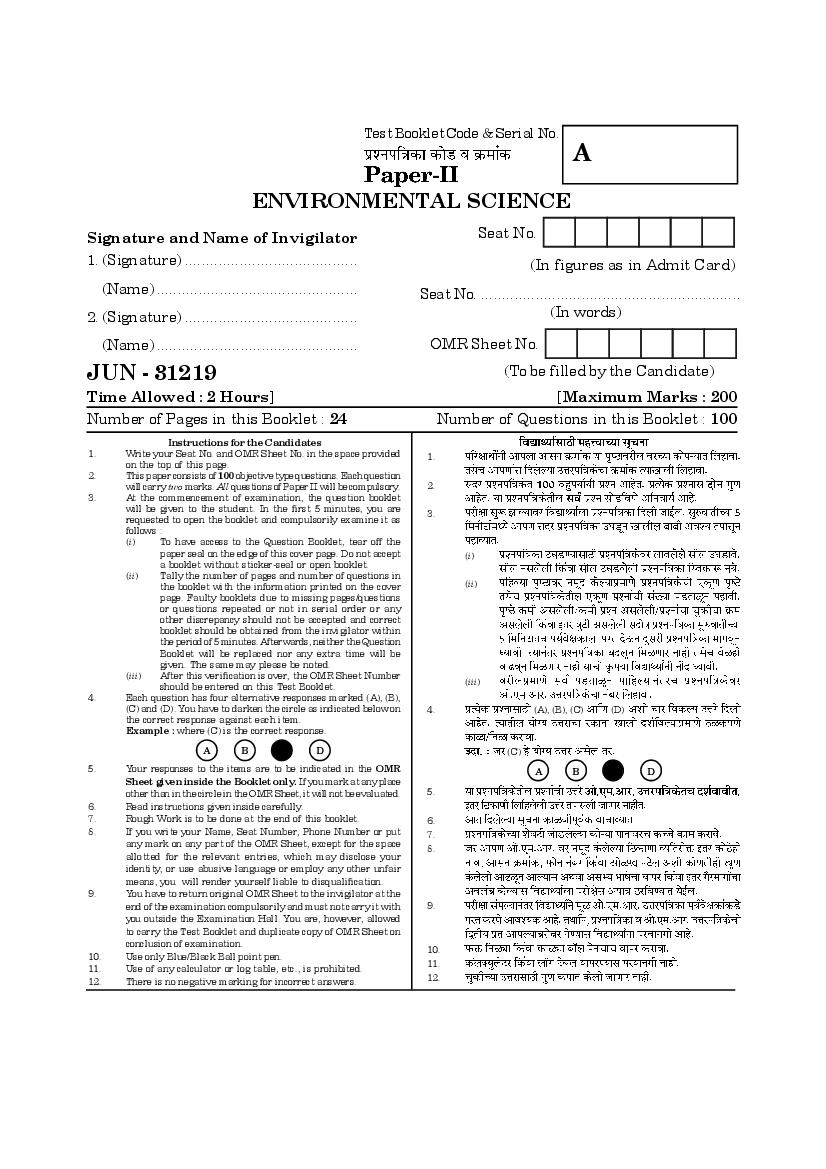
A
ENVIRONMENTAL SCIENCE
Signature and Name of Invigilator Seat No.
1. (Signature) ......................................... (In figures as in Admit Card)
(Name) ................................................ Seat No. ..............................................................
2. (Signature) ......................................... (In words)
(Name) ................................................ OMR Sheet No.
JUN - 31219 (To be filled by the Candidate)
Time Allowed : 2 Hours] [Maximum Marks : 200
Number of Pages in this Booklet : 24 Number of Questions in this Booklet : 100
Instructions for the Candidates
1. Write your Seat No. and OMR Sheet No. in the space provided 1.
on the top of this page.
2. This paper consists of 100 objective type questions. Each question
will carry two marks. All questions of Paper II will be compulsory. 2.
3. At the commencement of examination, the question booklet
will be given to the student. In the first 5 minutes, you are 3.
requested to open the booklet and compulsorily examine it as
follows :
(i) To have access to the Question Booklet, tear off the
paper seal on the edge of this cover page. Do not accept (i)
a booklet without sticker-seal or open booklet.
(ii) Tally the number of pages and number of questions in
the booklet with the information printed on the cover (ii)
page. Faulty booklets due to missing pages/questions
or questions repeated or not in serial order or any
other discrepancy should not be accepted and correct
booklet should be obtained from the invigilator within
the period of 5 minutes. Afterwards, neither the Question
Booklet will be replaced nor any extra time will be
given. The same may please be noted.
(iii) After this verification is over, the OMR Sheet Number
(iii)
should be entered on this Test Booklet.
4. Each question has four alternative responses marked (A), (B),
(C) and (D). You have to darken the circle as indicated below on 4. (A), (B), (C) (D)
the correct response against each item.
Example : where (C) is the correct response.
A B D (C)
5. Your responses to the items are to be indicated in the OMR A B D
Sheet given inside the Booklet only. If you mark at any place
other than in the circle in the OMR Sheet, it will not be evaluated. 5.
6. Read instructions given inside carefully.
7. Rough Work is to be done at the end of this booklet. 6.
8. If you write your Name, Seat Number, Phone Number or put 7.
any mark on any part of the OMR Sheet, except for the space
8.
allotted for the relevant entries, which may disclose your
identity, or use abusive language or employ any other unfair
means, you will render yourself liable to disqualification.
9. You have to return original OMR Sheet to the invigilator at the
end of the examination compulsorily and must not carry it with 9.
you outside the Examination Hall. You are, however, allowed
to carry the Test Booklet and duplicate copy of OMR Sheet on
conclusion of examination.
10.
10. Use only Blue/Black Ball point pen.
11.
11. Use of any calculator or log table, etc., is prohibited.
12. There is no negative marking for incorrect answers. 12.
Page 2
Page 3
Paper II
Time Allowed : 120 Minutes] [Maximum Marks : 200
Note : This Paper contains Hundred (100) multiple choice questions. Each question
carrying Two (2) marks. Attempt All questions.
1. Tropical cyclones are most frequently 3. Hydrostatic equation giving the
relation between height and
observed in the Bay of Bengal
pressure at a given temperature :
during :
dp
(A) = – T
dz
(A) July – August
dp –
(B)
dz T
(B) Jan. – Feb.
dp
(C) = – g
(C) March – May dz
dp –
(D) Oct. – Dec. (D)
dz g
2. The dispersal of pollutants in air is 4. Earth’s atmosphere is transparent to
dependent on : infrared radiation in the wavelength
band which is called atmospheric
(A) Wind speed only
window :
(B) Wind speed and thermal
(A) 8 – 13
stability both
(B) 14 – 17
(C) Thermal stability only
(C) 7 20
(D) Wind speed and humidity
(D) 5 – 7
3 [P.T.O.
Page 4
surface (open ocean) the albedo of
1000 m to 1500 m. If the
the surface will be :
temperature at 1000 m is 280 K,
(A) Maximum
(B) Minimum what will be temperature at the top
(C) More than bare soil of the layer (negative lapse rate
(D) More than wet soil 1.0°C/100 m) ?
6. In an adiabatic process the ................ (A) 290 K
remains unchanged.
(B) 278 K
(A) Temperature
(B) Entropy (C) 284 K
(C) Density
(D) 285 K
(D) Pressure
9. Subtropical jet stream with its core
7. If 10 calories of heat is added to a
system which does not change its of strong winds (exceeding 60 kt) at
specific volume, then as per the first nearly 200 hPa ...................... .
law of thermodynamics the change
in internal energy of the system will (A) Moves equatorward in summer
be :
(B) Remains at same location in
(A) Zero
winter and summer
(B) Positive
(C) Moves equatorward in winter
(C) Negative
(D) Either (A) or (C) (D) Moves poleward in winter
4
Page 5
condition the lapse rate is .............. the gases given in List-I generally
(A) – g/cv found in the urban environment :
List-I : O3, CO2, CH4, CO
(B) – g/cp
(A) 400 PPMV, 60 PPBV,
(C) – g/cpR
1.9 PPMV, 600 PPBV
(D) – gcp/R
(B) 60 PPBV, 400 PPMV,
11. Solar constant is :
1.9 PPMV, 600 PPBV
(A) 1345 W/M
(C) 1.9 PPMV, 60 PPBV,
(B) 1345 W/M2
400 PPMV, 600 PPBV
(C) 1200 W/M2
(D) 600 PPBV, 400 PPMV,
(D) 345 W/M 40 PPBV, 1.9 PPMV
12. If carbon monoxide concentration at 14. Which one of the following causes
1 atm and 25°C is 9.0 PPMV, then warming of the atmosphere but
concentration in mg/m3 is : cooling of the Earth’s surface ?
(A) 10.3 mg/m3 (A) Ozone
(B) 15.2 mg/m3 (B) Black carbon aerosols
(C) 20.0 mg/m3 (C) All greenhouse gases
(D) 5.6 mg/m3 (D) Sulphates and nitrates
5 [P.T.O.
Page 6
facilitates formation of tropospheric ......................... is considered as acid
ozone in the presence of sunlight ? rain.
(A) SO2 (A) More than 5.6
(B) NO2 (B) Less than 5.6
(C) NH3 (C) 10
(D) SF6 (D) 7
16. Alamatti Dam is on river Krishna 19. Which one is the most abundant
and is built in the state : greenhouse gas in the atmosphere ?
(A) Karnatka (A) CH4
(B) Maharashtra (B) SF 6
(C) Andhra Pradesh (C) N2O
(D) Telengana (D) CO2
17. What is the source of cloud 20. Which one of the following is NOT
formation and precipitation in a common component of photo-
troposphere ? chemical smog ?
(A) Water vapour (A) O3
(B) Rain (B) SO2
(C) Infiltration (C) PAN
(D) All of them (D) CFC’s
6
Page 7
gases in the increasing order of their semimetals, which one of the
Global Warming Potential (GWP) : following is considerded as metalloid ?
(A) N2O < SF6 < CH4 (A) Bi
(B) SF6 < N2O < CH4 (B) As
(C) Sp
(C) CH4 < N2O < SF6
(D) Graphite
(D) SF6 < CH4 < N2O
25. Immobilization of sulphur in soil
22. Decay of one -particle from
occurs when the C : S ratio is :
Thorium (90Th232) will result in :
(A) Below 50 : 1
(A) 90Th 231
(B) Below 100 : 1
(B) 88Ra 228
(C) Below 200 : 1
(C) 88 Ra 223
(D) Above 400 : 1
(D) 88 Ra 226
26. Mass spectrometer separates ions
23. Gypsum is :
based on the :
(A) CaCO 3
(A) Charge
(B) CaSO4.2H2O
(B) Mass
(C) CaCl 2
(C) Mass to charge ratio
(D) CaF2 (D) Molecular weight
7 [P.T.O.
Page 8
in : caused due to :
(A) Atomic absorption spectrometer (A) Magnesium chloride
(AAS)
(B) Magnesium sulphate
(B) Gas chromatography
(C) Magnesium carbonate
(C) High performance liquid
(D) Calcium sulphate
chromatography
30. Out of the following, the first step
(D) Capillary electrophoresis
of water treatment is :
28. In the process of dynamic dilution
(A) Filtration
to quantify odor in water, the
meaning of olfactory perception (B) Coagulation
threshold is : (C) Chlorination
(A) 25% of the jury perceives the (D) Sedimentation
odor
31. Which one of the following is a
(B) 50% of the jury perceives the
micronutrient for plants ?
odor
(A) S
(C) 75% of the jury perceives the
(B) B
odor
(C) Ca
(D) 100% of the jury perceives the
odor (D) P
8
Page 9
Absorption spectrometry is : (A) 48 g/mol
(B) 63 g/mol
(A) Air
(C) 62 g/mol
(B) Nitrogen
(D) 49 g/mol
(C) Acetylene
36. Factors influencing the environ-
(D) Nitrous oxide mental gradients in species diversity
are :
33. How many Nickel atoms are present
(A) Temperature
in 25 g Ni(MW of Nickel is
(B) Rainfall
58.71 g) ?
(C) Potential evapotranspiration
(A) 52.7 × 10²³ atoms of Ni (D) All of the above
(B) 25.7 × 10²³ atoms of Ni 37. In a deep water lake zonation of
water bodies w.r.t. levels from top to
(C) 2.57 × 10²³ atoms of Ni
bottom of D.O. and temperature are
(D) 5.27 × 10²³ atoms of Ni different zones are :
(A) Epilimnion Hypolimnion
34. The following reaction is an example
Mesolimnion
of CuCO3 — Cu + CO2
(B) Mesolimnion Epilimnion
(A) Acid base reaction Hypolimnion
(B) Chemiluminescence (C) Hypolimnion Mesolimnion
Epilimnion
(C) Thermal decomposition
(D) Epilimnion Mesolimnion
(D) Photometry Hypolimnion
9 [P.T.O.
Page 10
treatment of clarified sewage work
a deep water lake is known as Dark
on :
Zone ?
(A) Bacteria
(A) Littoral zone
(B) Algae
(B) Epilimnion zone (C) Bacteria and Algae
(C) Mesolimnion zone (D) All of the above
42. One of the following organisms
(D) Hypolimnion zone
is most commonly used as
39. Any organism that obtains its biofertilizer :
nutrition from dead organic material (A) Choococcus
is known as : (B) Pediastrum
(A) Autotrophs (C) Nostoc
(B) Heterotrophs (D) Aphanocapsa
43. Which one of the following is
(C) Saprotrophs
observed when analyse sewage
(D) Chemotrophs polluted water ?
40. Blue baby syndrome is caused to the (A) Low level of plant nutrient and
excess growth of algae
human infants due to :
(B) Low growth of algae and less
(A) Nitrate D.O.
(B) Sulphate (C) High concentration of nutrients
and low growth of algae
(C) Calcium
(D) High concentration of nutrients
(D) Potassium and excess growth of algae
10
Page 11
for bringing about bioconversion of disease like :
different substances ?
(A) TB (Tuberculosis)
(A) Yeasts
(B) Typhoid
(B) Molds
(C) Tetanus
(C) Bacteria
(D) Diphtheria
(D) Viruses
45. Azolla is used as a biofertilizer as 48. Pick the odd one out :
it has ...................... that fixes (A) Agrobacterium – horseradish
nitrogen.
(B) Azolla – Anabaena
(A) Rhizobium
(C) Frankia – Alder
(B) Anabaena
(D) Rhizobium – Peas
(C) Mycorrhiza
49. The ocean thermal energy
(D) Azotobacter
conversion system that is meant to
46. Which of the following are air-borne
generate power in most suitable in :
viral diseases ?
(A) Chickenpox, influenza, measles (A) Sub-tropical region
(B) Polio, rabies (B) Tropical region
(C) Tuberculosis, diphtheria (C) Cold region
(D) Cholera, typhoid (D) Moderate climate region
11 [P.T.O.
Page 12
curvilinear features observed on
of very energetic :
remotely sensed data products which
(A) Electron are of geologic origin that reflect
underlying structure.
(B) Mesons
(A) Lineament
(C) Protons
(B) Linear
(D) Neutron (C) Line
51. A discordant igneous intrusion is (D) Superlineament
known as : 54. The orbit of the satellite around the
earth that keeps pace with rotation
(A) Lopolith
of earth is known as :
(B) Laccolith (A) Sunsynchronous orbit
(C) Dyke (B) Geostationary orbit
(C) Low earth orbit
(D) Sill
(D) Elliptical orbit
52. Solifluction is a .................... type of
55. An automated system for capture,
mass movement. storage, retrieval, analysis and
display of spatial data is knonw as :
(A) Subsidence
(A) GPS
(B) Slide
(B) Landsat
(C) Rapid flow
(C) GIS
(D) Slow flow (D) Radiometer
12
Page 13
social impact ?
of Environmental Management
(A) Demographic
Plan in EIA ?
(B) Cultural
(A) Monitoring
(C) Gender
(D) Investment (B) Implementation schedule and
57. Scoping in EIA : cost estimates
(i) is a systematic exercise that
(C) TOR
establishes the boundaries of
EIA. (D) Mitigation
(ii) clearly establishes/indicates 59. Which category of projects does not
what is relevant and what is
require Environmental Impact
not.
Assessment in accordance with Indian
(iii) serves as a work plan for the
entire EIA process. EIA notification 2006 ?
Which of the following are true ? (A) Category B2
(A) (i) and (ii)
(B) Category B1
(B) (i) and (iii)
(C) Category A
(C) (ii) and (iii)
(D) All of the above (D) Category C
13 [P.T.O.
Page 14
Government of India for Protection
are to be disposed in yellow colour
and Conservation of Environment ?
coded container as per the
(A) Water (P & CP) Act, I
Biomedical Waste (Management and
(B) Air (P & CP) Act
Handling) Rules, 2016 ?
(C) Wildlife Conservation Act
(A) Human anatomical, animal,
(D) Environmental Protection Act
microbiology and biotechnology
61. Schedule II of the Hazardous Waste
(Management Handling and wastes
Transboundary Movement) Rules, (B) Waste sharps
2016 gives :
(C) Glassware
(A) List of processes generating
hazardous waste (D) Liquid waste
(B) List of waste constituents with 63. Montreal Protocol is related to :
concentration limits
(A) Greenhouse gas emission
(C) List of hazardous wastes
reduction
applicable for import and export
not requiring prior informed (B) Reducing ozone depleting
consent
substances
(D) List of hazardous wastes for
(C) Climate change protocol
import requiring prior informed
consent (D) Hazardous waste
14
Page 15
environmental audit : inland surface waters should not
exceed :
(A) Liabilities Audit
(A) 30 mg/L
(B) Waste Audits
(B) 50 mg/L
(C) EMS Audit
(C) 10 mg/L
(D) All of the above
(D) 100 mg/L
65. Biological treatment of waste water
68. Which of the following can remove
removes :
particulate as well as gaseous
(A) Suspended organic solids pollutants from air emissions ?
(B) Dissolved organic solids (A) Wet scrubber
(C) Dissolved inorganic solids (B) Cyclone
(D) All of the above (C) Electrostatic precipitation
66. Select the attached growth process (D) Bag filter
from the following : 69. A size of plot for vegetation studies
(A) Anaerobic Contact Process is decided on the basis of :
(B) Activated Sludge Process (A) No. of species
(B) Area covered by vegetation
(C) Rotating Biological Contactor
(C) Species-Area curve
(D) Upflow Anaerobic Sludge
Blanket (D) Random
15 [P.T.O.
Page 16
formation are relatively barren and
biodiversity study refers to :
nutrient deficient supporting very
(A) Number of genera in an area
poor aquatic life are :
(B) Number of species in an area
(A) Epiphytic
(C) Species composition in an area
(B) Parasitic
(D) Relative abundance of species in (C) Oligotrophic
an area (D) Saprophytic
71. The continuous increase in 73. Which one of the following agencies
concentration of a toxicant at has been designated by the Ministry
of Environment, Forest and Climate
successive trophic levels in a food
Change for Indian Eco-Mark
chain is :
Scheme ?
(A) Bioremediation
(A) Board of Indian Standards
(B) Biotransformation
(B) Bureau of Indian Standards
(C) Bioaugmentation
(C) Directorate of Marketing
(D) Biomagnification (D) Directorate of Plant Protection
16
Page 17
area is : of silt brought by rivers is
called ...................... .
(A) A flow of saline water on the
(A) Red soil
land through estuary
(B) Black soil
(B) An entry of saline water in a
(C) Alluvial soil
freshwater aquifer
(D) Pod soil
(C) An increase in salinity due to
77. Soil without living organisms is
waterlogging
referred as ..................... .
(D) An entry of marine water in
(A) Fertile soil
river in delta region
(B) Subfertile soil
75. The process of formation of soil
(C) Humus
through the breaking down of rocks
(D) Mineral substrate
is called :
78. Dodo is a flightless bird which is :
(A) Biogenesis
(A) Rare
(B) Pedogenesis
(B) Extinct
(C) Biodegradation
(C) Endangered
(D) Biomagnification (D) Critically endangered
17 [P.T.O.
Page 18
Reactivity of Substance
ecosystem refers to :
(a) Spontaneously and/or vigorously
(A) Apparent photosynthesis
react with water
(B) Total assimilation (b) Spontaneously and/or vigorously
react with air
(C) Total photosynthesis
(c) Generate toxic fumes
(D) Assimilation
(d) Explosive substance
80. Phytoplankton stage during
Example
hydrosere development include the
(i) Dynamite
following community : (ii) Aluminium nitrate
(A) Vallisnaria, Utricularia, (iii) Phosphorous pentaoxide
Hydrilla (iv) Trimethyl aluminium
Codes :
(B) Blue green algae, green algae,
(a) (b) (c) (d)
diatoms
(A) (iii) (i) (iv) (ii)
(C) Typha, Sagittaria, Phragmites
(B) (iv) (iii) (ii) (i)
(D) Nelumbo, Nymphea, Limnan- (C) (i) (ii) (iii) (iv)
themum (D) (iii) (iv) (ii) (i)
18
Page 19
of solid waste is reclaimed by machines emitting the equal sound
mechanical recovery ? level of 60 dB(A) :
(A) Food (A) 120 dB(A)
(B) Plastics (B) 90 dB(A)
(C) Leaves and plant debris (C) 63 dB(A)
(D) Metals (D) 66 dB(A)
83. Which of the following is ecofriendly 86. Which one of the following is NOT
process of solid waste management ? a natural factor that can affect
(A) Incineration watershed health ?
(B) Landfilling (A) Fires
(C) Open dumping (B) Mining
(D) Conversion into Compost/ (C) Floods
Biogas/Bioethanol (D) Earthquakes
84. The GRIHA rating was developed 87. Who was the founder of Appiko
by : movement in Uttara Kannada ?
(A) ISO (A) Pandurang Hegde
(B) TERI (B) Ganesh Gauda
(C) MoEFCC (C) Appa Swamy
(D) IGBC (D) Sunderlal Bahuguna
19 [P.T.O.
Page 20
Waste Separation Techniques of stepped matrix ?
(a) Stripping (A) Leopold et al (1971)
(b) Precipitation
(B) Johnson and Bell (1975)
(c) Sorption
(C) Carstea et al (1976)
(d) Solvent extraction
(D) Asian Development Bank
Pollutants Separated
(1987)
(i) Toxic metals
90. Which of the following is wrong
(ii) Oils and organochlorine
sentence related to Koyto Protocol ?
compounds
(A) Koyto Protocol was adopted in
(iii) Ethanol
1997
(iv) Xylene
(B) The first commitment period of
Codes :
this Protocol ended in 2012
(a) (b) (c) (d)
(A) (i) (ii) (iii) (iv) (C) The Protocol is about the
reduction of Greenhouse gases
(B) (iii) (i) (iv) (ii)
(C) (iv) (iii) (ii) (i) (D) The second commitment period
(D) (ii) (iv) (i) (iii) of the Protocol will end in 2030
20
Page 21
salinity of the open sea are known weakness in the Gaussian Plume
as : Model ?
(A) Grasses (A) The model does not evaluate
dispersion in all three
(B) Herbs
dimensions
(C) Shrubs
(B) The model cannot be used for
(D) Mangroves
reactive pollutants
92. Which one of the plant species
(C) The model is dependent upon
occurs in mangrove ecosystem ? steady-state conditions
(A) Rhizophora (D) The model is not designed as a
(B) Azadirachta long-term air shed pollutant
evaluator
(C) Mangifera
95. Which of the following cross
(D) Casurina
validation technique is best suited
93. For a certain Normal distribution,
for time series data ?
the first moment about 10 is 40.
(A) K-fold cross validation
What is the arithmetic mean ?
(B) Leave-one-out cross validation
(A) 40
(C) Stratified shuffle split cross
(B) 30
validation
(C) 50
(D) Forward chaining cross
(D) 20 validation
21 [P.T.O.
Page 22
null hypothesis when it is true, is resources of a given environment
can support is :
called :
(A) Population structure
(A) Level of confidence
(B) Carrying capacity
(B) Level of significance (C) Optimum population
(C) Power of the test (D) Minimum population
(D) All of the above 99. In statistical hypothesis of equality
of means such as H0 : = 10, if
97. The following are percentages of fat
= 5% :
found in 5 samples of each of two
(A) 95% of the time we will make
brands of food : an incorrect inference
A : 5.7, 4.5, 6.2, 6.3, 7.3 (B) 5% of the time we will say that
there is no real difference when
B : 6.3, 5.7, 5.9, 6.4, 5.1
there is no difference
To test the hypothesis of equal (C) 5% of the time we will say that
average fat content in the two types there is a real difference when
of food. Which of the following there is no difference
procedures is appropriate ? (D) 95% of the time the null
hypothesis will be correct
(A) Two sample t-test with 8
100. The following system of equations
degrees of freedom
has solution(s) :
(B) Paired t-test with 4 degrees of x + y = 2
freedom
6x + 6y = 12
(C) Two sample t-test with 9 (A) Infinite
degrees of freedom (B) No
(D) Paired t-test with 5 degrees of (C) Two
freedom (D) Unique
22
Page 23
23 [P.T.O.
Page 24
24
Document Details
| Board / Org | Maharashtra Exams |
| Exam | MAHA SET |
| Type | Question Paper |
| Pages | 24 |
| Updated | 30 Apr 2026 |