Kerala SET 2018 Jul Question Paper Mathematics
Finished viewing? Save it for later —
Download Kerala SET 2018 Jul Question Paper Mathematics (PDF · 13 pages)About Kerala SET 2018 Jul Question Paper Mathematics
Kerala SET 2018 Jul Question Paper Mathematics is available here for free download. Published by Default for Govt Jobs Exams, this question paper can be viewed online or downloaded as a PDF (13 pages). Candidates preparing for Govt Jobs Exams can use Kerala SET 2018 Jul Question Paper Mathematics to understand the exam pattern, the type of questions asked, and the overall difficulty level.
Frequently Asked Questions
How can I download Kerala SET 2018 Jul Question Paper Mathematics?
Open this page and click the Download button to save Kerala SET 2018 Jul Question Paper Mathematics as a PDF. It is completely free on AglaSem Docs.
Is Kerala SET 2018 Jul Question Paper Mathematics free to download?
Yes. Kerala SET 2018 Jul Question Paper Mathematics can be viewed online and downloaded as a PDF free of cost on AglaSem Docs.
How many pages does Kerala SET 2018 Jul Question Paper Mathematics have?
Kerala SET 2018 Jul Question Paper Mathematics contains 13 pages, which you can read online or download together as a single PDF.
Where can I find more Govt Jobs Exams study material?
You can find more Govt Jobs Exams question papers, sample papers, syllabus, and answer keys on AglaSem Docs.
Kerala SET 2018 Jul Question Paper Mathematics – Text
Read the full text of this question paper below — useful to quickly search, copy and reference the content online without downloading the PDF.
📄 View text version (13 pages)
Page 1
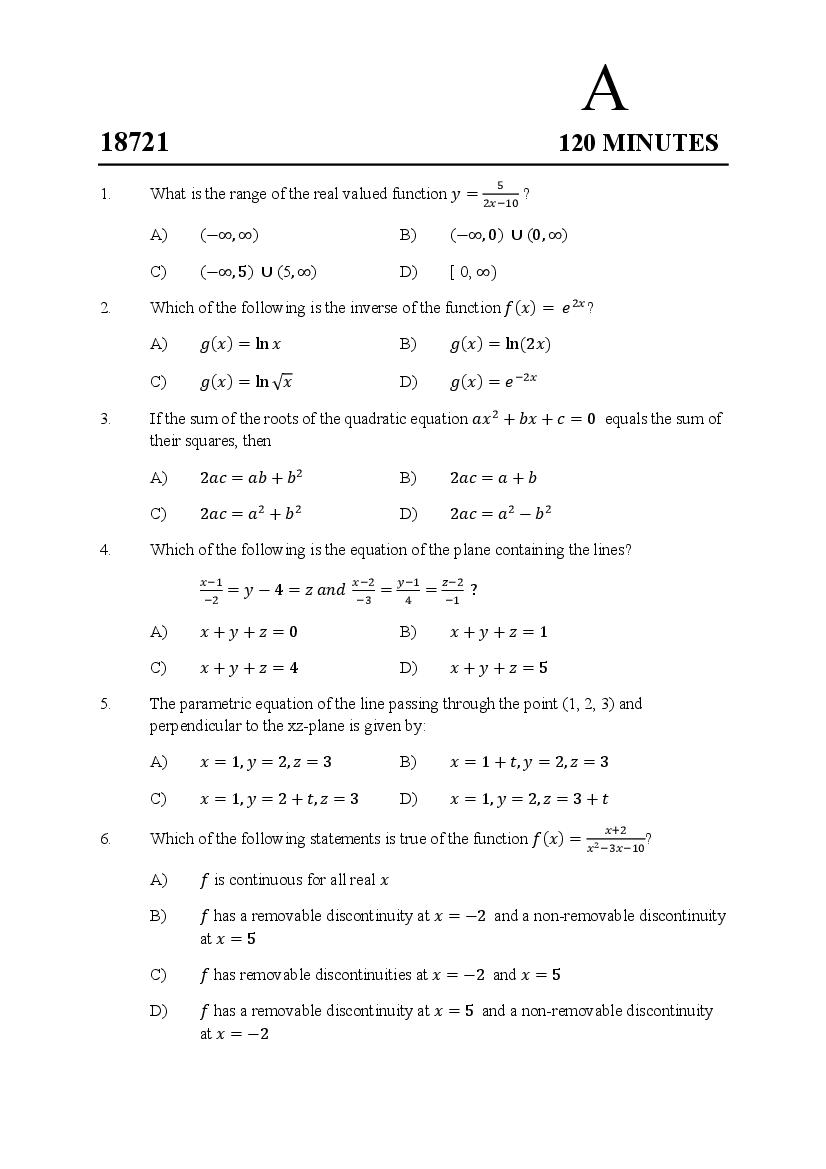
18721 120 MINUTES
1. What is the range of the real valued function = ?
A) (−∞, ∞) B) (−∞, 0) ∪ (0, ∞)
C) (−∞, 5) ∪ (5, ∞) D) [ 0, ∞)
2. Which of the following is the inverse of the function ( ) = ?
A) ( ) = ln B) ( ) = ln(2 )
C) ( ) = ln √ D) ( )=
3. If the sum of the roots of the quadratic equation + + = 0 equals the sum of
their squares, then
A) 2 = + B) 2 = +
C) 2 = + D) 2 = −
4. Which of the following is the equation of the plane containing the lines?
= −4= = = ?
A) + + =0 B) + + =1
C) + + =4 D) + + =5
5. The parametric equation of the line passing through the point (1, 2, 3) and
perpendicular to the xz-plane is given by:
A) = 1, = 2, = 3 B) =1+ , = 2, = 3
C) = 1, =2+ , =3 D) = 1, = 2, = 3 +
6. Which of the following statements is true of the function ( ) = ?
A) is continuous for all real
B) has a removable discontinuity at = −2 and a non-removable discontinuity
at = 5
C) has removable discontinuities at = −2 and =5
D) has a removable discontinuity at = 5 and a non-removable discontinuity
at = −2
Page 2
sin , ≠0
( )=
0, =0
And
, sin , ≠0
( )=
0, =0
Which of the following statements about and is true?
A) Both and are differentiable at =0
B) Both and are continuous at = 0 and neither is differentiable at =0
C) is continuous at = 0 but not differentiable at = 0, while is differentiable at
=0
D) is differentiable at = 0, while is continuous at = 0 but not differentiable at
=0
8. ∫ equals:
√ √
A) 2 ℎ √ + B) ℎ √ +
C) ln √ + √1 + + D) ln √ − √1 + +
9. What is the volume of the solid generated by rotating the area included between the curve
= and the line = about the line = 0
A) cubic units B) cubic units
C) cubic units D) cubic units
10. A card is drawn at random from a well-shuffed pack of cards. What is the probability that it
is a heart card or a red card or a king?
A) B) C) D)
11. An equilateral triangle is inscribed in a circle of radius 1 centimeter. If a point is taken at
random within the circle, what is the probability that the point lies in the triangular region?
√ √
A) B) C) D)
2
Page 3
( )
A) Converges for all p
B) Diverges for all p
C) Converges if > 1 and diverges if 0 < ≤1
D) Converges if ≥ 1 and diverges if 0 < <1
13. Which of the following statements is true of the function = , ≠ 0?
A) is uniformly continuous on (0, ∞)
B) is not uniformly continuous on [a, ∞), a > 0
C) is not continuous on [a, ∞), a > 0
D) is uniformly continuous on [a, ∞), a > 0, but not uniformly continuous on
(0, ∞)
14. Consider the function ( , ) = ( + ) . Then
A) Both ( , ) ( , ) fail to exist on the line =
B) Both ( , ) ( , ) fail to exist on the line =−
C) Both ( , ) ( , ) fail to exist on the line =0
D) Both ( , ) ( , ) fail to exist on the line =0
15. If = and = − , then
A) = tan B) = tan C) = sin D) = cos
16. Consider the following three statements about Riemann integrability of a function on [ , ]
I. If is monotonic on [ , ], then is Riemann integrable on [ , ]
II. If is bounded and continuous on [ , ] except possibly at , then is
Riemann integrable on [ , ]
III. If is bounded and continuous on [a, b] with only a finite number of points of
discontinuities in [ , ], then is Riemann integrable on [ , ].
A) Statements I and II are correct B) Statements II and III are correct
C) All the three Statements are correct D) None of the three statements are correct
3
Page 4
A) is of bounded variation on [ , ]
B) is not of bounded variation on [ , ]
C) may or may not be bounded variation on [ , ]
D) None of these statements is true
18. What does the equation | | = ( ) represent in the Argand plane?
A) The imaginary axis
B) The upper half plane
C) The circle centred at and of radius
D) The unit circle centred at the origin
19. Which of the following expressions is equal to ( + ) ?
A) ( + ) B) ( − )
C) ( − ) D) ( + )
!
20. The radius of convergence of the power series ∑ is given by
A) B) e C) 0 D) ∞
21. The largest order of the cyclic group contained in x is:
A) 12 B) 18 C) 24 D) 48
22. Let Q be the Quaternion group with centre ( ). Then the quotient group / ( ) is:
A) a cyclic group of order 4 B) a Klein four-group
C) a group of order 2 D) a group of order 8
23. Let be the group of 2x2 non-singular matrices under matrix multiplication. Let be the
0
subset consisting of lower triangular matrices of the form . Then
A) is not a proper subgroup of
B) is not a subgroup of
C) is a subgroup, but not a normal subgroup of
D) is a normal subgroup of
4
Page 5
A) 0 B) 1 C) 2 D) 3
25. Let be the permutation group on three symbols with identity element . Then the number
of elements of which satisfy the equation = is:
A) 1 B) 2 C) 3 D) 4
26. Consider the ring = ∶ . ∈ R with the usual addition and multiplication of
0
0
matrices and the set = ∶ ∈ R . Choose the correct statement.
0 0
A) is a subring of with same identity is that of S
B) is a subring of with an identity different from that of S
C) is not a subring of
D) None of these statements is true
27. The units of the Euclidean domain [ ] are:
A) ±1 B) ± C) ±1, ± D) None of these
28. Choose the incorrect statement:
A) [ (√2, 3) : (√2 )]= 2 B) [ (√2, 3) : (√3 )]= 3
C) [ (√2 ) : ]= 2 D) √2 and √3 are algebraic over
29. Squaring the circle is impossible because:
A) [ (√ ) : )] is a power of 2 B) [ (√ ) : ] is a power of 3
C) [ (√ ) : ] is finite D) [ (√ ) : ] is not a power of 2
2 1 1 0
30. If = and , then which of the following is the zero matrix?
3 −1 0 1
A) + −5 B) − −5
C) + +5 D) − +5
5
Page 6
A) If and are symmetric matrices, then AB is symmetric
B) If is a symmetric matrix, then is symmetric, ∈
C) If is a symmetric matrix, then ( ) is symmetric for any polynomial ( )
D) If is an x symmetric matrix and is an x matrix, then is
symmetric
32. Which of the following is a subspace of the vector space of x real matrices over R?
A) The set of x real symmetric matrices over R
B) The set of x real invertible matrices over R
C) The set of x real non-invertible matrices over R
D) The set of x real non-zero matrices over R
33. Which of the following is a basis for the vector space ?
I. {(1, 0, 1), (0, 1, 0), (-1, 0, 1)}
II. {(1, 2, 3), (2, 3, 4), (2, 4, 6)}
A) I only B) II only
C) Both I and II D) Neither I nor II
34. For the vector subspace of defined by = {( , , ): = 3 , , , ∈ R}
A) dim =0 B) dim =1 C) dim =2 D) dim =3
35. In which of the following cases is not a direct sum of and ?
A) = {( , , 0) ∶ , ∈ R}, = {(0, , ): , ∈ R}
B) = {( , , 0) ∶ , ∈ R}, = {(0, 0, ): ∈ R}
C) = {( , , ) ∶ = = , , , ∈ R}, = {(0, , ): , ∈ R}
D) = {( , 0, 0) ∶ ∈ R}, = {(0, , ): , ∈ R}
36. Let ∶ → be a surjective linear map. Let dim = 5 and dim = 3. Then
A) dim ker >2 B) dim ker ≥3
C) dim ker =2 D) dim ker = 0, 1 2 and each of these cases
can arise
6
Page 7
A) is neither linear nor one to one
B) is neither linear nor onto
C) is linear and has zero kernel
D) is linear and has a nonzero subspace as kernel
38. Which of the following is a solution of the differential equation −2 = ?
A) = B) = ( + )
C) = sin D) = ln
39. What is the solution of the differential equation
sec + − =0
with initial condition (1) = 0?
( ) ( )
A) = B) =
( ) ( )
C) = D) =
40. What is the particular integral of the partial differential equation
−7 +3 = ?
A) B) − C) − D) −
41. Which of the following partial differential equation is hyperbolic?
A) +6 +3 =0 B) 2 +4 +3 =0
C) 4 +4 + =0 D) −2 + =0
7
Page 8
A) ( , )
B) ( , )
C) ( , ) neither a nor a
D) ( , ) both and a
43. Which of the following statements is true?
A) For 1 ≤ ≤ ∞, the metric space is separable
B) For 1 ≤ ≤ ∞, the metric space is complete
C) For 1 ≤ ≤ ∞, the closed unit ball in is compact
D) For 1 ≤ < ≤ ∞, the normed space is contained in
44. Choose the correct statement from among the following:
A) The supremum norm on [ . ] comes from an inner product
B) [ . ] is not complete with respect to the supremum norm
C) [ . ] is complete with respect to ‖. ‖
D) [ . ] is complete with respect to the supremum norm
45. Consider two different inner products in ℝ
IP 1 defined by < , >= +( + )+2
for all = , = , ∈ ℝ and IP 2 the standard inner product on ℝ .
Then the angle between (1, 0) and (0, 1) is:
A) with respect to IP 2
B) with respect to IP 1
C) with respect to both IP 1 and IP 2
D) with respect to both IP 1 and IP 2
8
Page 9
1
A) - B) -1 C) 2 D) -2
8
47. If A=cos (cosx) + sin (cosx), then the least and greatest values of A are
A) 0 and 2 B) -1 and 1 C) − 2 and 2 D) 0 and 2
18
48. The values of cos2(5r)∘, where x∘ denotes the x degrees, is equal to
r=1
A) 0 B) 7/2 C) 17/2 D) 25/2
e2z
49. The value of
, where c is the circle |z|=2 is
(z−1) 5
c
A) B) C) D)
1−e−z
50. Let f:C→C be defined by f(z)= for z∈ℂ. For this function, the point z=0 is
z
A) an essential singularity B) a pole of order zero
C) a pole of order one D) a removable singularity
1
51. γ:[0,1]→C is defined by γ(t)=2e2πit. Then n(γ, ) is
2
A) Not defined B) 2 C) 1 D) 0
52. The number of fixed points of the Mobius-transformation
S(z) = az +b, a ≠ 0, a ≠ 1 are:
A) 2 B) 1 C) 0 D) 3
53. If |z−3i|=|z+3i|, the locus of z is:
A) real axis B) imaginary axis
C) circle x2+y2=1 D) parabola y2=9x
54. The number of elements of order 3 in the alternating group A4 is:
A) 7 B) 2 C) 8 D) 5
9
Page 10
A) 4 B) 3 C) 2 D) 1
56. Find the number of non-zero elements in the field Zp which are squares ie. of the
form m2, m∈Zp, m≠0 , where p is an odd prime number
p−1 p p+1
A) B) C) D) p
2 3 2
57. The number of group homomorphisms from the symmetric group S3 to ℤ/6ℤ is
A) 6 B) 2 C) 3 D) 1
58. Let G be a cyclic group of order 10. For a∈G, let <a> denote the subgroup generated
by a. How many elements are there in the set {a∈G| <a> = G}
A) 3 B) 4 C) 5 D) 1
59. The system x+y+2z=a1, −2x−z=a2, x+3y+5z=a3 has no solution, then
A) a3=a2 and a1≠0 B) a3=a2=a1=0
C) a3=3a1 and a2=0 D) a2=−3a1 and a3=0
60. The rank of the linear transformation : ℝ → ℝ by
T(a, b, c)=(a+2b−c, b+c, a+b−2c) is
A) 1 B) 2 C) 3 D) 0
61. Let A be a nilpotent linear transformation on a finite dimensional vector space V over
reals. Which of the following is true about A
A) A is invertible
B) I−A is invertible
C) Eigen values of A are of absolute value 1
D) A has ‘n’ distinct eigen values, where n is the dim of V
62. The geometrical effect of the linear transformation associated with the matrix
−1 0
is
0 2
π
A) rotation by an angle
2
B) stretching along Y-axis and a reflection with respect to Y-axis
C) a stretching along X-axis
D) reflection with respect to X-axis
10
Page 11
that for some α,β,γ∈C, αA−1=A2+βA+γI, where I is 3×3 identity matrix. Then (α,β,γ)
equals
A) (−1,−4,4) B) (−1,4,−2) C) (−1,−2,4) D) (4,−1,4)
1
64. Let M = 0 2 where a,b,c ∈ R, then M is diagonalizble if and only if
0 0 1
A) a = bc B) b = ac C) c = ab D) a=b=c
65. The general solution of the wave equation = is
A) y(x,t)=φ(x+ct) B) y(x,t)=φ(x+ct)+χ(x−ct)
C) y(x,t)=φ(x−ct) D) No general solution exist
66. For the equation (x2+x−2)2y''+3(x+2)y'+(x−1)y=0, which of the following is correct?
A) x = −2 is regular singular point; x =1 is irregular singular point
B) x = −2 is regular singular point; x =1 is regular singular point
C) x = −2 is irregular singular point; x =1 is irregular singular point
D) x = −2 is irregular singular point; x =1 is regular singular point
67. The partial differential equation uxx+x2uyy=0 is of
A) parabolic B) hyperbolic C) straight linear D) elliptic
68. The solution of (12x+5y−9)dx+(5x+2y−4)dy=0 is
A) 6x2−5xy−y2+9x−4y=c B) 3x2−4xy−y2+9x−3y=c
C) 6x2+5xy−y2−9x−4y=c D) 6x2+5xy+y2−9x−4y=c
69 Using Picard’s method the approximate solution to the initial value problem y'=1+y2,
y(0) = 0 is
A) y(x) = tanx B) ( )= − − ±⋯
C) ( )= − − ± ⋯ D) ( )= − − ±⋯
70. The partial differential equation formed from the equation that represents the set of all
spheres whose centre lie along the z-axis is given by
A) xp−yq=0 B) yp−2q=0 C) yp−xq=0 D) xp−2q=0
11
Page 12
A) cos(3x−y) B) x2+y2 C) sin(3x−3y) D) e−3πxsinπy
72. Which of the following is an example of parabolic type partial differential equation
A) Wave equation B) Heat equation
C) Laplace equation D) All the above
73. Let X and Y be two topological spaces which are homomorphic. Then which of the
following is not true
A) If X is connected then Y is also connected
B) If X is compact then Y is also compact
C) If X is Hausdroff then Y is also Hausdroff
D) If X is complete then Y is also complete
74. Which of the following is true?
A) The set of integers Z with usual metric is a complete metric space
B) [0, 1] is nowhere dense in R with usual topology
C) The set Q of rational numbers can be written as =∩ ∈ ∪ , where
{Un, n∈N} is a sequence of open sets in R with usual topology
D) If d is a bounded metric in X and ′ is an unbounded metric on X then d
cannot equivalent to ′
75. Let X be a Hausdroff space. Then which of the following is true
A) A sequence in X may have more than one limit
B) The diagonal {(x,x) |x∈X} is not closed
C) If f:X→Y is continuous and Y is Hausroff then {(x,y) | f(x)=f(y)} is a closed
subspace of X×X
D) There exists a metric space which is not Hausdroff
76. Let τ be the topology on R genertaed by { [a,a+1] | a∈R} , then
A) τ is the discrete topology B) τ is the trivial topology
C) τ is countable D) Every singleton set is open but not closed
12
Page 13
the sequence {xn} where xn=n for all n∈N
A) Converges and the limit is unique
B) The limit of xn cannot be an integer
C) Converges to 1
D) It has no limit points
78. If 1 ≤ p < q < ∞ and 0≠x∈lp, then which of the following relation is true always
A) ||x||p>||x||q B) ||x||p≥||x||q C) ||x||p<||x||q D) ||x||p≤||x||q
79. Let F:X→Y be a closed, linear map such that R(F)=Y where X and Y are Banach
spaces. Which of the following is true
A) F is continuous and open B) F is continuous but not open
C) F is open and discontinuous D) F is neither continuous nor open
80. Let X be an inner product space , Y be a subspace of X and x ∈ X. Let y be a best
approximation from Y to x. Then dist(x,Y) is
A) < , >/
B) < , − >/
C) < , + >/
D) < + , − >/
_______________________
13
Document Details
| Board / Org | Default |
| Exam | Govt Jobs Exams |
| Type | Question Paper |
| Pages | 13 |
| Updated | 22 Jul 2026 |