MBOSE Class 12 Question Paper 2023 for Political Science
Finished viewing? Save it for later —
Download MBOSE Class 12 Question Paper 2023 for Political Science (PDF · 12 pages)About MBOSE Class 12 Question Paper 2023 for Political Science
MBOSE Class 12 Question Paper 2023 for Political Science is available here for free download. Published by Meghalaya Board for Class 12, this question paper can be viewed online or downloaded as a PDF (12 pages). Candidates preparing for Class 12 can use MBOSE Class 12 Question Paper 2023 for Political Science to understand the exam pattern, the type of questions asked, and the overall difficulty level.
Frequently Asked Questions
How can I download MBOSE Class 12 Question Paper 2023 for Political Science?
Open this page and click the Download button to save MBOSE Class 12 Question Paper 2023 for Political Science as a PDF. It is completely free on AglaSem Docs.
Is MBOSE Class 12 Question Paper 2023 for Political Science free to download?
Yes. MBOSE Class 12 Question Paper 2023 for Political Science can be viewed online and downloaded as a PDF free of cost on AglaSem Docs.
How many pages does MBOSE Class 12 Question Paper 2023 for Political Science have?
MBOSE Class 12 Question Paper 2023 for Political Science contains 12 pages, which you can read online or download together as a single PDF.
Where can I find more Class 12 study material?
You can find more Class 12 question papers, sample papers, syllabus, and answer keys on AglaSem Docs.
MBOSE Class 12 Question Paper 2023 for Political Science – Text
Read the full text of this question paper below — useful to quickly search, copy and reference the content online without downloading the PDF.
📄 View text version (12 pages)
Page 1
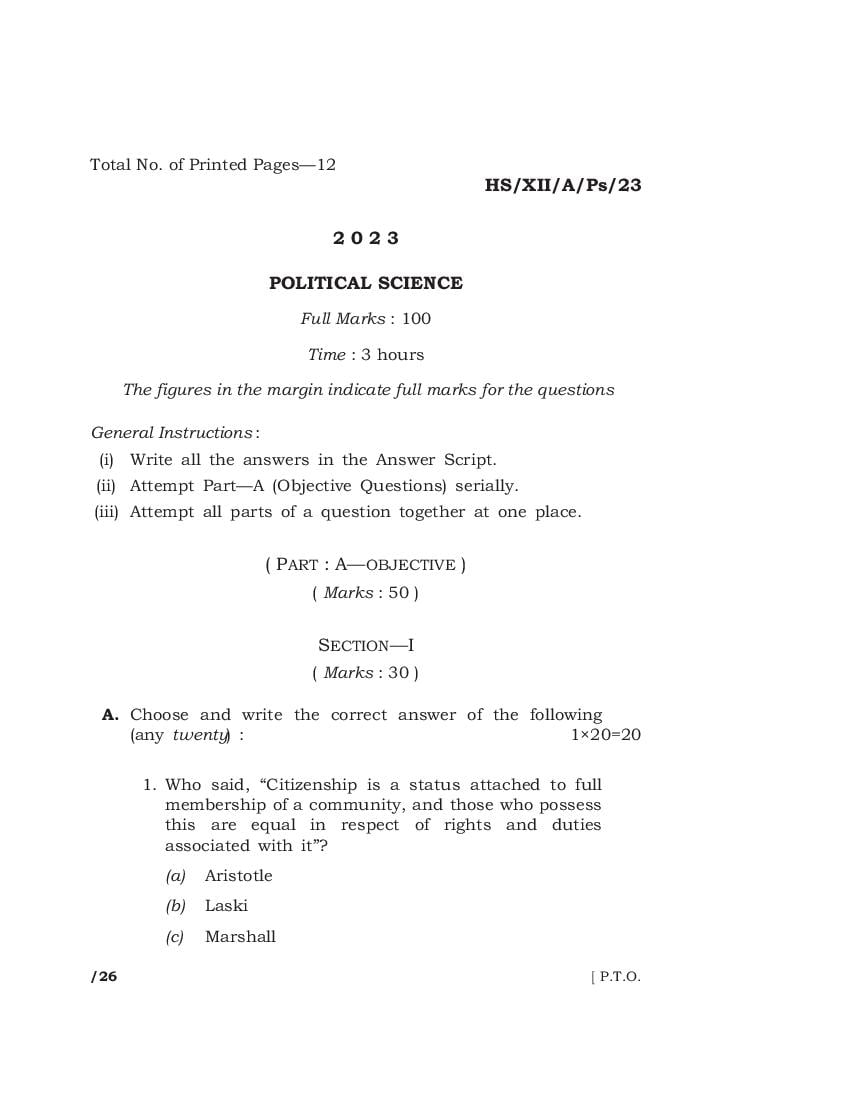
HS/XII/A/Ps/23
2023
POLITICAL SCIENCE
Full Marks : 100
Time : 3 hours
The figures in the margin indicate full marks for the questions
General Instructions :
(i) Write all the answers in the Answer Script.
(ii) Attempt Part—A (Objective Questions) serially.
(iii) Attempt all parts of a question together at one place.
( PART : A—OBJECTIVE )
( Marks : 50 )
SECTION—I
( Marks : 30 )
A. Choose and write the correct answer of the following
(any twenty) : 1×20=20
1. Who said, “Citizenship is a status attached to full
membership of a community, and those who possess
this are equal in respect of rights and duties
associated with it”?
(a) Aristotle
(b) Laski
(c) Marshall
/26 [ P.T.O.
Page 2
2. “A set of international, moral and legal norms that
attempts to protect individuals everywhere from
social, economic and political abuses”—refers to
(a) legal rights
(b) civil rights
(c) human rights
3. “Man is born free but everywhere he is in chains”,
was said by
(a) Locke
(b) Rousseau
(c) Hobbes
4. Who believed that liberty and equality are
antagonistic and antithetical to each other?
(a) Lord Acton
(b) R. H. Tawney
(c) C. E. M. Joad
5. True equality implies
(a) identical salaries
(b) the provision of adequate opportunities for all
(c) the absence of special privileges
HS/XII/A/Ps/23/26 [ Contd.
Page 3
6. According to Rawls, justice is
(a) equality
(b) fairness
(c) honesty
7. The most important source of law today is
(a) custom
(b) judicial decisions
(c) legislation
8. When the minimum age for the right to vote is
increased, the number of voters
(a) increases
(b) decreases
(c) remains constant
9. In which system of representation the constituencies
are demarcated after every census?
(a) Proportional
(b) Communal
(c) Territorial
HS/XII/A/Ps/23/26 [ P.T.O.
Page 4
10. Liberalism as an ideology started to emerge in the
(a) 17th Century
(b) 18th Century
(c) 19th Century
11. According to Marxism, which class will end the
capitalist system?
(a) The Bourgeois class
(b) The Proletariat class
(c) The Elite class
12. The judges of the International Court of Justice are
elected for a period of
(a) six years
(b) nine years
(c) five years
13. The Chief Administrative Officer of the UN is
(a) the Secretary General
(b) the Director General
(c) the Chairman
HS/XII/A/Ps/23/26 [ Contd.
Page 5
14. Habeas corpus literally means
(a) to have a body
(b) command
(c) to certify
15. The idea of Directive Principles of State Policy in the
Indian Constitution was largely influenced by the
(a) American Constitution
(b) Canadian Constitution
(c) Irish Constitution
16. Who among the following stands at the apex of the
administrative structure of India?
(a) The Prime Minister
(b) The President
(c) The Chief Justice
17. The President of India stands impeached when an
impeachment resolution is passed by
(a) 2/3rd majority in the Lok Sabha
(b) 1/3rd majority of both the Houses of the
Parliament
(c) 2/3rd majority in each House of the Parliament
HS/XII/A/Ps/23/26 [ P.T.O.
Page 6
18. The strength of the Union Council of Ministers must
not exceed 15% of the total members of
(a) the Lok Sabha
(b) the Rajya Sabha
(c) both the Houses
19. The Union Council of Ministers is collectively
responsible to
(a) the Council of States
(b) the House of the People
(c) both Houses of the Parliament
20. The phrase ‘first among equals’ refers to whom?
(a) The President
(b) The Chief Justice
(c) The Prime Minister
21. The quorum in the Sessions of the Lok Sabha or the
Rajya Sabha should be
(a) one-tenth
(b) one-twelfth
(c) one-third
HS/XII/A/Ps/23/26 [ Contd.
Page 7
22. The maximum strength of the Lok Sabha envisaged in
the Constitution is
(a) 530
(b) 545
(c) 552
23. Under the Act of 1935, an All India Court was called
as the
(a) Supreme Court
(b) Federal Court
(c) Apex Court
24. India’s agenda for reforms of the United Nations
relates mainly to
(a) restructuring of the UN Secretariat
(b) restructuring of the General Assembly
(c) restructuring of the Security Council
25. The National Human Rights Commission in India was
established on
(a) 12th October, 1953
(b) 12th October, 1993
(c) 12th December, 1948
HS/XII/A/Ps/23/26 [ P.T.O.
Page 8
B. Write whether the following statements are True or False
(any ten) : 1×10=10
1. Citizens as well as aliens can demand security from
the State.
2. Economic liberty means that a man should be forced
to do something for earning a livelihood.
3. Social justice seeks to protect the weaker sections of
the society.
4. Universal Adult Franchise is necessary for achieving
political equality.
5. Functional Representation is a system that gives
representation to different communities in the State.
6. Classical liberals consider individuals to be their own
masters.
7. According to Marx, revolution is not necessary to end
the capitalist social order.
8. The Security Council is the main judicial organ of
the UN.
9. Fundamental Rights are absolute.
10. The Directive Principles need legislation for their
implementation.
HS/XII/A/Ps/23/26 [ Contd.
Page 9
11. The President of India is elected through the method
of Proportional Representation.
12. The term of the Lok Sabha cannot be extended at all.
13. The joint sitting of the Parliament is presided over by
the President.
14. The Supreme Court’s adhoc judges are appointed by
the Chief Justice with prior consent of the President.
15. India is a signatory to the Universal Declaration of
Human Rights.
SECTION—II
( Marks : 20 )
C. Answer the following questions in about 2 or 3 sentences
each (any ten) : 2×10=20
1. What are the principles of citizenship acquired by
birth?
2. Write any two characteristics of rights.
3. Mention two ways in which law protects liberty.
4. What is Universal Adult Franchise?
HS/XII/A/Ps/23/26 [ P.T.O.
Page 10
5. What is positive liberalism?
6. Give the full forms of ICAO and UNESCO.
7. Name at least four States enjoying veto powers in the
UN Security Council.
8. What is mandamus?
9. State two differences between the Fundamental
Rights and the Directive Principles of State Policy.
10. What are the two ways in which the President’s Office
may be terminated before his term ends?
11. What are the two main powers of the Speaker of the
Lok Sabha?
12. What is the Principle of Collective Responsibility in
India?
13. What are the qualifications required to be a judge of
the Supreme Court?
14. Mention any two objectives of SAARC.
15. Why has India not signed the NPT?
HS/XII/A/Ps/23/26 [ Contd.
Page 11
( PART : B—DESCRIPTIVE )
( Marks : 50 )
GROUP—A
( Political Theory )
Answer any three of the following questions : 10×3=30
1. Define Rights. Explain the classification of Rights. 2+8=10
2. What are Negative Equality and Positive Equality?
Describe the different kinds of Equality. 3+7=10
3. Define Law. Explain the kinds of Law. 2+8=10
4. Explain Proportional Representation and state its merits
and demerits. 6+4=10
5. Explain the main features or tenets of Marxism. 10
6. Describe the composition, powers and functions of
the UN General Assembly. 2+8=10
7. Write short notes on any two of the following : 5×2=10
(a) Relationship between Liberty and Equality
(b) Economic Justice
(c) Religion as a Source of Law
(d) Merits of Universal Adult Franchise
(e) Five basic principles of the UN
HS/XII/A/Ps/23/26 [ P.T.O.
Page 12
GROUP—B
( The Indian Constitution )
Answer any two of the following questions : 10×2=20
8. Enumerate the Fundamental Rights of the Indian
Citizens. 10
9. Describe the powers and functions of the Prime Minister
of India. 10
10. Explain the powers and functions of the Rajya Sabha. 10
11. Describe the jurisdictions of the Supreme Court of India. 10
12. What is Non-Aligned Movement? Give a brief assessment
of India’s role in NAM. 5+5=10
13. Write short notes on any two of the following : 5×2=10
(a) Fundamental Duties of the Indian Citizens
(b) Gandhian Principles
(c) Vice President of India
(d) India’s role in the UN Security Council and its
peace-keeping operations
(e) Emergency powers of the Indian President
HHH
HS/XII/A/Ps/23/26 K23—27850
Document Details
| Board / Org | Meghalaya Board |
| Exam | Class 12 |
| Type | Question Paper |
| Pages | 12 |
| Updated | 22 Jul 2026 |