Kerala SET 2018 Jul Question Paper Philosophy
Finished viewing? Save it for later —
Download Kerala SET 2018 Jul Question Paper Philosophy (PDF · 13 pages)About Kerala SET 2018 Jul Question Paper Philosophy
Kerala SET 2018 Jul Question Paper Philosophy is available here for free download. Published by Default for Govt Jobs Exams, this question paper can be viewed online or downloaded as a PDF (13 pages). Candidates preparing for Govt Jobs Exams can use Kerala SET 2018 Jul Question Paper Philosophy to understand the exam pattern, the type of questions asked, and the overall difficulty level.
Frequently Asked Questions
How can I download Kerala SET 2018 Jul Question Paper Philosophy?
Open this page and click the Download button to save Kerala SET 2018 Jul Question Paper Philosophy as a PDF. It is completely free on AglaSem Docs.
Is Kerala SET 2018 Jul Question Paper Philosophy free to download?
Yes. Kerala SET 2018 Jul Question Paper Philosophy can be viewed online and downloaded as a PDF free of cost on AglaSem Docs.
How many pages does Kerala SET 2018 Jul Question Paper Philosophy have?
Kerala SET 2018 Jul Question Paper Philosophy contains 13 pages, which you can read online or download together as a single PDF.
Where can I find more Govt Jobs Exams study material?
You can find more Govt Jobs Exams question papers, sample papers, syllabus, and answer keys on AglaSem Docs.
Kerala SET 2018 Jul Question Paper Philosophy – Text
Read the full text of this question paper below — useful to quickly search, copy and reference the content online without downloading the PDF.
📄 View text version (13 pages)
Page 1
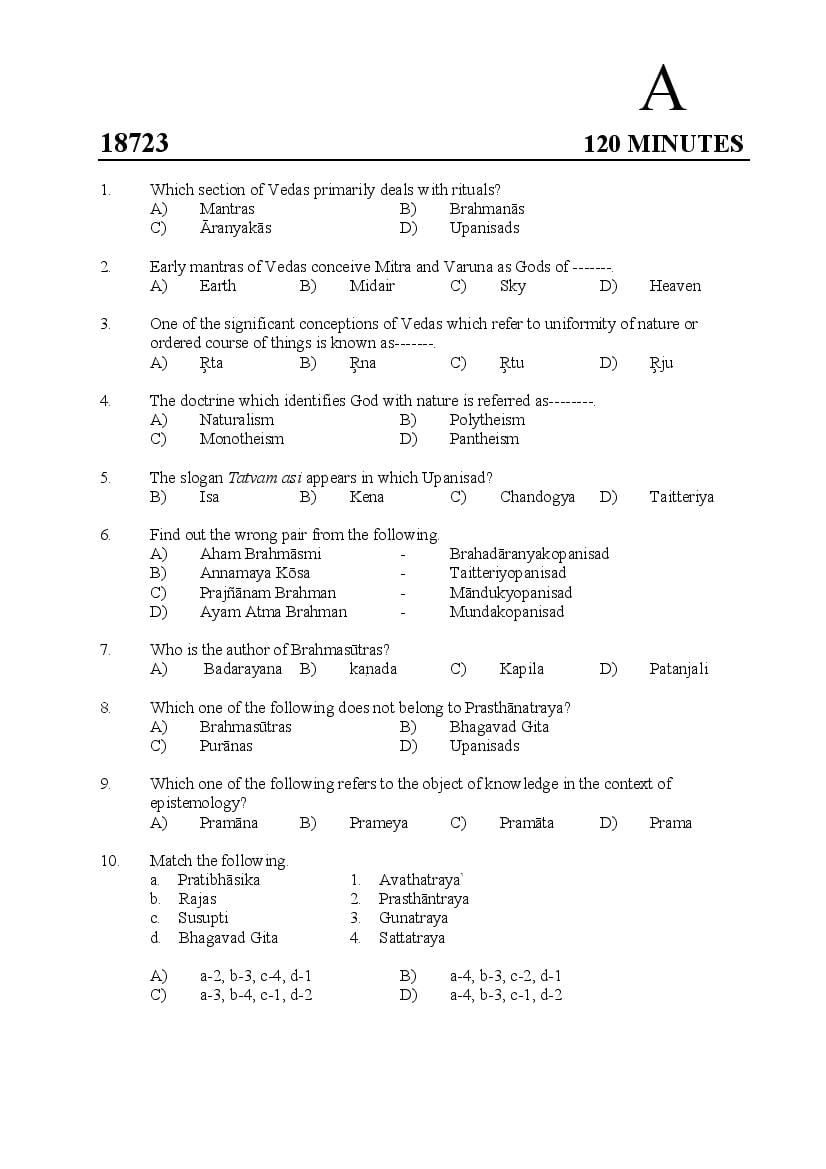
18723 120 MINUTES
1. Which section of Vedas primarily deals with rituals?
A) Mantras B) Brahmanās
C) Āranyakās D) Upanisads
2. Early mantras of Vedas conceive Mitra and Varuna as Gods of -------.
A) Earth B) Midair C) Sky D) Heaven
3. One of the significant conceptions of Vedas which refer to uniformity of nature or
ordered course of things is known as-------.
A) Ŗta B) Ŗna C) Ŗtu D) Ŗju
4. The doctrine which identifies God with nature is referred as--------.
A) Naturalism B) Polytheism
C) Monotheism D) Pantheism
5. The slogan Tatvam asi appears in which Upanisad?
B) Isa B) Kena C) Chandogya D) Taitteriya
6. Find out the wrong pair from the following.
A) Aham Brahmāsmi - Brahadāranyakopanisad
B) Annamaya Kōsa - Taitteriyopanisad
C) Prajñānam Brahman - Māndukyopanisad
D) Ayam Atma Brahman - Mundakopanisad
7. Who is the author of Brahmasūtras?
A) Badarayana B) kaṇada C) Kapila D) Patanjali
8. Which one of the following does not belong to Prasthānatraya?
A) Brahmasūtras B) Bhagavad Gita
C) Purānas D) Upanisads
9. Which one of the following refers to the object of knowledge in the context of
epistemology?
A) Pramāna B) Prameya C) Pramāta D) Prama
10. Match the following.
a. Pratibhāsika 1. Avathatraya`
b. Rajas 2. Prasthāntraya
c. Susupti 3. Gunatraya
d. Bhagavad Gita 4. Sattatraya
A) a-2, b-3, c-4, d-1 B) a-4, b-3, c-2, d-1
C) a-3, b-4, c-1, d-2 D) a-4, b-3, c-1, d-2
Page 2
A) Cit, Acit, Isvara B) Cit, Manas, Brahman
C) Samñja, Samskāra, Moksa D) Pramāna, Viparya, Vikalpa
12. --------is the view that physical events are caused by brain and mind is a by-product
of matter.
A) Phenomenalism B) Epiphenomenalism
C) Phenomenology D) Phenomena
13. Pratityasamudpādavāda of Buddhism refers to ---------.
A) The no-soul theory
B) The theory of momentariness
C) The law of dependent origination
D) The four noble truths
14. Jainism believes in 24 prophets or Thirthamkaras. Who was the first one?
A) Ŗșabha B) Ajita C) Sambhava D) Vardhamana
15. Which one of the following refers to Nyāya theory of causation?
A) Satkarana vāda B) Satkārya vāda
C) Svabhāva vāda D) Asatkārya vāda
16. Which one of the following does not belong to Yoga Sūtra of Patanjali?
A) Samādhipāda B) Samānyapāda
C) Sādhanapāda D) Vibhūtipāda
17. Mīmāmsa sūtras were written by -------.
A) Sabarasvamin B) Prbhakara
C) Kumarila Bhatta D) Jaimini
18. Who is the author of Nātyasāstra?
A) Anandavardhana B) Bhāmaha
C) Bharata Muni D) Vāmana
19. Match the following Stāyibhāvas with the corresponding Rasās.
a. Rati 1. Roudra
b. Soka 2. Veera
c. Krodha 3. Srangāra
d. Utsaha 4. Karuna
A) a-3, b-4, c-1, d-2 B) a-3, b-1, c-2, d-4
C) a-2, b-3, c-4, d-1 D) a-4, b-3, c-2, d-1
20. Which one of the following is directly related to suggested sense or dhvani?
A) Abhida B) Laksana C) Vyañjana D) Prathibha
21. Swami Vivekananda represented India at the World parliament of Religions held at------.
A) London B) Chicago C) Boston D) Melbourne
2
Page 3
A) To face the challenge developed by the importation of western ideas and
values
B) To promote western educational reforms
C) To integrate western ideas and traditional ideas
D) To integrate the princely states to a single unit
23. Who founded the Brahmo-Samaj?
A) Keseb Chandra Sen B) Dayananda Saraswati
C) Ramakrishna Paramahamsa D) Raja Ram Mohan Roy
24. What was the original childhood name of Swami Vivekananda?
A) Siddhartha B) Narendranath Datta
C) Viswanath Datta D) Ramakrishna
25. The concept of Integral Yoga was developed by-------.
A) Swami Vivekananda B) Ramakrishna Paramahamsa
C) Aurobindo D) Patanjali
26. Which one of the following represents the process of evolution according to
Sri. Aurobindo?
A) Matter, Psyche, Life, Mind. B) Matter, Mind, Life, Psyche.
C) Matter, Life, Psyche, Mind. D) Matter, Psyche, Mind, Life.
27. Which one of the following is a not a work of Sri Aurobindo?
A) Jñānayoga B) Synthesis of Yoga
C) The life Divine D) Savitri
28. Ramana Maharshi was a native of -------state.
A) Kerala B) Bengal C) Kashmir D) Tamilnadu
29. Who is the author of The Religion of Man?
A) Aurobindo B) Rabindranath Tagore
C) Dr.S.Radhakrishnan D) Swami Vivekananda
30. Examine the following statements and choose the appropriate alternatives.
1. Gitanjali is a great work of Rabindranath Tagore.
2. Rabindranath Tagore won the Nobel Prize for literature.
3. Rabindranath Tagore was born in Bombay.
4. Rabindranath Tagore established an ashram at Santhiniketan.
A) All statements are True.
B) Statements 1, 2,4 are True and 3 is false.
C) Statements 1, 2 are True and 3, 4 are False.
D) All statements are False.
31. According to Dr. Radhakrishnan--------- is an integral experience.
A) Perception B) Sensation C) Intelligence D) Intuition
3
Page 4
a. Rabindranath Tagore 1. Four Yogas.
b. Swami Vivekananda 2. Jñānavichara
c. Ramana Maharshi 3. Intellect and Intuition
d. Dr.S. Radhakrishnan 4. Gitanjali
A) a-4, b-1,c-2, d-3 B) a-4, b-2, c-1,d-3
C) a-3, b-1, c-4, d-2 D) a-2, b-1, c-4,d-3
33. Which one of the following is the autobiography of Mahatma Gandhi?
A) My Experiments with Truth
B) My Experience with Truth
C) The Story of My Experiments with Truth
D) The Story of My Experience with Truth
34. Which one of the following thinkers influenced Gandhi to develop the concept of
Sarvodaya?
A) Rousseau B) Tagore
C) Swami Vivekananda D) Ruskin
35. Truth is a pathless land is attributed to --------.
A) Gandhi B) J.Krishnamurthi
C) Tagore D) Sri Aurobindo
36. The concept of radical humanism was conceived by -------.
A) Aurobindo B) Iqbal C) Gandhi D) M.N.Roy.
37. Which one of the following is the work of Dr.B.R.Ambedkar?
A) Jati Mimamsa B) The Religion of Man
C) Annihilation of Caste D) Religion and Society
38. Where did Sree Narayana Guru Install the idol of Siva which is later described as
Ezhava Siva?
A) Aruvippuram B) Mannanthala
C) Varkala D) Chempazanthy
39. Match the following:
a. Chattampi Swamikal 1. Freedom from the Known
b. SreeNarayana Guru 2. Advaita Chinta Padhati
c. B.R.Ambedkar 3. One Caste, One Religion and One God for Mankind
d. J.Krishnamurthi 4. Indian Constitution
A) a-3, b-1, c-4, d-2 B) a-2, b-1, c-3, d-4
C) a-2, b-3, c-4, d-1 D) a-3, b-4, c-1, d-2
40. Who is the author of New Humanism?
A) Gandhi B) M.N.Roy C) Tagore D) Aurobindo
4
Page 5
A) Thales B) Anaximander
C) Anaximenes D) Pythagoras
42. The doctrine of change and unity of opposites were held by-------.
A) Thales B) Anaximander
C) Anaximenes D) Heraclitus
43. The midwifery method is attributed to-------.
A) Socrates B) Plato C) Aristotle D) Plotinus
44. Which one of the following is not a Cardinal Virtue of Plato?
A) Wisdom B) Temperance C) Pride D) Justice
45. Name the Greek philosopher who designed Syllogism as a tool for logical reasoning?
A) Socrates B) Aristotle C) Plato D) Plotinus
46. Which one of the following philosophers is known as Angelic Doctor?
A) St.Thomas Aquinas B) St.Anselm
C) St.Augustine D) Boethius
47. Match the following.
a. St.Thomas Aquinas 1. Nichomachean Ethics
b. Socrates 2. Theory of Ideas
c. Plato 3. Confessions
d. Aristotle 4. Dialectical method
A) a-2, b-3, c-1, d-4 B) a-3, b-4, c-2, d-1
C) a-3, b-1, c-2, d-4 D) a-4, b-3, c-2, d-1
48. Which one of the following is related to Ockham’s razor?
A) Entities should be explained ambiguously.
B) When so many explanations are possible, complex one should be taken.
C) Entities should not be multiplied unnecessarily.
D) None of these
49. St.Thomas Aquinas develops -----number proofs for the existence of God.
A) Three B) Four C) Five D) Six
50. Francis Bacon was an---------philosopher.
A) Italian B) Irish C) Ethiopian D) English
51. According to Bacon, the deceptive beliefs which are inherent in human beings are
referred as-----.
A) Idols of Tribe B) Idols of Cave
C) Idols of Market place D) Idols of Theatre
5
Page 6
1. Descartes was a French philosopher.
2. According to Descartes experience is the source of knowledge.
3. Descartes believed in innate ideas.
4. Descartes developed the method of initial scepticism.
A) Statement1, 2, 3 are true and 4 is false
B) Statement1, 3,4 are true and 2 is false.
C) All statements are true
D) Statement2, 3, 4 are true and 1 is false
53. Who developed the theory of Psycho Physical Parallelism?
A) Descartes B) Leibniz C) Spinoza D) Bacon
54. Who is the author of Monadology?
A) Bacon B) Leibniz C) Descartes D) Spinoza
55. The expression Tabula Rasa refers to --------.
A) Clean slate B) Preconceived notion
C) Intuition D) Experience
56. Which one of the following is not a work of George Berkeley?
A) An Essay towards a New Theory of Vision
B) Treatise concerning the Principles of Human Knowledge
C) A Treatise of Human Nature
D) Three Dialogues between Hylas and Philonous
57. -----statements are knowable apriori.
A) Analytic B) Synthetic
C) Both A & B D) Neither A nor B
58. Ethical ideas of Kant are seen in his ---------.
A) Critique of Judgment
B) Critique of Pure Reason
C) Critique of Practical Reason
D) None of these
59. Which one of the following does not belong to Hegelian dialectics?
A) Thesis B) Antithesis
C) Synthesis D) Synthetic
60. Choose the wrong pair.
A) Marx - Dictatorship of proletariat
B) Hume - Materialism
C) Kant - Noumena
D) Hegel - Absolute Idealism
6
Page 7
a. Marx 1. Intentionality of consciousness
b. Husserl 2. Nausea
c. Kierkegaard 3. Class struggle
d. Sartre 4. Religious stage of existence
A) a-2, b-3, c-4, d-1 B) a-4, b-3, c-2, d-1
C) a-3, b-1, c-4, d-2 D) a-1, b-4, c-2, d-3
62. Kierkegaard was a------philosopher.
A) German B) French C) British D) Danish
63. Who is the author of Mystery of Being?
A) Marcel B) Sartre C) Nietzsche D) Heidegger
64. According to Sartre which one of the following refers to beings of things?
A) Being-for –others B) Being-for-itself
C) Being-in-itself D) None of these
65. In which work of Friedrich Nietzsche the concept of Superman is seen?
A) The Birth of Tragedy B) On the Genealogy of Morals
C) Thus Spoke Zarathustra D) Human All too Human
66. Who has written the work Being and Time?
A) Sartre B) Marcel C) Nietzsche D) Heidegger
67. Heidegger uses the expression ------- to refer to the experience of being that is
peculiar to human beings.
A) Nausea B) Dasein C) Authenticity D) Angst
68. Match the following:
a. Russell 1. Language Truth and Logic
b. Frege 2. BlueBooks
c. Wittgenstein 3. Sense and Reference
d. A.J.Ayer 4. Theory of descriptions
A) a-2, b-1, c-4, d-3 B) a-3, b-2, c-1, d-4
C) a-4, b-3, c-2, d-1 D) a-1, b-4, c-3, d-2
69. In his work--------,Wittgenstein developed the concept of language games.
A) Philosophical Investigations B) Tractatus
C) On Certainty D) Culture and Value
70. Tractatus Logico Philosophicus contains statements that are hierarchically numbered,
with ------basic propositions at the primary level.
A) Six B) Seven C) Eight D) Nine
7
Page 8
A) Elimination of Metaphysics B) Verifiability principle
C) Vienna Circle D) All these
72. Find out the wrong pair.
A) Nietzsche - God is dead.
B) Gilbert Ryle - Category mistake.
C) Karl Popper - Speech-act theory.
D) Derrida - Deconstruction.
73. Who is the author of The Logic of Scientific Discovery?
A) Karl Popper B) Gabriel Marcel
C) Friederich Nietzsche D) Martin Heidegger
74. In 1962, Thomas Kuhn and ------- both independently introduced the idea of
incommensurability to the philosophy of science.
A) Karl Popper B) Paul Feyerabend
C) Ernest Nagel D) W.V.Quine
75. The "ghost in the machine" is the phrase introduce by the British philosopher -------
to describe René Descartes' mind-body dualism.
A) David Hume B) Bertrand Russell
C) G.E Moore D) Gilbert Ryle
76. How to Do Things with Words is one of the most influential works of --------.
A) Bertrand Russell B) J.Austin
C) G.E Moore D) Gilbert Ryle
77. Saussure developed the concept of Parole which means-------.
A) Language B) Freedom C) Speech D) Truth
78. Deconstruction is a critique of the relationship between text and meaning originated
by the philosopher ------.
A) Derrida B) Austin C) Saussure D) Gramsci
79. Which thinker developed the notion of Hegemony in his Prison Writings?
A) Saussure B) Austin C) Gramsci D) Derrida
80. Match the following:
a. Austin 1. Decentring
b. Sassure 2. Speech act theory
c. Derrida 3. Ideological State Apparatuses
d. Althusser 4. Signifier/Signified
A) a-3, b-2, c-1, d-4 B) a-4, b-3, c-2, d-1
C) a-1, b-3, c-2, d-4 D) a-2, b-4, c-1, d-3
81. Which one of the following is not a normative science?
A) Logic B) Ethics C) Biology D) Aesthetics
8
Page 9
A) Contradictory B) Contrary
C) Sub-contrary D) Subaltern
83. Find the converse of No Singers is performers.
A) No performers are singers
B) Some singers are performers
C) Some singers are not performers
D) Some performers are not singers
84. What is the contradictory of All students are intelligent?
A) No students are intelligent
B) Some students are not intelligent.
C) No intelligent persons are students
D) Some students are intelligent.
85. In an immediate inference All dogs are animals are written as No dogs are non-
animals. This is referred as---------.
A) Conversion B) Contraposition
C) Inversion D) Obversion
86. Which among the following limbs of Yoga represents the withdrawal of the senses?
A) Samadhi B) Pratyahara
C) Dhyana D) Dharana
87. Find the fallacy in the following argument.
If war breaks out, the prices of commodities will go up.
Prices of commodities go up.
Therefore war breaks out.
A) Fallacy of affirming the antecedent
B) Fallacy of affirming the consequent
C) Fallacy of denying the antecedent
D) Fallacy of denying the consequent.
88. Identify the Dilemma.
If we increase the prices, the sales will go down and if we decrease the quality, the
sales will go down.
Either we increase the price or decrease the quality.
Therefore, the sales will go down.
A) Complex Constructive B) Complex Destructive
C) Simple Constructive D) Simple Destructive.
9
Page 10
All artists are geniuses.
All scientists are geniuses.
All scientists are artists.
A) Fallacy of Undistributed middle
B) Fallacy of Illicit Major
C) Fallacy of Illicit Minor
D) Fallacy of Four Terms
90. A temporary explanation put forward in the initial stages of scientific induction is
referred as-----.
A) Statement B) Explanation C) Theory D) Hypothesis
91. Which one of the following is not suitable to Scientific Induction?
A) It has Inductive leap B) It observes all phenomena
C) It starts with observation D) Its aim is the formation of Law
92. A missing child is carried away by ghost. Identify the Hypothesis.
A) Working Hypothesis B) Rival Hypothesis
C) Barren Hypothesis D) False Hypothesis
93. Subduct from any phenomenon such part as is known by previous inductions to be the
effect of certain antecedents, and the residue of the phenomenon is the effect of the
remaining antecedents.
This is the canon of Mill’s method of -------------.
A) Agreement B) Difference
C) Agreement and Difference D) Residues
94. A proved theory is called -------.
A) Hypothesis B) Law C) Conjecture D) Statement
95. Analogy is an unscientific Induction which is based on ---------.
A) Analysis B) Counting C) Resemblances D) Differences
96. --------is a statement that is always true.
A) Tautology B) Contradiction
C) Contingency D) None of these
97. Choose the wrong pair.
A) Negation - ~
B) Disjunction - ˃
C) Implication - ⊃
D) Material Equivalence - ≡
10
Page 11
~p
∴ q
Name the rule of inference.
A) Modus Ponens B) Modus Tollens
C) Hypothetical Syllogism D) Disjunctive Syllogism
99. Who is the author of A Budget of Paradoxes?
A) Frege B) Peano C) DeMorgan D) Russell
100. Match the following:
a. Analogy 1. Formation of law
b. Proposition 2. Validity/Invalidity
c. Induction 3. Truth/ Falsity
d. Arguments 4. Unscientific Induction
A) a-4, b-3, c-1, d-2 B) a-3, b-4, c-2, d-1
C) a-2, b-4, c-3, d-1 D) a-1, b-4, c-3, d-2
101. ----------- is the philosophical study of values.
A) Sociology B) Analogy
C) Epistemology D) Axiology
102. Who is the author of Nicomachean Ethics?
A) Socrates B) Plato C) Aristotle D) Plotinus
103. Which one of the following is not a work of Immanuel Kant?
A) Critique of Morals. B) Critique of Pure Reason
C) Critique of Practical Reason D) Critique of Judgement
104. Categorical Imperative refers to --------.
A) Conditional Command B) Unconditional Command
C) Intuitive command D) Mysterious Command
105. According to -------, pleasure is the standard of morality.
A) Pragmatism B) Idealism C) Hedonism D) Realism
106. Who is the author of Appearance and Reality: A Metaphysical Essay?
A) SriSankara B) F.H.Bradley C) J.S.Mill D) Kant
107. --------is branch of ethics that deals with the nature of ethical theories and moral
judgments.
A) Normative Ethics B) Practical Ethics
C) Bioethics D) Metaethics
11
Page 12
A) Naturalistic Fallacy - G.E.Moore
B) Prescriptivism - R.M.Hare
C) Utilitarianism - Immanuel Kant
D) Emotivism - C.L.Stevenson
109. Examine the following statements and find out whether they are true or false.
1. Moore said that good is indefinable.
2. According to Stevenson scientific or empirical method of verification is not sufficient
for ethics.
3. According to Logical positivists ethical statements are factual statements.
4. The concept of the greatest happiness of the greatest number was held by Utilitarians.
A) Statements 1, 2, 3 are false and 4 is true
B) Statements 1, 2, 4, are true and 3 is false
C) All statements are true
D) All statements are false
110. The process by which a patient learns about and understands the purpose, benefits, and
potential risks of a medical intervention, including clinical trials, and finally agrees to
receive the treatment or participate in the trial is technically referred as----------.
A) Legal Consent B) Ethical Consent
C) Informed Consent D) Mutual Consent
111. When Euthanasia is conducted with the consent of the patient, it is known as----------.
A) Voluntary Euthanasia B) Non-voluntary Euthanasia
C) Involuntary Euthanasia D) None of these
112. ---------is an arrangement whereby a woman agrees to become pregnant and deliver a
child for a contracted party.
A) Test-tube baby B) Artificial reproduction
C) GIFT D) Surrogacy
113. ART refers to-----------.
A) Associated Reproductive Technology
B) Assisted Reproductive Technology
C) Autonomous Reproductive Technology
D) Available Reproductive Technology
114. Examine the following statement and find out the true or false statements.
1. IVF is a reproductive technology.
2. In active euthanasia a person directly and deliberately causes the patient's death.
3. Autonomy is usually associated with prohibiting patients to make their own decision.
4. Pro-life movement is an anti-abortion movement.
A) Statements1, 2 are true and 3, 4 are false
B) Statements3, 2 are true and 1, 4 are false
C) Statements3, 2 are false and 1, 4 are true
D) Statements 1, 2, 4 are true and 3 is false
12
Page 13
of medical ethics can be attributed to it?
A) Beneficence B) Non-maleficence
C) Justice D) Autonomy
116. --------- refers to the philosophy that human beings are the most significant species on
earth and that they are superior to all other organisms.
A) Anthropocentrism B) Ecocentrism
C) Biocentrism D) Technocentrism
117. Who introduced the expression Deep Ecology to Environmental literature?
A) Aldo Leopold B) Arne Naess
C) Rachel Carson D) John Muir
118 . Chipko Movement is a non-violent social and ecological movement originated in
Himalayan region of -----in 1973.
A) Madhya Pradesh B) Himachal Pradesh
C) Uttar Pradesh D) Gujarat
119. Choose the wrong pair.
A) Aldo Leopold - The Land Ethic
B) Rachael Carson - Silent Spring
C) Peter Singer - Animal Rights.
D) Arne Naess - Anthropocentrism
120. ------ generally refers to unauthorized intrusion into a computer or a network.
A) Bullying B) Stalking
C) Hacking D) Deception
_____________________
13
Document Details
| Board / Org | Default |
| Exam | Govt Jobs Exams |
| Type | Question Paper |
| Pages | 13 |
| Updated | 22 Jul 2026 |