Finished viewing? Save it for later —
Download NCERT Book Class 12 Geography (Fundamentals Of Human Geography) Chapter 6 Tertiary and Quaternary Activities (PDF · 9 pages)About NCERT Book Class 12 Geography (Fundamentals Of Human Geography) Chapter 6 Tertiary and Quaternary Activities
NCERT Book Class 12 Geography (Fundamentals Of Human Geography) Chapter 6 Tertiary and Quaternary Activities is available here for free download. Published by NCERT for Class 12, this books can be viewed online or downloaded as a PDF (9 pages). Candidates preparing for Class 12 can use NCERT Book Class 12 Geography (Fundamentals Of Human Geography) Chapter 6 Tertiary and Quaternary Activities to understand the exam pattern, the type of questions asked, and the overall difficulty level.
Frequently Asked Questions
How can I download NCERT Book Class 12 Geography (Fundamentals Of Human Geography) Chapter 6 Tertiary and Quaternary Activities?
Open this page and click the Download button to save NCERT Book Class 12 Geography (Fundamentals Of Human Geography) Chapter 6 Tertiary and Quaternary Activities as a PDF. It is completely free on AglaSem Docs.
Is NCERT Book Class 12 Geography (Fundamentals Of Human Geography) Chapter 6 Tertiary and Quaternary Activities free to download?
Yes. NCERT Book Class 12 Geography (Fundamentals Of Human Geography) Chapter 6 Tertiary and Quaternary Activities can be viewed online and downloaded as a PDF free of cost on AglaSem Docs.
How many pages does NCERT Book Class 12 Geography (Fundamentals Of Human Geography) Chapter 6 Tertiary and Quaternary Activities have?
NCERT Book Class 12 Geography (Fundamentals Of Human Geography) Chapter 6 Tertiary and Quaternary Activities contains 9 pages, which you can read online or download together as a single PDF.
Where can I find more Class 12 study material?
You can find more Class 12 question papers, sample papers, syllabus, and answer keys on AglaSem Docs.
NCERT Book Class 12 Geography (Fundamentals Of Human Geography) Chapter 6 Tertiary and Quaternary Activities – Text
Read the full text of this books below — useful to quickly search, copy and reference the content online without downloading the PDF.
📄 View text version (1 page)
Page 1
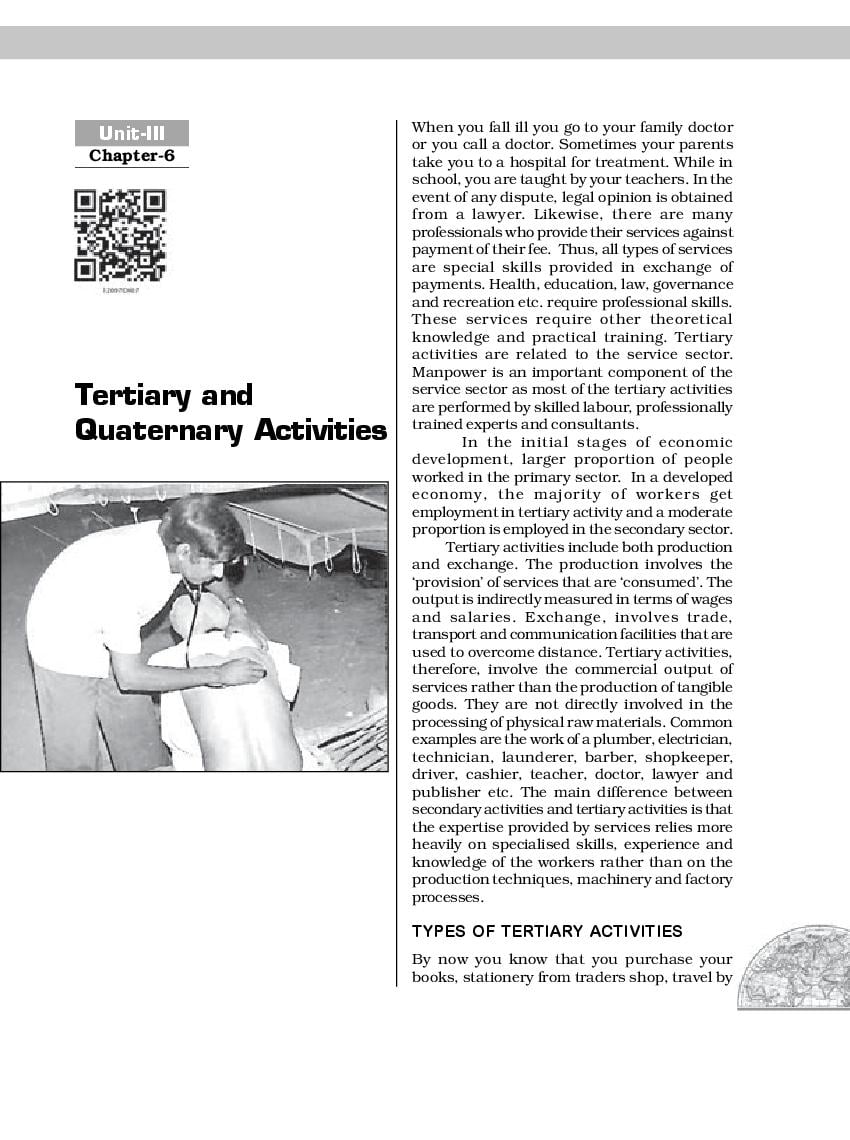
Unit-III or you call a doctor. Sometimes your parents
Chapter-6 take you to a hospital for treatment. While in
school, you are taught by your teachers. In the
event of any dispute, legal opinion is obtained
from a lawyer. Likewise, there are many
professionals who provide their services against
payment of their fee. Thus, all types of services
are special skills provided in exchange of
payments. Health, education, law, governance
and recreation etc. require professional skills.
These services require other theoretical
knowledge and practical training. Tertiary
activities are related to the service sector.
Manpower is an important component of the
Tertiary and service sector as most of the tertiary activities
are performed by skilled labour, professionally
Quaternary Activities trained experts and consultants.
In the initial stages of economic
development, larger proportion of people
worked in the primary sector. In a developed
economy, the majority of workers get
employment in tertiary activity and a moderate
proportion is employed in the secondary sector.
Tertiary activities include both production
and exchange. The production involves the
‘provision’ of services that are ‘consumed’. The
output is indirectly measured in terms of wages
and salaries. Exchange, involves trade,
transport and communication facilities that are
used to overcome distance. Tertiary activities,
therefore, involve the commercial output of
services rather than the production of tangible
goods. They are not directly involved in the
processing of physical raw materials. Common
examples are the work of a plumber, electrician,
technician, launderer, barber, shopkeeper,
driver, cashier, teacher, doctor, lawyer and
publisher etc. The main difference between
secondary activities and tertiary activities is that
the expertise provided by services relies more
heavily on specialised skills, experience and
knowledge of the workers rather than on the
production techniques, machinery and factory
processes.
TYPES OF TERTIARY ACTIVITIES
By now you know that you purchase your
books, stationery from traders shop, travel by
Showing the first page only. Download the PDF above for the complete document.
Document Details
| Board / Org | NCERT |
| Exam | Class 12 |
| Type | Books |
| Pages | 9 |
| Updated | 29 Aug 2026 |