MAHA SET 2025 Paper II Psychology Set A Question Paper
Finished viewing? Save it for later —
Download MAHA SET 2025 Paper II Psychology Set A Question Paper (PDF · 44 pages)About MAHA SET 2025 Paper II Psychology Set A Question Paper
MAHA SET 2025 Paper II Psychology Set A Question Paper is available here for free download. Published by Maharashtra Exams for MAHA SET, this question paper can be viewed online or downloaded as a PDF (44 pages). Candidates preparing for MAHA SET can use MAHA SET 2025 Paper II Psychology Set A Question Paper to understand the exam pattern, the type of questions asked, and the overall difficulty level.
Frequently Asked Questions
How can I download MAHA SET 2025 Paper II Psychology Set A Question Paper?
Open this page and click the Download button to save MAHA SET 2025 Paper II Psychology Set A Question Paper as a PDF. It is completely free on AglaSem Docs.
Is MAHA SET 2025 Paper II Psychology Set A Question Paper free to download?
Yes. MAHA SET 2025 Paper II Psychology Set A Question Paper can be viewed online and downloaded as a PDF free of cost on AglaSem Docs.
How many pages does MAHA SET 2025 Paper II Psychology Set A Question Paper have?
MAHA SET 2025 Paper II Psychology Set A Question Paper contains 44 pages, which you can read online or download together as a single PDF.
Where can I find more MAHA SET study material?
You can find more MAHA SET question papers, sample papers, syllabus, and answer keys on AglaSem Docs.
MAHA SET 2025 Paper II Psychology Set A Question Paper – Text
Read the full text of this question paper below — useful to quickly search, copy and reference the content online without downloading the PDF.
📄 View text version (45 pages)
Page 1
MAHA SET 2025
Paper II Psychology
Set A Question Paper
EXAM YEAR TYPE
MAHA SET 2025 Question Paper
Notes · Sample Papers · Previous Year Papers · Mock Tests
Page 2
m .co s e m
l a
ag
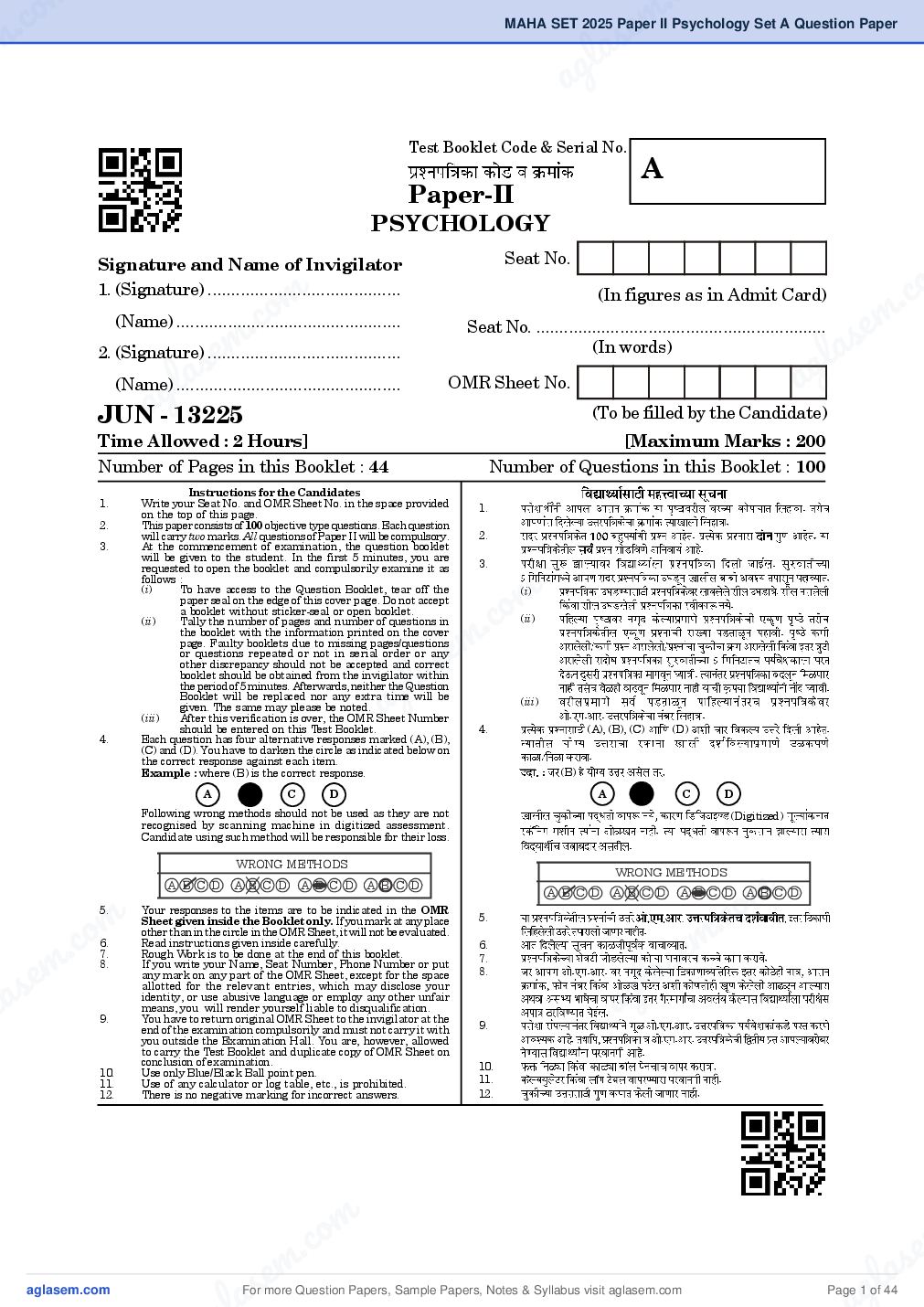
Test Booklet Code & Serial No.
A
Paper-II
PSYCHOLOGY
Signature and Name of Invigilator Seat No.
m
1. (Signature) .........................................
. co
c. o
(In figures as in Admit Card)
(Name) ................................................
e m
em
Seat No. ..............................................................
(In words)
l as
la s
2. (Signature) .........................................
ag
g
(Name) ................................................
JUNa- 13225
OMR Sheet No.
(To be filled by the Candidate)
Time Allowed : 2 Hours] [Maximum Marks : 200
Number of Pages in this Booklet : 44 Number of Questions in this Booklet : 100
Instructions for the Candidates
1. Write your Seat No. and OMR Sheet No. in the space provided 1.
on the top of this page.
2. This paper consists of 100 objective type questions. Each question
will carry two marks. All questions of Paper II will be compulsory. 2.
3. At the commencement of examination, the question booklet
will be given to the student. In the first 5 minutes, you are
requested to open the booklet and compulsorily examine it as 3.
m
follows :
c. o
(i) To have access to the Question Booklet, tear off the (i)
paper seal on the edge of this cover page. Do not accept
a booklet without sticker-seal or open booklet.
(ii) Tally the number of pages and number of questions in (ii)
the booklet with the information printed on the cover
e m
s
page. Faulty booklets due to missing pages/questions
or questions repeated or not in serial order or any
l a
other discrepancy should not be accepted and correct
ag
booklet should be obtained from the invigilator within
the period of 5 minutes. Afterwards, neither the Question
Booklet will be replaced nor any extra time will be (iii)
given. The same may please be noted.
(iii) After this verification is over, the OMR Sheet Number
should be entered on this Test Booklet. 4. (A), (B), (C) (D)
4. Each question has four alternative responses marked (A), (B),
(C) and (D). You have to darken the circle as indicated below on
the correct response against each item.
Example : where (B) is the correct response. (B)
A C D A C D
Following wrong methods should not be used as they are not (Digitized)
recognised by scanning machine in digitized assessment.
Candidate using such method will be responsible for their loss.
CORRECT METHOD WRONG METHODS
CORRECT METHOD WRONG METHODS
C D A B C D A B C D A B C D A B C D
m
.co
C D A B C D A B C D A B C D A B C D
m
5. Your responses to the items are to be indicated in the OMR
.co
Sheet given inside the Booklet only. If you mark at any place 5.
other than in the circle in the OMR Sheet, it will not be evaluated.
e m
s
6. Read instructions given inside carefully. 6.
m la
7. Rough Work is to be done at the end of this booklet.
e
7.
8. If you write your Name, Seat Number, Phone Number or put
s
8.
g
any mark on any part of the OMR Sheet, except for the space
la a
allotted for the relevant entries, which may disclose your
identity, or use abusive language or employ any other unfair
means, you will render yourself liable to disqualification.
9. You have to return original OMR Sheet to the invigilator at the
end of the examination compulsorily and must not carry it with 9.
you outside the Examination Hall. You are, however, allowed
to carry the Test Booklet and duplicate copy of OMR Sheet on
conclusion of examination. 10.
10. Use only Blue/Black Ball point pen.
11. Use of any calculator or log table, etc., is prohibited. 11.
12. There is no negative marking for incorrect answers. 12.
m
.co s e
s em
For more Question Papers, Sample Papers, Notes & Syllabus visit
gl a
Page 1 of 44
Page 3
For more Question Papers, Sample Papers, Notes & Syllabus visit Page 2 of 44
Page 4
m .co s e m
l a
ag
PSYCHOLOGY
Paper II
om . co
. c II e m
e m l as
l as
Time Allowed : 2 Hours] [Maximum Marks : 200
Note : This Question Paper contains Hundred (100) multiple choice questions.
ag
agEach question carries Two (2) marks. Attempt All questions.
(100) (2)
1. Which of the following principle is 1.
used by parsimonious fit indices ?
(A) Occam’s razor (A)
m
(B) Preference for complexity c. o(B)
e m
(C) Avoidance of s
simple
l a (C)
explanation
ag (D)
(D) Goodness of fit
2. The theory of knowledge, especially 2.
with regard to its methods, validity,
and scope, and the distinction
between justified belief and opinion
m
m is referred to as :
.co
m .co (A) Ontology
(A)
s e m
s e g la
la
(B)
(B) Epistemology
a
(C) Methodology (C)
(D) Post-positivism (D)
3
m
.co s e
s em
For more Question Papers, Sample Papers, Notes & Syllabus visit
gl a
Page 3 of 44
Page 5
meaning of ‘Blocking’ in
Randomized block design ?
(A)
(A) Participants with similar
characteristics are grouped
(B)
(B) Participants with similar
characteristics are removed
from experiment (C)
(C) Participants with dissimilar
characteristics are grouped (D)
(D) Random errors are blocked
4. (A) (R)
4. Following are the statements of
Assertion (A) and Reason (R).
Answer them with the help of the
following code :
Assertion (A) : Karl Popper (A) :
argued that
conjuncture and
falsification are
involved in science.
Reason (R) : Popper takes
falsifiability as (R) :
solution of
demarcation problem
and problem of
indiction.
(A) Both (A) and (R) are true and
(R) is the correct explanation (A) (A) (R)
of (A)
(R) (A)
(B) Both (A) and (R) are true and
(R) is not the correct (B) (A) (R)
explanation of (A) (R) (A)
(C) (A) is true but (R) is false (C) (A) (R)
(D) (A) is false but (R) is true (D) (A) (R)
4
For more Question Papers, Sample Papers, Notes & Syllabus visit Page 4 of 44
Page 6
m .co s e m
l a
ag
5. What is the Third Force of 5.
Psychology called ?
om . co
. c (A)
e m
e m
(A) Behaviorism
l as
as (B)
ag
(B)gl
a Humanistic (C)
(C) Psychoanalysis
(D)
(D) Gestalt psychology
6. Which of the following are quasi- 6.
experimental designs ?
m
(1) Interrupted
m
Time-Series .co
s e (1)
Designs;
g l a
(2) Non-equivalent ControlaGroup
(2)
Design; (3)
(3) Time Series with Non-
equivalent Control;
(4)
m
.co
(4) Block randomization
m (A) (1) only (A) (1)
m .co s e m
s e (B) (2)
g la
la
(B) (2) only
(C) (1)
a (3)
(C) (1) and (3) only
(D) (1), (2), and (3) only (D) (1), (2), (3)
5
m
.co s e
s em
For more Question Papers, Sample Papers, Notes & Syllabus visit
gl a
Page 5 of 44
Page 7
pictorial projective procedures ?
(1) Word association test (1)
(2) Sentence completion test (2)
(3) Figure drawing test (3)
(4) Thematic apperception test (4)
(A) (1) only (A) (1)
(B) (1) and (2) only (B) (1) (2)
(C) (1), (2), and (3) only (C) (1), (2), (3)
(D) (1), (2), and (4) only (D) (1), (2), (4)
8. The type of counselling process 8.
proposed by Carl Rogers is .........
(A) Directive counseling (A)
(B) Eclectic counselling (B)
(C) Dominant counselling (C)
(D) Non-directive counseling (D)
6
For more Question Papers, Sample Papers, Notes & Syllabus visit Page 6 of 44
Page 8
m.co s e m
l a
ag
9. The psychology that stresses the 9.
relationship between the individual
and the cosmos (universe) and in
om . co
doing focuses on the mystical and
. c e m
spiritual aspects of human nature is
called :
em (A)
l as
l as
(A) Transpersonal psychology ag
g
a Existential psychology
(B) (B)
(C) Psychoanalytical psychology (C)
(D) Behavioural psychology (D)
10. Which of the following is a major
difference between Indian 10.
Psychology and Indigenous
Psychology ?
m(A)
c. o
(A) Indigenous Psychology is more
theoretical than Indian
Psychology
e m
las
(B) Indian Psychology has a specific (B)
theoretical foundation, g
a not
while
Indigenous Psychology does
(C) Indian Psychology is only (C)
applicable within India, while
Indigenous Psychology is global
(D) Indian Psychology rejects (D)
cultural influences, while
Indigenous Psychology
embraces them
m
m
11. What is the range, mean, and 11.
.co
.co variance of normal probability
s em
em
curve ?
s (A) – to + ; ; 2 l
(A) – to + ;
g a ; 2
la (B) – 3 to + 3; ; 2 (B) – 3 to a+ 3; ; 2
(C) – to + ; 0; 1 (C) – to + ; 0; 1
(D) – 3 to + 3: 0; 1 (D) – 3 to + 3: 0; 1
7
m
.co s e
s em
For more Question Papers, Sample Papers, Notes & Syllabus visit
gl a
Page 7 of 44
Page 9
Assertion (A) and Reason (R).
Answer them with the help of the
following code :
Assertion (A) : Theoretical (A) :
sampling ultimately leads to
theoretical saturation stage in
grounded theory. (R) :
Reason (R) : Grounded theory
requires checking emerging theory
against reality by sampling
incidents that may further its
development until no new categories
can be identified. (A) (A) (R)
(A) Both (A) and (R) are true and (R) (A)
(R) is the correct explanation
(B) (A) (R)
of (A)
(B) Both (A) and (R) are true and (R) (A)
(R) is not the correct (C) (A) (R)
explanation of (A) (D) (A) (R)
(C) (A) is true but (R) is false
13.
(D) (A) is false but (R) is true
13. Arrange the steps of Braun and
Clarke thematic analysis in the (1)
correct order :
(2)
(1) Generating initial codes :
(2) Searching; (3)
(3) Familiarising; (4)
(4) Defining and naming; (5)
(5) Reviewing
(A) (1) (2) (3) (4) (5)
(A) (1) (2) (3) (4) (5)
(B) (2) (1) (3) (5) (4)
(B) (2) (1) (3) (5) (4)
(C) (3) (1) (2) (5) (4)
(C) (3) (1) (2) (5) (4)
(D) (5) (4) (3) (2) (1)
(D) (5) (4) (3) (2) (1)
8
For more Question Papers, Sample Papers, Notes & Syllabus visit Page 8 of 44
Page 10
m .co s e m
l a
ag
14. Match List I with List II and select 14. I II
the correct answer using the codes
om
given below the list : . co
. c I I
e m
emList
l as
l as ag
a g(Parametric Tests)
(P)
(P) Independent Samples t-test
(Q)
(Q) One Way ANOVA
(R)
(R) Dependent Samples t-test
(S)
(S) Pearson’s correlation
II
List II
m
(Non-Parametric Alternative)
m .co
s e (1)
(1) Sign test
l a
(2) Median Test ag (2)
(3) Binomial test (3)
(4) Kruskal-Wallis test (4)
(5) Kendall’s Tau (5)
Codes :
m
m (P) (Q) (R) (S)
.co
.co
(P) (Q) (R) (S)
m s e(5)m
la
(A) (2) (4) (1) (5) (A) (2) (4) (1)
s e g
la (B) (4) (2) (1) (3) (B) (4) (2)a (1) (3)
(C) (1) (2) (3) (5) (C) (1) (2) (3) (5)
(D) (2) (1) (4) (3) (D) (2) (1) (4) (3)
9
m
.co s e
s em
For more Question Papers, Sample Papers, Notes & Syllabus visit
gl a
Page 9 of 44
Page 11
motivation to those factors that :
(A) Energize behaviour and (A)
determine its direction
(B) Relate either to life instincts or
(B)
to death instincts
(C) Assume rational behaviour by
(C)
individuals
(D) Are biologically based and
(D)
predispose and organism to act
16. A ring of multiple arteries which
provides alternate bloodflow 16.
pathways and guards the brain
against damage is called :
(A) Cranium (A)
(B) Meninges (B)
(C) Circle of Willis (C)
(D) Blood Brain Barrier
(D)
10
For more Question Papers, Sample Papers, Notes & Syllabus visit Page 10 of 44
Page 12
m .co s e m
l a
ag
17. Following are the statements of 17. (A) (R)
Assertion (A) and Reason (R).
om
Answer them with the help of the
. co
. c
following codes :
e m
e m
Assertion (A) : IRT is commonly (A) :
l as
as
used in computerized psychological
l ag
IRT
ag
testing to estimate ability.
Reason (R) : In IRT, four
(R) : IRT
parameters can be estimated.
(A) Both (A) and (R) are true and
(R) is the correct explanation (A) (A) (R)
of (A) (R) (A)
(B) Both (A) and (R) are true and (B) (A) (R)
(R) is not the correct
o m (R) (A)
explanation of (A) .c (C) (A)
em
(R)
(C) (A) is true but (R) is false
s
(D) (A) is false but (R) is truela
(D) (A) (R)
a g 18.
18. Which among the following is the
correct order of changes in the
membrane potential during an
action potential ?
(A)
(A) De-polarization, Hyperpolarization,
Re-polarization, Polarization
m
.co
(B)
(B) Hyperpolarization, De-polarization,
m
.co m
Re-polarization, Polarization
m s e
s e (C) Polarization, De-polarization, (C)
g la
la Hyperpolarization,
polarization
Re-
a
(D)
(D) Polarization, Hyper polarization
De-polarization, Re-polarization
11
m
.co s e
s em
For more Question Papers, Sample Papers, Notes & Syllabus visit
gl a
Page 11 of 44
Page 13
information about an aspect of their
physiological state and then they
attempt to alter that state. This is
in an example of technique :
(A)
(A) Relaxation
(B)
(B) Biofeedback
(C)
(C) Exercise
(D)
(D) Hypnotism
20.
20. Thinking is a complex set of
collaborations between ........... and
.......... representations and processes.
(A) Linguistic; semantic (A)
(B) Linguistic; verbal (B)
(C) Semantic; non-linguistic (C)
(D) Linguistic; non-linguistic (D)
21. For MCMI IV, which of the following 21. MCMI IV
is not a severe personality pathology ?
(A) Schizotypal (A)
(B) Borderline (B)
(C) Paranoid (C)
(D) Schizoid (D)
12
For more Question Papers, Sample Papers, Notes & Syllabus visit Page 12 of 44
Page 14
m .co s e m
l a
ag
22. Which among the following is the 22.
co
main function of the pre-frontal
cortex ?
. c om e m .
e m l as
as
(A) Controlling reflexes (A)
ag
(B)gl
a Weighing the pros and cons of (B)
a possible action
(C)
(C) Receive light-touch and deep-
touch information
(D) Understanding the speech and
(D)
form of language
m
23. What is the relation between
m .co
e
s 23.
coefficient alpha and coefficientaof
l
g is
precision when a compositeatest
made up of non-parallel subtests ?
(A) coefficient alpha = coefficient of
precision
(B) coefficient alpha coefficient of
(A) =
m
.co
precision
m
m .co (C) coefficient alpha coefficient of (B)
s e m
s e precision
g la
la (D) coefficient alpha coefficient of
(C)
a
precision (D)
13
m
.co s e
s em
For more Question Papers, Sample Papers, Notes & Syllabus visit
gl a
Page 13 of 44
Page 15
statement/s best explain/s the role
of Blood Brain Barrier ?
(I)
(I) It controls the oxygen supply to
the brain (II)
(II) It protects the nervous system
from toxins and viruses (III)
(III) Allows the free flow of molecules
across the brain
(IV)
(IV) Hypertension can compromise
the blood brain barrier
(A) (I)
(A) Only (I)
(B) (II)
(B) Only (II)
(C) (II) (IV)
(C) Both (II) & (IV)
(D) Both (I) & (IV) (D) (I) (IV)
25. Which of the following personality 25.
measure contains assessment of
faking ?
(A) EPQ-R
(A) EPQ-R
(B) NEO-PI-3
(B) NEO-PI-3
(C) HEXACO-PI-R
(C) HEXACO-PI-R
(D) IPIP-NEO
(D) IPIP-NEO
14
For more Question Papers, Sample Papers, Notes & Syllabus visit Page 14 of 44
Page 16
m .co s e m
l a
ag
26. According to the Schachter-Singer 26.
theory of emotion, which sequence
m
of event is correct for the production
. co
of emotion ? co m
m . of a potential s e
e
(A) Perception
s g l a
g a
laroused bodysituation;
emotion-producing an
(A)
a
a states;
interpretation and labelling of
the bodily state
(B) An aroused body states; (B)
interpretation and labelling of
the bodily states perception of
potential emotion producing
m
situation c. o(C)
(C) Interpretation and labelling of
e m
s
the bodily states; perceptionaof
l
ag
a potential emotion-producing
situation; an aroused body state
(D) Perception of a potential
(D)
emotion-producing situation;
interpretation and labelling of
the body state; an aroused body
state
m
27. Edward’s personal preference
m schedule is based on : 27. .co
m .co s e m
s e (A) Maslow’s theory of need
(A)
g la
la hierarchy
(B) Murray’s theory of needs
(B) a
(C) Freud’s theory of Id-Ego conflict (C)
(D) Roger’s theory of personality (D)
15
m
.co s e
s em
For more Question Papers, Sample Papers, Notes & Syllabus visit
gl a
Page 15 of 44
Page 17
potentials that takes place even
without synaptic input is referred
as........
(A)
(A) Reflex arc
(B) Temporal summation (B)
(C) Spontaneous firing rate (C)
(D) Excitatory potential (D)
29. Which among the following tiny cells 29.
helps build the myelin sheaths in
the Central Nervous System ?
(A) Radial glia
(A)
(B) Astrocytes
(B)
(C) Microglia
(D) Oligodendrocytes (C)
30. Which of the following best describes (D)
Sri Krishna’s initial guidance of
Arjuna in the second chapter of the
30.
Bhagwad Gita ?
(A) The importance of renouncing
all actions
(B) The eternal and changeless (A)
nature of the self (B)
(C) The superiority of Bhakti yoga
other paths
(C)
(D) The resection of all worldly
duties (D)
16
For more Question Papers, Sample Papers, Notes & Syllabus visit Page 16 of 44
Page 18
m .co s e m
l a
ag
31. Creative thinking is different from 31.
routine problem solving in respect
co
of :
(1) Fluency om .
. c (1)
e m
em
(2) Flexibility (2)
l as
(3) l as
Originality (3) ag
(4)
g
a Day dreaming (4)
Codes :
(A) (1) and (2) (A) (1) (2)
(B) (2) and (3) (B) (2) (3)
(C) (3) and (4) (C) (3) (4)
(D) (1), (2) and (3) (D) (1), (2) (3)
32. Thurstone is associated with which 32.co
m
m .
of the following ?
s e
l a
(A) Equal appearing intervals scale
g
(A)
(B) Social distance scale a (B)
(C) Semantic differential scale (C)
(D) Summated ratings scale (D)
33. Which among the following is a
33.
function of efferent axons ?
(A) Controlling the voluntary (A)
m
.co
behaviour
m (B) Controlling the involuntary
.co m
(B)
m behaviour
s e
s e (C)
g la
la
(C) Carrying the information to the
brain structures a
(D)
(D) Carrying the output from one
brain structure to muscles
17
m
.co s e
s em
For more Question Papers, Sample Papers, Notes & Syllabus visit
gl a
Page 17 of 44
Page 19
34. (A) (R)
is ‘True’ for the statement of
Assertion and Reasoning ?
Assertion (A) : The Eightfold (A) :
Path consists of ethical, mental, and
wisdom based practices.
Reason (R) : Right speech, Right
(R) :
Action, and Right livelihood from
the wisdom section
Codes :
(A) Both (A) and (R) are true and (A) (A) (R)
(R) is the correct explanation of (R) (A)
(A)
(B) (A) (R)
(B) (A) is true but (R) is false
(C) (A) (R)
(C) (A) is false but (R) is true (D) (A) (R)
(D) Both (A) and (R) are true, but (R) (A)
(R) is not the correct
35.
explanation of (A)
35. According to Freudian theory, an
individual who is guided only by
pleasure, has no internalized social
rules of behaviour, and has little
ability to balance the id with reality
demonstates an :
(A)
(A) overdeveloped ego
(B) overdeveloped id (B)
(C) overdeveloped superego (C)
(D) underdeveloped id (D)
18
For more Question Papers, Sample Papers, Notes & Syllabus visit Page 18 of 44
Page 20
m .co s e m
l a
ag
36. Which of the following is/are true about 36.
the item discrimination index ?
om
(I) It is a measure of reliability (I)
. co
. c e m
(II) It is a measure of validity
e m
(II)
l as
as
(A) (I) only (A) (I)
ag
(B)gl
a (II) only
(C) Both (I) and (II)
(B) (II)
(C) (I) (II)
(D) Neither (I) nor (II) (D) (I) (II)
37. Which among the following 37.
chemicals is actively involved in
hunger and satiety ?
(A)
(A) Cholecystokinin
m
(B) Angiotensin c. o(B)
e m (C)
(C) Bradykinin
l as
(D) Histamine
a g (D)
38. Which of the following are factors 38.
adversely influencing interpretation
of correlation coefficient ?
(1) Sampling Restricted Range (1)
(2) Combining Heterogeneous (2)
Subgroups
(3)
m
.co
(3) Presence of Bivariate Outliers
m (4) Linearity
.co
(4)
e m
e m (A) Only (3)
(A) (3)
las
las (B) Only (4) (B) (4) g
a
(C) Only (2), (3) and (4) (C) (2), (3) (4)
(D) Only (1), (2) and (3) (D) (1), (2) (3)
19
m
.co s e
s em
For more Question Papers, Sample Papers, Notes & Syllabus visit
gl a
Page 19 of 44
Page 21
administered on the same sample
immediately one after the other, this
procedure will allow the researcher
to study : (A)
(A) Reliability across time (B)
(B) Reliability across content
(C)
(C) Construct validity of the test
(D)
(D) Concurrent validity of the test
40. In which of the methods of 40.
physiological psychology devices are
precisely positioned in the depth of
the brain ?
(A)
(A) Stereotaxic surgery
(B) Aspiration Lesions (B)
(C) Transcranial Magnetic
(C)
Stimulation
(D) Deoxyglucose Technique (D)
41. What argument Nagarjuna gives to 41.
demonstrate the emptiness of
phenomena ?
(A) The interdependent origination
of phenomena (A)
(B) The divine will as the source of
(B)
existence
(C) The indivisibility of subject and
(C)
object
(D) The unchanging nature of self (D)
20
For more Question Papers, Sample Papers, Notes & Syllabus visit Page 20 of 44
Page 22
m .co s e m
l a
ag
42. How many scales are there in Form 42. I
om
I and Form II of Luria Nebraska
II . co
. c e m
em
neurological battery, respectively :
l as
l as
(A) 11 & 12
(A) 11 & 12
ag
ag (B) 12 & 12
(B) 12 & 12
(C) 23 & 23 (C) 23 & 23
(D) 05 & 12 (D) 05 & 12
43. Which among the following cranial 43.
m
c. o(A)
nerves is related to eye movements ?
(A) Optic nerve
e m
l as
ag
(B) Abducens (B)
(C) Hypoglossal (C)
(D) Trigeminal nerve (D)
44. Which brain structure connects the 44.
two hemispheres of the brain ?
m
m (A) Cerebellum (A)
.co
m .co s e m
la
(B) Superior colliculus (B)
s e g
la (C) Corpus callosum (C) a
(D) Transverse fissure (D)
21
m
.co s e
s em
For more Question Papers, Sample Papers, Notes & Syllabus visit
gl a
Page 21 of 44
Page 23
from :
(A) The way in which people form
(A)
and act out behaviours and
habits
(B) A combination of Freudian and (B)
neo-Freudian theories
(C) Existential analysis of the way (C)
people behave on a daily basis
(D) The words people use to describe
themselves and others in (D)
everyday lives
46. Read each of the following 46. (A)
statements-Assertion (A) and Reason
(R)
(R); and indicate your answer using
codes given below :
Assertion (A) : Perception remains (A) :
constant although the proximal
sensation changes.
(R) :
Reason (R) : Our perceptual
system has mechanisms that adjust
our perception of the proximal
stimulus.
Codes : (A) (A) (R)
(A) Both (A) and (R) are true and
(R) (A)
(R) is the correct explanation
of (A) (B) (A) (R)
(B) Both (A) and (R) are true, (R) (A)
but (R) is not the correct (C) (A) (R)
explanation of (A)
(C) (A) is true, but (R) is false
(D) (A) (R)
(D) (A) is false, but (R) is true
22
For more Question Papers, Sample Papers, Notes & Syllabus visit Page 22 of 44
Page 24
m .co s e m
l a
ag
47. The “cocktail party phenomenon” 47.
co
inspired research on :
. c om e m .
(A) attention
em (A)
l as
l as
(B) stage hypnosis (B) ag
ag
(C) alcohol effects (C)
(D) biological rhythms (D)
48. Which one of the following 48.
statements is true ?
(A)
m
(A) The ‘Global Five’ factors in
.co
em
16
personality refer to the second
l as
order factors of 16 PF
ag
(B)
(B) The ‘Global Five’ factors refer
to the factors assessed by the
NEO-Five Factor Inventory
(C) The ‘Global Five’ factors refer (C)
m
m to the factors assessed by
.co
m .co Goldberg’s bipolar adjectives
s e m
s e (D)
g la
la (D) The ‘Global Five’ factors are a
derived from Eysenck
Personality Profiler
23
m
.co s e
s em
For more Question Papers, Sample Papers, Notes & Syllabus visit
gl a
Page 23 of 44
Page 25
correct, with respect to early
selection theory ?
(A) Registration by senses (A)
Filtering Unattended
information static Designated
information processed
(B) Filtering Registration by (B)
senses Unattended
information static Designated
information processed
(C) Unattended information static (C)
Filtering Registration by
senses Designated
information processed
(D) Registration by senses (D)
Unattended information static
Filtering Designated
information processed
50. Henri Tajfel is the father of which 50.
theory ?
(A) Equity (A)
(B) Social Exchange (B)
(C) Balance (C)
(D) Social Identity (D)
24
For more Question Papers, Sample Papers, Notes & Syllabus visit Page 24 of 44
Page 26
m .co s e m
l a
ag
Q.No. 51-55. are based on the following 51-55 500
paragraph. Read the following SEM
paragraph and answer five
om
(CFA)
. co
questions that follow :
. c e m
e m
A researcher carried out SEM based
l as
as
confirmatory factor analysis (CFA)
l ag
ag
of six indicators on a sample of 500
respondents. Three indicators
ML
measure altruism and three 1312 (p < .001)
measures trust. The ML estimates
M1 =
are obtained. The baseline model
M2 =
has chi-square of 1312 (p < .001).
She tested three models : M1 = M3 =
unifactor model, M2 = Two M1, M2 M3
m
.co
orthogonal-factors model; M3 = Two 230 (p < .01), 120 (p <
oblique-factors model. The chi-
e m .01) 65 (p < .01) M1,
square for M1, M2, and M3 are 230
l as M2 M3 GFI 0.81,
ag
(p < .01), 120 (p < .01), and 65
(p < .01), respectively. The GFI for 0.90, 0.95 AGFI 0.71;
M1, M2, and M3 are 0.81, 0.90, 0.95 0.85; 0.91 M1, M2,
and AGFI are 0.71; 0.85; and 0.91 M3
respectively. The Root Mean Square
Residual is 0.21, 0.09; and 0.04
respectively for M1, M2 and M3 with 0.21, 0.09, .4
phi = 0.54 for M3. phi = 0.54
m
51. What is df of baseline model in
m
51.
c. o df
.co m
above example ?
m s e
s e (A) 36 (A) 36
g la
la (B) 12 (B) 12 a
(C) 15 (C) 15
(D) 5 (D) 5
25
m
.co s e
s em
For more Question Papers, Sample Papers, Notes & Syllabus visit
gl a
Page 25 of 44
Page 27
(A) 11 (A) 11
(B) 8 (B) 8
(C) 6 (C) 6
(D) 5 (D) 5
53. Which model is best fit in the above 53.
example ?
(A) Only M1 (A) M1
(B) Only M2 (B) M2
(C) M3
(C) Only M3
(D) M2 M3
(D) Both M2 and M3
54.
54. Which of the following is correct for
the above paragraph ?
(1)
(1) Trust and altruism are
orthogonal
(2)
(2) Trust and altruism are oblique
(3) GFI AFGI M1
(3) Best GFI and AFGI are for M1
(4) All models are accepted since (4)
chi-square is significant
(A) Only (1) (A) (1)
(B) Only (2) (B) (2)
(C) (1) and (3) both (C) (1) (3)
(D) (2) and (4) both (D) (2) (4)
26
For more Question Papers, Sample Papers, Notes & Syllabus visit Page 26 of 44
Page 28
m .co s e m
l a
ag
55. Which of the following values 55. CFA
indicates best fit for Root Mean
Square Residual in CFA ?
m . co
c. o
(A) Closer to 1.00 (A) 1.00
s e m
(B) Closermto zero a
(C) l asethan 0.50
Less
(B)
ag l
agHigher than 1.00
(C) 0.50
(D) (D) 1.00
56. The fact that the inner corner of a 56.
room looks farther away than the
outer corner of a building provides
one explanation of the :
(A) Ponzo illusion (A)
(B) Ames room illusion
m (B)
(C) Poggendorf illusion c. o(C)
e m (D)
las 57.
(D) Müller-Lyer illusion
57. How does inducing positive g affect
a to
influence persuasion, according
research ?
(A)
(A) It always leads to attitude
change regardless of message
strength
(B) It promotes a positive response (B)
but depends on how the
m
m (C) It only works when the message
message is processed
.co
m .co (C)
s e m
s e contains strong logical
g la
la arguments
(D) a
(D) It has no impact on persuasion
as emotions are separate from
reasoning
27
m
.co s e
s em
For more Question Papers, Sample Papers, Notes & Syllabus visit
gl a
Page 27 of 44
Page 29
58.
predict that when faced with a
conflict between accuracy and self-
enhancement, people are likely to :
(A)
(A) Reject accuracy
(B) Reject themselves (B)
(C) Become frustrated (C)
(D) Compromise (D)
59. Psychologist who considered 59.
Aggression to be a basic human
instinct :
(A)
(A) Sigmund Freud
(B)
(B) B.F. Skinner
(C)
(C) Abraham Maslow
(D) Henri Tajfel (D)
60. As group size increased, individual 60.
effort decreased, this phenomenon is
called as :
(A)
(A) Social categorization
(B)
(B) Social loafing
(C)
(C) Social exclusion
(D)
(D) Social comparison
28
For more Question Papers, Sample Papers, Notes & Syllabus visit Page 28 of 44
Page 30
m .co s e m
l a
ag
61. A person not only has a set of 61.
abilities, but also a set of potential
co
abilities that can be realized if given
. c om
the proper guidance from other’s.
Who propagated this ?
e m .
em (A)
l as
(B) l as
(A) Piaget
(B) ag
g Vygotsky
a Bandura
(C)
(C)
(D)
(D) Skinner
62.
62. Gender schematic as are more likely
to see the word as ..........
(A) Divided into masculine and (A)
feminine categories
m(B)
c. o
(B) Biased against their gender
(C) Distorted ways that favor their
e m (C)
gender
l as
ag
(D) A place where their own gender (D)
dominates
63. The child will typically play with the 63.
toys and bring one to the caregiver
to show and describe it from time
to time. The child may be upset
when the caregiver departs but is
also happy to see the caregiver
m
.co
return. This shows which
m
.co
attachment style ?
e m
e m (A) Secure attachment style (A)
las
las (B) Disorganized attachment style (B)
ag
(C) Ambivalent attachment style (C)
(D) Avoidant attachment style
(D)
29
m
.co s e
s em
For more Question Papers, Sample Papers, Notes & Syllabus visit
gl a
Page 29 of 44
Page 31
the idea that when people pursue
positive goals their self-regulation
efforts are focused on reducing the
discrepancy between the current state
and a future goal ?
(A)
(A) Current goal theory
(B)
(B) Control theory
(C) Self-discrepancy theory (C)
(D) Gate-control theory (D)
65. ............ theory of motivation stated 65.
that the individuals are not only
motivated and driven from within,
but they are also pulled by external
factors of incentives.
(A)
(A) The drive reduction
(B)
(B) The arousal
(C)
(C) The humanistic
(D) The expectancy (D)
30
For more Question Papers, Sample Papers, Notes & Syllabus visit Page 30 of 44
Page 32
m .co s e m
l a
ag
66. According to the classic concepts of 66.
co
Row & Kahn, successful aging
m .
c. o
comprises of ...........
s e m
s emphysical, psychological (A)
g l a
g a
(A) High
land a
a social functioning in old age
without diseases
(B) Factors within the person like (B)
happiness
(C)
(C) Adaption to age related changes
m
in a given context
m .co
s e (D)
a
(D) Balance between person’s needs
l
and competency ag
67. Your ability to focus on a TV show 67.
while ignoring the noise of your
partner nagging about supper
illustrates :
m
.co
(A)
m
.co
(A) synesthesia
e m
e m (B) selective attention
(B)
las
las ag
(C) sensory attention (C)
(D) sensory adaptation (D)
31
m
.co s e
s em
For more Question Papers, Sample Papers, Notes & Syllabus visit
gl a
Page 31 of 44
Page 33
Primary, Secondary and Public
differ on all of the following except
for ...........
(A)
(A) Occupation by the owner
(B)
(B) Degree of personalization
(C)
(C) How others perceive ownership
(D)
(D) Concept of personal space
69. Which of the following lifestyle 69.
factors is known to affect wellbeing
positively in late adulthood ?
(A) Mental and physical activity (A)
(B) Alcohol consumption (B)
(C) Retiring early (C)
(D) Drug consumption (D)
32
For more Question Papers, Sample Papers, Notes & Syllabus visit Page 32 of 44
Page 34
m .co s e m
l a
ag
70. Crystallized abilities include the 70. (Crystallized)
co
ability to use skills, knowledge and
om
experience. These abilities tend to :
. c e m .
em with age as
(A) Improve
l as
as
lindividuals expand their
(A)
ag
g
a knowledge through experience (B)
(B) Decline with age along with
general cognitive function
(C)
(C) Stay static over time
(D)
(D) Do not change with age
m
.co
71. ............. is associated with cyber 71.
bullying.
e m (A)
(A) Physical abuse
l as
(B) Anonymities ag (B)
(C)
(C) Ragging
(D) Hurtful teasing (D)
72. What kind of processing involves 72.
high levels of cognition controlling
m
.co
and regulating events affecting
m lower levels of cognition ?
m .co s e m
la
(A)
s e (A) top-down processing
g
la (B) bottom-up processing (B)
a
(C) proprioception (C)
(D) transduction (D)
33
m
.co s e
s em
For more Question Papers, Sample Papers, Notes & Syllabus visit
gl a
Page 33 of 44
Page 35
(A) balancing rewards and (A)
contributions in relationships
(B) the effects of social class on
(B)
identity
(C) how people make economic
(C)
investments
(D) the study of power and politics (D)
74. According to Eysenck’s three-factor 74.
theory of personality, which one of the
following factors refers to a person’s
level of stability/instability ?
(A)
(A) Extraversion
(B)
(B) Conscientiousness
(C)
(C) Neuroticism
(D) Psychoticism (D)
75. ............ is not a type of neuron. 75.
(A) Bipolar (A)
(B) Unipolar (B)
(C) Multipolar
(C)
(D) Homozygous
(D)
34
For more Question Papers, Sample Papers, Notes & Syllabus visit Page 34 of 44
Page 36
m .co s e m
l a
ag
76. According to Gardner’s theory, 76.
intelligence is a/an .......... appropriate
to specified kinds of content.
om . co
(A) Factorial.celements (A)
e m
em processing skills l as
la s
(B) Comparative (B)
ag
(C)g Information-processing abilities
a (C)
(D) Ability clustering forms of
thinking (D)
77. What are the final two phases of 77.
Levinson’s stage model for adult
development ?
m (A)
c. o(B)
(A) Transition phase, settling down
period
e m 30
(B) Age 30 transition phase,
l as
settling down period
ag
(C) Transition phase, entering the
(C)
adult world phase
(D) Settling down period, age 30 (D) 30
transition phase
78. ........... is not a part of digital
78.
etiquette.
m
m (A) Smaller but intimidating .co
.co
(A)
e m
e m message
(B)
las
las (B) Read first, write later
ag
(C)
(C) Keep attachment short
(D) Review, review and send (D)
35
m
.co s e
s em
For more Question Papers, Sample Papers, Notes & Syllabus visit
gl a
Page 35 of 44
Page 37
(A) Moderately and positively (A)
related to intelligence
(B) Strongly and positively related (B)
to intelligence
(C) Moderately and negatively (C)
related to intelligence
(D) Strongly and negatively related (D)
to intelligence
80. Attentional cueing in infants
80.
requires :
(A) Attracting the infant’s attention
with an acoustic cue (A)
(B) A period of direct gaze before
averting the gaze (B)
(C) pointing in the direction of the (C)
attentional cue
(D)
(D) moving a colourful stimulus
towards the attentional cue
81. Individuals, during secondary
81.
appraisal in the cognitive appraisal
model of stress, ...........
(A) unconsciously recall other (A)
similar stressful events
(B) engage in the use of defense
(B)
mechanisms
(C) evaluate their resources for (C)
dealing with stress
(D) experience resistance and then
(D)
exhaustion
36
For more Question Papers, Sample Papers, Notes & Syllabus visit Page 36 of 44
Page 38
m .co s e m
l a
ag
82. When would a psychologist label a 82.
co
child as developing typically ?
. c om e m .
(A) When they reach 2 years of age
em (A)
l as
a s
with no obvious physical
lproblems 2 ag
ag
(B)
(B) When they follow predictable
developmental trajectory
(C)
(C) When they reach specific levels
of reading and writing ability
m
c. o(D)
(D) When they can walk unaided
e m
l as 83.
g
83. Length and itensity of Light wave
a
play an important role in :
(A) Perception of colour and
brightness (A)
(B) Perception of colour and
m
.co
illumination (B)
m
m .co (C) Perception of constancy and
s e m
s e (C)
g la
la brightness
a
(D) Perception of brightness and (D)
illumination
37
m
.co s e
s em
For more Question Papers, Sample Papers, Notes & Syllabus visit
gl a
Page 37 of 44
Page 39
intelligence consists of ........ that are
........... based and linked to the
context.
(A) multiple abilities; biologically (A)
(B) multiple intelligences; learning (B)
(C) modules; developmentally (C)
(D) processors; cognitively (D)
85. According to Milgram’s studies on 85.
obedience, which factor significantly
decreased participant’s willingness to
obey orders to administer shocks ?
(A) The presence of an authority (A)
figure in the room
(B)
(B) The participant’s belief that the
authority figure was responsible
for the outcome
(C) The physical and emotional (C)
proximity of the learner
receiving the shocks
(D) The use of scientific-sounding (D)
justifications for the experiment
86. People high in creativity also are 86.
likely to :
(A) Combine different ways of (A)
thinking
(B)
(B) Filter out irrelevant stimuli to
attend to the task at hand
(C)
(C) Display extrinsic motivation
(D) Be geniuses (D)
38
For more Question Papers, Sample Papers, Notes & Syllabus visit Page 38 of 44
Page 40
m .co s e m
l a
ag
87. Use of symbols to represent words, 87.
images and ideas, occurs at what
om
stage of development ?
. co
. c e m
(A) Preoperational stage
em (A)
l as
as
(B) Sensorimotor stage
lConcrete operational stage
(B)
ag
ag
(C) (C)
(D) Formal operational stage (D)
88. Which of the following is false about 88. HIV
HIV ?
(A) It is considered a terminal
(A)
condition
m
(B) It is treated using antiretroviral c. o(B)
therapy
e m
as
(C) At least half of the people lwho
are HIV-Positive are notagbeing (C) HIV-Positive
treated
(D) About a quarter of people who
(D) HIV-Positive
are HIV-Positive don’t know
that they have the disease
89. Cultural intelligence involves all of 89.
m
m the following dimensions EXCEPT :
.co
m .co (A) Metacognitive (A)
s e m
s e g la
la
(B) Emotional
(C) Motivational
(B)
a
(C)
(D) Behavioural (D)
39
m
.co s e
s em
For more Question Papers, Sample Papers, Notes & Syllabus visit
gl a
Page 39 of 44
Page 41
distinct processes in sensory
detection : (a)
(a) sensory process (b)
(b) decision process (c)
(c) motivational process
(d)
(d) response bias
Codes :
(A) (a) (b)
(A) (a) and (b) only
(B) (c) and (d) only (B) (c) (d)
(C) (a) and (c) only (C) (a) (c)
(D) (a) and (d) only (D) (a) (d)
91. According to Kurt Lewin’s formula 91.
behaviour is a function of which two
variables ? (A)
(A) Appraisal and Attitudes
(B)
(B) Person and Situation
(C)
(C) Affect and Cognition
(D)
(D) Attitudes and Beliefs
92. The observation that scores on 92.
intelligence tests worldwide have
increased substantially over the past
decades, this is called as :
(A) Flynn effect (A)
(B) The generation gap (B)
(C) The IQ effect (C)
(D) The Wechsler effect (D)
40
For more Question Papers, Sample Papers, Notes & Syllabus visit Page 40 of 44
Page 42
m .co s e m
l a
ag
93. Read each of the following two 93.
statements-Assertion (A) and Reason (A) (R)
co
(R) and indicate your answer using
. c om
the codes given below :
(A) :
e m .
Assertion (A) : Environments that
em l as
l as
influence educational and cultural
opportunities enhance crystallized
ag
ag
intelligence.
(R) :
Rea s on ( R) : Cry st a llize d
intelligence is developed through
stimulating fluid intelligence.
Codes : (A) (A) (R)
(A) Both (A) and (R) are true and (R) (A)
(R) is correct explanation of (A) (B) (A) (R)
(B) Both (A) and (R) are true, but
(R) is not the correct m (R) (A)
o(C) (A)
c
m. (D) (A)
(R)
explanation of (A)
(C) (A) is true, but (R) is false
s e (R)
l a
(D) (A) is false, but (R) is true
g
a
94. Which of the following statements 94.
is/are true with regards to Primary
prevention ?
(I)
(I) It basically means instilling
good health habits and
changing poor ones. (II)
(II) This means taking measures to
m
.co
combat risk factors for illness
m
.co
before illness has a chance to
develop.
e m
e m (A) (I)
l(I)as
(II)
las (A) (I) is true, (II) is false
(B) (II) ag
(B) (II) is true, (I) is false
(C) Both (I) and (II) are false (C) (I) (II)
(D) Both (I) and (II) are true (D) (I) (II)
41
m
.co s e
s em
For more Question Papers, Sample Papers, Notes & Syllabus visit
gl a
Page 41 of 44
Page 43
to illnesses caused by
atherosclerosis, the narrowing of the
coronary arteries.
(A)
(A) Metabolic syndrome
(B) Diabetes (B)
(C) Coronary heart disease (C)
(D) Alzheimer (D)
96. .......... is defined as life satisfaction, 96.
the presence of positive effect, and a
relative absence of negative affect.
(A) Happiness (A)
(B) Life satisfaction (B)
(C) Subjective well-being (C)
(D) Positive affect (D)
97. Selective attention in vision and 97.
audition respectively have been (audition)
dubbed as :
(A) ‘optic’ and ‘haptic’ (A)
(B) ‘spotlight’ and ‘gateway’ (B)
(C) ‘spatial’ and ‘acoustic’ (C)
(D) ‘central’ and ‘peripheral’ (D)
42
For more Question Papers, Sample Papers, Notes & Syllabus visit Page 42 of 44
Page 44
m .co s e m
l a
ag
98. What factor increases the pressure
for uniformity within groups, 98.
according to Festinger’s explanation
of conformity ?
m . co
c. o of a strong leader
(A) The presence
(A)
s e m
e m group goal
(B) An explicit
l a
l a
(C) Thes size of the group
(B)
ag
agIndividual intelligence levels
(D) (C)
99. Which therapeutic method is most (D)
effective in handling the initial
phase of treatment ? 99.
(A) Group therapy
(B) Psychoanalysis (A)
(C) Gestalt (B)
(D) Behaviour therapy
o m
(C)
100. Read each of the following two c. (D)
statements—Assertion (A) and
e m100.
Reason (R) and indicate your answer
l as (A) (R)
ag
using the codes given below :
Assertion (A) : Intelligence is a
single entity.
Reason (R) : Various types of (A) :
intelligence exist independently of (R) :
each other.
Choose the correct response :
(A) Both Assertion (A) and Reason
(A) (A) (R)
(R) are true, and Reason (R) is
the correct explanation for (R)
m
.co
Assertion (A) (A)
m
c. o
(B) Both Assertion (A) and Reason (B) (A) (R)
(R) are true, but Reason (R) is
e m (R)
e m not the correct explanation for
las
las Assertion (A)
(C) Assertion (A) is true, But
(C)
(A)
ag
(A)
Reason (R) is false (R)
(D) Assertion (A) is false, but (D) (A)
Reason (R) is true (R)
43
m
.co s e
s em
For more Question Papers, Sample Papers, Notes & Syllabus visit
gl a
Page 43 of 44
Page 45
44
For more Question Papers, Sample Papers, Notes & Syllabus visit Page 44 of 44
Document Details
| Board / Org | Maharashtra Exams |
| Exam | MAHA SET |
| Type | Question Paper |
| Pages | 44 |
| Updated | 17 Nov 2026 |