Karnataka 1st PUC Model Question Paper 2027 for Chemistry (Paper 1)
Finished viewing? Save it for later —
Download Karnataka 1st PUC Model Question Paper 2027 for Chemistry (Paper 1) (PDF · 3 pages)About Karnataka 1st PUC Model Question Paper 2027 for Chemistry (Paper 1)
Karnataka 1st PUC Model Question Paper 2027 for Chemistry (Paper 1) is available here for free download. Published by Karnataka Board for Class 11, this sample paper can be viewed online or downloaded as a PDF (3 pages). Candidates preparing for Class 11 can use Karnataka 1st PUC Model Question Paper 2027 for Chemistry (Paper 1) to understand the exam pattern, the type of questions asked, and the overall difficulty level.
Frequently Asked Questions
How can I download Karnataka 1st PUC Model Question Paper 2027 for Chemistry (Paper 1)?
Open this page and click the Download button to save Karnataka 1st PUC Model Question Paper 2027 for Chemistry (Paper 1) as a PDF. It is completely free on AglaSem Docs.
Is Karnataka 1st PUC Model Question Paper 2027 for Chemistry (Paper 1) free to download?
Yes. Karnataka 1st PUC Model Question Paper 2027 for Chemistry (Paper 1) can be viewed online and downloaded as a PDF free of cost on AglaSem Docs.
How many pages does Karnataka 1st PUC Model Question Paper 2027 for Chemistry (Paper 1) have?
Karnataka 1st PUC Model Question Paper 2027 for Chemistry (Paper 1) contains 3 pages, which you can read online or download together as a single PDF.
Where can I find more Class 11 study material?
You can find more Class 11 question papers, sample papers, syllabus, and answer keys on AglaSem Docs.
Karnataka 1st PUC Model Question Paper 2027 for Chemistry (Paper 1) – Text
Read the full text of this sample paper below — useful to quickly search, copy and reference the content online without downloading the PDF.
📄 View text version (4 pages)
Page 1
Karnataka 1st PUC
Model Question Paper
2027 for Chemistry
(Paper 1)
EXAM YEAR TYPE SUBJECT
Karnataka Class 11 2027 Sample Paper Chemistry
Notes · Sample Papers · Previous Year Papers · Mock Tests
Page 2
m .co
e m
em l a s
s GOVERNMENT OF KARNATAKA a g
DEPARTMENT OF SCHOOL EDUCATION (PRE-UNIVERSITY)
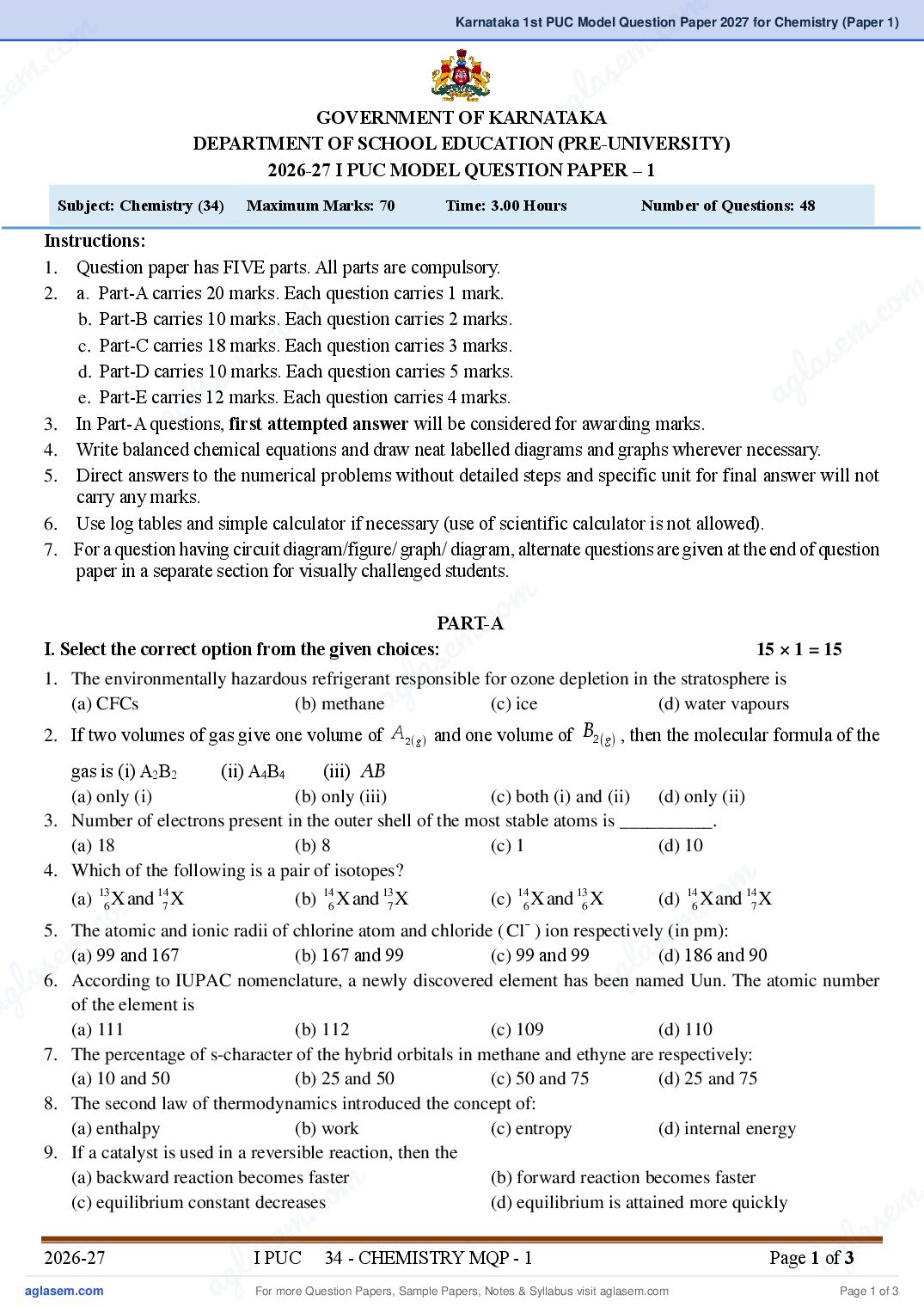
2026-27 I PUC MODEL QUESTION PAPER – 1
Subject: Chemistry (34) Maximum Marks: 70 Time: 3.00 Hours Number of Questions: 48
Instructions:
1. Question paper has FIVE parts. All parts are compulsory.
m
m c. o
2. a. Part-A carries 20 marks. Each question carries 1 mark.
.co e m
b. Part-B carries 10 marks. Each question carries 2 marks.
em
c. Part-C carries 18 marks. Each question carries 3 marks.
la s
l a s
d. Part-D carries 10 marks. Each question carries 5 marks.
a g
ag
e. Part-E carries 12 marks. Each question carries 4 marks.
3. In Part-A questions, first attempted answer will be considered for awarding marks.
4. Write balanced chemical equations and draw neat labelled diagrams and graphs wherever necessary.
5. Direct answers to the numerical problems without detailed steps and specific unit for final answer will not
carry any marks.
6. Use log tables and simple calculator if necessary (use of scientific calculator is not allowed).
7. For a question having circuit diagram/figure/ graph/ diagram, alternate questions are given at the end of question
paper in a separate section for visually challenged students.
m
. co
em
PART-A
s
a for ozone depletion in the stratosphere is
I. Select the correct option from the given choices:
l
15 × 1 = 15
(a) CFCs (b) methane a g
1. The environmentally hazardous refrigerant responsible
(c) ice (d) water vapours
2. If two volumes of gas give one volume of A2 ( g ) and one volume of B2 ( g ) , then the molecular formula of the
gas is (i) A2B2 (ii) A4B4 (iii) AB
(a) only (i) (b) only (iii) (c) both (i) and (ii) (d) only (ii)
3. Number of electrons present in the outer shell of the most stable atoms is __________.
(a) 18 (b) 8 (c) 1 (d) 10
4. Which of the following is a pair of isotopes?
o m
om and ionic radii of chlorine atom and chloride ( Cl ) ion respectively (in .c
5. The.catomic m
(a) 136 Xand 147 X (b) 146 Xand 137 X (c) 146 Xand 136 X (d) 146 Xand 147 X
m s e
a
−
e lnamed Uun. The atomic number
pm):
l as (a) 99 and 167 (b) 167 and 99 (c) 99 and 99
a g
(d) 186 and 90
ag of(a)the111element is
6. According to IUPAC nomenclature, a newly discovered element has been
(b) 112 (c) 109 (d) 110
7. The percentage of s-character of the hybrid orbitals in methane and ethyne are respectively:
(a) 10 and 50 (b) 25 and 50 (c) 50 and 75 (d) 25 and 75
8. The second law of thermodynamics introduced the concept of:
(a) enthalpy (b) work (c) entropy (d) internal energy
9. If a catalyst is used in a reversible reaction, then the
m .
co m
(a) backward reaction becomes faster (b) forward reaction becomes faster
(c) equilibrium constant decreases
m . (d) equilibrium is attained more quickly
s e
se 34 - CHEMISTRY MQP - 1 Page 1 ofg3
l a
l a a
ag
2026-27 I PUC
For more Question Papers, Sample Papers, Notes & Syllabus visit Page 1 of 3
Page 3
(a) + 1 (b) 0 (c) -1 (d) +2
11. The redox reaction: Mg (s ) + 2H2O ( l ) ⎯⎯
→ Mg ( OH )2 (s ) + H2 (g ) ; is an example of
(a) combination reaction (b) displacement reaction
(c) disproportionation reaction (d) decomposition reaction
12. Which of the following chemical species acts as an electrophile?
(a) BF3 (b) NH3 (c) H2O (d) Cl−
13. Methoxy methane and ethyl alcohol are examples of
(a) position isomers (b) chain isomers (c) functional isomers (d) metamers
14. According to Markownikoff’s rule, when hydrogen halide adds to an unsymmetrical alkene, the hydrogen of
HX attaches to
(a) carbon at the end of the molecule
(b) carbon with least number of hydrogen atoms
(c) carbon in the middle of the molecule
(d) carbon with maximum number of hydrogen atoms
15. Which of the following hydrocarbons damage DNA and cause cancer in the human body?
(a) 1,2-Benzanthracene (b) 1,2-Benzpyrene (c) all of these (d) 3-Methylcholanthrene
II. Fill in the blanks by choosing the appropriate word from those given in the brackets: 5×1=5
(Absorbed, Evolved, increased, ionic, nucleus, urea)
16. Rutherford's α-particle scattering experiment established the existence of a small, dense ______ at the centre
of the atom.
17. The bond formed between two atoms having high electronegativity difference is called _______ bond.
18. In an exothermic reaction, heat is _______.
19. When the pH of a solution decreases, its hydrogen ion concentration is ________.
20. An organic compound formed from an inorganic compound ammonium cyanate is _______.
PART – B
III. Answer any FIVE of the following. Each question carries two marks. 5 × 2 = 10
21. Give two properties of electromagnetic radiations
22. Give any two limitations of the octet rule.
23. Define dipole moment. What is its unit?
24. Define state functions. Give an example.
25. Write Gibbs equation to give the relation between free energy change, enthalpy change and entropy change.
26. Explain the Common ion effect. Give an example.
27. Write the relation between solubility and solubility product (Ksp) for an AB2 type of salt.
28. Mention the hybridisation of carbon atoms marked as a and b in the following compound.
29. Suggest a suitable method for separating glycerol from spent lye and explain the reason for your choice.
30. What happens to the boiling point of isomeric alkanes with an increase in branching? Give reason.
PART – C
IV. Answer any THREE of the following. Each question carries three marks. 3 × 3 = 09
31. Define electronegativity of an element. How does it vary along a period and down a group in the periodic
table?
32. Explain the shape of the ammonia molecule using VSEPR theory.
33. Define the following terms: (a) Lattice enthalpy (b) Bond angle (c) Bond enthalpy
2026-27 I PUC 34 - CHEMISTRY MQP - 1 Page 2 of 3
For more Question Papers, Sample Papers, Notes & Syllabus visit Page 2 of 3
Page 4
m .co
e m
em a s
34. Give any three differences between sigma and pi bonds.
s
35. Balance the chemical equation by the oxidation number method: Fe + HCl ⎯⎯
g l
→ FeCl3 + H2 .
V. Answer any THREE of the following. Each question carries three marks. a 3 × 3 = 09
36. Write any three postulates of Dalton’s atomic theory.
37. Write the significance of any three quantum numbers.
38. Derive the relationship between Cp and Cv for an ideal gas.
39. Write any three characteristic properties of equilibrium.
40. Derive the Henderson-Hasselbalch equation for acidic buffer.
m
PART – D
mexplain the principle and calculations involved in the estimation of carbonmin. c o
o
VI. Answer any TWO of the following. Each question carries five marks. 2 × 5 = 10
the organic compound.m.
c
41. With a neat labelled diagram,
s e
s efor the mechanism of chlorination of methane. g l a
a
l reaction with a suitable example.
(b) Explain thegWurtz
42. (a) Write the equation
a
43. (a) Explain a
(3+2)
the directive Influence of nitro and methyl groups in a monosubstituted benzene towards
electrophilic substitution reactions.
(b) Define polymerization. Mention any one use of polyethyne (polyacetylene). (3+2)
PART–E
(NUMERICAL PROBLEMS)
o m
c oxygen. The molecular mass of the compound is
VII. Answer any THREE of the following. Each question carries four marks. 3 × 4 = 12
.
miron & oxygen are 55.85u & 16u respectively)
160 gmol . Find molecular formula. (Atomic masseof
44. An iron oxide compound contains 69.9% Iron, and 30.1%
s
45. Yellow light emitted from a sodium lamp haslaawavelength of 580 nm. Calculate the a) frequency b) wave
-1
number. ag
46. Calculate the total work done when one mole of a gas expands isothermally and reversibly from an initial
volume of 10 dm3 to a final volume of 20 dm3 at 298 K. (R = 8.314 JK-1 mol-1)
47. Calculate ∆G0 for the hydrolysis of sucrose. The equilibrium constant KC is 2 × 10⁻³ at 300 K. (R = 8.314 J K-1
mol-1)
48. In Carius method of estimation of sulphur, 0.466 g of barium sulphate was formed from 0.32 g of organic
compound. Calculate the percentage of sulphur. (Given atomic mass of S = 32 u and molar mass of barium
m
co
sulphate = 233 g mol-1.
m .
c. o m
************
em la se
las a g
ag
m .
.co s e m
m
e 34 - CHEMISTRY MQP - 1 l a
l a s Page 3 ofg3
a
ag
2026-27 I PUC
For more Question Papers, Sample Papers, Notes & Syllabus visit Page 3 of 3
Document Details
| Board / Org | Karnataka Board |
| Exam | Class 11 |
| Type | Sample Paper |
| Pages | 3 |
| Updated | 13 Nov 2026 |