Kerala SET 2018 Jul Question Paper Psychology
Finished viewing? Save it for later —
Download Kerala SET 2018 Jul Question Paper Psychology (PDF · 21 pages)About Kerala SET 2018 Jul Question Paper Psychology
Kerala SET 2018 Jul Question Paper Psychology is available here for free download. Published by Default for Govt Jobs Exams, this question paper can be viewed online or downloaded as a PDF (21 pages). Candidates preparing for Govt Jobs Exams can use Kerala SET 2018 Jul Question Paper Psychology to understand the exam pattern, the type of questions asked, and the overall difficulty level.
Frequently Asked Questions
How can I download Kerala SET 2018 Jul Question Paper Psychology?
Open this page and click the Download button to save Kerala SET 2018 Jul Question Paper Psychology as a PDF. It is completely free on AglaSem Docs.
Is Kerala SET 2018 Jul Question Paper Psychology free to download?
Yes. Kerala SET 2018 Jul Question Paper Psychology can be viewed online and downloaded as a PDF free of cost on AglaSem Docs.
How many pages does Kerala SET 2018 Jul Question Paper Psychology have?
Kerala SET 2018 Jul Question Paper Psychology contains 21 pages, which you can read online or download together as a single PDF.
Where can I find more Govt Jobs Exams study material?
You can find more Govt Jobs Exams question papers, sample papers, syllabus, and answer keys on AglaSem Docs.
Kerala SET 2018 Jul Question Paper Psychology – Text
Read the full text of this question paper below — useful to quickly search, copy and reference the content online without downloading the PDF.
📄 View text version (21 pages)
Page 1
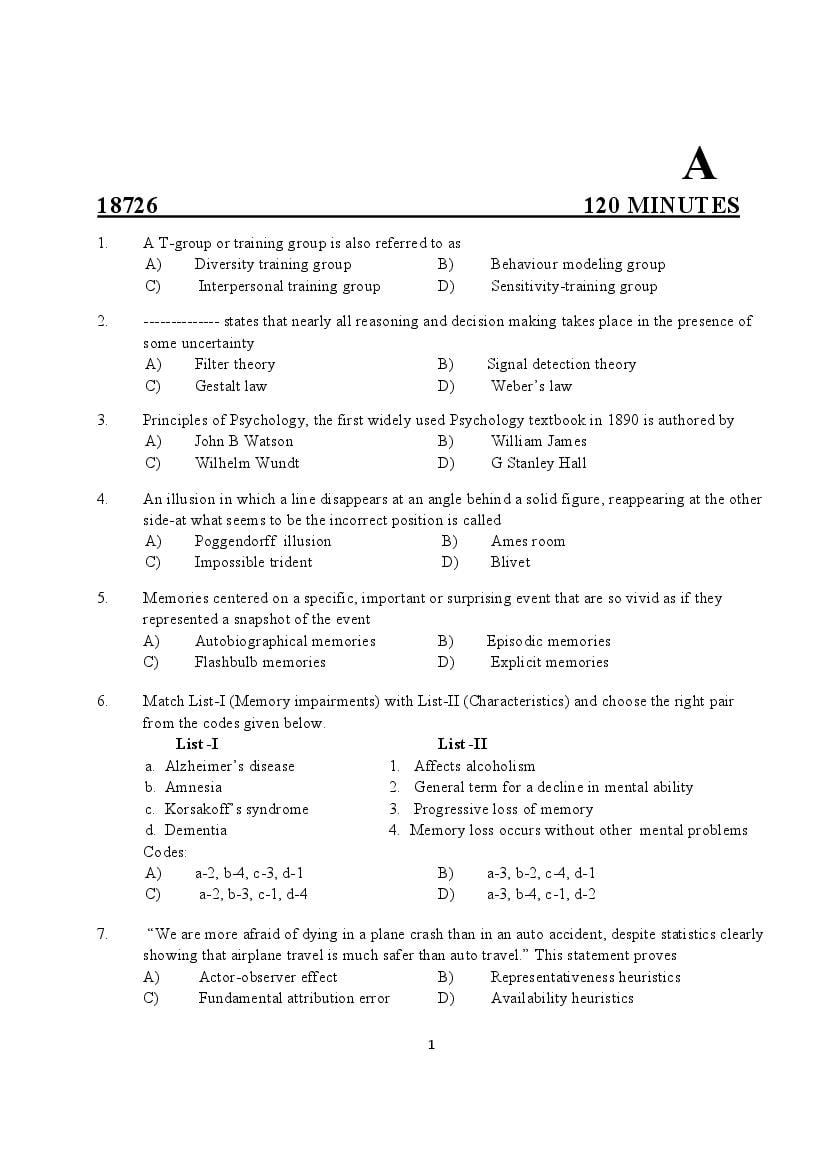
18726 120 MINUTES
1. A T-group or training group is also referred to as
A) Diversity training group B) Behaviour modeling group
C) Interpersonal training group D) Sensitivity-training group
2. -------------- states that nearly all reasoning and decision making takes place in the presence of
some uncertainty
A) Filter theory B) Signal detection theory
C) Gestalt law D) Weber’s law
3. Principles of Psychology, the first widely used Psychology textbook in 1890 is authored by
A) John B Watson B) William James
C) Wilhelm Wundt D) G Stanley Hall
4. An illusion in which a line disappears at an angle behind a solid figure, reappearing at the other
side-at what seems to be the incorrect position is called
A) Poggendorff illusion B) Ames room
C) Impossible trident D) Blivet
5. Memories centered on a specific, important or surprising event that are so vivid as if they
represented a snapshot of the event
A) Autobiographical memories B) Episodic memories
C) Flashbulb memories D) Explicit memories
6. Match List-I (Memory impairments) with List-II (Characteristics) and choose the right pair
from the codes given below.
List -I List -II
a. Alzheimer’s disease 1. Affects alcoholism
b. Amnesia 2. General term for a decline in mental ability
c. Korsakoff’s syndrome 3. Progressive loss of memory
d. Dementia 4. Memory loss occurs without other mental problems
A) a-2, b-4, c-3, d-1 B) a-3, b-2, c-4, d-1
C) a-2, b-3, c-1, d-4 D) a-3, b-4, c-1, d-2
7. “We are more afraid of dying in a plane crash than in an auto accident, despite statistics clearly
showing that airplane travel is much safer than auto travel.” This statement proves
A) Actor-observer effect B) Representativeness heuristics
C) Fundamental attribution error D) Availability heuristics
1
Page 2
subsequent competing hypothesis.
A) Functional fixedness B) Conformation bias
C) Mental set D) Convergent thinking
9. Reality therapy suggests that all human issues occur when one or more of five basic psychological
needs are not met which are
I. Power- Love and belonging- Freedom II. Achievement- Freedom- Fun
III. Freedom- Power- Survival IV. Love and belonging- Fun-Survival
A) I, III and IV only are correct B) III and IV only are correct
C) II, III and IV only are correct D) I, II and III only are correct
10. Match List-I (Biological factors of hunger) with List-II (Functions) and choose your answer
from the codes given below:
List-I List-II
a. Ventromedial hypothalamus 1. Leads to refusal of food and Starvation
b. Lateral hypothalamus 2. Causes extreme overeating
c. Ghrelin 3. Indicates satiation of hunger
d. Leptin 4. Communicates brain feelings of hunger
a b c d
A) 1 2 4 3
B) 2 1 3 4
C) 2 3 1 4
D) 2 1 4 3
11. Schachter-Singer theory explains
1. Activation of general physical arousal leads to observation of environmental cues
2. Brain interprets visceral changes as emotional experience
3. Activation of bodily changes in response to brain
4. Labeling of physiological arousal on the basis of cues from the environment
A) 1 and 2 only B) 1, 2 and 4 only C) 1 and 4 only D) 3 and 4 only
12. Yerkes- Dodson law states
1. Moderate levels of arousal lead to better performance
2. This effect does not vary with the difficulty of the task
3. We perform difficult tasks if we are not very aroused
4. Reducing or creating tension leads to arousal
Which options given below is correct?
A) 1, 3 & 4 only B) 1, 2 and 3 only
C) 2, 3 and 4 only D) 1, 2 and 4 only
2
Page 3
The study of the interaction between psychological processes and the nervous and immune
systems of the human body.
I. Psychoneuro immunology II. Psychoendoneuro immunology
III. Psycho immunoneurology IV. Psychoneuroendocrino immunology
A) I, II and IV only are correct B) I and III only are correct
C) All the above are correct D) I, II and III only are correct
14. Which option given below is NOT true for DNA finger printing?
A) Use of repetitive sequences that are highly variable in particular short tandem repeats.
B) No two individuals share the same genetic code
C) Means of identification when an attacker or assailant has left some kind of bodily fluid
or blood at the scene of a crime and when no visual identification is possible
D) Any two unrelated individuals would have comparable DNA
15. James is afraid of snakes. He won’t even look at pictures of them but turns the page or closes
the book instead. When he sees a picture of a snake, his anxiety goes up, but when he avoids
looking at the picture, his anxiety goes down. It is most correct to say that James’s avoidance
behavior is being
A) punished because he feels anxious after doing so.
B) punished because he will never get better
C) positively reinforced because he is rewarded by his anxiety going down.
D) negatively reinforced because he is rewarded by his anxiety going down.
16. How can punishment be made more effective?
1. Punishment should be consistent
2. Punishment and reinforcement should not be paired
3. Punishing a bad behavior does eliminate the behavior completely
4. Punishment should immediately follow the behavior it is meant to punish.
Which options given below is correct?
A) 1,2 and 3 are correct B) 1, 2 and 4 are correct
C) 1 and 4 are correct D) 1, 3 and 4 are correct
17. Seligman found many similarities between his “helpless” dogs and people suffering from
A) Aggressive behavior syndrome B) Alcoholism
C) Depression D) Schizophrenia
18. ---------- plays a central role in the acquisition of conditioned fears.
A) Hypothalamus B) Amygdala
C) Corpus callosum D) Hippocampus
3
Page 4
it is the ------------- that determine whether learning will occur.
A) consequences; antecedents B) antecedents; consequences
C) rewards; punishments D) punishments; rewards
20. Which of the following statement about creative people is NOT true?
A) They are very good at mental imagery
B) They value their independence
C) They are slightly eccentric
D) They are unconventional in their work
21. Remya is 35 years old, but her mind has never gone beyond the level of second-grade child.
Remya would be classified as ------------- developmentally delayed.
A) mildly B) moderately C) severely D) profoundly
22. ------------- occurs when new information impairs the retention of previously learned information.
A) Retrieval failure B) Decay
C) Retroactive interference D) Proactive interference
23. People who appear mentally retarded with respect to general intellectual abilities, yet show
outstanding mental ability in one area are called --------------
A) Mildly mentally retarded B) Idiot savants
C) Developmentally delayed D) Creative
24. Who is the author of the book Hereditary Genius?
A) Stanford Binet B) Francis Galton
C) Lewis Terman D) David Wechsler
25. When a student believes that her chances of failure in the final exams are lower and her chances
of success are higher than those of her peers, her thinking has an error called …………
A) Confirmation bias B) Functional fixedness
C) Optimism bias D) Mental set
26. An error in social cognition proposed by Daniel Kahneman and Amos Tversky in 1979 is called
A) Optimism bias B) Planning fallacy
C) Magical thinking D) Fundamental attribution error
27. Sternberg has found that ---------- intelligence is a good predictor of success in life but has a
low relationship to ------------- intelligence.
A) practical; academic B) practical; creative
C) academic; practical D) academic; creative
28. The ------------- heuristic can be used to create and maintain stereotypes.
A) availability B) representative C) insight D) means-end analysis
4
Page 5
moving against people, or moving away from people?
A) Jung B) Horney C) Adler D) Erikson
30. Who believed that traits existed as part of the nervous system?
A) Casta and McCrae B) Allport
C) Cattell D) Rogers
31. According to Adler, middle children tend to be
A) overachieving
B) competitive
C) resentful of the freedom of the older child
D) filled with feelings of inferiority
32. Which of the following has been shown to be true concerning the “teachers” in Milgram’s
experiment?
I. Most of the “teachers” were sorry to have been a part of the experiment.
II. “Teachers” became reluctant to administering the shocks
III. Only a very small percentage showed any signs of psychological problems after one year.
IV. They believed that they had not randomly been assigned to either the “teacher” role or the
“learner” role
A) I, II and III only are correct B) II and III only are correct
C) I, II and IV only are correct D) II, III and IV only are correct
33. When members of a cult are trying to enlist a new recruit, they start by asking the recruit to
make a small commitment, such as attending a short meeting or helping out at a social function.
Then the commitments get more involved, such as staying for a longer period of time and
eventually for major donations of money and moving in with the cult members. This is most
like which of the following techniques?
A) that’s-not-all technique B) foot-in-the door technique
C) low-ball technique D) door-in-the-face technique
34. In Asian cultures, people tend to explain the behavior of others as a result of
A) bad genes B) internal dispositions
C) situational factors D) personality traits
35. A person who is very low in self-worth is less likely to be affected by the
A) halo effect B) mere exposure effect
C) need complementarity effect D) reciprocity of liking effect
5
Page 6
Five decision points to help or don’t help are
I. Noticing- Taking responsibility-Taking action
II. Defining an emergency- Noticing- Taking responsibility
III. Taking responsibility- Noticing- Planning a course of action
IV. Defining an emergency- Taking responsibility- Planning a course of action
A) I, II and III only are correct B) II and III only are correct
C) I and IV only are correct D) II, III and IV only are correct
37. Prejudice and discrimination are least likely to develop in which of the following situations?
A) Two different groups of immigrants competing for jobs
B) Two different religious groups, in which one believes that its religion is the right one
C) Two groups dealing with the aftermath of tsunami
D) Two different groups, with one group being blamed for the economic difficulties of the other
38. The self-fulfilling prophecy is a negative outcome of
A) social identity B) scapegoating
C) reference grouping D) stereotype vulnerability
39. The people with whom a person identifies most strongly are called the
A) referent group B) membership group
C) in-group D) out-group
40. Match List-I (Psychological disorders) with List-II (Examples) and choose your answer from
the codes given below.
List-I List-II
a. Factitious disorder 1. Pyromania
b. Sleep disorder 2. Stress disorder
c. Impulse-control disorder 3. Munchausen syndrome
d. Anxiety disorder 4. Narcolepsy
A) a-3, b-4, c-1, d- 2 B) a-1, b-4, c-3, d- 2
C) a-1, b-4, c-2, d- 3 D) a-3, b-2, c-1, d- 4
41. Match List-I (Common phobias) with List-II (Scientific names) and choose your answer from
the codes given below.
List-I List-II
a. Lightning 1. Mysophobia
b. Washing and bathing 2. Xenophobia
c. Foreigners/strangers 3. Ablutophobia
d. Dirt/germs 4. Ceraunophobia
6
Page 7
C) a-4, b- 3, c-2, d-1 D) a-3, b-4, c-1, d-2
42. Joy believed that a famous song by a popular musical group carried a special, secret message
meant only for him. This would be an example of a delusion of
A) persecution B) reference C) influence D) grandeur
43. A few days after giving birth to her daughter, Susan felt anxious about being a new mother and
found herself crying for no good reason at odd moments throughout the day. If Susan
sometimes feared she might hurt her baby or had thoughts of suicide, she most likely was
experiencing
A) postpartum psychosis B) postpartum depression
C) baby blues D) postpartum neurosis
44. In which category of schizophrenia would a person be who shifts patterns of behavior?
A) catatonic B) disorganized C) paranoid D) undifferentiated
45. The psychoanalyst knows that repressed information is just “below the surface” of the
conversation when the client begins to experience
A) free association B) dream interpretation
C) resistance D) transference
46. Which person might benefit the least from a group therapy environment?
A) Sumitha, who has a phobia of cats B) Riya, who has a drinking problem
C) Jasmine, who is painfully shy D) Asish, who suffers from depression
47. Given below are two statements. Assertion (A) and Reason (R). Indicate your answer using the
codes given below.
Assertion (A) : Males are often more territorial than females.
Reason (R) : Personalization, marking, and status are used much more often than physical
aggression to control space and ideas.
A) Both (A) and (R) are true and (R) is the correct explanation of (A)
B) Both (A) and (R) are true, but (R) is not the correct explanation of (A)
C) (A) is true, but (R) is false
D) (A) is false, but (R) is true
48. The actual content of a dream is the ----------- content, according to Freud.
A) repressed B) latent C) manifest D) sexual
7
Page 8
codes given below.
Assertion (A) : Measures of central tendency represent the most typical score of a frequency
distribution
Reason (R) : One way to sum up numerical data is to find out some central number around
which all the others seem to fall
A) Both (A) and (R) are true and (R) is the correct explanation of (A)
B) Both (A) and (R) are true, but (R) is not the correct explanation of (A)
C) (A) is true, but (R) is false
D) (A) is false, but (R) is true
50. Given below are two statements. Assertion (A) and Reason (R). Indicate your answer using the
codes given below.
Assertion (A) : Correlation coefficient represents the direction of the relationship and its
strength between two variables
Reason (R) : It is possible to see if three or more scores are related
A) Both (A) and (R) are true and (R) is the correct explanation of (A)
B) Both (A) and (R) are true, but (R) is not the correct explanation of (A)
C) (A) is true, but (R) is false
D) (A) is false, but (R) is true
51. Sanjay got a slight sunburn. At first, he felt very uncomfortable whenever his shirt touched his
irritated skin. After a while, he stopped feeling that discomfort, Sanjay’s adjustment resulted
from a type of learning called -------------
A) conditioning B) modeling C) habituation D) sensitization
52. Find out the correct answer from the codes given below:
Sampling
I. Enables more accurate measurements for a sample study
II. Remains the only choice when a test involves the destruction of the item under study
III. Enables to estimate sampling and non-sampling errors
IV. Produces results faster and less expensive than a census study
A) I, II and III only are correct B) I and II only are correct
C) II, III and IV only are correct D) I, II and IV only are correct
8
Page 9
In a normal curve
I. Scores are symmetrically distributed around the mean
II. Mean, median and mode are located on the same point
III. Scores remains the same as the curve extends from the mean
IV. Highest point represents the average score in any distribution
A) I, II and III only are correct B) I, II and IV only are correct
C) II, III and IV only are correct D) I, III and IV only are correct
54. Match List-I (Properties) with List-II (Estimator characteristics) and choose your answer from
the codes given below.
List-I List-II
a. Property of efficiency 1. Using the information as much as possible from the sample
b. Property of unbiasedness 2. Approaching the value of population parameter as the
sample size becomes larger and larger
c. Property of consistency 3. Average should be equal to the value of the parameter
being estimated
d. Property of sufficiency 4. Estimator which has the smallest variance is the most
effective among a group of unbiased estimators
A) a-3, b- 2, c-1, d-4 B) a-3, b- 4, c-1, d-2
C) a-4, b- 3, c-1, d-2 D) a-4, b-3, c-2, d-1
55. ------------, the most common name associated with experimental designs has originally studied
them in ----------
A) S Siegel; archival research B) R A Fisher; agricultural research
C) Karl Pearson; geographical research D) P Freedman; population studies
56. Basic principles of experimental designs include
I. Replication-Standardisation- Randomization
II. Randomization- Local control-Verifiability
III. Replication-Randomization-Local control
IV. Statistical accuracy-Control of variability-Randomization
A) I, II and IV only are correct B) III and IV only are correct
C) I and IV only are correct D) I, II and III only are correct
9
Page 10
answer from the codes given below.
List-I List-II
a. Nominal scale 1. Product-moment correlation
b. Ordinal scale 2. Chi-square test
c. Interval scale 3. Post-hoc test
d. Ratio scale 4.Quartile measure
A) a-2, b- 4, c-1, d-3 B) a-4, b- 2, c-1, d-3
C) a-2, b- 1, c-3, d-4 D) a-2, b-4, c-3, d-1
58. Our ability to predict some outcome or estimate the existence of some current condition is
called
A) Content validity B) Construct validity
C) Concurrent validity D) Criterion-related validity
59. Niyama is said to be:
A) Rules for healthy personality
B) One among the three parts of breath
C) One among the eight limbs of yoga
D) One among the five personal disciplines of dharma
60. According to Macworth, performance decrement could be reduced in a number of ways, like
A) Brighter signals B) Presence of others
C) Feedback on performance D) All of the above
61. A decline in accuracy which occurs over time as an individual performs a task requiring
sustained attention.
A) Perceptual defense B) Performance decrement
C) Autonomic arousal D) None of the above
62. An illusion in which two alternative lights are seen as having continuous movement
between them is
A) Autokinetic Effect B) Phi Phenomenon
C) Geometric illusion D) Perceptual constancy
63. The Miller Lyer illusion occurs more frequently in:
A) Children than adults B) Men than women
C) People living in western culture D) People living in poverty
64. Brain wave pattern often seen when a person starts to feel slightly drowsy is
A) Alpha waves B) Beta waves
C) Theta waves D) Sleep spindles
10
Page 11
given below.
List I List II
(a) Somnabulism 1. Excessive daytime sleeping
(b) Night tremors 2. Urinating while asleep in bed.
(c) Hypersomnia 3. Extreme fear agitation screaming
(d) Enuresis 4. Sitting, walking or performing complex
behavior while asleep
Codes
a b c d
A) 4 3 1 2
B) 4 2 1 3
C) 3 1 2 4
D) 4 3 2 1
66. A mental image which allows us to collect, store, organize and utilize information
about the environment is __________and was first introduced by ___________
A) Prototype, Rosch B) Knowledge frame, Minsky
C) Schemata, Bartlett D) Cognitive Maps, Tolman
67. Three processes responsible for the formation of a person’s identity within a particular group:
I. Social categorization, social identity, social comparison
II. Stereotypes, social comparison, social categorization
III. Social identity, social discrimination, social comparison.
IV. Stereotype, social identity, social categorization.
Codes
A) Only 1 is correct B) 1 and II are correct
C) II and III are correct D) 1 and IV are correct
68. A commonly used personality inventory based on the ideas of Carl Jung and looks at four
dimensions of personality is:
A) Myers – Briggs Type Indicator (MBTI)
B) Eysenck Personality Questionnaire (EPQ)
C) California personality inventory (CPI)
D) 16 Personality Factor (16PF) Questionnaire
69. Delusions, hallucinations, changes in mood, disorganized or odd behavior, disturbed
or disorganized thoughts are all symptoms of
A) Dissociative disorders B) Antisocial personality disorders
C) Schizophrenia D) Mood disorders.
11
Page 12
answer from the codes given below.
List I List II
a) Nominal scale 1. Third level of measurement. Unit of measurement is constant
and equal numerical distance on the scale indicates equal
distance in the properties of the object being measured.
b) Ordinal Scale 2. Numbers are used to name identify or classify persons, groups etc.
c) Interval scale 3. Highest level of measurement. Ratio of any two number is
independent of the unit of measurement and therefore it can be
meaningfully equated.
d) Ratio scale 4. Second level. Numbers denote the rank order of the object or the
individual.
A) a-2, b-4, c-1, d-3 B) a-4, b-1, c-2, d-3
C) a-2, b-3, c-1, d-4 D) a-2, b-3, c-4, d-1
71. Given below are two statements, Assertion (A) and Reason (R). Indicate your
answer using the codes below.
Assertion (A): Validity refers to what the test measures and how well it measures.
Reason (R): Validity of the test may also be the correlation of the test with some
outside independent criteria.
Codes
A) A and R are true and R is the correct explanation of A
B) A and R are true but R is not the correct explanation of A
C) A and R are false
D) A is true R is false
72. A psychological test has these limitations.
I. Psychological tests create anxiety.
II. Psychological tests provide self knowledge.
III. Psychological tests measure only limited and beneficial aspects of behavior.
IV. Psychological tests are often used in evaluation of various type of educational and
social programmes.
A) I & III only are correct B) I & IV only are correct
C) III & IV only are correct D) II & IV only are correct
12
Page 13
the technique)
List I List II
a. Product moment method 1. Fisher
b. Rank difference method 2. Kendall
c. Coefficient of concordance 3. Pearson
d. F. Ratio 4. Spearman
Codes
A) a-3, b-4, c-2, d-1 B) a-3, b-4,c-1,d-2
C) a-3,b-2,c-4,d-1 D) a-4,b-3,c-1,d-2
74. Psychologists who tried to develop personality test using factor analytic strategy are:
A) Guilford, Cattell, Spearman B) Guilford, Cattell, Eysenck
C) Edwards, Cattell, Pearson D) Guilford, Spearman, Fisher
75. The best explanation for schizophrenia is offered by _______perspective.
A) Psychodynamic B) Behavioural
C) Biopsychological D) Humanistic
76. “Phantoms in the Brain” is a fascinating book written by
A) Paul Broca B) V.S. Ramachandran
C) A T Kovoor D) Gazzaniga M.S
77. Match List I (Monocular Cues) with List II (the propositions) and choose the answer from the
codes given below.
List I List II
A) Linear perspective 1. The discrepancy in motion of near and far objects.
B) Motion Parallax 2. When objects that people expect to be of a certain
size appear to be small and are therefore assumed
to be farther away.
C) Overlap 3. Tendency for the lines that are actually parallel,
seem to converge on each other.
D) Relative size 4. If one object seems to be blocking
another object, people assume that the
blocked object is behind the first one
and therefore further away.
Codes
A) a-2, b-4, c-1, d-3 B) a-3, b-2, c-4, d-1
C) a-3, b-1, c-4, d-2 D) a-2, b-1, c-4, d-3
13
Page 14
convenient, a kind of non-probability sample, sample selected is believed to be typical of the
population and individuals selected are relevant to the research design.
A) Incidental sampling B) Snowball Sampling
C) Systematic sampling D) Judgmental Sampling
79. The popular or ‘P’ responses are those responses which occur frequently in the ----------
protocol and indicate the ability for ----------
A) TAT, deriving gratification from general environment.
B) Rorschach, Perceiving and reacting to clear and district characteristics of world.
C) Rorschach, conventional perception.
D) All the above.
80. The SI model of intelligence was proposed by
A) Thorndike B) Guilford C) Sternberg D) Tolman
81. A form of behavior modification that uses both analysis of current behavior and behavioural
techniques to address socially relevant issue is.
A) Behaviour analysis B) Bio feedback
C) Applied Behaviour analysis D) Neuro feedback
82. A model of memory which assumes that information is stored in the brain in a connected
fashion with concepts that are related to each other stored physically closer to each other than
concepts that are not related is the –
A) Atkinson – Shriffin Model B) Levels of processing Model
C) Connectionist Model. D) Semantic Network model.
83. Match List I (Types of forgetting) with List II (reasons) and choose the answer from the codes
given below.
List I List II
(a) Encoding failure 1. Newer information interferes with the retrieval of older info
information.
(b) Decay or Disuse 2. The information is not attended to and fails to be encoded.
(c) Proactive Interference 3. Information that is not accessed decays from the storage
System overtime.
(d) Retroactive interference 4. Older information already in memory interferes in the
learning of new information.
Codes
A) a-2, b-3,c-4,d-1 B) a-3, b-1, c-4, d-2
C) a-2, b-4, c-1, d-3 D) a-3, b-4, c-1, d-2
84. The part of the brain that is responsible for the formation of new long term declarative memories.
A) Limbic System B) Hippocampus
C) Amygdala D) None of the above
14
Page 15
A) N1 (NREM Stage 1) B) N2 (NREM Stage 2)
C) N3 (NREM Stage 3) D) REM
86. An accurate means of assessing success in relationships and career is
A) Emotional intelligence B) Stress survey
C) Heredity studies D) Intellectual intelligence.
87. HARDY PERSONALITY has all the following characteristics EXCEPT.
A) A deep sense of commitment to their values beliefs, sense of identity work and family life.
B) They tend to internalize their emotions and find it difficult to express emotions
especially negative ones.
C) They feel they are in control of their lives and what happen to them.
D) When things go wrong they do not see a frightening problem, but a challenge.
88. Match List I (Stages in Kolb’s learning cycle) with List II (the features) and choose the answer
from the codes given below:-
List I List II
a) Concrete Experience 1. Thinking about the experience and trying to
understand what is happening.
b) Reflective observation 2. Testing out new ways of gathering experience based
on what we have learned.
c) Abstract Conceptualisation 3. Begins with our experience in the real world.
d) Active Experimentation 4. General Principles and meanings are drawn from
experience related to things that are learned.
Codes
A) a-3, b-4, c-1, d-2 B) a-4, b-3, c-2, d-1
C) a-4, b-1, c-2, d-3 D) a-3, b-1, c-4, d-2
89. The Yerkes – Dodson Law explains the relationship between..
A) Motivation and personality B) Task performance and arousal
C) Effort and Task performance D) Need for achievement and performance.
90. An approach where behavior is explained in terms of the external stimulus and its rewarding
properties is.
A) Humanistic approaches B) Incentive approaches
C) Arousal theory D) Drive reduction theory.
91. A theory which states that a stimulus causes an immediate cognitive appraisal resulting in an
emotional response which is followed by the appropriate bodily response is the
A) James – Lange theory B) Cognitive mediational theory
C) Cannon-Bard theory D) Cognitive arousal theory.
15
Page 16
external world is
A) Archetypes B) Anima C) Animus D) Ego
93. A special research design in which one group of people is followed and assessed at different
times as a group ages is the
A) Cross sectional design B) Cross sequential design
C) Longitudinal design D) None of the above
94. Which of the following would be an example of a stereotype threat?
A) Aruna, who feels she must excel on her IQ test.
B) Abay, who believes IQ tests are unfair to rural population, something that his IQ
scores seems to reflect.
C) Tina who believes that all testing no matter the type is stereotypical and biased.
D) Madhu who believes that tests are equal but must excel so as not to be
stereo typed by his friends.
95. Which of the following defining statements about the intellectual disability of a person is not
true?
A) They exhibit deficits in mental ability.
B) Their adaptive behavior is below the age appropriate level.
C) Their IQ score is one standard deviation below mean.
D) These begin in the developmental period.
96. A tendency for an animal’s behavior to revert to genetically controlled pattern is:-
A) Learned helplessness B) Instinctive drift
C) Discriminative behavior D) Conditioned behavour
97. Match List I (Learning concepts ) with List II (Basic features) and choose your answer
from the codes given below.
List I List II
a. Discriminative stimulus 1. Small steps towards some ultimate goal are
reinforced until the goal itself is reached.
b. Shaping 2. The disappearance or weakening of a learned
response following the removal or absence of
unconditioned stimulus or the removal of a reinforcer.
c. Performance distinction 3. Provides a cue for making a certain response in order
to obtain reinforcement.
d. Extinction 4. Learning takes place without actual performance.
A) a-3, b-4, c-1, d-2 B) a-2, b-1, c-4, d-3
C) a-3, b-4, c-2, d-1 D) a-3, b-1, c-4, d-2
16
Page 17
A) Recognition B) Recall C) STM D) LTM
99. The process of giving a psychological test to a large group of people for whom the test is
designed is referred to as
A) Sampling B) Standardisation
C) Item analysis D) Validation
100. An approach of analyzing data which are concerned with describing meaning rather than with
drawing statistical inferences from frequency count is:
A) Quantitative analysis B) Qualitative analysis
C) Interview D) Observational analysis
101. People who are ambitious, competitive, hate to waste time tend to have high level of hostility
and anger and who get easily annoyed are.
A) Type A Personality B) Type B Personality
C) Type C Personality D) None of the above
102. Match List I (Proponents) with List II (the concept associated with them) and choose the
answer from the codes.
List I List II
a. Rosenthal and Jacobsen 1. Social conformity
b. Vroom and Yetton 2. Balance theory
c. Solomon Asch 3. Self fulfilling prophecy
d. Heider 4. Decision-making model
A) a-3,b-1,c-4, d-2 B) a-2, b-3, c-4, d-1
C) a-4, b-3, c-1, d-2 D) a-3, b-4, c-1, d-2
103. A single trait that determines an individual’s entire personality is
A) Source trait B) Central trait C) Cardinal trait D) Secondary trait
104. A neo Freudian who believed personality was mostly a product of dealing with anxieties during
childhood is
A) Carl Jung B) Erik Erikson
C) Karen Horney D) Alfred Adler
105. A term that refers to the need to consider the unique characteristics of the culture in which the
person with a disorder is nurtured to be able to correctly diagnose and treat the disorders.
A) Cultural relativity B) Cultural idioms of distress
C) Cultural explanation D) Cultural syndromes
17
Page 18
A) Dysthymia B) Cyclothymia
C) Phobic disorder D) ADHD
107. Given below are two statements Assertion (A) and Reason (R) Indicate your answer using the
codes given below.
Assertion (A) : Individuals with bulimia may have a normal body weight whereas those
with anorexia tend to be severely under their expected body weight.
Reason (R) : Increased sensitivity to food and its reward value may play a role in Bulimia.
Codes
A) A and R are true but R is not the correct explanation of A
B) A and R are true and R is the correct explanation of A
C) A is true R is false.
D) A is false R is true.
108. The three key elements necessary in any successful person – therapist relationship according to
Roger is -------------
A) Authenticity, , Empathy
B) Authenticity, Openness, Honesty
C) Authenticity Empathy, Reflection.
D) Authenticity, Openness, Unconditional Positive Regard
109. Given below are two statements Assertion (A) and Reason (R) Indicate your answer
using the codes given below.
Assertion (A) : Biomedical therapies use some biological procedures to bring about
changes in the persons disordered behavior.
Reason (R) : Biomedical therapies include use of drugs, surgical methods. electric shock
treatments and non-invasive stimulation techniques and eliminates the
symptoms of the disorder.
A) A and R are false
B) A is true R is false
C) A and R are true and R is the correct explanation of A
D) A is false R is true.
110 Research which is conducted on the basis of using theory to generate hypotheses and
then carrying out research in order to see if the hypotheses appear to hold up is
A) Hypothetic deductive research B) Inductive research
C) Observational study D) Natural Experiment
18
Page 19
codes given below.
Assertion (A) : Factor comparison is a quantitative approach of identifying the most important
job in the organization which are compensated at justifiable rates.
Reason (R) : Factors which are common to all the jobs are analysed which include skill
responsibility, complexity and decision making. This is point rating. Each
factor is given a score depending on its importance and demand for a
particular job.
A) A and R are false B) A is true R is false
C) A is false R is true D) A and R are true and R explains A
112. Match List I (Psychologists) with List II (the contributing concept) and choose the
answer from codes given below.
List I List II
a. Tolman 1. Self efficacy
b. Mc Clelland 2. Learned Helplessness
c. Seligman 3. Cognitive Map
d. Bandura 4. Need for Achievement.
A) a-3, b-4, c-2, d-1 B) a-3, b-1, c-4, d-2
C) a-2, b-4, c-1, d-3 D) a-2, b-1, c-4, d-3
113. The 16 PF is a ---------- developed by ----------- measuring -------------.
A) Self report questionnaire, Cattell, Surface traits
B) Self report Inventory Cattell, Source traits
C) Rating scale, Allport, Source traits
D) Personality Inventory, Mc Crae and Costa, Personality Types.
114. Mistakes committed by people in the perceptual interpretation of organizational
behavior, like similarity error contrast error, first impression error, are
A) Judgmental Errors B) Perceptual errors
C) Attribution errors D) None of the above
115. Identify the projective technique which is the odd one in the following.
A) Rorschach Ink blot test B) Holtzman ink blot test
C) Draw a – person test D) Sentence completion test
19
Page 20
choose the answer form the codes given below.
List I List II
a. ‘t’ test 1. Compares frequencies of proportion
between groups to see if they are different.
b. F test 2. Represents the strength of relationship
between two variables
c. Chi square 3. Determines if the two means are different from each other
d. Correlation coefficient 4. ANOVA
A) a-3, b-4, c-1, d-2 B) a-4, b-1, c-2, d-3
C) a-3, b-1, c-4, d-2 D) a-2, b-1, c-4, d-3
117. Which of the following is the odd one in the ‘group’ types of tests?
A) Verbal test B) Non-Verbal test
C) Performance test D) Objective test
118. Match List I (Types of drugs) with List II (uses) and choose the answer from the codes
given below.
List I List II
a. Antipsychotic drugs 1. Treat symptoms associated with bipolar disorder. Most
common is lithium. May also include anticonvulsants and
antidepressants.
b. Antianxiety drugs 2. Treat symptoms such as hallucination, delusion, bizarre
Behavior and work by blocking certain dopamine receptors
in the brain.
c. Antimanic drugs 3. Include noramine oxidase inhibitors, Tricyclic antidepressants,
and selective serotonine reuptake inhibitors.
d. Antidepressant drugs 4. Include minor tranquilizers that have sedative effect.
Codes
A) a-2, b-4, c-1, d-3 B) a-3, b-1, c-4, d-2
C) a-4, b-3, c-2, d-1 D) a-2, b-1, c-4, d-3
119. A theory of learning commonly referred to as the “aha” phenomenon.
A) Tolman’s latent learning theory B) Kohler insight theory
C) Seilgman’s learned helplessness theory D) Bandura’s observational learning
20
Page 21
codes given below.
Assertion (A) : Situational tests utilize directly observable units of behavior
on the basis of assessment of traits.
Reason (R) : Situational tests are therefore called behavioural tests because they are directly
concerned with observable behavior and are suited to the measurement of traits
like dominance leadership responsibility and the like.
Codes
A) A and R are true and R is the correct explanation of A
B) A and R are true but R is not the correct explanation of A
C) A is true R is false
D) A and R are false
-----------------------------------------
21
Document Details
| Board / Org | Default |
| Exam | Govt Jobs Exams |
| Type | Question Paper |
| Pages | 21 |
| Updated | 22 Jul 2026 |