GATE 2018 Food Technology (XL-U) Question Paper with Answer
Finished viewing? Save it for later —
Download GATE 2018 Food Technology (XL-U) Question Paper with Answer (PDF · 10 pages)About GATE 2018 Food Technology (XL-U) Question Paper with Answer
GATE 2018 Food Technology (XL-U) Question Paper with Answer is available here for free download. Published by IIT for Graduate Aptitude Test in Engineering, this question paper can be viewed online or downloaded as a PDF (10 pages). Candidates preparing for Graduate Aptitude Test in Engineering can use GATE 2018 Food Technology (XL-U) Question Paper with Answer to understand the exam pattern, the type of questions asked, and the overall difficulty level.
Frequently Asked Questions
How can I download GATE 2018 Food Technology (XL-U) Question Paper with Answer?
Open this page and click the Download button to save GATE 2018 Food Technology (XL-U) Question Paper with Answer as a PDF. It is completely free on AglaSem Docs.
Is GATE 2018 Food Technology (XL-U) Question Paper with Answer free to download?
Yes. GATE 2018 Food Technology (XL-U) Question Paper with Answer can be viewed online and downloaded as a PDF free of cost on AglaSem Docs.
How many pages does GATE 2018 Food Technology (XL-U) Question Paper with Answer have?
GATE 2018 Food Technology (XL-U) Question Paper with Answer contains 10 pages, which you can read online or download together as a single PDF.
Where can I find more Graduate Aptitude Test in Engineering study material?
You can find more Graduate Aptitude Test in Engineering question papers, sample papers, syllabus, and answer keys on AglaSem Docs.
GATE 2018 Food Technology (XL-U) Question Paper with Answer – Text
Read the full text of this question paper below — useful to quickly search, copy and reference the content online without downloading the PDF.
📄 View text version (10 pages)
Page 1
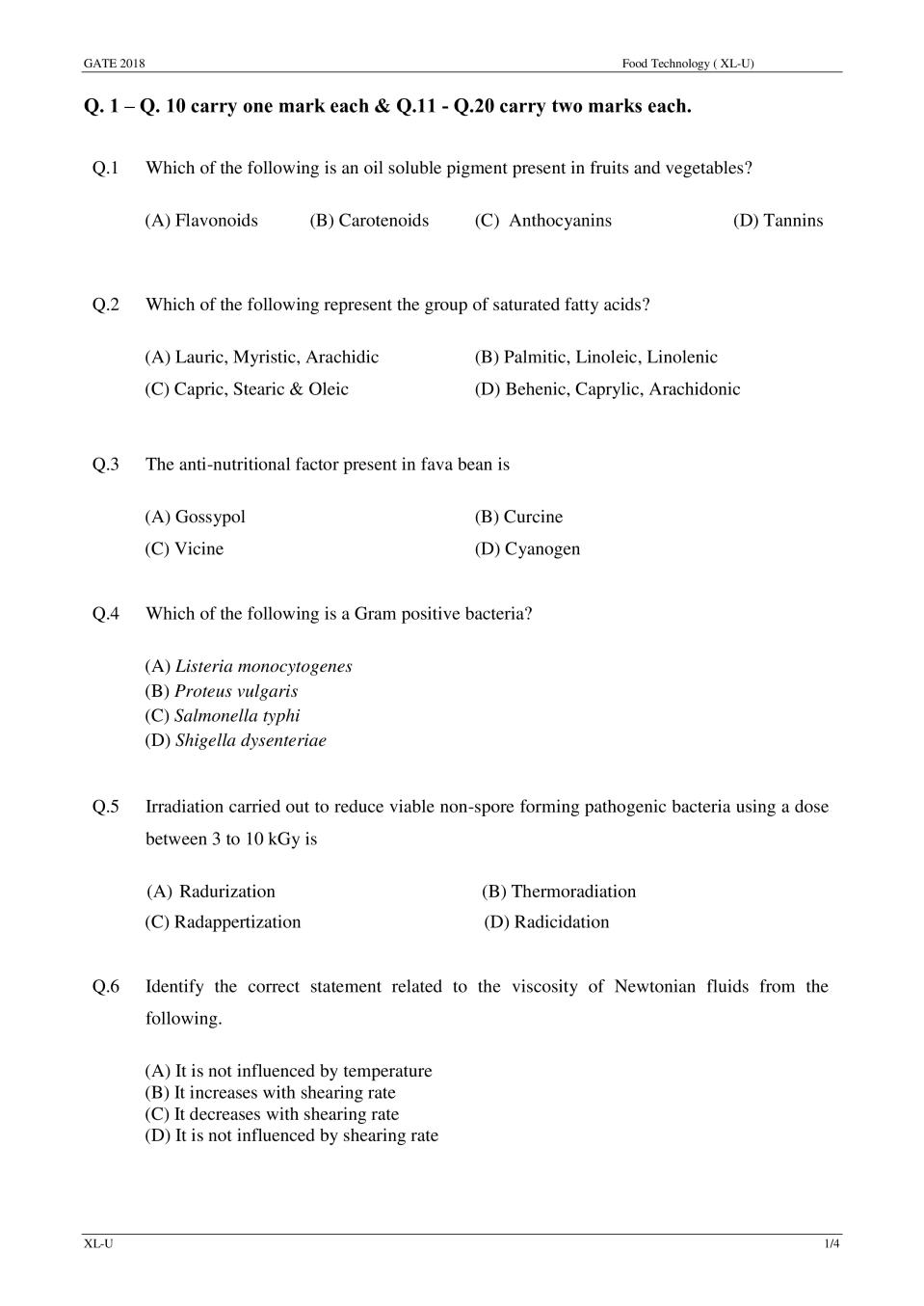
Q. 1 – Q. 10 carry one mark each & Q.11 - Q.20 carry two marks each.
Q.1 Which of the following is an oil soluble pigment present in fruits and vegetables?
(A) Flavonoids (B) Carotenoids (C) Anthocyanins (D) Tannins
Q.2 Which of the following represent the group of saturated fatty acids?
(A) Lauric, Myristic, Arachidic (B) Palmitic, Linoleic, Linolenic
(C) Capric, Stearic & Oleic (D) Behenic, Caprylic, Arachidonic
Q.3 The anti-nutritional factor present in fava bean is
(A) Gossypol (B) Curcine
(C) Vicine (D) Cyanogen
Q.4 Which of the following is a Gram positive bacteria?
(A) Listeria monocytogenes
(B) Proteus vulgaris
(C) Salmonella typhi
(D) Shigella dysenteriae
Q.5 Irradiation carried out to reduce viable non-spore forming pathogenic bacteria using a dose
between 3 to 10 kGy is
(A) Radurization (B) Thermoradiation
(C) Radappertization (D) Radicidation
Q.6 Identify the correct statement related to the viscosity of Newtonian fluids from the
following.
(A) It is not influenced by temperature
(B) It increases with shearing rate
(C) It decreases with shearing rate
(D) It is not influenced by shearing rate
XL-U 1/4
Page 2
Q.7 Adult male Wistar rats were fed with a protein based diet. Total 150 g of protein was
ingested per animal. If the average weight increased from 110 g to 350 g after the end of
experiment, the Protein efficiency ratio of the given protein would be _______. (up to two
decimal points).
Q.8 The initial moisture content of a food on wet basis is 50.76%. Its moisture content (%) on
dry basis is _______.(up to two decimal points)
Q.9 The oxygen transmission rate through a 2.54 x 10⁻³ cm thick low density polyethylene film
with air on one side and inert gas on the other side is 3.5 x 10⁻⁶ mL cm-2 s-1. Oxygen partial
pressure difference across the film is 0.21 atm. The permeability coefficient of the film to
oxygen is _______ x 10-11 mL (STP) cm cm-2 s-1 (cm Hg)-1.
Q.10 Ambient air at 30◦C dry bulb temperature and 80% relative humidity was heated to a dry
bulb temperature of 80◦C in a heat exchanger by indirect heating. The amount of moisture
gain (g kg-1 dry air) during the process would be _______.
Q. 11 – Q. 20 carry two marks each.
Q.11 Match the commodity in Group I with the bioactive constituent in Group II
Group I Group II
P. Ginger 1. Lutein
Q. Green tea 2. Gingerol
R. Spinach 3. Curcumin
S. Turmeric 4. Epigallocatechin gallate
(A) P-1, Q-2, R-3, S-4
(B) P-2, Q-4, R-1, S-3
(C) P-4, Q-1, R-3, S-2
(D) P-2, Q-3, R-1, S-4
Q.12 Match the process operation in Group I with the separated constituent in Group II
Group I Group II
P. Extraction 1. Phospholipids
Q. Degumming 2. Free fatty acids
R. Neutralization 3. Pigments
S. Bleaching 4. Crude oil
(A) P-3, Q-2, R-4, S-1 (B) P-4, Q-3, R-1, S-2
(C) P-4, Q-1, R-2, S-3 (D) P-4, Q-1, R-3, S-2
XL-U 2/4
Page 3
Q.13 Match the spoilage symptom in Group I with the causative microorganism in Group II
Group I Group II
P. Green rot of eggs 1. Micrococcus spp.
Q. Putrid swell in canned fish 2. Serretia marcescens
R. Red bread 3. Pseudomonas fluorescens
S. Yellow discoloration of meat 4. Clostridium sporogens
(A) P-4, Q-3, R-2, S-1 (B) P-2, Q-1, R-4, S-3
(C) P-3, Q-4, R-2, S-1 (D) P-1, Q-4, R-3, S-2
Q.14 Match the fermented product in Group I with the base material in Group II
Group I Group II
P. Sake 1. Milk
Q. Chhurpi 2. Cabbage
R. Natto 3. Rice
S. Sauerkraut 4. Soybean
(A) P-3, Q-1, R-4, S-2 (B) P-1, Q-3, R-4, S-2
(C) P-4, Q-1, R-3, S-2 (D) P-2, Q-4, R-1, S-3
Q.15 Match the operation in Group I with the process in Group II
Group I Group II
P. Cleaning 1. Quality separation
Q. Grading 2. Clarification
R. Size reduction 3. Screening
S. Filtration 4. Comminution
(A) P-1, Q-3, R-4, S-2 (B) P-4, Q-1, R-3, S-2
(C) P-2, Q-4, R-1, S-3 (D) P-3, Q-1, R-4, S-2
Q.16 Out of 7 principles of HACCP system, 4 are listed below. Arrange these principles in the
order in which they are applied.
(P) Conduct a hazard analysis
(Q) Establish monitoring process
(R) Establish critical limit
(S) Establish record keeping and documentation process
(A) P, R, Q, S (B) Q, R, P, S (C) P, Q, R, S (D) R, S, P, Q
XL-U 3/4
Page 4
Q.17 Identify an example of a classical diffusional mass transfer process without involving heat,
among the following.
(A) Drying of food grains
(B) Carbonation of beverages
(C) Distillation of alcohol
(D) Concentration of fruit juice
Q.18 For an enzyme catalyzed reaction S P , the kinetic parameters are:
[S] = 40 µM, V0 = 9.6 µM s-1 and Vmax = 12.0 µM s-1.
The Km of the enzyme in µM will be _______.(up to one decimal points)
Q.19 A microbial sample taken at 10 AM contained 1x10⁵ CFU/mL. The count reached to
1x10¹⁰ CFU/mL at 8 PM of the same day. The growth rate (h-1) of the microorganism
would be _______.(up to two decimal points)
Q.20 The rate of heat transfer per unit area from a metal plate is 1000 W m-2. The surface
temperature of the plate is 120◦C and ambient temperature is 20◦C. The convective heat
transfer coefficient (W m-2 ◦C-1) using the Newton’s law of cooling will be _______.
END OF THE QUESTION PAPER
XL-U 4/4
Page 5
1 MCQ GA A 1
2 MCQ GA C 1
3 MCQ GA B 1
4 MCQ GA B 1
5 MCQ GA B 1
6 MCQ GA A 2
7 MCQ GA D 2
8 MCQ GA D 2
9 MCQ GA B 2
10 MCQ GA C 2
1 MCQ XL‐P A 1
2 MCQ XL‐P D 1
3 MCQ XL‐P D 1
4 NAT XL‐P 11 to 11 1
5 NAT XL‐P 4 to 4 1
6 MCQ XL‐P D 2
7 MCQ XL‐P D 2
8 MCQ XL‐P A 2
9 MCQ XL‐P D 2
10 MCQ XL‐P A 2
11 MCQ XL‐P C 2
12 MCQ XL‐P B 2
13 NAT XL‐P 1.39 to 1.43 2
Page 6
14 NAT XL‐P 7.39 to 7.54 2
15 NAT XL‐P ‐13.40 to ‐13.36 2
1 MCQ XL‐Q B 1
2 MCQ XL‐Q A 1
3 MCQ XL‐Q C 1
4 MCQ XL‐Q C 1
5 MCQ XL‐Q D 1
6 MCQ XL‐Q C 1
7 MCQ XL‐Q D 1
8 MCQ XL‐Q B 1
9 NAT XL‐Q 12 to 12 1
10 NAT XL‐Q 50 to 50 1
11 MCQ XL‐Q A 2
12 MCQ XL‐Q A 2
13 MCQ XL‐Q D 2
14 MCQ XL‐Q B 2
15 MCQ XL‐Q B 2
16 NAT XL‐Q 512 to 512 2
17 NAT XL‐Q 20 to 20 2
18 NAT XL‐Q 0.8 to 0.8 2
19 NAT XL‐Q 77 to 77 2
20 NAT XL‐Q ‐8862 to ‐8862 2
1 MCQ XL‐R A 1
Page 7
2 MCQ XL‐R B 1
3 MCQ XL‐R C 1
4 MCQ XL‐R D 1
5 MCQ XL‐R B 1
6 MCQ XL‐R C 1
7 MCQ XL‐R A 1
8 MCQ XL‐R A 1
9 MCQ XL‐R B 1
10 NAT XL‐R 28.00 to 31.00 1
11 MCQ XL‐R D 2
12 MCQ XL‐R D 2
13 MCQ XL‐R C 2
14 MCQ XL‐R B 2
15 MCQ XL‐R C 2
16 MCQ XL‐R D 2
17 MCQ XL‐R A 2
18 MCQ XL‐R B 2
19 NAT XL‐R 20.25 to 20.25 2
20 NAT XL‐R 11.00 to 12.00 2
1 MCQ XL‐S B 1
2 MCQ XL‐S A 1
3 MCQ XL‐S A 1
4 MCQ XL‐S D 1
Page 8
5 MCQ XL‐S D 1
6 MCQ XL‐S C 1
7 MCQ XL‐S D 1
8 MCQ XL‐S B 1
9 MCQ XL‐S A 1
10 NAT XL‐S 1.38 to1.42 1
11 MCQ XL‐S C 2
12 MCQ XL‐S C 2
13 MCQ XL‐S A 2
14 MCQ XL‐S D 2
15 MCQ XL‐S B 2
16 MCQ XL‐S A 2
17 NAT XL‐S 2.60 to 2.80 2
18 NAT XL‐S 0.5 to 0.5 2
19 NAT XL‐S 45.50 to 46.50 2
20 NAT XL‐S 30.5 to 31.5 2
1 MCQ XL‐T C 1
2 MCQ XL‐T B 1
3 MCQ XL‐T A 1
4 MCQ XL‐T D 1
5 MCQ XL‐T C 1
6 MCQ XL‐T D 1
7 MCQ XL‐T B 1
Page 9
8 MCQ XL‐T A 1
9 MCQ XL‐T A 1
10 MCQ XL‐T C 1
11 MCQ XL‐T B 2
12 MCQ XL‐T D 2
13 MCQ XL‐T C 2
14 MCQ XL‐T C 2
15 MCQ XL‐T B 2
16 MCQ XL‐T D 2
17 MCQ XL‐T C 2
18 MCQ XL‐T A 2
19 NAT XL‐T 5270 to 5310 2
20 NAT XL‐T 0.056 to 0.062 2
1 MCQ XL‐U B 1
2 MCQ XL‐U A 1
3 MCQ XL‐U C 1
4 MCQ XL‐U A 1
5 MCQ XL‐U D 1
6 MCQ XL‐U D 1
7 NAT XL‐U 1.55 to 1.65 1
8 NAT XL‐U 103.0 to 103.2 1
9 NAT XL‐U 54 to 56 1
10 NAT XL‐U 0 to 0 1
Page 10
11 MCQ XL‐U B 2
12 MCQ XL‐U C 2
13 MCQ XL‐U C 2
14 MCQ XL‐U A 2
15 MCQ XL‐U D 2
16 MCQ XL‐U A 2
17 MCQ XL‐U B 2
18 NAT XL‐U 9.8 to 10.2 2
19 NAT XL‐U 1.1 to 1.8 2
20 NAT XL‐U 10 to 10 2
Document Details
| Board / Org | IIT |
| Exam | Graduate Aptitude Test in Engineering |
| Type | Question Paper |
| Pages | 10 |
| Updated | 22 Jul 2026 |