UPSC IES ISS 2026 Notification
Finished viewing? Save it for later —
Download UPSC IES ISS 2026 Notification (PDF · 33 pages)About UPSC IES ISS 2026 Notification
UPSC IES ISS 2026 Notification is available here for free download. Published by UPSC for Indian Economic Service / Indian Statistical Service Examination, this notification can be viewed online or downloaded as a PDF (33 pages). Candidates preparing for Indian Economic Service / Indian Statistical Service Examination can use UPSC IES ISS 2026 Notification to understand the exam pattern, the type of questions asked, and the overall difficulty level.
Frequently Asked Questions
How can I download UPSC IES ISS 2026 Notification?
Open this page and click the Download button to save UPSC IES ISS 2026 Notification as a PDF. It is completely free on AglaSem Docs.
Is UPSC IES ISS 2026 Notification free to download?
Yes. UPSC IES ISS 2026 Notification can be viewed online and downloaded as a PDF free of cost on AglaSem Docs.
How many pages does UPSC IES ISS 2026 Notification have?
UPSC IES ISS 2026 Notification contains 33 pages, which you can read online or download together as a single PDF.
Where can I find more Indian Economic Service / Indian Statistical Service Examination study material?
You can find more Indian Economic Service / Indian Statistical Service Examination question papers, sample papers, syllabus, and answer keys on AglaSem Docs.
UPSC IES ISS 2026 Notification – Text
Read the full text of this notification below — useful to quickly search, copy and reference the content online without downloading the PDF.
📄 View text version (33 pages)
Page 1
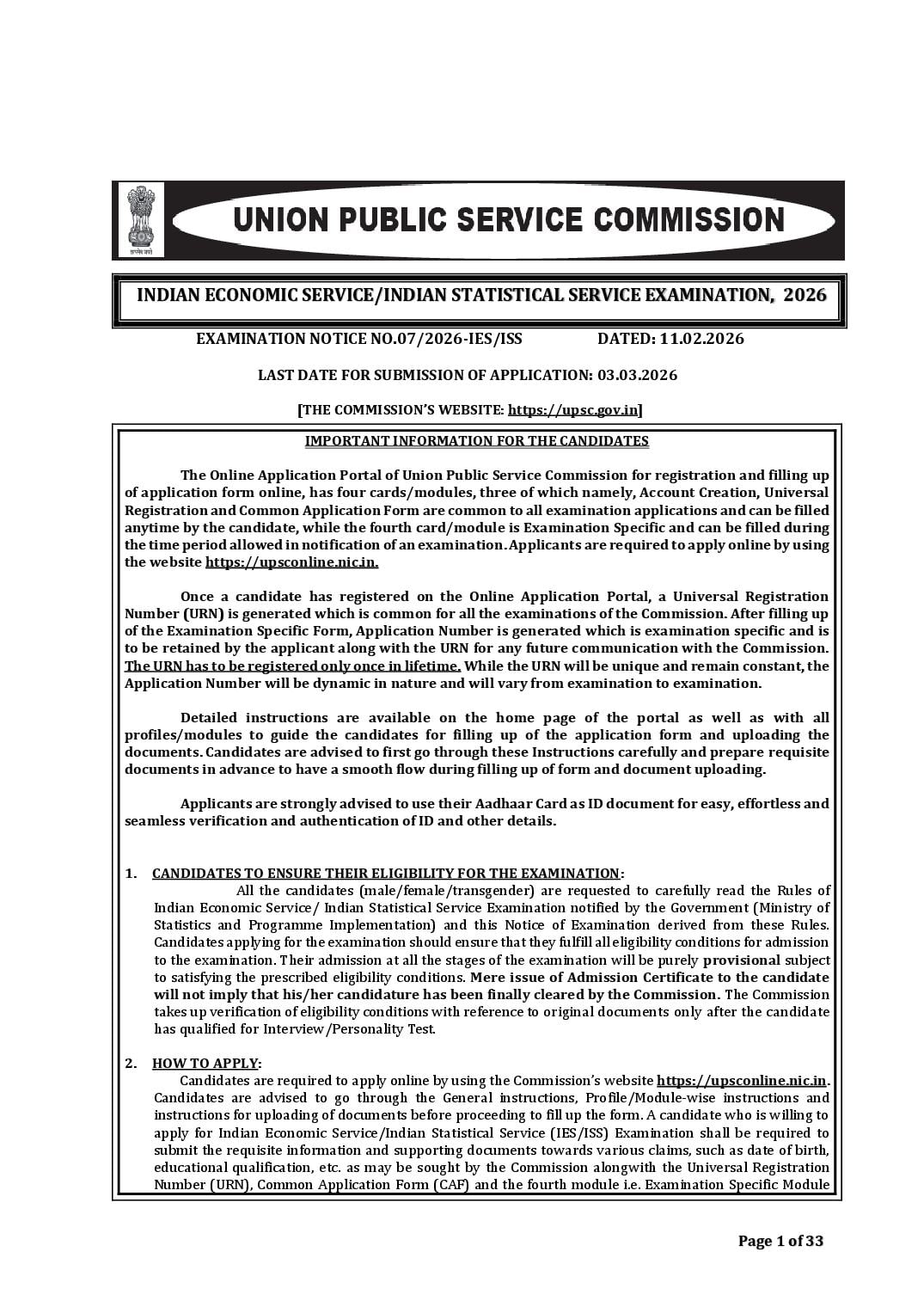
EXAMINATION NOTICE NO.07/2026-IES/ISS DATED: 11.02.2026
LAST DATE FOR SUBMISSION OF APPLICATION: 03.03.2026
[THE COMMISSION’S WEBSITE: https://upsc.gov.in]
IMPORTANT INFORMATION FOR THE CANDIDATES
The Online Application Portal of Union Public Service Commission for registration and filling up
of application form online, has four cards/modules, three of which namely, Account Creation, Universal
Registration and Common Application Form are common to all examination applications and can be filled
anytime by the candidate, while the fourth card/module is Examination Specific and can be filled during
the time period allowed in notification of an examination. Applicants are required to apply online by using
the website https://upsconline.nic.in.
Once a candidate has registered on the Online Application Portal, a Universal Registration
Number (URN) is generated which is common for all the examinations of the Commission. After filling up
of the Examination Specific Form, Application Number is generated which is examination specific and is
to be retained by the applicant along with the URN for any future communication with the Commission.
The URN has to be registered only once in lifetime. While the URN will be unique and remain constant, the
Application Number will be dynamic in nature and will vary from examination to examination.
Detailed instructions are available on the home page of the portal as well as with all
profiles/modules to guide the candidates for filling up of the application form and uploading the
documents. Candidates are advised to first go through these Instructions carefully and prepare requisite
documents in advance to have a smooth flow during filling up of form and document uploading.
Applicants are strongly advised to use their Aadhaar Card as ID document for easy, effortless and
seamless verification and authentication of ID and other details.
1. CANDIDATES TO ENSURE THEIR ELIGIBILITY FOR THE EXAMINATION:
All the candidates (male/female/transgender) are requested to carefully read the Rules of
Indian Economic Service/ Indian Statistical Service Examination notified by the Government (Ministry of
Statistics and Programme Implementation) and this Notice of Examination derived from these Rules.
Candidates applying for the examination should ensure that they fulfill all eligibility conditions for admission
to the examination. Their admission at all the stages of the examination will be purely provisional subject
to satisfying the prescribed eligibility conditions. Mere issue of Admission Certificate to the candidate
will not imply that his/her candidature has been finally cleared by the Commission. The Commission
takes up verification of eligibility conditions with reference to original documents only after the candidate
has qualified for Interview/Personality Test.
2. HOW TO APPLY:
Candidates are required to apply online by using the Commission’s website https://upsconline.nic.in.
Candidates are advised to go through the General instructions, Profile/Module-wise instructions and
instructions for uploading of documents before proceeding to fill up the form. A candidate who is willing to
apply for Indian Economic Service/Indian Statistical Service (IES/ISS) Examination shall be required to
submit the requisite information and supporting documents towards various claims, such as date of birth,
educational qualification, etc. as may be sought by the Commission alongwith the Universal Registration
Number (URN), Common Application Form (CAF) and the fourth module i.e. Examination Specific Module
Page 1 of 33
Page 2
Common Application Form (CAF) will entail cancellation of candidature for the examination.
NOTE-1: The Commission provides a one-time facility for candidates to update or modify their Universal
Registration Number (URN) Profile. Please note that any changes made to the URN Profile will not
be reflected in applications already submitted. The updated information will apply only to
applications submitted after the candidate has made the necessary changes and successfully re-
locked the URN Profile.
NOTE -2: Live Photo Capture for filling up of Common Application Form (CAF):
Applicants are required to upload their photograph and also capture their live photograph
while filling up the Common Application Form (CAF). Applicants must ensure that the uploaded
photograph and the live photograph captured are clear as per instructions given on “Instructions
and FAQs > Instruction for filling the form > Photos and Signature” available on the Commission’s
website: https://upsconline.nic.in .
NOTE -3: Uploading of Signature:
Applicants are required to sign three times (one below the other) on a plain white paper
using black ink and upload the same while filling up the Common Application Form (CAF). The
uploaded signatures should be clear and legible. The Candidates are advised to refer to the
instruction for uploading the signature available under “Instructions and FAQs” on the
Commission’s website: https://upsconline.nic.in.
2.1. WITHDRAWAL OF APPLICATION:
The candidates will not be allowed to withdraw their applications after submission of the same.
Further no correction/alteration/modification in any field(s) of the Application Form is allowed after
submission.
Brief instructions for filling up the Online Application Form have been given in Appendix-II (A).
2.2. The candidates should have details of one Photo ID Card viz. Aadhaar Card/Voter Card (EPIC)/PAN
Card/Passport/Driving License/Any other Photo ID Card issued by the State/Central Government. The
details of this Photo ID Card will have to be provided by the candidate while filling up the Universal
Registration Number (URN) Profile. This Photo ID Card will be used for all future reference and the
candidate is advised to carry this Photo ID Card while appearing for Examination/Personality Test.
3. LAST DATE FOR SUBMISSION OF APPLICATION:
The Online Application can be filled up to 03rd March, 2026 till 18:00 hours.
4. ISSUANCE OF e-ADMIT CARD:
The eligible candidates will be issued an e-Admit Card on the last working day of preceding week of the
date of the Examination. Further, those candidates who have opted for change of Scribe seven (07) days
prior to the date of the examination, shall be issued e-Admit Card three (03) days prior to the date of
examination. The e-Admit Card will be made available on the Commission’s website
[https://upsconline.nic.in] for downloading by the candidates. No Admit Card will be sent by post or email.
All the applicants are requested to provide valid and active email ID, while creating account as the Commission
may use electronic mode for contacting them.
5. SPECIAL INSTRUCTIONS:
Candidates are advised to read carefully “Special Instructions to Candidates for Conventional Type
Papers” (Appendix-III) and “Special Instructions to Candidates for Objective Type Tests” (Appendix-IV).
5. INSTRUCTIONS FOR FILLING UP OMR SHEETS:
(a) For both writing and marking answers in the OMR Sheets (Answer Sheet) candidates must use black ball
point pen only. Pens with any other colours are prohibited. Do not use Pencil or Ink pen.
(b) Candidates should note that any omission/mistake/discrepancy in encoding/filling in details in the OMR
answer sheet; especially with regard to Roll Number and Test Booklet Series Code, will render the answer
sheet liable for rejection.
7. PENALTY FOR WRONG ANSWERS:
Candidates should note that there will be a penalty (Negative Marking) for wrong answers marked by
a candidate in the Objective Type Question Paper.
Page 2 of 33
Page 3
The Commission has established a dedicated helpline to assist the candidates during the
application process. Candidates seeking clarification, guidance, or assistance related to the
application process or examination details can contact the helpline no. 011-24041001 or email ID –
[email protected]. The helpline will be operational from 10:00 AM to 5:30 PM on all working days
during the application window i.e from 11.02.2026 to 03.03.2026. Applicants may utilize this service
for any issues relating to the application process, including fee payment, uploading of documents, etc.
9. CHANGE OF SCRIBE:
Candidates, who have opted to use a scribe, may request a change of scribe upto seven (07) days prior
to the date of the examination. Such requests shall be submitted via URL https://upsconline.nic.in. The
request will be reviewed in accordance with the prescribed guidelines, and the candidate will be informed
accordingly.
10. MOBILE PHONES BANNED:
(a) The use of any mobile phone (even in switched off mode), pager or any electronic equipment or
programmable device or storage media like pen drive, smart watches etc. or camera or Bluetooth devices
or any other equipment or related accessories either in working or switched off mode capable of being
used as a communication device during the examination is strictly prohibited. Any infringement of these
instructions shall entail disciplinary action including ban from future examinations.
(b) Candidates are advised in their own interest not to bring any of the banned items including mobile
phones/ pagers or any valuable/costly items to the venue of the examination, as no arrangement for
safe-keeping will be made at the venue of the Examination. The Commission will not be responsible for
any loss in this regard.
11. REPORTING AT EXAMINATION VENUE:
The candidates should reach the venue of the Examination well in time at least 30 minutes prior
to the commencement of each session of the Examination. No late entry will be allowed inside the
Examination Venue under any circumstances.
12. FACE AUTHENTICATION FOR CANDIDATES AT THE EXAMINATION VENUE:
In order to ensure a secure and smooth examination process, all the candidates will be required
to undergo face authentication at the examination venue mandatorily. The candidates are advised to
enter the examination venue well in time for face authentication/identity verification and frisking.
13. ONLINE QUESTION PAPER REPRESENTATION PORTAL (QPRep):
The Commission will be providing an opportunity to the appeared candidates to make
representations to the Commission on the questions asked in the Papers of the Examination and on
the Answer Key of the Question Paper(s) (Objective Type) of this examination in a time frame of five
(05) days i.e. from the 3rd day of the Examination date to 06:00 PM of the 7th day. The appeared
candidates may login to the Commission’s website https://upsconline.nic.in and submit their
representation(s), if any, on Question Paper(s) under the header ‘Examinations > Representations
on Question Paper’. No representation by email/post/hand or by any other mode shall be accepted
and the Commission shall not involve into any correspondence with the candidates in this regard. No
representation shall be accepted under any circumstances after this window of five (05) days is over.
CANDIDATES ARE REQUIRED TO APPLY ONLINE ONLY. NO OTHER MODE IS ALLOWED FOR SUBMISSION
OF APPLICATION.
GOVERNMENT STRIVES TO HAVE A WORKFORCE WHICH REFLECTS GENDER BALANCE AND WOMEN
CANDIDATES ARE ENCOURAGED TO APPLY.
Page 3 of 33
Page 4
mentioned in Para 2 below will be held by the Union Public Service Commission commencing from 19th June, 2026
in accordance with the Rules published by the Ministry of Statistics & Programme Implementation in the Gazette
of India dated the 11th February, 2026.
(A) The examination will be held at the following centres:
Sl. No. CENTRE Sl. No. CENTRE
01 AHMEDABAD 12 JAIPUR
02 BENGALURU 13 JAMMU
03 BHOPAL 14 KOLKATA
04 CHANDIGARH 15 LUCKNOW
05 CHENNAI 16 MUMBAI
06 CUTTACK 17 PATNA
07 DELHI 18 PRAYAGRAJ (ALLAHABAD)
08 DISPUR 19 SHILLONG
09 FARIDABAD 20 SHIMLA
10 GHAZIABAD 21 THIRUVANANTHAPURAM
11 HYDERABAD
`The Centres and the date of holding the examination as mentioned above are liable to be changed at the
discretion of the Commission. Applicants should note that there will be a ceiling on the number of candidates
allotted to each of the Centres, except Ahmedabad, Chennai, Delhi, Dispur and Kolkata. Allotment of Centres
will be on the “first-apply–first-allot” basis, and once the capacity of a particular Centre is attained, the Centre
will no longer be available as an option for Non-PwBD candidates, however, the PwBD candidates
would be able to opt for the desired centre. Applicants, who cannot get a Centre of their choice due to ceiling,
will be required to choose a Centre from the remaining ones. Applicants are, thus, advised that they may apply
early so that they could get a Centre of their choice. If any candidate appears at a venue other than the one
indicated by the Commission in his/her e-Admit Card, such candidate will not be allowed to take the
examination.
NB: Notwithstanding the aforesaid provision, the Commission reserves the right to change the Centres
at their discretion if the situation so demands. All the Examination Centres for Indian Economic
Service/Indian Statistical Service Examination, 2026 will cater to examination for Persons with
Benchmark Disability in their respective Centres. Candidates admitted to the examination will be
informed of the time table and place or places of examination. The candidates should note that no
request for change of Examination Centre will be entertained.
(B) REGISTRATION & ONLINE APPLICATION FORM:
B.1: A candidate who is willing to apply for Indian Economic Service/Indian Statistical Service
Examination shall be required to apply online and submit the requisite information and supporting
documents towards various claims, such as date of birth, category [viz. SC/ST/OBC/ EWS/PwBD/Ex -
Servicemen], educational qualification, etc. as may be sought by the Commission along with the Common
Application Form. The failure to provide the required information/documents along with the Universal
Registration Number (URN) Profile and Common Application Form (CAF) will entail cancellation of
candidature for the examination.
Note: The candidate should also note that no addition/deletion/any changes are allowed in Online
Application Form in any circumstances once submitted. However, the Commission provides
a one-time facility for candidates to update or modify their Universal Registration Number
(URN) Profile. Please note that any changes made to the URN Profile will not be reflected in
the application already submitted. The updated information will apply only to the
application submitted after the candidate has made the necessary changes and successfully
re-locked the URN Profile.
B.2: The Commission shall provide a window of 15 (Fifteen) days after the declaration of
result of written part of Indian Economic Service/Indian Statistical Service (IES/ISS) Examination ,
2026. All the candidates who qualified for the Personality Test/Interview shall be required
to mandatorily login to the portal (https://upsconline.nic.in) during this period and shall be
required to update their details/educational qualification status (whether appearing/appeared)
alongwith proof of passing the requisite qualifying examination, and upload the relevant
Page 4 of 33
Page 5
participate in the further stages of this examination and no correspondence will be
entertained by the Commission in this regard.
Note-1: In addition to Para-B.2 above, the candidates (wherever applicable) are required to
update the Correspondence/Permanent Postal Address, Higher Educational Qualification,
Achievement in different fields (if any), Employment details/Service Experience, details
of the Service allocated on the basis of earlier/previous Indian Economic Service/Indian
Statistical Service Examinations (if any), Marital Status, PwBD Recommendation details
in past, Parental details, Debarment information, earlier Examination details, OBC/EWS
Annexure (wherever applicable), Socio-economic questionnaire], whichever is applicable
and submit their Online Application Form.
Note-2: Candidates who have uploaded the required documents/information earlier and have no
information to update/fill in, are also required to login and finally submit after verifying
the details so as to generate the e-Summon letter for the Personality Test/Interview.
Note-3: The candidates are advised to regularly visit the Commission’s website with regard to
further updates.
2. (a) The Services to which recruitment is to be made on the results of this examination and the tentative
number of vacancies in Junior Time Scale of the Services are given below:
(i) Indian Economic Service - 16
(ii) Indian Statistical Service - 28
NOTE-1: Out of 16 Vacancies in Indian Economic Service, One (01) Vacancy is reserved for PwBD
under category ‘e’ multiple disabilities from amongst category (a) to (c) excluding
category (d), subject to the condition that the post shall not be earmarked for a
combination of complete blindness under category (a) and complete deafness under
category (b).
NOTE-2: Out of 28 Vacancies in Indian Statistical Service, total two (02) Vacancies are reserved
for PwBD. One (01) Vacancy is carried forward reserved for Deaf and Hard of Hearing
(D/HH) which can be interchanged in terms of DoPT’s OM dated 15.01.2018 and One (01)
fresh Vacancy is reserved for Special Learning Disability/Multiple Disability (SLD/MD)
and this vacancy is not to be interchanged as per DoPT’s OM dated 15.01.2018.
The number of vacancies mentioned above is tentative and liable to alteration.
Reservation will be made for the candidates belonging to Scheduled Castes, Scheduled Tribes, Other
Backward Classes, Economically Weaker Sections and Persons with Benchmark Disability categories in respect of
vacancies as may be fixed by the Government.
(b) A candidate may compete for any one of the Services only viz. the Indian Economic Service or the Indian
Statistical Service, for which he/she is eligible in terms of the rules.
A candidate will be eligible to get the benefit of community reservation only in case the particular caste
to which the candidate belongs is included in the list of reserved Communities issued by the Central Government.
The candidates will be eligible to get the benefit of the Economically Weaker Section reservation only in case the
candidate meets the criteria issued by the Central Government and in possession of such eligibility certification.
The OBC candidates applying for Indian Economic Service /Indian Statistical Service Examination, 2026
must produce OBC (Non-Creamy Layer) certificate based on the income for the Financial Year (FY) 2024-25, 2023-
24 and 2022-23 and issued on/after 01.04.2025 (after completion of FY 2024-25) but not later than the closing
date of the application for Indian Economic Service/Indian Statistical Service Examination, 2026.
If a candidate indicates in his/her application form for Indian Economic Service/Indian Statistical Service
Examination that he/she belongs to Unreserved category but subsequently writes to the Commission to change
his/her category to a reserved one, such request shall not be entertained by the Commission. Further, once a
candidate has chosen a reserved category, no request shall be entertained for change to other reserved category
viz. SC to ST, ST to SC, OBC to SC/ST or SC/ST to OBC, SC to EWS, EWS to SC, ST to EWS, EWS to ST, OBC to EWS,
EWS to OBC. No reserved category candidates other than those who qualified each stage of the Examination on
General Merit, shall be allowed to change (on their request or as decided by the Commission/Government based
on the documents submitted by them) their category from Reserved to Unreserved or claim the vacancies (Cadre)
Page 5 of 33
Page 6
on General Standard, their candidature shall be cancelled.
Further, no Persons with Benchmark Disabilities (PwBD) candidate of any subcategory thereunder shall
be allowed to change his/her subcategory of disability.
While the above principle will be followed in general, there may be a few cases where there was a gap not
more than 3 months between the issuance of a Government Notification enlisting a particular community in the
list of any of the reserved Communities and the date of submission of the application by the candidate. In such
cases the request of change of community from general to reserved may be considered by the Commission on
merit. In case of a candidate unfortunately becoming Person with Benchmark Disability during the course of
the examination process, the candidate should produce valid documents showing him/her acquiring a disability to
the extent of 40% or more as defined under the Rights of Persons with Disabilities Act, 2016 to enable him/her to
get the benefits of reservation earmarked for Person with Benchmark Disability provided he/she otherwise
remains eligible for the Indian Economic Service/Indian Statistical Service as per Rule 19 of the Rules of the Indian
Economic Service/ Indian Statistical Service Examination, 2026.
Candidates seeking reservation/relaxation benefits available for SC/ST/OBC/EWS/PwBD/Ex-
servicemen must ensure that they are entitled to such reservation/relaxation as per eligibility prescribed in the
Rules/Notice. They should also be in possession of all the requisite valid certificates in the prescribed format in
support of their claim as stipulated in the Rules/Notice for such benefits by the closing date of the application.
A candidate of Indian Economic Service/Indian Statistical Service Examination, 2026 will be eligible to
get the benefit of the Economically Weaker Section reservation only in case the candidate meets the criteria issued
by the Central Government and is in possession of requisite Income & Asset Certificate based on the income for
Financial Year (FY) 2024-2025 and issued on/after 01.04.2025 (after the completion of FY 2024-25) but not later
than the closing date of the application for Indian Economic Service/Indian Statistical Service Examination, 2026.
3. PRATIBHA SETU PORTAL (erstwhile PUBLIC DISCLOSURE SCHEME):
As per the policy notified by the Government for increasing the access of unemployed to job opportunities,
the information of candidates who appeared in the final stage of Examination (Interview/ Personality Test) but
not recommended, will be made accessible to any registered Private Company, Public Sector Undertaking,
Statutory and Autonomous organisations of Government of India on the dedicated Portal on the website of the
Commission to identify suitable candidates in line of their requirements for providing employment. Short biodata
of the candidates with their educational qualifications, contact numbers, details including their percentile (not
absolute or percentage marks), etc. will also be made accessible on this dedicated Portal. The data available on this
Portal shall be restricted for the purpose of evaluation of suitability of the candidates for employment purpose
only to these registered organisations. These lists will be made available after the declaration of final result. It may
be noted that there is no option for partial disclosure and choice once opted cannot be changed.
Candidates will be required to give their consent at the time of filling the Exam Specific Module. A
candidate may opt out of the scheme also and in that case his/her details will not be published by the Commission.
Besides sharing of the information of the non-recommended willing candidates of this examination, , the
Commission will not assume any responsibility or liability for the method and manner in which information related
to such candidates is utilized by these registered organizations.
4. ELIGIBILITY CONDITIONS:
(I) Nationality: A candidate must be either:—
(a) a citizen of India; or
(b) a subject of Nepal; or
(c) a subject of Bhutan; or
(d) a Tibetan refugee who came over to India, before the 1st January, 1962, with the intention of
permanently settling in India; or
(e) a person of Indian origin who has migrated from Pakistan, Burma, Sri Lanka, East African countries of
Kenya, Uganda, the United Republic of Tanzania, Zambia, Malawi, Zaire and Ethiopia or Vietnam with the
intention of permanently settling in India :
Provided that a candidate belonging to categories (b), (c), (d) & (e) above shall be person in whose
favour a certificate of eligibility has been issued by the Government of India.
A candidate in whose case a certificate of eligibility is necessary may be admitted to the examination
but the offer of appointment may be given only after the necessary eligibility certificate has been issued to him/her
by the Government of India.
Page 6 of 33
Page 7
(a) A candidate must have attained the age of 21 years and must not have attained the age of 30 years on
1st August, 2026 i.e. he/she must have been born not earlier than 2nd August, 1996 and not later
than 1st August, 2005.
(b) The upper age-limit prescribed above will be relaxable as follows :—
(i) up to a maximum of five years if a candidate belongs to a Scheduled Caste or a Scheduled Tribe;
(ii) up to a maximum of three years in the case of candidate belonging to Other Backward Classes
who are eligible to avail of reservation applicable to such candidates;
(iii) up to a maximum of three years in the case of Defence Services Personnel disabled in operations
during hostilities with any foreign country or in a disturbed area, and released as a consequence
thereof ;
(iv) up to a maximum of five years in the case of Ex-servicemen including Commissioned Officers and
ECOs/SSCOs who have rendered at least five years Military Service as on 1st August, 2026 and
have been released : (i) on completion of assignment (including those whose assignment is due
to be completed within one year from 1st August, 2026 otherwise than by way of dismissal or
discharge on account of misconduct or inefficiency; or (ii) on account of Physical disability
attributable to Military Service; or (iii) on invalidment;
(v) up to a maximum of five years in the case of ECOs/SSCOs who have completed an initial period
of assignment of five years of Military Service as on 1st August, 2026 and whose assignment has
been extended beyond five years and in whose case the Ministry of Defence issues a certificate
that they can apply for Civil employment and that they will be released on three months’ notice
on selection from the date of receipt of offer of appointment;
(vi) up to a maximum of 10 years in the case of Persons with Benchmark Disabilities viz; (a) blindness
and low vision; (b) deaf and hard of hearing; (c) locomotor disability including cerebral palsy,
leprosy cured, dwarfism, acid attack victims and muscular dystrophy; (d) autism, intellectual
disability, specific learning disability and mental illness; (e) multiple disabilities from amongst
person under clauses (a) to (d) including deaf blindness.
NOTE-I: Candidates belonging to the Scheduled Castes and the Scheduled Tribes and the Other Backward
Classes who are also covered under any other clauses of para 4(II)(b) above, viz. those coming under
the category of Ex-servicemen and Persons with Benchmark Disabilities will be eligible for grant of
cumulative age-relaxation under both the categories.
NOTE-II: The term Ex-servicemen will apply to the persons who are defined as Ex-servicemen in the Ex-
servicemen (Re-employment in Civil Services and Posts) Rules, 1979, as amended from time to time.
NOTE-III: The age concession under Para 4(II)(b)(iv) and (v) will be admissible to Ex-servicemen i.e. a person
who has served in any rank whether as combatant or non-combatant in the Regular Army, Navy and
Air Force of the Indian Union and who either has been retired or relieved or discharged from such
service whether at his own request or being relieved by the employer after earning his or her
pension.
NOTE-IV: Notwithstanding the provisions of age relaxation under Para 4(II)(b)(vi) above, a Person with
Benchmark Disabilities will be considered to be eligible for appointment only if he/she (after such
physical examination as the Government or appointing authority as the case may be, may prescribe)
if found to satisfy the requirement of physical and medical standard for the concerned
Services/Posts to be allocated to the Persons with Benchmark Disabilities (PwBD) by the
Government.
NOTE V : The details of Functional Classification (FC) and Physical Requirements (PR) of each service is
indicated in this Notice which are identified and prescribed by the respective Cadre Controlling
Authorities (CCAs) as per the provisions of Section 33 and 34 of the Rights of Persons with
Disabilities Act, 2016. Only those category (ies) of disability (ies) mentioned in the Notice shall apply
for the examination under Persons with Benchmark Disability (PwBD) categories. Therefore, the
candidates belonging to the Persons with Benchmark Disability (PwBD) categories are advised to
read it carefully before applying for the examination.
SAVE AS PROVIDED ABOVE THE AGE LIMITS PRESCRIBED CAN IN NO CASE BE RELAXED
The date of birth, accepted by the Commission is that entered in the Matriculation or Secondary School
Leaving Certificate or in a certificate recognized by an Indian University as equivalent to Matriculation or in an
extract from a Register of Matriculates maintained by a University, which extract must be certified by the proper
authority of the University or in the Higher Secondary or an equivalent examination certificate.
Page 7 of 33
Page 8
the examination.
No other document relating to age like horoscopes, affidavits, birth extracts from Municipal Corporation,
Service Records and the like will be accepted.
The expression Matriculation/Higher Secondary Examination Certificate in this part of the instruction
includes the alternative certificates mentioned above.
NOTE-1: Candidates should note that only the Date of Birth as recorded in the Matriculation/ Higher Secondary
Examination Certificate or an equivalent certificate as on the date of submission of applications will be
accepted by the Commission, and no subsequent request for its change will be considered or granted.
NOTE-2: Candidates should also note that once Date of Birth has been submitted by them in Universal
Registration Number (URN) Profile and Common Application Form (CAF) and entered in records of the
Commission for the purpose of admission to an Examination, no change will be allowed subsequently
(or at any other Examination of the Commission) on any grounds whatsoever.
(III) MINIMUM EDUCATIONAL QUALIFICATIONS:
(a) A candidate for the Indian Economic Service must have obtained a Post-Graduate Degree in
Economics/Applied Economics/Business Economics/Econometrics from a University incorporated by an Act of
the Central or State Legislature in India or other Educational Institutes established by an Act of Parliament or
declared to be deemed as University under Section 3 of the University Grants Commission Act, 1956 or a Foreign
University approved by the Central Government from time to time.
(b) A candidate for the Indian Statistical Service must have obtained a Bachelor's Degree with
Statistics/Mathematical Statistics/Applied Statistics as one of the subjects or a Master's degree in
Statistics/Mathematical Statistics/Applied Statistics from a University incorporated by an Act of the Central or
State Legislature in India or other Educational Institutes established by an Act of Parliament or declared to be
deemed as University under Section 3 of the University Grants Commission Act, 1956 or a Foreign University
approved by the Central Government from time to time.
NOTE-1: Candidates who have appeared at an examination the passing of which would render them
educationally qualified for the Commission’s examination but have not been informed of the results as
also the candidates who intend to appear at such a qualifying examination will also be eligible for
admission to the Examination. However, all such candidates, who are declared qualified by the
Commission for Interview/Personality Test, will be required to produce proof of passing of the
requisite qualifying examination within the time limit prescribed in Rule 4.1 of IES/ISS Examination,
2026.
Only valid proof of passing the qualifying examination viz. Degree Certificate/Final Mark
Sheet/Provisional Degree Certificate etc. as are normally issued to the candidate by the competent
authority after the formal declaration of results by the University/Boards may be accepted.
NOTE-2: In exceptional cases, the Commission may treat a candidate, who has none of the foregoing qualification,
as a qualified candidate provided that he/she has passed examinations conducted by other institutions
the standard of which in the opinion of the Commission, justifies his/her admission to the examination.
NOTE-3: A candidate who is otherwise qualified but who has taken a degree from a Foreign University may also
apply to the Commission and may be admitted to the examination at the discretion of the Commission.
NOTE-4: For Indian Statistical Service Examination, the study of Statistics as a component of a multidisciplinary
course for one or two semesters should not be considered as eligibility for admission to the Indian
Statistical Service Examination in terms of the existing educational qualification prescribed for the
Examination. The study of Statistics should be in all the years of Bachelor Degree Course.
(IV) PHYSICAL STANDARDS:
Candidates must be physically fit according to physical standard for admission to Indian
Economic Service/Indian Statistical Service Examination, 2026 as per Regulations given in Appendix-III of the
Rules for the Indian Economic Service/Indian Statistical Service Examination, 2026 published in the Gazette of
India dated 11th February, 2026.
Page 8 of 33
Page 9
Candidates (except Female/SC/ST/Persons with Benchmark Disability (PwBD) Candidates who
are exempted from payment of fee) are required to pay fee of Rs. 200/- (Rupees Two Hundred only) either by using
Net Banking Facility of any bank or by using Visa/Master/RuPay/Credit/Debit Card/UPI Payment for appearing
in Indian Economic Service/Indian Statistical Service Examination, 2026.
NOTE-1: Candidates should note that payment of examination fee can be made only through the modes prescribed
above. Payment of fee through any other mode is neither valid nor acceptable. Applications submitted
without the prescribed fee/mode (unless remission of fee is claimed) shall be summarily rejected.
NOTE-2: Fee once paid shall not be refunded under any circumstances nor can the fee be held in reserve for any
other examination or selection.
ALL FEMALE CANDIDATES AND CANDIDATES BELONGING TO SCHEDULED CASTES/ SCHEDULED TRIBES
AND PERSONS WITH BENCHMARK DISABILITY ARE NOT REQUIRED TO PAY ANY FEE. NO FEE EXEMPTION
IS, HOWEVER, AVAILABLE TO OBC/EWS CANDIDATES AND THEY ARE REQUIRED TO PAY THE FULL
PRESCRIBED FEE.
Candidates belonging to Persons with Benchmark Disabilities are exempted from the payment of fee
provided they are otherwise eligible for appointment to the Services to be filled on the results of this examination
on the basis of the standards of medical fitness for these Services (including any concessions specifically extended
to the Persons with Benchmark Disability). A person with Benchmark Disability claiming age relaxation/fee
concession will be required by the Commission to submit alongwith his/her Registration and Online Application
Form, a certified copy of the Certificate of Disability from a Government Hospital/Medical Board in support of
his/her claim for belonging to Person with Benchmark Disability.
NOTE: Notwithstanding the aforesaid provision for age relaxation/fee exemption, a Person with Benchmark
Disabilities will be considered to be eligible for appointment only if he/she (after such physical
examination as the Government or the Appointing Authority, as the case may be, may prescribe) is found
to satisfy the requirements of Physical and Medical Standards for the concerned Service(s) to be allocated
to Persons with Benchmark Disabilities by the Government.
NOTE-I: Applications without prescribed Fee (unless remission of Fee is claimed) shall be summarily rejected.
NOTE-II: Fee once paid shall not be refunded under any circumstances nor can the fee be held in reserve for any
other examination or selection.
NOTE-III: If any candidate who took the Indian Economic Service/Indian Statistical Service Examination held in
2025 wishes to apply for admission to this examination, he/she must apply online by the prescribed
date without waiting for the results or any offer of appointment.
6. HOW TO APPLY:
(a) Candidates are required to apply online by using the website https://upsconline.nic.in.
Candidates are advised to go through the General instructions, Profile/Module-wise instructions and instructions
for uploading of documents before proceeding to fill up the form. A candidate who is willing to apply for Indian
Economic Service/Indian Statistical Service Examination shall be required to submit the requisite information and
supporting documents towards various claims, such as date of birth, educational qualification, etc. as may be
sought by the Commission alongwith the Universal Registration Number (URN), Common Application Form (CAF)
and the fourth module i.e. Examination Specific Module (including fees and centre etc.). Failure to provide the
required information/documents alongwith the Common Application Form (CAF) will entail cancellation of
candidature for the examination.
NOTE-1: The Commission provides a one-time facility for candidates to update or modify their Universal
Registration Number (URN) profile. Please note that any changes made to the URN Profile will not be
reflected in applications already submitted. The updated information will apply only to applications
submitted after the candidate has made the necessary changes and successfully re-locked the URN
Profile.
NOTE-2: Live Photo Capture for filling up of Common Application Form (CAF):
Applicants are required to upload their photograph and also capture their live photograph while
filling up the Common Application Form (CAF). Applicants must ensure that the uploaded photograph
and the live photograph captured is clear as per instructions given on “Instructions and FAQs >
Instruction for filling the form > Photos and Signature” available on the Commission’s website
https://upsconline.nic.in.
Page 9 of 33
Page 10
Applicants are required to sign three times (one below the other) on a plain white paper using a
black ink and upload the same while filling up the Common Application Form (CAF). The uploaded
signatures should be clear and legible. The Candidates are advised to refer to the instruction for uploading
the signature available under “Instructions and FAQs” on the website of the Commission with the URL:
https://upsconline.nic.in.”
NOTE-4: The candidates will not be allowed to withdraw their applications after the submission of the same.
Further no correction /alteration/modification in any field(s) of the Application Form is allowed after
submission.
(b) All the candidates, whether already in Government Service, or in Government owned industrial
undertakings or other similar organizations or in private employment should submit their applications direct to
the Commission.
Persons already in Government service, whether in a permanent or temporary capacity or as work
charged employees other than casual or daily rated employees or those serving under Public Enterprises are
however, required to inform in writing to their Head of Office/Department that they have applied for the
Examination.
Candidates should note that in case a communication is received from their employer by the Commission
withholding permission to the candidates applying for/appearing at the examination, their applications will be
liable to be rejected/candidature will be liable to be cancelled.
NOTE-1: While filling in his/her Online Application Form, the candidate should carefully decide about his/her
choice for the Centre for the Examination. If any candidate appears at a Centre other than the one
indicated by the Commission in his/her e-Admission Certificate, the papers of such a candidate will not
be evaluated and his/her candidature will be liable to cancellation.
NOTE-2: Incomplete or defective applications shall be summarily rejected. No representation or correspondence
regarding such rejection shall be entertained under any circumstances.
Candidates are not required to submit hard copy of their application to the Commission.
The candidates applying for the examination should ensure that they fulfill all the eligibility conditions for
admission to the Examination. Their admission at all the stages of examination for which they are admitted
by the Commission, viz. Written Examination and Interview Test will be purely provisional, subject to their
satisfying the prescribed eligibility conditions. If on verification, at any time, before or after the written
examination or Interview Test, it is found that they do not fulfill any of the eligibility conditions; their
candidature for the examination will be cancelled by the Commission.
If any of their claims is found to be incorrect, they may render themselves liable to disciplinary action by
the Commission in terms of Rule 12 of the Rules for the Indian Economic Service/Indian Statistical Service
Examination, 2026 notified in the Gazette of India dated 11th February, 2026 and also reproduced below:
(1) A candidate who is or has been declared by the Commission to be guilty of :-
(a) Obtaining support for candidature by the following means, namely :-
(i) offering illegal gratification to; or
(ii) applying pressure on; or
(iii) blackmailing, or threatening to blackmail any person connected with the conduct of the
examination; or
(b) impersonation; or
(c) procuring impersonation by any person; or
(d) submitting fabricated/incorrect documents or documents which have been tampered with; or
(e) uploading irrelevant or incorrect photo/signature in the application form in place of actual
photo/signature; or
(f) making statements which are incorrect or false or suppressing material information; or
(g) resorting to the following means in connection with the candidature for the examination, namely :-
(i) obtaining copy of question paper through improper means; or
(ii) finding out the particulars of the persons connected with secret work relating to the
examination; or
(iii) influencing the examiners; or
(h) being in possession of or using unfair means during the examination; or
(i) writing obscene matter or drawing obscene sketches or irrelevant matter in the scripts; or
Page 10 of 33
Page 11
boycott examination, creating a disorderly scene and the like; or
(k) harassing, threatening or doing bodily harm to the staff employed by the Commission for the conduct
of the examination; or
(l) being in possession of or using any mobile phone, (even in switched-off mode), pager or any electronic
equipment or programmable device or storage media like pen drive, smart watches etc. or camera or
Bluetooth devices or any other equipment or related accessories (either in working or switched-off
mode) capable of being used as a communication device during the examination; or
(m) violating any of the instructions issued to candidates along with their admission certificates permitting
them to take the examination; or
(n) attempting to commit or, as the case may be, abetting the commission of all or any of the acts specified
in the foregoing clauses;
In addition to being liable to appropriate legal action as deemed fit under the Public
Examinations (Prevention of Unfair Means) Act, 2024, as amended from time to time , the candidate
shall be disqualified by the Commission from the Examination held under these Rules; and/or shall be liable
to be debarred either permanently or for a specified period:-
(i) by the Commission, from any examination or selection held by them;
(ii) by the Central Government from any employment under them;
and shall be liable to face disciplinary action under the appropriate rules if already in service under Government;
Provided that no penalty under this rule shall be imposed except after :-
(i) giving the candidate an opportunity of making such representation in writing as the candidate
may wish to make in that behalf; and
(ii) taking the representation, if any, submitted by the candidate within the period allowed for this
purpose, into consideration.
(2) Any person who is found by the Commission to be guilty of colluding with a candidate(s) in committing
or abetting the Commission of any of the misdeeds listed at the clauses (a) to (m) above will be liable to
appropriate legal action in terms of the clause (n) above as deemed fit under the Public Examinations
(Prevention of Unfair Means) Act, 2024, as amended from time to time.
Note: “If a candidate is found to be in possession or using unfair means, may not be allowed to continue in the said
exam as soon as the incident comes to notice of the Examination functionaries and the action against the candidates
may be taken in consultation with the Commission. Further, the candidate may also not be allowed in any of the
subsequent papers of the said examination.”
7. LAST DATE FOR SUBMISSION OF APPLICATION:
(i) The Online Application can be filled upto 03rd March, 2026 till 18:00 hours, after which the link will be disabled.
Detailed instructions regarding filling of Online Application is available at Appendix-II(A).
(ii) Withdrawal of Application: The candidates will not be allowed to withdraw their applications after
submission of the same.
8. CORRESPONDENCE WITH THE COMMISSION:
The Commission will not enter into any correspondence with the candidates about their candidature
except in the following cases:
(i) The eligible candidates shall be issued an e-Admit Card on the last working day of preceding week of the
date of the Examination. Further, those candidates, who have opted for change of Scribe upto seven (07) days
prior to the date of the examination, shall be issued e-Admit Card three (03) days prior to the date of
examination. The e-Admit Card will be made available on the Commission’s website [https://upsconline.nic.in ]
for downloading by candidates. No Admit Card will be sent by post or email. If a candidate does not receive his/her
e-Admit Card or any other communication regarding his/her candidature for the examination on the last working
day of the preceding week of the date of examination, he/she should at once contact the Commission. Information
in this regard can also be obtained from the Facilitation Counter located in the Commission’s Office either in person
or over phone via Helpdesk no. 011-24041001. In case no communication is received in the Commission’s office
from the candidate regarding non-receipt of his/her e-Admit Card at least three days before the commencement
of the examination, he/she himself/herself will be solely responsible for non-receipt of his/her e-Admission
Certificate.
Page 11 of 33
Page 12
examination. On downloading of e-Admit Card, check it carefully and bring discrepancies/errors, if any, to the
notice of UPSC immediately.
The candidates should note that their admission to the examination will be purely provisional based on
the information given by them in the Application Form. This will be subject to verification of all the eligibility
conditions by the Commission.
The mere fact that an e-Admit Card to the Examination has been issued to a candidate will not
imply that the Commission has finally cleared his/her candidature or that the Commission has accepted
entries made by the candidate in his/her Universal Registration Number (URN) Profile, Common
Application Form and Exam Specific Form for the Indian Economic Service/Indian Statistical Service
Examination as true and correct. Candidates may note that the Commission will take up the verification of
eligibility conditions of a candidate, with reference to original documents, only after the candidate has
qualified the Indian Economic Service/Indian Statistical Service (Written) Examination. Unless the
Commission formally confirms candidature, it continues to be provisional.
The decision of the Commission as to the eligibility or otherwise of a candidate for admission to the
Examination shall be final. Candidates should note that the name in the e-Admission Certificate in some cases may
be abbreviated due to technical reasons.
(ii) The candidates must ensure that their email ID given in their Online Applications are valid and active as
the Commission may use electronic mode of communication while contacting them at different stages of
examination processes.
(iii) A candidate must see that communications sent to him/her at the address stated in his/her application
are redirected, if necessary. Change in address should be communicated to the Commission at the earliest
opportunity. Although the Commission makes every effort to take account of such changes, they cannot accept any
responsibility in the matter.
(iv) Candidates may note that they will not be allowed to take the examination on the strength of an e-Admit
Card issued in respect of another candidate.
IMPORTANT: ALL COMMUNICATIONS TO THE COMMISSION SHOULD INVARIABLY CONTAIN THE FOLLOWING
PARTICULARS:
1. NAME AND YEAR OF THE EXAMINATION
2. UNIVERSAL REGISTRATION NUMBER (URN)
3. APPLICATION NUMBER
4. ROLL NUMBER (IF RECEIVED)
5. NAME OF CANDIDATE (IN FULL AND IN BLOCK LETTERS)
6. COMPLETE POSTAL ADDRESS AS GIVEN IN THE APPLICATION.
7. VALID AND ACTIVE REGISTERED E-MAIL ID AND REGISTERED MOBILE NUMBER.
N.B.I: COMMUNICATIONS NOT CONTAINING THE ABOVE PARTICULARS MAY NOT BE ATTENDED TO.
N.B.II: IF A LETTER/COMMUNICATION IS RECEIVED FROM A CANDIDATE AFTER AN EXAMINATION HAS BEEN
HELD AND IT DOES NOT GIVE HIS/HER FULL NAME AND ROLL NUMBER, IT WILL BE IGNORED AND NO
ACTION WILL BE TAKEN THEREON.
N.B.III: CANDIDATES ARE STRONGLY ADVISED TO KEEP A PRINTOUT OR SOFT COPY OF THEIR ONLINE
APPLICATION FOR FUTURE REFERENCES.
9. The eligibility for availing reservation against the vacancies reserved for the Persons with Benchmark
Disabilities shall be the same as prescribed in “The Rights of Persons with Disabilities Act, 2016 (RPwD Act, 2016)”.
The candidates of Multiple Disabilities will be eligible for reservation under category (e) - Multiple Disabilities only
of Section 34(1) of RPwD Act, 2016 and shall not be eligible for reservation under any other categories of
disabilities i.e. (a) to (d) of Section 34(1) of RPwD Act, 2016 on account of having 40% and above impairment in
any of these categories of PwBD.
Provided further that the Persons with Benchmark Disabilities shall also be required to meet special
eligibility criteria in terms of Physical Requirements/Functional Classification (abilities/ disabilities) consistent
with requirements of the identified Service/Post as under:-
Page 12 of 33
Page 13
Sl. Functional Classification Physical Requirements
No.
a Blindness (B) H, SP, S, ST, W, MF, RW (in Braille/ software)
Low Vision (LV) H, SP, S, ST, W, MF, RW, SE (with appropriate aids)
b Deaf (D) SP, S, ST, W, MF, RW, SE
Hard of Hearing (HH) H (with appropriate aids), SP, S, ST, W, MF, RW,
SE
c OA (One Arm affected ), OL (One leg affected), OLA H, SP, S, ST, W, MF, RW, SE
(One arm and one leg affected), BL (Both leg
affected) , DW (Dwarfism), LC (Leprosy Cured), [Mobility should not be affected. Persons should
AAV (Acid Attack Victims) and CP (Cerebral Palsy) be assessed with appropriate aids and
appliances].
d SLD (except dyscalculia) H, SP, S, ST, W, MF, RW, SE, N
e Multiple Disability (MD) involve the following:-
Locomotor Disability (excluding muscular H, SP, S, ST, W, MF, RW (for Blindness in
dystrophy) with low vision or blindness i.e. OA Braille/software), SE (for LV only)
with LV/B, OL with LV/B, OLA with LV/B, BL with
LV/B, DW with LV/B, AAV with LV/B, LC with
LV/B.
Locomotor Disability (excluding muscular SP, S, ST, W, MF, RW, SE, H (for HH only)
dystrophy) with Deaf (D) or Hard of Hearing (HH)
i.e. OA with D/HH, OL with D/HH, OLA with D/HH,
BL with D/HH, DW with D/HH, AAV with D/HH, LC
with D/HH.
LV with HH H (with appropriate aids), SP, S, ST, W, MF, RW, SE
(with appropriate aids)
Locomotor disability (excluding muscular H, SP, S, ST, W, MF, RW, SE, N
dystrophy) with SLD i.e. OA with SLD, OL with SLD, [Mobility should not be affected. Persons should
OAL with SLD, BL with SLD, AAV with SLD, DW be assessed with appropriate aids and
with SLD appliances].
SLD with LV H, SP, S, ST, W, MF, RW, SE (with appropriate
aids), N
SLD with HH H (with appropriate aids), SP, S, ST, W, MF, RW,
SE, N
Locomotor Disability (excluding muscular H, SP, S, ST, W, MF, RW (for Blindness in
dystrophy) with HH Braille/software), SE (for LV only)
NOTE: H- Hearing, SP- Speaking, S – Sitting, ST – Standing, W – Walking, MF – Manipulation by fingers, RW –
Reading & Writing, SE – Seeing, OA - One Arm affected, OL - One Leg affected, OLA - One Leg One Arm
affected, N- Numerical calculation ability, C - Communication and BL - Both legs affected.
Page 13 of 33
Page 14
Category for which identified Functional Classification Physical Requirements
(a) Blindness and Low Vision Blindness (B) MF, S, ST, W, C, H, SP, RW (in Braille/software)
Low Vision (LV) MF, S, ST, W, C, H, SP, RW, SE (with appropriate
aids)
(b) Deaf and Hard of Hearing Deaf (D) MF, S, ST, W, C, SP, RW, SE
Hard of Hearing (HH) MF, S, ST, W, C, SP, RW, SE, H (with
appropriate aids)
(c) Locomotor disability OA (One Arm affected), OL MF, S, ST, W, C, SP, RW, SE, H
including cerebral palsy, leprosy (One leg affected), OLA (One [Mobility should not be affected. Persons
cured, dwarfism and acid attack arm and one leg affected), BL should be assessed with appropriate aids and
victims (Both legs affected), CP appliances].
(Cerebral Palsy), DW
(Dwarfism), LC (Leprosy
Cured), AAV (Acid Attack
Victims), SD (Spinal
Deformity) and SI (Spinal
Injury) without any
associated neurological/limb
dysfunction
(e) Multiple Disabilities (from Locomotor Disability H, SP, S, ST, W, MF, RW (for Blindness in
amongst category (a) to (c) (excluding muscular Braille/ software), SE (for LV only)
excluding category (d), subject dystrophy) with low vision
to the condition that the post (LV) or blindness (B) i.e. OA
shall not be earmarked for with LV/B, OL with LV/B,
combination of complete OLA with LV/B, BL with
blindness under category (a) LV/B, DW with LV/B, AAV
and complete deafness under with LV/B, LC with LV/B.
category (b).
Locomotor Disability SP, S, ST, W, MF, RW, SE, H (for HH only)
(excluding muscular
dystrophy) with Deaf (D) or
Hard of Hearing (HH) i.e. OA
with D/HH, OL with D/HH,
OLA with D/HH, BL with
D/HH, DW with D/HH, AAV
with D/HH, LC with D/HH.
LV with HH H (with appropriate aids), SP, S, ST, W, MF,
RW, SE (with appropriate aids)
Locomotor Disability H, SP, S, ST, W, MF, RW (for Blindness in
(excluding muscular Braille/ software), SE (for LV only)
dystrophy) with HH
NOTE: MF – Manipulation by fingers, S – Sitting, ST – Standing, W – Walking, C – Communication, H- Hearing, SP
- Speaking, RW – Reading & Writing, SE – Seeing, OA - One Arm affected, OL - One Leg affected, OLA - One
Leg One Arm affected and BL - Both legs affected, SD (Spinal Deformity) and SI (Spinal Injury) without
any associated neurological/limb dysfunction.
10. Details about the Scheme of Examination, Standard and Syllabi of the subjects etc. may be seen in
Appendix-I of this Notice.
(Jitendra Kumar Mandal)
Under Secretary (Examination)
Union Public Service Commission
Page 14 of 33
Page 15
SCHEME OF EXAMINATION
SECTION-I
The examination shall be conducted according to the following plan—
Part I- Written examination carrying a maximum of 1000 marks in the subjects as shown below.
Part II-Viva voce of such candidates as may be called by the Commission carrying a maximum of 200 marks.
PART-I
The subjects of the written examination under Part-I, the maximum marks allotted to each subject/paper
and the time allowed shall be as follows:
A. Indian Economic Service
Sl. Subject Maximum Time
No. Marks Allowed
1. General English 100 3 hrs.
2. General Studies 100 3 hrs.
3. General Economics-I 200 3 hrs.
4. General Economics-II 200 3 hrs.
5. General Economics-III 200 3 hrs.
6. Indian Economics 200 3 hrs.
B. Indian Statistical Service
Sl. Subject Maximum Time
No. Marks Allowed
1. General English 100 3 hrs.
2. General Studies 100 3 hrs.
3. Statistics-I (Objective) 200 2 hrs.
4. Statistics-II (Objective) 200 2 hrs.
5. Statistics-III (Descriptive) 200 3 hrs.
6. Statistics-IV (Descriptive) 200 3 hrs.
Note-1: Statistics I & II will be of Objective Type Questions (80 questions with maximum marks of 200 in
each paper) to be attempted in 120 minutes.
Note-2: Statistics III and IV will be of Descriptive Type having Short Answer/ Small Problems Questions
(50%) and Long Answer and Comprehension problem questions (50%). At least one Short Answer
and One Long Answer Question from each section is compulsory. In Statistics-IV, there will be
SEVEN Sections in the paper. Candidates have to choose any TWO Sections out of them. All Sections
will carry equal marks.
Note-3: The papers on General English and General Studies, common to both Indian Economic Service and
Indian Statistical Service will be of subjective type.
Note-4: All other papers of Indian Economic Service will be of subjective type.
Note-5: The details of standard and syllabi for the examination are given in Section-II below.
2. The question papers in all subjects in Indian Economic Service Examination and in Indian Statistical Service
Examination will be of Conventional (essay) type except in Statistics Paper I and Statistics Paper II which are
Objective Type Papers.
2.1. ‘Rounding-Off Marks’ and ‘Tie-Breaking Principle’:-
The provisions relating to the rounding-off of marks, wherever applicable, and the
principles for resolving cases of tie in scores shall be as prescribed below:
(A) Rounding-Off Marks:-
Marks obtained by the candidates shall be rounded off up to two decimal
digits, at all stage(s) of the examination, by applying the standard rounding -off principle,
wherever applicable. Accordingly, while applying the ‘Tie-Breaking Principles’ the rounded
off marks up to two decimal digits shall be considered for resolving all tie cases.
(B) Tie-Breaking Principle:-
(a) Indian Economic Service:
(i) If the marks in aggregate (Final Marks) are equal, the candidate securing more
marks in subject specific papers of written examination (“General Economics
Page 15 of 33
Page 16
together will be ranked higher;
(ii) If the marks at (i) above are equal, the candidate securing more marks in subject
specific papers of written examination (“General Economics Paper-I, II, III and
Indian Economics Paper” put together) will be ranked higher;
(iii) If the marks at (i) & (ii) are also equal, candidate senior in age will be ranked
higher; and
(iv) In cases where a tie persists even after applying the above tie breaking
principles, it will be resolved at the discretion of the Commission.
(b) Indian Statistical Service:
(i) If the marks in the aggregate (Final Marks) are equal, the candidate securing
more marks in subject specific papers of written examination (“Statistics Paper-
I, II, III & IV”) plus marks of Personality Test put together will be ranked higher;
(ii) If the marks at (i) above are equal, candidates securing more marks in subject
specific papers of written examination (“Statistics Paper-I, II, III & IV” put
together) will be ranked higher;
(iii) If the marks at (i) & (ii) are also equal, candidate senior in age will be ranked
higher; and
(iv) In cases where a tie persists even after applying the above tie breaking
principles, it will be resolved at the discretion of the Commission.
3. ALL QUESTION PAPERS MUST BE ANSWERED IN ENGLISH; QUESTION PAPERS WILL BE SET IN ENGLISH
ONLY.
4.1 Candidates must write the papers in their own hand. In no circumstances will they be allowed the help of
a scribe to write the answers for them. However, the Persons with Benchmark Disabilities in the categories of
blindness, locomotor disability (both arms affected–BA) and cerebral palsy will be eligible for the facility of scribe.
In case of other category of Persons with Benchmark Disabilities as defined under section 2(r) of the RPWD Act,
2016, such candidates will be eligible for the facility of scribe on production of a certificate to the effect that the
person concerned has physical limitation to write, and scribe is essential to write examination on behalf, from the
Chief Medical Officer/Civil Surgeon/Medical Superintendent of a Government Health Care institution as per
proforma at Appendix–V.
Further, for persons with specified disabilities covered under the definition of Section 2(s) of the RPwD
Act, 2016 but not covered under the definition of Section 2(r) of the said Act, i.e. persons having less than 40%
disability and having difficulty in writing will be eligible for the facility of scribe subject to production of a
certificate to the effect that person concerned has limitation to write and that scribe is essential to write
examination on his/her behalf from the competent medical authority of a Government Health Care Institution as
per proforma at Appendix-VII.
4.2. The candidates have discretion of opting for their own scribe or request the Commission for the same.
The details of scribe i.e. whether own or the Commission’s and the details of scribe in case candidates are bringing
their own scribe, will be sought at the time of filling up the application form online as per proforma at Appendix-
VI (for Candidates having 40% disability or more) and Appendix-VIII (for Candidates having less than 40%
disability and having difficulty in writing).
4.3. The qualification of the Commission’s scribe as well as own scribe will not be more than the minimum
qualification criteria of the examination. However, the qualification of the scribe should always be matriculate or
above.
4.4. The Persons with Benchmark Disabilities in the category of blindness, locomotor disability (both arms
affected – BA) and cerebral palsy will be eligible for Compensatory Time of twenty minutes per hour of the
examination. In case of other categories of Persons with Benchmark Disabilities, such candidates will be eligible
for this facility on production of a certificate to the effect that the person concerned has physical limitation to write
from the Chief Medical Officer/Civil Surgeon/Medical Superintendent of a Government Health Care institution as
per proforma at Appendix–V.
Further, for persons with specified disabilities covered under the definition of Section 2(s) of the RPwD
Act, 2016 but not covered under the definition of Section 2(r) of the said Act, i.e. persons having less than 40%
disability and having difficulty in writing will be eligible for compensatory time subject to production of a
Page 16 of 33
Page 17
Government Health Care Institution as per proforma at Appendix-VII.
4.5. Facility of Scribe and/or Compensatory time to eligible candidates will be provided, if desired by them.
Note-1: The eligibility conditions of a scribe and his/her conduct inside the examination hall and the manner in
which an extent to which he/she can help the eligible candidate (as defined above) in writing the Indian
Economic Service/Indian Statistical Service Examination shall be governed by the instructions issued by
the Commission in this regard. Violation of all or any of the said instructions shall entail the cancellation
of the candidature of the candidate in addition to any other action that the Commission may take against
the scribe.
Note-2: The criteria for determining the percentage of visual impairment shall be as follows:
Better eye Worse eye Per Cent Disability category
Best Corrected Best Corrected Impairment
6/6 to 6/18 6/6 to 6/18 0% 0
6/24 to 6/60 10% 0
Less than 6/60 to 3/60 20% I
Less than 3/60 to No Light 30% II (One eyed person)
Perception
6/24 to 6/60 6/24 to 6/60 40% III a (low vision)
Or Less than 6/60 to 3/60 50% III b (low vision)
Visual field less than 40 up to Less than 3/60 to No Light 60% III c (low vision)
20 degree around centre of Perception
fixation or heminaopia
involving macula
Less than 6/60 to 3/60 Less than 6/60 to 3/60 70% III d (low vision)
Or Less than 3/60 to No Light 80% III e (low vision)
Visual field less than 20 up to Perception
10 degree around centre of
fixation
Less than 3/60 to 1/60 Less than 3/60 to No Light 90% IV a (Blindness)
Or Perception
Visual field less than 10 degree
around centre of fixation
Only HMCF Only HMCF 100% IV b (Blindness)
Only Light Perception Only Light Perception
No Light Perception No Light Perception
Note-3: The concession admissible to blind/low vision candidates shall not be admissible to those suffering from
Myopia.
5. The Commission have the discretion to fix qualifying marks in any or all the subjects of the examination.
6. If a candidate’s handwriting is not easily legible, a deduction will be made on this account, from the total
marks otherwise accruing to him/her.
7. Marks will not be allotted for mere superficial knowledge.
8. Credit will be given for orderly effective and exact expression combined with due economy of words.
9. In the question papers, wherever required, SI Units will be used.
10. Candidates will be allowed the use of Scientific (Non-Programmable type) Calculators in Descriptive Type
Papers at the examination. Programmable type calculators will, however, not be allowed and the use of such
calculators shall tantamount to resorting to unfair means by the candidates. Loaning or interchanging of
calculators in the Examination Hall is not permitted. However, no calculator will be allowed in the Objective Type
Papers at the examination.
11. Candidates should use only International Form of Indian numerals (e.g., 1, 2, 3, 4, 5, 6 etc.) while
answering question papers.
PART - II
Viva voce—The candidate will be interviewed by a Board of competent and unbiased observers who will
have before them a record of his/her career. The object of the interview is to assess his/her suitability for the
service for which he/she has competed. The interview is intended to supplement the written examination for
Page 17 of 33
Page 18
taken an intelligent interest not only in his/her subjects of academic study but also in events which are happening
around him/her both within and outside his/her own State or Country as well as in modern currents of thought
and in new discoveries which should rouse the curiosity of well-educated youth.
The technique of the interview is not that of a strict cross-examination, but of a natural, thorough directed
and purposive conversation intended to reveal the candidate's mental qualities and his/her grasp of problems. The
Board will pay special attention to assess the intellectual curiosity, critical powers of assimilation, balance of
judgment and alertness of mind, the ability for social cohesion, integrity of character initiative and capacity for
leadership.
SECTION-II
STANDARD AND SYLLABI
The standard of papers in General English and General Studies will be such as may be expected of a graduate
of an Indian University.
The standard of papers in the other subjects will be that of the Master’s degree examination of an Indian
University in the relevant disciplines. The candidates will be expected to illustrate theory by facts, and to analyse
problems with the help of theory. They will be expected to be particularly conversant with Indian problems in the
field(s) of Economics/Statistics.
GENERAL ENGLISH (COMMON TO BOTH IES/ISS)
Candidates will be required to write an essay in English. Other questions will be designed to test their
understanding of English and workman like use of words. Passages will usually be set for summary or precis.
GENERAL STUDIES (COMMON TO BOTH IES/ISS)
General knowledge including knowledge of current events and of such matters of everyday observation and
experience in their scientific aspects as may be expected of an educated person who has not made a special study
of any scientific subject. The paper will also include questions on Indian Polity including the political system and
the Constitution of India, History of India and Geography of a nature which a candidate should be able to answer
without special study.
GENERAL ECONOMICS – I (For IES only)
PART A:
1. Theory of Consumer’s Demand—Cardinal utility Analysis: Marginal utility and demand, Consumer’s
surplus, Indifference curve Analysis and utility function, Price, income and substitution effects, Slutsky theorem
and derivation of demand curve, Revealed preference theory. Duality and indirect utility function and expenditure
function, Choice under risk and uncertainty. Simple games of complete information, Concept of Nash equilibrium.
2. Theory of Production: Factors of production and production function. Forms of Production Functions: Cobb
Douglas, CES and Fixed coefficient type, Translog production function. Laws of return, Returns to scale and Return
to factors of production. Duality and cost function, Measures of productive efficiency of firms, technical and
allocative efficiency. Partial Equilibrium versus General Equilibrium approach. Equilibrium of the firm and
industry.
3. Theory of Value: Pricing under different market structures, public sector pricing, marginal cost pricing,
peak load pricing, cross-subsidy free pricing and average cost pricing. Marshallian and Walrasian stability analysis.
Pricing with incomplete information and moral hazard problems.
4. Theory of Distribution: Neo classical distribution theories; Marginal productivity theory of determination
of factor prices, Factor shares and adding up problems. Euler’s theorem, Pricing of factors under imperfect
competition, monopoly and bilateral monopoly. Macro- distribution theories of Ricardo, Marx, Kaldor, Kalecki.
5. Welfare Economics: Inter-personal comparison and aggression problem, Public goods and externalities,
Divergence between social and private welfare, compensation principle. Pareto optimality. Social choice and other
recent schools, including Coase and Sen.
PART B : Quantitative Methods in Economics
1. Mathematical Methods in Economics: Differentiation and Integration and their application in economics.
Optimisation techniques, Sets, Matrices and their application in economics. Linear algebra and Linear
programming in economics and Input-output model of Leontief.
2. Statistical and Econometric Methods: Measures of central tendency and dispersions, Correlation and
Regression. Time series. Index numbers. Sampling of curves based on various linear and non-linear function. Least
square methods and other multivariate analysis (only concepts and interpretation of results). Analysis of Variance,
Factor analysis, Principle component analysis, Discriminant analysis. Income distribution: Pareto law of
Distribution, lognormal distribution, measurement of income inequality. Lorenz curve and Gini coefficient.
Univariate and multivariate regression analysis. Problems and remedies of Hetroscedasticity, Autocorrelation and
Multicollnearity.
GENERAL ECONOMICS – II (For IES only)
1. Economic Thought: Mercantilism Physiocrats, Classical, Marxist, Neo-classical, Keynesian and Monetarist
schools of thought.
Page 18 of 33
Page 19
between three measures of national income in the presence of Government sector and International transactions.
Environmental considerations, Green national income.
3. Theory of employment, Output, Inflation, Money and Finance: The Classical theory of Employment and
Output and Neo classical approaches. Equilibrium, analysis under classical and Neo classical approach. Keynesian
theory of Employment and Output. Post Keynesian developments. The inflationary gap; Demand pull versus cost
push inflation, the Philip’s curve and its policy implication. Classical theory of Money, Quantity theory of Money.
Friedman’s restatement of the quantity theory, the neutrality of money. The supply and demand for loanable funds
and equilibrium in financial markets, Keynes’ theory on demand for money. IS-LM Model and AD-AS Model in
Keynesian Theory.
4. Financial and Capital Market: Finance and economic development, financial markets, stock market, gilt
market, banking and insurance. Equity markets, Role of primary and secondary markets and efficiency, Derivatives
markets; Future and options.
5. Economic Growth and Development: Concepts of Economic Growth and Development and their
measurement: characteristics of less developed countries and obstacles to their development – growth, poverty
and income distribution. Theories of growth: Classical Approach: Adam Smith, Marx and Schumpeter- Neo classical
approach; Robinson, Solow, Kaldor and Harrod Domar. Theories of Economic Development, Rostow, Rosenstein-
Roden, Nurske, Hirschman, Leibenstien and Arthur Lewis, Amin and Frank (Dependency school) respective role of
state and the market. Utilitarian and Welfarist approach to social development and A.K. Sen’s critique. Sen’s
capability approach to economic development. The Human Development Index. Physical quality of Life Index and
Human Poverty Index. Basics of Endogenous Growth Theory.
6. International Economics: Gains from International Trade, Terms of Trade, policy, international trade
and economic development- Theories of International Trade; Ricardo, Haberler, Heckscher- Ohlin and Stopler-
Samuelson- Theory of Tariffs- Regional Trade Arrangements. Asian Financial Crisis of 1997, Global Financial Crisis
of 2008 and Euro Zone Crisis- Causes and Impact.
7. Balance of Payments: Disequilibrium in Balance of Payments, Mechanism of Adjustments, Foreign Trade
Multiplier, Exchange Rates, Import and Exchange Controls and Multiple Exchange Rates. IS-LM Model and Mundell-
Fleming Model of Balance of Payments.
8. Global Institutions: UN agencies dealing with economic aspects, role of Multilateral Development Bodies
(MDBs), such as World Bank, IMF and WTO, Multinational Corporations. G-20.
GENERAL ECONOMICS – III (For IES only)
1. Public Finance—Theories of taxation: Optimal taxes and tax reforms, incidence of taxation. Theories of
public expenditure: objectives and effects of public expenditure, public expenditure policy and social cost benefit
analysis, criteria of public investment decisions, social rate of discount, shadow prices of investment, unskilled
labour and foreign exchange. Budgetary deficits. Theory of public debt management.
2. Environmental Economics—Environmentally sustainable development, Rio process 1992 to 2012, Green
GDP, UN Methodology of Integrated Environmental and Economic Accounting. Environmental Values: Users and
Non-Users values, option value. Valuation Methods: Stated and revealed preference methods. Design of
Environmental Policy Instruments: Pollution taxes and Pollution permits, collective action and informal regulation
by local communities. Theories of exhaustible and renewable resources. International environmental agreements,
RIO Conventions. Climatic change problems. Kyoto protocol, UNFCC, Bali Action Plan, other agreements related
to climate change, tradable permits and carbon taxes. Carbon Markets and Market Mechanisms. Climate Change
Finance and Green Climate Fund.
3. Industrial Economics—Market structure, conduct and performance of firms, product differentiation and
market concentration, monopolistic price theory and oligopolistic interdependence and pricing, entry preventing
pricing, micro level investment decisions and the behaviour of firms, research and development and innovation,
market structure and profitability, public policy and development of firms.
4. State, Market and Planning—Planning in a developing economy. Planning regulation and market.
Indicative planning. Decentralised planning.
INDIAN ECONOMICS (For IES only)
1. History of development and planning— Alternative development strategies—goal of self-reliance
based on import substitution and protection, the post-1991 globalisation strategies based on stabilisation and
structural adjustment packages: fiscal reforms, financial sector reforms and trade reforms.
Page 19 of 33
Page 20
Commissions and their formulae for sharing taxes, Financial aspect of Sarkaria Commission Report, Financial
aspects of 73rd and 74th Constitutional Amendments.
3. Budgeting and Fiscal Policy—Tax, expenditure, budgetary deficits, pension and fiscal reforms, Public
debt management and reforms, Fiscal Responsibility and Budget Management (FRBM) Act, Black money and
Parallel economy in India—definition, estimates, genesis, consequences and remedies.
4. Poverty, Unemployment and Human Development—Estimates of inequality and poverty measures for
India, appraisal of Government measures, India’s human development record in global perspective. India’s
population policy and development. Development related to the skilling ecosystem in India.
5. Agriculture and Rural Development Strategies— Technologies and institutions, land relations and
land reforms, rural credit, modern farm inputs and marketing— price policy and subsidies; commercialization and
diversification. Rural development programmes including poverty alleviation programmes, development of
economic social infrastructure, and rural employment programmes.
6. India’s experience with Urbanisation and Migration—Different types of migratory flows and their
impact on the economies of their origin and destination, the process of growth of urban settlements; urban
development strategies.
7. Industry: Strategy of industrial development— Industrial Policy Reform; Reservation Policy relating
to small scale industries. Competition policy, Sources of industrial finance. Bank, share market, insurance
companies, pension funds, non-banking sources and foreign direct investment, role of foreign capital for direct
investment and portfolio investment, Public sector reform, privatisation and disinvestment.
8. Labour—Employment, unemployment and underemployment, industrial relations and labour welfare—
strategies for employment generation—Urban labour market and informal sector employment, Report of National
Commission on Labour, Social issues relating to labour e.g. Child Labour, Bonded Labour International Labour
Standard and its impact - Reforms in labour laws in India.
9. Foreign trade—Salient features of India’s foreign trade, composition, direction and organisation of trade,
recent changes in trade, balance of payments, tariff policy, exchange rate, India and WTO requirements. Bilateral
Trade and Investment Agreements their implications to Indian Economy.
10. Money and Banking—Financial sector reforms, Organisation of India’s money market, changing roles of
the Reserve Bank of India, commercial banks, development finance institutions, foreign banks and non-banking
financial institutions, Indian capital market and SEBI, Development in Global Financial Market and its relationship
with Indian Financial Sector. Economic implications of financial crimes, Commodity Market in India-Spot and
Futures Market.
11. Inflation—Definition, trends, estimates, consequences and remedies (control): Wholesale Price Index.
Consumer Price Index: components and trends.
STATISTICS-I (OBJECTIVE TYPE) (For ISS only)
(i) Probability:
Classical and axiomatic definitions of Probability and consequences. Law of total probability, Conditional
probability, Bayes' theorem and applications. Discrete and continuous random variables. Distribution functions
and their properties.
Standard discrete and continuous probability distributions - Bernoulli, Uniform, Binomial, Poisson, Geometric,
Rectangular, Exponential, Normal, Cauchy, Hyper geometric, Multinomial, Laplace, Negative binomial, Beta,
Gamma, Lognormal. Random vectors, Joint and marginal distributions, conditional distributions, Distributions of
functions of random variables. Modes of convergences of sequences of random variables - in distribution, in
probability, with probability one and in mean square. Mathematical expectation and conditional expectation.
Characteristic function, moment and probability generating functions, Inversion, uniqueness and continuity
theorems. Borel 0-1 law, Kolmogorov's 0-1 law. Tchebycheff's and Kolmogorov's inequalities. Laws of large
numbers and central limit theorems for independent variables.
(ii) Statistical Methods:
Collection, compilation and presentation of data, charts, diagrams and histogram. Frequency distribution.
Measures of location, dispersion, skewness and kurtosis. Bivariate and multivariate data. Association and
contingency. Curve fitting and orthogonal polynomials. Bivariate normal distribution. Regression-linear,
Page 20 of 33
Page 21
Correlation ratio.
Standard errors and large sample test. Sampling distributions of sample mean, sample variance, t, chi-square and
F; tests of significance based on them, Small sample tests.
Non-parametric tests-Goodness of fit, sign, median, run, Wilcoxon, Mann-Whitney, Wald-Wolfowitz and
Kolmogorov-Smirnov. Order statistics-minimum, maximum, range and median. Concept of Asymptotic relative
efficiency.
(iii) Numerical Analysis:
Finite differences of different orders: , E and D operators, factorial representation of a polynomial, separation
of symbols, sub-division of intervals, differences of zero.
Concept of interpolation and extrapolation: Newton Gregory's forward and backward interpolation formulae
for equal intervals, divided differences and their properties, Newton's formula for divided difference, Lagrange’s
formula for unequal intervals, central difference formula due to Gauss, Sterling and Bessel, concept of error terms
in interpolation formula.
Inverse interpolation: Different methods of inverse interpolation.
Numerical Integration: Trapezoidal, Simpson’s one-third and three-eight rule and Waddles rule.
Summation of Series: Whose general term (i) is the first difference of a function (ii) is in geometric progression.
Numerical solutions of differential equations: Euler's Method, Milne’s Method, Picard’s Method and Runge-
Kutta Method.
(iv) Computer application and Data Processing:
Basics of Computer: Operations of a computer, Different units of a computer system like central processing unit,
memory unit, arithmetic and logical unit, input unit, output unit etc., Hardware including different types of input,
output and peripheral devices, Software, system and application software, number systems, Operating systems,
packages and utilities, Low and High level languages, Compiler, Assembler, Memory – RAM, ROM, unit of computer
memory (bits, bytes etc.), Network – LAN, WAN, internet, intranet, basics of computer security, virus, antivirus,
firewall, spyware, malware etc.
Basics of Programming: Algorithm, Flowchart, Data, Information, Database, overview of different programming
languages, frontend and backend of a project, variables, control structures, arrays and their usages, functions,
modules, loops, conditional statements, exceptions, debugging and related concepts.
STATISTICS- II (OBJECTIVE TYPE) (For ISS only)
(i) Linear Models:
Theory of linear estimation, Gauss-Markov linear models, estimable functions, error and estimation space,
normal equations and least square estimators, estimation of error variance, estimation with correlated
observations, properties of least square estimators, generalized inverse of a matrix and solution of normal
equations, variances and covariances of least square estimators.
One way and two-way classifications, fixed, random and mixed effects models. Analysis of variance (two-way
classification only), multiple comparison tests due to Tukey, Scheffe and Student-Newmann-Keul-Duncan.
(ii) Statistical Inference and Hypothesis Testing:
Characteristics of good estimator. Estimation methods of maximum likelihood, minimum chi-square, moments
and least squares. Optimal properties of maximum likelihood estimators. Minimum variance unbiased estimators.
Minimum variance bound estimators. Cramer-Rao inequality. Bhattacharya bounds. Sufficient estimator.
factorization theorem. Complete statistics. Rao-Blackwell theorem. Confidence interval estimation. Optimum
confidence bounds. Resampling, Bootstrap and Jacknife.
Hypothesis testing: Simple and composite hypotheses. Two kinds of error. Critical region. Different types of
critical regions and similar regions. Power function. Most powerful and uniformly most powerful tests. Neyman-
Pearson fundamental lemma. Unbiased test. Randomized test. Likelihood ratio test. Wald's SPRT, OC and ASN
functions. Elements of decision theory.
(iii) Official Statistics:
Page 21 of 33
Page 22
Official Statistics: (a) Need, Uses, Users, Reliability, Relevance, Limitations, Transparency, its visibility (b)
Compilation, Collection, Processing, Analysis and Dissemination, Agencies Involved, Methods
National Statistical Organization: Vision and Mission, NSSO and CSO; roles and responsibilities; Important
activities, Publications etc.
National Statistical Commission: Need, Constitution, its role, functions etc; Legal Acts/ Provisions/ Support for
Official Statistics; Important Acts.
Index Numbers: Different Types, Need, Data Collection Mechanism, Periodicity, Agencies Involved, Uses
Sector Wise Statistics: Agriculture, Health, Education, Women and Child etc. Important Surveys & Census,
Indicators, Agencies and Usages etc.
National Accounts: Definition, Basic Concepts; issues; the Strategy, Collection of Data and Release.
Population Census: Need, Data Collected, Periodicity, Methods of data collection, dissemination, Agencies
involved.
Misc: Socio Economic Indicators, Gender Awareness/Statistics, Important Surveys and Censuses.
STATISTICS- III (DESCRIPTIVE TYPE) (For ISS only)
(i) Sampling Techniques:
Concept of population and sample, need for sampling, complete enumeration versus sampling, basic concepts in
sampling, sampling and Non-sampling error, Methodologies in sample surveys (questionnaires, sampling design
and methods followed in field investigation) by NSSO.
Subjective or purposive sampling, probability sampling or random sampling, simple random sampling with and
without replacement, estimation of population mean, population proportions and their standard errors. Stratified
random sampling, proportional and optimum allocation, comparison with simple random sampling for fixed
sample size. Covariance and Variance Function.
Ratio, product and regression methods of estimation, estimation of population mean, evaluation of Bias and
Variance to the first order of approximation, comparison with simple random sampling.
Systematic sampling (when population size (N) is an integer multiple of sampling size (n)). Estimation of
population mean and standard error of this estimate, comparison with simple random sampling.
Sampling with probability proportional to size (with and without replacement method), Des Raj and Das
estimators for n=2, Horvitz-Thomson’s estimator.
Equal size cluster sampling: estimators of population mean and total and their standard errors, comparison of
cluster sampling with SRS in terms of intra-class correlation coefficient.
Concept of multistage sampling and its application, two-stage sampling with equal number of second stage units,
estimation of population mean and total. Double sampling in ratio and regression methods of estimation.
Concept of Interpenetrating sub-sampling.
(ii) Econometrics:
Nature of econometrics, the general linear model (GLM) and its extensions, ordinary least squares (OLS)
estimation and prediction, generalized least squares (GLS) estimation and prediction, heteroscedastic
disturbances, pure and mixed estimation.
Auto correlation, its consequences and tests. Theil BLUS procedure, estimation and prediction, multi-collinearity
problem, its implications and tools for handling the problem, ridge regression.
Linear regression and stochastic regression, instrumental variable estimation, errors in variables, autoregressive
linear regression, lagged variables, distributed lag models, estimation of lags by OLS method, Koyck’s geometric
lag model.
Simultaneous linear equations model and its generalization, identification problem, restrictions on structural
parameters, rank and order conditions.
Page 22 of 33
Page 23
k-class estimators, 3 SLS estimator, full information maximum likelihood method, prediction and simultaneous
confidence intervals.
(iii) Applied Statistics:
Index Numbers: Price relatives and quantity or volume relatives, Link and chain relatives composition of index
numbers; Laspeyre's, Paasches’, Marshal Edgeworth and Fisher index numbers; chain base index number, tests for
index number, Construction of index numbers of wholesale and consumer prices, Income distribution-Pareto and
Engel curves, Concentration curve, Methods of estimating national income, Inter-sectoral flows, Inter-industry
table, Role of CSO. Demand Analysis.
Time Series Analysis: Economic time series, different components, illustration, additive and multiplicative models,
determination of trend, seasonal and cyclical fluctuations.
Time-series as discrete parameter stochastic process, auto covariance and autocorrelation functions and their
properties.
Exploratory time Series analysis, tests for trend and seasonality, exponential and moving average smoothing. Holt
and Winters smoothing, forecasting based on smoothing.
Detailed study of the stationary processes: (1) moving average (MA), (2) auto regressive (AR), (3) ARMA and (4)
AR integrated MA (ARIMA) models. Box-Jenkins models, choice of AR and MA periods.
Discussion (without proof) of estimation of mean, auto covariance and autocorrelation functions under large
sample theory, estimation of ARIMA model parameters.
Spectral analysis of weakly stationary process, periodogram and correlogram analyses, computations based on
Fourier transform.
STATISTICS-IV (DESCRIPTIVE TYPE) (For ISS only)
(Equal number of questions i.e. 50% weightage from all the sub-sections below and
candidates have to choose any two subsections and answer)
(i) Operations Research and Reliability:
Definition and Scope of Operations Research: phases in Operation Research, models and their solutions, decision-
making under uncertainty and risk, use of different criteria, sensitivity analysis.
Transportation and assignment problems. Bellman’s principle of optimality, general formulation, computational
methods and application of dynamic programming to LPP.
Decision-making in the face of competition, two-person games, pure and mixed strategies, existence of solution
and uniqueness of value in zero-sum games, finding solutions in 2x2, 2xm and mxn games.
Analytical structure of inventory problems, EOQ formula of Harris, its sensitivity analysis and extensions allowing
quantity discounts and shortages. Multi-item inventory subject to constraints. Models with random demand, the
static risk model. P and Q- systems with constant and random lead times.
Queuing models – specification and effectiveness measures. Steady-state solutions of M/M/1 and M/M/c models
with associated distributions of queue-length and waiting time. M/G/1 queue and Pollazcek-Khinchine result.
Sequencing and scheduling problems. 2-machine n-job and 3-machine n-job problems with identical machine
sequence for all jobs.
Branch and Bound method for solving travelling salesman problem.
Replacement problems – Block and age replacement policies.
PERT and CPM – basic concepts. Probability of project completion.
Reliability concepts and measures, components and systems, coherent systems, reliability of coherent systems.
Life-distributions, reliability function, hazard rate, common univariate life distributions – exponential, weibull,
gamma, etc. Bivariate exponential distributions. Estimation of parameters and tests in these models.
Page 23 of 33
Page 24
exponential distribution.
Reliability estimation based on failure times in variously censored life-tests and in tests with replacement of failed
items. Stress-strength reliability and its estimation.
(ii) Demography and Vital Statistics:
Sources of demographic data, census, registration, ad-hoc surveys, Hospital records, Demographic profiles of the
Indian Census.
Complete life table and its main features, Uses of life table. Makehams and Gompertz curves. National life tables.
UN model life tables. Abridged life tables. Stable and stationary populations.
Measurement of Fertility: Crude birth rate, General fertility rate, Age specific birth rate, Total fertility rate, Gross
reproduction rate, Net reproduction rate.
Measurement of Mortality: Crude death rate, Standardized death rates, Age-specific death rates, Infant Mortality
rate, Death rate by cause.
Internal migration and its measurement, migration models, concept of international migration. Net migration.
International and postcensal estimates. Projection method including logistic curve fitting. Decennial population
census in India.
(iii) Survival Analysis and Clinical Trial:
Concept of time, order and random censoring, likelihood in the distributions – exponential, gamma, Weibull,
lognormal, Pareto, Linear failure rate, inference for these distribution.
Life tables, failure rate, mean residual life and their elementary classes and their properties.
Estimation of survival function – actuarial estimator, Kaplan – Meier estimator, estimation under the assumption
of IFR/DFR, tests of exponentiality against non-parametric classes, total time on test.
Two sample problem – Gehan test, log rank test.
Semi-parametric regression for failure rate – Cox’s proportional hazards model with one and several covariates,
rank test for the regression coefficient.
Competing risk model, parametric and non-parametric inference for this model.
Introduction to clinical trials: the need and ethics of clinical trials, bias and random error in clinical studies,
conduct of clinical trials, overview of Phase I – IV trials, multicenter trials.
Data management: data definitions, case report forms, database design, data collection systems for good clinical
practice.
Design of clinical trials: parallel vs. cross-over designs, cross-sectional vs. longitudinal designs, review of factorial
designs, objectives and endpoints of clinical trials, design of Phase I trials, design of single-stage and multi-stage
Phase II trials, design and monitoring of phase III trials with sequential stopping,
Reporting and analysis: analysis of categorical outcomes from Phase I – III trials, analysis of survival data from
clinical trials.
(iv) Quality Control:
Statistical process and product control: Quality of a product, need for quality control, basic concept of process
control, process capability and product control, general theory of control charts, causes of variation in quality,
control limits, sub grouping summary of out of control criteria, charts for attributes p chart, np chart, c-chart, V
chart, charts for variables: R, ( X ,R), ( X ,σ) charts.
Basic concepts of process monitoring and control; process capability and process optimization. General theory and
review of control charts for attribute and variable data; O.C. and A.R.L. of control charts; control by gauging; moving
average and exponentially weighted moving average charts; Cu-Sum charts using V-masks and decision intervals;
Economic design of X-bar chart.
Page 24 of 33
Page 25
plans for inspection by variables for one-sided and two sided specification.
(v) Multivariate Analysis:
Multivariate normal distribution and its properties. Random sampling from multivariate normal distribution.
Maximum likelihood estimators of parameters, distribution of sample mean vector.
Wishart matrix – its distribution and properties, distribution of sample generalized variance, null and non-null
distribution of multiple correlation coefficients.
Hotelling’s T2 and its sampling distribution, application in test on mean vector for one and more multivariate
normal population and also on equality of components of a mean vector in multivariate normal population.
Classification problem: Standards of good classification, procedure of classification based on multivariate normal
distributions.
Principal components, dimension reduction, canonical variates and canonical correlation —definition, use,
estimation and computation.
(vi) Design and Analysis of Experiments:
Analysis of variance for one way and two way classifications, Need for design of experiments, basic principle of
experimental design (randomization, replication and local control), complete analysis and layout of completely
randomized design, randomized block design and Latin square design, Missing plot technique. Split Plot Design
and Strip Plot Design.
Factorial experiments and confounding in 2n and 3n experiments. Analysis of covariance. Analysis of non-
orthogonal data. Analysis of missing data.
(vii) Computing with C and R:
Basics of C: Components of C language, structure of a C program, Data type, basic data types, Enumerated data
types, Derived data types, variable declaration, Local, Global, Parametric variables, Assignment of Variables,
Numeric, Character, Real and String constants, Arithmetic, Relation and Logical operators, Assignment operators,
Increment and decrement operators, conditional operators, Bitwise operators, Type modifiers and expressions,
writing and interpreting expressions, using expressions in statements. Basic input/output.
Control statements: conditional statements, if - else, nesting of if - else, else if ladder, switch statements, loops in
c, for, while, do - while loops, break, continue, exit ( ), goto and label declarations, One dimensional two
dimensional and multidimensional arrays. Storage classes: Automatic variables, External variables, Static
variables, Scope and lifetime of declarations.
Functions: classification of functions, functions definition and declaration, assessing a function, return statement,
parameter passing in functions. Pointers (concept only).
Structure: Definition and declaration; structure (initialization) comparison of structure variable; Array of
structures : array within structures, structures within structures, passing structures to functions; Unions accessing
a union member, union of structure, initialization of a union variable, uses of union. Introduction to linked list,
linear linked list, insertion of a node in list, removal of a node from list.
Files in C: Defining and opening a file, input – output operation on a file, creating a file, reading a file.
Statistics Methods and techniques in R.
Page 25 of 33
Page 26
INSTRUCTIONS TO THE CANDIDATES FOR FILLING ONLINE APPLICATIONS
Candidates are required to apply Online using the website https://upsconline.nic.in.
Detailed instructions for filling up Online Application are available on the above mentioned website under the
header ‘Instructions and FAQs’ > ‘Instructions for Filling the form.’
Candidates are advised to go through the General instructions, Profile/Module-wise instructions and
instructions for uploading of documents before proceeding to fill up the form. A candidate who is willing to apply
for Indian Economic Service/Indian Statistical Service Examination shall be required to submit the requisite
information and supporting documents towards various claims, such as date of birth, educational qualification, etc.
as may be sought by the Commission along with the Universal Registration Number (URN), Common Application
Form (CAF) and the fourth module i.e. Examination Specific Module (including Fees and Centres etc.).
The Candidates (except Female/SC/ST/Persons with Benchmark Disability (PwBD) Candidates who are
exempted from payment of fee) are required to pay fee of Rs. 200/- (Rupees Two Hundred only) either by using
Net Banking Facility of any bank or by using Visa/Master/RuPay/Credit/Debit Card/UPI Payment for appearing
in Indian Economic Service/Indian Statistical Service Examination, 2026.
Before filling up Online Application Form, a candidate must have his photograph and signature duly scanned
in the .jpg format in such a manner that photograph file should not exceed 200 KB and must not be less than 20 KB
in size and signature file should not exceed 100 KB and must not be less than 20 KB in size.
The candidate should have details of one Photo ID viz. Aadhar Card/ Voter Card (EPIC) / PAN Card / Passport/
Driving License / Any other photo ID Card issued by the State / Central Government. The details of this photo ID
will have to be provided by the candidate while filling up the Online Application Form. This photo ID will be used
for all future references and the candidate is advised to carry this ID while appearing for the examination.
The Online Application can be filled from 11th February, 2026 to 03rd March, 2026 till 18:00 hours.
The applicants must ensure that while filling up their Application Form, they are providing their valid and
active email ID as the Commission may use electronic mode of communication while contacting them at different
stages of examination process.
The applicants are advised to check their emails at regular intervals and ensure that the email addresses
ending with @ nic.in and @ gov.in are directed to their inbox folder and not to the SPAM folder or any other folder.
Candidates are strongly advised to apply online well in time without waiting for the last date for
submission of Online Application.
Applicants should not submit multiple applications.
APPENDIX-II (B)
IMPORTANT INSTRUCTIONS TO WITHDRAW APPLICATION
The candidates will not be allowed to withdraw their applications after submission of the same.
Page 26 of 33
Page 27
Special Instructions to Candidates for Conventional Type Papers
1. ARTICLES PERMITTED INSIDE EXAMINATION HALL :
Battery-operated pocket calculators of “non-programmable” type only,
mathematical/engineering/drawing instruments, including a flat rule divided on the edges into inches and tens of
an inch and into centimeters and millimeters, a slide rule, set squares, a protractors and a pair of compasses,
pencils, coloured pencils, mapping pens, eraser, T-square and drawing board for use wherever necessary.
Candidates are not allowed to bring with them any “Tables or Charts” for use in the Examination Hall.
Mobile phones, Bluetooth or any other communication devices are not allowed inside the premises where the
examination is being conducted. Any infringement of these instructions shall entail disciplinary action including
ban from future examinations.
Candidates are advised in their own interest not to bring any of the banned items including mobile
phones/Bluetooth to the venue of the examination, as arrangements for safekeeping cannot be assured.
2. TABLES TO BE SUPPLIED BY UPSC :
If it is considered necessary for answering the questions set in any paper, the Commission may supply
any of the following for reference purpose only:
(i) Mathematical/Physical, Chemical and Engineering Tables (including Logarithmic Tables);
(ii) Steam Table (including Mollier Diagrams for Temperature up to 800 C and Pressure up to 500 kgf/cm²);
(iii) National Building Code of India 1970 or 1983 Group 2 Part VI;
(iv) Any other special articles as may be necessary for the candidates to answer the questions set in the
question paper.
After conclusion of the examination, return the above items to the invigilator.
3. ANSWERS TO BE WRITTEN IN OWN HAND :
Write the answers in your own hand in ink. Pencil may be used for maps, mathematical drawings or rough
work.
4. CHECK ANSWER BOOK :
The candidate must write his/her roll number (and not his/her name) only in the space provided for the
purpose on every answer book used by him/her. Before writing in the answer book, please see that it is complete.
In case there are any missing pages, it should be got replaced.
Do not tear out any pages from the Answer Book. If you use more than one Answer Book, indicate on the
cover of first Answer Book the total number of Answer Books used. Do not leave any blank, unused spaces between
answers. If such spaces are left, score them out.
5. ANSWERS IN EXCESS OF PRESCRIBED NUMBER WILL BE IGNORED:
The candidate must attempt questions strictly in accordance with the directions given on each question
paper. If questions are attempted in excess, the prescribed number shall be valued and the remaining answers
will be ignored.
6. Questions relating to graph/précis should be attempted only on graph/précis sheets to be supplied on
demand by the invigilators. All loose sheets such as précis sheet, drawing papers, graph sheets etc. whether used
or not, should be placed inside the answer books and fastened along with the additional answer book(s), if any.
Candidates who fail to observe this instruction will be penalized. Do not write your roll number on these sheets.
7. UNFAIR MEANS STRICTLY PROHIBITED :
Do not copy from the papers of any other candidates nor allow your papers to be copied nor give nor
attempt to give nor obtain nor attempt to obtain irregular assistance of any description. It will be responsibility
of every candidate to ensure that his/her answers are not copied by another candidate. Failure to do so will invite
penalty, as may be awarded by the Commission for adoption of unfair means.
8. CONDUCT IN EXAMINATION HALL :
Do not misbehave in any manner or create disorderly scene in the examination hall or harass or bodily
harm the staff deployed for the conduct of examination. You will be severely penalized if you attempt to do so.
9. Please read carefully and abide by the instructions printed on the Question Paper and on the Answer
Book supplied in the Examination Hall.
Page 27 of 33
Page 28
Special Instruction to Candidates for Objective Type Tests
1. ARTICLES PERMITTED INSIDE EXAMINATION HALL:
Clip board or hard board (on which nothing is written), a good quality black ball pen for making
responses on the Answer Sheet. Answer Sheet and sheet for rough work will be supplied by the invigilator.
2. ARTICLES NOT PERMITTED INSIDE EXAMINATION HALL:
Do not bring into the Examination Hall any article other than those specified above e.g. books,
notes, loose sheets, electronic or any other type of calculators, mathematical and drawing instruments, Log
Tables, stencils of maps, slide rules, Test Booklets, rough sheets pertaining to earlier session(s), etc.
Mobile phones, Bluetooth or any other communication devices are not allowed inside the
premises where the examination is being conducted. Any infringement of these instructions shall
entail disciplinary action including ban from future examinations. Candidates are advised in their
own interest not to bring any of the banned items including mobile phones to the venue of the
examination, as arrangements for safekeeping cannot be assured.
3. PENALTY FOR WRONG ANSWERS:
There will be a penalty (negative marking) for wrong answers marked by a candidate in the
objective type question papers.
(i) There are four alternatives for the answer to every question. For each question for which a
wrong answer has been given by the candidate, one third (0.33) of the marks assigned to that
question will be deducted as penalty.
(ii) If a candidate gives more than one answer, it will be treated as a wrong answer even if one of
the given answers happens to be correct and there will be same penalty as above for that
question.
(iii) If a question is left blank i.e. no answer is given by the candidate, there will be no penalty
for that question.
4. UNFAIR MEANS STRICTLY PROHIBITED:
No candidates shall copy from the papers of any other candidate nor permit his papers to be copied
nor give nor attempt to give nor obtain nor attempt to obtain irregular assistance of any description.
5. CONDUCT IN EXAMINATION HALL:
No candidates should misbehave in any manner or create disorderly scene in the Examination Hall
or harass the staff employed by the Commission for the conduct of the examination. Any such misconduct
will be severely penalised.
6. ANSWER SHEET PARTICULARS:
(i) Write in black ball pen your Centre and subject followed by Test Booklet series (in bracket), subject
code and roll number at the appropriate space provided on the Answer Sheet at the top. Also encode
your booklet series (A, B, C or D as the case may be), subject code and roll number with black ball
pen in the circles provided for the purpose in the Answer Sheet. The guidelines for writing the above
particulars and encoding the above particulars are given in Annexure. In case the booklet series is
not printed on the Test Booklet or Answer Sheet is unnumbered, please report immediately to the
invigilator and get the Test Booklet/Answer Sheet replaced.
(ii) Candidates should note that any omission/mistake/discrepancy in encoding/filling of details in the
OMR answer sheet, especially with regard to Roll Number and Test Booklet Series Code, will render
the answer sheet liable for rejection.
(iii) Immediately after commencement of the examination please check that the Test Booklet supplied to
you does not have any unprinted or torn or missing pages or items etc. If so, get it replaced by a
complete Test Booklet of the same series and subject.
7. Do not write your name or anything other than the specific items of information asked for, on the Answer
Sheet/Test Booklet/sheet for rough work.
8. Do not fold or mutilate or damage or put any extraneous marking in the Answer Sheet. Do not write anything
on the reverse of the Answer Sheet.
9. Since the Answer Sheets will be evaluated on computerised machines, candidates should exercise due care in
handling and filling up the Answer Sheets. They should use black ball pen only to darken the circles. For
writing in boxes, they should use black ball pen. Since the entries made by the candidates by darkening
the circles will be taken into account while evaluating the Answer Sheet on computerised machines,
Page 28 of 33
Page 29
the Answer Sheet with good quality black ball pen.
10. METHOD OF MARKING ANSWERS:
In the "OBJECTIVE TYPE" of examination, you do not write the answers. For each question
(hereinafter referred to as "Item") several suggested answers (hereinafter referred to as "Responses") are
given. You have to choose one response to each item. The question paper will be in the Form of TEST
BOOKLET. The booklet will contain item bearing numbers 1, 2, 3 etc. Under each item, Responses marked
(a), (b), (c), (d) will be given. Your task will be to choose the correct response. If you think there is more
than one correct response, then choose what you consider the best response.
In any case, for each item you are to select only one response. If you select more than one
response, your response will be considered wrong. In the Answer Sheet, Serial Nos. from 1 to 160 are
printed. Against each numbers, there are circles marked (a), (b), (c) and (d). After you have read each item
in the Test Booklet and decided which one of the given responses is correct or the best, you have to mark
your response by completely blackening to indicate your response.
Ink pen or pencil should not be used for blackening the circle on the Answer Sheet. For example,
if the correct answer to item 1 is (b), then the circle containing the letter (b) is to be completely blackened
with black ball pen as shown below:
Example : (a) • (c) (d)
11. ENTRIES IN SCANNABLE ATTENDANCE LIST:
Candidates are required to fill in the relevant particulars with black ball pen only against their columns
in the Scannable Attendance List, as given below:
i) Blacken the circle (P) under the column (Present/Absent)
ii) Blacken the relevant circle for Test Booklet Series
iii) Write Test Booklet Serial No.
iv) Write the Answer Sheet serial No. and also blacken the corresponding circles below
v) Append signature in the relevant column
12. Please read and abide by the instructions on the cover of Test Booklet. If any candidate indulges in
disorderly or improper conduct, he/she will render himself/herself liable for disciplinary action and/or
imposition of a penalty as the Commission may deem fit.
13. The candidates are not allowed to leave the Examination Hall before the expiry of prescribed time
period of the examination.
Annexure
How to fill in the Answer Sheet of objective type tests in the Examination Hall
Please follow these instructions very carefully. You may note that since the Answer Sheets are to be
evaluated on machine, any violation of these instructions may result in reduction of your score for which you
would yourself be responsible.
Before you mark your responses on the Answer Sheet, you will have to fill in various particulars in it.
As soon as the candidate receives the Answer Sheet, he/she should check that it is numbered at the bottom.
If it is found unnumbered he/she should at once get it replaced by a numbered one.।
You will see from the Answer Sheet that you will have to fill in the top line, which reads thus:
कें द्र विषय विषय कोड अनक्र
ु म ांक
------- -------- ----------- ----------------
Centre Subject S. Code Roll Number
If you are, say, appearing for the examination in Delhi Centre for the General Studies Paper and your Roll No. is
081276 and your Test Booklet series is ‘A’, you should fill in thus, using ball pen.
* This is just illustrative and may not be relevant to the Examination concerned.
कें द्र विषय विषय कोड अनक्र
ु म ांक
------- -------- ----------- ----------------
9 9 0 8 1 2 7 6
Centre Subject S. Code Roll Number
Delhi General
Studies (A)
Page 29 of 33
Page 30
Booklet Series is indicated by Alphabets A, B, C or D at the top right hand corner of the Booklet. Write your Roll
Numbers exactly as it is in your e-Admission Certificate/ e-Admit Card in the boxes provided for this purpose.
Do not omit any zero(s) which may be there.
The next step is to find out the appropriate subject code from the Time Table. Now encode the Test Booklet
Series, Subject Code and the Roll Number in the circles provided for this purpose. Do the encoding with black ball
point pen. The name of the Centre need not be encoded.
Writing and encoding of Test Booklet Series is to be done after receiving the Test Booklet and confirming
the Booklet Series from the same.
For General Ability subject paper of ‘A’ Test Booklet Series you have to encode the subject code, which is 99. Do it
thus.
पवु तिक क्रम विषय कोड
Booklet Series (A) Subject Code 9 9
------------------------ --------------------------
0 0
B 1 1
2 2
C
3 3
D
4 4
5 5
6 6
7 7
8 8
All that is required is to blacken completely the circle marked ‘A’ below the Booklet Series and below the
subject code blacken completely the Circles for ‘9’ (in the first vertical column) and ’9’ (in the second vertical
column). You should then encode the Roll No. 081276. Do it thus similarly.
अनक्र
ु म ांक
Roll Numbers
0 8 1 2 7 6
0 0 0 0 0 Important : Please ensure that you have carefully
1 1 1 1 1 encoded your subject, Test Booklet Series
2 2 2 2 2 and Roll Number.
3 3 3 3 3 3
4 4 4 4 4 4 * This is just illustrative and may not be relevant to your Examination.
5 5 5 5 5 5
6 6 6 6 6
7 7 7 7 7
8 8 8 8 8
9 9 9 9 9 9
Page 30 of 33
Page 31
Certificate regarding physical limitation in an examinee to write
This is to certify that, I have examined Mr./Ms./Mrs………………………….. (name of the candidate with
benchmark disability), a person with ……………………….. (nature and percentage of disability as mentioned
in the certificate of disability), S/o/D/o……………………., a resident of ………………………………..
(Village/District/ State) and to state that he/she has physical limitation which hampers his/her writing
capabilities owing to his/her disability.
Signature
Chief Medical Officer/Civil Surgeon /
Medical Superintendent of a Government Health Care Institution.
Note: Certificate should be given by a specialist of the relevant stream/disability (eg. Visual Impairment –
Ophthalmologist, Locomotor disability – Orthopaedic specialist/PMR).
APPENDIX-VI
Letter of Undertaking for Using Own Scribe
(To be filled by the candidates online to the Commission)
I…………………., a candidate with………………………(name of the disability) appearing for the
…………………. (name of the examination)……………….. bearing Roll No……………….. at ……….. (name of the
centre) in the District …………………., ……………… (name of the State). My qualification is …………..
I do hereby state that …………………………… (name of the scribe) will provide the service of
scribe/reader/lab assistant for the undersigned for taking the aforesaid examination.
I do hereby undertake that his qualification is …………………… In case, subsequently it is found that
his/her qualification is not as declared by the undersigned and is beyond my qualification, I shall forfeit
my right to the post and claims thereto.
(Signature of the candidates with Disability)
Place:
Date:
Page 31 of 33
Page 32
Certificate for person with specified disability covered under the definition of Section 2(s) of the RPwD Act,
2016 but not covered under the definition of Section 2(r) of the said Act, i.e. persons having less than 40%
disability and having difficulty in writing
This is to certify that, we have examined Mr./Ms./Mrs……………………………… (name of the candidate),
S/o/D/o …………………………………………………., a resident of ………………………… (Vill/PO/PS/District/State), aged
……… yrs, a person with …………………………….. (nature of disability/condition), and to state that he/she has
limitation which hampers his/her writing capability owing to his/her above condition. He/she requires support of
scribe for writing the examination.
2. The above candidate uses aids and assistive device such as prosthetics & orthotics, hearing aid (name to
be specified) which is/are essential for the candidate to appear at the examination, with the assistance of scribe.
3. This certificate is issued only for the purpose of appearing in written examinations conducted by
recruitment agencies as well as academic institutions and is valid upto ………………… (it is valid for maximum period
of six months or less as may be certified by the medical authority)
Signature of medical authority
(Signature & (Signature & Name) (Signature & (Signature & (Signature &
Name) Name) Name) Name)
Orthopedic/ Clinical Psychologist/ Neurologist (if Occupational Other Expert, as
PMR Specialist Rehabilitation Psychologist/ available) therapist nominated by the
Psychiatrist/ Special Educator (if available) Chairperson
(if any)
(Signature & Name)
Chief Medical Officer / Civil Surgeon / Chief District Medical Officer ………………………
Chairperson
Name of Government Hospital / Health Care Institution with seal
Place :
Date :
Page 32 of 33
Page 33
Letter of Undertaking by the person with specified disability covered under the definition of Section 2(s)
of the RPwD Act, 2016 but not covered under the definition of Section 2(r) of the said Act, i.e. persons
having less than 40% disability and having difficulty in writing
I………………………………………………, a candidate with …………………………… (nature of disability/condition)
appearing for the ……………..…………………………….. (name of the examination) bearing Roll No……………….. at
………………………………… (name of the centre) in the District …………………………….,…………… …… …… …… (name of the
state). My educational qualification is …………………………………………
2. I do hereby state that ……………………………………. (name of the scribe) will provide the service of scribe for
the undersigned for taking the aforementioned examination.
3. I do hereby undertake that his qualification is ………………………………. In case, subsequently it is found that
his qualification is not as declared by the undersigned and is beyond my qualification, I shall forfeit my right to the
post or certificate/diploma/degree and claims relating thereto.
(Signature of the candidate)
Place :
Date :
Page 33 of 33
Document Details
| Board / Org | UPSC |
| Exam | Indian Economic Service / Indian Statistical Service Examination |
| Type | Notification |
| Pages | 33 |
| Language | english |
| Updated | 24 Sep 2026 |