Kerala SET 2018 Jul Question Paper Social Work
Finished viewing? Save it for later —
Download Kerala SET 2018 Jul Question Paper Social Work (PDF · 17 pages)About Kerala SET 2018 Jul Question Paper Social Work
Kerala SET 2018 Jul Question Paper Social Work is available here for free download. Published by Default for Govt Jobs Exams, this question paper can be viewed online or downloaded as a PDF (17 pages). Candidates preparing for Govt Jobs Exams can use Kerala SET 2018 Jul Question Paper Social Work to understand the exam pattern, the type of questions asked, and the overall difficulty level.
Frequently Asked Questions
How can I download Kerala SET 2018 Jul Question Paper Social Work?
Open this page and click the Download button to save Kerala SET 2018 Jul Question Paper Social Work as a PDF. It is completely free on AglaSem Docs.
Is Kerala SET 2018 Jul Question Paper Social Work free to download?
Yes. Kerala SET 2018 Jul Question Paper Social Work can be viewed online and downloaded as a PDF free of cost on AglaSem Docs.
How many pages does Kerala SET 2018 Jul Question Paper Social Work have?
Kerala SET 2018 Jul Question Paper Social Work contains 17 pages, which you can read online or download together as a single PDF.
Where can I find more Govt Jobs Exams study material?
You can find more Govt Jobs Exams question papers, sample papers, syllabus, and answer keys on AglaSem Docs.
Kerala SET 2018 Jul Question Paper Social Work – Text
Read the full text of this question paper below — useful to quickly search, copy and reference the content online without downloading the PDF.
📄 View text version (17 pages)
Page 1
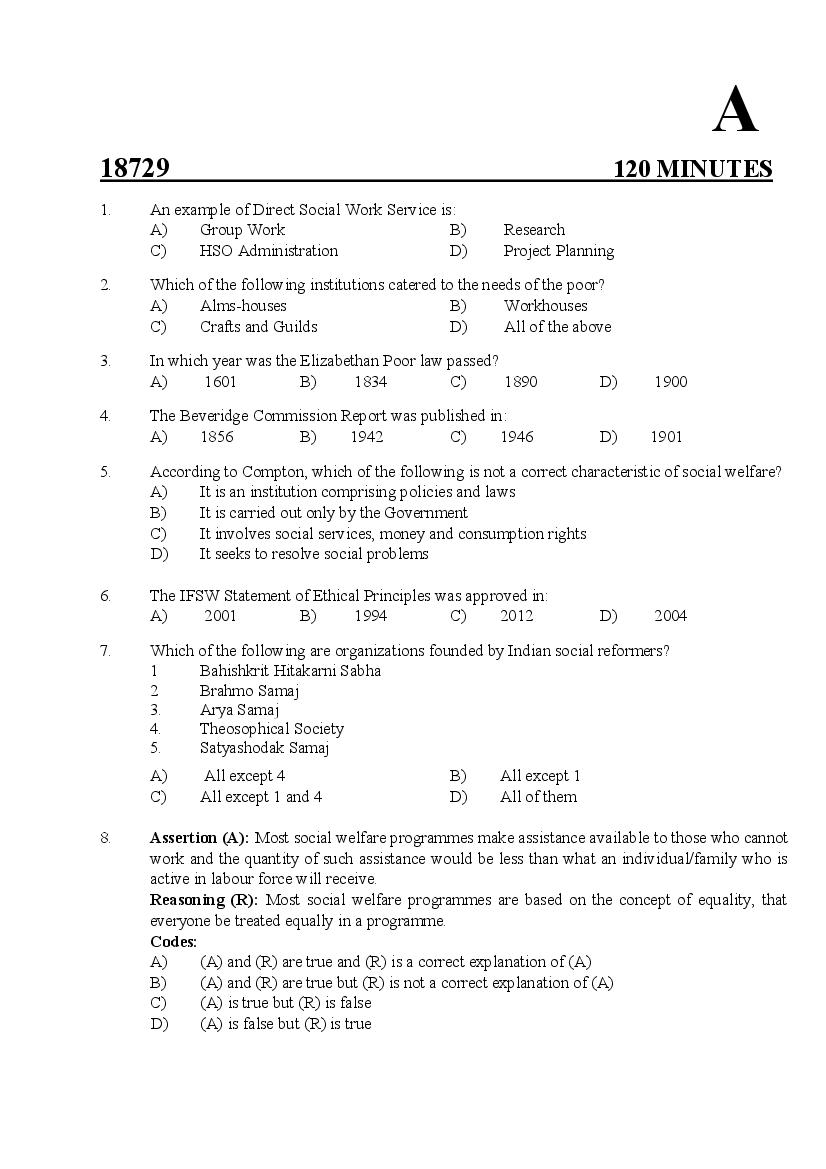
18729 120 MINUTES
1. An example of Direct Social Work Service is:
A) Group Work B) Research
C) HSO Administration D) Project Planning
2. Which of the following institutions catered to the needs of the poor?
A) Alms-houses B) Workhouses
C) Crafts and Guilds D) All of the above
3. In which year was the Elizabethan Poor law passed?
A) 1601 B) 1834 C) 1890 D) 1900
4. The Beveridge Commission Report was published in:
A) 1856 B) 1942 C) 1946 D) 1901
5. According to Compton, which of the following is not a correct characteristic of social welfare?
A) It is an institution comprising policies and laws
B) It is carried out only by the Government
C) It involves social services, money and consumption rights
D) It seeks to resolve social problems
6. The IFSW Statement of Ethical Principles was approved in:
A) 2001 B) 1994 C) 2012 D) 2004
7. Which of the following are organizations founded by Indian social reformers?
1 Bahishkrit Hitakarni Sabha
2 Brahmo Samaj
3. Arya Samaj
4. Theosophical Society
5. Satyashodak Samaj
A) All except 4 B) All except 1
C) All except 1 and 4 D) All of them
8. Assertion (A): Most social welfare programmes make assistance available to those who cannot
work and the quantity of such assistance would be less than what an individual/family who is
active in labour force will receive.
Reasoning (R): Most social welfare programmes are based on the concept of equality, that
everyone be treated equally in a programme.
A) (A) and (R) are true and (R) is a correct explanation of (A)
B) (A) and (R) are true but (R) is not a correct explanation of (A)
C) (A) is true but (R) is false
D) (A) is false but (R) is true
Page 2
latest:
1. New Poor Law
2. Elizabethan Poor Law
3. Act for punishment of Sturdy Vagabonds and Beggars
4. The Workhouse Act
A) 3, 2, 4, 1 B) 2, 3, 4, 1 C) 2, 3, 1, 4 D) 3, 2, 1, 4
10 Match the following personalities in List I with activities they are associated with in List II:
LIST I LIST II
a. Octavia Hill 1. Association for Improving the Condition of the Poor (AICP)
b. Thomas Chalmers 2. Public Health programmes for poor
c. Edwin Chadwick 3. Divided parish into proportions and appointed deacons to be
responsible for the poor
d. Robert Hartley 4. Reforms of nursing, hospitals and medical practice
e. Florence Nightingale 5. Commons Society for building parks, gardens and
recreational facilities for poor
a b c d e
A) 3 2 1 4 5
B) 5 1 2 3 4
C) 5 3 2 1 4
D) 3 4 5 1 2
11 ‘Mandamus’ is associated with:
A) Right to Freedom B) Right to Constitutional remedies
C) Directive Principles D) Cultural and Educational Rights
12 The age of juvenile delinquency for heinous crimes is:
A) 15 B) 16 C) 19 D) 21
13 The Nirbhaya Act 2013 deals with:
A) Offences in Workplace B) Internal security
C) Sexual offences D) Protection of Children
14 The prison’s manual is an important document for the social worker because:
A) It aims at developing prison system in the country as an effective instrument for the
reformation and rehabilitation of offenders
B) It concerns the rules for visiting prisoners
C) It reports the statistics of prisoners
D) It consists of the laws governing prisoners
15. The UN Commission of Human Rights was replaced by ----------- in 2006.
A) UN Commission on Economic and political rights
B) UN Committee for Human Rights
C) UN Human Rights Organization
D) UN Human Rights Council
2
Page 3
A) Hindu adoption B) Muslim Triple Talaq
C) Christian Divorce D) Muslim Maintenance
17. Which of the following conventions has been considered ‘particularly relevant’ by the IFSW in
its Statement of Ethical Principles?
1. Universal Declaration of Human Rights
2. The International Covenant on Civil and Political Rights
3. The International Covenant on Economic Social and Cultural Rights
4. The Convention on the Elimination of all Forms of Racial Discrimination
5. The Convention on the Elimination of All Forms of Discrimination against Women
6. The Convention on the Rights of the Child
7. Indigenous and Tribal Peoples Convention (ILO convention 169)
8. The Convention on Environmental Protection
A) All except 7 B) 1, 2 & 6 C) All except 8 D) All except 3
18. Assertion (A): Courts can ignore the directive principles of state policies.
Reason (R): Directive principles of state policy places obligations on the state but are non-
enforceable in courts.
A) (A) and (R) are true and (R) is a correct explanation of (A)
B) (A) and (R) are true but (R) is not a correct explanation of (A)
C) (A) is true but (R) is false
D) (A) is false but (R) is true
19. Arrange the following Acts in the order of their passing, starting from the earliest to the latest.
1. Child Labour (Prohibition & Regulation) Amendment Act
2. Prevention of Child Sexual Offenses (POCSO) Act
3 Sexual Harassment of Women at Workplace (Prevention, Prohibition and Redressal)
(POSH) Act
4. Immoral Trafficking (ITP) Act
5. Right of Children to Free and Compulsory Education(RTE) Act
A) 1, 4, 3, 2, 5 B) 4, 1, 3, 5, 2
C) 4, 5, 2, 3, 1 D) 1, 4, 5, 3, 2
20 Match the concepts in List I with related concepts in List II
LIST I LIST II
a. Right to equality 1. Public interest litigation
b. Right to freedom 2. Abolition of Untouchability
c. Right to religious freedom 3. Right to Privacy
d. Right against exploitation 4. Minority educational institutions
e. Right to constitutional remedies 5. Secularism
f. Cultural and educational rights 6. Abolition of forced labour
a b c d e f
A) 2 3 5 6 1 4
B) 2 1 5 6 3 4
C) 6 1 5 2 3 4
D) 6 3 5 2 1 4
3
Page 4
called:
A) Ascribed Status B) Achieved Status
C) Social Status D) Economic status
22 Social Stratification refers to:
A) The division of people socio-economically into layers or strata
B) Cultural practices and outlooks of a given community of people that set them apart
from others.
C) A human group that defines itself and/or is defined by other groups as different
D) Relatively stable systems of social relationships and opportunities
23 Which of the following is not a formal form of social control?
A) Military B) Police C) School D) Judiciary
24 Emile Durkheim’s first major work was:
A) The Sociological Imagination B) Division of Labour in Society
C) Das Capital D) The Tipping Point
25 Which one of the following thinkers belong to the linear view of social change?
A) Spengler B) Sorokin C) Pareto D) Comte
26 What is an example of a redemptive social movement?
A) Spread of Christianity B) Bhoodan
C) Quit India D) Arya Samaj
27 Theory Z believes that employees are motivated by:
A) Mutual trust and cooperation B) Self-interest and sustainable income
C) Creativity and responsibility D) Authority and delegation
28 Assertion (A): In a caste system in which the accommodation lasts for a long time, the
attitudes of members of the stratified groups get adjusted to the arrangement.
Reason (R): Accommodation is more than a purely external relationship and has become a
conditioning force in shaping the social attitudes of persons.
A) (A) and (R) are true and (R) is a correct explanation of (A)
B) (A) and (R) are true but (R) is not a correct explanation of (A)
C) (A) is true but (R) is false
D) (A) is false but (R) is true
29 Which of the following movements was not against Government actions?
1. Narmada Bachao Andolan 1985
2. Appiko Movement1983
3. Plachimada Struggle 2002
4. Muthanga Struggle 2003
5. Koodankulam Protest 2011
A) All except 3 & 5 B) All except 2 & 3
C) All except 5 & 2 D) All except 3
4
Page 5
LIST I LIST II
a. Society 1. Religion
b. Community 2. Club
c. Association 3. Village
d. Social Institution 4. Nomads
a b c d
A) 3 4 2 1
B) 4 3 1 2
C) 4 3 2 1
D) 3 2 1 4
31 The G20 comprises of:
A) Group of Industrialised and developing economies
B) Group of World’s poorest nations
C) Group of Southeast Asian Countries
D) Group of countries of Africa
32 In Economics, Demand is the relationship between:
A) Price and quantity B) Consumer and market
C) Consumption and supply D) Price and Market
33 Which of the following is not an economic function of the Government in a market economy?
A) Increasing efficiency
B) Passing social legislations
C) Promoting equity
D) Fostering macroeconomic stability and growth
34 PPC is the abbreviation of:
A) Production Possibility Costs B) Production Possibility Choice
C) Production Packing Costs D) Production Possibility Curve
35 Utility in economics refers to:
A) How consumers use goods
B) How consumers stop buying certain goods
C) How consumers rank different goods and services
D) None of the above
36 Who proposed the principle of “Laissez-Faire”
A) Adam Smith B) Max Weber C) Karl Marx D) John Locke
37 Human Poverty Index (HPI) has been replaced by:
A) Human Development Index (HDI)
B) Gross Domestic Product (GDP)
C) Physical Quality of Life Index (PQLI)
D) Multi-dimensional Poverty Index (MPI)
5
Page 6
Reason (R): Governments have to ensure equitable distribution of resources
A) (A) and (R) are true and (R) is a correct explanation of (A)
B) (A) and (R) are true but (R) is not a correct explanation of (A)
C) (A) is true but (R) is false
D) (A) is false but (R) is true
39 During which five year plan ‘Plan holiday’ was declared due to the wake of disruptions in the
economy on account of two years of drought, two wars, and the devaluation of the rupee:
A) 4th B) 5th C) 3rd D) 2nd
40 Match the concepts in List I to their meanings in List II
LIST I LIST II
a. Command Economy 1. Application of statistics to economic problems
b. Macroeconomics 2. Behaviour of individual entities like individuals,
markets, firms and households
c. Econometrics 3. Production and consumption decisions made by
Government
d. Microeconomics 4. The overall performance of economy
e. Market economy 5. Production and consumption decisions made by
individuals and private firms
a b c d e
A) 1 3 4 2 5
B) 2 4 1 3 5
C) 3 4 5 1 2
D) 3 4 1 2 5
41 The Nature Vs Nurture controversy in Development Psychology is about:
A) The role of inheritance and learning in development
B) The quantity and quality of growth
C) Growth and maturation
D) Continuous and discontinuous growth
42 Development Psychology is defined as the scientific study of:
A) Physical development
B) Bio-psycho social processes in development
C) Ontogenetic development
D) Emotional and cognitive development
43 Erikson’s developmental crisis specific to the first stage of psychosocial development is:
A) Generativity Vs Stagnation B) Autonomy Vs Shame
C) Trust Vs Mistrust D) Integrity Vs Despair
44 Prenatal stage is the stage of development:
A) From foetal stage to embryonic stage
B) From fertilization stage to childbirth
C) From the germinal stage to foetal stage
6
Page 7
45 Vygotsky’s socio-cultural theory of development proposed the concept of :
A) Secure Attachment B) Defence Mechanisms
C) Developmental Tasks D) Zone of Proximal Development
46 The theory of Separation-Individuation was proposed by:
A) Bowlby B) Ainsworth C) Erickson D) Mahlor
47 Select the developmental hazards most specific to adolescence:
1. Sexually transmitted diseases
2. Developmental delays
3. Delinquency
4. Eating Disorders
5. Accidents
A) All B) All except 2 & 5
C) All except 4 & 5 D) All except 2 & 4
48 Assertion (A): When the same amount of water is poured into a tall thin glass and a small
broad glass, most children in the age group 2-7 are likely to say that there is more water in a
tall thinner glass.
Reason (R): Children of age group 7-11 understand the principle of conservation.
A) (A) and (R) are true and (R) is a correct explanation of (A)
B) (A) and (R) are true but (R) is not a correct explanation of (A)
C) (A) is true but (R) is false
D) (A) is false but (R) is true
49 Arrange the stages of information processing in the right order from first to last:
1. Retrieval 2. Attending 3. Processing
4. Storing 5. Sensing
A) 5, 3, 2, 4, 1 B) 2, 5, 4, 1, 3 C) 2, 5, 4, 3, 1 D) 5, 2, 3, 4, 1
50 Match the Kohlberg’s stages in LIST I to statements that indicate the line of thought
corresponding to each stage in LIST II:
LIST 1 LIST II
a. Obedience and punishment 1. I do my homework because I will receive a gift
orientation from my teacher.
b. Self-interest orientation 2. I don’t do my homework because I strongly believe
that homework is a burdensome system which steals
the right to child’s leisure after school.
c. Interpersonal accord and 3. I do my homework because I want to please my
Conformity teachers and friends
d. Authority and social order 4. I do my homework because I agreed to do it, even
maintaining orientation though I don’t believe homework is essential to
education.
e. Social contract orientation 5. I do my homework because I’m afraid I will not be
allowed to play.
7
Page 8
Orientation rules.
a b c d e f
A) 2 1 3 5 6 4
B) 5 1 6 3 2 4
C) 5 1 3 6 4 2
D) 1 3 4 5 6 2
51 MSE is the abbreviation for:
A) Memory Sensory Examination B) Mental Study and Examination
C) Mental Status Examination D) Mind Sensory Exercise
52 Fritz and Laura Perls is associated with:
A) Gestalt Therapy B) Person-Centred Therapy
C) Cognitive Behavioural Therapy D) Existential Therapy
53 The book Client-centred Therapy was written by:
A) Carl Jung B) Carl Rogers C) Alfred Adler D) George Kelly
54 Co-morbidity refers to:
A) Two or more diseases of the same type occurring together
B) Two or more different diseases occurring together
C) One or more diseases or disorders occurring soon after a primary disease or disorder
D) One or more diseases or disorder co-occurring with a primary disease or disorder
55 Co –dependency refers to:
A) Unhealthy relationships in which one person depends on the other for identity and self-
worth
B) The relationship between wife and husband in families living with addiction
C) A relationship in which two persons are always fighting
D) A relationship in which one person is dependent on the other for everything
56 What is the condition that Freud theorized that manifests in females corresponding to the
Oedipus complex in males?
A) Cassandra Complex B) Medusa Complex
C) Ophelia Complex D) Electra Complex
57 Drugs called Benzodiazepines are used to treat:
A) Depression B) Anxiety
C) Schizophrenia D) Mood disorders
58 Counter conditioning is an exposure therapy technique which involves:
A) Learning that one negative event may be linked to another
B) Exposing the client to the feared stimulus
C) Learning that an event or situation is no longer threatening
D) Helping the client to see that the behaviour is counter productive
59 The defence mechanism of ‘conversion’ refers to:
A) Turning a distressing idea into a physical disorder
B) Acting impulsively to pre-empt awareness of distressing inner states
8
Page 9
D) Attributing a distressing aspect of oneself to someone else.
60 Match the concepts in Transactional Analysis provided in List I to their components in
List II.
LIST I LIST II
a. Ego states 1. Decontamination, Redecision, Rechilding,
Relearning, Reorientation
b. Ok-ness 2. I’m Ok, You are Ok, I’m Ok you are not Ok
c. Three drives 3. Confusion, conflict and development deficit
d. Models of Psychological 4. Parent, child and adult
disturbance
e. Techniques 5. Mortido, libido, physics
a b c d e
A) 1 3 2 4 5
B) 4 2 5 3 1
C) 2 4 3 1 5
D) 5 2 4 1 3
61 In Process Recording, the report consists of:
A) A summary of all verbal interactions
B) A word by word account of the interview
C) A summary of salient parts of the interview
D) A detailed report of the social worker’s preparations, observations, words,
actions, feelings, thoughts, impressions etc
62 Case Workers were first known as:
A) Almoners B) Friendly visitors
C) Charity visitors D) Friends of Poor
63 Authority in Social Case Work refers to:
A) The power of the Agency to safeguard confidential information
B) The power of the client to take his own decisions
C) The power of the worker to influence the client by virtue of his specialize
knowledge and experience
D) The power of the case worker to transfer the client to other workers
64 Systematic Desensitization does not involve:
A) Free Association B) Anxiety Hierarchy
C) Relaxation D) Exposure
65 Client-incongruence in Client-centred therapy refers to:
A) The transference between client and counsellor
B) The contradictory information received from collateral contacts
C) The discrepancy between client’s self image and actual experiences
D) The negative emotions that the client feels towards counsellor
66 The Functional Model of Social Case Work is based on the teachings of:
A) Sigmund Freud B) Jean Piaget
9
Page 10
67 Which of the following are indirect methods of social case work intervention?
1. Environment Modification 2. Counselling
3. Legal Aid 4. Resource networking
5. Material help 6. Guidance
A) All B) All except 2 & 6
C) All except 5 & 6 D) All except 1 & 4
68 Assertion (A): Case Work is both an art and a science.
Reasoning (R): Case Work applies scientific findings to individual situations
A) (A) and (R) are true and (R) is a correct explanation of (A)
B) (A) and (R) are true but (R) is not a correct explanation of (A)
C) (A) is true but (R) is false
D) (A) is false but (R) is true
69 What is the correct sequence of steps in the crisis intervention model by Robert (2005)?
1. Rapidly establish rapport
2. Deal with Feelings and Emotions
3. Identify the major problems or Crisis Precipitants
4. Follow Up
5. Psychosocial and Lethality assessment
6. Implement an Action Plan
7. Generate and explore alternatives
A) 1, 5, 3, 7, 6, 2, 4 B) 3, 2, 1, 4, 6, 7, 5
C) 5, 1, 3, 2, 7, 6, 4 D) 5, 1, 2, 3, 6, 7, 4
70 Match the stages of case work process (in LIST I) with the key activities in each stage (in LIST
II)
LIST I LIST II
a. Engagement 1. Contracting
b. Exploration 2. Improving functioning of client
c. Planning 3. Plan for follow up
d. Intervention 4. Psychosocial assessment
e. Evaluation 5. Rapport Building
f. Termination 6. Reviews of Case records and Client feedbacks
a b c d e f
A) 1 4 2 3 6 5
B) 5 4 1 2 6 3
C) 4 3 2 1 5 6
D) 3 2 5 6 1 4
71 Group Cohesion is:
A) the degree to which members are attracted to one another
B) The rules by which the members are governed
C) The ways of distributing power among members
D) The common values held by the group members
10
Page 11
A) Teams B) Committees C) Peers D) Therapy
73 YMCA was founded by:
A) David McConaughy B) William James
C) Edwin Chadwick D) Thomas Chalmers
74 Coalitions are groups that come together:
A) To offer services B) To participate in therapy
C) To support each other D) To achieve a particular goal
75 What is the focus of the Social Goals Model of Social Group Work?
A) Dysfunction B) Reciprocal relationships
C) Group Dynamics D) Social Change
76 When the place of residence is mothers, it is called:
A) Matrilineal B) Matriarchy C) Matrilocal D) Matrimony
77 What is the term Tuckman uses for reaching consensus as a group?
A) Storming B) Performing C) Forming D) Norming
78 The Maintenance function of Social Group Work leads to:
A) Social and emotional support B) Productivity of the group
C) Conflict within group D) Consensus within group
79 According to Belbin (1981) an extroverted and enthusiastic person fits with what role?
A) Coordinator B) Shaper
C) Resource Investigator D) Implementer
80 Match the purposes of social group work in LIST I with their examples in LIST II:
LIST I LIST II
a. Socialization 1. Removal of stigma from problems seen as socially
unacceptable
b. Recapitulation 2. Learning social skills from others
c. Normalization 3. Working through unsatisfactory relationships with family
members, peers and friends with the help of group members
d. Correction 4. Helping persons who are dealing with addictions
e. Problem Solving 5. Learning new ways to cope effectively with a stressful
situation
a b c d e
A) 1 2 3 4 5
B) 2 3 1 5 4
C) 2 3 1 4 5
D) 4 2 3 1 5
81 The book “Pedagogy of the Oppressed” was written by:
A) Paulo Freire B) Antonio Gramsci
C) John Dewey D) Lev Vygotsky
82 Murray G.Ross published the Principles of the community organization process in his book:
A) Community Organization for social welfare
11
Page 12
C) Generic Community welfare organization
D) Social Work and Social Action
83 Community Chests are organizations that:
A) Mobilize neighbourhoods into action groups
B) Link social welfare organizations and schemes
C) Raise funds and redistribute it for community welfare
D) Dole out charity to poor
84 The Panchayati Raj 3 Tier system was introduced in:
A) 1957 B) 1958 C) 1959 D) 1960
85 What does the Social Development Model of Social Work Practice imply?
A) Changes in social welfare organizations
B) Changes in social institutions
C) Changes in individuals with problems
D) Changes in social groups
86 Which of the following is not a function of Community Chests?
A) Eliminating multiple solicitations from agencies
B) Raising fund to finance member agencies
C) Distributing the funds through joint budgeting
D) Administering social services
87 Political Social Action, according to Dunham (1970) is also called as:
A) Procedural Social Action B) Social Reform
C) Direct Social Action D) Legal Action
88 According to Saul Alinsky, the Settlement house movement was not a model of social action
because it adopted:
A) Cooperative approaches B) Adversarial approaches
C) Conflict approaches D) Non-cooperative
89 According to Murray G. Ross, what should initiate the process of community organization?
A) A project by an NGO
B) The discontent of community
C) The commitment of the Community organizer
D) The leaders of the Community
90 Match the following persons in List I with the books they have written on Community
Organization, given in List II:
LIST I LIST II
a. Wayne McMillan 1. Community Practice Skills
b. Gamble and Weil 2. Community Organization for Social Welfare
c. Kramer and Specht 3. Community Organization and Agency Responsibility
d. John and De Marche 4. Community Organization in India
e. Gangrade K.D 5. Readings in Community Organization Practice
a b c d e
A) 2 1 5 3 4
12
Page 13
C) 2 3 5 1 4
D) 3 4 5 1 2
91 Who conceptualized the organization as a natural system?
A) Elton Mayo B) Henry Fayol
C) Chester Bernard D) Frederick Taylor
92 Theory X and Theory Y was proposed by:
A) William Ouchi B) Max Weber
C) Frederick Taylor D) Douglas McGregor
93 The function of management that arranges appropriate staffing and assigns responsibilities and
tasks to individuals and groups, in order to best achieve the objectives established by planning
is called:
A) Planning B) Organizing C) Leading D) Controlling
94 Which theory presupposes that there is one best way to do any particular job, that it can be
ascertained and taught to employees, and that workers are motivated primarily by money?
A) Scientific Management B) Theory X and Theory Y
C) Classical Theory D) Bureaucracy
95 The FCRA Act of 2010 was amended two times by the Parliament in 2016 and 2018
to sanction:
A) Political parties to receive funds from foreign companies
B) Charitable trusts to associate freely with foreign agencies
C) Indian companies to receive assistance from foreign companies
D) NGOs to receive donations from foreign individuals
96 360 Degree Appraisal Method uses:
A) The opinion of a number of evaluators
B) A checklist of proficiency
C) Information from a variety of sources
D) A list of critical requirements of the job
97 Which of the following belong to Henri Fayol’s 14 Principles of Management?
1. Espirit de Corps 2. Unity of Command
3. Power Structure 4. Division of Labour
5. Scalar Chain 6. Laissez-Faire
A) All B) All except 6
C) All except 1 & 6 D) All except 3 & 6
98 Assertion (A): Wherever there is a formal organization there is an informal organization.
Reasoning (R): Managers cannot control grapevine.
A) (A) and (R) are true and (R) is a correct explanation of (A)
B) (A) and (R) are true but (R) is not a correct explanation of (A)
C) (A) is true but (R) is false
D) (A) is false but (R) is true
13
Page 14
A) Edward Tolman B) F.W. Taylor
C) David McClelland D) Abraham Maslow
100 Match the functions of Social Welfare in List I to corresponding examples in List II
List I List II
a. Remedial 1. Capacity building
b. Preventive 2. Emergency relief
c. Developmental 3. Social Security
d. Protective 4. Screening Services
a b c d
A) 3 2 1 4
B) 4 3 2 1
C) 1 2 4 3
D) 2 4 1 3
101 Which of the following is not a Non-probability Sampling type?
A) Cluster B) Quota C) Snowball D) Accidental
102 Which of the following is the correct meaning of secondary data?
A) Data collected by enumerator
B) Data collected from books
C) Data collected by someone other than researcher for other purposes
D) Data collected on background of the research topics
103 The function of Social work research is best identified as:
A) Causative research B) Evaluative research
C) Correlational research D) Descriptive research
104 What is the difference between a questionnaire and interview schedule?
A) Questionnaire is for quantitative research, while interview schedule is for qualitative
B) Questionnaire is filled in by the respondent, while interview schedule is filled in by the
enumerator
C) Questionnaire is used for survey research, whereas interview schedule is used for
Interviews
D) Questionnaire contains closed-ended questions, while interview schedule contains both
open and closed-ended questions
105 Select the software that assists in Literature Review:
A) Zotero B) nVivo C) SPSS D) Wunderlist
106 In the CIPP Evaluation Model, CIPP is the abbreviation of:
A) Content- Income- Product- Process
B) Community- Individual- Place- Participation
C) Community- Income- Place- Participation
D) Context– Input– Process– Product
107 Single-subject designs have the following characteristics:
1. They include a single unit of analysis- like individual, family or community
2. They are basically quasi-experimental designs
3. The impact of an intervention is assessed before and after
14
Page 15
5. Time series analysis technique is used
A) 1, 2 & 3 B) 1, 2, 3 and 5 C) 1, 3 & 5 D) All the above
108 Assertion (A): Formative evaluation is more desirable than summative evaluation.
Reasoning (R): Summative evaluation assesses the impact of the programme.
A) (A) and (R) are true and (R) is a correct explanation of (A)
B) (A) and (R) are true but (R) is not a correct explanation of (A)
C) (A) is true but (R) is false
D) (A) is false but (R) is true
109 Arrange the following in the right sequence:
1. Editing 2. Setting up analytical models 3. Preparation of Master charts
4. Coding 5. Tabulation 6. Analysis
A) 1, 4, 3, 5, 2, 6 B) 3, 4, 6, 1, 2, 5
C) 1, 3, 4, 5, 6, 2 D) 3, 1, 5, 4, 6, 2
110 Match the phrases in List I with their related data analysis technique in List II
LIST I LIST II
a. Uni-variate 1. Cross-tabs
b. Bi-variate 2. Frequency
c. Tri-variate 3. Regression
d. Multi-variate 4. Correlation
a b c d
A) 1 2 3 4
B) 1 2 4 3
C) 2 1 4 3
D) 2 3 4 1
111 Which phase of the Project Cycle is PERT part of?
A) Project Formulation B) Project Implementation
C) Project Monitoring D) Project Evaluation
112 Performance Analysis is a process of project review in which the progress of the project in
terms of _____are assessed.
A) Scope, objectives and quality of implementation
B) Variance from planned and budgeted activities
C) Community’s feedback
D) Budget parameters
113 The function of PMIS is:
A) To facilitate budgeting in projects
B) To assess the need for the project
C) To facilitate the collection and use information on projects
D) To manage personnel for the project
114 Sunk Cost is defined as:
A) Cost that do not vary with output
B) Costs incurred in labour and materials
15
Page 16
D) Cost that is directly incurred in production
115 Gantt charts is an activity calendar which assist in project scheduling from start to finish using:
A) Detailed task reports B) Pie Charts
C) Paper charts D) Horizontal bar charts
116 Social Cost Benefit Analysis measures the net benefit of the project in terms of:
A) Shadow prices B) Selling Price
C) Cost Price D) Market Price
117 Which of the following are PRA tools?
1. Venn Diagram 2. Indicators
3. Transect walk 4. Means of Verification
5. Seasonal Calendar 6. Income Expenditure Matrix
A) All except 4 & 6 B) All except 2 & 4
C) All except 2 D) All of the above
118 Alternative analysis refers to:
A) Comparing different problems in the community and their alternative solutions
B) Analysis of the need of the project and determining the priorities
C) Determining the outputs of different solutions
D) The comparison of different choices in achieving a particular objective
119 Arrange the following LFA concepts in the correct order from left corner of the frame to the
right:
A) Assumptions, Objectives, Means of Verification and Measurable indicators
B) Goals, Means of Verification, Measurable indicators, Assumptions
C) Objectives, Measurable indicators, Means of Verification, Assumptions
D) Goals, Purpose, Output, Activities, Input
120 Match the stages of Project Formulation in LIST I with their purpose in List II
LIST I LIST II
a. Feasibility Analysis 1. Estimation of costs and fund requirements
b. Techno-economic Analysis 2. Assessment of material and human resources required.
c. Project Design and Network 3. Consideration of the overall worth of the project
Analysis
d. Input Analysis 4. An examination of whether to go in for detailed
investment proposal
e. Financial Analysis 5. Presented of consolidated report to
sponsoring/implementation body
f. Social Cost Benefit Analysis 6. Definition of individual activities of the project and
their inter-relationships.
g. Pre-investment Analysis 7. Analysis of the demand potential of the project
a b c d e f g
A) 4 3 1 6 2 7 5
B) 3 7 5 4 6 2 1
C) 4 7 6 2 1 3 5
D) 3 6 7 5 1 2 4
16
Page 17
17
Document Details
| Board / Org | Default |
| Exam | Govt Jobs Exams |
| Type | Question Paper |
| Pages | 17 |
| Updated | 22 Jul 2026 |