Page 1
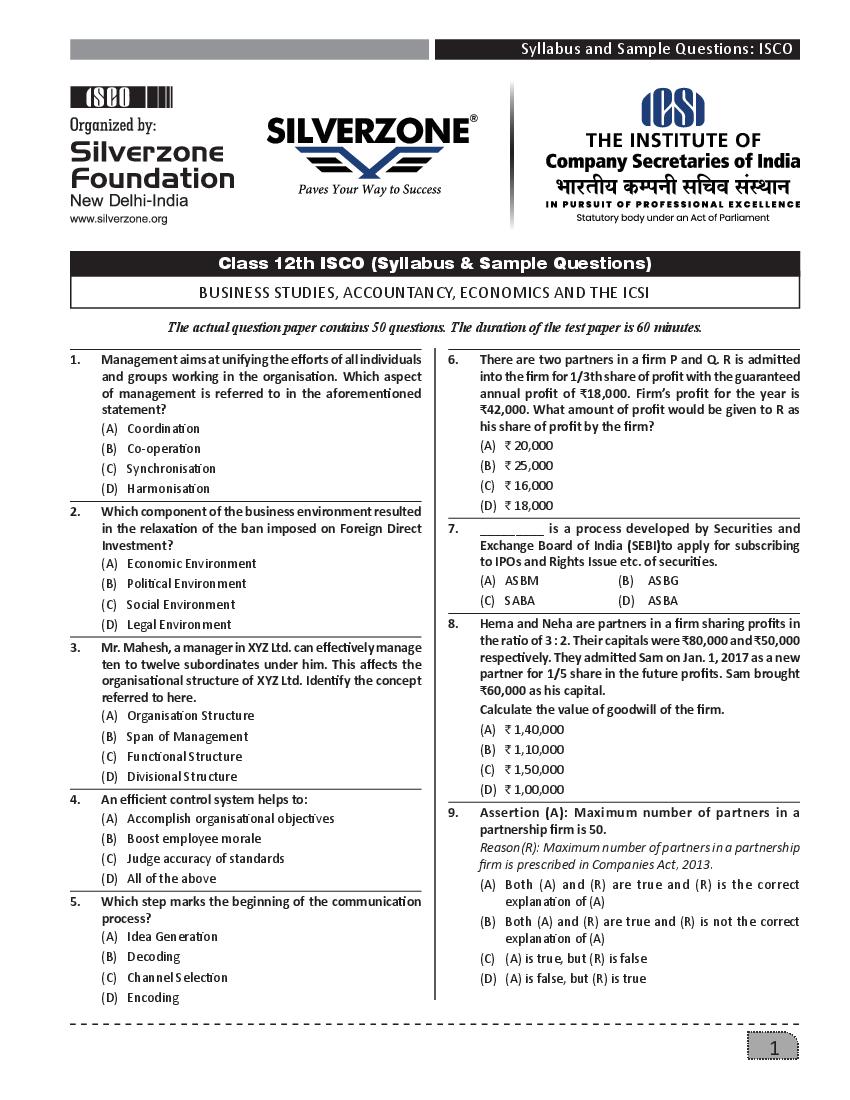
Syllabus and Sample Questions: ISCO Class 12th ISCO (Syllabus & Sample Questions) BUSINESS STUDIES, ACCOUNTANCY, ECONOMICS AND THE ICSI The actual question paper contains 50 questions. The duration of the test paper is 60 minutes. 1. Management aims at unifying the efforts of all individuals 6. There are two partners in a firm P and Q. R is admitted and groups working in the organisation. Which aspect into the firm for 1/3th share of profit with the guaranteed of management is referred to in the aforementioned annual profit of ₹18,000. Firm’s profit for the year is statement? ₹42,000. What amount of profit would be given to R as (A) Coordination his share of profit by the firm? (B) Co-operation (A) `20,000 (C) Synchronisation (B) `25,000 (D) Harmonisation (C) `16,000 2. Which component of the business environment resulted (D) `18,000 in the relaxation of the ban imposed on Foreign Direct 7. _________ is a process developed by Securities and Investment? Exchange Board of India (SEBI)to apply for subscribing (A) Economic Environment to IPOs and Rights Issue etc. of securities. (B) Political Environment (A) ASBM (B) ASBG (C) Social Environment (C) SABA (D) ASBA (D) Legal Environment 8. Hema and Neha are partners in a firm sharing profits in 3. Mr. Mahesh, a manager in XYZ Ltd. can effectively manage the ratio of 3 : 2. Their capitals were ₹80,000 and ₹50,000 ten to twelve subordinates under him. This affects the respectively. They admitted Sam on Jan. 1, 2017 as a new organisational structure of XYZ Ltd. Identify the concept partner for 1/5 share in the future profits. Sam brought referred to here. ₹60,000 as his capital. (A) Organisation Structure Calculate the value of goodwill of the firm. (B) Span of Management (A) `1,40,000 (C) Functional Structure (B) `1,10,000 (D) Divisional Structure (C) `1,50,000 (D) `1,00,000 4. An efficient control system helps to: (A) Accomplish organisational objectives 9. Assertion (A): Maximum number of partners in a partnership firm is 50. (B) Boost employee morale Reason(R): Maximum number of partners in a partnership (C) Judge accuracy of standards firm is prescribed in Companies Act, 2013. (D) All of the above (A) Both (A) and (R) are true and (R) is the correct 5. Which step marks the beginning of the communication explanation of (A) process? (B) Both (A) and (R) are true and (R) is not the correct (A) Idea Generation explanation of (A) (B) Decoding (C) (A) is true, but (R) is false (C) Channel Selection (D) (A) is false, but (R) is true (D) Encoding 1
Page 2
Syllabus and Sample Questions: ISCO 10. On the death of a partner, the amount due to him will be 14. Which of the following policies will most likely reduce credited to: the Gini coefficient? (A) All partner’s capital accounts. (A) Progressive income tax. (B) Remaining partner’s capital accounts. (B) Regressive income tax (C) His executor’s account. (C) Fixed rate income tax. (D) Government’s revenue account. (D) None of the Above 11. In which year did the British start railway operations in 15. Assertion (A): The policy of import substitution in India India? led to the development of indigenous industries in sectors (A) 1800 (B) 1820 such as electronics and automobiles. (C) 1850 (D) 1870 Reason (R): The protection provided by the government allowed these industries to mature without facing 12. Name the architect of Indian Planning: competition from more developed economies. (A) William Digby (B) P.C. Mahalanobis (A) Both Assertion (A) and Reason (R) are true, and (C) V.K.R.V. Rao (D) Dadabhai Naoroji Reason (R) is the correct explanation of Assertion (A). 13. The bow shape of the production possibilities curve (B) Both Assertion (A) and Reason (R) are true, illustrates but Reason (R) is not the correct explanation of (A) Law of Increasing Marginal Cost Assertion (A). (B) The production is inefficient (C) Assertion (A) is true, but Reason (R) is false. (C) The production combination of the given two goods (D) Assertion (A) is false, but Reason (R) is true. is unattainable (D) The demand is relatively elastic SAMPLE QUESTION’S ANSWERS 1. (A) 2. (D) 3. (B) 4. (D) 5. (A) 6. (D) 7. (D) 8. (B) 9. (C) 10. (C) 11. (C) 12. (B) 13. (A) 14. (A) 15. (A) 2