MBOSE Class 12 Question Paper 2018 for Philosophy
Finished viewing? Save it for later —
Download MBOSE Class 12 Question Paper 2018 for Philosophy (PDF · 8 pages)About MBOSE Class 12 Question Paper 2018 for Philosophy
MBOSE Class 12 Question Paper 2018 for Philosophy is available here for free download. Published by Meghalaya Board for Class 12, this question paper can be viewed online or downloaded as a PDF (8 pages). Candidates preparing for Class 12 can use MBOSE Class 12 Question Paper 2018 for Philosophy to understand the exam pattern, the type of questions asked, and the overall difficulty level.
Frequently Asked Questions
How can I download MBOSE Class 12 Question Paper 2018 for Philosophy?
Open this page and click the Download button to save MBOSE Class 12 Question Paper 2018 for Philosophy as a PDF. It is completely free on AglaSem Docs.
Is MBOSE Class 12 Question Paper 2018 for Philosophy free to download?
Yes. MBOSE Class 12 Question Paper 2018 for Philosophy can be viewed online and downloaded as a PDF free of cost on AglaSem Docs.
How many pages does MBOSE Class 12 Question Paper 2018 for Philosophy have?
MBOSE Class 12 Question Paper 2018 for Philosophy contains 8 pages, which you can read online or download together as a single PDF.
Where can I find more Class 12 study material?
You can find more Class 12 question papers, sample papers, syllabus, and answer keys on AglaSem Docs.
MBOSE Class 12 Question Paper 2018 for Philosophy – Text
Read the full text of this question paper below — useful to quickly search, copy and reference the content online without downloading the PDF.
📄 View text version (8 pages)
Page 1
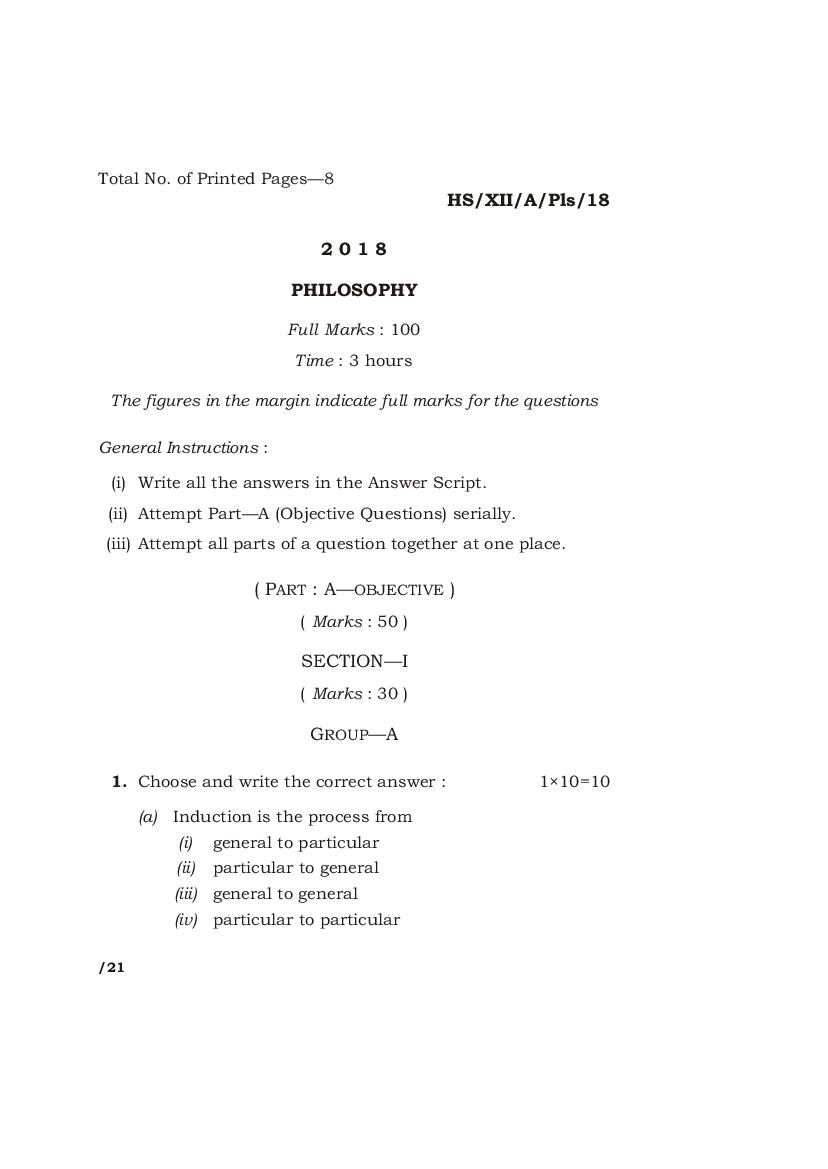
HS/XII/A/Pls/18
2018
PHILOSOPHY
Full Marks : 100
Time : 3 hours
The figures in the margin indicate full marks for the questions
General Instructions :
(i) Write all the answers in the Answer Script.
(ii) Attempt Part—A (Objective Questions) serially.
(iii) Attempt all parts of a question together at one place.
( PART : A—OBJECTIVE )
( Marks : 50 )
SECTION—I
( Marks : 30 )
GROUP—A
1. Choose and write the correct answer : 1×10=10
(a) Induction is the process from
(i) general to particular
(ii) particular to general
(iii) general to general
(iv) particular to particular
/21
Page 2
(b) Quantitatively the
(i) cause is equal to the effect
(ii) cause is less than the effect
(iii) cause is more than the effect
(iv) cause is sometimes more and sometimes
less than the effect
(c) ‘John is not married’, is a
(i) simple statement
(ii) compound statement
(iii) Both simple and compound statements
(iv) None of the above
(d) Induction by complete enumeration is the
synonym for
(i) perfect induction
(ii) scientific induction
(iii) unscientific induction
(iv) analogy
(e) Bain says that the course of the world is
(i) a uniformity
(ii) uniformities
(iii) a unity
(iv) None of the above
Page 3
(f) Mill points out that the fallacies of observation
are of
(i) two kinds
(ii) three kinds
(iii) four kinds
(iv) five kinds
(g) The general propositions which induction
establishes are
(i) verbal propositions
(ii) real propositions
(iii) Both verbal and real propositions
(iv) None of the above
(h) The term ‘colligation of facts’ was originally used
by
(i) Mill
(ii) Whewell
(iii) Bain
(iv) None of them
(i) The expression, ‘plurality of causes’ was
introduced by
(i) Carveth Read
(ii) Mill
(iii) Hume
(iv) None of them
Page 4
(j) The ‘experimental methods’ have been called by
Mill
(i) the ‘methods of elimination’
(ii) the ‘methods of addition’
(iii) the ‘methods of multiplication’
(iv) None of the above
GROUP—B
2. Write whether the following statements are True or
False : 1×10=10
(a) Philosophy literally means love of argument.
(b) ‘ É’ is a symbol for disjunction.
(c) A hypothesis means a provisional supposition.
(d) Induction necessarily involves a passage from
the unknown to known.
(e) Induction and deduction differ in their starting
point, not in their principle.
(f) Observation is active experience, while
experiment is passive experience.
(g) Malobservation is a negative fallacy.
(h) Analogy yields merely probable conclusions.
Page 5
(i) Induction is something more than colligation.
(j) Condition means necessary factor of a cause.
GROUP—C
3. Fill in the blanks : 1×10=10
(a) Deductive argument may be _____ true but
materially false.
(b) Analysis means breaking up complex fact into its
_____ factors.
(c) The ground of induction is itself an _____.
(d) The cause is relative to a given phenomenon
called the _____.
(e) Observation is a well-regulated _____ of facts and
circumstances with a definite purpose.
(f) The first requisite of the proof of a hypothesis is
_____.
(g) The world is a _____ of laws.
(h) Mill formulates _____ experimental methods.
(i) Intuition is immediate apprehension by _____.
(j) Indian philosophy is initially pessimism but
ultimately _____.
Page 6
SECTION—II
( Marks : 20 )
4. Answer the following questions in 2 or 3 sentences
each : 2×10=20
(a) What is a real proposition?
(b) What is the paradox of induction?
(c) Name three empiricist philosophers.
(d) What is malobservation?
(e) What are the grounds of induction?
(f) State one advantage of observation over
experiment.
(g) What is a negative condition according to Mill?
(h) Define analogy.
(i) State one condition of a valid hypothesis.
(j) What is empiricism?
Page 7
( PART : B—DESCRIPTIVE )
( Marks : 50 )
Answer Question No. 5 and any three from the rest
5. (a) Symbolize any four of the following : 2½×4=10
(i) It is not the case that if Mumbai wins the
match, then Kolkata and Chennai will get to
the semifinal.
(ii) Either taxes are increased or if expenditure
rises, then the debt ceiling is raised.
(iii) It is not the case that there is P and there is
no Q.
(iv) Either John or David will go to the picnic,
but they will not both go to the picnic.
(v) It is not true that John is short or
handsome.
(vi) If prices fall or wages rise, then both retail
sales and advertising activities increase.
(b) Use truth tables to determine the validity or
invalidity of any two of the following argument
forms : 5×2=10
(i) p Éq
\~ q É ~ p
Page 8
(ii) p É (q Ú r )
p Éq
\r
(iii) p Úq
~ p
\ ~q
(iv) p Ú (q × ~ p )
p
\ ~ (q × ~ p )
6. “The difference between deduction and induction is
not one of principle but of starting point.” Discuss. 10
7. Explain and examine the law of the uniformity of
nature. 10
8. Explain the method of difference with examples. 10
9. Explain rationalism as a theory of knowledge. 10
10. “Observation and experiment do not differ in kind
but only in degree.” Discuss. 10
11. What is hypothesis? What are the conditions of a
legitimate hypothesis? 2+8=10
12. What is a cause according to Carveth Read? Explain
its marks or characteristics. 2+8=10
HHH
8K—6990/21 HS/XII/A/Pls/18
Document Details
| Board / Org | Meghalaya Board |
| Exam | Class 12 |
| Type | Question Paper |
| Pages | 8 |
| Updated | 15 Jul 2026 |