MBOSE Class 12 Question Paper 2018 for History
Finished viewing? Save it for later —
Download MBOSE Class 12 Question Paper 2018 for History (PDF · 12 pages)About MBOSE Class 12 Question Paper 2018 for History
MBOSE Class 12 Question Paper 2018 for History is available here for free download. Published by Meghalaya Board for Class 12, this question paper can be viewed online or downloaded as a PDF (12 pages). Candidates preparing for Class 12 can use MBOSE Class 12 Question Paper 2018 for History to understand the exam pattern, the type of questions asked, and the overall difficulty level.
Frequently Asked Questions
How can I download MBOSE Class 12 Question Paper 2018 for History?
Open this page and click the Download button to save MBOSE Class 12 Question Paper 2018 for History as a PDF. It is completely free on AglaSem Docs.
Is MBOSE Class 12 Question Paper 2018 for History free to download?
Yes. MBOSE Class 12 Question Paper 2018 for History can be viewed online and downloaded as a PDF free of cost on AglaSem Docs.
How many pages does MBOSE Class 12 Question Paper 2018 for History have?
MBOSE Class 12 Question Paper 2018 for History contains 12 pages, which you can read online or download together as a single PDF.
Where can I find more Class 12 study material?
You can find more Class 12 question papers, sample papers, syllabus, and answer keys on AglaSem Docs.
MBOSE Class 12 Question Paper 2018 for History – Text
Read the full text of this question paper below — useful to quickly search, copy and reference the content online without downloading the PDF.
📄 View text version (12 pages)
Page 1
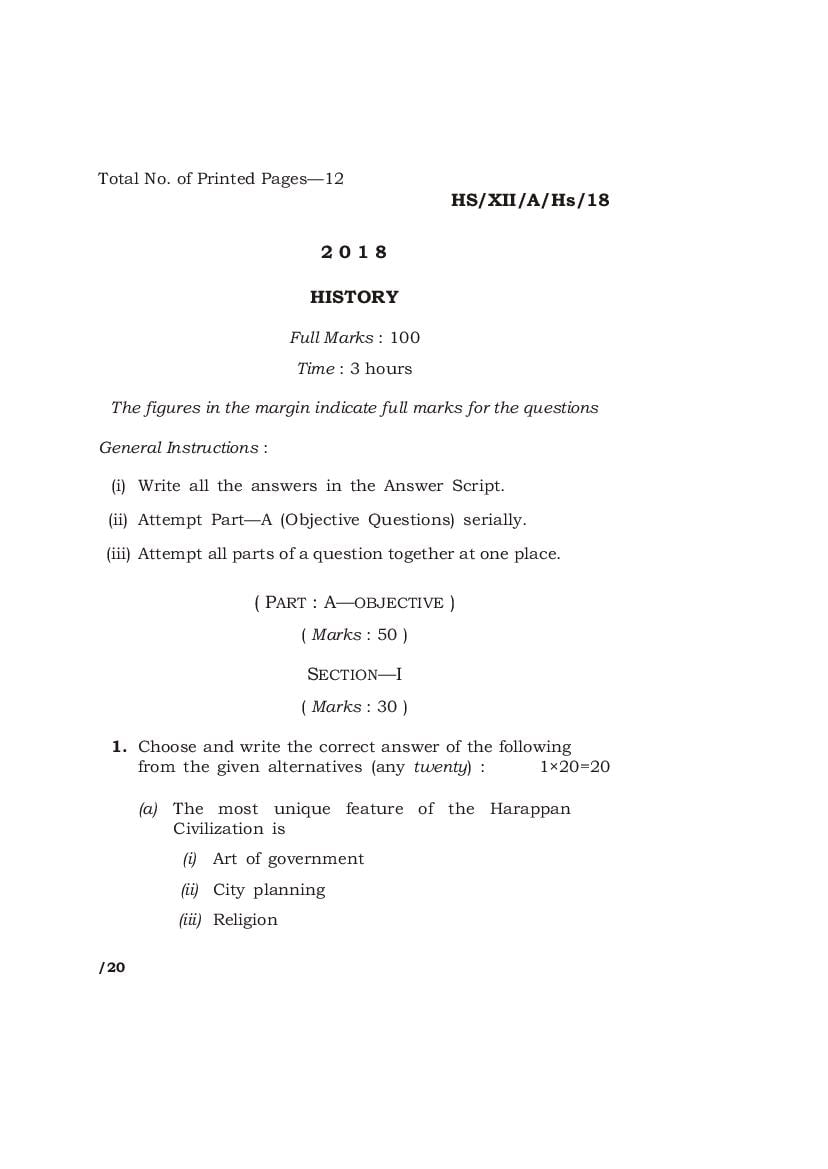
HS/XII/A/Hs/18
2018
HISTORY
Full Marks : 100
Time : 3 hours
The figures in the margin indicate full marks for the questions
General Instructions :
(i) Write all the answers in the Answer Script.
(ii) Attempt Part—A (Objective Questions) serially.
(iii) Attempt all parts of a question together at one place.
( PART : A—OBJECTIVE )
( Marks : 50 )
SECTION—I
( Marks : 30 )
1. Choose and write the correct answer of the following
from the given alternatives (any twenty) : 1×20=20
(a) The most unique feature of the Harappan
Civilization is
(i) Art of government
(ii) City planning
(iii) Religion
/20
Page 2
(b) The Harappan established contact with the
outside world through
(i) Kalibangan
(ii) Lothal
(iii) Chanhudaro
(c) The founder of the Mauryan dynasty was
(i) Chandragupta Maurya
(ii) Bindusara
(iii) Ashoka
(d) The Allahabad Pillar Inscription was composed
by
(i) Panini
(ii) Nagarjuna
(iii) Harisena
(e) The Sanskrit word ‘Veda’ means
(i) knowledge and wisdom
(ii) literature
(iii) rites and rituals
Page 3
(f) The ‘family’ is the English version of the Sanskrit
term
(i) Vamsha
(ii) Kula
(iii) Jati
(g) The practice of erecting Stupas was associated
with
(i) Brahmanism
(ii) Jainism
(iii) Buddhism
(h) The temples of the Deccan are identified with the
(i) Dravida style
(ii) Nagara style
(iii) Vesara style
(i) The Ain-i-Akbari is a book written by
(i) Al-Biruni
(ii) Abul Fazl
(iii) Firdausi
Page 4
(j) Which ruler is considered as the greatest Mughal
Emperor?
(i) Babur
(ii) Akbar
(iii) Shah Jahan
(k) Bhakti implies
(i) loving devotion to God
(ii) worship of Rama
(iii) sacrifices to God
(l) Pilgrimage to Sufi’s tombs are called
(i) Dargah
(ii) Khanqah
(iii) Ziyarat
(m) The Kitab-al-Hind was written by
(i) Francois Bernier
(ii) Ibn Batutah
(iii) Al-Biruni
Page 5
(n) To Bernier, Indian towns appeared to be as
(i) big towns
(ii) camp towns
(iii) small towns
(o) The rule of the East India Company started from
(i) Assam
(ii) Avadh
(iii) Bengal
(p) Who among the following Europeans established
their settlements in Pondicherry in 1673?
(i) English
(ii) French
(iii) Portuguese
(q) The district headquarters was shifted from
Cherrapunji to Shillong in the year
(i) 1864
(ii) 1865
(iii) 1866
Page 6
(r) Which part of Assam was annexed by the British
in 1828?
(i) Central Assam
(ii) Lower Assam
(iii) Upper Assam
(s) The ‘Father of Khasi Alphabet’ was
(i) Thomas Jones
(ii) William Carey
(iii) William Williams
(t) In Bihar, the Revolt of 1857 was led by
(i) Nana Sahib
(ii) Tantia Topi
(iii) Kunwar Singh
(u) The East India Association was founded by
(i) Anand Mohan Bose
(ii) Dadabhai Naoroji
(iii) Surendranath Banerjee
Page 7
(v) “Home Rule is my birthright and I will have it.”
Who among the following gave the above popular
slogan?
(i) Bipin Chandra Pal
(ii) Lala Lajpat Rai
(iii) Lokmanya Tilak
(w) Gandhi’s first experiment of Satyagraha on
Indian soil came in 1917 at
(i) Kheda
(ii) Champaran
(iii) Ahmedabad
(x) Gandhiji was shot dead on
(i) 30th January, 1947
(ii) 30th January, 1948
(iii) 30th January, 1949
(y) Who was the President of the Constituent
Assembly?
(i) Mahatma Gandhi
(ii) Dr. B. R. Ambedkar
(iii) Dr. Rajendra Prasad
Page 8
2. Write whether the following statements are True or
False (any ten) : 1×10=10
(a) The Harappans had trade relations with Oman.
(b) Ashoka endeavoured to hold his empire together
by propagating ‘Dhamma’.
(c) The term ‘Jati’ was based on religion.
(d) Hazara Rama temple is one of the splendid
temples of the time at Vijayanagara.
(e) The Buland Darwaza at Fatehpur Sikri was built
by Shah Jahan.
(f) Kabir probably lived in the fifteen-sixteenth
centuries.
(g) Francois Bernier did not provide any information
on Sati.
(h) The Rajmahal Hills were occupied by the
Paharias and the Santhals.
(i) For the British, the ‘Black’ areas symbolized
anarchy, filth and diseases.
Page 9
(j) In 1839, the Assam Company was launched in
Calcutta.
(k) In the 17th century, Bengal’s trade with Assam
had flourished.
(l) The rebellious soldiers proclaimed Bahadur
Shah the Emperor of India.
(m) Satyagraha is a teaching of violent struggle.
(n) In September 1946, an interim Cabinet headed
by Jawaharlal Nehru was formed by the
Congress.
(o) On 26th November, 1949, Dr. B. R. Ambedkar
signed the Constitution as the President of the
Assembly.
SECTION—II
( Marks : 20 )
3. Answer any ten of the following questions in 2 or 3
sentences each : 2×10=20
(a) What led to the decline and disappearance of the
Harappan civilization?
(b) Name the four important Mahajanapadas of the
sixth century BC.
(c) Mention the four ‘Varnas’ of the caste system.
Page 10
(d) Who were the founders of the Vijayanagar
Kingdom?
(e) Who was Sir William Jones?
(f) Who was Mira Bai?
(g) What is the meaning of ‘Daman-i-Koh’?
(h) Differentiate between the ‘white town’ and the
‘black town’.
(i) Mention the three colonial architectural styles
visible in Bombay city.
(j) Who was Togan Sangma?
(k) Name the main centres of the Revolt of 1857.
(l) When did Gandhiji launch the Civil
Disobedience Movement?
(m) What is Communalism?
(n) What was the Muslim League Resolution of
1940?
(o) Who was Dr. B. R. Ambedkar?
Page 11
( PART : B—DESCRIPTIVE )
( Marks : 50 )
4. Answer Question No. (j) and any three from the rest :
(a) Describe the city-planning and architecture of
Mohenjo Daro and Harappa. 12
(b) Describe the system of administration of the
Mauryan rulers. 12
(c) Give an account of the life and teachings of
Mahavira or Gautama Buddha. 12
(d) Who was Al-Biruni? What was his perception of
the caste system? 2+10=12
(e) What were the causes of non-payment of
revenue by the Zamindars in Bengal? 12
(f) How did the British occupy Assam? 12
(g) How did the Revolt of 1857 start and spread to
Delhi? 12
Page 12
(h) Who was the founder of the Indian National
Congress? What were the objectives and method
of political work of the Indian National
Congress? 2+10=12
(i) Give an account of the Quit India Movement. 12
(j) Write short notes on any two of the following :
7×2=14
(i) Mahabharata
(ii) Rock-cut temples
(iii) Role of Women in Agrarian Society
(iv) Babur
(v) Ryotwari system
(vi) Shillong—a hill station
(vii) Gandhi-Irwin Pact
HHH
8K—15810/20 HS/XII/A/Hs/18
Document Details
| Board / Org | Meghalaya Board |
| Exam | Class 12 |
| Type | Question Paper |
| Pages | 12 |
| Updated | 15 Jul 2026 |