MBOSE Class 12 Question Paper 2018 for Political Science
Finished viewing? Save it for later —
Download MBOSE Class 12 Question Paper 2018 for Political Science (PDF · 11 pages)About MBOSE Class 12 Question Paper 2018 for Political Science
MBOSE Class 12 Question Paper 2018 for Political Science is available here for free download. Published by Meghalaya Board for Class 12, this question paper can be viewed online or downloaded as a PDF (11 pages). Candidates preparing for Class 12 can use MBOSE Class 12 Question Paper 2018 for Political Science to understand the exam pattern, the type of questions asked, and the overall difficulty level.
Frequently Asked Questions
How can I download MBOSE Class 12 Question Paper 2018 for Political Science?
Open this page and click the Download button to save MBOSE Class 12 Question Paper 2018 for Political Science as a PDF. It is completely free on AglaSem Docs.
Is MBOSE Class 12 Question Paper 2018 for Political Science free to download?
Yes. MBOSE Class 12 Question Paper 2018 for Political Science can be viewed online and downloaded as a PDF free of cost on AglaSem Docs.
How many pages does MBOSE Class 12 Question Paper 2018 for Political Science have?
MBOSE Class 12 Question Paper 2018 for Political Science contains 11 pages, which you can read online or download together as a single PDF.
Where can I find more Class 12 study material?
You can find more Class 12 question papers, sample papers, syllabus, and answer keys on AglaSem Docs.
MBOSE Class 12 Question Paper 2018 for Political Science – Text
Read the full text of this question paper below — useful to quickly search, copy and reference the content online without downloading the PDF.
📄 View text version (11 pages)
Page 1
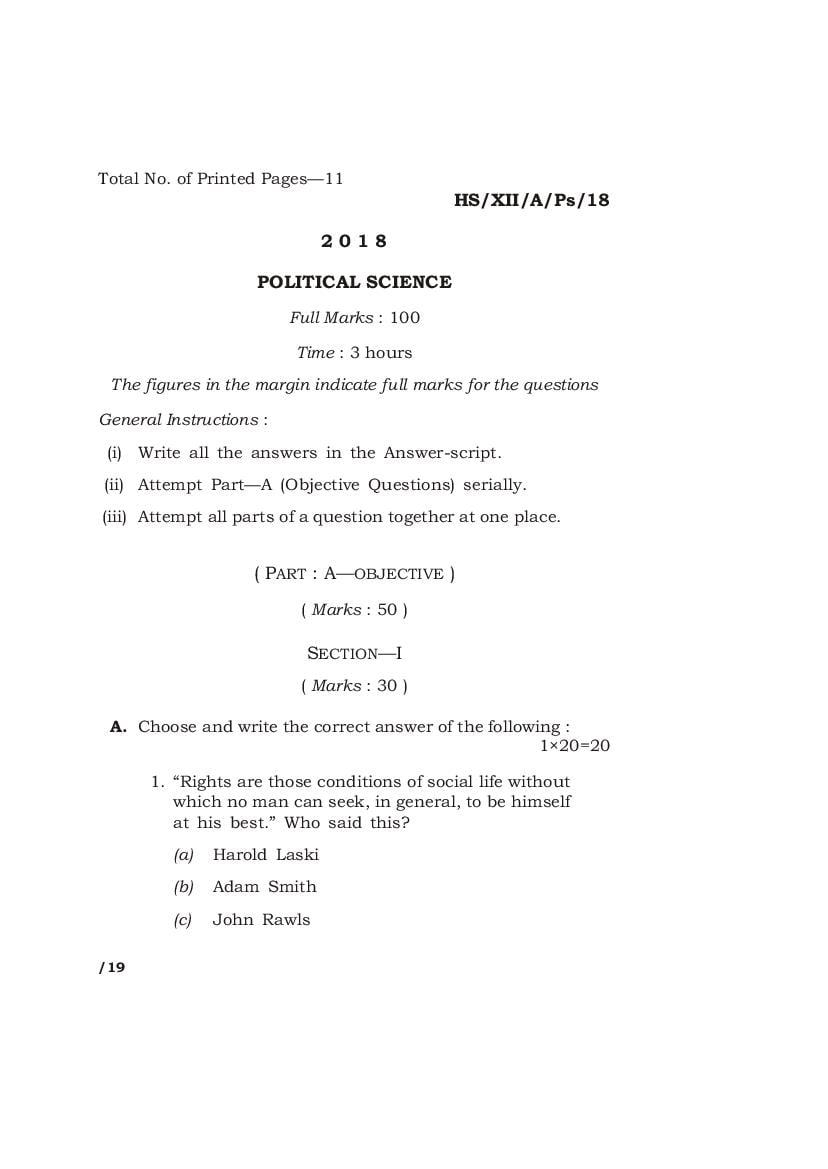
HS/XII/A/Ps/18
2018
POLITICAL SCIENCE
Full Marks : 100
Time : 3 hours
The figures in the margin indicate full marks for the questions
General Instructions :
(i) Write all the answers in the Answer-script.
(ii) Attempt Part—A (Objective Questions) serially.
(iii) Attempt all parts of a question together at one place.
( PART : A—OBJECTIVE )
( Marks : 50 )
SECTION—I
( Marks : 30 )
A. Choose and write the correct answer of the following :
1×20=20
1. “Rights are those conditions of social life without
which no man can seek, in general, to be himself
at his best.” Who said this?
(a) Harold Laski
(b) Adam Smith
(c) John Rawls
/19
Page 2
2. Rights based on ethical norms are
(a) civil rights
(b) moral rights
(c) legal rights
3. Protective discrimination means
(a) discrimination in favour of weaker sections
(b) discrimination in favour of minorities
(c) discrimination in favour of privileged sections
4. In case of conflict between constitutional law
and ordinary law
(a) ordinary law prevails
(b) constitutional law prevails
(c) None of the above
5. Citizen who acquires citizenship after birth and
not by birth is known as
(a) natural citizen
(b) naturalized citizen
(c) alien
Page 3
6. When the minimum age for the right to vote is
lowered, the number of voters
(a) increases
(b) decreases
(c) remains constant
7. One of the features of Marxism is
(a) class cohesion
(b) class struggle
(c) class organization
8. The UN Secretary-General is appointed by the
(a) General Assembly
(b) Security Council
(c) General Assembly on the recommendation
of the Security Council
9. The principal administrative agency of the UN is
(a) the UN Secretariat
(b) World Health Organization
(c) International Monetary Fund
Page 4
10. The present Secretary-General of the UN is
(a) Ban Ki-moon
(b) Kofi Annan
(c) Antonio Guterres
11. Which Article of the Constitution deals with
‘protection of life and personal liberty’?
(a) Article 20
(b) Article 21
(c) Article 22
12. The Fundamental Duties are mentioned in
(a) Part IV of Article 51A
(b) Part IV A of Article 51A
(c) Part V of Article 51
13. The President of India is elected by an Electoral
College consisting of
(a) elected members of the Parliament
(b) all elected members of the Parliament
and elected members of the Legislative
Assemblies
(c) members of the Legislative Council
Page 5
14. Under Article 356, the President can proclaim
Emergency in a State when
(a) the security of India is threatened
(b) the State fails to comply with Federal
directive
(c) there is a failure of constitutional machinery
in a State
15. The disputes concerning the election of the
Vice President of India is decided by the
(a) Parliament
(b) Supreme Court
(c) Election Commission
16. The Union Council of Ministers holds office as
long as it enjoys
(a) the confidence of the President
(b) the confidence of the Rajya Sabha
(c) the confidence of the Lok Sabha
17. The proportion of members of the Rajya Sabha,
who retire every two years is usually
(a) 1
3
(b) 2
3
(c) 1
4
Page 6
18. Quorum in the meeting of the Lok Sabha or
Rajya Sabha is
(a) 1 of the total membership
10
(b) 1 of the total membership
2
(c) 2 of the total membership
3
19. The Universal Declaration of Human Rights was
approved by the UN General Assembly on
(a) 10th December, 1948
(b) 11th December, 1948
(c) 10th November, 1948
20. Nations who joined as the members of NAM were
(a) African nations
(b) Asian nations
(c) African and Asian nations
Page 7
B. Write whether the following statements are True or
False : 1×10=10
1. Liberty and equality are opposed to each other.
2. Suffrage is considered to be a natural and
inherent right of every citizen in a democracy.
3. The Hare system and List system are the two
means of proportional representation.
4. Classical liberalist emphasized human dignity
and autonomy of individuals.
5. The Headquarters of the International Court of
Justice is in The Hague.
6. The Fundamental Rights are absolute.
7. Directive Principles of State Policy need
legislation for their application.
8. A money bill can be introduced in either House
of the Parliament.
Page 8
9. The advice given by the Supreme Court to the
President is binding.
10. India played a key role in the establishment of
Group of 77 and G–15.
SECTION—II
( Marks : 20 )
Answer the following questions in about 2 or 3 sentences
each : 2×10=20
1. Mention two methods of losing citizenship.
2. What is meant by political justice?
3. Give two demerits of universal adult franchise.
4. What do you understand by ‘class struggle’ as
explained by Karl Marx?
5. Name at least four States enjoying veto power in the
UN Security Council.
Page 9
6. Mention four writs for the enforcement of the
Fundamental Rights.
7. What are the two exclusive powers of the Rajya
Sabha?
8. What should be the total number of members in the
Union Council of Ministers?
9. How is a Judge of the Supreme Court removed?
10. What is disarmament?
( PART : B—DESCRIPTIVE )
( Marks : 50 )
GROUP—A
( Political Theory )
Answer any three of the following questions : 10×3=30
1. What is the negative and positive meaning of liberty?
Examine the relationship between law and liberty.
3+7=10
2. What is equality? Explain various kinds of equality.
2+8=10
Page 10
3. Define law. Briefly explain different kinds of law.
2+8=10
4. What is representation? Describe the territorial and
functional representation. 2+8=10
5. Describe the principal features of liberalism. 10
6. Describe the composition, powers and functions of
the UN General Assembly. 2+8=10
7. Write short notes on any two of the following : 5×2=10
(a) Duties of the citizens
(b) Relationship between law and morality
(c) Dialectical materialism
(d) Principles of the UN
(e) Economic justice
GROUP—B
( The Indian Constitution and Political
System in Operation )
Answer any two of the following questions : 10×2=20
8. Describe different kinds of the Directive Principles
of State Policy as enumerated in the Indian
Constitution. 10
Page 11
9. Describe the appointment, powers and functions of
the Prime Minister of India. 10
10. What is the composition of the Lok Sabha? Describe
its powers and functions. 2+8=10
11. What has been India’s role in the activities of
SAARC? 10
12. Write short notes on any two of the following : 5×2=10
(a) Five distinctions between Fundamental Rights
and Directive Principles
(b) Speaker of the Lok Sabha
(c) Original jurisdiction of the Supreme Court of
India
(d) India’s role in the Non-Aligned Movement
(e) Right to Freedom
HHH
8K—27100/19 HS/XII/A/Ps/18
Document Details
| Board / Org | Meghalaya Board |
| Exam | Class 12 |
| Type | Question Paper |
| Pages | 11 |
| Updated | 15 Jul 2026 |