MBOSE Class 12 Question Paper 2018 for Economics
Finished viewing? Save it for later —
Download MBOSE Class 12 Question Paper 2018 for Economics (PDF · 11 pages)About MBOSE Class 12 Question Paper 2018 for Economics
MBOSE Class 12 Question Paper 2018 for Economics is available here for free download. Published by Meghalaya Board for Class 12, this question paper can be viewed online or downloaded as a PDF (11 pages). Candidates preparing for Class 12 can use MBOSE Class 12 Question Paper 2018 for Economics to understand the exam pattern, the type of questions asked, and the overall difficulty level.
Frequently Asked Questions
How can I download MBOSE Class 12 Question Paper 2018 for Economics?
Open this page and click the Download button to save MBOSE Class 12 Question Paper 2018 for Economics as a PDF. It is completely free on AglaSem Docs.
Is MBOSE Class 12 Question Paper 2018 for Economics free to download?
Yes. MBOSE Class 12 Question Paper 2018 for Economics can be viewed online and downloaded as a PDF free of cost on AglaSem Docs.
How many pages does MBOSE Class 12 Question Paper 2018 for Economics have?
MBOSE Class 12 Question Paper 2018 for Economics contains 11 pages, which you can read online or download together as a single PDF.
Where can I find more Class 12 study material?
You can find more Class 12 question papers, sample papers, syllabus, and answer keys on AglaSem Docs.
MBOSE Class 12 Question Paper 2018 for Economics – Text
Read the full text of this question paper below — useful to quickly search, copy and reference the content online without downloading the PDF.
📄 View text version (11 pages)
Page 1
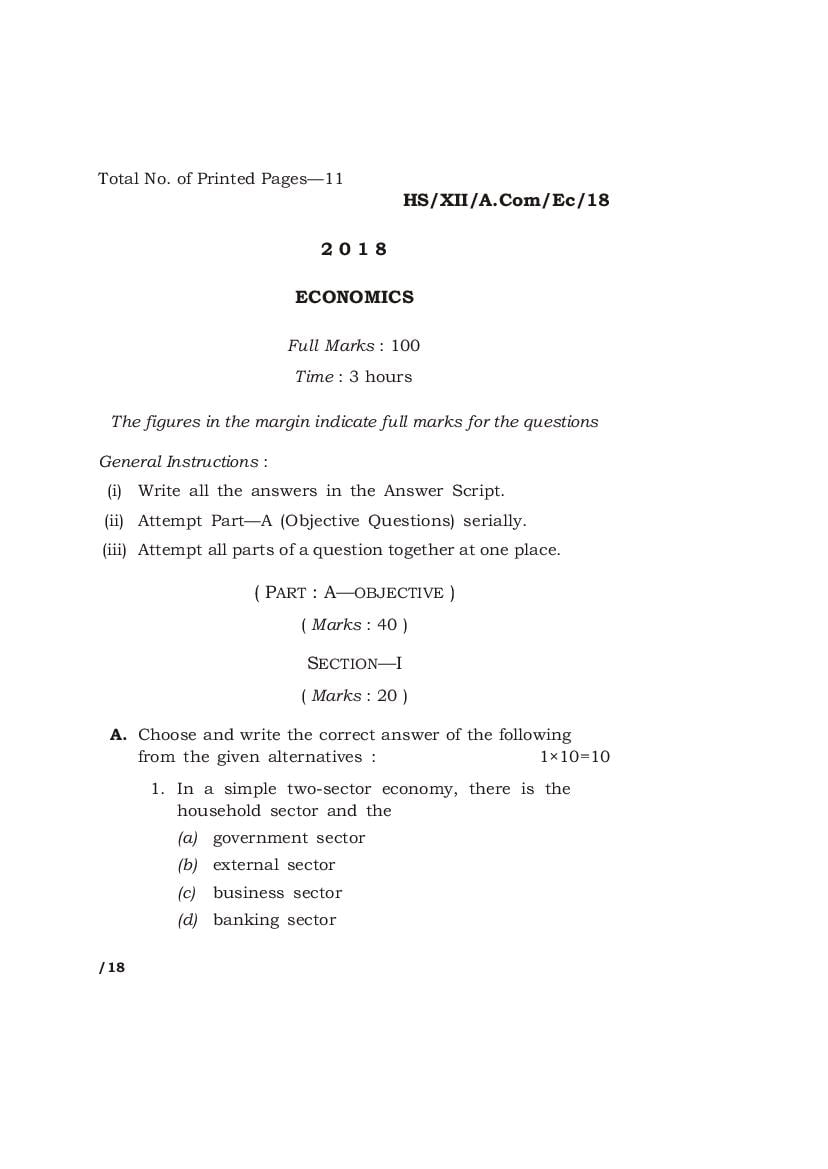
HS/XII/A.Com/Ec/18
2018
ECONOMICS
Full Marks : 100
Time : 3 hours
The figures in the margin indicate full marks for the questions
General Instructions :
(i) Write all the answers in the Answer Script.
(ii) Attempt Part—A (Objective Questions) serially.
(iii) Attempt all parts of a question together at one place.
( PART : A—OBJECTIVE )
( Marks : 40 )
SECTION—I
( Marks : 20 )
A. Choose and write the correct answer of the following
from the given alternatives : 1×10=10
1. In a simple two-sector economy, there is the
household sector and the
(a) government sector
(b) external sector
(c) business sector
(d) banking sector
/18
Page 2
2. When the percentage change in demand is less
than the percentage change in price, demand is
said to be
(a) less elastic
(b) more elastic
(c) perfectly elastic
(d) perfectly inelastic
3. The total receipts that a firm receives from the
sale of its products is
(a) marginal revenue
(b) total revenue
(c) average revenue
(d) None of the above
4. Different brands of soaps, shampoos,
toothpastes, etc., are examples of
(a) perfect competition
(b) monopoly
(c) oligopoly
(d) monopolistic competition
Page 3
5. Rent according to Ricardo is
(a) a differential surplus
(b) an alternative surplus
(c) an economic surplus
(d) None of the above
6. The average income of the people of a country in
a particular year is
(a) personal income
(b) disposable personal income
(c) per capita income
(d) None of the above
Page 4
7. Public finance studies the financial operations
of the
(a) public sector
(b) private sector
(c) joint sector
(d) None of the above
8. Balance of trade is
(a) same with the balance of payments
(b) totally different from the balance of
payments
(c) a part of the balance of payments
(d) None of the above
Page 5
9. Land Development Banks are also known as
(a) Land Mortgage Banks
(b) Government Banks
(c) Primary Land Development Banks
(d) Central Development Banks
10. The objectives of economic planning are
classified as
(a) political objectives
(b) economic objectives
(c) social and ethical objectives
(d) All of the above
Page 6
B. Fill in the blanks with appropriate word(s) : 1×10=10
1. The cost of sacrificing the next best alternative
foregone is called _____ cost.
2. Demand for necessities is _____.
3. A firm in equilibrium is said to earn normal
profit when average cost is _____ to average
revenue.
4. Under perfect competition, the AR curve _____
with the MR curve.
5. _____ wage is that wage which is expressed in
terms of money.
6. Borrowing by the State is known as public
_____.
7. Infrastructure is also known as social _____
capital in development economics.
Page 7
8. Indian agriculture still remains a gamble in the
_____.
9. The Industrial Policy Resolutions, 1956
classified industries into _____ categories.
10. Those imports that help in expanding the
productive capacity of the economy are called
_____ imports.
SECTION—II
( Marks : 20 )
C. Answer any ten of the following in 2 or 3 sentences
each : 2×10=20
1. Define microeconomics.
2. State the law of diminishing marginal utility.
3. Give two exceptions to the law of demand.
4. What is a monopoly market?
5. Define net interest.
Page 8
6. Give two examples of direct tax.
7. What is public expenditure?
8. What is a budget?
9. Give two points of differences between internal
trade and international trade.
10. Give two examples of economic infrastructure.
11. Give two causes of low agricultural productivity
in India.
12. Mention two problems that are being faced by
cottage and small-scale industries.
13. Name two import items of India.
14. What do you mean by economic planning?
Page 9
( PART : B—DESCRIPTIVE )
( Marks : 60 )
Answer ten questions, taking four from Section—I and
three each from Section—II and Section—III
SECTION—I
1. Explain the three central problems of an economy. 6
2. What are the factors affecting elasticity of demand? 6
3. What is elasticity of supply? Measure elasticity of
supply with the help of percentage method. 1+5=6
4. Explain the determination of price under perfect
competition. 6
5. What are the factors determining real wages? 6
6. Explain the uncertainty-bearing theory of profit. 6
Page 10
SECTION—II
7. Point out the differences between micro- and macro-
economics. 6
8. Explain the concepts of the following : 2+2+2=6
(a) Net National Product at market price (NNPmp )
(b) Net Domestic Product at factor cost (NDP fc )
(c) Disposable Personal Income (DPI)
9. What are the sources of public revenue? Explain
them. 6
10. Distinguish between the following : 3+3=6
(a) Plan expenditure and Non-plan expenditure
(b) Developmental expenditure and Non-
developmental expenditure
11. Explain the concepts of balance of payments and
balance of trade. 4+2=6
SECTION—III
12. Explain the importance of Indian agriculture. 6
13. What is Green Revolution? Explain the impacts of
Green Revolution. 1+5=6
Page 11
14. What are the main features of the Industrial Policy
of 1991? 6
15. Describe the role of foreign trade in economic
development of an underdeveloped country. 6
16. What are the main features of economic reforms in
India? 6
HHH
8K—21350/18 HS/XII/A.Com/Ec/18
Document Details
| Board / Org | Meghalaya Board |
| Exam | Class 12 |
| Type | Question Paper |
| Pages | 11 |
| Updated | 15 Jul 2026 |