KLEEE 2027 Sample Paper B.Tech
Finished viewing? Save it for later —
Download KLEEE 2027 Sample Paper B.Tech (PDF · 11 pages)About KLEEE 2027 Sample Paper B.Tech
KLEEE 2027 Sample Paper B.Tech is available here for free download. Published by KLU for KLEEE, this sample paper can be viewed online or downloaded as a PDF (11 pages). Candidates preparing for KLEEE can use KLEEE 2027 Sample Paper B.Tech to understand the exam pattern, the type of questions asked, and the overall difficulty level.
Frequently Asked Questions
How can I download KLEEE 2027 Sample Paper B.Tech?
Open this page and click the Download button to save KLEEE 2027 Sample Paper B.Tech as a PDF. It is completely free on AglaSem Docs.
Is KLEEE 2027 Sample Paper B.Tech free to download?
Yes. KLEEE 2027 Sample Paper B.Tech can be viewed online and downloaded as a PDF free of cost on AglaSem Docs.
How many pages does KLEEE 2027 Sample Paper B.Tech have?
KLEEE 2027 Sample Paper B.Tech contains 11 pages, which you can read online or download together as a single PDF.
Where can I find more KLEEE study material?
You can find more KLEEE question papers, sample papers, syllabus, and answer keys on AglaSem Docs.
KLEEE 2027 Sample Paper B.Tech – Text
Read the full text of this sample paper below — useful to quickly search, copy and reference the content online without downloading the PDF.
📄 View text version (11 pages)
Page 1
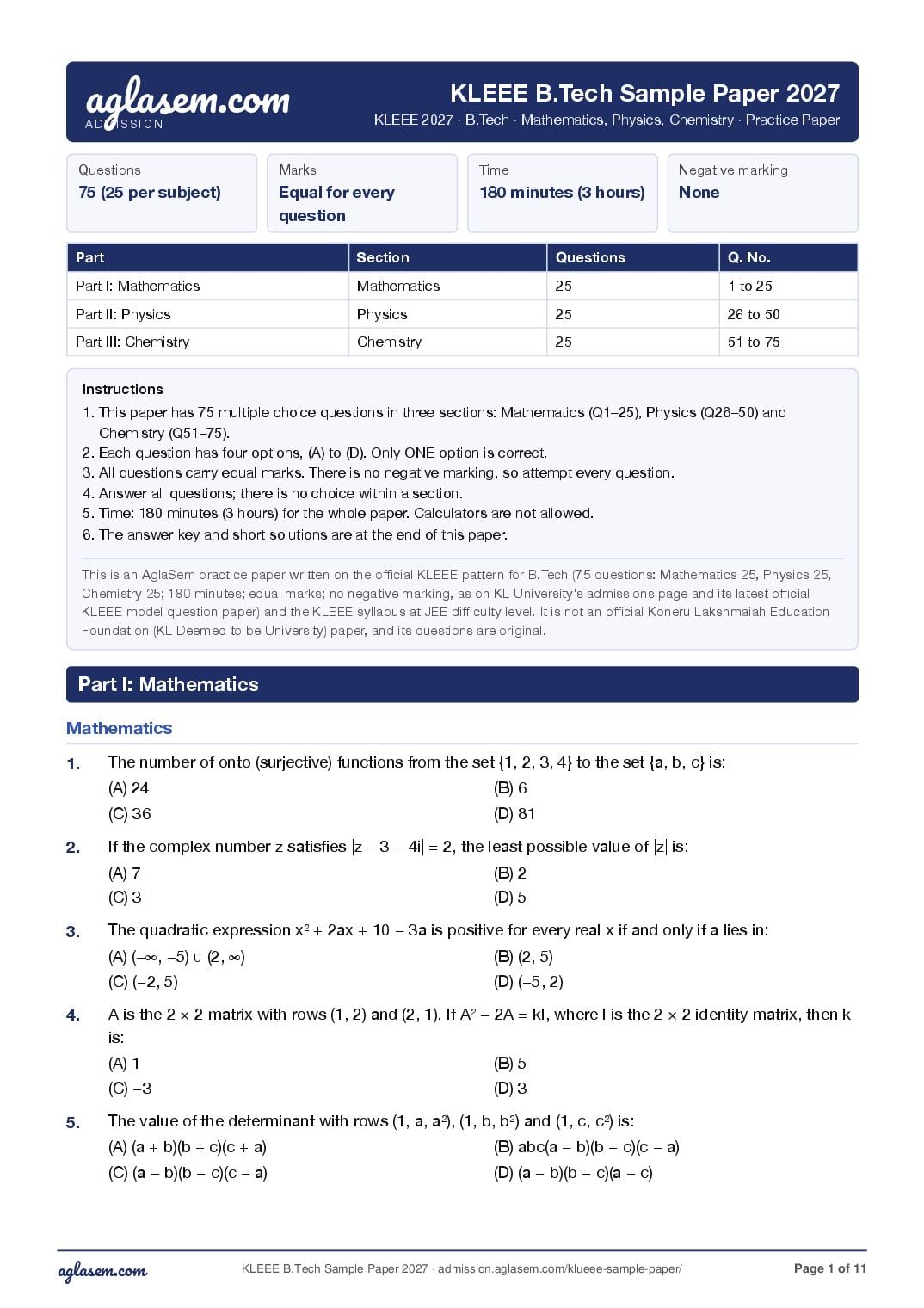
KLEEE B.Tech Sample Paper 2027
KLEEE 2027 · B.Tech · Mathematics, Physics, Chemistry · Practice Paper
Questions Marks Time Negative marking
75 (25 per subject) Equal for every 180 minutes (3 hours) None
question
Part Section Questions Q. No.
Part I: Mathematics Mathematics 25 1 to 25
Part II: Physics Physics 25 26 to 50
Part III: Chemistry Chemistry 25 51 to 75
Instructions
1. This paper has 75 multiple choice questions in three sections: Mathematics (Q1–25), Physics (Q26–50) and
Chemistry (Q51–75).
2. Each question has four options, (A) to (D). Only ONE option is correct.
3. All questions carry equal marks. There is no negative marking, so attempt every question.
4. Answer all questions; there is no choice within a section.
5. Time: 180 minutes (3 hours) for the whole paper. Calculators are not allowed.
6. The answer key and short solutions are at the end of this paper.
This is an AglaSem practice paper written on the official KLEEE pattern for B.Tech (75 questions: Mathematics 25, Physics 25,
Chemistry 25; 180 minutes; equal marks; no negative marking, as on KL University's admissions page and its latest official
KLEEE model question paper) and the KLEEE syllabus at JEE difficulty level. It is not an official Koneru Lakshmaiah Education
Foundation (KL Deemed to be University) paper, and its questions are original.
Part I: Mathematics
Mathematics
1. The number of onto (surjective) functions from the set {1, 2, 3, 4} to the set {a, b, c} is:
(A) 24 (B) 6
(C) 36 (D) 81
2. If the complex number z satisfies |z − 3 − 4i| = 2, the least possible value of |z| is:
(A) 7 (B) 2
(C) 3 (D) 5
3. The quadratic expression x² + 2ax + 10 − 3a is positive for every real x if and only if a lies in:
(A) (−∞, −5) ∪ (2, ∞) (B) (2, 5)
(C) (−2, 5) (D) (−5, 2)
4. A is the 2 × 2 matrix with rows (1, 2) and (2, 1). If A² − 2A = kI, where I is the 2 × 2 identity matrix, then k
is:
(A) 1 (B) 5
(C) −3 (D) 3
5. The value of the determinant with rows (1, a, a²), (1, b, b²) and (1, c, c²) is:
(A) (a + b)(b + c)(c + a) (B) abc(a − b)(b − c)(c − a)
(C) (a − b)(b − c)(c − a) (D) (a − b)(b − c)(a − c)
KLEEE B.Tech Sample Paper 2027 · admission./klueee-sample-paper/ Page 1 of 11
Page 2
(A) 2296 (B) 1792
(C) 2520 (D) 4536
7. By mathematical induction it can be shown that, for every natural number n, 7^n − 3^n is divisible by:
(A) 10 (B) 4
(C) 3 (D) 7
8. The remainder when 3^2027 is divided by 8 is:
(A) 3 (B) 7
(C) 5 (D) 1
9. The sum of the infinite series 1 + 4/5 + 7/5² + 10/5³ + … is:
(A) 5/4 (B) 35/16
(C) 25/16 (D) 15/16
10. The arithmetic mean of two positive numbers is 25 and their harmonic mean is 16. Their geometric
mean is:
(A) 20 (B) 21
(C) 18 (D) 22
11. The value of lim(x→0) (e^x − 1 − x)/x² is:
(A) 1 (B) 2
(C) 0 (D) 1/2
12. The function f(x) = |x² − 3x + 2| is not differentiable at:
(A) x = 1 and x = 2 only (B) x = 1 only
(C) no real value of x (D) x = 0, 1 and 2
13. The function f(x) = x³ − 6x² + 9x + 1 is strictly decreasing in the interval:
(A) (−∞, 1) (B) (0, 2)
(C) (3, ∞) (D) (1, 3)
14. ∫ dx/(1 + e^x) equals:
(A) x + ln(1 + e^x) + C (B) ln(1 + e^x) − x + C
(C) x − ln(1 + e^x) + C (D) ln(1 + e^x) + C
15. If [t] denotes the greatest integer not exceeding t, then ∫₀² [x²] dx equals:
(A) 5 − √2 − √3 (B) 5 + √2 − √3
(C) 1 + √3 (D) 3 − √2
16. The area of the region enclosed by the parabola y = x² and the line y = 2x is:
(A) 2/3 sq. units (B) 1/3 sq. units
(C) 8/3 sq. units (D) 4/3 sq. units
17. The general solution of the differential equation x(dy/dx) + y = x² (x > 0) is:
(A) y = x³/3 + C (B) y = x²/2 + C/x
(C) y = x²/3 + C/x (D) y = x²/3 + Cx
18. The equation of the circle passing through the points (0, 0), (4, 0) and (0, 6) is:
(A) x² + y² − 8x − 12y = 0 (B) x² + y² − 4x − 6y − 13 = 0
(C) x² + y² + 4x + 6y = 0 (D) x² + y² − 4x − 6y = 0
KLEEE B.Tech Sample Paper 2027 · admission./klueee-sample-paper/ Page 2 of 11
Page 3
(A) 4/3 (B) 8/3
(C) 9/2 (D) 16/3
20. The line (x − 1)/1 = (y + 2)/2 = (z − 3)/(−1) meets the plane x + y + z = 8 at the point:
(A) (4, 4, 0) (B) (0, 4, 4)
(C) (3, 2, 1) (D) (2, 0, 2)
21. If |a| = 3, |b| = 4 and |a + b| = 5 for vectors a and b, then |a − b| is:
(A) √7 (B) 5
(C) 7 (D) 1
22. The mean of five observations is 4 and their variance is 5.2. If three of the observations are 1, 2 and 6,
the other two are:
(A) 3 and 8 (B) 2 and 9
(C) 5 and 6 (D) 4 and 7
23. Box I has 2 red and 3 white balls; Box II has 4 red and 1 white ball. A box is chosen at random and a
ball drawn from it is red. The probability that it came from Box II is:
(A) 3/5 (B) 1/3
(C) 2/3 (D) 4/5
24. The value of sin 20° sin 40° sin 60° sin 80° is:
(A) 1/16 (B) √3/16
(C) 3/16 (D) 3/8
25. The negation of the statement "If it rains, then the match is cancelled" (p → q) is:
(A) If the match is cancelled, then it rains (q → p)
(B) It does not rain or the match is cancelled (~p ∨ q)
(C) If it does not rain, the match is not cancelled (~p → ~q)
(D) It rains and the match is not cancelled (p ∧ ~q)
Part II: Physics
Physics
26. If velocity (v), time (T) and force (F) are chosen as the fundamental quantities, the dimensional formula of
energy is:
(A) [F v T⁻¹] (B) [F v⁻¹ T]
(C) [F v T] (D) [F v² T]
27. The position of a particle moving along a straight line is x = 2t³ − 15t² + 36t (x in metres, t in seconds).
The distance it covers in the first 4 seconds is:
(A) 32 m (B) 28 m
(C) 34 m (D) 36 m
28. A bob of a conical pendulum hangs from a string of length L that makes an angle θ with the vertical. The
time period of its circular motion is:
(A) 2π√(L sin θ/g) (B) 2π√(L cos θ/g)
(C) 2π√(L/(g cos θ)) (D) 2π√(L/g)
KLEEE B.Tech Sample Paper 2027 · admission./klueee-sample-paper/ Page 3 of 11
Page 4
N/m. The maximum compression of the spring is:
(A) 0.6 m (B) 0.15 m
(C) 0.3 m (D) 0.09 m
30. A bullet of mass 10 g moving horizontally at 400 m/s gets embedded in a wooden block of mass 1.99
kg hanging from a long string. The block rises to a height of (g = 10 m/s²):
(A) 0.4 m (B) 2 m
(C) 0.02 m (D) 0.2 m
31. A circular hole of radius R/2 is cut from a uniform disc of radius R, the hole touching the edge of the
disc. The centre of mass of the remaining part is shifted from the centre of the disc by:
(A) R/2 (B) R/6
(C) R/3 (D) R/4
32. A uniform solid sphere rolls down a rough inclined plane of inclination θ without slipping. Its acceleration
is:
(A) (1/2) g sin θ (B) (5/7) g sin θ
(C) g sin θ (D) (2/3) g sin θ
33. A satellite of mass m circles the Earth (mass M, radius R) at a distance 2R from the Earth's centre. The
minimum energy needed to shift it to an orbit of radius 3R is:
(A) GMm/(12R) (B) GMm/(2R)
(C) GMm/(6R) (D) GMm/(3R)
34. The surface tension of a soap solution is T. The work done in blowing a soap bubble of radius r (starting
from zero size, at constant temperature) is:
(A) 4πr²T (B) 16πr²T
(C) 8πr²T (D) 2πr²T
35. One mole of an ideal gas expands isothermally and reversibly at 300 K from 10 L to 20 L. The work
done by the gas is about (R = 8.31 J mol⁻¹ K⁻¹, ln 2 = 0.693):
(A) 2.49 kJ (B) 1.73 kJ
(C) 0.86 kJ (D) 3.46 kJ
36. One mole of a monatomic ideal gas is mixed with one mole of a diatomic ideal gas (rigid molecules).
The ratio Cp/Cv for the mixture is:
(A) 3/2 (B) 4/3
(C) 5/3 (D) 7/5
37. A particle performs simple harmonic motion x = A sin ωt with time period T. The minimum time it takes
to go from the mean position to a point at x = A/2 is:
(A) T/12 (B) T/8
(C) T/6 (D) T/4
38. A wave on a string is y = 0.02 sin[2π(10t − 0.5x)], with x and y in metres and t in seconds. The speed of
the wave is:
(A) 5 m/s (B) 20 m/s
(C) 10 m/s (D) 0.05 m/s
39. Four equal point charges q are placed at the corners of a square of side a. With k = 1/(4πε₀), the electric
field and the potential at the centre of the square are:
(A) E = 0 and V = 4√2 kq/a (B) E = 0 and V = 4kq/a
(C) E = 4√2 kq/a² and V = 0 (D) E = 0 and V = 0
KLEEE B.Tech Sample Paper 2027 · admission./klueee-sample-paper/ Page 4 of 11
Page 5
energy lost in the process is:
(A) zero (B) 5 mJ
(C) 10 mJ (D) 2.5 mJ
41. Two cells, of emf 6 V and 4 V, each with internal resistance 1 Ω, are connected in parallel (positive to
positive) across a 3 Ω resistor. The current in the 3 Ω resistor is:
(A) 2 A (B) 10/7 A
(C) 2/7 A (D) 10/3 A
42. A long straight wire carrying current I has a semicircular loop of radius R in it, and both straight parts lie
along a line passing through the centre of the semicircle. The magnetic field at the centre is:
(A) μ₀I/(4πR) (B) μ₀I/(2R)
(C) μ₀I/(2πR) (D) μ₀I/(4R)
43. A metal rod of length l rotates with angular speed ω about an axis through one end, perpendicular to the
rod, in a uniform magnetic field B parallel to the axis. The emf between its ends is:
(A) ¼Bωl² (B) 2Bωl²
(C) Bωl² (D) ½Bωl²
44. A series circuit of a 30 Ω resistor and an inductor of reactance 40 Ω is connected to a 200 V (rms) ac
supply. The rms current is:
(A) 2.86 A (B) 6.67 A
(C) 4 A (D) 5 A
45. For an equilateral glass prism the angle of minimum deviation is 30°. The refractive index of the glass is:
(A) √3 (B) 2/√3
(C) 1.5 (D) √2
46. In Young's double-slit experiment with light of wavelength 600 nm, a thin film of refractive index 1.5 and
thickness 6 μm is placed over one slit. The central bright fringe shifts by:
(A) 2.5 fringe widths (B) 15 fringe widths
(C) 10 fringe widths (D) 5 fringe widths
47. A proton and an alpha particle are accelerated from rest through the same potential difference. The ratio
of their de Broglie wavelengths (proton : alpha) is:
(A) 2 (B) √2
(C) 2√2 (D) 1/(2√2)
48. The ionisation energy of a hydrogen atom in its ground state is 13.6 eV. The ionisation energy of a Li²⁺
ion in its ground state is:
(A) 122.4 eV (B) 40.8 eV
(C) 54.4 eV (D) 13.6 eV
49. Input A is fed to one NOT gate and input B to another NOT gate. The two outputs are then fed to a NOR
gate. The whole combination is equivalent to:
(A) a NOR gate (B) an AND gate
(C) a NAND gate (D) an OR gate
50. A screw gauge has a pitch of 0.5 mm and 50 divisions on its circular scale, and no zero error. While
measuring a wire, the linear scale shows 2 divisions (of 0.5 mm each) and the 25th circular division is on
the reference line. The diameter of the wire is:
(A) 2.25 mm (B) 0.75 mm
(C) 1.25 mm (D) 1.025 mm
KLEEE B.Tech Sample Paper 2027 · admission./klueee-sample-paper/ Page 5 of 11
Page 6
Chemistry
51. The mass of oxygen needed for the complete combustion of 4.4 g of propane (C₃H₈) is:
(A) 8 g (B) 32 g
(C) 16 g (D) 3.2 g
52. The wavelength of the spectral line emitted when the electron in a hydrogen atom falls from n = 4 to n =
2 is about (R = 1.097 × 10⁷ m⁻¹):
(A) 486 nm (B) 122 nm
(C) 656 nm (D) 434 nm
53. The numbers of angular nodes and radial nodes in a 4d orbital are:
(A) 2 angular and 2 radial (B) 2 angular and 1 radial
(C) 1 angular and 2 radial (D) 3 angular and 0 radial
54. Among H₂O, NH₃, CH₄ and H₂S, the molecule with the smallest bond angle is:
(A) CH₄ (B) H₂S
(C) NH₃ (D) H₂O
55. For the reaction N₂(g) + 3H₂(g) → 2NH₃(g) at temperature T, the value of ΔH − ΔU is:
(A) −RT (B) −2RT
(C) zero (D) +2RT
56. For a reaction, ΔH = +45 kJ mol⁻¹ and ΔS = +150 J K⁻¹ mol⁻¹. Taking both as independent of
temperature, the reaction is feasible only above:
(A) 30 K (B) 3000 K
(C) 0.3 K (D) 300 K
57. 3.42 g of sucrose (molar mass 342 g/mol) is dissolved in 50 g of water. If Kf for water is 1.86 K kg mol⁻¹,
the depression in freezing point is:
(A) 0.0372 K (B) 3.72 K
(C) 0.186 K (D) 0.372 K
58. The solubility product of a sparingly soluble salt AB₂ is 4 × 10⁻¹² at 298 K. Its molar solubility is:
(A) 1 × 10⁻⁴ M (B) 1 × 10⁻⁶ M
(C) 2 × 10⁻⁴ M (D) 1 × 10⁻³ M
59. For the cell Zn | Zn²⁺(0.01 M) ‖ Cu²⁺(1 M) | Cu, E°cell = 1.10 V. Taking 2.303RT/F = 0.059 V, the cell emf
at 298 K is:
(A) 1.159 V (B) 1.100 V
(C) 1.218 V (D) 1.041 V
60. The rate constant of a first-order reaction is 4.606 × 10⁻³ s⁻¹. The time needed for 99% of the reactant to
be used up is:
(A) 500 s (B) 1000 s
(C) 2000 s (D) 100 s
61. Which of the following is true of physical adsorption (physisorption)?
(A) It always increases with temperature
(B) It is highly specific to the adsorbate
(C) It needs a high activation energy
(D) It can form layers several molecules thick
KLEEE B.Tech Sample Paper 2027 · admission./klueee-sample-paper/ Page 6 of 11
Page 7
(A) O²⁻ > N³⁻ > F⁻ > Mg²⁺ > Na⁺ (B) N³⁻ > O²⁻ > F⁻ > Na⁺ > Mg²⁺
(C) Mg²⁺ > Na⁺ > F⁻ > O²⁻ > N³⁻ (D) F⁻ > O²⁻ > N³⁻ > Na⁺ > Mg²⁺
63. Which alkali metal combines directly with nitrogen to form a nitride?
(A) Na (B) Li
(C) Cs (D) K
64. The shape of the XeO₃ molecule is:
(A) trigonal pyramidal (B) tetrahedral
(C) trigonal planar (D) T-shaped
65. In acidic solution, the number of moles of KMnO₄ needed to oxidise one mole of oxalate ion (C₂O₄²⁻) to
CO₂ is:
(A) 5/2 (B) 1
(C) 1/5 (D) 2/5
66. The spin-only magnetic moment of the tetrahedral complex ion [NiCl₄]²⁻ is about:
(A) 3.87 BM (B) 1.73 BM
(C) 2.83 BM (D) 0 BM
67. [Co(NH₃)₅(NO₂)]Cl₂ and [Co(NH₃)₅(ONO)]Cl₂ are examples of:
(A) coordination isomerism (B) geometrical isomerism
(C) linkage isomerism (D) ionisation isomerism
68. The number of chiral (asymmetric) carbon atoms in the open-chain form of D-glucose is:
(A) 5 (B) 3
(C) 4 (D) 6
69. But-2-yne is reduced with sodium in liquid ammonia. The product is:
(A) trans-but-2-ene (B) butane
(C) cis-but-2-ene (D) but-1-ene
70. 2-Bromo-2-methylpropane is heated with sodium ethoxide in ethanol. The main organic product is:
(A) 2-methylpropene (B) 2-methylpropane
(C) 2-methylpropan-2-ol (D) 2-ethoxy-2-methylpropane
71. Methoxybenzene (anisole) is heated with HI. The products are:
(A) phenol and methyl iodide (B) phenol and methane
(C) iodobenzene and methanol (D) iodobenzene and methyl iodide
72. Which of the following does NOT give a positive iodoform test?
(A) propanone (B) propan-2-ol
(C) pentan-3-one (D) ethanol
73. Which of the following amines cannot be prepared by Gabriel phthalimide synthesis?
(A) propan-1-amine (B) aniline
(C) ethylamine (D) benzylamine
74. On prolonged heating with HI, glucose gives:
(A) sorbitol (B) gluconic acid
(C) saccharic acid (D) n-hexane
KLEEE B.Tech Sample Paper 2027 · admission./klueee-sample-paper/ Page 7 of 11
Page 8
H₂SO₄ is poured carefully along the side of the test tube. The salt contains the:
(A) nitrate ion (B) sulphate ion
(C) carbonate ion (D) chloride ion
KLEEE B.Tech Sample Paper 2027 · admission./klueee-sample-paper/ Page 8 of 11
Page 9
1 C 2 C 3 D 4 D 5 C 6 A 7 B 8 A 9 B 10 A
11 D 12 A 13 D 14 C 15 A 16 D 17 C 18 D 19 B 20 A
21 B 22 D 23 C 24 C 25 D 26 C 27 C 28 B 29 C 30 D
31 B 32 B 33 A 34 C 35 B 36 A 37 A 38 B 39 A 40 B
41 B 42 D 43 D 44 C 45 D 46 D 47 C 48 A 49 B 50 C
51 C 52 A 53 B 54 B 55 B 56 D 57 D 58 A 59 A 60 B
61 D 62 B 63 B 64 A 65 D 66 C 67 C 68 C 69 A 70 A
71 A 72 C 73 B 74 D 75 A
Solutions
Mathematics
1. (C) Total functions 3⁴ = 81. Remove those missing at least one image (inclusion–exclusion): 81 − 3(2⁴) + 3(1⁴) = 81 −
48 + 3 = 36.
2. (C) z lies on a circle with centre 3 + 4i (distance 5 from the origin) and radius 2. The nearest point is 5 − 2 = 3 from
the origin.
3. (D) Leading coefficient is positive, so we need discriminant < 0: 4a² − 4(10 − 3a) < 0, i.e. a² + 3a − 10 < 0, i.e. (a + 5)
(a − 2) < 0, so −5 < a < 2.
4. (D) A² has rows (5, 4) and (4, 5); 2A has rows (2, 4) and (4, 2). So A² − 2A has rows (3, 0) and (0, 3), which is 3I.
5. (C) This is a Vandermonde determinant; R2 − R1 and R3 − R1 and taking out the common factors give (b − a)(c − a)
(c − b), which equals (a − b)(b − c)(c − a). Option (a − b)(b − c)(a − c) has the opposite sign.
6. (A) Units digit 0: 9 × 8 × 7 = 504. Units digit 2, 4, 6 or 8: 4 × (8 choices for the first digit, not 0 or the units digit) × 8 ×
7 = 1792. Total = 2296.
7. (B) For n = 1 the value is 4. If 4 divides 7^k − 3^k, then 7^(k+1) − 3^(k+1) = 7(7^k − 3^k) + 4(3^k) is also divisible by
4. (n = 1 rules out 3, 7 and 10.)
8. (A) 3² = 9 ≡ 1 (mod 8). 3^2027 = (3²)^1013 × 3 ≡ 1 × 3 = 3 (mod 8).
9. (B) This is an AGP with a = 1, d = 3, r = 1/5. S = a/(1 − r) + dr/(1 − r)² = 5/4 + (3/5)/(16/25) = 5/4 + 15/16 = 35/16.
10. (A) For two positive numbers G² = A × H = 25 × 16 = 400, so G = 20. (The numbers are 40 and 10.)
11. (D) e^x = 1 + x + x²/2 + …, so (e^x − 1 − x)/x² → 1/2.
12. (A) x² − 3x + 2 = (x − 1)(x − 2) changes sign with a non-zero slope at x = 1 and x = 2, so the modulus makes sharp
corners there; it is smooth elsewhere.
13. (D) f'(x) = 3x² − 12x + 9 = 3(x − 1)(x − 3), which is negative only for 1 < x < 3.
14. (C) 1/(1 + e^x) = 1 − e^x/(1 + e^x). Integrating: x − ln(1 + e^x) + C.
15. (A) [x²] = 0 on [0, 1), 1 on [1, √2), 2 on [√2, √3), 3 on [√3, 2). Integral = (√2 − 1) + 2(√3 − √2) + 3(2 − √3) = 5 − √2 − √3.
16. (D) They meet at x = 0 and x = 2. Area = ∫₀² (2x − x²) dx = 4 − 8/3 = 4/3.
17. (C) The left side is d(xy)/dx, so xy = x³/3 + C and y = x²/3 + C/x.
18. (D) Take x² + y² + 2gx + 2fy + c = 0. (0, 0) gives c = 0; (4, 0) gives 16 + 8g = 0, g = −2; (0, 6) gives 36 + 12f = 0, f =
−3.
19. (B) x²/9 + y²/4 = 1, so a = 3, b = 2 and the latus rectum = 2b²/a = 8/3.
20. (A) A general point is (1 + t, −2 + 2t, 3 − t). Substituting: 2 + 2t = 8, so t = 3 and the point is (4, 4, 0). (3, 2, 1) is on
the line but not the plane.
21. (B) |a + b|² = 9 + 16 + 2a·b = 25 gives a·b = 0. Then |a − b|² = 9 + 16 − 0 = 25, so |a − b| = 5.
KLEEE B.Tech Sample Paper 2027 · admission./klueee-sample-paper/ Page 9 of 11
Page 10
28: a, b = 4 and 7.
23. (C) By Bayes' theorem: (½ × 4/5)/(½ × 2/5 + ½ × 4/5) = (4/5)/(6/5) = 2/3.
24. (C) sin θ sin(60° − θ) sin(60° + θ) = (1/4) sin 3θ. With θ = 20°: sin 20° sin 40° sin 80° = (1/4) sin 60° = √3/8.
Multiplying by sin 60° = √3/2 gives 3/16.
25. (D) p → q is equivalent to ~p ∨ q. Its negation is ~(~p ∨ q) = p ∧ ~q.
Physics
26. (C) Energy = force × distance, and distance = velocity × time, so E = [F v T].
27. (C) v = 6t² − 30t + 36 = 6(t − 2)(t − 3), so it reverses at t = 2 s and t = 3 s. x(0) = 0, x(2) = 28, x(3) = 27, x(4) = 32.
Distance = 28 + 1 + 5 = 34 m (displacement 32 m).
28. (B) T cos θ = mg and T sin θ = mω²(L sin θ) give ω² = g/(L cos θ), so the period is 2π√(L cos θ/g).
29. (C) ½mv² = ½kx²: 2 × 36 = 800x², so x² = 0.09 and x = 0.3 m.
30. (D) Momentum: 0.01 × 400 = 2 × V, so V = 2 m/s. Energy after impact: h = V²/2g = 4/20 = 0.2 m.
31. (B) The removed part has mass M/4 with its centre at R/2. x = −(M/4)(R/2)/(3M/4) = −R/6, i.e. R/6 on the side away
from the hole.
32. (B) a = g sin θ/(1 + I/mr²) = g sin θ/(1 + 2/5) = (5/7) g sin θ.
33. (A) Total orbital energy is −GMm/(2r). ΔE = −GMm/(6R) − (−GMm/(4R)) = GMm(1/4 − 1/6)/R = GMm/(12R).
34. (C) A soap bubble has two surfaces, so the new surface area is 2 × 4πr². W = T × 8πr² = 8πr²T.
35. (B) W = nRT ln(V₂/V₁) = 1 × 8.31 × 300 × 0.693 ≈ 1728 J ≈ 1.73 kJ.
36. (A) Cv(mix) = (3R/2 + 5R/2)/2 = 2R and Cp(mix) = Cv + R = 3R. γ = 3R/2R = 3/2.
37. (A) A/2 = A sin ωt gives ωt = π/6, so t = (π/6)/(2π/T) = T/12.
38. (B) ω = 20π rad/s and k = π rad/m, so v = ω/k = 20 m/s (frequency 10 Hz, wavelength 2 m).
39. (A) Fields from opposite corners cancel, so E = 0. Each charge is a/√2 from the centre, so V = 4kq/(a/√2) = 4√2
kq/a.
40. (B) Initial energy ½ × 2 μF × 100² = 10 mJ. Common voltage 50 V; final energy 2 × ½ × 2 μF × 50² = 5 mJ. Loss = 5
mJ (in heat and radiation).
41. (B) Let the terminal voltage be V: (6 − V)/1 + (4 − V)/1 = V/3, so 10 = 7V/3 and V = 30/7 V. Current = V/3 = 10/7 A.
42. (D) The straight parts point along the line through the centre, so dl × r = 0 and they give no field. The semicircle
gives half the field of a full loop: μ₀I/(4R).
43. (D) e = ∫ B(ωx) dx from 0 to l = ½Bωl².
44. (C) Z = √(30² + 40²) = 50 Ω. I = 200/50 = 4 A. (Adding R and X directly would wrongly give 200/70 = 2.86 A.)
45. (D) μ = sin[(A + δm)/2]/sin(A/2) = sin 45°/sin 30° = (1/√2)/(1/2) = √2.
46. (D) Extra optical path = (μ − 1)t = 0.5 × 6 μm = 3 μm. Number of fringes = 3 μm/0.6 μm = 5.
47. (C) λ = h/√(2mqV), so λ(p)/λ(α) = √[(m(α)q(α))/(m(p)q(p))] = √(4 × 2) = 2√2.
48. (A) For a hydrogen-like ion E ∝ Z². For Li²⁺, Z = 3: 13.6 × 9 = 122.4 eV.
49. (B) Y = (A' + B')' = A·B by De Morgan's theorem, which is the AND operation.
50. (C) Least count = 0.5/50 = 0.01 mm. Reading = 2 × 0.5 + 25 × 0.01 = 1.00 + 0.25 = 1.25 mm.
Chemistry
51. (C) C₃H₈ + 5O₂ → 3CO₂ + 4H₂O. 4.4 g propane = 0.1 mol, which needs 0.5 mol O₂ = 16 g.
52. (A) 1/λ = R(1/4 − 1/16) = 3R/16, so λ = 16/(3 × 1.097 × 10⁷) m ≈ 4.86 × 10⁻⁷ m = 486 nm (the blue-green Balmer
line).
53. (B) Angular nodes = l = 2. Radial nodes = n − l − 1 = 4 − 2 − 1 = 1.
54. (B) In H₂S the bonds use almost pure p orbitals of the large, less electronegative S, so the angle is about 92°,
against 104.5° for H₂O, 107° for NH₃ and 109.5° for CH₄.
55. (B) ΔH = ΔU + Δn(g)RT with Δn(g) = 2 − 4 = −2, so ΔH − ΔU = −2RT.
KLEEE B.Tech Sample Paper 2027 · admission./klueee-sample-paper/ Page 10 of 11
Page 11
57. (D) Moles = 0.01; molality = 0.01/0.050 kg = 0.2 mol/kg. ΔTf = 1.86 × 0.2 = 0.372 K.
58. (A) AB₂ ⇌ A²⁺ + 2B⁻, so Ksp = s(2s)² = 4s³ = 4 × 10⁻¹². s³ = 10⁻¹², s = 10⁻⁴ M.
59. (A) E = E° − (0.059/2) log([Zn²⁺]/[Cu²⁺]) = 1.10 − 0.0295 × (−2) = 1.10 + 0.059 = 1.159 V.
60. (B) t = (2.303/k) log([A]₀/[A]) = (2.303/4.606 × 10⁻³) × log 100 = 500 × 2 = 1000 s.
61. (D) Physisorption is due to weak van der Waals forces: it is non-specific, reversible, has low enthalpy (about 20–40
kJ/mol), needs no activation energy, decreases with temperature and can be multimolecular.
62. (B) All have 10 electrons. The greater the nuclear charge, the more strongly they are pulled in, so the radius falls
from N (Z = 7) to Mg (Z = 12).
63. (B) Lithium, like magnesium (diagonal relationship), burns in N₂ to form Li₃N. The other alkali metals do not form
nitrides directly.
64. (A) Xe in XeO₃ has three bond pairs (double bonds to O) and one lone pair: sp³ hybridisation with a pyramidal
shape.
65. (D) 2MnO₄⁻ + 5C₂O₄²⁻ + 16H⁺ → 2Mn²⁺ + 10CO₂ + 8H₂O. Mn gains 5 e⁻ and each oxalate loses 2 e⁻, so 2/5 mol per
mol of oxalate.
66. (C) Ni²⁺ is d⁸. Cl⁻ is a weak-field ligand and the complex is tetrahedral (sp³), leaving 2 unpaired electrons: μ = √8 ≈
2.83 BM. ([Ni(CN)₄]²⁻, square planar, is diamagnetic.)
67. (C) The ambidentate NO₂⁻ ligand is bonded through N (nitro) in one and through O (nitrito) in the other.
68. (C) In CHO–(CHOH)₄–CH₂OH, carbons 2, 3, 4 and 5 each carry four different groups. C1 (CHO) and C6 (CH₂OH)
are not chiral.
69. (A) Birch-type (dissolving metal) reduction adds the two H atoms anti, giving the trans (E) alkene. Lindlar's catalyst
would give the cis alkene.
70. (A) With a strong base, a tertiary halide undergoes elimination (E2) rather than substitution, so the alkene is the
main product.
71. (A) The O–CH₃ bond is cleaved: I⁻ attacks the methyl carbon (SN2). The O–aryl bond is strong (partial double bond),
so phenol is formed, not iodobenzene.
72. (C) The test needs CH₃CO– or CH₃CH(OH)– group. Pentan-3-one (CH₃CH₂COCH₂CH₃) has neither.
73. (B) The step needs SN2 attack of the phthalimide anion on an alkyl halide. Aryl halides such as chlorobenzene do
not undergo it, so aromatic primary amines cannot be made this way.
74. (D) HI reduces all the oxygen-bearing groups; formation of n-hexane shows that the six carbon atoms of glucose
are in a straight chain.
75. (A) Nitrate is reduced to NO, which forms the brown complex [Fe(H₂O)₅(NO)]²⁺ at the junction of the two layers.
KLEEE B.Tech Sample Paper 2027 · admission./klueee-sample-paper/ Page 11 of 11
Document Details
| Board / Org | KLU |
| Exam | KLEEE |
| Type | Sample Paper |
| Pages | 11 |
| Language | english |
| Updated | 27 Oct 2026 |