TN 10th Question Paper 2022 Science
Finished viewing? Save it for later —
Download TN 10th Question Paper 2022 Science (PDF · 11 pages)About TN 10th Question Paper 2022 Science
TN 10th Question Paper 2022 Science is available here for free download. Published by Tamil Nadu Board for Class 10, this question paper can be viewed online or downloaded as a PDF (11 pages). Candidates preparing for Class 10 can use TN 10th Question Paper 2022 Science to understand the exam pattern, the type of questions asked, and the overall difficulty level.
Frequently Asked Questions
How can I download TN 10th Question Paper 2022 Science?
Open this page and click the Download button to save TN 10th Question Paper 2022 Science as a PDF. It is completely free on AglaSem Docs.
Is TN 10th Question Paper 2022 Science free to download?
Yes. TN 10th Question Paper 2022 Science can be viewed online and downloaded as a PDF free of cost on AglaSem Docs.
How many pages does TN 10th Question Paper 2022 Science have?
TN 10th Question Paper 2022 Science contains 11 pages, which you can read online or download together as a single PDF.
Where can I find more Class 10 study material?
You can find more Class 10 question papers, sample papers, syllabus, and answer keys on AglaSem Docs.
TN 10th Question Paper 2022 Science – Text
Read the full text of this question paper below — useful to quickly search, copy and reference the content online without downloading the PDF.
📄 View text version (11 pages)
Page 1
2345
2345
2345
2345
2345
2345
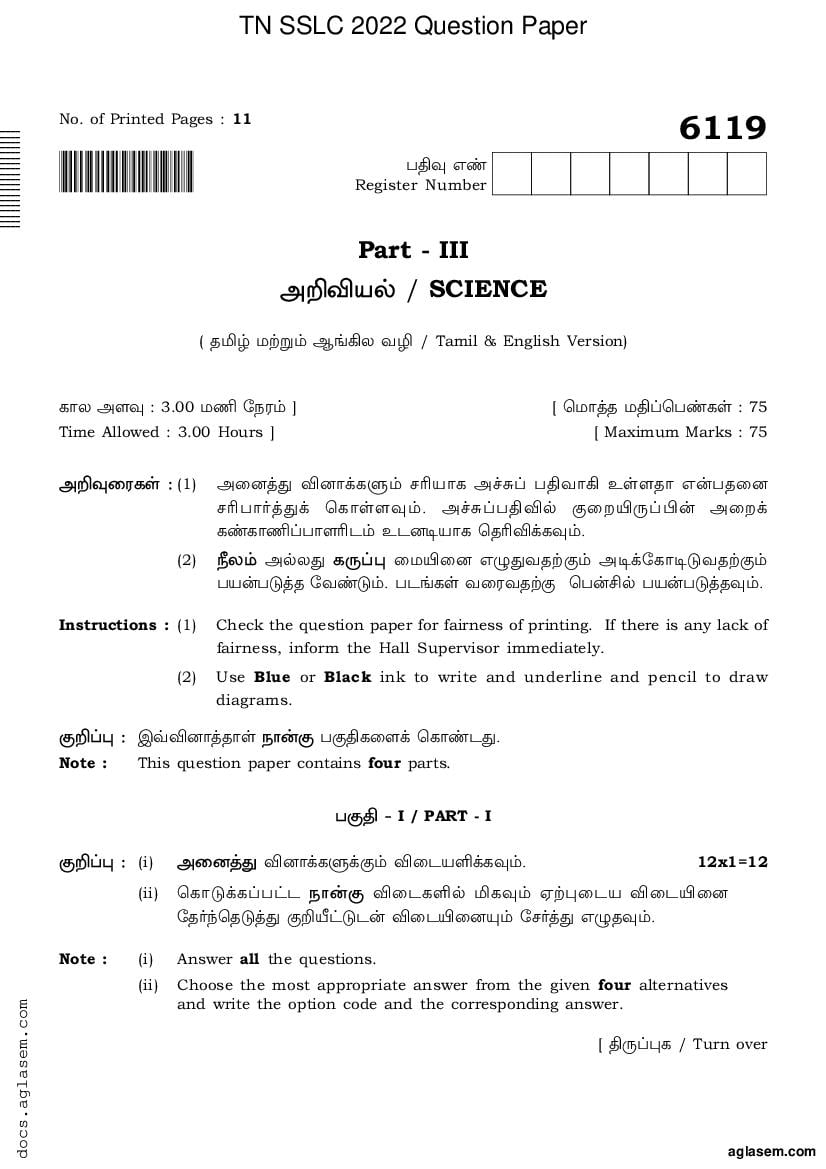
6119
!6119Science!
2345
2345 £vÄ Gs
2345
2345
2345
2345 Register Number
2345
2345
2345
2345
2345
2345
2345
2345
Part - III
AÔ¯À / SCIENCE
( uªÌ ©ØÖ® B[Q» ÁÈ / Tamil & English Version)
Põ» AÍÄ : 3.00 ©o ÷|µ® ] [ ö©õzu ©v¨ö£sPÒ : 75
Time Allowed : 3.00 Hours ] [ Maximum Marks : 75
AÔÄøµPÒ : (1) AøÚzx ÂÚõUPЮ \›¯õP Aa_¨ £vÁõQ EÒÍuõ GߣuøÚ
\›£õºzxU öPõÒÍÄ®. Aa_¨£vÂÀ SøÓ°¸¨¤ß AøÓU
PsPõo¨£õÍ›h® EhÚi¯õP öu›ÂUPÄ®.
(2) }»® AÀ»x P¸¨¦ ø©°øÚ GÊxÁuØS® AiU÷PõikÁuØS®
£¯ß£kzu ÷Ásk®. £h[PÒ ÁøµÁuØS ö£ß]À £¯ß£kzuÄ®.
Instructions : (1) Check the question paper for fairness of printing. If there is any lack of
fairness, inform the Hall Supervisor immediately.
(2) Use Blue or Black ink to write and underline and pencil to draw
diagrams.
SÔ¨¦ : CÆÂÚõzuõÒ |õßS £SvPøÍU öPõshx.
Note : This question paper contains four parts.
£Sv & I / PART - I
SÔ¨¦ : (i) AøÚzx ÂÚõUPÐUS® Âøh¯ÎUPÄ®. 12x1=12
(ii) öPõkUP¨£mh |õßS ÂøhPÎÀ ªPÄ® Hئøh¯ Âøh°øÚ
÷uº¢öukzx SÔ±mkhß Âøh°øÚ²® ÷\ºzx GÊuÄ®.
Note : (i) Answer all the questions.
(ii) Choose the most appropriate answer from the given four alternatives
and write the option code and the corresponding answer.
Page 2
1. J¸ S ÂÀ-ø»-°À ö£õ¸Îß AÍÂØS \©©õÚ, uø»RÇõÚ ö©´¤®£®
QøhUP ö£õ¸Ò øÁUP¨£h ÷Ási¯ öuõø»Ä :
(A) f (B) DÔ»õz öuõø»Ä
(C) 2f (D) f &US® 2f &US® Cøh°À
Where should an object be placed so that a real and inverted image of same size
is obtained by a convex lens ?
(a) f (b) infinity
(c) 2f (d) between f and 2f
2. J¸ ‰»UTÓõÚx J÷µ uÛ©zvß AqUPÍõÀ E¸ÁõUP¨£mhõÀ, Ax
__________ ‰»UTÖ GÚ AøÇUP¨£kQÓx.
(A) Kµq (B) ÷ÁØÖ Aq (C) Jzu Aq (D) £» Aq
If a molecule is made of similar kind of atoms, then it is called __________ molecule.
(a) Mono atomic (b) hetero atomic (c) homo atomic (d) poly atomic
3. C¸©iUPøµ\¼À EÒÍ TÖPÎß GsoUøP __________.
(A) 2 (B) 3 (C) 4 (D) 5
The number of components in a binary solution is _________.
(a) 2 (b) 3 (c) 4 (d) 5
4. 12 T¾® ªßÞmh® 5 Â|õi ÷|µ® J¸ ªßÂÍUQß ÁȯõP £õ´QÓx GÛÀ,
Auß ÁÈ÷¯ ö\À¾® ªß÷Úõmhzvß AÍÄ GßÚ ?
(A) 60 A (B) 17 A (C) 2.4 A (D) 24 A
A charge of 12 coulomb flows through a bulb in 5 second. What is the current
through the bulb ?
(a) 60 A (b) 17 A (c) 2.4 A (d) 24 A
Page 3
5. G›\õµõ¯® Gߣx J¸ }º© Pøµ\À. Cv¾ÒÍ GzuÚõ¼ß \uÃu® __________.
(A) 95.5% (B) 75.5% (C) 55.5% (D) 45.5%
Rectified spirit is an aqueous solution which contains about __________ of ethanol.
(a) 95.5% (b) 75.5% (c) 55.5% (d) 45.5%
6. EÒ ÷|õUQ¯ ø\»® Gߣx Guß ]Ó¨¦¨ £s£õS® ?
(A) ÷Áº (B) usk (C) Cø»PÒ (D) ©»ºPÒ
The endarch condition is the characteristic feature of __________.
(a) root (b) stem (c) leaves (d) flowers
7. «ßPÎß Cu¯® __________ AøÓPÒ öPõshx.
(A) 3 (B) 4 (C) 2 (D) 5
The heart of fishes possess __________ chambers.
(a) 3 (b) 4 (c) 2 (d) 5
8. ‰i¯ Âøu²øh¯ uõÁµ[PÎÀ (Bg]÷¯õìö£º®PÒ) Bs ÷P«m GÆÁøP
ö\À¼¼¸¢x E¸ÁõQÓx ?
(A) EØ£zv ö\À (B) Eh» ö\À
(C) ©Pµ¢uzyÒ uõ´ ö\À (D) ø©U÷µõì÷£õº
Male gametes in angiosperms are formed by the division of __________.
(a) Generative cell (b) Vegetative cell
(c) Pollen grain mother cell (d) Microspore
Page 4
9. RÌPshÁØÖÒ "uø»ø©a _µ¨¤' GÚ P¸u¨£kÁx Gx ?
(A) ¥Û¯À _µ¨¤ (B) ¤m³mh› _µ¨¤
(C) øuµõ´k _µ¨¤ (D) Am›ÚÀ _µ¨¤
Which one is referred as “Master Gland” ?
(a) Pineal gland (b) Pituitary gland
(c) Thyroid gland (d) Adrenal gland
10. P»¨¤Ú©õUP® ©ØÖ® ÷uºÄ ö\´uÀ ‰»©õP E¸ÁõUP¨£mh, x¸ ÷|õ´US
Gvº¨¦z ußø©¨ ö£ØÓ î®Q› Gߣx __________ Cß µP©õS®.
(A) ªÍPõ´ (B) ©UPõa÷\õÍ® (C) P¸®¦ (D) ÷Põxø©
Himgiri developed by hybridization and selection for disease resistance against
rust pathogens is a variety of __________.
(a) chilli (b) maize (c) sugarcane (d) wheat
11. ö£õ¸zxP :
(1) `›¯ BØÓÀ (i) Kk® }º
(2) ö£m÷µõ¼¯® (ii) Aø»÷£]
(3) ¦ÚÀ ªßÚõØÓÀ (iii) wº¢x ÷£õPõu BØÓÀ
(4) ªßÚq \õuÚ® (iv) wº¢x ÷£õPU Ti¯ BØÓÀ ‰»®
(A) (1) - (iv), (2) - (iii), (3) - (ii), (4) - (i)
(B) (1) - (iii), (2) - (iv), (3) - (i), (4) - (ii)
(C) (1) - (iii), (2) - (i), (3) - (iv), (4) - (ii)
(D) (1) - (i), (2) - (iv), (3) - (ii), (4) - (iii)
Match the following :
(1) Solar Energy (i) Flowing water
(2) Petroleum (ii) Mobile phone
(3) Hydropower (iii) Inexhaustible energy
(4) Electronic device (iv) Exhaustible energy resource
(a) (1) - (iv), (2) - (iii), (3) - (ii), (4) - (i)
(b) (1) - (iii), (2) - (iv), (3) - (i), (4) - (ii)
(c) (1) - (iii), (2) - (i), (3) - (iv), (4) - (ii)
(d) (1) - (i), (2) - (iv), (3) - (ii), (4) - (iii)
Page 5
12. \›¯õÚ Cønø¯U PõsP :
(A) Q›Pº ÷áõPß ö©shÀ & C¯ØøPz ÷uºÄ ÷Põm£õk
(B) ÁõÀ÷h¯º & S÷µõ÷©õ÷\õ®PÒ
(C) Áõm\ß ©ØÖ® Q›U & £›nõ©U ÷Põm£õkPÒ
(D) ãß £õ¨iìm »õ©õºU & £õµ®£›¯ ÂvPÒ
Find the correct pair :
(a) Gregor Johann Mendel - Theory of Natural Selection
(b) Waldeyer - Chromosomes
(c) Watson and Crick - Theory of Evolution
(d) Jean Baptiste Lamarck - Law of Heredity
£Sv & II / PART - II
SÔ¨¦ : GøÁ÷¯Ý® HÊ ÂÚõUPÐUS Âøh¯ÎUPÄ®. ÂÚõ Gs 22 &US
Pmhõ¯©õP Âøh¯ÎUPÄ®. 7x2=14
Note : Answer any seven questions. Question No. 22 is compulsory.
13. {³mhÛß Cµshõ® Âv°øÚ TÖP.
State Newton’s second law.
14. Gvöµõ¼°ß H÷uÝ® Cµsk £¯ß£õkPøÍ GÊxP.
Write any two applications of echo.
15. £õ°À Âvø¯U TÖP.
State Boyle’s Law.
Page 6
16. öPõkUP¨£mkÒÍ ÷\º©[PÎß ÂøÚö\¯À öuõSv ©ØÖ® ¤ßöÚõmkPøÍ
GÊxP.
÷\º©® ÂøÚ ö\¯À öuõSv ¤ßöÚõmk
BÀPíõÀ
BÀiøík
Rm÷hõß
Põº£õU]¼U Aª»®
Write the functional group and the suffix used for the following class of compounds.
Class of Compounds Functional Group Suffix used
Alcohol
Aldehyde
Ketone
Carboxylic Acid
17. ©øÇ }º ÷\ª¨¤ß •UQ¯zxÁ[PÒ ¯õøÁ ?
What is the importance of rainwater harvesting ?
18. öPõkUP¨£mkÒÍ £hzvÀ A, B, C, D BQ¯ £õP[PøÍ Aøh¯õÍ® PõsP.
Identify the parts A, B, C, D in the given figure.
19. £›nõ©® GßÓõÀ GßÚ ? £›nõ©U ÷Põm£õkPøÍ •ßö©õÈ¢uÁºPÒ ¯õº ?
What is evolution ? Who proposed the theories of evolution ?
Page 7
20. ø»]ß Aª÷Úõ Aª»® ö\Ô¢u Cµsk ©UPõa÷\õÍ P»¨¦°› ÁøPPÎß
ö£¯øµ GÊxP.
Name the two maize hybrids rich in amino acid lysine.
21. Cu¯ ÁõÀÄPÎß •UQ¯zxÁ® GßÚ ?
What is the importance of valves in the heart ?
22. Qmh¨£õºøÁU SøÓ£õk Eøh¯ J¸ ©ÛuµõÀ, 4 « öuõø»ÂÀ EÒÍ
ö£õ¸ÒPøÍ ©mk÷© Põn C¯¾®. AÁº 20« öuõø»ÂÀ EÒͨ ö£õ¸øÍ
Põn ¸®¤ÚõÀ £¯ß£kzu¨£h ÷Ási¯ SÈ ö»ß]ß S¯z öuõø»Ä
GßÚ ?
A person with myopia can see objects placed at a distance of 4 m. If he wants to
see objects at a distance of 20 m, what should be the focal length and power of
the concave lens he must wear ?
£Sv & III / PART - III
SÔ¨¦ : GøÁ÷¯Ý® HÊ ÂÚõUPÐUS Âøh¯ÎUPÄ®. ÂÚõ Gs 32 &US
Pmhõ¯©õP Âøh¯ÎUPÄ®. 7x4=28
Note : Answer any seven questions. Question No. 32 is compulsory.
23. {øÓ ©ØÖ® Gøhø¯ ÷ÁÖ£kzxP.
Differentiate mass and weight.
24. J롧 H÷uÝ® |õßS £s¦PøÍU TÖP.
List any four properties of light.
Page 8
25. Cø\¯µ[P[PÎß ÷©ØTøµ ÁøÍÁõP C¸¨£x Hß ?
Explain why the ceilings of concert halls are curved ?
26. (A) E÷»õPUP»øÁ GßÓõÀ GßÚ ?
(B) E÷»õPUP»øÁ E¸ÁõUSÁuØPõÚ Põµn[PÒ ¯õøÁ ?
(a) What is an alloy ?
(b) Give the reasons for alloying.
27. RÌPsh ÷\º©[PÎß Põº£ß \[Q¼ öuõhøµ¨ ö£õÖzx ÁøP¨£kzxP ©ØÖ®
Aø©¨¦ Áõ´¨£õmøh GÊxP.
(i) ¦µ¨÷£ß (ii) ö£ß^ß
(iii) Áøͯ ¤³m÷hß (iv) ¤³µõß
Classify the following compounds based on the pattern of carbon chain and give
their structural formula :
(i) Propane (ii) Benzene
(iii) Cyclobutane (iv) Furan
28. (A) _Áõ\ DÄ GßÓõÀ GßÚ ?
(B) JÎa÷\ºUøP°ß Jmkö©õzu \©ß£õmøh GÊxP.
(a) What is respiratory quotient ?
(b) Write the overall reaction for photosynthesis.
Page 9
29. (A) }µõ¨ ÷£õUS |øhö£Ö® {PÌa]°ß £h® Áøµ¢x £õP[PøÍ
SÔUPÄ®.
(B) xPÒPÐøh¯ ö\ÀPÎß £h[PøÍ ÁøµP.
(a) Draw and label the parts of process of transpiration.
(b) Draw the pictures of Granulocytes.
30. (A) E°›Ú[PÎß ÷uõØÓ® £ØÔ¯ ÷Põm£õkPøͨ £mi¯¼kP.
(B) Ámhõµ CÚ uõÁµÂ¯À GßÝ® ö\õÀø» AÔ•P¨£kzv¯Áº ¯õº ?
(a) List the theories postulated to explain the origin of life.
(b) Who coined the term ‘Ethnobotany’ ?
31. ©¸zxÁz xøÓ°À E°º öuõÈÀ~m£Â¯¼ß •UQ¯zxÁzøu GÊxP.
Discuss the importance of biotechnology in the field of medicine.
32. ‘A’ Gߣx }» {Ó¨ £iP E¨¦. CuøÚa `k£kzx®÷£õx }»{Ózøu CÇ¢x
‘B’ BP ©õÖQÓx. ‘B’&CÀ }øµa ÷\ºUS® ÷£õx ‘B’ «sk® ‘A’ &BP ©õÖQÓx.
‘A’ ©ØÖ® ‘B’ &°øÚ Aøh¯õÍ® PõsP. \©ß£õmiøÚ GÊxP.
‘A’ is a blue coloured crystalline salt. On heating it loses blue colour and gives ‘B’.
When water is added, ‘B’ gives back ‘A’. Identify ‘A’ and ‘B’. Write the equation.
Page 10
£Sv & IV / PART - IV
SÔ¨¦ : AøÚzx ÂÚõUPÐUS® Âøh¯ÎUPÄ®. ÷uøÁ¯õÚ Ch[PÎÀ £h®
Áøµ¯Ä®. 3x7=21
Note : Answer all the questions. Draw diagrams wherever necessary.
33. (A) (i) ªß÷Úõmh® GßÓõÀ GßÚ ?
(ii) ªß÷Úõmhzvß A»S ¯õx ? Áøµ¯ÖUPÄ®.
(iii) ªß÷Úõmhzøu G¢u P¸Â°ß ‰»® AÍÂh •i²® ? AuøÚ J¸
ªß_ØÔÀ GÆÁõÖ CønUP ÷Ásk® ?
AÀ»x
(B) (i) C¯ØøPU Pv›¯UPzøuU PshÔ¢uÁº ¯õº ?
(ii) C¯ØøP ©ØÖ® ö\¯ØøP Pv›¯UPzvß H÷uÝ® ‰ßÖ £s¦PøÍ
GÊxP.
(iii) ÷ÁÍõsø©z xøÓ°À Pv›¯UP ÷µi÷¯õ I÷\õ÷hõ¨¦PÎß £¯ßPÒ
H÷uÝ® ‰ßÔøÚ GÊxP.
(a) (i) What is meant by electric current ?
(ii) Name and define its unit.
(iii) Which instrument is used to measure the electric current ? How should
it be connected in a circuit ?
OR
(b) (i) Who discovered natural radioactivity ?
(ii) Write any three features of natural and artificial radioactivity.
(iii) Give any three uses of radio isotopes in the field of agriculture.
Page 11
34. (A) (i) AqUPmk Gs Áøµ¯ÖUPÄ®. GkzxUPõmk u¸P.
(ii) AqUPÒ ©ØÖ® ‰»UTÖPÐUQøh÷¯¯õÚ ÷ÁÖ£õkPøÍ öuõSzx
GÊxP.
AÀ»x
(B) (i) ÷\ºUøP ÂøÚ & Áøµ¯ÖUPÄ®.
(ii) ÷\ºUøP ÂøÚUS Kº GkzxUPõmk u¸P.
(iii) «Ò ©ØÖ® «Íõ ÂøÚPøÍ ÷ÁÖ£kzxP.
(a) (i) Define : Atomicity. Give an example.
(ii) Consolidate the major differences between atoms and molecules.
OR
(b) (i) Define combination reaction.
(ii) Give an example for combination reaction.
(iii) Differentiate reversible and irreversible reaction.
35. (A) (i) ö\¯ØøP BU]ßPÒ GߣøÁ ¯õøÁ ? GkzxUPõmkPÒ u¸P.
(ii) ‰ÂønÄ & Áøµ¯ÖUPÄ®.
(iii) BsPÎß Cµshõ® {ø» CÚ¨ö£¸UP EÖ¨¦PøÍU TÖP.
AÀ»x
(B) (i) ö©shÀ uß B´ÂØS Hß ÷uõmh¨ £mhõoa ö\iø¯z
÷uº¢öukzuõº ?
(ii) ©x A¸¢x£ÁºPÐUS HØ£k® ¤µa]øÚPøÍ \› ö\´ÁuØPõÚ wºøÁz
u¸P.
(a) (i) What are synthetic auxins ? Give examples.
(ii) Define triple fusion.
(iii) Name the secondary sex organs in male.
OR
(b) (i) Why did Mendel select pea plant for his experiment ?
(ii) Suggest measures to overcome the problems of an alcoholic.
-o0o-
Document Details
| Board / Org | Tamil Nadu Board |
| Exam | Class 10 |
| Type | Question Paper |
| Pages | 11 |
| Updated | 30 Apr 2026 |