Karnataka 1st PUC Model Question Paper 2027 for Chemistry (Paper 2)
Finished viewing? Save it for later —
Download Karnataka 1st PUC Model Question Paper 2027 for Chemistry (Paper 2) (PDF · 4 pages)About Karnataka 1st PUC Model Question Paper 2027 for Chemistry (Paper 2)
Karnataka 1st PUC Model Question Paper 2027 for Chemistry (Paper 2) is available here for free download. Published by Karnataka Board for Class 11, this sample paper can be viewed online or downloaded as a PDF (4 pages). Candidates preparing for Class 11 can use Karnataka 1st PUC Model Question Paper 2027 for Chemistry (Paper 2) to understand the exam pattern, the type of questions asked, and the overall difficulty level.
Frequently Asked Questions
How can I download Karnataka 1st PUC Model Question Paper 2027 for Chemistry (Paper 2)?
Open this page and click the Download button to save Karnataka 1st PUC Model Question Paper 2027 for Chemistry (Paper 2) as a PDF. It is completely free on AglaSem Docs.
Is Karnataka 1st PUC Model Question Paper 2027 for Chemistry (Paper 2) free to download?
Yes. Karnataka 1st PUC Model Question Paper 2027 for Chemistry (Paper 2) can be viewed online and downloaded as a PDF free of cost on AglaSem Docs.
How many pages does Karnataka 1st PUC Model Question Paper 2027 for Chemistry (Paper 2) have?
Karnataka 1st PUC Model Question Paper 2027 for Chemistry (Paper 2) contains 4 pages, which you can read online or download together as a single PDF.
Where can I find more Class 11 study material?
You can find more Class 11 question papers, sample papers, syllabus, and answer keys on AglaSem Docs.
Karnataka 1st PUC Model Question Paper 2027 for Chemistry (Paper 2) – Text
Read the full text of this sample paper below — useful to quickly search, copy and reference the content online without downloading the PDF.
📄 View text version (5 pages)
Page 1
Karnataka 1st PUC
Model Question Paper
2027 for Chemistry
(Paper 2)
EXAM YEAR TYPE SUBJECT
Karnataka Class 11 2027 Sample Paper Chemistry
Notes · Sample Papers · Previous Year Papers · Mock Tests
Page 2
m .co
c. o
e m
em l a s
s a g
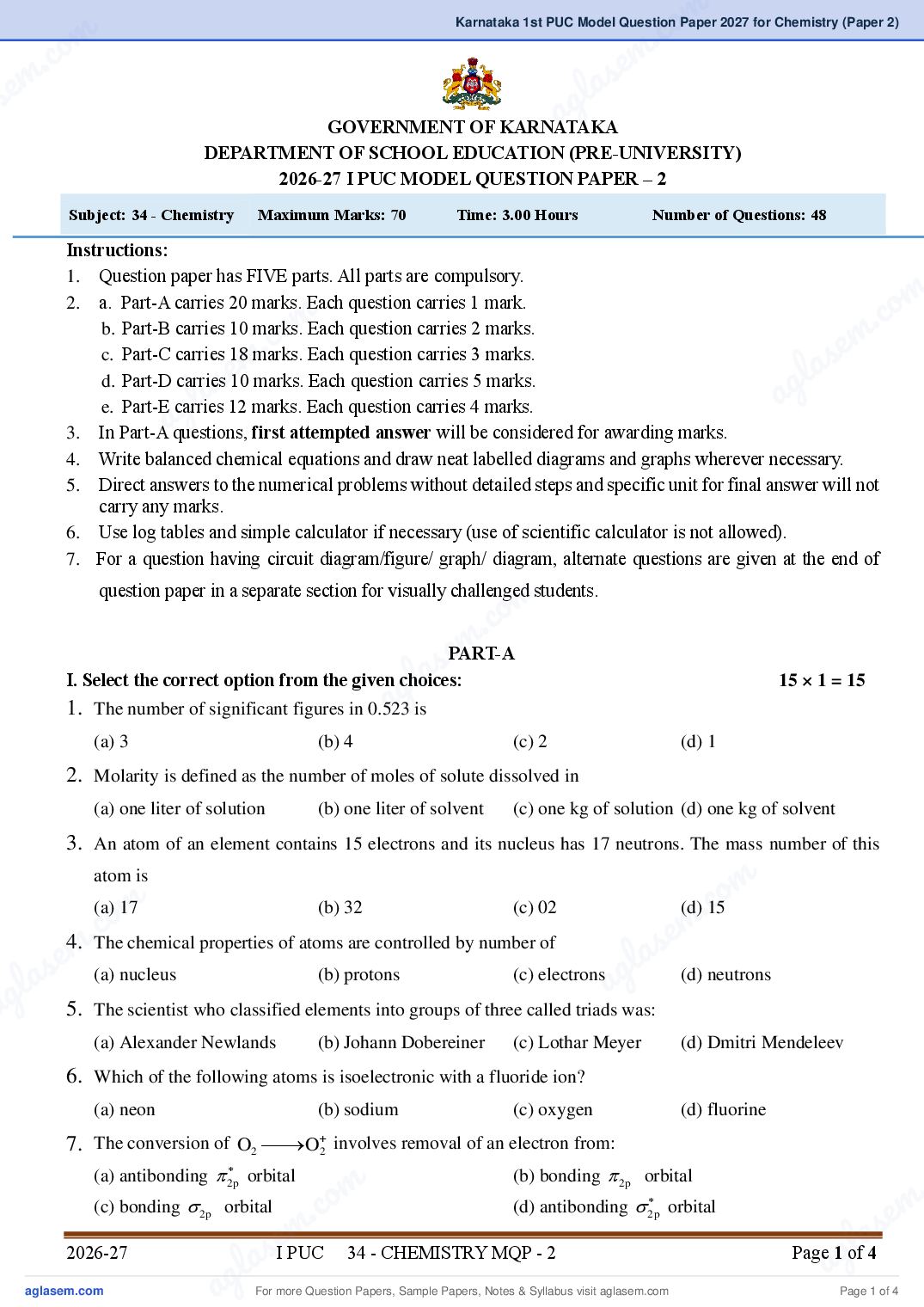
GOVERNMENT OF KARNATAKA
DEPARTMENT OF SCHOOL EDUCATION (PRE-UNIVERSITY)
2026-27 I PUC MODEL QUESTION PAPER – 2
Subject: 34 - Chemistry Maximum Marks: 70 Time: 3.00 Hours Number of Questions: 48
Instructions:
m
1. Question paper has FIVE parts. All parts are compulsory.
m
2. a. Part-A carries 20 marks. Each question carries 1 mark.
c. o
.co
b. Part-B carries 10 marks. Each question carries 2 marks.
s e m
em la
s
c. Part-C carries 18 marks. Each question carries 3 marks.
l a
d. Part-D carries 10 marks. Each question carries 5 marks.
a g
ag
e. Part-E carries 12 marks. Each question carries 4 marks.
3. In Part-A questions, first attempted answer will be considered for awarding marks.
4. Write balanced chemical equations and draw neat labelled diagrams and graphs wherever necessary.
5. Direct answers to the numerical problems without detailed steps and specific unit for final answer will not
carry any marks.
6. Use log tables and simple calculator if necessary (use of scientific calculator is not allowed).
7. For a question having circuit diagram/figure/ graph/ diagram, alternate questions are given at the end of
m
co
question paper in a separate section for visually challenged students.
.
s em
la
PART-A
g
a is
I. Select the correct option from the given choices:
1. The number of significant figures in 0.523
15 × 1 = 15
(a) 3 (b) 4 (c) 2 (d) 1
2. Molarity is defined as the number of moles of solute dissolved in
(a) one liter of solution (b) one liter of solvent (c) one kg of solution (d) one kg of solvent
3. An atom of an element contains 15 electrons and its nucleus has 17 neutrons. The mass number of this
m
co
atom is
o m (d) .15
m
c
.The chemical properties of atoms are controlled by number of se
(a) 17 (b) 32 (c) 02
m
e (a) nucleus l a (d) neutrons
s
4.
la a g
g
(b) protons (c) electrons
a 5. The scientist who classified elements into groups of three called triads was:
(a) Alexander Newlands (b) Johann Dobereiner (c) Lothar Meyer (d) Dmitri Mendeleev
6. Which of the following atoms is isoelectronic with a fluoride ion?
(a) neon (b) sodium (c) oxygen (d) fluorine
→ O+2 involves removal of an electron from:
7. The conversion of O2 ⎯⎯
om .
(a) antibonding 2p
(b) bonding 2p orbital
m
orbital
c
m. s e
(c) bonding 2p orbital (d) antibonding 2p
a
orbital
se l
Page 1gof 4
l a a
ag
2026-27 I PUC 34 - CHEMISTRY MQP - 2
For more Question Papers, Sample Papers, Notes & Syllabus visit Page 1 of 4
Page 3
(a) internal energy (b) temperature (c) enthalpy (d) heat capacity
9. “Energy of universe is conserved but entropy of universe always increases during any natural process”.
The statement is based on:
(a) Faradays laws (b) 3rd law of thermodynamics
(c) 1st and 2nd law of thermodynamics (d) Zeroth law of thermodynamics
10.Statement - 1: Equilibrium is possible only in a closed system at a given temperature.
Statement - 2: At equilibrium, all measurable properties of the system remain constant.
Identify the correct statement
(a) Both statement 1 and 2 are correct (b) Statement 1 is correct and statement 2 is incorrect.
(c) Both statement 1 and 2 are incorrect (d) Statement 1 is incorrect and statement 2 is correct.
11.Match the following elements in compounds with their oxidation state:
Element Oxidation state
A) Oxygen in potassium superoxide i) +1
B) Hydrogen in metal hydrides ii) - ½
C) Sodium in rock salt iii) -2
D) Sulphur in hydrogen sulphide iv) -1
(a) A) → i); B) → ii); C) → iii); D) → iv) (b) A) → ii); B) → iv); C) → i); D) → iii)
(c) A) → ii); B) → iii); C) → i); D) → iv) (d) A) → iii); B) → iii); C) → i); D) → ii)
12.Which of the following will not show resonance?
(a) C6H6 (b) C6H12 (c) CH3NO2 (d) C6H5COO-
13.The property catenation is more marked in the case of
(a) silicon (b) carbon (c) tin (d) copper
14.The carbon atoms in benzene are
(a) sp 2 hybridized (b) sp − hybridized (c) sp3 − hybridised (d) unhybridised
15.Which of the following reagents will produce trans alkenes through the reduction of alkynes?
(a) H2/Pt (b) H2/Pd (c) H2/Ni (d) Na /liquid NH3
II. Fill in the blanks by choosing the appropriate word from those given in the brackets: 5×1=5
(-CH2-, weak base, zero, - CH3, Helium, Fluorine)
16.The element ________ was discovered in the sun by spectroscopic method.
17.The valency of the noble gases is ______.
18.If a Bronsted acid is a strong acid then its conjugate base is a _______.
19.If an element X has the same oxidation state in all of its compounds, then element X is _______.
20.In a homologous series of aliphatic hydrocarbons, successive members differ from each other in their
molecular formula by a _______ group.
2026-27 I PUC 34 - CHEMISTRY MQP - 2 Page 2 of 4
For more Question Papers, Sample Papers, Notes & Syllabus visit Page 2 of 4
Page 4
m .co
c. o
e m
m a s
se 21.State Heisenberg’s Uncertainty Principle. Mention one significance
PART – B
g l
a of this principle.
III. Answer any FIVE of the following. Each question carries two marks. 5 × 2 = 10
22.Mention two factors that determine the percentage covalent character in an ionic bond.
23.Mention the shape of SO2 molecule. Why is the bond angle of SO₂ slightly less than 120° (approximately
119°)?
24.Define entropy. What happens to the entropy when liquid changes into a vapour?
m
m c. o
25.What is extensive property? Give an example.
.c o
26.What is a buffer solution? Give an example for acidic buffer.
e m
e l a s is
27.State Le Chatelier’smprinciple. What is the effect of temperature on equilibrium if the reaction
exothermic? a
l s a g
ag differences between the inductive effect and the electromeric effect.
28.Give any two
29.Among primary, secondary and tertiary carbocations, which is the most stable? Give reasons.
30.Explain Ozonolysis of alkenes with an example.
PART – C
IV. Answer any THREE of the following. Each question carries three marks. 3 × 3 = 09
m
c. o
31.Define ionization enthalpy. Mention any two factors affecting ionization enthalpy.
em bond order & the magnetic property of lithium
32.Calculate the formal charge on each oxygen atom present in ozone.
la s
33.Based on MOT, write the electronic configuration,
molecule.
a g
34.Define a hydrogen bond. Mention its types.
35.Define redox reactions. Explain the oxidizing agent and reducing agent in terms of electron transfer.
V. Answer any THREE of the following. Each question carries three marks. 3 × 3 = 09
36.Mention the different scales of measuring temperature.
o m
c
37.Write three conclusions regarding atomic structure based on Rutherford’s atomic model.
o mthe Born-Haber Cycle used to calculate the lattice enthalpy of NaCl. m.
c
.Plot a graph of concentration vs time, for the attainment of chemical equilibrium e in the reversible reaction:
38.Draw
em a s
l position on the graph.
s g
39.
l a a
ag 40.For the following figures, predict the direction of the reaction.
H ( g2) + I (
2 g ) 2HI ( g ) from either direction. Identify the equilibrium
(i) (ii) (iii)
m .
.co s e m
e m l a
l a s Page 3gof 4
a
ag
2026-27 I PUC 34 - CHEMISTRY MQP - 2
For more Question Papers, Sample Papers, Notes & Syllabus visit Page 3 of 4
Page 5
VI. Answer any TWO of the following. Each question carries five marks. 2 × 5 = 10
41.(a) Explain the test for the detection of halogen using Sodium fusion extract. (3+2)
(b) Write the bond-line structure formula for 3-chlorooct-5-enal. Identify the functional group in it.
42.(a) Complete the following reactions
(i) 2CH 4 + O2 ⎯⎯⎯⎯⎯⎯
Cu/523K/100 atm
→
Mo 2O3 /
(ii) CH 4 + O2 ⎯⎯⎯⎯ →
(CH3COO)Mn/
(iii) 2CH3 − CH3 + 3O2 ⎯⎯⎯⎯⎯⎯ →
(b) Explain Reforming reaction with a suitable example. (3+2)
43.(a) Explain the mechanism of the nitration of benzene.
(b) Draw the staggered conformation of ethane. (3+2)
PART–E
(NUMERICAL PROBLEMS)
VII. Answer any THREE of the following. Each question carries four marks. 3 × 4 = 12
44.Naturally occurring chlorine consists of two isotopes with atomic weights 34.97 and 36.97 and their
abundance 75.8% and 24.2% respectively. Calculate the average atomic mass of chlorine.
45.Calculate the wave length of moving electron whose kinetic energy is 3.0 x 10⁻²⁵ J. [Given: Mass of
electron = 9.1094 10 –31 kg ]
46.The combustion of one mole of benzene at 298 K and 1 atm liberates 3267.0 kJ of heat. Calculate the
standard enthalpy of formation ( ΔH o f ) of benzene. Standard enthalpies of formation of CO2(g) and H2O(l)
are –393.5 kJ mol–1 and – 285.83 kJ mol–1 respectively.
47.Calculate the pH of 0.08M solution of hypochlorous acid, HOCl. The ionization constant of the acid is
2.5×10⁻⁵. Determine the percent dissociation of HOCl.
48.On complete combustion 0.246 g of an organic compound gave 0.198g of carbon dioxide and 0.101g of
water. Determine the percentage composition of carbon and hydrogen in the compound.
PART–F
(For visually challenged students only)
40. Write the relationship between dissociation constant of acid and its conjugate base. Give the importance
of these two. (3)
**********
2026-27 I PUC 34 - CHEMISTRY MQP - 2 Page 4 of 4
For more Question Papers, Sample Papers, Notes & Syllabus visit Page 4 of 4
Document Details
| Board / Org | Karnataka Board |
| Exam | Class 11 |
| Type | Sample Paper |
| Pages | 4 |
| Updated | 13 Nov 2026 |