MBOSE Class 12 Question Paper 2021 for Chemistry
Finished viewing? Save it for later —
Download MBOSE Class 12 Question Paper 2021 for Chemistry (PDF · 24 pages)About MBOSE Class 12 Question Paper 2021 for Chemistry
MBOSE Class 12 Question Paper 2021 for Chemistry is available here for free download. Published by Meghalaya Board for Class 12, this question paper can be viewed online or downloaded as a PDF (24 pages). Candidates preparing for Class 12 can use MBOSE Class 12 Question Paper 2021 for Chemistry to understand the exam pattern, the type of questions asked, and the overall difficulty level.
Frequently Asked Questions
How can I download MBOSE Class 12 Question Paper 2021 for Chemistry?
Open this page and click the Download button to save MBOSE Class 12 Question Paper 2021 for Chemistry as a PDF. It is completely free on AglaSem Docs.
Is MBOSE Class 12 Question Paper 2021 for Chemistry free to download?
Yes. MBOSE Class 12 Question Paper 2021 for Chemistry can be viewed online and downloaded as a PDF free of cost on AglaSem Docs.
How many pages does MBOSE Class 12 Question Paper 2021 for Chemistry have?
MBOSE Class 12 Question Paper 2021 for Chemistry contains 24 pages, which you can read online or download together as a single PDF.
Where can I find more Class 12 study material?
You can find more Class 12 question papers, sample papers, syllabus, and answer keys on AglaSem Docs.
MBOSE Class 12 Question Paper 2021 for Chemistry – Text
Read the full text of this question paper below — useful to quickly search, copy and reference the content online without downloading the PDF.
📄 View text version (24 pages)
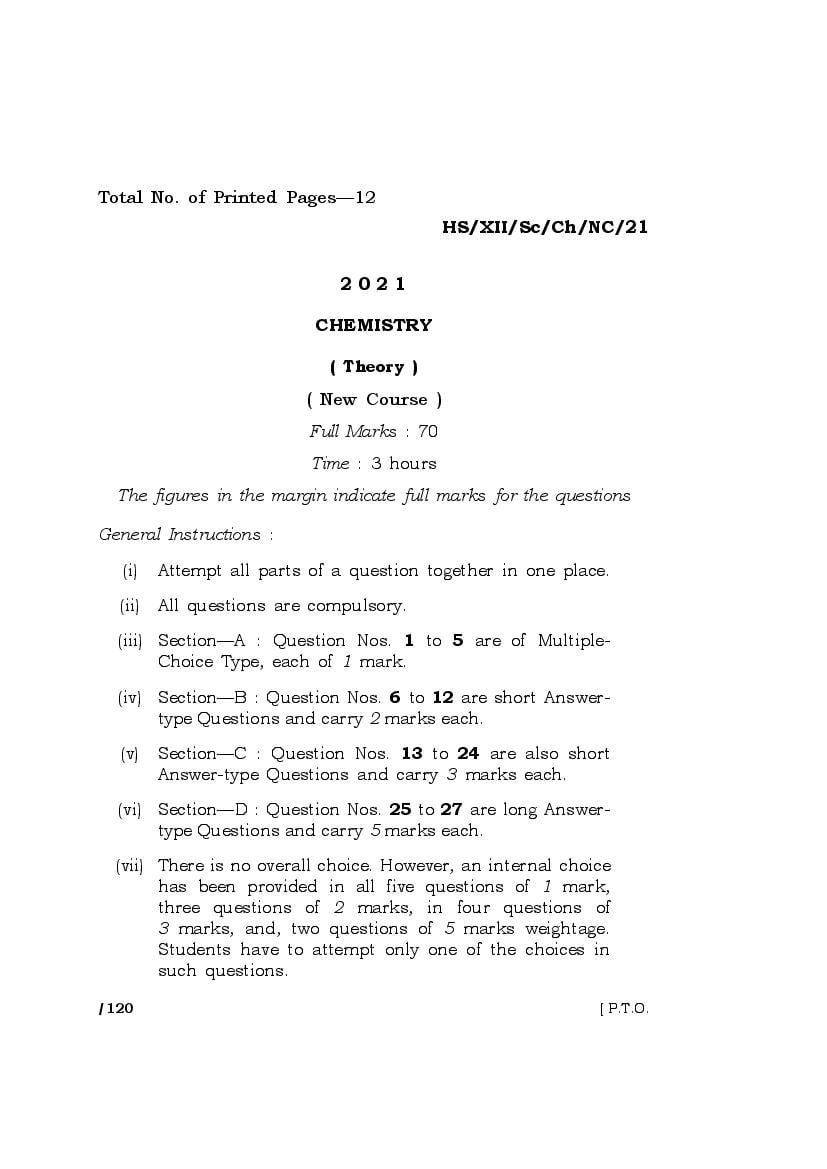
Page 1
HS/XII/Sc/Ch/NC/21
2021
CHEMISTRY
( Theory )
( New Course )
Full Marks : 70
Time : 3 hours
The figures in the margin indicate full marks for the questions
General Instructions :
(i) Attempt all parts of a question together in one place.
(ii) All questions are compulsory.
(iii) Section—A : Question Nos. 1 to 5 are of Multiple-
Choice Type, each of 1 mark.
(iv) Section—B : Question Nos. 6 to 12 are short Answer-
type Questions and carry 2 marks each.
(v) Section—C : Question Nos. 13 to 24 are also short
Answer-type Questions and carry 3 marks each.
(vi) Section—D : Question Nos. 25 to 27 are long Answer-
type Questions and carry 5 marks each.
(vii) There is no overall choice. However, an internal choice
has been provided in all five questions of 1 mark,
three questions of 2 marks, in four questions of
3 marks, and, two questions of 5 marks weightage.
Students have to attempt only one of the choices in
such questions.
/120 [ P.T.O.
Page 2
(viii) Use of non-programmable ordinary scientific
calculators and log tables are allowed.
(ix) Mobile phones and Pagers are not allowed inside the
Examination Hall.
SECTION—A
Choose and write the correct answers for the following in the
Answer Script :
1. The appearance of colour in solid alkali metal halides is
generally due to
(a) Schottky defect
(b) Frenkel defect
(c) interstitial defect
(d) F-centres 1
2. In the colloidal system, if the dispersion medium is
water, the sol is called
(a) aerosol
(b) alcosol
(c) aquasol
(d) foam 1
HS/XII/Sc/Ch/NC/21/120 [ Contd.
Page 3
3. Trimethylamine, (CH3)3N is a
(a) 1° amine
(b) 2° amine
(c) 3° amine
(d) 4° amine 1
4. The correct IUPAC name of [Ni(CO)4] is
(a) tetracarbonyl nickel (0)
(b) tetracarbonyl nickel (I)
(c) tetracarbonyl nickel (II)
(d) tetracarbonyl nickel (III) 1
5. In the reaction
X is
(a) propionaldehyde
(b) benzaldehyde
(c) acetone
(d) acetophenone 1
HS/XII/Sc/Ch/NC/21/120 [ P.T.O.
Page 4
SECTION—B
6. The boiling point of benzene is 353·23 K. When 1·80 g
of a non-volatile solute was dissolved in 90 g of
benzene, the boiling point is raised to 354·11 K.
Calculate the molar mass of the solute, Kb for benzene
is 2·53 K kg mol–1. 2
7. The inversion of cane sugar is represented by the
reaction
(a) What is the order of this reaction? 1
(b) Give one condition that determines the order of this
reaction. 1
8. Either
(a) Why nitrogen exists as a diatomic molecule, N2
whereas phosphorus exists as P4? 2
Or
(b) Why dry chlorine does not act as a bleaching
agent? 2
9. Calculate the spin only magnetic moment of
Mn2 (aq) (Z 25). 2
HS/XII/Sc/Ch/NC/21/120 [ Contd.
Page 5
10. Either
(a) Write the IUPAC name of
1
(b) Write one condition for an organic compound to be
called a chiral compound. 1
Or
(c) Explain Wurtz reaction with a suitable example. 2
11. Identify the compounds A and B in the following
sequence of reactions : 2
12. Either
(a) Write the structures of the products of the following
reactions : 1+1
(i)
(ii)
Or
(b) Carboxylic acids are higher boiling liquids than
aldehydes, ketones and even alcohols of comparable
molecular masses. Why? 1
(c) Which acid in the following pair is stronger and
why? 1
CH3CO2H or CH2FCO2H
HS/XII/Sc/Ch/NC/21/120 [ P.T.O.
Page 6
SECTION—C
13. Silver forms c.c.p. lattice and X-ray studies of its crystals
show that the edge length of its unit cell is 408·6 pm.
Calculate the density of silver. (Atomic mass = 107·9 u) 3
14. (a) What are colligative properties? 1
(b) Define osmosis and osmotic pressure. 2
15. For a zero-order reaction, R P , derive the integrated
rate equation and find its half-life (t½) time period. 3
16. (a) What is an adsorption isotherm? 1
(b) Give the equation for Freundlich adsorption
isotherm for a gas adsorbed by a solid. 1
(c) Why are powdered substances more effective
adsorbents than their crystalline forms? 1
17. Either
(a) Why does NH 3 act as a Lewis base? 1
(b) How does ammonia react with an aqueous solution
of Cu2+? 1
(c) Mention any two conditions required to maximise
the yield of ammonia by Haber’s process. 1
Or
(d) Why does O3 act as a powerful oxidising agent? 1
(e) Complete the following reactions :
(i) CH4 O2 1
(ii) Al O2 1
HS/XII/Sc/Ch/NC/21/120 [ Contd.
Page 7
18. What happens when—
(a) chlorine reacts with cold and dilute NaOH;
(b) SO2 is passed through an aqueous solution of
Fe(III) salt;
(c) sodium azide (NaN3) is decomposed thermally? 1+1+1
19. (a) Name the only metal of the d-block elements which
is a liquid at room temperature. 1
(b) Write the exceptional electronic configurations of the
elements Cr (Z = 24) and Cu (Z = 29). 1
(c) Why scandium, Sc (Z = 21) is a transition element
but zinc, Zn (Z = 30) is not? 1
20. Either
(a) Write the structures of the major products of the
following reactions :
(i) CH3 —CH2 —CH=CH2 HCl 1
(ii) CH3CH2Br NaI 1
(iii) 1
Or
(b) What happens when reacts with the following
(Give equations only) : 1+1+1
(i) CH3Cl in presence of anhydrous AlCl3;
(ii) conc. HNO3 and conc. H2SO4;
(iii) Na and RX in the presence of dry ether?
HS/XII/Sc/Ch/NC/21/120 [ P.T.O.
Page 8
21. Either
(a) Identify the compounds A, B and C in the following
reaction : 3
Or
(b) Complete the following reactions : 1+1+1
(i)
(ii)
(iii)
22. Either
(a) Account for the following : 1+1+1
(i) Ethylamine is soluble in water whereas aniline
is not;
(ii) pKb of aniline is more than that of methylamine;
(iii) Aniline does not undergo Friedel-Crafts reaction.
HS/XII/Sc/Ch/NC/21/120 [ Contd.
Page 9
Or
(b) Arrange the following in decreasing order of their
basic strength : 1
C6H5NH2, C2H5NH2, (C2H5)2NH, NH3
(c) Give equation only for the preparation of primary
amines by Hofmann bromamide degradation
reaction. 1
(d) What happens on reduction of nitriles (R—C>N)
with LiAlH4? (Give equation only) 1
23. (a) What are essential and non-essential amino acids? 1
(b) Glycylalanine (Gly-Ala) forms by the following
reaction :
Name the type of linkage connecting the two
different types of amino acids (Gly and Ala). 1
(c) Name the type of proteins present in hair and
muscles. 1
24. (a) Mention two important biological functions of
nucleic acids. 2
(b) What happens when D-glucose is heated with HI?
(Give equation only) 1
HS/XII/Sc/Ch/NC/21/120 [ P.T.O.
Page 10
SECTION—D
25. Either
(a) Represent the cell in which the following reaction
takes place :
Mg(s) 2 Ag (0·0001M ) Mg 2 (0·130M ) 2Ag(s)
Calculate its Ecell if
E 2·37 V and E 0·80 V 5
Mg/Mg 2 Ag /Ag
Or
(b) The standard electrode potential, E cell for Daniel cell
is 1·1 V. Calculate G for the reaction
Zn(s) Cu2 (aq) Zn2 (aq) Cu(s) 2
(c) m for NaCl, HCl and CH3COONa are 126·4, 425·9
and 91·0 S cm2 mol–1 respectively. Calculate the
m for CH3COOH. 2
(d) Write the Nernst equation for the reaction
Cu2 (aq) 2e Cu(s) 1
26. Either
(a) Classify the following as primary/secondary/tertiary
alcohols :
1
HS/XII/Sc/Ch/NC/21/120 [ Contd.
Page 11
(b) Predict the products of the following reactions : 1+1
(i)
(ii)
(c) Give the structure of the products you would expect
when Butan-1-ol reacts with the following : 2
(i) SOCl2
(ii) HCl—ZnCl2
Or
(d) Identify the products A, B, C and D from the following
reactions : ½×4=2
(i)
(ii)
(e) Convert cumene to phenol. 1
(f) Give the structures and IUPAC names of the products
expected from the following reactions : 1×2=2
(i) Catalytic reduction of butanal
(ii) Hydration of propene in the presence of dilute
sulphuric acid.
HS/XII/Sc/Ch/NC/21/120 [ P.T.O.
Page 12
27. (a) What is a ligand? Give one example each of a
bidentate and an ambidentate ligand. 1+½+½=2
(b) Explain on the basis of VBT, why tetrahedral Ni(II)
complexes are paramagnetic but square planar Ni(II)
complexes are diamagnetic. 2
(c) According to CFT, what happens to the degeneracy
of the d-orbitals in the presence of asymmetrically
negative field due to the ligands? 1
HS/XII/Sc/Ch/NC/21/120 11-21—5360
Page 13
HS/XII/Sc/Ch/OC/21
2021
CHEMISTRY
( Theory )
( Old Course )
Full Marks : 70
Time : 3 hours
The figures in the margin indicate full marks for the questions
General Instructions :
(i) Write all answers in the Answer Script.
(ii) Attempt all parts of a question together in one place.
(iii) All questions are compulsory.
(iv) Marks for each question are indicated against it.
(v) Question No. 1 of Part—I is of Multiple-choice Type,
containing eight part questions, each of ½ mark.
Choose and write the correct answer in the Answer
Script from the four options given.
(vi) Question Nos. 2 to 9 of Part—II are Very Short-answer
Type Questions of 1 mark each. Answer these either
in one sentence or in one word each, wherever
applicable.
(vii) Question Nos. 10 to 17 of Part—III are Short-answer
Type–I Questions of 2 marks each. Answer these in
about 20–30 words each, wherever applicable.
/121 [ P.T.O.
Page 14
(viii) Question Nos. 18 to 26 of Part—IV are Short-answer
Type–II Questions of 3 marks each. Answer these in
about 40–50 words each, wherever applicable.
(ix) Question Nos. 27 to 29 of Part—V are Long-answer
Type Questions of 5 marks each. Answer these in
about 70–80 words each, wherever applicable.
(x) There is no overall choice. However, an internal choice
has been provided in two questions of 2 marks, three
questions of 3 marks and two questions of 5 marks
weightage. Students have to attend only one of the
choices in such questions.
(xi) Use of non-programmable ordinary Scientific
Calculators and Log Tables is allowed.
(xii) Mobile Phones and Pagers are not allowed inside the
Examination Hall.
PART—I
1. Choose and write the correct answer for the following
in the Answer Script : ½×8=4
(a) The number of atoms in b.c.c. arrangement is
(i) 1
(ii) 2
(iii) 3
(iv) 4
(b) To get n-type semiconductor, impurity to be added
to silicon should have which of the following
numbers of valence electrons?
(i) 2
(ii) 3
(iii) 1
(iv) 5
HS/XII/Sc/Ch/OC/21/121 [ Contd.
Page 15
(c) The colloidal system in which the dispersed phase
and the dispersion medium are both liquids is
known as
(i) a gel
(ii) an aerosol
(iii) an emulsion
(iv) a foam
(d) The process of separation of dissolved impurities
from colloids by passing through a suitable
membrane is called
(i) filtration
(ii) electrophoresis
(iii) dialysis
(iv) ultrafiltration
(e) Which of the following is an example of unidentate
and monodentate ligand?
(i) H2N—CH2—CH2—NH2
2
(ii) C2O4
(iii) Cl
(iv) H2NCH2COO
HS/XII/Sc/Ch/OC/21/121 [ P.T.O.
Page 16
(f) The coordination number of Pt in [PtCl6]2– is
(i) 2
(ii) 6
(iii) 4
(iv) 8
(g) The deficiency of which of the following vitamins in
our body causes night-blindness?
(i) Vitamin C
(ii) Vitamin D
(iii) Vitamin K
(iv) Vitamin A
(h) The coagulation of egg-white on boiling is a common
example of
(i) denaturation of proteins
(ii) hydrolysis of proteins
(iii) solubility of proteins
(iv) formation of proteins
HS/XII/Sc/Ch/OC/21/121 [ Contd.
Page 17
PART—II
2. What are ‘point defects’ in crystalline substances? 1
3. In crystalline solids, what is a space lattice? 1
4. Write the IUPAC name of
1
5. Arrange the following compounds in increasing order of
their boiling points : 1
Bromomethane, Bromoform, Chloromethane,
Dibromomethane
6. Write the structure of the major product of
1
7. Write the structures of the functional groups in
aldehydes and ketones. 1
8. Classify the following amines as primary or secondary :
CH3NH2 and (CH3)2NH 1
9. Give one reaction to show the basic character of
primary amines. 1
HS/XII/Sc/Ch/OC/21/121 [ P.T.O.
Page 18
PART—III
10. Silver crystallises in f.c.c. lattice. If edge length of the cell
is 4·07 108 cm and density is 10·5 gcm–3, calculate
the atomic mass of silver. (Given NA = 6·022 × 1023 mol–1). 2
11. Define the term ‘solution’. Give one example of liquid
solution. 2
12. Either
(a) Calculate the molarity of a solution containing
5 g of NaOH in 450 ml solution. (Mol. wt.
of NaOH=40 g mol–1) 2
Or
(b) Calculate the molality of 2·5 g of ethanoic acid
(C2H4O2) in 75 g of benzene (molar mass of
C2H4O2 = 60 g mol–1). 2
13. Define speed/rate of a reaction. Give any one specific
way of expressing the rate of a reaction. 2
14. (a) Name an element in the 3d-series of transition
metals which is usually not regarded as a transition
metal and write its electronic configuration. 1
(b) Which transition metal of the 3d-series exhibits the
largest number of oxidation states and why? 1
15. What are homoleptic and heteroleptic complexes?
Give one example of each. 2
HS/XII/Sc/Ch/OC/21/121 [ Contd.
Page 19
16. Either
(a) Why is chloroform (CHCl3) stored in dark coloured
bottles? 2
Or
(b) In the following pairs of halogen compounds, which
would undergo SN2 reaction faster and why?
(i) 1
(ii) 1
17. Why have primary amines (RNH2) higher boiling point
than tertiary amines (R3N) of comparable molecular
mass? 2
PART—IV
18. (a) Calculate the overall order of a reaction, which has
the rate expression :
(i) Rate = k [ A ]3/2 [B ]1/2 1
(ii) Rate = k [ A ]3/2 [B ]1 1
(b) The reaction R P has zero order. Write the rate
equation for this reaction. 1
19. (a) What are lyophilic and lyophobic sols? Write one
example of each type. 2
(b) Write one difference between Homogeneous
catalysis and heterogeneous catalysis. 1
HS/XII/Sc/Ch/OC/21/121 [ P.T.O.
Page 20
20. Either
(a) What types of ores are roasted? 1
(b) Name the method used for refining of nickel. 1
(c) Why is pine-oil used in froth-floatation method? 1
Or
(d) Write the chemical reaction involved in the
extraction of zinc from zinc oxide. How is it
collected? 2
(e) Write one difference between ‘pig iron’ and ‘cast iron’. 1
21. Either
(a) In the manufacture of H2SO4 by contact process,
giving step-wise reactions, write the principle and
conditions involved. 3
Or
(b) Why is dinitrogen less reactive at room
temperature? 1
(c) In the manufacture of ammonia by Haber’s
process, give the equation involved and mention the
optimum conditions required to maximise the yield
of ammonia. 2
22. The magnetic moments of Sc3+ and Fe2+ are 0·00 BM
and 4·90 BM. Which of these ions—
(a) has the maximum number of unpaired electrons
and why;
(b) forms colourless aqueous solutions and why? 3
HS/XII/Sc/Ch/OC/21/121 [ Contd.
Page 21
23. Write the structures of the products in the following
reactions : 1+1+1=3
(a) ?
(b) ?
(c) ?
24. How are vitamins classified? Name the vitamin
responsible for the coagulation of blood. 3
25. Either
(a) Explain the terms ‘polymer’ and ‘monomer’ with an
example of each. 3
Or
(b) Write the names and structures of the monomers
used for synthesizing the following polymers : 1+1+1
(i) Polythene
(ii) Teflon
(iii) Polyacrylonitrile
26. (a) What are soaps? 1
(b) Why do soaps not work in hard water? 2
HS/XII/Sc/Ch/OC/21/121 [ P.T.O.
Page 22
PART—V
27. In the Daniel cell, the following redox reaction occurs :
Zn(s) Cu2 (aq) Zn2 (aq) Cu(s)
Answer the following : 1×5=5
(a) Write the reduction half-cell reaction.
(b) Write the oxidation half-cell reaction.
(c) Write the half-cell reaction which acts as the anode.
(d) Write the half-cell reaction which acts as the
cathode.
(e) Define galvanic cell.
28. Either
(a) Account for the following : 2+1+2=5
(i) Moist chlorine is a powerful bleaching agent for
vegetable or organic matter
(ii) Formation of a black residue occurs when
concentrated H2SO4 is added to a test tube
containing cane sugar (a carbohydrate)
(iii) Anomalous behaviour of fluorine
Or
(b) (i) Which substances deplete the ozone layer in
the upper atmosphere? 1
HS/XII/Sc/Ch/OC/21/121 [ Contd.
Page 23
(ii) How is SO2 responsible in producing acid
rain? 1
(iii) Which gas is used in oxyacetylene welding? 1
(iv) Write the name and ratios of the two acids used
for dissolving noble metals like Au, Pt, etc. 1
(v) Name the Gr 17 element used in sterilising
drinking water. 1
29. Either
(a) Arrange the following compounds in the increasing
order of their boiling points : 1
CH3CHO, CH3CH2OH, CH3OCH3, CH3CH2CH3
(b) What happens when (give equations only)— 1×4=4
(i) acetaldehyde (CH3CHO) reacts with HCN;
(ii) propanone reacts with CH3MgI in the presence
of H2O/H+;
(iii) acetic acid (CH3COOH) is heated in the
presence of strong dehydrating agent such
as P2O5;
(iv) two moles of acetaldehyde (CH3CHO) condense
in the presence of NaOH.
HS/XII/Sc/Ch/OC/21/121 [ P.T.O.
Page 24
Or
(c) Write the products of the following reactions : 1×5=5
(i) ?
(ii) ?
(iii) ?
(iv) ?
(v) ?
HS/XII/Sc/Ch/OC/21/121 11-21—1010
Document Details
| Board / Org | Meghalaya Board |
| Exam | Class 12 |
| Type | Question Paper |
| Pages | 24 |
| Updated | 01 May 2026 |