JEE NEET Chemistry Question Bank - Chemistry in Everyday Life
Finished viewing? Save it for later —
Download JEE NEET Chemistry Question Bank - Chemistry in Everyday Life (PDF · 28 pages)About JEE NEET Chemistry Question Bank - Chemistry in Everyday Life
JEE NEET Chemistry Question Bank - Chemistry in Everyday Life is available here for free download. Published by NTA for National Eligibility cum Entrance Test (Undergraduate), this question bank can be viewed online or downloaded as a PDF (28 pages). Candidates preparing for National Eligibility cum Entrance Test (Undergraduate) can use JEE NEET Chemistry Question Bank - Chemistry in Everyday Life to understand the exam pattern, the type of questions asked, and the overall difficulty level.
Frequently Asked Questions
How can I download JEE NEET Chemistry Question Bank - Chemistry in Everyday Life?
Open this page and click the Download button to save JEE NEET Chemistry Question Bank - Chemistry in Everyday Life as a PDF. It is completely free on AglaSem Docs.
Is JEE NEET Chemistry Question Bank - Chemistry in Everyday Life free to download?
Yes. JEE NEET Chemistry Question Bank - Chemistry in Everyday Life can be viewed online and downloaded as a PDF free of cost on AglaSem Docs.
How many pages does JEE NEET Chemistry Question Bank - Chemistry in Everyday Life have?
JEE NEET Chemistry Question Bank - Chemistry in Everyday Life contains 28 pages, which you can read online or download together as a single PDF.
Where can I find more National Eligibility cum Entrance Test (Undergraduate) study material?
You can find more National Eligibility cum Entrance Test (Undergraduate) question papers, sample papers, syllabus, and answer keys on AglaSem Docs.
JEE NEET Chemistry Question Bank - Chemistry in Everyday Life – Text
Read the full text of this question bank below — useful to quickly search, copy and reference the content online without downloading the PDF.
📄 View text version (28 pages)
Page 1
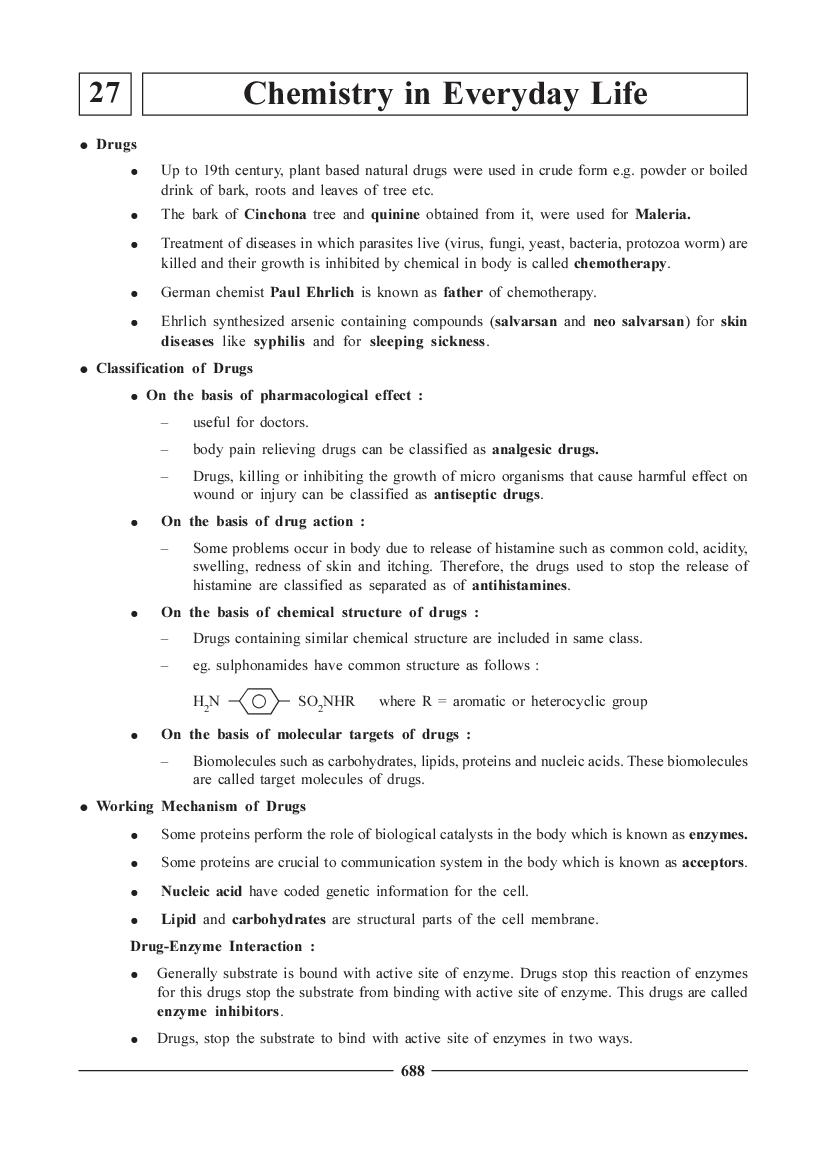
Drugs
Up to 19th century, plant based natural drugs were used in crude form e.g. powder or boiled
drink of bark, roots and leaves of tree etc.
The bark of Cinchona tree and quinine obtained from it, were used for Maleria.
Treatment of diseases in which parasites live (virus, fungi, yeast, bacteria, protozoa worm) are
killed and their growth is inhibited by chemical in body is called chemotherapy.
German chemist Paul Ehrlich is known as father of chemotherapy.
Ehrlich synthesized arsenic containing compounds (salvarsan and neo salvarsan) for skin
diseases like syphilis and for sleeping sickness.
Classification of Drugs
On the basis of pharmacological effect :
useful for doctors.
body pain relieving drugs can be classified as analgesic drugs.
Drugs, killing or inhibiting the growth of micro organisms that cause harmful effect on
wound or injury can be classified as antiseptic drugs.
On the basis of drug action :
Some problems occur in body due to release of histamine such as common cold, acidity,
swelling, redness of skin and itching. Therefore, the drugs used to stop the release of
histamine are classified as separated as of antihistamines.
On the basis of chemical structure of drugs :
Drugs containing similar chemical structure are included in same class.
eg. sulphonamides have common structure as follows :
H2N SO2NHR where R = aromatic or heterocyclic group
On the basis of molecular targets of drugs :
Biomolecules such as carbohydrates, lipids, proteins and nucleic acids. These biomolecules
are called target molecules of drugs.
Working Mechanism of Drugs
Some proteins perform the role of biological catalysts in the body which is known as enzymes.
Some proteins are crucial to communication system in the body which is known as acceptors.
Nucleic acid have coded genetic information for the cell.
Lipid and carbohydrates are structural parts of the cell membrane.
Drug-Enzyme Interaction :
Generally substrate is bound with active site of enzyme. Drugs stop this reaction of enzymes
for this drugs stop the substrate from binding with active site of enzyme. This drugs are called
enzyme inhibitors.
Drugs, stop the substrate to bind with active site of enzymes in two ways.
688
Page 2
Drugs compete with natural substrate for their attachment on the active site of enzymes.
Such durgs are called competitive inhibitors.
Drug Drug
Active size
Enzyme
Substrate Enzyme Substrate
Allosteric site :
Some drugs do not bind to the active site of enzyme but bind to a different site. This site
is called allosteric site.
This type of binding of drug with enzyme results in the change in shape of active site
therefore substrate cannot bind with it.
Active site with changed
Active site place
Allosteric site
Enzyme Inhibiror
(Inhibitor occupying)
allisteric site
Drug-Receptor Interaction
In the body, message between two neurons to muscles is communicated through certain chemicals.
These chemicals are called chemical messengers.
Drugs bind to receptor site and stop communication process of cell. These drugs are called
antagonists.
If the messenger shaped drug is used, then receptor accept it and under the impression of
natural messenger the communication process occurs. These drugs are called agonists.
Antagonists is competitor and Agonists is contender.
689
Page 3
(1) Adrenaline (2) Nora adrenaline (3) acetylcholine (4) Dopamine (5) serotonin
Binding cell Chemical messenger
Binding site
site
Outer surface
of cell
membrane
Cell membrance
Interior of cell Message
(a) (b) (c)
(a) Receptor receiving chemical messenger.
(b) Shape of the receptor changed for attachment of messenger.
(b) Receptor regains structure after removal of chemical messenger.
1. Who is the father of chemotherapy ?
(A) Alexander fleming (B) Haward flour
(C) Paul Ehrlich (D) Ernest Borisch chain
2. Which of the following act us hormon and nerve transmitted both ?
(A) Nora adrenaline (B) Dopamine (C) Acetyl choline (D) Serotonin
3. For which treatment of disease drugs containing arsenic is more used ?
(A) Jaundice (B) Typhoid (C) Syphilis (D) TB
4. Which facts for following statements accroding to drugs receptor interaction ?
(1) Drugs bind to acceptor site and stop communication process of cell, known as antagonists.
(2) Some drugs bind to a different site instead of its active site known as allosteric site.
(3) Drugs bind the substrate from binding with active site of enzyme known as enzyme inhibitors.
(A) T T F (B) T T T (C) F T T (D) F T F
5. Which of the following release to create diease like common cold, acidity, swelling, redness of skin
and itching ?
(A) Virus (B) Bacteria (C) Histamine (D) Worm
6. Due to which bond between catalyst and drugs that it cannot be easily broken ?
(A) Ionic bond (B) Van-dar waals bond (C) Hydrogen bond (D) co-valent bond
7. Which of the following is the structure of sulphonamide drugs ?
O
||
(A) H2N S NHR2 (B) H2N S NH R
|| ||
O O
O
||
(C) H2N C NH R (D) All above
||
O
690
Page 4
(A) Aspirin (B) Peniciline
(C) Chloroquine (D) Paracetamol
9. For which two diseases Ehrlich synthesised arsenic containing compounds in chemotherapy ?
(A) Sleeping sickness, Syphilis (B) Acidity, Apathy
(C) Fever, Convulsion (D) Paralysis, Bleeding
10. Which of the following drugs is not a target molecule ?
(A) Nucleic acid (B) Protein (C) Catalyst (D) Lipid
11. What is indicated by this figure ?
Binding site
Message
(A) Receptor receiving chemical messenger.
(B) shape of the receptor changed for attachment of messenger.
(C) Receptor regains structure after removal of chemical messenger.
(D) Receptor attached to cell element.
12. What are M, N, O, P in given figure ?
M
N
P
O
(A) Minhibitor, Ncatalyst, Oactive site, Pallosteric site
(B) Mallosteric site, Ncatalyst, Oinhibitor, Pactive site
(C) Mcatalyst, Nactive site, Oinhibitor, Pallosteric site
(D) Mactive site, Nallosteric site, Ocatalyst, Pinhibitors
691
Page 5
reason (R). Select correct option to study carefully :
(A) Statement (A) is correct. Reason (R) is correct and Reason (R) is not correct explanation of
reason (R).
(B) Statement (A) is correct. Reason (R) is correct and Reason (R) is correct explanation of reason
(R).
(C) Statement (A) is wrong and Reason (R) is wrong.
(D) Statement (A) is true but reason (R) is wrong.
13. Statement (A) : Sulpha drugs contain sulphonamide group.
Reason (R) : Salvarsan is sulpha drug.
14. Statement (A) : Chemical messanger communicate message between two neutrons or between
neuron to musctes.
Reason (R) : Chemical messanger enter into cell through receptors.
15. Statement (A) : Chemical messenger gives message to the cell without entering into the cell.
Reason (R) : Chemical messenger is obtained at binding site of receptor like protein.
16. Statement (A) : Nucleic acids have coded genetic information for the cell.
Reason (R) : Nucleic acid is target molecules of drugs.
Answers : 1. (C), 2. (A), 3. (C), 4. (A), 5. (C), 6. (D), 7. (B), 8. (C), 9. (A), 10. (C),
11. (B), 12. (D), 13. (D), 14. (D), 15. (B), 16. (A)
Therapeutic Action of Different classes of Drugs.
(1) Antacids :
Due to overeating or indigestion
↓
Much acid is released in stomach
↓
Effects
Acidity
↓ ↓
Substance use for - Acidity causes
the removal - Irritation and
↓ pain in stomach
- Severe cases of
Antacids ulcers are developed
e.g. in stomach
Sodium bicarbonate (NaHCO3)
Magnesium hydroxide (Mg(OH)2)
Magnesium carbonate (MgCO3)
Magnesium trisilicate (Mg Si O8)
2 3
Aluminium hydroxide (Al(OH)3)
692
Page 6
(2) Antihistamines :
}}}}}m
structure
HN
Produced in the body Histamine
N
↓ ↓
Stimulates the secretion of Pepsin Common cold, redness of skin
and hydrocholoric acid in stomach. allergy like itching
↓ ↓
Antacids Antiallergenic Drugs
e.g. (1) Cimetidine (Tegamet) e.g. (1) Terfenadine (seldane)
(2) Ranitidine (zantac) (2) Brompheniramine (Dimetapp)
(3) Diphenylhydramine (benadryl)
(4) Cetirizine
(5) Chlorphenaramine zite
(6) Promethazine
Structur :
Antihistamines drugs :
(1) Cimetidine (Tegamet)
HN
N
(2) Ranitidine (Zantac)
O
Antiallergenic drugs :
(1) Brompheniramine (Dimetapp) :
N
693
Page 7
N
OH
Ph
HO
Ph
17. Which of the following is not an antacid ?
(A) NaHCO3 (B) Mg(OH)2 (C) AlPO4 (D) Al2O3
HN
18. is the structure of
N
(A) Histamine (B) Promathazine (C) Seldan (D) Cimetidine
19. Which of the following substance is not used as an antacid ?
(A) NaHCO3 (B) Al(OH)3 (C) Mg(OH)2 (D) NaOH
20. Which catalyst stimulates in stomach when release of histamine in our body ?
(A) Urase (B) Zymase (C) Pepsin (D) Pitesin
21. Which drug prevents the interaction of histamine with the receptors present in stomach wall ?
(A) Tegamet (B) brompheniramine (C) Iproniazid (D) Meprobamate
22. Which drug is not antiallergenic ?
(A) terfenadine (B) cetryzine (C) promatniue (D) ranitidine
23. In which of the following drugs structure furan ring is present ?
(A) Seldan (B) Ranitidine (C) Dimetapp (D) Cimetidine
Answers : 17. (D), 18. (A), 19. (D), 20. (C), 21. (A), 22. (D), 23. (B)
Neurologically active drugs
Tranquilizers and analgesics are neurologically active drugs.
These drugs affect mainly the message transfer mechanism between nerve and receptor.
Tranquilizers
Relives anxiety, stress, irritability or excitement.
Noradrenaline is one of the neurotransmitter that means neuro messenger.
If the level of noradrenaline is low, due to this person feels depressed.
694
Page 8
↓ ↓
(1) Iproniazid (2) phenelzine
mild tranquilizers
↓ ↓
(3) Chlordiazepoxide (4) Meprobamate
→ (5) Equanil drugs relieves from depression and hypertension.
(6) Barbiturates (Derivatives of barbituric acid) (sedative durgs)
→ barbituric acid, veronal, seconal, amytal, nembutal
(7) Valium
(8) Serotonin
Structure :
H
NHNHCH(CH3)2 N CH
O 3
C NHNH2 N=C
CH2
+
Cl C=N
N –
C6H5 O
Iproniazid Phenelzine Chlordiazepoxide
(1) (2) (3)
O CH 3 O O CH 3 O
|| | || || | ||
H 2 N – C – O – CH 2 – C – CH 2 – O – C – NH 2 H 2 N – C – O – CH 2 – C – CH 2 – O – C – NH 2
| |
(CH 2 ) 2CH 3 CH 3
Meprobamate Equanil
(4) (5)
H H
O N O O N O
C2H5
HN H–
N
O O C2H5
(6) Barbituric acid Veronal
695
Page 9
Physical pain reducing drugs can be classified into two classes.
Narcotic analgesic drugs :
Relieve pain, produce sleep and excitement occurs before sleep. It is called euphoria then
person has to take it regularly and becomes an addict.
Alkaloids like Morphine, Codeine, Heroine (Morphine diacetate) obtained from opeum
popy known as opeats.
eg. (1) morphine
NCH3
HO O
OH
Morphine
Non-narcotic analgesic drugs :
Due to these drugs, a person does not suffer from sleepiness or excitement.
Aspirin : (2acetyloxy benzoic acid)
These drugs relieve from skeletal pain such as that caused by arthritis.
Aspirin prevents coagulation of blood, due to this it is more useful to patient of heart
diseases.
In body released prostaglandis chemical causes inflammation and pain in the tissue. Aspirin
inhibits synthesis of prostaglandis.
Structure : OCOCH3
COOH
Aspirin (Acetylsalicylic acid)
Paracetamol :
These drugs reduce body temperature which means they are fever relievers.
696
Page 10
O
NH – C – CH3
IUPAC name : 4-acetamidophenol
Naproxen :
CH3
CH – COOH
H 3CO
Naproxen
Ibuprofen :
H 3C – CH – CH 2 CH – COOH
CH3 CH3
Diclofena sodium/potassium :
Cl CH2COONa/K
NH
Cl
24. Barbiturates are used as which of the following ?
(A) Analgesic (B) Antipyretics (C) preservatives (D) Tranquilizes
25. Which of the following level if low, then the person feels depression ?
(A) Noradrenaline (B) cerotinine (C) Nembutal (D) seconal
26. Which drug is used as antidepressent ?
(A) Noradrenaline (B) Iproniazide (C) phenelzine (D) All above
27. Rameshbhai is very sad and worried due to excessive loss in sharemarket. Which drug is adviced
by doctor at that time ?
(A) Chlordiazepoxide (B) Meprobamate (C) Equanil (D) Phenelzine
28. Which of the following is not barbiturates ?
(A) veronal (B) seconal (C) amytal (D) equanil
697
Page 11
H HO H
N N NHNH2
(A) O O (B) (C) O O (D)
HO OH
N N –H
N
N–
H– H–
H
O O
30. Which of the following chemical release in body causes inflammation and pain in tissue ?
(A) Norandrenaline (B) Prostaglandis (C) Veronal (D) Gerotinine
31. Which of the following drugs do not produce excitement and sleep in person ?
(A) Paracetamol (B) Morphine (C) Cocaine (D) Heroin
32. Select correct option for the facts of aspirin ?
(i) Prevents coagulation of blood, it is more useful to patient of heart diseases.
(ii) Inhibits synthesis of prostaglandis in body.
(iii) It is made from acetylation reaction of m-hydroxy benzoic acid.
(iv) Its other name is acetyl salicylic acid.
(A) T T F F (B) T T T T (C) T T F T (D) F T T T
33. Which antipyretic drug is more used ?
(A) Neproxin (B) Paracetamol (C) Phenosetine (D) Salicylic acid
34. OCOCH3 Which of the following uses this compound ?
COOH
(A) antibiotics (B) antiseptics (C) analgesic (D) digiufectants
35. Which of the following is the structure of aspirin ?
(A) OCOCH3 (B) OH (C) OCOCH3 (D) OH
COOH CO OCH3 OH
C OOCH3
36. What is neproxin ?
(A) Non-narcotic analgesic drugs (B) Narcotic analgesic drugs
(C) Antiseptics (D) Diginfectants
Cl CH2COONa
37. NH This compound is used as which of the following ?
Cl
(A) to releive pain (B) releive in itching (C) to prevent cold (D) as antipyretics
698
Page 12
Section-I Section-II
(Structure) (Name)
(P) H 3C – CH – CH 2 CH – COOH (S) Neproxin
| |
CH 3 CH3
CH3
(Q) CH – COOH (T) Ibruphopheine
H 3CO
O
(R) OH NH – C – CH3 (U) Suphanilamide
(V) Ceramycutine
(A) (P)-(U), (Q)-(S), (R)-(V) (B) (P)-(V), (Q)-(T), (R)-(U)
(C) (P)-(S), (Q)-(T), (R)-(U) (D) (P)-(T), (Q)-(S), (R)-(V)
39. According to chemically haroin is ......
(A) morphine monoacetate (B) morphine diacetate
(C) morphine dibenzoate (D) morphine mono benzoate
40. Whose derivaties are sulpha drugs ?
(A) Benzene sulphonic acid (B) Sulphanillic acid
(C) Suphanilamide (D) Pamino benzoic acid
41. Which drugs are used as analgesic and antipyretics ?
(A) Quinin (B) Penicilin (C) Insulin (D) Aspirin
42. Which sulpha drugs used in treatment in neumonia ?
(A) Sulphadiazine (B) Sulphapyridine (C) Sulphagwanidine (D) Suphanilamide
43. Correct structure of paracetamol drug ?
(A) HO CONH2 (B) HO NHCOCH3
(C) Cl CONH2 (D) Cl NHCOCH3
44. What is the name of situation when excitement occurs before sleep due to morphine ?
(A) Phobia (B) Euphoria
(C) Stupor (D) Pathoqentic situation
45. Which of the following is not alkaloid ?
(A) Reserpine (B) Morphine (C) Quinine (D) Phenyl butazone
46. Haroin is a derivative of which of the following ?
(A) Caffeine (B) Nicotine (C) Cocaine (D) Morphine
47. Which of the following is not analgesic drug ?
(A) Ibruphophane (B) Dichlofenac sodium (C) Neproxane (D) Ofloxacine
699
Page 13
(A) tranquilizers (B) antiseptics (C) analgesic (D) insecticide
H
O N O
49. is the structure of
C2H5
N
H– C2H5
O
(A) Amytal (B) Luminal (C) Veronal (D) Seconal
50. Whose acetylation process synthesizes Paracetamol drug ?
(A) 2amino hydroxy benzene (B) 3amino hydroxy benzene
(C) 4amino hydroxy benzene (D) hydroxy benzene
51. Wintergreen oil and salol are ester of which of the following ?
(A) salicylic acid (B) lactic acid (C) acetic acid (D) sulphanilic acid
52. Which drug among the structure of drugs is different on the basis of the cure ?
C 2H 5 O C 6H 5 O
H H
N– N–
(A) C2H 5 (B) C2H 5
O N O O N O
H H
O
NHNH2
(C) HO NH – C – CH3 (D)
53. Which statement is improper for Barbiturates ?
(A) They are sleep producing drugs (sedatives).
(B) They are tranquilizers.
(C) They affect nervous system to relieve tension.
(D) They are non-narcotic analgesic drugs.
54. Identify the drug different from the other drugs :
(A) Morphine (B) Heroin (C) Cocaine (D) Aspirine
55. Which of the following is nurcotic analgesic drugs ?
(A) Heroin (B) Ibruprophen (C) Nepoxane (D) Aspirine
56. Which of the following is the structure of salol ?
(A) OH (B) OH (C) COOH (D) COOH
CO OCH3 CO OC6H5 CO OC6H5 COOCH3
57. Which alkaloids obtained from named opium-poppy ?
(A) Morphin (B) Cocain (C) Heroin (D) All above.
700
Page 14
Iproniazid, phinelzin, chlordiazepoxid, aspirin, paracetamol, neproxin, ibruprofan, sodium dichilofenac,
equanil, morphine, meprobamate, veronal, seconal, valium, heroin, luminal, cerotenin.
58. How many number of tranguilizers given above drugs ?
(A) 6 (B) 8 (C) 10 (D) 9
59. How many number of non-narcotic analgesic drugs from given above drugs ?
(A) 5 (B) 7 (C) 9 (D) 8
60. How many number of narcotic analgesic drugs from given above drugs ?
(A) 5 (B) 2 (C) 3 (D) 4
Answers : 24. (D), 25. (A), 26. (D), 27. (C), 28. (D), 29. (A), 30. (B), 31. (A), 32. (C),
33. (B), 34. (C), 35. (A), 36. (A), 37. (A), 38. (D), 39. (B), 40. (C), 41. (D),
42. (B), 43. (B), 44. (B), 45. (D), 46. (D), 47. (D), 48. (A), 49. (C), 50. (C),
51. (A), 52. (C), 53. (D), 54. (D), 55. (A), 56. (B), 57. (D), 58. (C), 59. (A),
60. (B),
Antimicrobial drugs
(A) Antibiotics :
The chemical substance produced by living organism to inhibit the growth or to kill microorganism
are called antibiotics.
Penicillin produced by microorganisms is first antibiotic that acts as drug. (Alexander Fleming)
Antibiotic
↓ ↓
Microbicidal Microbiostatic
kill microorganisms inhibit the growth of
microorganisms
eg. penicillin eg. erythromycin
ofloxacin tetracycline
aminoglycosiders, (streptomycin) chloramphenicol
(Bactericidal) ↓ ↓ (Bacteriostatic)
(Tuberculosis) (Typhoid and
TB disease can be treated pneumonia can be
treated)
Common structure :
O H H S CH3
R – C – NH
CH3
N COOH
O H
Penicillin
For Penicillin G, R = CH2
For Penicillin K, R = CH3(CH2)6
For Penicillin F, R = CH3CH2CH = CHCH2
For Ampicillin, R = CHNH2
701
Page 15
↓ ↓ ↓ ↓ ↓ ↓
Based on Based on Based on Based on Based on Based on
name of Name of place name of names of name of name of
Bateria where soil relatives secretary patient factory
samples were Vernamycin Bacitracin
(1) Pencillin first collected Hemycin
from Angolamycin → Seramycetin from from a from
penicillium from Angola name of mother patient Hindustan
notatum in law named Antibiotics
(2) Streptomycin → Halinin from name of Tarcey Ltd.
from streptomy- a scientists wife
cesgriseus
Antiseptics
Antiseptic are useful in making tissues free from microorganisms.
(1) Potassium permanganate (KMnO4) → Making mouth free from microorganisms by gargling
(2) Furacin
(3) Soframycin
(4) Dettol (mixture of Chloroxylenol + aterpineol)
(5) Bithionol - added to soaps to develop the antiseptic properties.
(6) Tincture of iodine → 2-3% Iodine solution in alcohol-water mixture.
(7) Boric acid (H3BO3) → Washing solution of eyes to free them from microorganisms
(8) Hydrogen peroxide (H2O2) (perhydrol) → For washing teeth
(9) Salol (phenyl salicylate) → Treatement for throat
(10) 23 % concentration solution of mercurochrome solution is used as an antiseptic for skin
(11) 0.2 % aqueous solution of phenol for Antiseptic.
Structure :
CH3
OH Cl OH OH Cl
S
H3C CH3
Cl H 3C CH OH Cl Cl
3
Chloroxylenol α-Terpineol Bithionol
702
Page 16
Disinfectants are applied to inanimate objects for making them free from microorganisms.
Activity is experessed by phenol coefficient
Activity is checked on salmonella typhosa bacteria
(1) 1 % of phenol solution
(2) 0.2 to 0.4 ppm concentration containing aqueous solution of chlorine
(3) SO2 gas (very low concentration)
(4) Lysol-Aqueous solution of o/m/p-cresol
Antifertility drugs
Drugs used for prevention of impregnation are called Antifertility drugs.
Mixture of mestranol (estrogenic) and norenthindrone (progestorone) is used as pill.
61. Who had found penicilin ?
(A) Alexander Fleming (B) Ziggler-Natta (C) Paul-Ehlrich (D) Emil-Fischer
62. Which of the following is not included in antimicrobial drugs ?
(A) Antibiotics (B) Antacids (C) Antiseptics (D) Distufectants
63. Which of the following drug is not antibiotics ?
(A) Penicillin (B) Tetracyclin (C) mypheprestone (D) Chloramphenicol
64. Which of the following is used in treatment of typhoid not microbiocidal ?
(A) Ofloxacin (B) Streptomycin (C) Penicilline (D) Chloramphenicol
65. Which of the following is not microbiocidal ?
(A) Penicillin (B) Ofloxacin (C) Aminoglycosides (D) Erythromycin
66. Which of the following is not antimicrobial drugs ?
(A) Eryhromycin (B) Tetracyclin (C) Chloramphenicol (D) Ofloxacin
67. Which antibiotics is used in treatement of Tuberculosis (TB) ?
(A) Aminoglycosides (B) Penicilline (C) Erythromycin (D) Tetracyclin
O H H S CH3
68. Whose structure is this ? CH2 – C – NH
CH3
N COOH
O H
(A) Penicillin-G (B) Penicillin-F (C) Penicillin-K (D) Ampicillin
703
Page 17
(A) Penicillin (B) Oxytosin (C) Erythromysin (D) Tetracyclin
70. Which of the following pair is not antibacterial ?
(A) Erythromycin, tetracyclin (B) Erythromycin, chlormphenicol
(C) Ofloxacin, amino glycoside (D) Tetracyclin, chloremphenicol
71. Which of the following is antibacterial ?
(A) Tetracyclin (B) Chloramphenicol
(C) Erythromycin (D) Straptomycin
NHCOCHCl2
|
72. Whose structure is this ? O2N CH – CH – CH 2OH
|
OH
(A) Chlorozylanol (B) Chloramphenicol (C) Penicillin-F (D) Ampicillin
73. Which of the following is not an example of large spectrum antibiotic ?
(A) Penicillin (B) Tetracyclin (C) Chloremphenicol (D) Vencomycin
74. Match the correct pair according to names of antibiotics :
Section-I Section-II
Nomenclature of antibiotics
(P) Name of Mother-in-law (T) Vernamycin
(Q) Name of Bacteria (U) Hemycin
(R) Name of Secretary (V) Streptomycin
(S) Name of factory (W) Seramycetin
(A) (P)-(W), (Q)-(V), (R)-(T), (S)-(U) (B) (P)-(V), (Q)-(W), (R)-(U), (S)-(T)
(C) (P)-(T), (Q)-(U), (R)-(V), (S)-(W) (D) (P)-(U), (Q)-(T), (R)-(V), (S)-(W)
75. What is the name of antibiotics based on name of patient ?
(A) Angolamycin (B) Vernamycin (C) Hemycin (D) Bacitracin
76. Give the name of antibiotic based on name of scientists wife :
(A) Bacitracin (B) Halinin (C) Vernamycin (D) Seramycetin
77. Where is the industrial production of penicillin in India ?
(A) Vadodara (Gujarat) (B) Kalpakkam (Tamilnadu)
(C) Pimpari (Maharashtra) (D) Kota (Rajasthan)
78. Which aqueous solution of substance is used for eyes to free it from microorganisms ?
(A) I2 (B) H3BO3 (C) KMnO4 (D) SO2
79. Which substance is used to make mouth free from microorganisms by gargling ?
(A) Boric acid (B) H2O2 (C) KMnO4 (D) Soframycin
80. Which drug is not included in antiseptic class ?
(A) KMnO4 (B) Furacin (C) Soframycin (D) Vernamycin
704
Page 18
(A) 2.3% iondine of alcohol-water mixture (B) 2-3 % bromine of alcohol-water mixture
(C) 2-3% H2O2 of alcohol-water mixture (D) 2-3 % phenol of alcohol-water mixture
82. What is the mixture of Dettol ?
(A) Chloroxylenol + Terpinol (B) Terpinol + Bithionol
(C) Chloroxylenol + Bithionol (D) Chloroxylenol + Salol
83. Which antiseptic is added to soaps to develop the antiseptic property ?
(A) Terpineol (B) Phenol (C) Boric acid (D) Bithionol
84. For which of the following uses of 2-5 % concentrated mercuroform solution ?
(A) for treatment of neck (B) cleaning of teeth
(C) eyes free from microorganisms (D) skin free from insecticides
OH
85. is the structure of
H3C CH3
Cl
(A) Terpineol (B) Chloroxylenol (C) Bithionol (D) Salol
86. Which of the following compound is used in soap to develop the antiseptic properties ?
Cl OH OH Cl OH
CO OC6H5
(A) S (B)
Cl Cl
(C) KMnO4 (D) H2O2
87. Match correct pair :
Antiseptics Uses
(P) Salol (T) For eyes free from microorganism.
(Q) KMnO4 (U) In soap to develop antiseptic properties.
(R) Bithionol (V) Making mouth free from microorganism
(S) Boric acid (W) Treatment of neck
(A) (P)-(V), (Q)-(W), (R)-(U), (S)-(T) (B) (P)-(W), (Q)-(V), (R)-(U), (S)-(T)
(C) (P)-(U), (Q)-(W), (R)-(V), (S)-(T) (D) (P)-(R), (Q)-(W), (R)-(U), (S)-(V)
88. Which aqueous solution act as antiseptics disinfectants both ?
(A) phenol (B) potassium permenganate (C) hydrogen peroxide (D) salol
89. ...... of phenol solution acts as antiseptic.
(A) 0.2 % (B) 1 % (C) 2-3 % (D) 2-5 %
705
Page 19
(A) Antiseptics (B) disintectants
(C) Antibiotic (D) Antimicrobial
91. By which of the following the activity of disinfectants is expressed ?
(A) Iodine coefficient (B) Phenol coefficient
(C) Carbon coefficient (D) Bromine coefficient
92. On which type of bacteria is checked the activity of disinfectants
(A) Penicillin nonatum (B) Streptomycin gracius
(C) Salmonella typhosa (D) E-Coli
93. ........ of phenol solution act as disinfectant ?
(A) 1 % (B) 0.2 % (C) 0.5 % (D) 2 %
94. ....... of chlorine solution act as disinfectant :
(A) 30 - 40 ppm (B) 0.1 - 100 ppm
(C) 10 - 20 ppm (D) 0.2 - 0.4 ppm
95. What amount of water is added to 100 ml 1% aqueous solution of phenol used as antiseptic ?
(A) 400 ml (B) 108 ml (C) 500 ml (D) 100 ml
96. Which of the following is known as aqueous solution of o/m/p cresol ?
(A) dettol (B) lysol (C) sevlon (D) Salol
97. Which of the following gas in very less concentration act as disinfectants ?
(A) CO2 (B) SO2 (C) NO2 (D) O2
98. What is the name of chemical substances used for birth control ?
(A) Antacid (B) Antiseptic (C) Antifertility (D) Antibiotics
99. Which two mixture of compounds is used as antifertility pills ?
(A) Estrogenic, Progestrogenic (B) Testogenic, Estrogenic
(C) Progestogenic, Testogenic (D) Thiogenic, Estrogenic
100. Which of the following is used as morning after pill ?
(A) Norenthindrone (B) Bithionol (C) Mephriprestone (D) Promathazine
101. Which of the following mixture is antifertility pills ?
(A) Aspirin + Ibruprofen (B) Mestranol + Norenthindrone
(C) Luminal+Equanil (D) Cimetidine + Ranitidine
102. Chloraxylenol antiseptic is ...... .
(A) 4-chloro, 3,5-dimethyl phenol (B) 3-chloro,4-5-dimethyl phenol
(C) 4-chloro, 2,5-dimethyl phenol (D) 5-chloro, 3, 4-dimethyl phenol
Answers : 61. (A), 62. (B), 63. (C), 64. (D), 65. (D), 66. (D), 67. (A), 68. (A), 69. (B),
70. (D), 71. (C), 72. (B), 73. (A), 74. (A), 75. (D), 76) (B), 77. (C), 78. (B),
79. (C), 80. (D), 81. (A), 82. (A), 83. (D), 84. (D), 85. (B), 86. (A), 87. (B),
88. (A), 89. (A), 90. (B), 91. (B), 92. (C), 93. (A), 94. (D), 95. (A), 96. (B),
97. (B), 98. (C), 99. (A), 100. (C), 101. (B), 102. (A)
706
Page 20
Artificial sweetening agents :
Sweetness value of artificial sweetening agent determins relative sweetness value of sucrose.
Sweetness value of sucrose is accepted as 100.
Examples Sweetness value
(1) Aspartame 160 It decomposes at cooking tempertures
(used in cold foods and soft drinks)
CO
(2) Saccharin 550 Structure NH
SO 2
(3) Sucrolose 600 stable at temperatures used for cooking
(looks and tastes like sucrose)
(4) Alitame 2000
(5) N-Cyclohexyl Sulphamate 07 (Cyclamate)
Food preservatives
The chemicals used to prevent food from spoiling by microorganisms like fungi are called food
preservatives.
example :
(1) table salt (NaCl)
(2) sodium benzoate (C6H5COONa)
(3) sodium metabisulphite (Na2S2O5)
(Jams, squashes, pickles)
Its preservative action is due to SO2 which dissolves in water to give sulphurous acid.
Which resist yeast, bacterias.
Na2S2O5 → Na2SO3 + SO2
SO2 + H2O → H2SO3 (Sulphurous acid)
(4) Sorbic acid and its salts :
(5) Epoxides
(6) P-Hydroxybenzoates esters
(7) Salt of propionic acid
Antioxidants
Addition of some chemical compounds to food causes slow activity of oxygen, so that the food
is preserved for a long time. These types of chemical compounds are called Antioxidants.
707
Page 21
(2) Citric acid
(3) BHA (Butylated hydroxy anisole)
(4) BHT (Butylated hydroxy toluene)
OH OH
(CH3)3C C(CH 3)3 (CH3)3C C(CH 3)3
CH3 OCH3
BHT BHA
O
O
CH2 – COOH
HO CHCH2OH
HO C COOH
OH
CH2 – COOH OH
Ascorbic acid Citric acid
(5) β-tocopherol (Vitamin E)
Food colours
b-Carotene Caramel
Tetrazine Arneto
Iron oxide (Red colour) (Inorganic colour) Cetron (saffron)
Titanium dioxide (Inorganic colour) Amaranth (magenta red colour)
Indigo carmine (Sky blue colour) Erythrosine (Fast Red)
103. Which of the following is not an artificial sweeting agent ?
(A) Sucrolose (B) Alitame (C) Sedccharin (D) Sucrose
104. Which dipeptides methyl ester is artificial sweetning agent aspartame ?
(A) Glycine alanine (B) Aspartyle phenyl alanine
(C) Phenyl alanyle aspartic acid (D) Alanine alycine
105. Which of the following has maximum sweetness values ?
(A) Alitame (B) Aspartam (C) Sucrose (D) Sucrolose
106. Which of the following synthesized sweetining substance which is unstable at room temperature ?
(A) Alitame (B) Surcrolose (C) Aspartame (D) All mentioned
708
Page 22
(A) It is unstable at cooking temperature.
(B) It is converted into phenyl pyruvic acid which responsible for mental diseases like brainhemorrage
(C) Its sweetness value is less like (160) .
(D) Both (A) and (B).
108. Which artificial sweeting substance is used in cold foods and cold drinks ?
(A) Alitame (B) Aspartame (C) Sucrolose (D) Saccharin
109. What is the sweetness value of ?
(A) 160 (B) 550 (C) 7 (D) 600
110. Which artificial sweetning agent is stable at room temperature which has appearance and taste like
sugar ?
(A) Sucrolose (B) Alitame (C) Saccharin (D) Aspartame
111. Match correct pair :
Artificial sweetning agent Sweetness value
(P) Aspartame (T) 7
(Q) Saccharin (U) 600
(R) Alitame (V) 100
(S) Cyclamate (W) 550
(X) 160
(Y) 2000
(A) (P)-(X), (Q)-(W), (R)-(Y), (S)-(T) (B) (P)-(W), (Q)-(X), (R)-(T), (S)-(Y)
(C) (P)-(W), (Q)-(T), (R)-(Y), (S)-(U) (D) (P)-(X), (Q)-(T), (R)-(W), (S)-(T)
112. What is the use of salts of sorbic acid and propionic acid ?
(A) Anti oxidant (B) Fragranting agent
(C) Food preservatives (D) Artificial sweetning agent
113. Which of the following is used as food preservatives ?
(A) Methyl benzoate (B) Methyl Salycylate (C) Sodium benzoate (D) Sodium phenoxide
114. Which of the following food preservatives used pickels, jam etc ?
(A) Sodium bisulptite (B) Epoxide
(C) P-hydroxy benzoate (D) Sorbic acid and its salts
115. Which of the following acid acts as antioxidant ?
(A) Sorbic acid (B) Citric acid (C) Ascorbic acid (D) Both (B) and (C)
116. How many-COOH group are present in Citric acid ?
(A) 1 (B) 3 (C) 2 (D) 4
117. Which of the following is not an anti-oxidant ?
(A) BHA (B) BHT (C) Ascorbic acid (D) Sodium benzoate
709
Page 23
(A) Seffrone (B) bcarotene (C) Tetrazine (D) Melamine
119. Which of the following pair is not for food preservatives and food colour ?
(A) Salt of sorbic acid, caramel (B) Sodium benzoate, citric acid
(C) Propionic acid, b-carotene (D) Sodium metabisulphite, arneto
120. Which of the following is inorganic food colour ?
(A) b-carotene (B) Tetrazine (C) Caramel (D) Titanium dioxide
121. Which food colour prepare meganta red colour ?
(A) Iron oxide (B) Emernth (C) Indio carmine (D) Titanium dioxide
Some name of substances are given give answer the following questions on the basis of that
compound :
(Aspartame, Table salt, sodium benzoate, Saccharin, Epoxide, P-hydroxy benzoate ester, Propionic
acid, Sorbic acid, Cyclamate, Alitame, sodium metabisulphite, Ascorbic acid, BHA, BHT, b-Carotene,
Caramel, Erythromycin, Emernth, Tetrazine, Arneto)
122. How many number of anti-oxidants from the above given ?
(A) 06 (B) 10 (C) 05 (D) 03
123. How many number of food colours from the above given ?
(A) 8 (B) 6 (C) 7 (D) 4
124. How many number of artificial sweetning agents from the above given ?
(A) 03 (B) 04 (C) 05 (D) 06
125. How many number of food preservaties from the above given ?
(A) 04 (B) 03 (C) 05 (D) 07
Answers : 103. (D), 104. (C), 105. (A), 106. (C), 107. (D), 108. (B), 109. (C), 110. (A),
111. (A), 112. (B), 113. (C), 114. (A), 115. (D), 116. (B), 117. (D), 118. (B),
119. (B), 120. (D), 121. (B), 122. (D), 123. (B), 124. (B), 125. (D),
Cleansing Agents
SOAP :
Soap is Sodium or Potassium salt of fatty acid (Stearic acid, Oleic acid, Palmitic acid)
Lauric acid [C11H23COOH]
Palmitic acid [C15H31COOH]
Stearic acid [C17H35COOH]
Oleic acid [C17H31COOH]
Saponification process :
O
CH2 – O – C – C17H 35 CH2 – OH
CH – O – C – C17H35 + 3NaOH 3C17H35COONa + CH – OH
O Sodium Soap
CH2 – O – C – C17H 35 hydroxide CH2 – OH
O Glycerol
Glyceryl ester of
stearic acid
710
Page 24
Bath soap :
Quality of bath soap can be decided on the basis of presence of TFM (Total Fatty Matters)
Laundry soap :
Shaving soap : (add glycerol to prevent rapid drying)
Rosin is added while preparing. It forms Sodium-Rosinate which produces lather.
Medicated soap :
Deodorants are added during preparation.
Limitations :
Soap does not produce foam with Acidic medium and hard water.
TFM (As per BIS) Grade
more than 76% 1
more than 65% but less than 76% 2
more than 60% but less than 65% 3
Synthetic Detergents
Sodium salts of organic sulphonic acid
The cleanliness ability in acidic medium or even with hard water.
In this detergents 10 to 14 carbon atoms attach in branch of aromatic ring.
Classification of Detergents
Anionic detergents :
In aqueous solutions, negative ions are formed.
Effective also in dilute acidic medium.
e.g. ABS (Branched sodium dodecyl benzene Sulphonate)
CH3 CH3 Biohard detergent
– +
CH3 CH – CH2 CH SO3 Na
3
ABS detergent
IUPAC Name : Sodium 4- (1, 3, 5, 7-tetramethyl octyl) benzenesulphonate
Example (2) LAS (Linear sodium dodecylbenzene sulphonate)
CH3 (CH2)11 SO3 Na+ (Biosoft detergent)
(LAS detergent)
IUPAC Name : Sodium 4-(1-dodesail) benzen salphonet
Cationic detergents : (known as invert shop)
In aqueous solution, positive ion is formed
Use :
These type of detergents being Germicidal are used in hospitals
Also used in preparation of cosmetics.
Hair conditioner.
711
Page 25
CH3 +
–
CH3 – (CH2)15 – N – CH3 Br
CH3
(2) Trimethyl cetyl ammonium chloride (3) Benzalconium chloride
CH3 + CH3 +
– –
CH3 – (CH2)17 – N – CH3 Cl CH3 – N – C12H25 Cl
CH3 CH3
Non-ionic detergents :
Neither in cationic nor in anionic form in their aqueous solution.
Use : Cleaning the glass and Ceramic wares.
(1) Polyethylene glycol and ester of stearic acid are these type of detergents.
CH3 (CH2)16 COOH + HO (CH2CH2O)n CH2CH2 OH }}}}
–H2O
m
stearic acid polyethylene glycol
CH3 (CH2)16 COO (CH2CH2O)nCH2CH2OH
Non-ionic detergents
Biosoft Detergent
The detergents easily degraded by microorganism are called bisoft detergents. eg. LAS
Biohard Detergents
The detergents not easily degraded or very slowly degraded by microorganisms are called
biohard detergents. e.g. ABS
(2) Pentaerythritol monostearate (Non-ionic detergents)
O CH 2OH
|| |
C17H35 C O CH2 C – CH 2OH
|
CH 2OH
126. Which biproduct is obtained except soap in saponification process ?
(A) Ethanol (B) Glycerol (C) Ethylene glycol (D) propanol
127. Which substance is added in shaving soap that its foam does not dry rapidly ?
(A) rosin (B) glycerol (C) caustic soda (D) oil
128. What is the proportion of total fatty matters (TFM) of soap grade-1 as per BIS ?
(A) > 76 % (B) < 76 % (C) 76 % (D) 70 %
712
Page 26
(A) Rosin (B) Glycerol (C) Caustic soda (D) Oil
130. How many carbon atoms in chain attached to aromatic ring in detergent ?
(A) 2 to 4 (B) 6 to 10 (C) 10 to 14 (D) 14 to 20
131. Which organic detergent is used in hair conditioner ?
(A) Sodium dodecyl benzene sulphonate (B) Sodium Lauryl sulphate
(C) Sodium steryl sulphate (D) Cetyl trimethyl ammonium bromide
132. Which is the example of anionic detergent ?
(A) CH3(CH2)16CH2OSO3Na (B) CH3(CH2)16N+(CH3)3Cl
(C) CH3(CH2)16COO(CH2CH2O)nCH2CH2OH (D) C6H5SO3Na
133. Which detergent is used as insecticides ?
(A) Sodium lauryl sulphate (B) Cetyl trimethyl ammonium bromide
(C) Lauryl alcohol ethoxylate (D) Sodium-2-dodecyl benzene sulphonate
134. Which of the following is cationic detergent ?
(A) Cetyl trimethyl ammonium chloride (B) trimethyl cetyl ammonium chloride
(C) Benzalconium chloride (D) All above
135. Select correct option for following statements of catonic detergent :
(i) It is also known as invert shop.
(ii) In aqueous medium it is negative ion.
(iii) Used in hair conditioner.
(iv) In preparation of cosmetics.
(A) T F T T (B) T T T T (C) F F T T (D) T T F F
136. Which of the following is the important role of phosphate in detergent powder ?
(A) To control the pH value in mixture of water in detergent.
(B) To remove Ca2+ and Mg2+ ion in hard water.
(C) Whitening of clothes.
(D) All above.
137. Which of the following is an example of bio hard (non biodegradable detergents) ?
(A) CH3(CH2)11 SO3Na (B) CH3(CH2)9 CH SO3Na
|
CH 3
CH3 CH3
(C) CH3 CH – CH2 CH SO3Na (D) CH3(CH2)10 CH2OSO3Na
3
713
Page 27
(A) Anionic detergent (B) Cationic detergent
(C) Non-ionic detergent (D) None.
139. What is the use of non-ionic detergent ?
(A) As cleaning in hospitals (B) In cosmetics
(C) In hair conditioners (D) As cleaning glass and ceramic wares.
140. Match the proper pair :
Section-I Section-II
(P) Neuro transmitter (T) Ipronizid
(Q) Antidepression drugs (U) Sodium benzoate
(R) Artificial sweeting agent (V) Dopamine
(S) Preservatives (W) Aspartame
(A) (P)-(V), (Q)-(T), (R)-(W), (S)-(U) (B) (P)-(U), (Q)-(W), (R)-(T), (S)-(V)
(C) (P)-(W), (Q)-(V), (R)-(U), (S)-(T) (D) (P)-(T), (Q)-(U), (R)-(V), (S)-(W)
141. Match the correct pair :
Section-I Section-II
(P) Cetyl trimethyl ammonium chloride (T) Hormone
(Q) Norpheneramine (U) Nerve transmitter
(R) Acetylcoline (V) Insecticides
(S) Adrenaline (W) Cationic detergent
(A) (P)-(V),(W), (Q)-(T),(U), (R)-(U), (S)-(T) (B) (P)-(T),(U), (Q)-(V),(W), (R)-(U), (S)-(T)
(C) (P)-(U), (Q)-(T), (R)-(T),(U), (S)-(V),(W) (D) (P)-(V),(W), (Q)-(U), (R)-(T),(U), (S)-(T)
There are two statements are given. Among these one is statement (A) and other is rea-
son (R). Read instructions carefully and select correct option :
(A) Statement (A) and reason (R) both correct, Reason (R) is correct explanation of statement (A).
(B) Statement (A) and reason (R) both correct but Reason is not correct explanation of statement (A).
(C) Statement (A) is correct but reason (R) is worng.
(D) Statement (A) is wrong but reason (R) is correct.
142. Statement (A) : Diphenyl hydrazine is antiallergic drug white cimetidine is used in treatment of
acidity.
Reason (R) : Both are antihistamine drugs.
143. Statement (A) : Depression due to less proportion of noradrenaline.
Reason (R) : Antidepression drugs synthesis noradrenaline.
714
Page 28
Reason (R) : It releives pain whithout effect on nervous system.
145. Statement (A) : BHA is a preservative.
Reason (R) : BHA is more reactive than O2 so it does not oxidised edible oil.
146. Statement (A) : Saccharine is artificial sweetening agent.
Reason (R) : Its calorie value is very high.
147. Correct order according to sweetness :
(A) Aspartame > Sucrolose > Alitame > Saccharin
(B) Aspartame > Saccharin > Sucrolose > Alitame
(C) Alitame > Sucrolose > Saccharine > Aspartame
(D) Saccharine > Aspartame > Alitame > Sucrolose
148. Which of the following two pairs are proper ?
(A) Food preservatives - Sodium benzoate
(B) Antioxidant-propionic acid
(C) Food colour −β−carotene
(D) artificial sweetening substance - arneto
(A) (A), (B) (B) (A), (C) (C) (A), (D) (D) (B), (D)
Answers : 126. (B), 127. (B), 128. (A), 129. (A), 130. (C), 131. (D), 132. (A), 133. (B),
134. (D), 135. (A), 136. (B), 137. (C), 138. (C), 139. (D), 140. (A), 141. (A),
142. (B), 143. (C), 144. (A), 145. (D), 146. (C), 147. (C), 148. (B),
715
Document Details
| Board / Org | NTA |
| Exam | National Eligibility cum Entrance Test (Undergraduate) |
| Type | Question Bank |
| Pages | 28 |
| Updated | 22 Jul 2026 |