CUET (UG) 2027 Sample Paper (Mathematics)
Finished viewing? Save it for later —
Download CUET (UG) 2027 Sample Paper (Mathematics) (PDF · 6 pages)About CUET (UG) 2027 Sample Paper (Mathematics)
CUET (UG) 2027 Sample Paper (Mathematics) is available here for free download. Published by NTA for CUET UG, this sample paper can be viewed online or downloaded as a PDF (6 pages). Candidates preparing for CUET UG can use CUET (UG) 2027 Sample Paper (Mathematics) to understand the exam pattern, the type of questions asked, and the overall difficulty level.
Frequently Asked Questions
How can I download CUET (UG) 2027 Sample Paper (Mathematics)?
Open this page and click the Download button to save CUET (UG) 2027 Sample Paper (Mathematics) as a PDF. It is completely free on AglaSem Docs.
Is CUET (UG) 2027 Sample Paper (Mathematics) free to download?
Yes. CUET (UG) 2027 Sample Paper (Mathematics) can be viewed online and downloaded as a PDF free of cost on AglaSem Docs.
How many pages does CUET (UG) 2027 Sample Paper (Mathematics) have?
CUET (UG) 2027 Sample Paper (Mathematics) contains 6 pages, which you can read online or download together as a single PDF.
Where can I find more CUET UG study material?
You can find more CUET UG question papers, sample papers, syllabus, and answer keys on AglaSem Docs.
CUET (UG) 2027 Sample Paper (Mathematics) – Text
Read the full text of this sample paper below — useful to quickly search, copy and reference the content online without downloading the PDF.
📄 View text version (6 pages)
Page 1
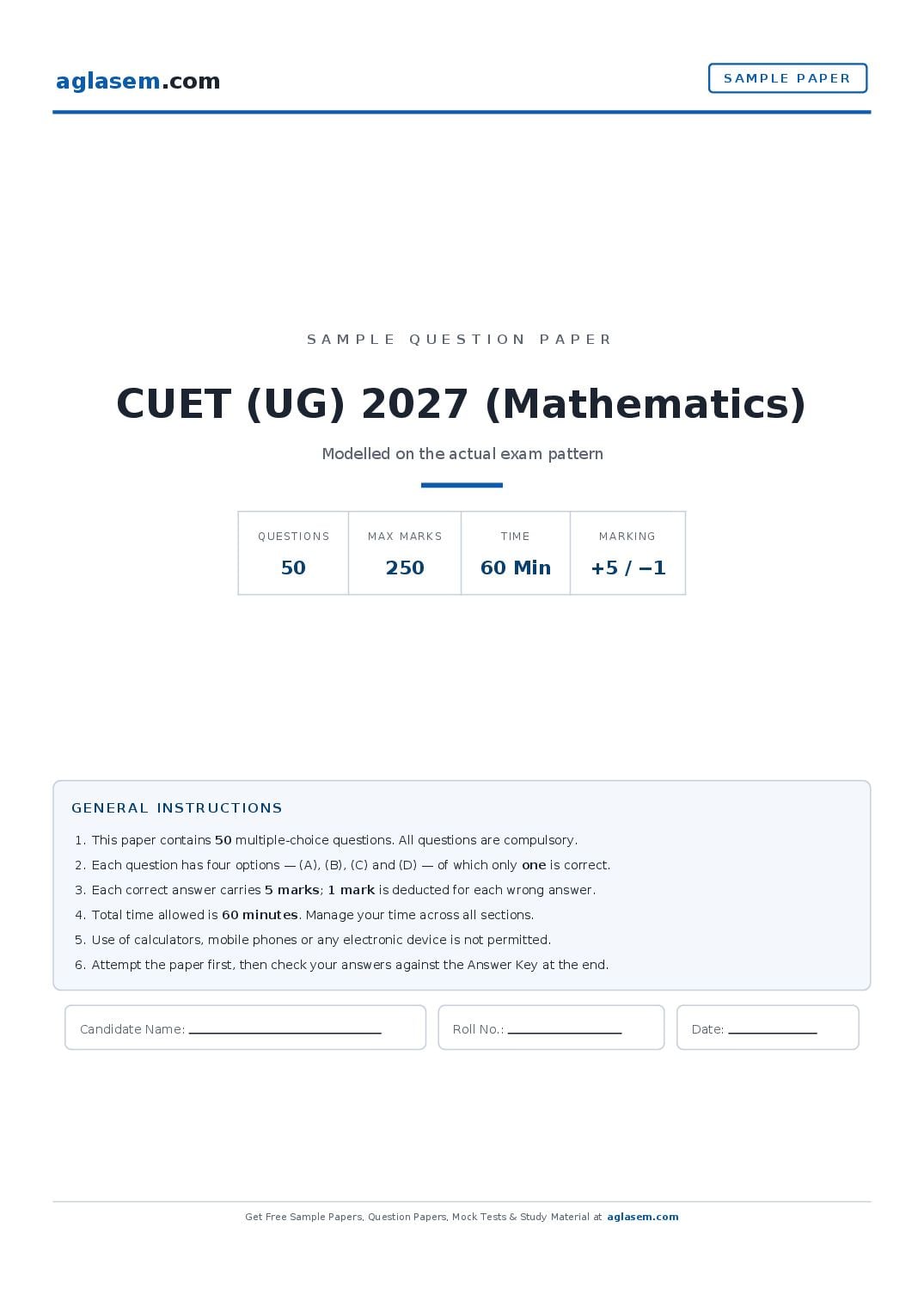
S A M P L E Q U E S T I O N P A P E R
CUET (UG) 2027 (Mathematics)
Modelled on the actual exam pattern
.
QUESTIONS MAX MARKS TIME MARKING
50 250 60 Min +5 / −1
GENERAL INSTRUCTIONS
1. This paper contains 50 multiple-choice questions. All questions are compulsory.
2. Each question has four options — (A), (B), (C) and (D) — of which only one is correct.
3. Each correct answer carries 5 marks; 1 mark is deducted for each wrong answer.
4. Total time allowed is 60 minutes. Manage your time across all sections.
5. Use of calculators, mobile phones or any electronic device is not permitted.
6. Attempt the paper first, then check your answers against the Answer Key at the end.
Candidate Name: Roll No.: Date:
Page 2
CUET (UG) 2027 (Mathematics)
SAMPLE QUESTION PAPER
Questions 50 Max Marks 250 Time 60 Min Marking +5 / −1
Attempt all questions. Choose the one correct option for each.
MATHEMATICS
1. The area of the region bounded by the curve y=x2 and 2. Integrating factor of the differential equation cos x (d
the line y=16 y)/(d x)+y sin x=1 is :
(A) (32)/(3) (A) cosx
(B) (256)/(3) (B) tanx
(C) (64)/(3) (C) secx
(D) (128)/(3) (D) sinx
3. The area of the region bounded by the curve x2=4 y 4. The area enclosed by the circle x2+y2=2 is equal to
and the straight line x = 4y – 2 is
(A) 4π sq units
(A) (3)/(8) sq units (B) 2√(2) π sq units
(B) (5)/(8) sq units (C) 4 π2 sq units
(C) (7)/(8) sq units (D) 2π sq units
(D) (9)/(8) sq units
5. ∫ 2|x cos π x| d x is equal to 6. The equation of tangent to the curve y(1+x2)=2-x ,
-2
where it crosses x-axis is:
(A) (8)/(π)
(B) (4)/(π) (A) x + 5y = 2
(C) (2)/(π) (B) x – 5y = 2
(D) (1)/(π) (C) 5x – y = 2
(D) 5x + y = 2
7. Consider the following two binary relations on the set 8. The feasible region for an LPP is shown in the Figure.
A ={a, b, c} : Let F = 3x – 4y be the objective function. Maximum value
R₁={(c, a), (b, b), (a, c), (c, c), (b, c), (a, a)} and of F is.
R₂={(a, b), (b, a), (c, c), (c, a), (a, a), (b, b), (a, c)}. Then :
(A) 0
(A) both R₁ and R₂ are not symmetric. (B) 8
(B) R₁ is not symmetric but it is transitive. (C) 12
(C) R₂ is symmetric but it is not transitive. (D) –18
(D) both R₁ and R₂ are transitive.
9. Let us define a relation R in R as aRb if a ≥ b. Then R is 10. If ∫ 3 ex-5 e-x4 ex+5 e-x d x=a x+b log |4 ex+5 e-x|+C,
then
(A) an equivalence relation
(B) reflexive, transitive but not symmetric (A) a=(-1)/(8), b=(7)/(8)
(C) symmetric, transitive but not reflexive (B) a=(1)/(8), b=(7)/(8)
(D) neither transitive nor reflexive but symmetric. (C) a=(-1)/(8), b=(-7)/(8)
(D) a=(1)/(8), b=(-7)/(8)
Page 3
represents: 5 and 7. The smallest value of n for which 900 such
distinct numbers can be formed, is:
(A) a rectangular hyperbola
(B) parabola whose vertex is at origin (A) 6
(C) straight line passing through origin (B) 7
(D) a circle whose centre is at origin (C) 8
(D) 9
13. The corner points of the feasible region determined 14. Which of the following is the principal value branch of
by the following system of linear constraints are (0, 10), cosec -1 x ?
(5, 5), (15, 15), (0, 20). Let Z = px + qy, where p, q > 0.
(A) ((-π)/(2), (π)/(2))
Condition on p and q so that the maximum of Z occurs at
(B) [0, π]-\(π)/(2)\
both the points (15, 15) and (0, 20) is:
(C) [(-π)/(2), (π)/(2)]
(A) p = q
(D) [(-π)/(2), (π)/(2)]-\0\
(B) p = 2q
(C) q = 2p
(D) q = 3p
15. Let f(t)=|cos t & t & 1 \ 2 sin t & t & 2 t \ sin t & t & t|, 16. The area enclosed by the ellipse x2a2+y2b2=1 is
then lim f(t)t2 is equal to equal to
t arrow 0
(A) 0 (A) π2 a b
(B) -1 (B) πab
(C) 2 (C) π a2 b
(D) 3 (D) π a b2
17. If A and B are two events such that P(A)=(1)/(2), 18. The two curves x3-3 x y2+2=0 and 3 x2 y-y3-2=0
P(B)=(1)/(3), P(A | B)=(1)/(4), then \ P(A′ B) equals intersect at an angle of
(A) (1)/(12) (A) (π)/(4)
(B) (3)/(4) (B) (π)/(3)
(C) (1)/(4) (C) (π)/(2)
(D) (3)/(16) (D) (π)/(6)
19. The set of points where the function f given by f(x)=|2 20. ∫ (cos 2 x-cos 2 θ)/(cos x-cos θ) d x is equal to
x-1| sin x is differentiable is
(A) 2(sinx + xcosθ) + C
(A) R (B) 2(sinx – xcosθ) + C
(B) R-\(1)/(2)\ (C) 2(sinx + 2xcosθ) + C
(C) (0, ∞) (D) 2(sinx – 2x cosθ) + C
(D) None of these
21. The feasible solution for a LPP is shown in Figure. Let 22. The area of the quadrilateral ABCD, where A(0,4,1), B
Z = 3x – 4y be the objective function. Minimum of Z (2, 3, –1), C(4, 5, 0) and D (2, 6, 2), is equal to
occurs at
(A) 9 sq. units
(A) (0, 0) (B) 18 sq. units
(B) (0, 8) (C) 27 sq. units
(C) (5, 0) (D) 81 sq. units
(D) (4, 10)
Page 4
has magnitude 9 is
(A) 2
(B) -12 √1-x2 (A) i-2 j+2 k
(C) (2)/(x) (B) (i-2 j+2 k)/(3)
(D) 1-x2 (C) 3(i-2 j+2 k)
(D) 9(i-2 j+2 k)
25. The domain of the function defined by f(x)=sin -1 √(x- 26. A and B are events such that P(A) = 0.4, P(B) = 0.3
1) is and P(A ∪ B) = 0.5. Then P(B′ A) equals
(A) [1, 2] (A) (2)/(3)
(B) [–1, 1] (B) (1)/(2)
(C) [0, 1] (C) (3)/(10)
(D) None of these (D) (1)/(5)
27. If A and B are matrices of same order, then (AB′-BA′) 28. P is a point on the line segment joining the points (3,
is a 2, –1) and (6, 2, –2). If x co-ordinate of P is 5, then its y
co-ordinate is
(A) skew symmetric matrix
(B) null matrix (A) 2
(C) symmetric matrix (B) 1
(D) unit matrix (C) -1
(D) -2
29. The area enclosed by the circle x2+y2=2 is equal to 30. If P(A)=(4)/(5), and P(A B)=(7)/(10), then P(B | A) is
equal to
(A) 4π sq units
(B) 2 √(2) π Sq units (A) (1)/(10)
(C) 4 π2 sq units (B) (1)/(8)
(D) 2π sq units (C) (7)/(8)
(D) (17)/(20)
31. The matrix P=[0 & 0 & 4 \ 0 & 4 & 0 \ 4 & 0 & 0] is a 32. The corner points of the feasible region determined
by the system of linear constraints are (0, 0), (0, 40), (20,
(A) square matrix
40), (60, 20), (60, 0). The objective function is Z = 4x +
(B) diagonal matrix
3y. Compare the quantity in Column A and Column B.
(C) unit matrix
(A) The quantity in column A is greater
(D) None
(B) The quantity in column B is greater
(C) The two quantities are equal
(D) The relationship can not be determined on the basis of
the information supplied
Page 5
the system of linear constraints are (0, 3), (1, 1) and (3,
(A) β
0). Let Z = px+qy, where p, q > 0. Condition on p and q
(B) |β|
so that the minimum of Z occurs at (3, 0) and (1, 1) is
(C) |β|+|v|
(A) p = 2q
(D) √α2+y2
(B) p=(q)/(2)
(C) p = 3q
(D) p = q
35. The sine of the angle between the straight line (x- 36. If the curve a y+x2=7 and x3=y , cut orthogonally at
2)/(3)=(y-3)/(4)=(z-4)/(5) and the plane 2x – 2y + z = 5 is (1, 1), then the value of a is:
(A) 106 √(5) (A) 1
(B) 45 √(2) (B) 0
(C) 2 √(3)5 (C) -6
(D) √(2)10 (D) .6
37. If P(B)=(3)/(5), P(A | B)=(1)/(2) and P(A B)=(4)/(5), 38. The vector having initial and terminal points as (2, 5,
then P(A B)′+P(A′ B)= 0) and (–3, 7, 4), respectively is
(A) (1)/(5) (A) -i+12 j+4 k
(B) (4)/(5) (B) 5 i+2 j-4 k
(C) (1)/(2) (C) -5 i+2 j+4 k
(D) 1 (D) i+j+k
39. The value of the expression 2 sec -1 2+sin -1((1)/(2)) 40. If a relation R on the set {1, 2, 3} be defined by R =
is {(1, 2)}, then R is
(A) (π)/(6) (A) reflexive
(B) (5π)/(6) (B) transitive
(C) (7π)/(6) (C) symmetric
(D) 1 (D) None of these
41. The area of a triangle with vertices (–3, 0), (3, 0) and 42. The function f(x)=4-x24 x-x3 is
(0, k) is 9 sq. units. The value of k will be
(A) discontinuous at only one point
(A) 9 (B) discontinuous at exactly two points
(B) 3 (C) discontinuous at exactly three points
(C) -9 (D) None of these
(D) 6
43. The degree of the differential equation (d2 yd x2)2 44. There are two values of a which makes determinant,
+((d y)/(d x))2=x sin ((d y)/(d x)) is: Δ=|1 & -2 & 5 \ 2 & a & -1 \ 0 & 4 & 2 a|=86 , then sum of
these number is
(A) 1
(B) 2 (A) 4
(C) 3 (B) 5
(D) Not defined (C) -4
(D) 9
Page 6
determinant
(A) diagonal matrix
|-1 & cos C & cos B \ cos C & -1 & cos A \ cos B & cos A & -
(B) symmetric matrix
1| equal to
(C) skew symmetric matrix
(A) 0
(D) scalar matrix
(B) -1
(C) 1
(D) None of these
47. The value of λ for which the two vectors 2 i-j+2 k and 48. The area of the region bounded by the curve y=√16-x
3 i+λ j+k are perpendicular is 2 and x -axis is
(A) 2 (A) 8 sq units
(B) 4 (B) 20πsq units
(C) 6 (C) 16π sq units
(D) 8 (D) 256π sq units
49. If x, y, z are all different from zero and |1+x & 1 & 1 \ 50. ∫ b+c f(x) d x is equal to
a+c
1 & 1+y & 1 \ 1 & 1 & 1+z|=0, then value of x-1+y-1+z-1 is
(A) ∫ b f(x-c) d x
a
(A) x y z (B) ∫ b f(x+c) d x
a
(B) x-1 y-1 z-1 (C) ∫ b f(x) d x
0
(C) – x – y – z (D) ∫ b-c f(x) d x
a-c
(D) –1
ANSWER KEY
1. (B) 2. (C) 3. (D) 4. (D) 5. (A) 6. (A) 7. (C)
8. (C) 9. (B) 10. (C) 11. (C) 12. (B) 13. (D) 14. (D)
15. (A) 16. (B) 17. (C) 18. (C) 19. (B) 20. (A) 21. (B)
22. (A) 23. (A) 24. (C) 25. (A) 26. (D) 27. (A) 28. (A)
29. (D) 30. (C) 31. (A) 32. (B) 33. (D) 34. (B) 35. (D)
36. (D) 37. (D) 38. (C) 39. (B) 40. (B) 41. (B) 42. (C)
43. (D) 44. (C) 45. (A) 46. (C) 47. (D) 48. (A) 49. (D)
50. (B)
Document Details
| Board / Org | NTA |
| Exam | CUET UG |
| Type | Sample Paper |
| Pages | 6 |
| Language | english |
| Updated | 24 Sep 2026 |