MBOSE Class 11 Question Paper 2018 for Psychology
Finished viewing? Save it for later —
Download MBOSE Class 11 Question Paper 2018 for Psychology (PDF · 3 pages)About MBOSE Class 11 Question Paper 2018 for Psychology
MBOSE Class 11 Question Paper 2018 for Psychology is available here for free download. Published by Meghalaya Board for Class 11, this question paper can be viewed online or downloaded as a PDF (3 pages). Candidates preparing for Class 11 can use MBOSE Class 11 Question Paper 2018 for Psychology to understand the exam pattern, the type of questions asked, and the overall difficulty level.
Frequently Asked Questions
How can I download MBOSE Class 11 Question Paper 2018 for Psychology?
Open this page and click the Download button to save MBOSE Class 11 Question Paper 2018 for Psychology as a PDF. It is completely free on AglaSem Docs.
Is MBOSE Class 11 Question Paper 2018 for Psychology free to download?
Yes. MBOSE Class 11 Question Paper 2018 for Psychology can be viewed online and downloaded as a PDF free of cost on AglaSem Docs.
How many pages does MBOSE Class 11 Question Paper 2018 for Psychology have?
MBOSE Class 11 Question Paper 2018 for Psychology contains 3 pages, which you can read online or download together as a single PDF.
Where can I find more Class 11 study material?
You can find more Class 11 question papers, sample papers, syllabus, and answer keys on AglaSem Docs.
MBOSE Class 11 Question Paper 2018 for Psychology – Text
Read the full text of this question paper below — useful to quickly search, copy and reference the content online without downloading the PDF.
📄 View text version (3 pages)
Page 1
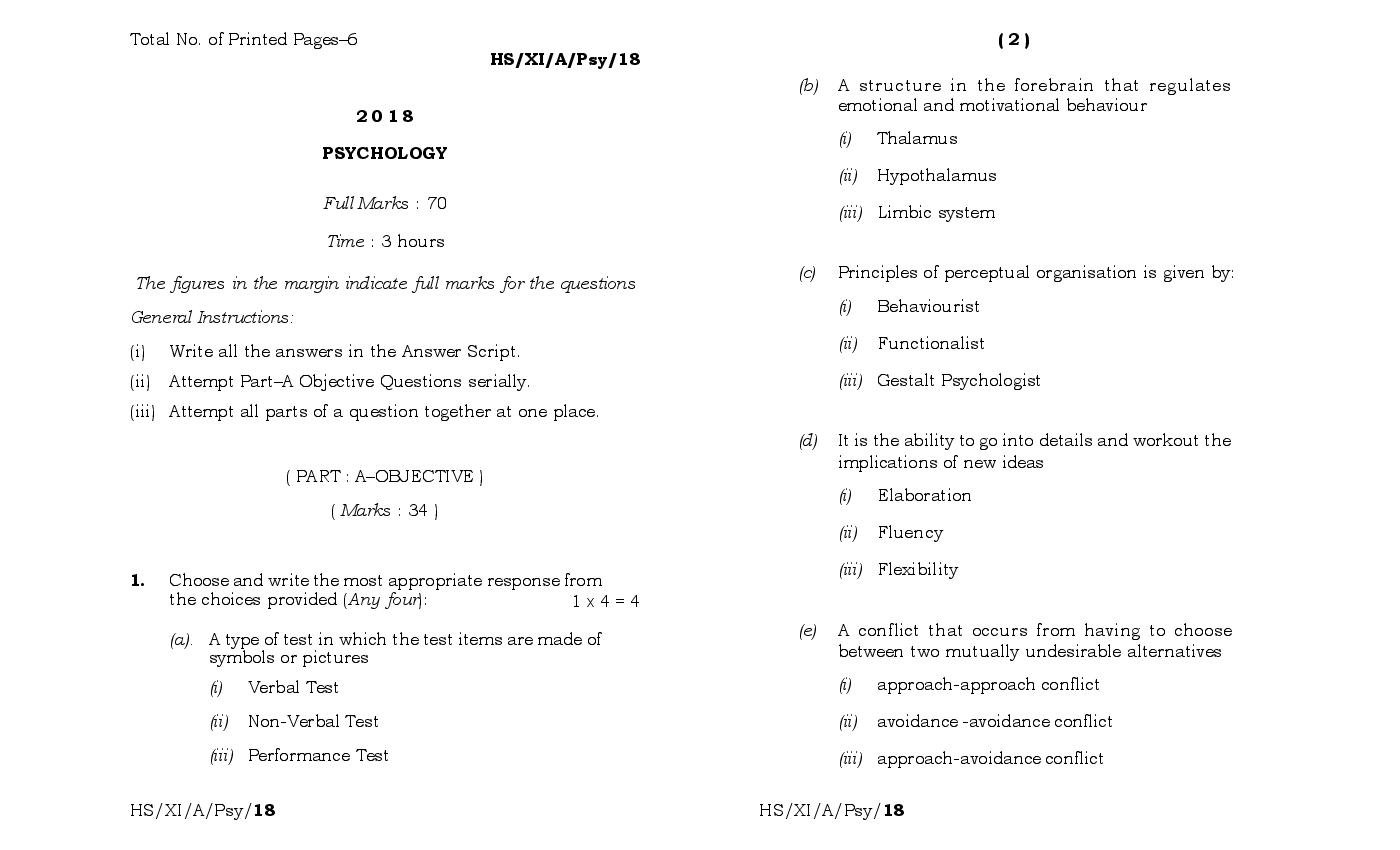
HS/XI/A/Psy/18
(b) A structure in the forebrain that regulates
emotional and motivational behaviour
2018
(i) Thalamus
PSYCHOLOGY
(ii) Hypothalamus
Full Marks : 70
(iii) Limbic system
Time : 3 hours
(c) Principles of perceptual organisation is given by:
The figures in the margin indicate full marks for the questions
(i) Behaviourist
General Instructions:
(i) Write all the answers in the Answer Script. (ii) Functionalist
(ii) Attempt Part–A Objective Questions serially. (iii) Gestalt Psychologist
(iii) Attempt all parts of a question together at one place.
(d) It is the ability to go into details and workout the
implications of new ideas
( PART : A–OBJECTIVE )
(i) Elaboration
( Marks : 34 )
(ii) Fluency
(iii) Flexibility
1. Choose and write the most appropriate response from
the choices provided (Any four): 1x4=4
(e) A conflict that occurs from having to choose
(a). A type of test in which the test items are made of
symbols or pictures between two mutually undesirable alternatives
(i) Verbal Test (i) approach-approach conflict
(ii) Non-Verbal Test (ii) avoidance -avoidance conflict
(iii) Performance Test (iii) approach-avoidance conflict
HS/XI/A/Psy/18 HS/XI/A/Psy/18
Page 2
2. Fill in the blanks : 1x5=5 (b) Imaginary audience and personal fable.
(c) Phases of skill acquisition
(a) The method gives detailed in-depth
information about a person or phenomena. (d) Symptoms of learning disabilities
(e) Episodic memory and Semantic memory.
(b) The initial experience of a stimulus registered
by a particular sense organ is called . (f) Obstacles to solving problems.
(g) Brainstorming
(c) are strategies for improving memory.
(d) reasoning is used in drawing
PART B – DESCRIPTIVE
conclusion based on a particular observation.
( Marks : 36 )
(e) is a type of learning in which response
is strengthened if followed by reinforcement.
5. Answer the following questions in 2 – 3 paragraphs.
4 x 6 = 24
3. Answer the following questions in 2 or 3 sentences (a) What are some of the ethical principles that
only. 2 x 5 = 10 psychologist need to follow in the conduct of
psychological studies. 4
(a) What is Behaviourism?
Or
(b) What is illusion?
Describe the quantitative and qualitative method
(c) What is problem solving? for analysis of data.
(d) What are positive emotions?
(e) What is motivation? (b) Briefly explain the two major factors that influence
the formation of Identity during Adolescence. 4
4. Write short notes on any 5 (five) of the following. Or
3 x 5 = 15
(a) Types of observation Briefly explain the challenges in early adulthood.
HS/XI/A/Psy/18 HS/XI/A/Psy/18
Page 3
(c) Explain the main principles of perceptual 6. Answer the following questions: 6 x 2 = 12
organisation. 4
(a) Give a brief account of the development of
Or psychology in India. 6
Describe some of the monocular cues used in
depth perception. Or
Describe some of the major disciplines linked to
(d) Describe classical conditioning. the field of psychology.
4
Or
(b) What is acculturation? Describe the acculturative
Describe the different methods used in studying strategies adopted by individuals during the
verbal learning. course of acculturation. 2+4=6
Or
(e) What is memory? Briefly explain the three
memory systems. What are endocrine glands? Describe briefly any
1+3=4
two endocrine glands of the human body. 1 + 5 = 6
Or
What is forgetting? Briefly explain with the help
of a typical experimental design the two kinds of
Interference that may result in forgetting. 1 + 3 = 4
(f) Briefly explain the different physiological basis
of emotion. 4
Or
Briefly explain the three most common
psychosocial motives.
HS/XI/A/Psy/18 HS/XI/A/Psy/18
Document Details
| Board / Org | Meghalaya Board |
| Exam | Class 11 |
| Type | Question Paper |
| Pages | 3 |
| Updated | 30 Apr 2026 |