NCERT Book Class 6 Science Chapter 2 Sorting Materials into Groups
Finished viewing? Save it for later —
Download NCERT Book Class 6 Science Chapter 2 Sorting Materials into Groups (PDF · 10 pages)About NCERT Book Class 6 Science Chapter 2 Sorting Materials into Groups
NCERT Book Class 6 Science Chapter 2 Sorting Materials into Groups is available here for free download. Published by NCERT for Class 6, this books can be viewed online or downloaded as a PDF (10 pages). Candidates preparing for Class 6 can use NCERT Book Class 6 Science Chapter 2 Sorting Materials into Groups to understand the exam pattern, the type of questions asked, and the overall difficulty level.
Frequently Asked Questions
How can I download NCERT Book Class 6 Science Chapter 2 Sorting Materials into Groups?
Open this page and click the Download button to save NCERT Book Class 6 Science Chapter 2 Sorting Materials into Groups as a PDF. It is completely free on AglaSem Docs.
Is NCERT Book Class 6 Science Chapter 2 Sorting Materials into Groups free to download?
Yes. NCERT Book Class 6 Science Chapter 2 Sorting Materials into Groups can be viewed online and downloaded as a PDF free of cost on AglaSem Docs.
How many pages does NCERT Book Class 6 Science Chapter 2 Sorting Materials into Groups have?
NCERT Book Class 6 Science Chapter 2 Sorting Materials into Groups contains 10 pages, which you can read online or download together as a single PDF.
Where can I find more Class 6 study material?
You can find more Class 6 question papers, sample papers, syllabus, and answer keys on AglaSem Docs.
NCERT Book Class 6 Science Chapter 2 Sorting Materials into Groups – Text
Read the full text of this books below — useful to quickly search, copy and reference the content online without downloading the PDF.
📄 View text version (1 page)
Page 1
2.1 OBJECTS AROUND US
We have seen that our food and clothes Let us say, we wish to make a group
have so much variety in them. Not just of objects that are made of plastics.
food and clothes, there is such a vast Buckets, lunch boxes, toys, water
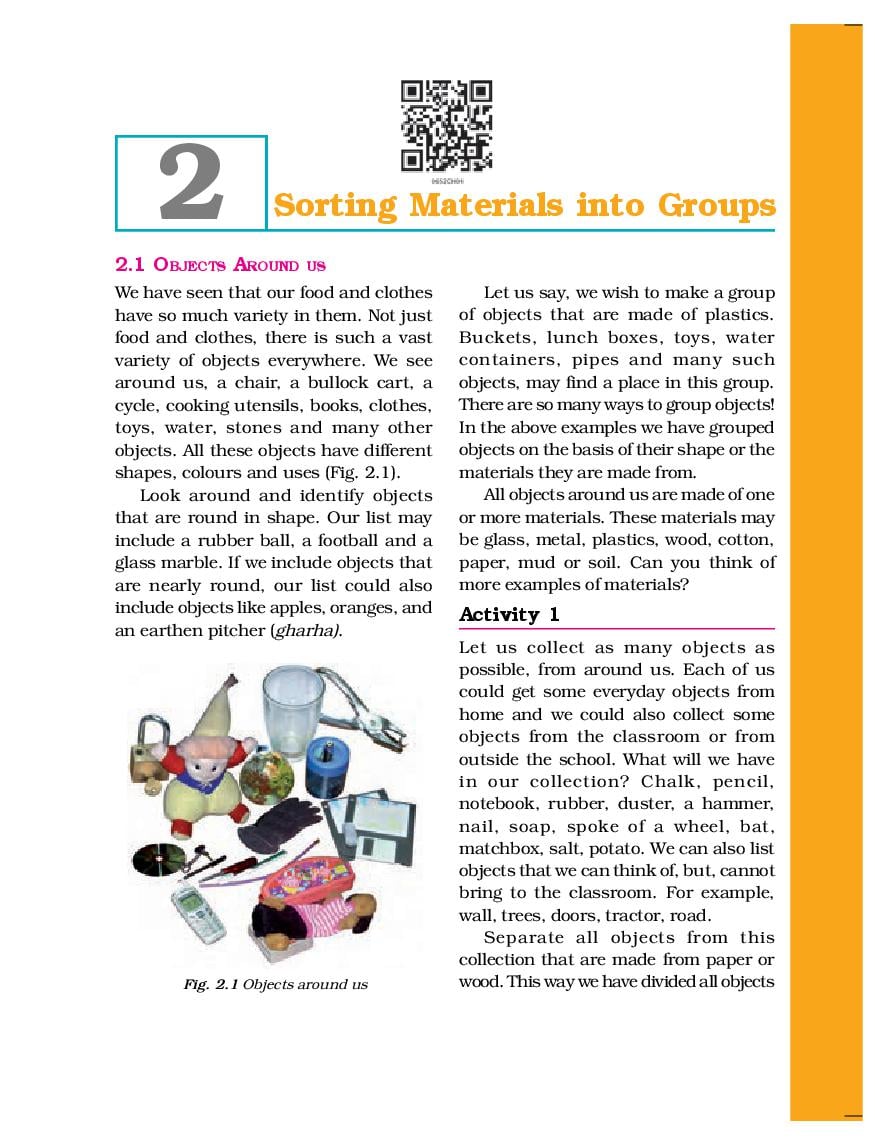
variety of objects everywhere. We see containers, pipes and many such
around us, a chair, a bullock cart, a objects, may find a place in this group.
cycle, cooking utensils, books, clothes, There are so many ways to group objects!
toys, water, stones and many other In the above examples we have grouped
objects. All these objects have different objects on the basis of their shape or the
shapes, colours and uses (Fig. 2.1). materials they are made from.
Look around and identify objects All objects around us are made of one
that are round in shape. Our list may or more materials. These materials may
include a rubber ball, a football and a be glass, metal, plastics, wood, cotton,
glass marble. If we include objects that paper, mud or soil. Can you think of
are nearly round, our list could also more examples of materials?
include objects like apples, oranges, and
Activity 1
an earthen pitcher (gharha).
Let us collect as many objects as
possible, from around us. Each of us
could get some everyday objects from
home and we could also collect some
objects from the classroom or from
outside the school. What will we have
in our collection? Chalk, pencil,
notebook, rubber, duster, a hammer,
nail, soap, spoke of a wheel, bat,
matchbox, salt, potato. We can also list
objects that we can think of, but, cannot
bring to the classroom. For example,
wall, trees, doors, tractor, road.
Separate all objects from this
collection that are made from paper or
Fig. 2.1 Objects around us wood. This way we have divided all objects
Showing the first page only. Download the PDF above for the complete document.
Document Details
| Board / Org | NCERT |
| Exam | Class 6 |
| Type | Books |
| Pages | 10 |
| Updated | 22 Jul 2026 |