Goa Board Class 12 Question Paper 2022 Biology
Finished viewing? Save it for later —
Download Goa Board Class 12 Question Paper 2022 Biology (PDF · 16 pages)About Goa Board Class 12 Question Paper 2022 Biology
Goa Board Class 12 Question Paper 2022 Biology is available here for free download. Published by Goa Board for Class 12, this question paper can be viewed online or downloaded as a PDF (16 pages). Candidates preparing for Class 12 can use Goa Board Class 12 Question Paper 2022 Biology to understand the exam pattern, the type of questions asked, and the overall difficulty level.
Frequently Asked Questions
How can I download Goa Board Class 12 Question Paper 2022 Biology?
Open this page and click the Download button to save Goa Board Class 12 Question Paper 2022 Biology as a PDF. It is completely free on AglaSem Docs.
Is Goa Board Class 12 Question Paper 2022 Biology free to download?
Yes. Goa Board Class 12 Question Paper 2022 Biology can be viewed online and downloaded as a PDF free of cost on AglaSem Docs.
How many pages does Goa Board Class 12 Question Paper 2022 Biology have?
Goa Board Class 12 Question Paper 2022 Biology contains 16 pages, which you can read online or download together as a single PDF.
Where can I find more Class 12 study material?
You can find more Class 12 question papers, sample papers, syllabus, and answer keys on AglaSem Docs.
Goa Board Class 12 Question Paper 2022 Biology – Text
Read the full text of this question paper below — useful to quickly search, copy and reference the content online without downloading the PDF.
📄 View text version (16 pages)
Page 1
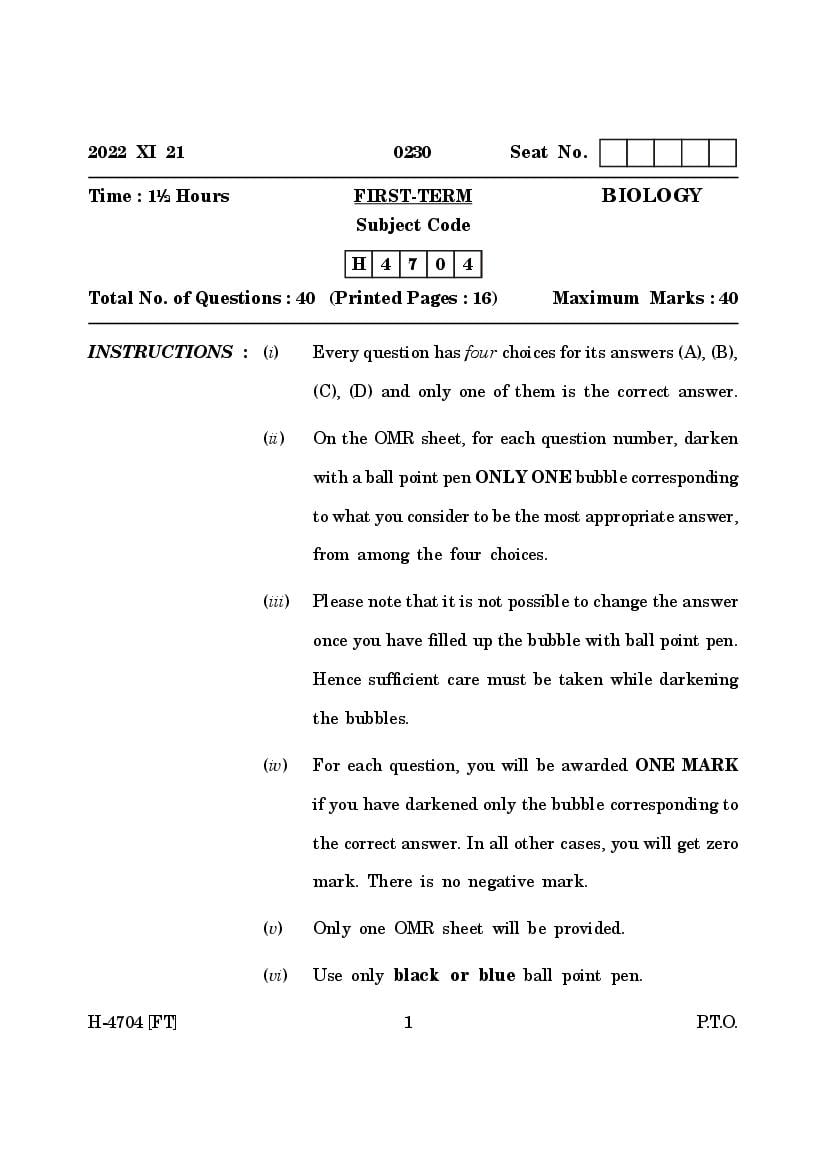
Time : 1½ Hours FIRST-TERM BIOLOGY
Subject Code
H 4 7 0 4
Total No. of Questions : 40 (Printed Pages : 16) Maximum Marks : 40
INSTRUCTIONS : (i) Every question has four choices for its answers (A), (B),
(C), (D) and only one of them is the correct answer.
(ii) On the OMR sheet, for each question number, darken
with a ball point pen ONLY ONE bubble corresponding
to what you consider to be the most appropriate answer,
from among the four choices.
(iii) Please note that it is not possible to change the answer
once you have filled up the bubble with ball point pen.
Hence sufficient care must be taken while darkening
the bubbles.
(iv) For each question, you will be awarded ONE MARK
if you have darkened only the bubble corresponding to
the correct answer. In all other cases, you will get zero
mark. There is no negative mark.
(v) Only one OMR sheet will be provided.
(vi) Use only black or blue ball point pen.
H-4704 [FT] 1 P.T.O.
Page 2
of the same plant is called ......................... .
(A) Geitonogamy
(B) Karyogamy
(C) Xenogamy
(D) Autogamy
2. A patient is suspected to be suffering from AIDS. Which diagnostic technique
will you recommend for its detection ?
(A) WIDAL
(B) MRI
(C) CT
(D) ELISA
3. The average temperature in hydrothermal vents found in deep sea is one
of the following :
(A) 20–30ºC
(B) Sub-zero level
(C) >50ºC
(D) Exceeds 100ºC
4. To isolate a DNA from a plant cell a biologist will use all the following
enzymes, except ............................ .
(A) Cellulase
(B) DNAase
(C) RNAase
(D) Protease
H-4704 [FT] 2
Page 3
Kwashiorkor amongst the children in the developing countries. Therefore,
genetically modified crops are developed to ......................... .
(A) Reduce dependency on chemical pesticides
(B) Make plants more tolerant to abiotic stress
(C) Increase efficiency of mineral usage
(D) Enhance nutritional value of food
6. Researchers in Netherland have discovered a gene ‘‘PAR’’ from Dandelion
species that will make it possible to produce seeds from the crops that are
genetically identical to the mother plant and do not need pollinators. The
technique probably used must be .................................. .
(A) Apomixis
(B) Triple fusion
(C) Parthenocarpy
(D) Syngamy
7. First artificial rDNA was constructed by .......................... .
(A) Gregor Mendel and T.H. Morgan
(B) T.H. Morgan and Alfred Sturtevant
(C) Stanley Cohen and Alfred Sturtevant
(D) Stanley Cohen and Herbert Boyer
8. In the life cycle of a malarial parasite, where would you look for the mature
sporozoites of the parasite ?
(A) Saliva of a female Anopheles mosquito
(B) Liver of a healthy human
(C) RBCs of infected human
(D) Intestine of a female Anopheles mosquito
H-4704 [FT] 3 P.T.O.
Page 4
woodlands with abundant food resources. The population experience 5 natural
deaths and 30 births during one-year period. If the population maintains the
current growth pattern in the next two years, the plot of its growth would
resemble ....................................... .
(A) Logistic growth
(B) Exponential growth
(C) K selected growth
(D) Fluctuating growth
10. The figure given below shows the T.S. of an apple. Select the option which
is correctly identified.
(A) (i) thalamus (ii) seeds (iii) endocarp (iv) mesocarp
(B) (i) mesocarp (ii) seeds (iii) endocarp (iv) epicarp
(C) (i) epicarp (ii) seeds (iii) endocarp (iv) mesocarp
(D) (i) thalamus (ii) endosperm (iii) seeds (iv) endocarp
H-4704 [FT] 4
Page 5
plants had tendrils arising from the stem while in others it was from the
leaf tip as well as petiole. This is an example of ......................... .
(A) Homology
(B) Analogy
(C) Adaptive radiation
(D) Branching descent
12. A person likely to develop tetanus is immunised by administering .......... .
(A) Preformed antibodies
(B) Dead germs
(C) Wide spectrum antibiotics
(D) Weakened germs
13. A blonde-haired, blue-eyed families from Swedan move to India where their
children grow up, marry Indians and produce offspring, who now have
blonde-haired, blue-eyed alleles. The phenomenon depicts ................... .
(A) Genetic drift
(B) Gene migration
(C) Mutation
(D) Artificial selection
H-4704 [FT] 5 P.T.O.
Page 6
(A) = Unaffected male
(B) = Parents below and children above
(C) = affected individuals
(D) = mating between the relatives
15. The Colorado potato beetle, a severe pest of potato has developed resistance
to almost every insecticide. The only possible way to eradicate these pests
was to introduce a specific toxin gene into potato plants, so that it produces
an insecticidal protein that will kill the pest.
The source organism of the toxin gene is ................................ .
(A) Bacillus thuringiensis
(B) Meloidegyne incognitia
(C) Agrobacterium tumefaciens
(D) Escherichia coli
16. The type of organic compound formed in an experiment, conducted by S.L.
Miller on chemical evolution was ............................... .
(A) Sugars
(B) Amino acids
(C) Pigments
(D) Lipids
H-4704 [FT] 6
Page 7
Animals Response to abiotic factors
Shrews (i)
(ii) Hibernation
Siberian crane (iii)
(A) (i) Conformers (ii) Bear (iii) Migration
(B) (i) Migration (ii) Zooplanktons (iii) Conformers
(C) (i) Conformers (ii) Fish (iii) Aestivation
(D) (i) Migration (ii) Humming bird (iii) Conformers
18. A very old viable seed that has been found during archaeological excavation
at King Herod’s Palace near the Dead Sea is ......................... .
(A) Phoenix dactylifera
(B) Lupinus arcticus
(C) Pisum sativum
(D) Oxalis
19. On the island of Puerto Rico, the two species of Lizard, Anoles evermanni
and A. gundalchi eats the same type of food resource–insects. However,
species gundalchi feeds on the insect found on the forest floor while
evermanni on higher up in the habitat, on trees.
The above adaptations shown by the species is ......................... .
(A) Intraspecific competition
(B) Symbiosis
(C) Competition exclusion
(D) Resource partitioning
H-4704 [FT] 7 P.T.O.
Page 8
plants for the seed shape and colour. The genotypes of the parent is ......... .
(A) RR YY X RRyy
(B) RrYy X rryy
(C) RRYY X rryy
(D) rryy X Rryy
21. Which one of the following options gives the correct matching of a disease
with its causative organism and mode of infection ?
Disease Causative Mode of Infection
Organism
(A) Elephantiasis Wuchereria bancrofti With inspired air
(B) Typhoid Entamoeba histolitica With infected water and
food
(C) Pneumonia Haemophilus influenzae With inhaling droplets
from infected person
(D) Amoebiasis Salmonella typhi With bite of a female
mosquito
22. An American company ‘‘Eli Lily’’ successfully discovered ‘‘humulin’’ in 1983,
by preparing DNA sequences coding for polypeptide chains of human insulin
namely ............................... .
(A) A and B chain
(B) A, B and C chain
(C) B and C chain
(D) A and C chain
H-4704 [FT] 8
Page 9
is 0.17 while the allele of black coat colour (a) has an allelic frequency of
0.83. According to the Hardy-Weinberg equation, the frequency of
heterozygous (Aa) individuals in a population will be ........................ .
(A) 0.50
(B) 0.35
(C) 0.42
(D) 0.28
24. Read the following statements given below on predation and select only the
correct ones out of them.
(1) Lion eating deer and a sparrow feeding on grains are the examples
of predation
(2) Predator star fish ‘‘Pisaster’’ help in maintaining species diversity of
invertebrates in its habitat
(3) Predation leads to the extinction of prey species
(4) Production of nicotine and strychnine by plants attracts predators
Options :
(A) (1) and (2)
(B) (2) and (3)
(C) (1) and (4)
(D) (2) and (4)
H-4704 [FT] 9 P.T.O.
Page 10
permanently by .......................... .
(A) Administering ADA activators
(B) Enzyme replacement theory
(C) Introducing the gene isolated from marrow cells producing ADA into
cells at early embryonic stages
(D) Periodic infusion of genetically engineered lymphocytes having
functional ADA cDNA
26. T.H. Morgan carried out several dihybrid crosses in Drosophila that were sex
linked. To his surprise, F2 results got completely deviated from that of
Mendelian ratio, as shown below :
Cross I : parental type – 98.7%; recombinant types – 1.3%
Cross II : parental type – 62.8%; recombinant type – 37.2%
The correct inference drawn by T.H. Morgan was that .................... .
(A) In Cross I the genes are loosely linked
(B) In Cross I the genes are tightly linked
(C) In Cross II the genes are tightly linked
(D) In Cross II the genes are located on two separate chromosomes
27. A typical fruit has sixteen seeds. How many number of meiotic divisions are
required to give pollens involved in the formation these seeds ?
(A) 16 meiotic divisions
(B) 4 meiotic divisions
(C) 3 meiotic divisions
(D) 20 meiotic divisions
H-4704 [FT] 10
Page 11
(1) 650–800cc
(2) 900cc
(3) 1400cc
1 2 3
(A) Homo habilis Homo erectus Neanderthal
(B) Homo erectus Homo habilis Australopithecus
(C) Neanderthal Homo erectus Homo habilis
(D) Homo erectus Australopithecus Homo habilis
29. A disorder of haemoglobin which is controlled by a gene HBB present on
Chromosome 11 is ............................. .
(A) Sickle cell anaemia
(B) â Thalassemia
(C) a' Thalassemia
(D) Haemophilia
30. Identify the plant shown below and select the right option with the drug it
produces.
(A) Papaver somniferum–Morphine
(B) Cannabis sativa – Hashish
(C) Papaver somniferum – Charas
(D) Cannabis sativa – Crack
H-4704 [FT] 11 P.T.O.
Page 12
recognising a specific sequence.
5'–GTCGAC–3
3'–CAGCTG–5'
How many number of DNA fragments will be formed, if this enzyme is
subjected to the DNA molecule given below ?
(A) 2
(B) 3
(C) 4
(D) 5
32. Observe the various steps in the following diagrammatic representation. At
which step does the reductional division occur ?
(A) Step 1
(B) Step 3 and 4
(C) Step 5
(D) Step 4 and 5
H-4704 [FT] 12
Page 13
while the other with normal vision. If the couple had daughters, then the
expected phenotypes would be ...................... .
(A) All will be carrier of the trait
(B) 50% normal and 50% carrier of the trait
(C) All will be colour-blind
(D) 50% colour-blind and 50% carrier of the trait
34. An individual has XXY sex chromosome along with 22 pairs of autosomes
will show :
(A) Rudimentary ovaries
(B) Poor development of breasts
(C) Gynaecomastia
(D) Broad flat face
35. Sweat, tears and salvia contain enzyme lysozyme that prevents the growth
of invading bacteria or viruses in our body. These defence elements are called
as ................................... .
(A) Physical barriers
(B) Cellular barriers
(C) Cytokine barriers
(D) Physiological barriers
36. How many primer/s are used in each polymerase chain reaction ?
(A) One
(B) Four
(C) Three
(D) Two
H-4704 [FT] 13 P.T.O.
Page 14
(I) Obtaining foreign gene (a) Heat shock treatment
product
(II) Separation and isolation of (b) Down streaming
DNA
(III) Transfer of rDNA in hosts (c) Gel electrophoresis
cells
(IV) Separation and purification (d) Bioreactors
of a recombinant protein
Options :
(A) (Ia) (IIc) (IIId) (IVb)
(B) (Id) (IIb) (IIIa) (IVc)
(C) (Id) (IIc) (IIIa) (IVb)
(D) (Ic) (IId) (IIIb) (IVa)
38. Ring worm is the most common infectious disease in man and is caused
by a ....................... .
(A) Hook worm
(B) Bacteria
(C) Fungi
(D) Protozoa
39. When two black-white speckled cats were mated, the offspring obtained were
5 black cats, 12 black-white speckled cats and 4 white cats. Name the pattern
of inheritance.
(A) Polygeny
(B) Incomplete dominance
(C) Co-dominance
(D) Pleiotropy
H-4704 [FT] 14
Page 15
These plasmid vectors were then transferred into E. coli and were allowed
to grow in two different media as shown below.
Now observe the diagrammatic representation carefully. Some E.coli have
survived in both the media. The reason for their survival could be that they
are :
(A) Transformants and recombinants
(B) Non-transformants
(C) Having natural resistance to both antibiotic
(D) Transformants but not recombinants
H-4704 [FT] 15 P.T.O.
Page 16
Document Details
| Board / Org | Goa Board |
| Exam | Class 12 |
| Type | Question Paper |
| Pages | 16 |
| Updated | 24 Sep 2026 |