Goa Board Class 12 Question Paper 2022 Chemistry
Finished viewing? Save it for later —
Download Goa Board Class 12 Question Paper 2022 Chemistry (PDF · 15 pages)About Goa Board Class 12 Question Paper 2022 Chemistry
Goa Board Class 12 Question Paper 2022 Chemistry is available here for free download. Published by Goa Board for Class 12, this question paper can be viewed online or downloaded as a PDF (15 pages). Candidates preparing for Class 12 can use Goa Board Class 12 Question Paper 2022 Chemistry to understand the exam pattern, the type of questions asked, and the overall difficulty level.
Frequently Asked Questions
How can I download Goa Board Class 12 Question Paper 2022 Chemistry?
Open this page and click the Download button to save Goa Board Class 12 Question Paper 2022 Chemistry as a PDF. It is completely free on AglaSem Docs.
Is Goa Board Class 12 Question Paper 2022 Chemistry free to download?
Yes. Goa Board Class 12 Question Paper 2022 Chemistry can be viewed online and downloaded as a PDF free of cost on AglaSem Docs.
How many pages does Goa Board Class 12 Question Paper 2022 Chemistry have?
Goa Board Class 12 Question Paper 2022 Chemistry contains 15 pages, which you can read online or download together as a single PDF.
Where can I find more Class 12 study material?
You can find more Class 12 question papers, sample papers, syllabus, and answer keys on AglaSem Docs.
Goa Board Class 12 Question Paper 2022 Chemistry – Text
Read the full text of this question paper below — useful to quickly search, copy and reference the content online without downloading the PDF.
📄 View text version (15 pages)
Page 1
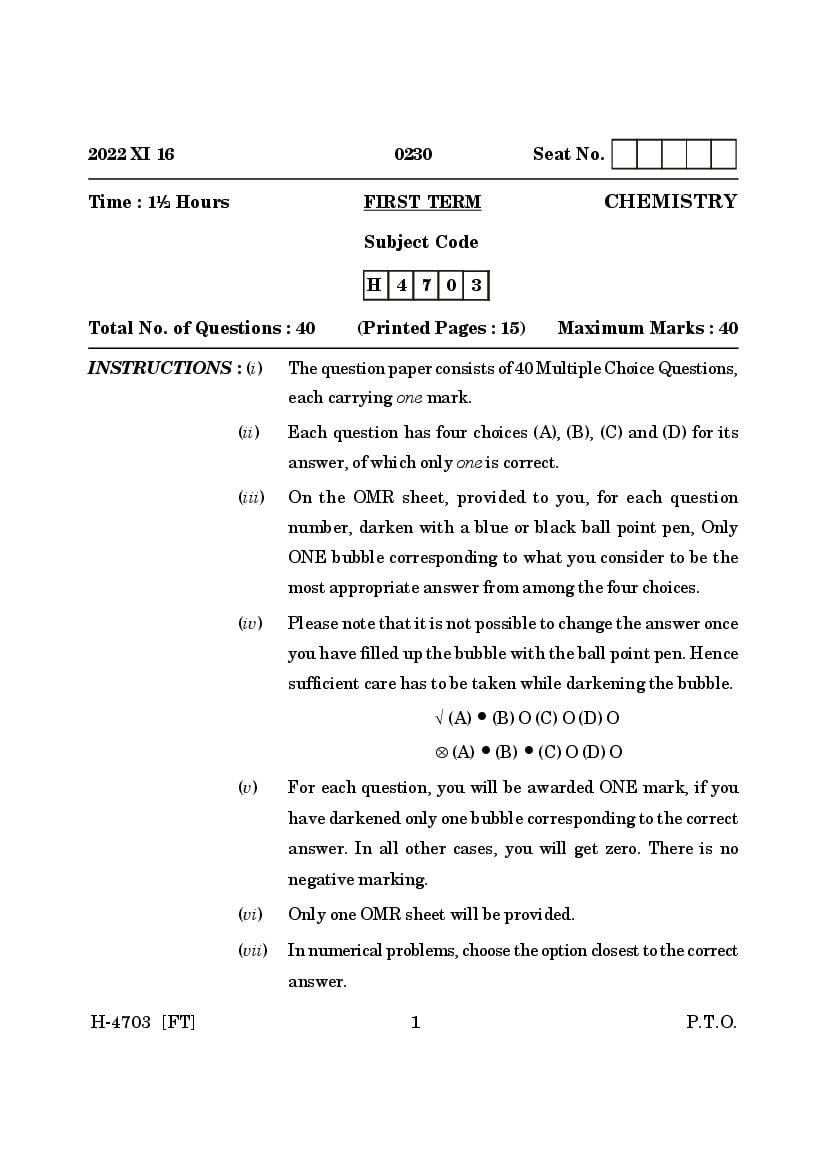
Time : 1½ Hours FIRST TERM CHEMISTRY
Subject Code
H 4 7 0 3
Total No. of Questions : 40 (Printed Pages : 15) Maximum Marks : 40
INSTRUCTIONS : (i) The question paper consists of 40 Multiple Choice Questions,
each carrying one mark.
(ii) Each question has four choices (A), (B), (C) and (D) for its
answer, of which only one is correct.
(iii) On the OMR sheet, provided to you, for each question
number, darken with a blue or black ball point pen, Only
ONE bubble corresponding to what you consider to be the
most appropriate answer from among the four choices.
(iv) Please note that it is not possible to change the answer once
you have filled up the bubble with the ball point pen. Hence
sufficient care has to be taken while darkening the bubble.
(A) • (B) O (C) O (D) O
(A) • (B) • (C) O (D) O
(v) For each question, you will be awarded ONE mark, if you
have darkened only one bubble corresponding to the correct
answer. In all other cases, you will get zero. There is no
negative marking.
(vi) Only one OMR sheet will be provided.
(vii) In numerical problems, choose the option closest to the correct
answer.
H-4703 [FT] 1 P.T.O.
Page 2
(A) Frenkel Defect
(B) Schottky Defect
(C) Impurity Defect
(D) Formation of F-centres
2. To get n-type semiconductor from silicon, it should be doped with a substance
with valency .......................... .
(A) 1
(B) 2
(C) 3
(D) 5
3. The following is a diagram of square closed packed unit cell. The packing
efficiency of the said solid is .......................... .
(A) 39.27%
(B) 52.4%
(C) 68.02%
(D) 74.05%
H-4703 [FT] 2
Page 3
edge length 1.0 × 10⁻¹⁰ cm. Calculate its density if its atomic mass is
6.022 g/mol. (NA = 6.022 × 10²³ mol–1)
(A) 107 g/cm3
(B) 106 g/cm3
(C) 105 g/cm3
(D) 1013 g/cm3
5. A solution of acetone in ethanol shows .......................... .
(A) the bond strength between the two molecules after mixing becomes
stronger than before
(B) an ideal behaviour in accordance with Raoult’s law
(C) a negative deviation from Raoult’s law
(D) a positive deviation from Raoult’s law
6. A raw mango when placed in a concentrated salt solution to prepare pickle
tends to shrink due to .......................... .
(A) gaining of water due to osmosis
(B) loss of water due to osmosis
(C) gaining of water due to reverse osmosis
(D) loss of water due to reverse osmosis
H-4703 [FT] 3 P.T.O.
Page 4
the mole fraction of the other component will be .......................... .
(A) 0.386
(B) 0.489
(C) 0.614
(D) 0.772
8. Isotonic solutions are the solutions having the same .......................... .
(A) Surface tension
(B) Density
(C) Osmotic pressure
(D) Viscosity
9. The increase in the boiling point of a 0.05 molal solution is 0.50ºC. The molal
elevation constant of the solution is ........................... .
(A) 0.05 K kg mol–1
(B) 0.5 K kg mol–1
(C) 1 K kg mol–1
(D) 10 K kg mol–1
10. The rate law for the following reaction, A 2B — AB2 is Rate k[A]1[B]2 ,
if the concentration of B is doubled, then the rate of reaction will
.......................... .
(A) increase by 4 times
(B) decrease by 2 times
(C) increase by 2 times
(D) remain the same
H-4703 [FT] 4
Page 5
................. .
(A) zero order reactions
(B) first order reactions
(C) second order reactions
(D) third order reactions
12. A first order reaction is half completed in 3 minutes. How long does it take
for completion of 99% of the reaction ?
2.303
(Given : 9.969; log 100 2.0000 )
0.231
(A) 1.9938 minutes
(B) 19.938 minutes
(C) 9.969 minutes
(D) 91.93 minutes
13. If the rate constant of a reaction is 0.3 × 10⁻⁴ mol–1 L s–1, the order of the
reaction is ...................... .
(A) zero order
(B) first order
(C) second order
(D) fractional order
H-4703 [FT] 5 P.T.O.
Page 6
3NO2(g) H2O(l) 2HNO3(aq) NO(g)
The differential rate expression of the above reaction can be expressed in
terms of concentration of 3NO2(g ) , H2O(l) , 2HNO3(aq) , NO(g) . The
instantaneous rate expressions for the above equation are ....................... .
(A) Rate = –3d[NO2]/dt = –d[H2O]/dt = +2d[HNO3]/dt = +d[NO]/dt
(B) Rate = 1/3d[NO2]/dt = d[H2O]/dt = 1/2d[HNO3]/dt = d[NO]/dt
(C) Rate = –1/3d[NO2]/dt = –d[H2O]/dt = +1/2d[HNO3]/dt = +d[NO]/dt
(D) Rate = –d[NO2]/dt = –d[H2O]/dt = +d[HNO3]/dt = +d[NO]/dt
15. Chlorine water on standing loses its yellow colour due to the formation
of ........................ .
(A) HCl and O2
(B) H2 and ClO2
(C) HCl and HOCl
(D) H2 and Cl2O
16. From the following Xenon compounds, distorted octahedral structure is shown
by compound .......................... .
(A) XeOF4
(B) XeF4
(C) XeO3
(D) XeF6
H-4703 [FT] 6
Page 7
metals except .......................... .
(A) Copper
(B) Platinum
(C) Nickel
(D) Zinc
18. Sulphur belonging to Group 16 of the periodic table has a maximum
oxidation state as .......................... .
(A) 2
(B) 4
(C) 6
(D) 8
19. The decreasing order of the thermal stability of the hydrides of Group 16
is .......................... .
(A) H2O < H2S < H2Se < H2Te < H2Po
(B) H2O > H2S > H2Se > H2Te > H2Po
(C) H2O < H2S < H2Se > H2Te > H2Po
(D) H2O > H2S > H2Se < H2Te < H2Po
20. Oleum is formed by the mixing of ..................... .
(A) H2SO4 + SO3
(B) H2SO4 + CaF2
(C) H2SO4 + H2O
(D) H2SO4 + Cu
H-4703 [FT] 7 P.T.O.
Page 8
2-Bromobutane; the decreasing order of the boiling points will be .................. .
(A) 1-Bromobutane > 2-Bromo-2-methylpropane > 2-Bromobutane
(B) 2-Bromobutane > 2-Bromo-2-methylpropane > 1-Bromobutane
(C) 2-Bromo-2-methylpropane > 2-Bromobutane > 1-Bromobutane
(D) 1-Bromobutane > 2-Bromobutane > 2-Bromo-2-methylpropane
22. When chlorobenzene reacts with chloromethane in presence of sodium and
dry ether, the major product obtained is ......................... .
(A) Methylbenzene
(B) ethane
(C) 4-chloro-1-methylbenzene
(D) diphenyl
23. From the compounds 2-bromopropane, 2-bromo-2-methylpropane,
1-bromopropane, 2,2-dibromopropane, the compound that undergoes
substitution nucleophilic reaction with complete inversion in its configuration
is .......................... .
(A) 2-bromopropane
(B) 2-bromo-2-methylpropane
(C) 1-bromopropane
(D) 2,2-dibromopropane
24. The compound which has a asymmetric carbon atom in the following
compounds is .......................... .
CH3CH2CH2CH2Cl; CH3CH2CH(Cl) CH3; (CH3)2CH CH2(Cl); (CH3)3C Cl
(A) CH3CH2CH(Cl) CH3
(B) (CH3)2CH CH2(Cl)
(C) CH3CH2CH2CH2Cl
(D) (CH3)3C Cl
H-4703 [FT] 8
Page 9
(A) and
(B) and
(C) and
(D) and
H-4703 [FT] 9 P.T.O.
Page 10
(A) Phenoxide ion is more resonance stabilised than phenol
(B) There is more hydrogen bonding in phenol than ethyl alcohol
(C) Ethoxide ion is less resonance stabilised than ethyl alcohol
(D) Phenol has higher boiling point than ethyl alcohol
27. For the following reaction, the product ‘P’ is .......................... .
(A)
(B)
(C)
(D)
H-4703 [FT] 10
Page 11
is .......................... .
(A) Propanoic acid
(B) Butan-2-al
(C) Methanoic acid
(D) Propan-1-al
29. When an acetone is treated with an appropriate Grignard Reagent, the
product obtained is 2-methylpropan-2-ol. The Grignard reagent is .................. .
(A) ethyl magnesium iodide
(B) isopropyl magnesium iodide
(C) methyl magnesium iodide
(D) tert-butyl magnesium iodide
30. In the following reaction, the product ‘Z’ is .......................... .
(A) 2-nitrophenol
(B) 2,4-dinitrophenol
(C) 2,6-dinitrophenol
(D) 2,4,6-trinitrophenol
31. Ethanamine when treated with chloromethane forms the final product ........... .
(A) (CH3)4 N+Cl–
(B) CH3 – NH2
(C) (CH3)3 N
(D) (CH3)2 NH
H-4703 [FT] 11 P.T.O.
Page 12
compounds in aqueous solution .......................... .
C6H5NH2; C2H5NH2; NH3; (CH3)2NH
(A) C6H5NH2 > C2H5NH2 > NH3 > (CH3)2NH
(B) (CH3)2NH > C2H5NH2 > NH3 > C6H5NH2
(C) C2H5NH2 > C6H5NH2 > NH3 > (CH3)2NH
(D) (CH3)2NH > NH3 > C2H5NH2 > C6H5NH2
33.
In the above reaction, the product ‘S’ is .......................... .
(A)
(B)
(C)
(D)
H-4703 [FT] 12
Page 13
is .......................... .
(A) CH3CH2NH2
(B) CH3–NH2
(C) CH3CH=N – OH
(D) CH2=N – CH3
35. Most common types of secondary structures of proteins are ........................ .
(A) -helix and -helix structures
(B) -helix and -pleated sheet structures
(C) right and left hand twisted structures
(D) globular and fibrous structures
36. The six membered cyclic structure of glucose is called .......................... .
(A) Pyranose structure
(B) Furanose structure
(C) Azetidines structure
(D) Oxetanes structure
37. Rajesh is suffering from symptoms such as fatigue, shortness of breath, weight
loss and has been diagnosed with Pernicious anaemia. The vitamin whose
deficiency causes Pernicious anaemia is .......................... .
(A) Vitamin B1
(B) Vitamin B2
(C) Vitamin B6
(D) Vitamin B12
H-4703 [FT] 13 P.T.O.
Page 14
(A) Cetyltrimethylammonium bromide
(B) Sodium laurylsulphate
(C) Sodium dodecylbenzenesulphonate
(D) Tetramethyl ammonium chloride
39. The substance which when taken as 0.2% solution acts as an antiseptic
while the same substance when taken as 1% solution acts as a disinfectant
is .......................... .
(A) Iodine
(B) Phenol
(C) Bithionol
(D) Chlorine
40. The non-narcotic analgesic used in the prevention of heart attacks is .............. .
(A) Paracetamol
(B) Morphine
(C) Codein
(D) Aspirin
H-4703 [FT] 14
Page 15
H-4703 [FT] 15 P.T.O.
Document Details
| Board / Org | Goa Board |
| Exam | Class 12 |
| Type | Question Paper |
| Pages | 15 |
| Updated | 24 Sep 2026 |