ICSE Class 9 Specimen Paper for Chemistry
Finished viewing? Save it for later —
Download ICSE Class 9 Specimen Paper for Chemistry (PDF · 8 pages)About ICSE Class 9 Specimen Paper for Chemistry
ICSE Class 9 Specimen Paper for Chemistry is available here for free download. Published by CISCE for Class 9, this sample paper can be viewed online or downloaded as a PDF (8 pages). Candidates preparing for Class 9 can use ICSE Class 9 Specimen Paper for Chemistry to understand the exam pattern, the type of questions asked, and the overall difficulty level.
Frequently Asked Questions
How can I download ICSE Class 9 Specimen Paper for Chemistry?
Open this page and click the Download button to save ICSE Class 9 Specimen Paper for Chemistry as a PDF. It is completely free on AglaSem Docs.
Is ICSE Class 9 Specimen Paper for Chemistry free to download?
Yes. ICSE Class 9 Specimen Paper for Chemistry can be viewed online and downloaded as a PDF free of cost on AglaSem Docs.
How many pages does ICSE Class 9 Specimen Paper for Chemistry have?
ICSE Class 9 Specimen Paper for Chemistry contains 8 pages, which you can read online or download together as a single PDF.
Where can I find more Class 9 study material?
You can find more Class 9 question papers, sample papers, syllabus, and answer keys on AglaSem Docs.
ICSE Class 9 Specimen Paper for Chemistry – Text
Read the full text of this sample paper below — useful to quickly search, copy and reference the content online without downloading the PDF.
📄 View text version (8 pages)
Page 1
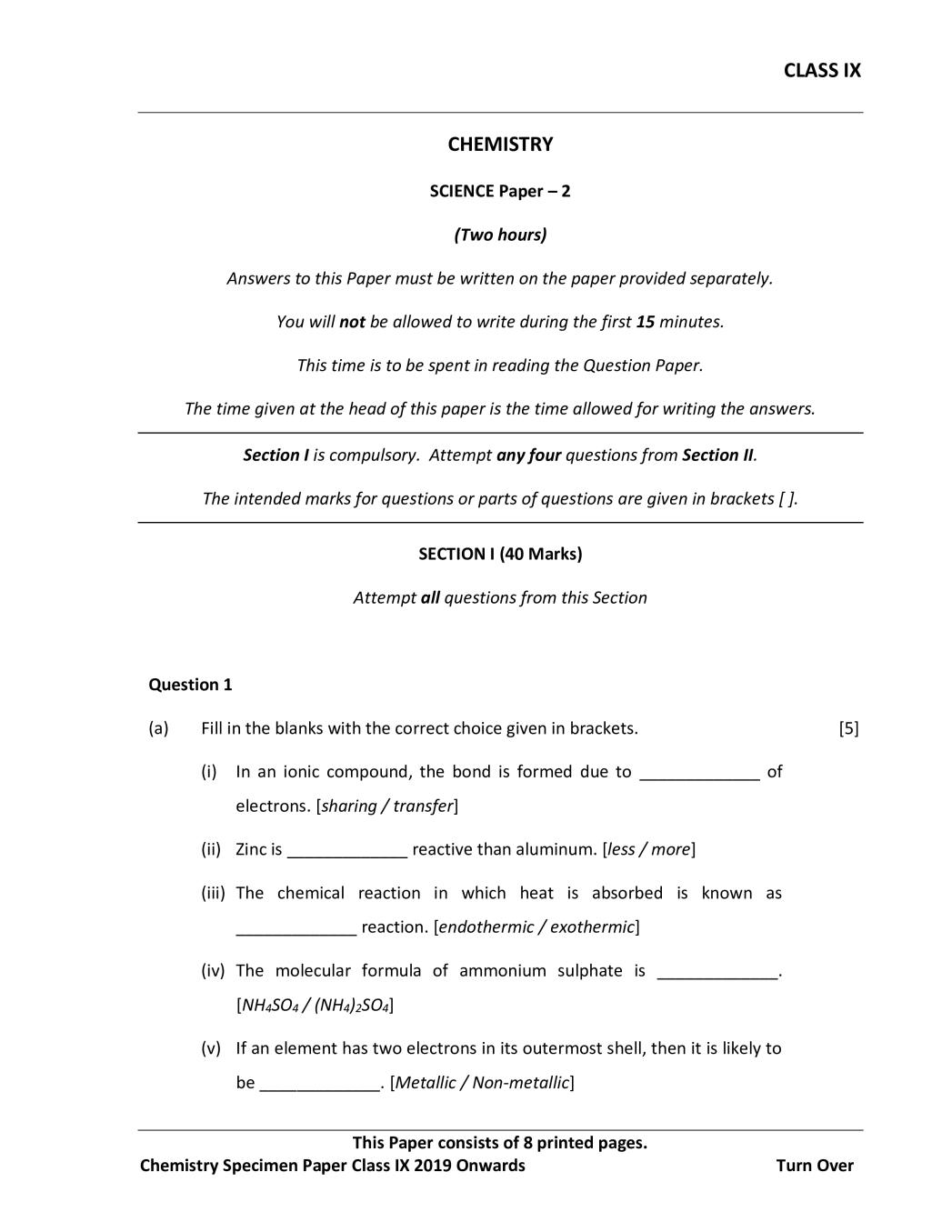
CHEMISTRY
SCIENCE Paper – 2
(Two hours)
Answers to this Paper must be written on the paper provided separately.
You will not be allowed to write during the first 15 minutes.
This time is to be spent in reading the Question Paper.
The time given at the head of this paper is the time allowed for writing the answers.
Section I is compulsory. Attempt any four questions from Section II.
The intended marks for questions or parts of questions are given in brackets [ ].
SECTION I (40 Marks)
Attempt all questions from this Section
Question 1
(a) Fill in the blanks with the correct choice given in brackets. [5]
(i) In an ionic compound, the bond is formed due to _____________ of
electrons. [sharing / transfer]
(ii) Zinc is _____________ reactive than aluminum. [less / more]
(iii) The chemical reaction in which heat is absorbed is known as
_____________ reaction. [endothermic / exothermic]
(iv) The molecular formula of ammonium sulphate is _____________.
[NH4SO4 / (NH4)2SO4]
(v) If an element has two electrons in its outermost shell, then it is likely to
be _____________. [Metallic / Non-metallic]
This Paper consists of 8 printed pages.
Chemistry Specimen Paper Class IX 2019 Onwards Turn Over
Page 2
(i) The gas that causes the greenhouse effect:
A. Oxygen
B. Ammonia
C. Methane
D. Hydrogen Sulphide
(ii) According to the modern periodic law, the properties of elements are a
periodic function of their:
A. Atomic volume
B. Atomic number
C. Atomic weight
D. Mass number
(iii) Which of the following has water of crystallization?
A. Potassium chloride
B. Sodium chloride
C. Sodium nitrate
D. Washing soda crystals
(iv) The gas which has a rotten egg smell is:
A. Hydrogen sulphide
B. Ammonia
C. Sulphur dioxide
D. Hydrogen chloride
(v) The temperature of 0o Celcius on the Kelvin scale is equal to:
A. –273 K
B. 273 K
C. 0 K
D. 100 K
Chemistry Specimen Paper Class IX 2019 Onwards 2
Page 3
(i) Copper carbonate is heated strongly.
(ii) Action of dilute hydrochloric acid on sodium sulphite.
(iii) Nitrogen combines with hydrogen.
(iv) Action of dilute sulphuric acid on sodium carbonate.
(v) Addition of sodium to cold water.
(d) Give a reason for each of the following: [5]
(i) Noble gases do not combine with other elements to form molecules.
(ii) Dilute nitric acid cannot be used in the preparation of hydrogen.
(iii) Hydrogen although lighter than air, is not collected by the downward
displacement of air.
(iv) Anhydrous calcium chloride turns into a colourless solution when
exposed to air.
(v) Metals form positive ions.
(e) What do you observe when: [5]
(i) Iodine crystals are heated in a test tube?
(ii) Iron nails are added to copper sulphate solution?
(iii) Lead nitrate crystals are heated strongly?
(iv) Ferric chloride crystals are exposed to atmosphere for some time?
(v) Blue copper sulphate crystals are heated?
(f) (i) State Boyle’s law. [5]
(ii) What is standard temperature and pressure?
(iii) Calculate the percentage of nitrogen in ammonium nitrate. [NH4NO3]
[ N = 14, H = 1, O = 16]
Chemistry Specimen Paper Class IX 2019 Onwards 3
Turn Over
Page 4
1. FeCl3 + NH4OH NH4Cl + Fe(OH)3
2. KI + Cl2 KCl + I2
(ii) Identify the substance which matches the description given below:
1. White crystalline substance which sublimes on heating.
2. The gas which turns lime water milky but has no effect on potassium
dichromate paper.
3. The metal that cannot displace hydrogen from dilute hydrochloric
acid.
(h) Match Column A with Column B. [5]
Column A Column B
(i) Causes hardness in water A. Calcium oxide
(ii) Causes ozone depletion B. Concentrated sulphuric acid
(iii) Dehydrating agent C. Magnesium bicarbonate
(iv) Causes acid rain D. Chlorofluorocarbon
(v) Drying agent E. Nitrogen dioxide
SECTION II (40 Marks)
Attempt any four questions from this Section
Question 2
(a) The formula of the chloride of a metal ‘M’ is MCl2. State the formula of its: [3]
(i) Carbonate
(ii) Nitrate
(iii) Hydroxide
Chemistry Specimen Paper Class IX 2019 Onwards 4
Page 5
(i) Reaction of iron with chlorine.
(ii) Addition of silver nitrate solution to sodium chloride solution.
(iii) Addition of zinc to sodium hydroxide solution.
(c) Draw the orbit structure for each of the following compounds: [4]
(i) Methane [H = 1, C = 6]
(ii) Magnesium chloride [Mg = 12, Cl = 17]
Question 3
(a) (i) Name the industrial method for the production of hydrogen gas. [3]
(ii) Name the catalyst used in the above process.
(iii) Write the balanced chemical equation for the production of water gas.
(b) (i) What is meant by ‘Group’ in the Periodic Table? [3]
(ii) Explain why the elements of the same group exhibit the same chemical
behaviour.
(iii) In which Group are the inert gases placed in the Periodic Table?
(c) A part of the periodic table is shown below with one element missing: [4]
H He
Li Be B C N O F Ne
Na Mg Al Si – S Cl Ar
K Ca
Based on the above table, answer the following questions:
(i) Name the element that has duplet structure.
(ii) Name the lightest alkali metal.
Chemistry Specimen Paper Class IX 2019 Onwards 5
Turn Over
Page 6
(iv) Identify the missing element.
Question 4
(a) Calculate the volume of gas X at S.T.P. if it occupies 380 litres at 300 K and [3]
70 cm of mercury.
(b) A gas occupies 70 litres at 27oC. [3]
What volume will it occupy at 273oC, pressure remaining constant?
(c) Calculate the relative molecular mass of each of the following: [4]
(i) Ammonium dichromate [(NH4)2Cr2O7]
(ii) Hydrated Copper Sulphate [CuSO4.5H2O]
[H = 1, N = 14, O = 16, S = 32, Cr = 52, Cu = 64]
Question 5
(a) (i) What do you understand by the term isotopes? [3]
(ii) Why do isotopes of an element possess identical chemical properties?
(iii) Name the isotope of hydrogen which does not have a neutron in it.
(b) State the type of covalent bonding in the following molecules: [3]
(i) Chlorine
(ii) Nitrogen
(iii) Oxygen
(c) How would you distinguish between the following pairs of substances on the [4]
basis of the chemical tests given in brackets?
(i) Sodium Chloride and Potassium Chloride (flame test)
(ii) Zinc Carbonate and Lead Carbonate (dry heating)
Chemistry Specimen Paper Class IX 2019 Onwards 6
Page 7
(a) State if the solubility increases, decreases or remains the same with rise in [3]
temperature for each of the following compounds:
(i) Calcium sulphate
(ii) Potassium nitrate
(iii) Sodium chloride
(b) (i) What is the difference between temporary hard water and permanent [3]
hard water?
(ii) Write a balanced chemical equation for the removal of:
1. Permanent hardness
2. Temporary hardness
(c) Classify each of the following reactions as combination, decomposition, [4]
displacement or double displacement:
(i) 2Al + Fe2O3 Al2O3 + 2Fe
(ii) 2KClO3 2KCl + 3O2
(iii) BaCl2 + Na2SO4 BaSO4 + 2NaCl
(iv) CaO + H2O Ca(OH)2
Question 7
(a) Complete the following table: [6]
Number Number
Mass Atomic Number
Element of of
Number Number of Protons
Electrons Neutrons
Phosphorous 31 15
Potassium 19 20
Chemistry Specimen Paper Class IX 2019 Onwards 7
Turn Over
Page 8
40
(i) 20𝐶𝑎
32
(ii) 16𝑆
(c) State the valency of the element having: [2]
(i) 6 electrons in the valence shell.
(ii) the electronic configuration of : 2, 3
Chemistry Specimen Paper Class IX 2019 Onwards 8