MBOSE Class 11 Question Paper 2018 for Economics
Finished viewing? Save it for later —
Download MBOSE Class 11 Question Paper 2018 for Economics (PDF · 5 pages)About MBOSE Class 11 Question Paper 2018 for Economics
MBOSE Class 11 Question Paper 2018 for Economics is available here for free download. Published by Meghalaya Board for Class 11, this question paper can be viewed online or downloaded as a PDF (5 pages). Candidates preparing for Class 11 can use MBOSE Class 11 Question Paper 2018 for Economics to understand the exam pattern, the type of questions asked, and the overall difficulty level.
Frequently Asked Questions
How can I download MBOSE Class 11 Question Paper 2018 for Economics?
Open this page and click the Download button to save MBOSE Class 11 Question Paper 2018 for Economics as a PDF. It is completely free on AglaSem Docs.
Is MBOSE Class 11 Question Paper 2018 for Economics free to download?
Yes. MBOSE Class 11 Question Paper 2018 for Economics can be viewed online and downloaded as a PDF free of cost on AglaSem Docs.
How many pages does MBOSE Class 11 Question Paper 2018 for Economics have?
MBOSE Class 11 Question Paper 2018 for Economics contains 5 pages, which you can read online or download together as a single PDF.
Where can I find more Class 11 study material?
You can find more Class 11 question papers, sample papers, syllabus, and answer keys on AglaSem Docs.
MBOSE Class 11 Question Paper 2018 for Economics – Text
Read the full text of this question paper below — useful to quickly search, copy and reference the content online without downloading the PDF.
📄 View text version (5 pages)
Page 1
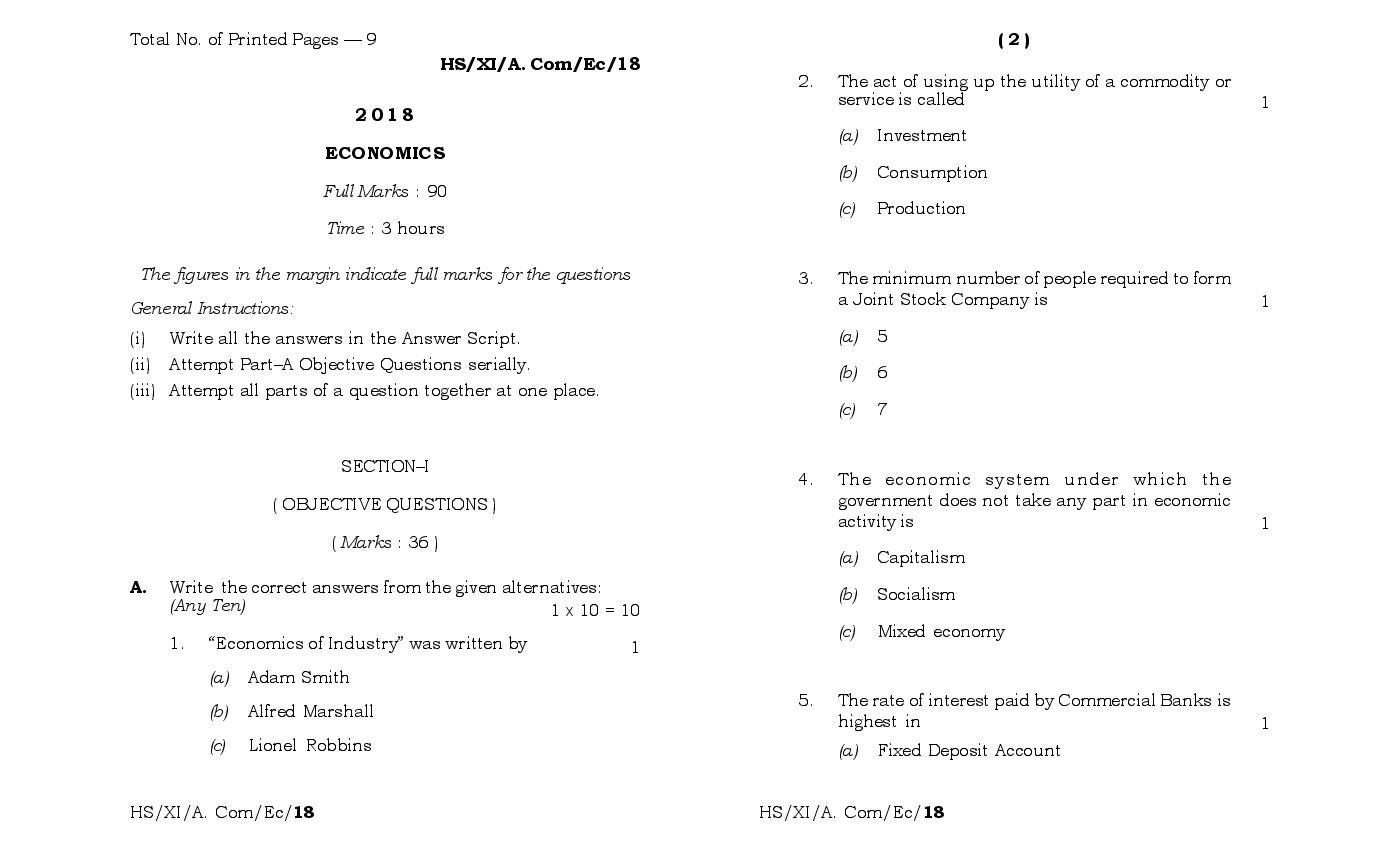
HS/XI/A. Com/Ec/18
2. The act of using up the utility of a commodity or
service is called 1
2018
(a) Investment
ECONOMICS
(b) Consumption
Full Marks : 90
(c) Production
Time : 3 hours
The figures in the margin indicate full marks for the questions 3. The minimum number of people required to form
a Joint Stock Company is 1
General Instructions:
(i) Write all the answers in the Answer Script. (a) 5
(ii) Attempt Part–A Objective Questions serially. (b) 6
(iii) Attempt all parts of a question together at one place.
(c) 7
SECTION–I
4. The economic system under which the
( OBJECTIVE QUESTIONS ) government does not take any part in economic
activity is 1
( Marks : 36 )
(a) Capitalism
A. Write the correct answers from the given alternatives: (b) Socialism
(Any Ten) 1 x 10 = 10
(c) Mixed economy
1. “Economics of Industry” was written by 1
(a) Adam Smith
5. The rate of interest paid by Commercial Banks is
(b) Alfred Marshall
highest in 1
(c) Lionel Robbins (a) Fixed Deposit Account
HS/XI/A. Com/Ec/18 HS/XI/A. Com/Ec/18
Page 2
(b) Current Deposit Account 9. The number of people living below the poverty line in
India is/has 1
(c) Saving Deposit Account
(a) Constant
(b) Increased
6. Resources like water, fisheries and forests are 1 (c) Declined
(a) Renewable resources
10. Statistics may be called the science of counting 1
(b) Non-renewable resources
(a) A. L. Bowley
(c) Exhaustible resources
(b) Yule and Kendall
(c) Croxton and Cowden
7. Sex ratio refers to the number of females per 1
(a) 100 males 11. Graphical representation of a time series data is
called a 1
(b) 1000 males
(a) Pie diagram
(c) 10000 males
(b) Historigram
(c) Frequency polygon
8. Unemployment found mostly in the urban sector
is 1
12. The concept of Standard Deviation was
introduced by 1
(a) Seasonal unemployment
(a) Croxton and Cowden
(b) Disguised unemployment
(b) A. L. Bowley
(c) Industrial unemployment
(c) Karl Pearson
HS/XI/A. Com/Ec/18 HS/XI/A. Com/Ec/18
Page 3
B. Fill in the blanks with one word only : (Any Ten) 11. is that value of the variable which
1 x 10 = 10 occurs with maximum frequency. 1
12. is the simplest form of dispersion. 1
1. The two broad branches of Economics are
Micro-economics and Economics. 1
C. Answer the following questions in two or three
2. Activities carried out for getting a monetary reward sentences each. (Any eight) 2 x 8 = 16
are known as activities. 1
1. Define utility. 2
3. Land is in supply. 1
2. State two characteristics of land. 2
4. Mixed economy is that economy in which both
the sector and private sector co-exist. 1 3. What is a capitalist economy? 2
5. In India one rupee notes/coins are issued by the 4. State Gresham’s Law. 2
Ministry of . 1
5. What is a bank? 2
6. Under developed countries have
consumption level. 1
6. What is density of population? 2
7 India’s population is the largest in
7. Mention two causes of unemployment in India. 2
the world. 1
8. Give full form of 1+1=2
8. unemployment can happen even in
a situation of full employment. 1 (a) IRDP
(b) NREP
9. National income at constant price is also called 9. What is per capita income? 2
national income. 1
10. What is primary data? 2
10. Frequency polygon is derived from a . 1
HS/XI/A. Com/Ec/18 HS/XI/A. Com/Ec/18
Page 4
11. What is a Multiple bar diagram? 2 6. Briefly explain the functions of a Central Bank. 6
12. Calculate range for the following 2 PART – II
Marks: 0-10 10-20 20-30
Frequency: 1 3 2 ( ANY THREE )
SECTION –– II 7. Distinguish between economic growth and economic
development. 3+3=6
( DESCRIPTIVE QUESTIONS )
8. Explain the direct benefits of forest resources. 6
( Marks – 54 )
9. Distinguish between: 3+3=6
Answer any nine questions taking three from each part. (a) Open unemployment and disguised
6 x 9 = 54 unemployment.
(b) Under-employment and seasonal unemployment.
PART – I
( ANY THREE ) 10. What are the measures suggested to control the rapid
growth of population in India? 6
1. State and explain Robbins’ definition of Economics.
2+4=6 11. What are the causes of poverty in India? 6
2. Define wealth. What are the characteristics of wealth?
12. Discuss the sectoral distribution of national income
2+4=6
in India. 6
3. What are the functions of an entrepreneur as a factor
of production? 6
PART – III
4. What are the general features of socialism? 6
( ANY THREE )
5. Discuss the primary and secondary functions of
money. 6 13. Describe the importance of statistics. 6
HS/XI/A. Com/Ec/18 HS/XI/A. Com/Ec/18
Page 5
14. Distinguish between Census Enumeration and
Sampling Technique. What are their respective merits?
2+4=6
15. Calculate the median for the following: 6
Marks : 10 20 30 40 50 60
Frequency : 5 8 11 12 5 9
16. Calculate the mode for the following series: 6
Marks : 0 – 10 10 – 20 20 – 30 30 – 40 40 – 50
Frequency : 8 12 16 10 6
17. Define Mean Deviation. What are the advantages and
disadvantages of Mean Deviation? 2+4=6
18. Calculate the Standard Deviation for the following. 6
Marks : 2 4 6 8 10
Frequency : 4 5 11 7 3
HS/XI/A. Com/Ec/18
Document Details
| Board / Org | Meghalaya Board |
| Exam | Class 11 |
| Type | Question Paper |
| Pages | 5 |
| Updated | 30 Apr 2026 |