MAHA SET 2024 Paper II Education Set A Question Paper
Finished viewing? Save it for later —
Download MAHA SET 2024 Paper II Education Set A Question Paper (PDF · 32 pages)About MAHA SET 2024 Paper II Education Set A Question Paper
MAHA SET 2024 Paper II Education Set A Question Paper is available here for free download. Published by Maharashtra Exams for MAHA SET, this question paper can be viewed online or downloaded as a PDF (32 pages). Candidates preparing for MAHA SET can use MAHA SET 2024 Paper II Education Set A Question Paper to understand the exam pattern, the type of questions asked, and the overall difficulty level.
Frequently Asked Questions
How can I download MAHA SET 2024 Paper II Education Set A Question Paper?
Open this page and click the Download button to save MAHA SET 2024 Paper II Education Set A Question Paper as a PDF. It is completely free on AglaSem Docs.
Is MAHA SET 2024 Paper II Education Set A Question Paper free to download?
Yes. MAHA SET 2024 Paper II Education Set A Question Paper can be viewed online and downloaded as a PDF free of cost on AglaSem Docs.
How many pages does MAHA SET 2024 Paper II Education Set A Question Paper have?
MAHA SET 2024 Paper II Education Set A Question Paper contains 32 pages, which you can read online or download together as a single PDF.
Where can I find more MAHA SET study material?
You can find more MAHA SET question papers, sample papers, syllabus, and answer keys on AglaSem Docs.
MAHA SET 2024 Paper II Education Set A Question Paper – Text
Read the full text of this question paper below — useful to quickly search, copy and reference the content online without downloading the PDF.
📄 View text version (33 pages)
Page 1
MAHA SET 2024 Paper
II Education Set A
Question Paper
EXAM YEAR TYPE
MAHA SET 2024 Question Paper
Notes · Sample Papers · Previous Year Papers · Mock Tests
Page 2
.co s e m
s em l a
a ag
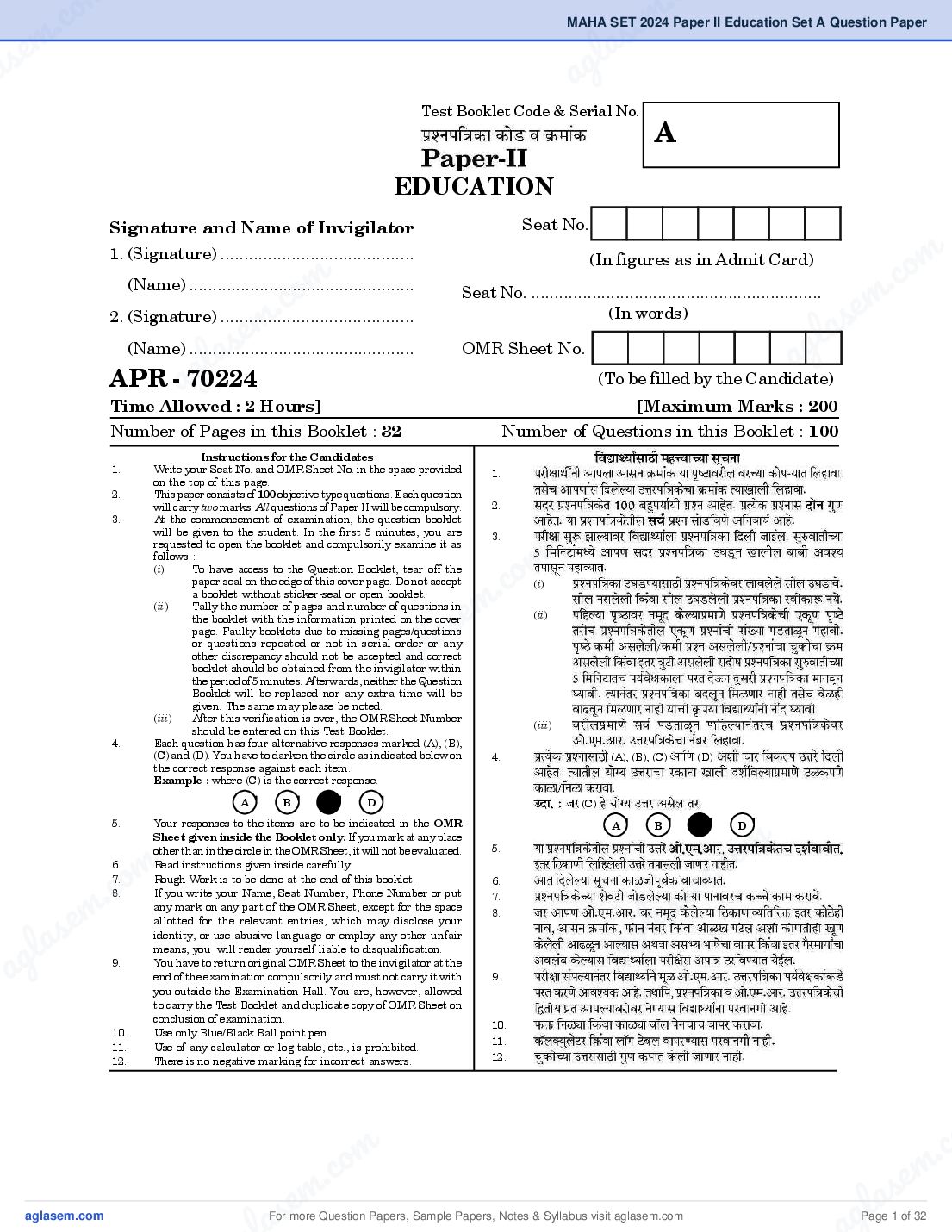
Test Booklet Code & Serial No.
A
EDUCATION
Signature and Name of Invigilator Seat No.
m
co
1. (Signature) ......................................... (In figures as in Admit Card)
c om
(Name) ................................................
. e
Seat No. ..............................................................
m .
em
2. (Signature) ......................................... (In words)
l as
l a s
(Name) ................................................ OMR Sheet No.
ag
APR -a70224g (To be filled by the Candidate)
Time Allowed : 2 Hours] [Maximum Marks : 200
Number of Pages in this Booklet : 32 Number of Questions in this Booklet : 100
Instructions for the Candidates
1. Write your Seat No. and OMR Sheet No. in the space provided 1.
on the top of this page.
2. This paper consists of 100 objective type questions. Each question
will carry two marks. All questions of Paper II will be compulsory. 2.
3. At the commencement of examination, the question booklet
will be given to the student. In the first 5 minutes, you are 3.
m
requested to open the booklet and compulsorily examine it as
.co
follows :
(i) To have access to the Question Booklet, tear off the
paper seal on the edge of this cover page. Do not accept (i)
a booklet without sticker-seal or open booklet.
e m
s
(ii) Tally the number of pages and number of questions in
a
the booklet with the information printed on the cover (ii)
l
page. Faulty booklets due to missing pages/questions
ag
or questions repeated or not in serial order or any
other discrepancy should not be accepted and correct
booklet should be obtained from the invigilator within
the period of 5 minutes. Afterwards, neither the Question
Booklet will be replaced nor any extra time will be
given. The same may please be noted.
(iii) After this verification is over, the OMR Sheet Number
(iii)
should be entered on this Test Booklet.
4. Each question has four alternative responses marked (A), (B),
(C) and (D). You have to darken the circle as indicated below on 4. (A), (B), (C) (D)
the correct response against each item.
Example : where (C) is the correct response.
A B D (C)
5. Your responses to the items are to be indicated in the OMR
m
A B D
.co
Sheet given inside the Booklet only. If you mark at any place
5.
m
other than in the circle in the OMR Sheet, it will not be evaluated.
.co
6. Read instructions given inside carefully.
7. Rough Work is to be done at the end of this booklet. 6.
e m
m s
8. If you write your Name, Seat Number, Phone Number or put 7.
e la
any mark on any part of the OMR Sheet, except for the space
s
8.
g
allotted for the relevant entries, which may disclose your
la a
identity, or use abusive language or employ any other unfair
ag 9.
means, you will render yourself liable to disqualification.
You have to return original OMR Sheet to the invigilator at the
end of the examination compulsorily and must not carry it with 9.
you outside the Examination Hall. You are, however, allowed
to carry the Test Booklet and duplicate copy of OMR Sheet on
conclusion of examination.
10.
10. Use only Blue/Black Ball point pen.
11.
11. Use of any calculator or log table, etc., is prohibited.
12. There is no negative marking for incorrect answers. 12.
m . c
c. o s e m
s em
For more Question Papers, Sample Papers, Notes & Syllabus visit
gl a
Page 1 of 32
Page 3
For more Question Papers, Sample Papers, Notes & Syllabus visit Page 2 of 32
Page 4
.co s e m
s em l a
a ag
Education
Paper II
m
om . co
Time Allowed : .120c Minutes] II
[Maximum Marks : 200 e m
e m l as
l as Two (2) marks. Attempt All questions.
Note : This Paper contains Hundred (100) multiple choice
g
questions. Each question
a
ag
carrying
(100) (2)
1. A small and primary social group 1.
is .................... .
(A) Family (A)
(B) Peers
o m
(B)
m .c
e
(C) Cotravellers in a bus (C)
l as
g
(D) Whatsapp group (D)
2.
a
In our constitution, the subject of 2.
Education is included in concurrent
list. It means that .................. .
(A) Only union government will
pay attention to education (A)
m
.co
(B) Only state government will pay
m
.co
(B)
attention to education
e m
e m (C)
las
las (C) The subject of education is the
ag
ag responsibility of both union and
state government
(D)
(D) The subject of education is
handled only by the President
3 [P.T.O.
m . c
c. o s e m
s em
For more Question Papers, Sample Papers, Notes & Syllabus visit
gl a
Page 3 of 32
Page 5
....................... made efforts in widow
re-marriage.
(A) Swami Vivekananda (A)
(B) Sri Aurobindo (B)
(C) Mahatma Gandhi (C)
(D) Savitribai Phule (D)
4. The idea of .................... was borrowed 4.
from Gandhiji’s Basic Education
System and was included in
recommendations of Kothari
Commission. (A)
(A) Technical Education (B)
(B) Work Experience
(C)
(C) Compulsory English
(D)
(D) Religious Education
5. Rabindranath Tagore founded the 5.
following three institutes :
(A) Shantiniketan, Geetanjali,
Shikshabhavan (A)
(B) Kalabhavan, Sangeetbhavan,
Vidyabhavan (B)
(C) Vidyabhavan, Sriniketan,
(C)
Vishvabhavan
(D) Shantiniketan, Sriniketan, (D)
Vishvabharati
6. In the former period of his life 6.
J. Krishnamurthy was concerned
with the spiritual institution
called .................. .
(A) Brahmo Samaj (A)
(B) Theosophical Society (B)
(C) Ramkrishna Mission (C)
(D) Arya Samaj
(D)
4
For more Question Papers, Sample Papers, Notes & Syllabus visit Page 4 of 32
Page 6
.co s e m
s em l a
a ag
7. As per Sri Aurobindo’s idea of 7.
Integral Education the last stage of
it is ................ .
m
om . co
m
(A)
c
(A) Spiritual Education
m . s e
e
(B) Yogic Education
s
(B)
g l a
g l a
(C) Psychic Education (C) a
(D) aValue Education (D)
8. According to Swami Vivekananda, 8.
the education is ................... already
in man.
(A) Concentration of knowledge (A)
m (B)
c. o (C)
(B) Meditation on the spirit
(C) Manifestation of the spirituality
e m
l as
(D) Manifestation of the perfection (D)
9. agcame 9.
The philosophy of naturalism
forward with reaction to .............. .
(A) Idealism (A)
(B) Realism (B)
(C) Pragmatic (C)
(D)
(D) Existentialism
m
m
c. o the values are .................. .
10. According to pragmatic philosophy, 10.
m.co
m s e
s e g la
la a
(A) Dynamic and absolute (A)
ag (B) Eternal and relative (B)
(C) Experiential and subjective (C)
(D) Experimental and objective (D)
5 [P.T.O.
m . c
c. o s e m
s em
For more Question Papers, Sample Papers, Notes & Syllabus visit
gl a
Page 5 of 32
Page 7
preprimary education by a
committee, was to be processed for
feedback. The most appropriate
group of stakeholders is :
(A)
(A) Social workers, educationists,
politicians
(B) B.Ed. college staff, students, (B)
principals
(C)
(C) Teacher educators,
pediatricians, anganwadi
teachers
(D)
(D) Teacher educators, anganwadi
teachers, learners
12. In consideration to Indian 12.
constitutional provision, admission
to Govt. primary shools and Govt.
higher educational institutes, the
principle adopted is :
(A)
(A) Equality
(B)
(B) Equity
(C)
(C) Equity for primary, equality for
higher education
(D) Equality for primary, equity for (D)
higher education
13. Mudaliar Commission had 13.
recommend on :
(A) Early childhood education (A)
(B) Primary education (B)
(C) Secondary education (C)
(D) Higher education (D)
6
For more Question Papers, Sample Papers, Notes & Syllabus visit Page 6 of 32
Page 8
.co s e m
s em l a
a ag
14. Kothari Commission emphasize to 14.
focus, education for .................. .
(A) Environmental consciousness (A)
m
om
(B) Art and cultural education (B)
. co
. c e m
s
(C) Informal education (C)
e m l a
as
(D) Productivity
l the target expansion of
(D)
ag
g
a enrolment, the Education
15. To reach
student
15.
1964-66
Commission 1964-66 proposed to
have one-third of the student in the
institutes by name :
(A) Open University (A)
(B) Distance Education Institutes (B)
m
c. o (D)
(C) Correspondence Education (C)
Institute
e m
(D) Digital Media Institute
l as 16.
ag
16. The two reports headed by Prof.
Yashpal are :
(i) National Policy on Education- (i) 1986
1986
(ii) National Knowledge Commission (ii)
(iii) National Curriculum Frame- (iii) 2005
work-2005
(iv)
m
.co
(iv) Curriculum Framework for
m (v)
c. o (v) Renovation and Rejuvenation
Teacher Education
e m
e m a s
l(iv)
las of Higher Education (A) (iii)
ag
ag (A) (iii) and (iv)
(B) (i) (ii)
(B) (i) and (ii)
(C) (i) (iii)
(C) (i) and (iii)
(D) (iii) and (v) (D) (iii) (v)
7 [P.T.O.
m . c
c. o s e m
s em
For more Question Papers, Sample Papers, Notes & Syllabus visit
gl a
Page 7 of 32
Page 9
that the 291 D.Ed. colleges reassured
and resulted :
(A) Majority were qualifying for
(A)
recongnition
(B) 50
(B) Less than 50 were qualified for
recongnition
(C) All were fit to disqualify for (C)
their recongnition (D)
(D) All were fit to be recongnised
18. For secondary teacher education
18. NCFTE
curriculum, which one of the
following is proposed as course
under foundation area by NCFTE ?
(A) Foundation of Psychology and
(A)
learning
(B) Foundation of Philosophy and (B)
thinkers
(C)
(C) Childhood, child adolescence
and development of learning
(D) Contribution of Indian History
(D)
of Education
19. The NCFTE has observed that the 19. NCFTE
M.A. Education and M.Ed. courses :
(A) both are similar course details
(B) have very distinct curriculum (A)
(C) both are professional in nature (B)
(D) Neither of them are stage (C)
specific (D)
8
For more Question Papers, Sample Papers, Notes & Syllabus visit Page 8 of 32
Page 10
.co s e m
s em l a
a ag
20. National Policy of Education-1986 20. 1986
recommended nationalisation
m
through :
om
(A) ICT based skill development (A) ICT
. co
. c e m
m
(B) Technical skill based programme
e
(B)
l as
as
(C) Agricultural vocational course
l vocational courses
(C)
ag
ag
(D) Generic (D)
21. Rogers while explaining personality, 21.
he gives importance to ................ .
(A) Here and now phenomenon (A)
(B) Futuristic phenomenon (B)
(C) Past phenomenon (C)
(D) Self
o m
(D)
m
22. Hemant has collection of 1200 words, 22..c 1200
s e
he himself can wear his socks, he
a
himself can eat, then what willl be
his minimum age ? ag
(A)
(A) One year
(B)
(B) Two years
(C) Three and half years (C)
(D) Five years (D)
23. Ramesh always in search of Idol, he 23.
m
malways criticises traditions, then he
.co
m .co belongs to ..................... stage of
s e m
s e development.
g la
g la (A) Pre-childhood
(A)
a
a (B) Post-childhood (B)
(C) Adolescent (C)
(D) Adult (D)
9 [P.T.O.
m . c
c. o s e m
s em
For more Question Papers, Sample Papers, Notes & Syllabus visit
gl a
Page 9 of 32
Page 11
may be explained with the following
equation :
(A) I = G + (S1 + S2 + S3 + ..... Sn)
(A) I = G + (S1 + S2 + S3 + ..... Sn)
(B) I = (G + S 1) + (G + S2) +
(B) I = (G + S 1) + (G + S2) + (G + S3) + ...... (G + Sn)
(G + S3) + ...... (G + Sn)
(C) I = [PMA1 + PMA2 + PMA3 +
(C) I = [PMA1 + PMA2 + PMA3 + ........ PMA8]
........ PMA8]
(D) I = S1 + S2 + S3 + ...... Sn
(D) I = S1 + S2 + S3 + ...... Sn
where :
G —
G — General factor
S —
S — Specific factor
PMA — Primary mental abilities PMA —
25. In information processing theory of 25.
intelligence, the following is the last
step of information processing :
(A) Decoding (A)
(B) Encoding (B)
(C) Response (C)
(D) Application (D)
26. .................. is not the important 26.
supportive component for problem
solving.
(A)
(A) Guide
(B)
(B) Motivation
(C) Intelligence (C)
(D) Practice (D)
27. Skinner gives more importance 27.
.................... in learning.
(A) stimulus (A)
(B) response (B)
(C) process (C)
(D) behaviour (D)
10
For more Question Papers, Sample Papers, Notes & Syllabus visit Page 10 of 32
Page 12
.co s e m
s em l a
a ag
28. .................. is not the affecting factor 28.
to social learning.
(A) Culture (A)
m
m
(B) Social context (B)
. co
colearner’s behaviour
(C) Relevance .of (C)
s e m
s em
(D) Motivation (D)
g l a
29. Breverla a
g while defining guidance, he
a importance to ............... .
gives
29.
(A) self-guidance (A)
(B) interactions with others (B)
(C) purpose (C)
(D) adjustment (D)
30. Which of the following statements 30.
m
.co
is wrong in respect to counselling ?
(A) Counselling is interactive
e m (A)
process
l as
ag
(B) Counselling is meaningful (B)
process (C)
(C) In counselling there is no need
of face to face interaction
(D)
(D) Purpose of counselling is to
solve the problems of counsellee
31. According to the National Education 31. 2020
m
Policy 2020, the work of National
m .co
Mission for Mentoring (NMM) for
.co
(NMM)
the professional development of
e m
e m teachers will be done through which
as
s (A) NCERTgl
la
organization ?
g a
a
(A) NCERT
(B) IUCTE
(B) IUCTE
(C) UGC (C) UGC
(D) NCTE (D) NCTE
11 [P.T.O.
m . c
c. o s e m
s em
For more Question Papers, Sample Papers, Notes & Syllabus visit
gl a
Page 11 of 32
Page 13
advantage of Computer Assisted (CAI)
Instruction (CAI) :
(A)
(A) Computers are absolutely
impartial (B)
(B) Self-pacing is impossible if the
tutorial mode is used
(C)
(C) Higher cognitive abilities are
achievable with the right mode
(D) CAI is instructor independent (D) CAI
33. Which was the main reason that 33.
Diploma in Higher Education (DHE) (DHE)
course for teachers at higher 1985
secondary level was discontinued
in 1985 by the Government of
Maharashtra ? (A)
(A) The aim of higher secondary
level education is not achieved
through this course
(B)
(B) This is postal course
(C) No new teaching methods are (C)
used in this course
(D) The curriculum is not enough (D)
to improve the quality of
teachers at the higher
secondary level
34. In case of derecognition of a College 34.
of Education in the State of
Maharashtra, they should appeal to
which of the following NCTE NCTE
offices ? (A)
(A) Eastern Regional Committee
(B)
(B) Western Regional Committee
(C) Northern Regional Committee (C)
(D) Southern Regional Committee (D)
12
For more Question Papers, Sample Papers, Notes & Syllabus visit Page 12 of 32
Page 14
.co s e m
s em l a
a ag
35. In which years the in-service 35.
teacher education programme, (PMOST)
Programme of Mass Orientation of
m
co
School Teachers (PMOST) was
om .
implemented ? (A) 1986-90
(A) 1986-90
. c e m
em (B) 1987-90
l as
s
(B) 1987-90
l a
(C) 1985-90
(C) 1985-90
ag
ag
(D) 1984-90 (D) 1984-90
36. Under which in-service teacher 36.
training Operation Blackboard
materials provided to primary school
teachers ?
(A) SOPT
(A) SOPT
(B) MOST
(B) MOST
(C) DPEP
(C) DPEP
o m
(D) IIPCAT
. c (D) IIPCAT
e m37.
s
37. Which of the following component is
related to respect of component of
l a
ethical standards in teaching
profession ? ag (A)
(A) Honesty
(B)
(B) Fair mindedness
(C)
(C) Interest
(D)
(D) Moral Action
38. What are the key attributes of 38.
m
Professional code of ethics ?
m .co
(i) Confidentiality (i)
m .co (ii) Interest (ii)
s e m
s e (iii) Loyalty (iii)
g la
g la (iv) Emotional wellness (iv)
a
a (A) (i), (ii), (iii)
(B) (ii), (iii), (iv)
(A) (i), (ii), (iii)
(B) (ii), (iii), (iv)
(C) (i), (iii) (C) (i), (iii)
(D) (i), (iv) (D) (i), (iv)
13 [P.T.O.
m . c
c. o s e m
s em
For more Question Papers, Sample Papers, Notes & Syllabus visit
gl a
Page 13 of 32
Page 15
graduates with three years’
experience to be admitted to M.Ed.
course ?
(A) Yashpal committee
(B) Education Commission reports (A)
1964-66
(B) 1964-66
(C) University Grants Commission
reports 1960s (C) 1960
(D) Chattopadhyaya committee
(D) 1983-85
1983-85
40. Under Sarva Shiksha Abhiyan, in- 40.
service training for in-service
teachers was for ........... days while
induction training for newly
recruited teachers was for ..............
days. (A) 10 20
(A) 10 and 20
(B) 20 28
(B) 20 and 28
(C) 14 and 28 (C) 14 28
(D) 20 and 30 (D) 20 30
41. Which of the following subjects is 41.
mostly useful in selecting the
objectives ?
(A)
(A) Performing Arts
(B)
(B) Psychology
(C) History (C)
(D) Physical Education (D)
42. According to Bradfeld and 42.
Moredock, which of the following is
the Level-I performance ?
(A)
(A) Creating
(B) Imitating (B)
(C) Explaining (C)
(D) Comparing (D)
14
For more Question Papers, Sample Papers, Notes & Syllabus visit Page 14 of 32
Page 16
.co s e m
s em l a
a ag
43. Competency based curriculum design 43.
especially emphasizes on .............
m
co
(A) Mastery of knowledge (A)
o m m .
. c
(B) Mastery of understanding
(C) Masterymof specific skills
(B)
s e
s e of crafts (C)
g l a
l a
(D) Mastery
g
(D) a
a to the Kirkpatrick model
44. According 44.
of evaluation on which level we can
measure the institutional outcomes ?
(A) Level of Reaction (A)
(B) Level of Learning (B)
(C) Level of Transfer
om
(C)
(D) Level of Results
m .c (D)
45. Arrange the steps of thinking in e 45.
l as
ag
their normal sequence :
(i) Collecting relevant facts (i)
(ii) Testing the hypothesis
(ii)
(iii) Drawing conclusions
(iii)
(iv) Sensing a difficulty
(iv)
(v) Identifying the problem
m
(v)
.co
(vi) Formulating possible hypothesis
m
c. o Choose
(vi)
em
the most correct answer from
e m the options given below :
la s
las (A) (v)-(i)-(vi)-(ii)-(iv)-(iii) a g
(A) (v)-(i)-(vi)-(ii)-(iv)-(iii)
ag (B) (v)-(iv)-(i)-(vi)-(ii)-(iii) (B) (v)-(iv)-(i)-(vi)-(ii)-(iii)
(C) (iv)-(v)-(i)-(vi)-(ii)-(iii) (C) (iv)-(v)-(i)-(vi)-(ii)-(iii)
(D) (i)-(vi)-(ii)-(v)-(iii)-(iv) (D) (i)-(vi)-(ii)-(v)-(iii)-(iv)
15 [P.T.O.
m . c
c. o s e m
s em
For more Question Papers, Sample Papers, Notes & Syllabus visit
gl a
Page 15 of 32
Page 17
process in order to sequence :
(i) Evidence on teaching-learning (i)
operations
(ii)
(ii) Evidence on factors affecting
learning
(iii) Evidence on pupil behaviour (iii)
pertaining to objective
(iv) Objectives (iv)
Choose the correct answer from the
options given below :
(A) (ii)-(i)-(iv)-(iii)
(A) (ii)-(i)-(iv)-(iii)
(B) (iii)-(ii)-(i)-(iv)
(B) (iii)-(ii)-(i)-(iv)
(C) (iv)-(i)-(iii)-(ii) (C) (iv)-(i)-(iii)-(ii)
(D) (i)-(ii)-(iv)-(iii) (D) (i)-(ii)-(iv)-(iii)
47. Arrange the affective categories in 47.
order to sequence :
(i)
(i) Organization of a value system
(ii)
(ii) Reflection to a phenomenon
(iii) Characterization by a value (iii)
(iv) Receiving sensitivity to (iv)
a phenomenon
(v)
(v) Valuing belief in a phenomenon
Choose the correct answer from the
options given below : (A) (iii)-(i)-(ii)-(iv)-(v)
(A) (iii)-(i)-(ii)-(iv)-(v) (B) (iv)-(iii)-(i)-(ii)-(v)
(B) (iv)-(iii)-(i)-(ii)-(v)
(C) (iv)-(ii)-(v)-(i)-(iii)
(C) (iv)-(ii)-(v)-(i)-(iii)
(D) (iii)-(iv)-(ii)-(v)-(i)
(D) (iii)-(iv)-(ii)-(v)-(i)
16
For more Question Papers, Sample Papers, Notes & Syllabus visit Page 16 of 32
Page 18
.co s e m
s em l a
a ag
48. Arrange the factors of the cone of 48.
curriculum in order to sequence :
(i)
(i) Fused
m
(ii) Core curriculum
om
(ii)
. co
. c e m
m
(iii) Correlated
e
(iii)
l as
as (iv)
ag
gl curriculum
(iv) Broad fields
(v) aActivity (v)
(vi) Disciplinary (vi)
Choose the most correct answer from
the options given below :
(A) (ii)-(iii)-(v)-(i)-(iv)-(vi)
(A) (ii)-(iii)-(v)-(i)-(iv)-(vi)
(B) (iii)-(iv)-(ii)-(v)-(vi)-(i)
(B) (iii)-(iv)-(ii)-(v)-(vi)-(i)
o m
(C) (iv)-(v)-(ii)-(iii)-(i)-(vi)
.c
(C) (iv)-(v)-(ii)-(iii)-(i)-(vi)
e
(D) (v)-(ii)-(iv)-(i)-(iii)-(vi) m (D) (v)-(ii)-(iv)-(i)-(iii)-(vi)
as 49.
49. Which of the following are lthe
ag
general principles in selecting
learning experiences ?
(i)
(i) Opportunity to practice
(ii)
(ii) Student’s satisfaction
(iii) Students involvement (iii)
(iv) Teacher’s attitude (iv)
m
m(v) Environmental demand
c. o Choose the most correct answer from
(v)
.co
m s em
s e the options given below : a
(A) (i), (ii) gl (iii)
g la (A) (i), (ii) and (iii) only a
a (B) (ii), (iii) and (iv) only
(B) (ii), (iii) (iv)
(C) (iii), (iv) and (v) only (C) (iii), (iv) (v)
(D) (i), (ii) and (v) only (D) (i), (ii) (v)
17 [P.T.O.
m . c
c. o s e m
s em
For more Question Papers, Sample Papers, Notes & Syllabus visit
gl a
Page 17 of 32
Page 19
of selecting content ?
(i) Topics selection (i)
(ii) Basic ideas selection (ii)
(iii) Specific content selection
(iii)
(iv) Sampling of the content
(iv)
(v) Processing content
(v)
Choose the correct answer from the
options given below :
(A) (i), (ii) and (iii) only (A) (i), (ii) (iii)
(B) (ii), (iii) and (iv) only (B) (ii), (iii) (iv)
(C) (iii), (iv) and (v) only (C) (iii), (iv) (v)
(D) (iv), (v) and (i) only (D) (iv), (v) (i)
51. Prediction is one of the ..................... 51.
of research as scientific activity.
(A) Aims (A)
(B) Types (B)
(C) Source (C)
(D) Feature (D)
52. The research which is done for 52.
human welfare, animal welfare and
plant welfare is called ................. .
(A) Historical research (A)
(B) Applied research (B)
(C) Fundamental research (C)
(D) Action research (D)
53. The research which is designed to 53.
solve practical problem of the
modern world, rather than to acquire
knowledge for knowledge’s sake is
called .................. . (A)
(A) Fundamental research
(B)
(B) Applied research
(C) Action research (C)
(D) Historical research (D)
18
For more Question Papers, Sample Papers, Notes & Syllabus visit Page 18 of 32
Page 20
.co s e m
s em l a
a ag
54. The ................. technique is the most 54.
commonly used technique specially
in studies relating to behavioural
m
co
studies.
(A) Observationom .
(A)
. c e m
e
(B) Interview m (B)
l as
l as
(C) Questionnaire (C)
ag
g
(D) aProjective (D)
55. Thematic Appreciation Test is a 55.
.................... technique.
(A) Word association (A)
(B) Sentence completion (B)
(C) Story completion (C)
(D) Pictorial technique
o m
(D)
56. The ................ is a statistical measure
m .c
56.
used in the context of sampling e
l a s
ag
analysis for comparing a variance to
a theoretical variance.
(A) (ANOVA)
(A) ANOVA
(B)
(B) chi-square test
(C) z-test
(D) t-test (D) t-
57. The .................. refers to the process 57.
m
.co
of selecting, focusing, simplifying,
m
.co m
abstracting and transforming the
m
data that appear in written up field
s e
s e notes or transcriptions.
g la
g la (A) Analytical induction
(A)
a
a (B) Triangulation (B)
(C) Constant comparison (C)
(D) Data reduction (D)
19 [P.T.O.
m . c
c. o s e m
s em
For more Question Papers, Sample Papers, Notes & Syllabus visit
gl a
Page 19 of 32
Page 21
qualitative methods, in combination,
provide a better understanding of
the research problem and question
than either method by itself is
called .................. .
(A) Action research designs (A)
(B) Case study (B)
(C) Mixed methods designs (C)
(D) Narrative research designs (D)
59. The purpose of ...................... is to 59.
simultaneously collected both
quantitative and qualitative data,
merge the data and use the results
to understand a research problem.
(A) (convergent)
(A) Convergent mixed methods
design
(B) Exploratory sequential design (B)
(C) Embedded design (C)
(D) Multiphase design (D)
60. Providing a rational for the design 60.
is the characteristic of ............... .
(A) Graded theory designs (A)
(B) (ethnographic)
(B) Ethnographic designs
(C) Narrative research designs (C)
(D) Mixed methods designs (D)
61. For diagnostic tests, the test-difficulty 61.
is .................. .
(A) Low (A)
(B) Moderate (B)
(C) High (C)
(D) Very high (D)
20
For more Question Papers, Sample Papers, Notes & Syllabus visit Page 20 of 32
Page 22
.co s e m
s em l a
a ag
62. .................. emphasizes discrimination 62.
among individuals in terms of
relative level of learning.
m
om
(A) Content Referenced Test
(A)
. co
. c (B)
e m
m
(B) Objective Referenced Test
e l as
as (C)
ag
gl Referenced Test
(C) Criterion Referenced Test
(D) aNorms (D)
63. Using ................ is an efficient way 63.
to assess ‘portfolios’.
(A) Oral examinations (A)
(B) Questionnaire (B)
om
(C) Observation (C)
(D) Rubrics
m .c (D)
64. Management and monitoring, e 64.
l as
ag are
assessment of learning needs,
collaboration and self-evaluation
components of ................. .
(A)
(A) Self-Directed Learning
(B)
(B) Self-Defined Learning
(C)
(C) Self-Determined Learning
(D)
m
.co
(D) Self-Derived Learning
m
.co m
65. .................. scores are widely used for 65.
m s e
la
local norms.
s e g
g la (A) Z-scores (A) Z-
a
a (B) T-scores (B) T-
(C) Stannine scores (C)
(D) Percentile (D)
21 [P.T.O.
m . c
c. o s e m
s em
For more Question Papers, Sample Papers, Notes & Syllabus visit
gl a
Page 21 of 32
Page 23
nature.
(A)
(A) Judgemental not developmental
(B) Developmental not judgemental (B)
(C) Judgemental not external (C)
(D) Developmental not internal (D)
67. Pedagogy is concerned with ............ . 67.
(A) Assessment methods (A)
(B) Teaching methods (B)
(C) Curriculum (C)
(D) Content to be taught (D)
68. What is the correct sequence of 68.
learning outcomes related to
affective domain, from lower to
higher level ?
(i)
(i) Responding
(ii)
(ii) Receiving
(iii)
(iii) Organisation
(iv) (Valuing)
(iv) Valuing
(A) (i), (ii), (iv) and (iii) (A) (i), (ii), (iv) (iii)
(B) (ii), (i), (iv) and (iii) (B) (ii), (i), (iv) (iii)
(C) (i), (ii), (iii) and (iv) (C) (i), (ii), (iii) (iv)
(D) (vi), (iii), (ii) and (i) (D) (vi), (iii), (ii) (i)
69. According to Galloway’s theory, 69.
which of the following factors
are influencing on non-verbal
communication ? (i)
(i) Socio-economic status
(ii)
(ii) Social life
(iii)
(iii) Values
(iv)
(iv) Various language styles
(v) Literacy levels (v)
(A) (i), (ii), (v) (A) (i), (ii), (v)
(B) (i), (iv), (v) (B) (i), (iv), (v)
(C) (i), (ii), (iii) (C) (i), (ii), (iii)
(D) (i), (iv), (v) (D) (i), (iv), (v)
22
For more Question Papers, Sample Papers, Notes & Syllabus visit Page 22 of 32
Page 24
.co s e m
s em l a
a ag
70. Which type of assessment is most 70.
likely to engage students in active-
m
learning ?
om
(A) Traditional paper-pencil tests (A)
. co
. c e m
m
(B) Multiple choice quizzes
e
(B)
l as
as ag
gl
(C) Standardized tests (C)
(D) aPerformance-based tests (D)
71. The great importance of educational 71.
technology is in the formulation and
development of ................ .
(A)
(A) Learning theories
(B)
(B) Teaching theories
m
(C) Evaluation theories c. o (C)
e m (D)
(D) Media theories
l as
ag
72. According to Bruner, the relation 72.
between concept formation and
concept attainment is like ............. .
(A) Concept formation and concept (A)
attainment are different terms
(B) Concept formation and concept
m
attainment are not different (B)
m terms
c. o (C) Concept formation and concept m.co
m s e
s e (C)
g la
la
attainment are dependent
g a
a
terms
(D) Concept formation and concept
(D)
attainment are independent
terms
23 [P.T.O.
m . c
c. o s e m
s em
For more Question Papers, Sample Papers, Notes & Syllabus visit
gl a
Page 23 of 32
Page 25
online delivery of educational
content with the best features of
classroom interaction and live
instruction to personalise learning.
(A)
(A) Blended learning
(B) Mobile learning (B)
(C) Cooperative learning (C)
(D) Open learning (D)
74. In the mobile learning approach 74.
...................... tool is included as a
interactive type of learning.
(A) Video (A)
(B) Teleconferncing (B)
(C) News (C)
(D) Podcast lectures (D)
75. According to the five E’s of 75. E
constructivism, to reflect upon new E
learning is the goal of .............. ‘E’.
(A) Exploration (A)
(B) Explanation (B)
(C) Elaboration (C)
(D) Evaluation (D)
76. Assistive technology is any ............ 76.
that helps student work around
challenges so they can learn,
communicate and function better.
(i) Device (i)
(ii) Software (ii)
(iii) Equipment (iii)
(A) Only (i) (A) (i)
(B) Only (iii) (B) (iii)
(C) (i) and (ii) (C) (i) (ii)
(D) (i), (ii) and (iii) (D) (i), (ii) (iii)
24
For more Question Papers, Sample Papers, Notes & Syllabus visit Page 24 of 32
Page 26
.co s e m
s em l a
a ag
77. .................. facility is provided in the 77. 2.0
web 2.0.
(i) User participation is democratic
m
co
(i)
. c om
(ii) Nature of web content is closed (ii)
e m .
e m
(iii) Type of interaction for user is (iii)
l as
a s
two-way
l and writing capability ag
g
ais passive
(iv) Reading
(iv)
(v)
(v) Change of content is dynamic
(A) (i), (ii) (iv)
(A) (i), (ii) and (iv)
(B) (ii), (iii) (iv)
(B) (ii), (iii) and (iv)
(C) (i), (iii) and (v) (C) (i), (iii) (v)
o m
c
(D) (i), (iv) (v)
.
(D) (i), (iv) and (v)
78. According to Piaget, the concrete m78.
reasoning stage of the child ais s e
g l
a
determined at .................. age.
(A) 7 10
(A) 7 to 10 year
(B) 7 9
(B) 7 to 9 year
(C) 7 8
(C) 7 to 8 year
(D) 7 to 11 year (D) 7 11
79.
m
79. UGC is made available the
mopportunity to review the major
.co
m .co Indian University Ph.D. thesis
s e m
s e through ................. portal.
g la
g la (A) Shodhgangotri (A) a
a (B) Shodhganga (B)
(C) Shodhsindhu (C)
(D) E-Pathshala (D)
25 [P.T.O.
m . c
c. o s e m
s em
For more Question Papers, Sample Papers, Notes & Syllabus visit
gl a
Page 25 of 32
Page 27
interastions’, this sentence is related
with ............. constructivist learning
principle.
(A)
(A) Piaget
(B)
(B) Bruner
(C)
(C) Vygotsky
(D) Glaserfield (D)
81. In which leadership style, the leader 81.
actively seeks out and listens to the
opinions of their team members ?
(A) Laissez-faire (A)
(B) People-oriented (B)
(C) Democratic (C)
(D) Autocratic (D)
82. What are the key characteristics of 82.
transactional leaders ?
(A) Guiding, mentoring and (A)
motivating
(B) Guiding, demonstrating and (B)
motivating
(C)
(C) Guiding, mentoring and
demonstrating
(D)
(D) Guiding, commanding and
motivating
83.
83. What is the term for power derived
from status or position in an
organisation ? (A)
(A) Referent
(B)
(B) Legitimate
(C)
(C) Expert
(D)
(D) Reward
26
For more Question Papers, Sample Papers, Notes & Syllabus visit Page 26 of 32
Page 28
.co s e m
s em l a
a ag
84. What are the main characteristics 84.
of an effective control system ?
m
co
(A) Flexibility, accuracy, timeliness (A)
and objectivity
. om
c measurability, e m .
m
(B) Flexibility,
e
(B)
l as
as
timeliness and objectivity
ag
gl
(C) aFlexibility, accuracy, timeliness (C)
and relevance
(D) Flexibility, accuracy, relevance (D)
and objectivity
85. In which of the following functions 85.
a manager monitors the work
m
.co
performance of workers in his
m
department to determine if the
quality of their work is ‘up to
s e
l a
ag
standard’ ? (A)
(A) Planning
(B)
(B) Controling
(C)
(C) Leading
(D) Organising (D)
86. Which leadership model focuses on 86.
m
.co
the ability and willingness of
m
c. o individual employees ? s e m
e m (A) Tridimensional Model (A)
la
las ag
ag (B) Hersey Blanchard Model (B)
(C) Blake and Mouton’s Managerial
(C)
Grid
(D) Fiedler’s Contingency Model (D)
27 [P.T.O.
m . c
c. o s e m
s em
For more Question Papers, Sample Papers, Notes & Syllabus visit
gl a
Page 27 of 32
Page 29
identify steps in a process where an
error can be prevented before it
occurs ?
(A)
(A) Just in time
(B) PERT
(B) PERT
(C) Poka-Yoke (C)
(D) Cost benefit analysis (D)
88. What is the term for the process of 88.
evaluating the best policies to
achieve an institution’s goals and
priorities ?
(A)
(A) External Management
(B)
(B) Internal Management
(C) Strategic Management (C)
(D) Maintenance Management (D)
89. Who said, “Management is the art 89.
of knowing exactly what you want
to do and seeing that they do it in
the best and cheapest way” ?
(A) F. W. Taylor (A)
(B) F. M. Smith (B)
(C) G. Terry Page (C)
(D) J. B. Thomas (D)
90. The duplication of works and 90.
experiments avoided in ............... .
(A) Decentralized system (A)
(B) Centralized system (B)
(C) Technocratic system (C)
(D) Bureaucratic system (D)
28
For more Question Papers, Sample Papers, Notes & Syllabus visit Page 28 of 32
Page 30
.co s e m
s em l a
a ag
91. Put the following laws in chronological 91.
order :
(a)
m
(a) The Salamanca Declaration
co
(b)
om .
(b) The Bikawo Millennium Frame-
. c
work for Action for Asia and
e m
Pacific
em (c)
l as
l as ag
g
(c) The UN Declaration on the
aRight of Disabled Person (d)
(d) The UN Convention on the
Right of Persons with Disabilities
(A) (b) (d) (c) (a)
(A) (b) (d) (c) (a)
(B) (c) (a) (b) (d)
(B) (c) (a) (b) (d)
(C) (c) (d) (b) (a) (C) (c) (d) (b) (a)
m
c. o
(D) (b) (d) (c) (a) (D) (b) (d) (c) (a)
92. What is the theme of International
e m92. 2023
Day of persons with disabilities
l as
agand
2023 ?
(A)
(A) United in action to rescue
achieve the SDGs for, with and
by persons with disabilities
(B) Transformative solutions for (B)
inclusive development. The role
of innovation in fuelling an
accessible and equitable world
m
m (C)
.co
.co
(C) Achieving good health and well-
being for all (SDGs) requires the
e m
e m meaningful participation
las
las g
a 19
g
(D) Leadership and participation of
a persons with disabilities (D)
towards an inclusive, accessible
and sustainable post COVID-19
world.
29 [P.T.O.
m . c
c. o s e m
s em
For more Question Papers, Sample Papers, Notes & Syllabus visit
gl a
Page 29 of 32
Page 31
learners ranges from ............... .
(A) 70-90 (A) 70-90
(B) 60-90 (B) 60-90
(C) 50-60 (C) 50-60
(D) 40-50 (D) 40-50
94. Which year was celebrated as the 94.
International year of disabled
person ?
(A) 1989
(A) 1989
(B) 1986
(B) 1986
(C) 1981 (C) 1981
(D) 1990 (D) 1990
95. Full form of AAIDD is .............. . 95. AAIDD
(A) Australia Association of
Intellectual and Developmental (A)
Disabilities
(B) American Association of
(B)
Intellectual and Development
Disabilities
(C) American Association of (C)
Intelligent and Development
Disabilities
(D) Australia Association of (D)
Intelligent and Development
Disabilities
96. .................... is a separate classroom 96.
for students with special needs.
(A) Inclusion (A)
(B) Segregation (B)
(C) Exclusion (C)
(D) Integrated (D)
30
For more Question Papers, Sample Papers, Notes & Syllabus visit Page 30 of 32
Page 32
.co s e m
s em l a
a ag
97. .................. is Government of India’s 97.
flagship program for achievement of
Universalization of Elementary
m
co
Education in a time bound manner.
o m of Education m .
c
(A) National Policy
.Curriculum Frame-
(A)
s e
workse
m
(B) National (B)
l a
la Shiksha Abhiyan ag
ag
(C) Sarva
(C)
(D) Special Education Program (D)
98. Which of the following institutes 98.
controlled the special education
courses and training programs ?
(A) Rehabilitation Council of India
(A)
(B) Medical Council of India
m
(C) National Council of Teacher c. o (B)
Education
e m
s
(D) Special Education Council aof
l
(C)
India ag (D)
99. ‘Education of all—in school for all’ 99.
could be tagline for which of the
following ?
(A)
(A) Special Education
(B)
(B) Cooperative Education
(C)
(C) Cohesive Education
m
omErrors of learners often indicate
(D) Inclusive Education
c.100.
(D)
m.co
m
100.
s e
s e ...................... .
g la
g la (A) How they learn (A) a
a (B) Social-Barrier (B)
(C) The need for mechanical drill (C)
(D) Learning disabilities (D)
31 [P.T.O.
m . c
c. o s e m
s em
For more Question Papers, Sample Papers, Notes & Syllabus visit
gl a
Page 31 of 32
Page 33
32
For more Question Papers, Sample Papers, Notes & Syllabus visit Page 32 of 32
Document Details
| Board / Org | Maharashtra Exams |
| Exam | MAHA SET |
| Type | Question Paper |
| Pages | 32 |
| Updated | 17 Nov 2026 |