MBOSE Class 11 Question Paper 2018 for Home Science
Finished viewing? Save it for later —
Download MBOSE Class 11 Question Paper 2018 for Home Science (PDF · 3 pages)About MBOSE Class 11 Question Paper 2018 for Home Science
MBOSE Class 11 Question Paper 2018 for Home Science is available here for free download. Published by Meghalaya Board for Class 11, this question paper can be viewed online or downloaded as a PDF (3 pages). Candidates preparing for Class 11 can use MBOSE Class 11 Question Paper 2018 for Home Science to understand the exam pattern, the type of questions asked, and the overall difficulty level.
Frequently Asked Questions
How can I download MBOSE Class 11 Question Paper 2018 for Home Science?
Open this page and click the Download button to save MBOSE Class 11 Question Paper 2018 for Home Science as a PDF. It is completely free on AglaSem Docs.
Is MBOSE Class 11 Question Paper 2018 for Home Science free to download?
Yes. MBOSE Class 11 Question Paper 2018 for Home Science can be viewed online and downloaded as a PDF free of cost on AglaSem Docs.
How many pages does MBOSE Class 11 Question Paper 2018 for Home Science have?
MBOSE Class 11 Question Paper 2018 for Home Science contains 3 pages, which you can read online or download together as a single PDF.
Where can I find more Class 11 study material?
You can find more Class 11 question papers, sample papers, syllabus, and answer keys on AglaSem Docs.
MBOSE Class 11 Question Paper 2018 for Home Science – Text
Read the full text of this question paper below — useful to quickly search, copy and reference the content online without downloading the PDF.
📄 View text version (3 pages)
Page 1
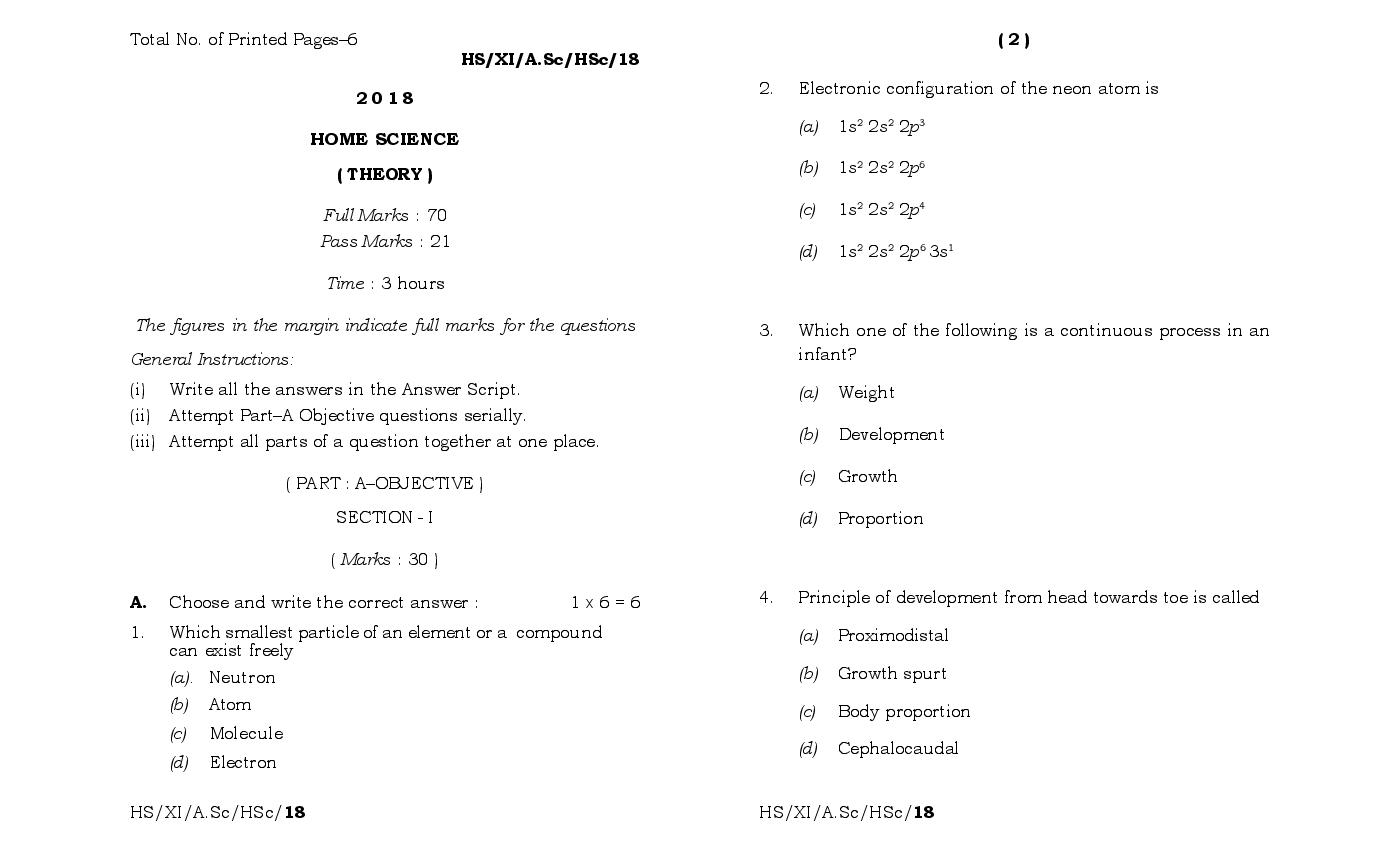
HS/XI/A.Sc/HSc/18
2. Electronic configuration of the neon atom is
2018
(a) 1s2 2s2 2p3
HOME SCIENCE
( THEORY ) (b) 1s2 2s2 2p6
Full Marks : 70 (c) 1s2 2s2 2p4
Pass Marks : 21
(d) 1s2 2s2 2p 6 3s1
Time : 3 hours
The figures in the margin indicate full marks for the questions 3. Which one of the following is a continuous process in an
General Instructions: infant?
(i) Write all the answers in the Answer Script. (a) Weight
(ii) Attempt Part–A Objective questions serially.
(iii) Attempt all parts of a question together at one place. (b) Development
( PART : A–OBJECTIVE ) (c) Growth
SECTION - I (d) Proportion
( Marks : 30 )
A. Choose and write the correct answer : 1x6=6 4. Principle of development from head towards toe is called
1. Which smallest particle of an element or a compound (a) Proximodistal
can exist freely
(a). Neutron (b) Growth spurt
(b) Atom (c) Body proportion
(c) Molecule
(d) Cephalocaudal
(d) Electron
Page 2
5. Identifying a problem is the first step in C. Match Column– A with Column– B 1
2 x6=3
(a) Organising process
(b) Decision-making process Column– A Column– B
(c) Planning process 1. Alkynes (a) Motor development
(d) Evaluating process 2. Alkanes (b) Equilibrium
3. Muscular co-ordination (c) CnH2n–2
6. Which of the following refers to the ability to do work? 4. Writing and painting (d) Focal point
(a) Energy 5. Emphasis (e) CnH2n+2
(b) Time 6. Balance (f) Fine Muscular
co-ordination
(c) Money
(g) Cognitive
(d) Skill development
B. Fill in the blanks : 1x6=6
D. State whether the following statements are ‘True’ or
1 are electrically attracted to the nucleus. ‘False’ 1 x 6 = 3
2
2 In model of atomic structure protons are 1. pH is the measure of protons in water or the
in the nucleus and electrons orbit around the strength of the proton donation reaction.
nucleus.
2. Number of electrons/ shell in hydrogen is 2.
3. The rates of growth and development are not
3. Early childhood years is also called the ‘pre-school
.
years’.
4. Beginning of adolescence is generally accepted 4. Growth is a qualitative change.
with the onset of .
5. Mass arrangement is the type of flower
5. Lines are basic element of . arrangement where more flowers are used with
6. Facing of the building in such a way to get different colours.
maximum benefit from elements of nature is
6. Skills and attitudes are non-human resources.
called .
Page 3
E. Write short notes (not more than 4 to 5 sentences G. Answer any two of the following: 2 x 8 = 16
each): 2 x 6 = 12
1. Define ‘Developmental task’. List out some of the
1. Functional groups and Homologous series. important developmental tasks of late childhood.
2+6=8
2. Shells and subshells
2. Define ‘Adolescence’. Discuss briefly the factors
3. Importance of developmental tasks. which influence the personality development
during adolescence. 1+7=8
4. ‘Peer culture’ during adolescence.
5. Use of elements of design with reference to 3. Which period of life span is called ‘early
balance. childhood’? Discuss the factors contributing to
their intellectual development. 1+7=8
6. Human and Non-human resources.
H. Answer any two of the following: 2 x 7 = 14
( PART : B–DESCRIPTIVE )
Section - II 1. What is a ‘Budget’? Explain the different types
of budget. 1+6=7
( Marks : 40 )
2. What are the points to be followed in flower
arrangement? Give a short description of the
F. Answer any two of the following: 2 x 5 = 10 types of flower arrangement. 2+5=7
1. Explain briefly Bohr’s theory of atomic structure. 5 3. Write the meaning of family resources. Explain
the important characteristics of resources. 2 + 5 = 7
2. What are the different classes of Hydrocarbons?
Illustrate each class with an example. 1+4=5
3. Classify carboydrates. Illustrate structure of each
class with example. 5
HS/XI/A.Sc/HSc/18 HS/XI/A.Sc/HSc/18
Document Details
| Board / Org | Meghalaya Board |
| Exam | Class 11 |
| Type | Question Paper |
| Pages | 3 |
| Updated | 30 Apr 2026 |