UPSC CGGE 2020 (Prelims) Question Paper Geology
Finished viewing? Save it for later —
Download UPSC CGGE 2020 (Prelims) Question Paper Geology (PDF · 40 pages)About UPSC CGGE 2020 (Prelims) Question Paper Geology
UPSC CGGE 2020 (Prelims) Question Paper Geology is available here for free download. Published by UPSC for Combined Geo-Scientist Examination, this question paper can be viewed online or downloaded as a PDF (40 pages). Candidates preparing for Combined Geo-Scientist Examination can use UPSC CGGE 2020 (Prelims) Question Paper Geology to understand the exam pattern, the type of questions asked, and the overall difficulty level.
Frequently Asked Questions
How can I download UPSC CGGE 2020 (Prelims) Question Paper Geology?
Open this page and click the Download button to save UPSC CGGE 2020 (Prelims) Question Paper Geology as a PDF. It is completely free on AglaSem Docs.
Is UPSC CGGE 2020 (Prelims) Question Paper Geology free to download?
Yes. UPSC CGGE 2020 (Prelims) Question Paper Geology can be viewed online and downloaded as a PDF free of cost on AglaSem Docs.
How many pages does UPSC CGGE 2020 (Prelims) Question Paper Geology have?
UPSC CGGE 2020 (Prelims) Question Paper Geology contains 40 pages, which you can read online or download together as a single PDF.
Where can I find more Combined Geo-Scientist Examination study material?
You can find more Combined Geo-Scientist Examination question papers, sample papers, syllabus, and answer keys on AglaSem Docs.
UPSC CGGE 2020 (Prelims) Question Paper Geology – Text
Read the full text of this question paper below — useful to quickly search, copy and reference the content online without downloading the PDF.
📄 View text version (40 pages)
Page 1
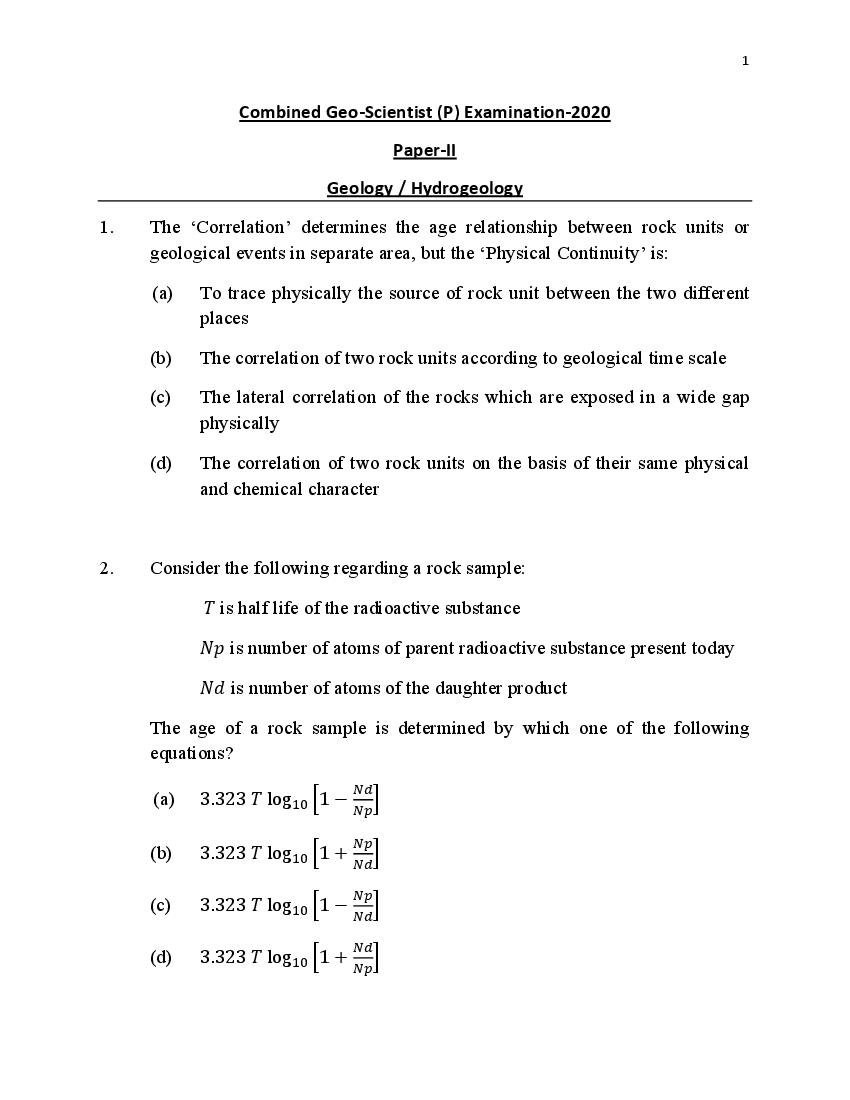
Combined Geo‐Scientist (P) Examination‐2020
Paper‐II
Geology / Hydrogeology
1. The ‘Correlation’ determines the age relationship between rock units or
geological events in separate area, but the ‘Physical Continuity’ is:
(a) To trace physically the source of rock unit between the two different
places
(b) The correlation of two rock units according to geological time scale
(c) The lateral correlation of the rocks which are exposed in a wide gap
physically
(d) The correlation of two rock units on the basis of their same physical
and chemical character
2. Consider the following regarding a rock sample:
is half life of the radioactive substance
is number of atoms of parent radioactive substance present today
is number of atoms of the daughter product
The age of a rock sample is determined by which one of the following
equations?
(a) 3.323 log 1
(b) 3.323 log 1
(c) 3.323 log 1
(d) 3.323 log 1
Page 2
3. In “humid temperate climate” the rocks are weathered predominantly by a
combination of both disintegration and decomposition, resulting in the
formation of:
(a) Black cotton soil
(b) Lateritic soil
(c) Podzol soil
(d) Sandy soil
4. The molten spheroidal mass that the earth originally was started cooling with
the result that a solid crust was formed over a molten core. The process of
gradual release of previously dissolved gasses, in molten magma, is called:
(a) Degassing
(b) Diagenesis
(c) Decomposition
(d) Disintegration
5. The volcanism of island arcs and continental-margin orogens are associated
with plate convergence. More extensive vast sheets of basaltic lavas which
have formed on the continents at various times in the past are referred to as:
(a) Continental flood basalts
(b) Mid-oceanic lava flow
(c) Andesitic lava flow
(d) Rhyolitic lava flow
Page 3
6. Isostatic adjustment is:
(a) The horizontal movement of crustal rock tending to rise or sink
gradually until they are balanced by the weight of displaced mantle
rocks.
(b) The vertical movement of crustal rock tending to rise and sink
gradually until they are balanced by the weight of displaced mantle
rocks.
(c) Shrinking of crust rock during the process of convergent plate
boundary movement which is equal to applied stress
(d) Rearrangement of morphological features at the surface of earth after
removal of applied pressure
7. The ‘truncated spurs’ are the Erosional landscapes associated with valley
glacier, these are:
(a) Sharp peaks that remain after cirques have cut back into a mountain
on several sides
(b) Frost wedging on the rocks exposed above the glacier, steepening and
cutting back the side wall of the valley
(c) Lower parts of ridges that have been carved into triangular facets by
glacial erosion
(d) Steep sided, rounded hollow carved into a mountain at the head of a
glacial valley
8. The quantity of water which enters stream channels in a drainage basin over
a specified period of time can be determined by a:
(a) Channel steepness equation
(b) Stream length gradient equation
(c) Water-balance equation
(d) Darcy equation
Page 4
9. Crevasses form along the:
(a) Margins of glaciers in places where the path is curved
(b) Bed rock, by the marking of boulders that are dragged at the base of
ice sheet
(c) Grinding of rocks into a powder of fine fragment of silt and clay size
(d) Marking on rock in the form of scratches by the sharp corner of rock
fragments
10. The threshold flow velocity at which a particle settles to a channel bed is
known as:
(a) Fall velocity
(b) Increasing velocity
(c) Decreasing velocity
(d) Runoff velocity
11. Pedalfer is a type of soil in the wet climate, it is formed by:
(a) An effective downward leaching due to the high rainfall and acids
produced by the decay of abundant humus
(b) An upward movement of soil water beneath the land surface
characterized by little leaching, scant humus
(c) The cementation of clay particles, silica and iron compound that have
accumulated at horizon
(d) An intense and deep weathering in tropical regions where silica
disintegrates into clay and mica
Page 5
12. Abrasion is a process that can mechanically weather rock, and:
(a) Solvent action of water which attack in the mineral structure for
disintegration
(b) Disintegration of rock masses by the process of frost wedging
(c) Exposing fresh country rock to the surface due to the removal of their
overlying weathering material
(d) Grinding away of rocks by friction and impact during transportation
13. If the beds are vertical, the synclinal axis is in the:
(a) Opposite direction from that in which the bedding dips
(b) Opposite direction from that in which the cleavage dips
(c) Same direction from that in which the bedding dips
(d) Same direction from that in which the cleavage dips
14. In a plunging fold, if the strike of cleavage is diagonal to the strike of the
bedding, the plunge of fold can be determined by:
(a) Obtuse angle between strike of bedding on vertical plane and strike of
cleavage on horizontal plane
(b) Acute angle between line drawn on the ground perpendicular to the
strike of bedding and strike of cleavage
(c) Obtuse angle between strike of bedding and cleavage strike
(d) Acute angle between the line drawn parallel to the strike and dip
direction of cleavage
Page 6
15. With regard to strain-slip cleavage, in metamorphic terranes the schistosity
may be crinkled into:
(a) Small wavelength folds, and the mica flakes are rotated into non
discrete zones
(b) Big wavelength folds, and the mica flakes are rotated into non discrete
zones
(c) Big wavelength folds, and the mica flakes are rotated into discrete
zones
(d) Small folds with a wavelength of a fraction of an inch and the mica
flakes are rotated into discrete zones
16. The slip refers to the displacement along the fault line, while shift is used to
refer to:
(a) An angle between the fault plane and vertical plane that strikes
parallel to the fault
(b) The differential movement takes place by systematic small
displacement along a large number of closely spaced fractures
(c) The total displacement measured on fault surface between two
adjacent points situated on opposite walls of fault
(d) The displacement on opposite site of fault and outside the dislocated
zone
Page 7
17. Consider the following regarding apparent dip and true dip:
is the apparent dip on a vertical plane
is the angle between strike of bed and direction of apparent dip
is the true dip
Which one of the following is the correct equation for an apparent dip of a
bed in any desired direction from the true dip?
(a) tan tan sin
(b) tan tan sin
(c) tan tan sin
(d) tan tan sin
18. Consider the following regarding Mohr stress envelope:
is the cohesive strength of the rock
∅ is the angle of internal friction
is the normal stress across the plane
is the shear strength on the failure plane
The curve of the Mohr envelope is determined by which one of the
following equations?
(a) 2 tan ∅
(b) 2 tan ∅
(c) tan ∅
(d) tan ∅
Page 8
19. The space lattice of a mineral is:
(a) An assemblage of atoms that is constantly repeated to form a mineral.
(b) A glide plane parallel to which there are number of additional planes
along which gliding takes place
(c) A position of mineral in terms of their resistance towards failure
(d) A position of mineral before plastic deformation and recrystallization
20. A tectonite is:
(a) A recrystallized rock without any change in shape and orientation of
grain
(b) A rock showing an imperfection in crystal structure resulting
reorientation of rock in terms of volume not in structure
(c) A rock that result from the accumulation of many separate
components and each of which moved into place independently of its
neighbors
(d) A deformed rock, the fabric of which is due to the systematic
movement of the individual units under a common external force
21. The topography has no control on the outcrop pattern of vertical beds
whereas the top and bottom of a vertical bed will appear on the map as:
(a) Vertical lines perpendicular to the bed
(b) Vertical lines parallel to the dip direction
(c) Straight lines parallel to the strike of the bed
(d) Straight line perpendicular to the bed
Page 9
22. In the Rule of ’ , the outcrop pattern of beds that dip:
(a) Downstream at an angle greater than the stream gradient forms a ,
the apex of which points downstream
(b) Downstream at an angle greater than the stream gradient forms a ,
the apex of which points upstream
(c) Downstream at an angle smaller than the stream gradient forms a ,
the apex of which points downstream
(d) Downstream at an angle smaller than the stream gradient forms a ,
the apex of which points upstream
23. In , the projections of the poles which are perpendicular to a
horizontal plane will coincide:
(a) With the poles of diametrically opposite
(b) At the - quadrant of the net
(c) With the center of the projection
(d) At the - quadrant of the net
24. The Chromite deposits in the north limb of the Sukinda syncline in Orissa
are blanketed by:
(a) Breccia and Sandstone
(b) Sandstone and Shale
(c) Alluvium and Shale
(d) Laterite and Colluvium
Page 10
25. deposits are:
(a) Greyish-black variety of corundum, containing much admixed
magnetite and hematite
(b) Red gemstone of corundum found in metamorphosed bauxite deposit
(c) Placer variety of corundum having rounded pebbles in alluvium
(d) Thermally altered alumina rich shales in zenothic of basic igneous
rock
26. A tetragonal unit is a right square prism with and edge lengths equal and
different with two space lattices:
(a) Primitive and body centered
(b) Primitive and face centered
(c) Primitive only
(d) Body centered and face centered
27. In feldspar group of minerals, while cooling, unmixing of potash feldspars
and soda feldspars takes place. The larger component occurs as ground mass
and the minor one oriented parallel lamellae within the groundmass.
This process of unmixing of two minerals is:
(a) Exsolution
(b) Isomorphism
(c) Polymorphism
(d) Magmatic segregation
Page 11
28. Polymorphism is the phenomenon when a mineral exhibits:
(a) Distinctly different physical or optical properties in spite of
possessing the same chemical composition
(b) Identical physical or optical properties in spite of possessing the same
chemical composition
(c) Identical physical or chemical properties in spite of possessing the
different crystal lattice
(d) Distinctly different physical or chemical properties in spite of
possessing the same crystal lattice
29. The characteristic feature of a group is:
(a) 3.5 oxygens are shared between adjacent tetrahedra
(b) 2 oxygen atoms link together to form a ring of composition
(c) 2 tetrahedra sharing common oxygen
(d) 2.5 oxygens are shared by adjacent tetrahedra
30. The characteristic feature of an is:
(a) It is contaminated form of silica with varying amount of and
in its structures
(b) It contains a variable quantity of water molecules in its structures
(c) It contains large numbers of micro-cavity in its structure
(d) It contains traces of colloidal carbon and iron in its structure
Page 12
31. The fibrous variety of anthophyllite is called:
(a) Glaucophane
(b) Jadeite
(c) Enstatite
(d) Amosite
32. Piezoelectricity is the simultaneous development of:
(a) Positive and negative charges of electricity when its temperature is
suitably changed
(b) Positive and negative charges of electricity on different parts of same
crystal when its pressure is suitably changed
(c) Magnetic charge when its pressure and temperature is suitably
changed
(d) Electrical charges on different parts of same crystal when its pressure
is suitably changed
33. minerals are those which have:
(a) An uniform white streak though the colour is variable
(b) A different colour based on chemical composition
(c) A characteristic and constant colour
(d) The same physical appearance in spite of having different chemical
composition
Page 13
34. consisting mainly of an:
(a) Alkali feldspar host with an exsolved -rich plagioclase feldspar
phase which segregated from the host during cooling
(b) -rich feldspar as host with an exsolved alkali feldspar segregated
from host
(c) Equal amount of alkali feldspar and a more -rich plagioclase
(d) Intrusion of -rich plagioclase into alkali feldspar with a phase of
segregation
35. Duhem’s Theorem states that, a system is said to be closed if:
(a) No masses are added to or subtracted from it in the course of the
transformation under consideration
(b) Masses are added to it in the course of the transformation under
consideration
(c) Masses are subtracted from it in the course of the transformation
under consideration
(d) Masses are partially added to or subtracted from it in the course of the
transformation under consideration
36. If crystallization is strictly along Bowen’s reaction series, such
crystallization is called:
(a) Cotectic crystallization
(b) Eutectic crystallization
(c) Peritectic crystallization
(d) Fractional crystallization
Page 14
37. The classification of plutonic rocks is applicable to visually crystalline
(Phaneritic) rocks which are presumed to have formed at considerable depth.
This classification is strictly:
(a) Based on silica percentage
(b) A quantitative mineralogical
(c) A depth wise
(d) Based on texture
38. are:
(a) Calciferous mineral rich in silica than feldspar
(b) Aluminosilicates which occur as constituents of igneous rocks and
which are poorer in silica than corresponding alkali feldspars
(c) Monomineralic rocks which only composed of sodic feldspar
(d) Aluminosilicates saturated with silica and poorer in alkali feldspars
39. structure is a special type of orbicular structure where ovoid
phenocrysts of -feldspar are mantled by shells of granular oligoclase. This
structure is typically developed in:
(a) Merozone granites
(b) Catazone granites
(c) Epizonal granites
(d) -type granites
Page 15
40. texture is a type of quench texture and resembles a bunch of
‘grass’. It is usually associated with:
(a) Low magnesian lava
(b) Granitic lava
(c) High magnesian lava
(d) Andesitic lava
41. Incongruent melting occurs when:
(a) A melt break down into two or more than two chemically distinct
phase by assimilation
(b) A solid split at very high temperature into two solids having same
bulk chemical composition
(c) A solid splits at definite temperature into another solid and liquid
(d) A rock is subjected to high confining pressure without any increase in
temperature
42. Influence of dissolved water is one of the process of magmatic
differentiation, it involves:
(a) Alkalis and certain metals co-ordinate with the water and concentrate
in the regions of lowest pressure and temperature
(b) Alkalis and metals are hydrophobic so they move from water
saturated area to water deficient area
(c) Different chemical potential of water throughout the magma chamber
(d) Water provides a way to gravitational rising of heavy crystal
Page 16
43. During the complex process of reaction between magma and invaded rock,
magma becomes modified by incorporation of material originally present in
wall rock. This process is termed as magmatic:
(a) Differentiation
(b) Mixing
(c) Assimilation
(d) Crystallization
44. Kimberlites are alkalic rocks characteristically ultramaphic in composition.
They differ from lamprophyres and lamproites in:
(a) Kimberlites have high silica
(b) Contents of alkalis i.e. in Kimberlites are in a lower
level
(c) Contents of Mg are low in Kimberlites
(d) Contents of alkalis are high in Kimberlites
45. Crystallization may be localized at a cooling margin, where the temperature
is lower than the central parts of magma, thus:
(a) A solid phase is formed
(b) A liquid phase is formed
(c) A solid and a liquid phases are formed
(d) A Liquid and gaseous phases is formed
Page 17
46. A certain mineralogical change in rock that is also of local extent but is of
different character from either contact or cataclastic metamorphism is called:
(a) Cataclastic metamorphism
(b) Hydrothermal metamorphism
(c) Dynamo-thermal metamorphism
(d) Regional Burial metamorphism
47. Nucleation in metamorphic rocks is:
(a) Faster when entropy change is smallest
(b) Faster when entropy change is highest
(c) Initiated by entropy but not depends on entropy in advance stage
(d) Controlling factor for second order transitions
48. Consider the following regarding phase rule:
is the number of independent degrees of freedom for the system
is the number of chemical components
is the number of phases
The phase rule is expressed by which one of the following equations?
(a) 2
(b) 2
(c) 2
(d) 2
Page 18
49. A foliation marked by the parallel orientation of tabular minerals in a
metamorphic rock with a sufficiently coarse grain size is called a:
(a) Cleavage
(b) Schistosity
(c) Gneissosity
(d) Solution cleavage
50. Pseudotachylytes are:
(a) Thin seams of glassy igneous intrusion by extreme from the magma
with mafic composition
(b) Thin seams of glassy rock produced of the results of melting due to
frictional heating and are restricted to dry rocks
(c) A rock mass with random fabric of interlocking with a tough texture
and strength
(d) Fine grained rock produced in the zone of intense ductile deformation
whereas pre existing grains have been recrystallized as finer grains
51. When an igneous rock is metamorphosed and the original texture continues
to occur in metamorphosed ones, the resulting texture is said to be:
(a) Granoblastic texture
(b) Blasto-porphyritic texture
(c) Porphyroblastic texture
(d) Xenoblastic texture
Page 19
52. Metamorphic facies can be defined as:
(a) A range of chemical reaction under the process of metamorphism
where bulk chemical composition of altered rock remain same as
parent rock
(b) A range of pressure-temperature conditions over which a particular
common mineral assemblage or range of mineral assemblages are
stable
(c) A physically separable constituents of the system in the form of solid,
liquid or gas
(d) A changing condition of pressure and temperature which lead to
reaction and production of new assemblage
53. A specific change in mineral assemblage reflecting a metamorphic reaction
and satisfying the condition of reaction equilibrium is called:
(a) Isograd
(b) Isopatch
(c) Isocontour
(d) Line of phase change
54. Skarns are:
(a) Metasedimentary rock that are rich in -or - silicate
(b) Recrystallized rock where all the igneous minerals recrystallized into
high grade metamorphic minerals
(c) Metamorphic rocks formed by hydrothermal alteration of limestone
into marble
(d) A variety of calc-silicate rock formed by metasomatic interaction
between marble and silicate rock
Page 20
55. In a type paired metamorphic belt:
(a) The high and low pressure belt of the same age occurred next to one
another, separated by major faults
(b) Two high pressure belts of the different age occurred next to one
another
(c) The high and low pressure belt of different age occurred next to one
another separated by faults
(d) Two low pressure belts of the different age occurred next to one
another
56. The steps involved in a metamorphic reaction will be the slowest in a natural
geological setting and will therefore control the rate of the overall reaction is
known as:
(a) Rate limiting step
(b) Surface step
(c) Heat energy step
(d) Natural reaction step
57. The difference between carbonate and siliciclastic sediment is:
(a) The carbonate sequence occur in shallow tropical environments while
siliciclastic occurs worldwide and at all depths
(b) The carbonate sequence occur at deep marine environments while
siliciclastic occurs at all depths
(c) Both carbonate and siliciclastic occur at same depositional
environment with only difference of grain size and texture
(d) The carbonate deposits results from shallow water bodies from
interaction of current and waves while siliciclastic sediments are
result of only deep, calm water deposit
Page 21
58. Grain size interpretation in siliciclastic rock is much simpler than carbonate
and evaporites because:
(a) Diagenesis in carbonates and evaporites obscures original grain
relationship
(b) Siliclastic rocks are cemented on sea floor and easy for stratigraphic
co-relation
(c) For carbonate and evaporites climate is no constraints, sediment occur
worldwide and at all depth
(d) In carbonate sediment periodic exposure of sediment during
deposition leaves deposits relatively unaffected
59. are:
(a) Microscopic erosional surface on the underside of bedding plane
formed by natural casts of erosional feature
(b) Vortex erosion typically at the base of turbidity current
(c) Organically bored surfaces which encrusted with fossils in growth
position
(d) Resistant surface altered by erosional impact of large objects
entrained in the flow
60. In sedimentary rocks, the beds that contain internal layers that are essentially
parallel to the bounding bedding surfaces are said to be:
(a) Cross stratified
(b) Planar stratified
(c) Composite bedsets
(d) Laminated bedding
Page 22
61. Ichnofacies dominated by deep vertical burrows in a tidal zone named the:
(a) Scolithos (Skolithos)
(b) Cruziana
(c) Zoophycus
(d) Nereites
62. The clastic ratio of a lithiofacies is calculated by:
(a)
(b)
(c)
(d)
63. Textural maturity of sandstone is determined by:
(a) The relative abundance of stable and unstable framework grains
(b) The ratio of matrix and well defined grain under hydrostatic condition
(c) The relative abundance of matrix and the degree of rounding and
sorting of framework grains
(d) The proportion of coarse grain sediment to fine grain sediment when
matrix is absent
Page 23
64. Vertical profile model of a cyclic sequence in evaporite bearing sediments,
reflecting a sensitive response of evaporite environments to:
(a) Climate change, brine level or water chemistry
(b) Change in lateral dispersal of sediment as sea level changes
(c) Vertical profile in evaporites cyclic sequence does not reflect
(d) Change in sediment supply as a response of faunal and floral
intervention
65. The non-clastic sediment composed of microcrystalline quartz, found in both
bed and nodules of limestones and sandstones is known as:
(a) Cherts
(b) Silly sandstone
(c) Breccia
(d) Evaporites
66. Which one of the following zone of carbonate diagenetic depth occurs below
the calcite compensation depth ?
(a) Zone of precipitation
(b) Zone of partial dissolution
(c) Zone of no carbonate
(d) Zone of active dissolution
Page 24
67. Which one of the following may be caused by carbonic acid-rich waters
produced by the devolatilization of coal beds?
(a) Kaolinization
(b) Montmorillonite
(c) Rudaceous rock formation
(d) Salt rock formation
68. Reef and carbonate slope build-ups have steeply dipping sediment-water
interfaces, much steeper than the angle of repose of loose talus, is due to:
(a) Deposits at equatorial regions only and grows towards overhead sun
(b) Characteristic feature that grows vertical or overhanging
(c) Organic binding and early cementation
(d) Vertical growth from sea beds
69. The most favourable conditions for fossilization are present in:
(a) Terrestrial
(b) Fluvial
(c) Sea
(d) Lacustrine
70. Fossils range from ancient time upto the present day without any change in
their primitive characters are known as:
(a) Living fossils
(b) Derived fossils
(c) Facies fossils
(d) Remanie ́fossils
Page 25
71. A specimen of a species from the same locality as its holotypes or syntypes
is a:
(a) Plesiotype
(b) Metatype
(c) Paratype
(d) Topotype
72. Two populations differing in one or more morphologic characteristics to a
statistically significant degree are called:
(a) Morphonomical species
(b) Morphospecies
(c) Founder species
(d) Allopatric species
73. Which one of the following is the median part of the cephalon that inflated
in trilobites?
(a) Glabella
(b) Cheeks
(c) Axial furrows
(d) Pleuron
Page 26
74. Which one of the following is the oldest known ammonoides during upper
Silurian–Devonian period?
(a) Trilobites
(b) Gymmites
(c) Agoniatites
(d) Prolecanites
75. In Gastropods, the cavity opens at the base of the shell is called:
(a) Umbilicus
(b) Columella
(c) Whorl
(d) Apex
76. A straight conical shell of an ammonoid cephalopod is known as:
(a) Camerae
(b) Cyrotocone
(c) Bactriticone
(d) Roastrum
77. The earliest fossil remains of horse in equine evolution is:
(a) Epihippus
(b) Mesohippus
(c) Eohippus
(d) Miohippus
Page 27
78. The modern horses belong to which one of the following genus?
(a) Epihippus
(b) Equus
(c) Miohippus
(d) Orohippus
79. The first formed chamber in multilocular form of foraminifera is known as:
(a) Protegulam
(b) Proloculum
(c) Protoconch
(d) Prodissononch
80. In which one of the following rhizome (root) on which Glossopteris and
Gangamopteris grew?
(a) Ptilophyllum
(b) Vertebraria
(c) Calamites
(d) Lepidodendron
81. In conformable contacts, if the change from one lithology to another is less
marked than abrupt contacts, reflecting gradual change in depositional
conditions with time is said to be:
(a) Gradational
(b) Lateral Adjustment
(c) Lithostratigraphy
(d) Angular Unconformity
Page 28
82. When geological formations are equivalent in age but situated wide apart in
different districts, countries or continents, they are said to be:
(a) Homotaxis
(b) Homotaxial
(c) Synchronous beds
(d) Contemporaneous
83. The Sargur Schist Complex rocks have undergone a high degree of
metamorphism ranging from amphibolites to lower granulite facies, and
these rocks have often been extensively migmatised and mobilized during
the subsequent phase of emplacement of:
(a) Peninsular Gneissic Complex
(b) Closepet Granite
(c) Bundelkhand Granite
(d) Newer Green Stone Belt
84. The characteristic feature of the ‘ ’ of Eastern Ghats
Province is:
(a) Hypersthene bearing granite composed of blue quartz, felspar and
hypersthene
(b) Garnetiferous quartzite
(c) Potash felspar with graphite and manganese
(d) Dry metamorphic rocks comprising minerals devoid of water
Page 29
85. The gneisses known as ‘ ’ belonging to ‘ ’ are
rich in:
(a) Iron ore
(b) Manganese ore
(c) Copper
(d) Lead-Zinc
86. The Cuddapah system is made up of alternate layers of:
(a) Shales and sandstones
(b) Quartzites and shales
(c) Shales and breccia
(d) Quartzite and breccia
87. The Vindhyan system lies unconformably on the:
(a) Kurnool rocks
(b) Kuling rocks
(c) Cuddapah rocks
(d) Kanwar rocks
88. The rocks of fresh water origin which occur in Madhya Pradesh
are called the:
(a) Lameta group
(b) Bagh bed
(c) Nimar sandstone
(d) Umia sandstone
Page 30
89. A series of mainly acidic volcanic rocks belonging to the
‘ ’ are known as:
(a) Rialo series
(b) Malani Volcanics
(c) Charnockite series
(d) Khondalite series
90. Trigonia beds with the characteristic fossils of Trigonia of Mesozoic
succession of Kutch Region belongs to:
(a) Chari Formation
(b) Patcham Formation
(c) Umia Formation
(d) Katrol Formation
91. Which one of the following basins of the Damodar Valley region shows the
maximum development of coaliferous beds that contain several superior
quality coal measures?
(a) Barker basin
(b) Talchir basin
(c) Raniganj basin
(d) Panchet basin
Page 31
92. The origin and structure of Indo-Gangetic Plain are closely related with the
rise of the Himalaya. This plane is:
(a) A basin caused by the central rifting of continental crust during
Himalayan orogeny
(b) A dome of Precambrian rock with representation of the sediment in
the same basin
(c) A plateau with the Archean Basement unconformably overlain by the
sediment of Tertiary sediment
(d) A deep crustal trough filled with Quaternary sediments
93. The ‘ ’ rocks were deposited in:
(a) A geosynclinal basin bordering the shelf sea of the Zanskar-Spiti
region
(b) A shallow freshwater stream flowing in a wide sedimentary basin
(c) A deep sea with phases of sea transgression and regression
(d) A deep lake deposit with the intervening sea fringes
94. A process of mineral deposits associated with volcanism, thermal springs
and fumaroles wherefrom volatilized matter is redeposited at lower
temperature and pressure is:
(a) Evapotranspiration
(b) Oxidation
(c) Sedimentation
(d) Sublimation
Page 32
95. Tenor is:
(a) The concentration of gang mineral associated with the ore mineral
(b) The metal content of an ore, expressed in percent (%), and is
expressed in ounces per tonne in case of precious metals or gems
(c) The total quantity of matter that is used to extract a particular kind of
ore
(d) The ratio of total quantity of host rock to total quantity of ore
extracted
96. Most of the primary gold deposits occur in the vicinity of:
(a) Basic igneous intrusions
(b) Acidic igneous intrusions
(c) Intermediate igneous intrusions
(d) Pegmatite igneous intrusions
97. The rock that holds the oil and gas in place so that they do not escape until
released by drilling is known as:
(a) Reservoir rock
(b) Cap rock
(c) Basement rock
(d) Stratigraphic trap
Page 33
98. Auriferous veins occur in the Hutti-Gold-field within the schistose rocks of:
(a) Permian age
(b) Cambrian age
(c) Dharwarian age
(d) Archean age
99. ‘ - ’ deposit of Rajasthan show the
mineralogical changes in wall rock brought about by the depletion of some
element from the wall rock. These deposits are:
(a) Epigenetic
(b) Syngenetic
(c) Postgenetic
(d) Residual
100. The ‘ ’ represent:
(a) A gaseous phase where substances are carried and demonstrate the
ability of gaseous emanations to collect, transport and deposit the
metal
(b) A water phase contain many mineral substance with higher
temperature water dissolve, transport and deposit mineral
(c) A magmatic source of mineral deposits which transport and deposit
many non metallic mineral as hydrothermal injections
(d) A mineral deposits of copper and lead formed by supergene
enrichment after a volcanic eruption
Page 34
101. The cap-rock of an ore deposit in the form of cellular mass of limonite and
gangue formed due to oxidation of an ore and points to the nature of
underlying hidden deposits is called:
(a) Carnotite
(b) Gossan
(c) Host rock
(d) Parent rock
102. The process of metasomatic replacement is by:
(a) Alteration
(b) Hydrolysis
(c) Hydrostatic alteration
(d) Diffusion
103. Oil formed from marine organisms buried in sediments is explained by:
(a) Animal-origin theory
(b) Vegetable-origin theory
(c) Mendelef’s carbide theory
(d) Cosmic theory
Page 35
104. Gold province of Karnataka-Andhra Pradesh-Tamil Nadu is occupied by
Dharwars, the rock type in the area are represented by:
(a) Granite that intruded schist
(b) Metamorphosed mafic volcanic rocks altered to schistose, granular
and fibrous amphibolites
(c) Precambrian tremalite, actinolite schist and granite gneiss
(d) Metamorphosed flysch with exogenic quartzite and limestone
105. In an area of 100 , the water table dropped by 4.5 , the porosity is
30 % and specific retention is 10 %. The change in groundwater storage will
be:
(a) 3 10
(b) 6 10
(c) 9 10
(d) 12 10
106. Which one of the following types of rocks are relatively high porous because
there is a great variation in degree of packing on the one hand and in size,
shape and arrangement of the grains on the other hand?
(a) Igneous
(b) Metamorphic
(c) Sedimentary
(d) Crystalline rocks
Page 36
107. In designing a critical underpass drain to accept a 10 % risk that flooding
will occur in the next 5 . The return period for a highway engineer use
will be nearly:
(a) 58
(b) 52
(c) 48
(d) 42
108. Consider the following regarding Darcy’s law:
is the length of the column
is the hydraulic conductivity
is the difference in hydraulic head
Which one of the following is the correct rate of flow or flux velocity of
groundwater through a column of saturated sand in accordance with the
Darcy’s law?
(a)
(b)
(c)
(d)
109. The Sodium adsorption ratio is:
(a)
⁄
(b)
⁄
(c)
⁄
(d)
⁄
Page 37
110. Which of the following isotopes will be used for an age determination of
groundwater?
(a) Hydrogen - 3 (Tritium)
(b) Uranium
(c) Hydrogen - 3 (Tritium) and Uranium
(d) Hydrogen - 3 (Tritium) and Carbon – 14
111. Lateral reduction in hydraulic conductivity of aquifer below the recharge
area causes a higher hydraulic gradient underneath the recharge basin,
adequate to cause:
(a) An entire volume of recharged ground water to flow towards the
domain boundary
(b) The hydraulic conductivity of the function to reduce at the centre of
aquifer
(c) The value of groundwater head to remain constant for a section in
plain surface
(d) The ground water head value to a lower level at margin
112. Consider the following regarding surface depressions:
is the maximum storage capacity of the depressions
is the rainfall excess
is constant
Which one of the following is the correct volume of water stored by
surface depressions at any given time?
(a) 1
(b) 1
(c) 1
(d) 1
Page 38
113. Consider the following regarding an unconfined aquifer:
is the average specific yield of the aquifer
∆ is the volume of the aquifer lying between the original water
table and the water table at some later specific time
Which one of the following is the correct change in storage volume ∆ in an
unconfined aquifer?
(a) ∆
(b) ∆
(c)
∆
(d) ∆
114. Consider the following regarding storage coefficient of the aquifer:
is the specific weight of water
is the porosity of soil (decimal)
is the thickness of the confined aquifer
is the bulk modulus of elasticity of water
is the modulus of compressibility (elasticity) of the soil grains
of the aquifer
Which one of the following is the correct storage coefficient of the aquifer ?
(a)
(b)
(c)
(d)
Page 39
Directions: -- Each of the next Six (06) items consists of two statements,
one labeled as the ‘Statement (I)’ and the other as ‘Statement (II)’. You are to
examine these two statements carefully and select the answers to these items using
the codes given below:
Codes:
(a) Both Statement (I) and Statement (II) are individually true and Statement
(II) is the correct explanation of Statement (I)
(b) Both Statement (I) and Statement (II) are individually true but Statement (II)
is NOT the correct explanation of Statement (I)
(c) Statement (I) is true but Statement (II) is false
(d) Statement (I) is false but Statement (II) is true
115. Statement (I): Material is pulled out of the sun by an external force such as
gravitational pull resulting from the dynamic encounter or near
collision of the sun with another star.
Statement (II): The planets become isolated masses of matter as the material of
the solar-system condensed into the sun.
116. Statement (I): A strike-slip fault is one in which the net slip is parallel to the
strike of the fault.
Statement (II): Faults may be classified on the basis of their genesis is called
strike slip fault.
Page 40
117. Statement (I): The diagram is analyzed on the assumptions that the folds
are cylindrical.
Statement (II): The diagram involve the projection of the planes rather
than perpendicular to the planes.
118. Statement (I): Feldspars are the most abundant minerals in the earth crust.
Statement (II): Feldspars are essential minerals in only metamorphic rock and
stable over a limited range of pressure-temperature conditions.
119. Statement (I): Igneous rocks are formed during the cooling and hardening of
magma within the earth surface.
Statement (II): Igneous rocks constitute 65% of the total mass of the rocks
composing the crust.
120. Statement (I): The texture and mineral composition of sedimentary rocks are
of great value in determining the nature of the environment at
the time when the sediment was deposited.
Statement (II): A conglomerate, arkose and shale indicates high energy,
inorganic material, such as swamp and lagoons are examples of
sedimentary rocks.
Document Details
| Board / Org | UPSC |
| Exam | Combined Geo-Scientist Examination |
| Type | Question Paper |
| Pages | 40 |
| Updated | 30 Apr 2026 |