MAHA SET 2024 Paper II Mathematical Sciences Set A Question Paper
Finished viewing? Save it for later —
Download MAHA SET 2024 Paper II Mathematical Sciences Set A Question Paper (PDF · 48 pages)About MAHA SET 2024 Paper II Mathematical Sciences Set A Question Paper
MAHA SET 2024 Paper II Mathematical Sciences Set A Question Paper is available here for free download. Published by Maharashtra Exams for MAHA SET, this question paper can be viewed online or downloaded as a PDF (48 pages). Candidates preparing for MAHA SET can use MAHA SET 2024 Paper II Mathematical Sciences Set A Question Paper to understand the exam pattern, the type of questions asked, and the overall difficulty level.
Frequently Asked Questions
How can I download MAHA SET 2024 Paper II Mathematical Sciences Set A Question Paper?
Open this page and click the Download button to save MAHA SET 2024 Paper II Mathematical Sciences Set A Question Paper as a PDF. It is completely free on AglaSem Docs.
Is MAHA SET 2024 Paper II Mathematical Sciences Set A Question Paper free to download?
Yes. MAHA SET 2024 Paper II Mathematical Sciences Set A Question Paper can be viewed online and downloaded as a PDF free of cost on AglaSem Docs.
How many pages does MAHA SET 2024 Paper II Mathematical Sciences Set A Question Paper have?
MAHA SET 2024 Paper II Mathematical Sciences Set A Question Paper contains 48 pages, which you can read online or download together as a single PDF.
Where can I find more MAHA SET study material?
You can find more MAHA SET question papers, sample papers, syllabus, and answer keys on AglaSem Docs.
MAHA SET 2024 Paper II Mathematical Sciences Set A Question Paper – Text
Read the full text of this question paper below — useful to quickly search, copy and reference the content online without downloading the PDF.
📄 View text version (49 pages)
Page 1
MAHA SET 2024 Paper
II Mathematical
Sciences Set A
Question Paper
EXAM YEAR TYPE
MAHA SET 2024 Question Paper
Notes · Sample Papers · Previous Year Papers · Mock Tests
Page 2
. s e
em l a
as a g
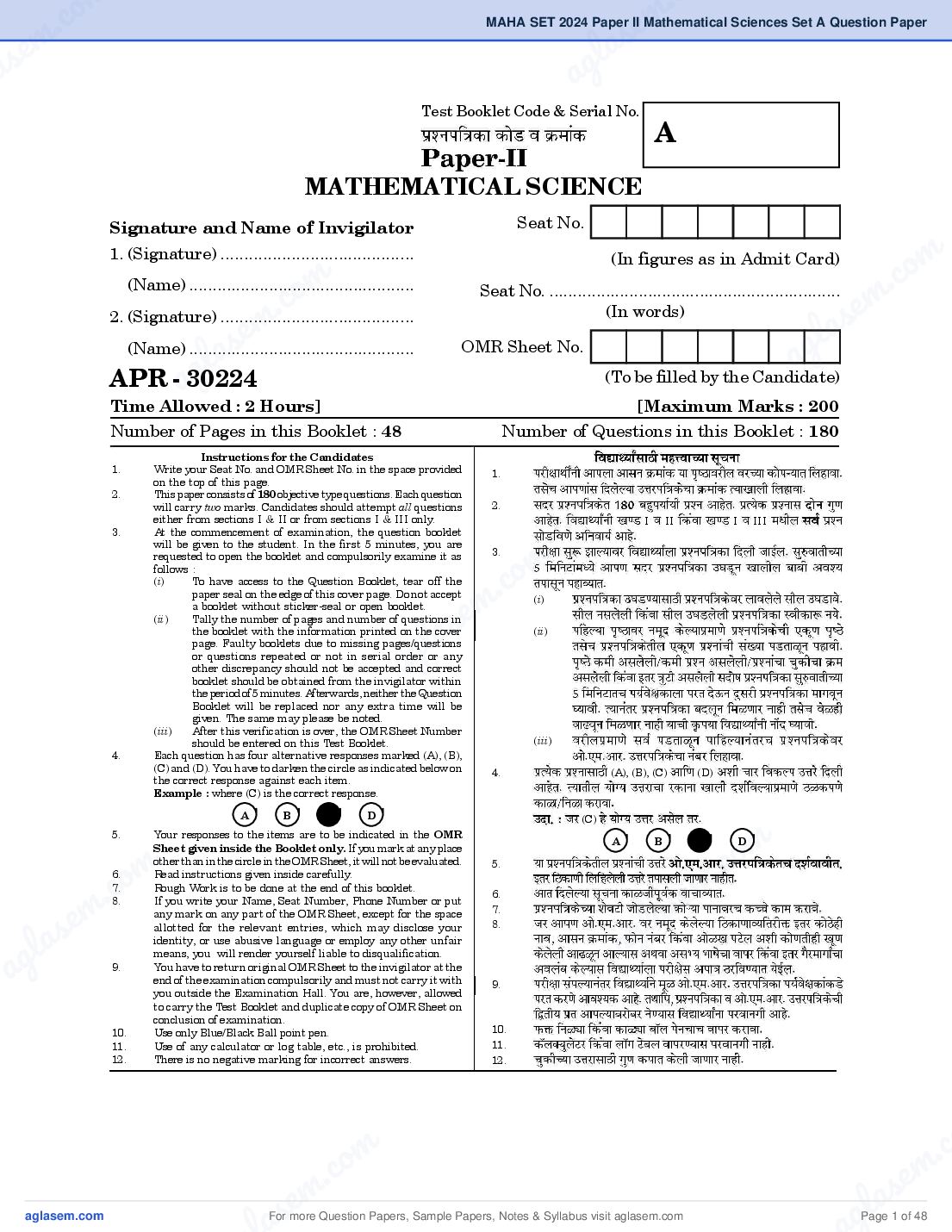
Test Booklet Code & Serial No.
A
MATHEMATICAL SCIENCE
Seat No.
m
Signature and Name of Invigilator
om . co
1. (Signature) ......................................... (In figures as in Admit Card)
. c e m
(Name) ................................................
s
Seat No. ..............................................................
s em l a
(In words)
g
2. (Signature) .........................................
g l a
(Name) ................................................ OMR Sheet No.
a
APR -a30224 (To be filled by the Candidate)
Time Allowed : 2 Hours] [Maximum Marks : 200
Number of Pages in this Booklet : 48 Number of Questions in this Booklet : 180
Instructions for the Candidates
1. Write your Seat No. and OMR Sheet No. in the space provided 1.
on the top of this page.
2. This paper consists of 180 objective type questions. Each question
will carry two marks. Candidates should attempt all questions 2.
either from sections I & II or from sections I & III only. I II I III
m
3. At the commencement of examination, the question booklet
co
will be given to the student. In the first 5 minutes, you are
3.
.
requested to open the booklet and compulsorily examine it as
follows :
em
(i) To have access to the Question Booklet, tear off the
s
paper seal on the edge of this cover page. Do not accept
(i)
a
a booklet without sticker-seal or open booklet.
l
(ii) Tally the number of pages and number of questions in
a g
the booklet with the information printed on the cover (ii)
page. Faulty booklets due to missing pages/questions
or questions repeated or not in serial order or any
other discrepancy should not be accepted and correct
booklet should be obtained from the invigilator within
the period of 5 minutes. Afterwards, neither the Question
Booklet will be replaced nor any extra time will be
given. The same may please be noted.
(iii) After this verification is over, the OMR Sheet Number
should be entered on this Test Booklet. (iii)
4. Each question has four alternative responses marked (A), (B),
(C) and (D). You have to darken the circle as indicated below on 4. (A), (B), (C) (D)
the correct response against each item.
Example : where (C) is the correct response.
m
A B D (C)
c. o
5. Your responses to the items are to be indicated in the OMR
m
A B D
c. o
Sheet given inside the Booklet only. If you mark at any place
m
other than in the circle in the OMR Sheet, it will not be evaluated.
e
5.
s
6. Read instructions given inside carefully.
em la
7. Rough Work is to be done at the end of this booklet.
6.
s
8. If you write your Name, Seat Number, Phone Number or put
la ag
any mark on any part of the OMR Sheet, except for the space 7.
8.
g
allotted for the relevant entries, which may disclose your
a
identity, or use abusive language or employ any other unfair
means, you will render yourself liable to disqualification.
9. You have to return original OMR Sheet to the invigilator at the
end of the examination compulsorily and must not carry it with 9.
you outside the Examination Hall. You are, however, allowed
to carry the Test Booklet and duplicate copy of OMR Sheet on
conclusion of examination.
10. Use only Blue/Black Ball point pen. 10.
11. Use of any calculator or log table, etc., is prohibited. 11.
12. There is no negative marking for incorrect answers. 12.
m . c
c. o s e m
m a
se
For more Question Papers, Sample Papers, Notes & Syllabus visit
g l
Page 1 of 48
Page 3
For more Question Papers, Sample Papers, Notes & Syllabus visit Page 2 of 48
Page 4
. s e
em l a
as a g
Mathematical Science
Paper II
m
Time Allowed : 120 Minutes] [Maximum Marks : 200
om . co
Note : This Paper contains One Hundred Eighty (180) multiple choice questions
.c
in THREE (3) sections, each question carrying TWO (2) marks. Attempt
e m
em
all questions either from Sections I & II only or from Sections I & III
l a s
l a s
only. The OMR sheets with questions attempted from both the Sections viz.
a g
ag
II & III, will not be assessed.
Number of questions, sectionwise :
Section I : Q. Nos. 1 to 20, Section II : Q. Nos. 21 to 100,
Section III : Q. Nos. 101 to 180.
SECTION I 3. Let K R n be with the property
that any real valued continuous
1. The set given by
function on K is bounded. Then K
{1 ( 1)n |n
o m
.c (A) Bounded
N} is :
is :
e m
l a s
g
(A) {1, –1}
a
(B) Compact
(B) N (C) Derise
(C) {0, 1} (D) Connected
(D) {0, 2} 4. Suppose a bounded function
f : [0, 1] R is Riemann integrable.
2. The number of non-empty subsets
Then which of the following is not
o m
of X = {1, 2, 3, 4, 5, 6, 7} containing
c
true ?
m .
c. o (A) 7 m
only even integers is :
e of f is same
(A) f is Lebesgue integrable
em s
la integral of f
s g
(B) Riemann integral
gla a
as Lebesgue
a
(B) 8
(C) f is not Lebesgue integrable
(C) 1 whenever f is discontinuous
(D) 3 (D) |f| is Lebesgue integrable
3 [P.T.O.
m . c
c. o s e m
m a
se
For more Question Papers, Sample Papers, Notes & Syllabus visit
g lPage 3 of 48
Page 5
which of the following is not true ?
of real numbers such that each term
(A) If f is continuous then so is |f| of the sequence is either 0, 1, 2, 3.
(B) If f is integrable then so is |f| Let S be the set of all such sequences.
(C) If f is differentiable then so Then, which of the following is
is |f| true ?
(D) If f is bounded then so is |f|
(A) S is finite
6. For n 1 , let An be the set of all
irrational numbers in the interval (B) S is countable infinite
[1 1 / n, 1 1 / n] . Then, which of (C) S is equivalent to the interval
the following is true ?
(0, 1)
(A) lim sup A n {1}
(D) S is equivalent to the set of all
(B) lim inf A n {1}
positive integers
(C) lim A n
9. Suppose that f 1 , f 2 and f 3 are
(D) lim A n {0}
functions defined by :
7. Suppose that f is a function defined
by : f1 ( x) x2 , 0 x
x if 0 x ½ f 2 ( x) cos( x), 0 x /2
f ( x)
x ½ if ½ x 1 sin( x) / x if x 0
f3 ( x )
1 if x 0
1 1 3
If M , , N ,1 and
4 2 4 Which of the above functions is /are
1 1 uniformly continuous on their
Q x| f ( x) , , then which
4 2 respective domains ?
of the following is true ? (A) None of the three functions
(A) Q = M
(B) Only f1 and f2
(B) Q N
(C) Only f1 and f3
(C) Q M N
(D) Q M N (D) Only f2 and f3
4
For more Question Papers, Sample Papers, Notes & Syllabus visit Page 4 of 48
Page 6
. s e
em l a
as a g
10. Consider the function f : R 2 R 12. Let A be a 4 × 3 matrix and B a
m
defined by : 3 × 4 matrix. Which of the following
om . co
is always true ?
c m
x2 y 2 , if
. e
x 0, y 0
s
f ( x, y)
em a
otherwise . (A) det (AB) = 0, det (BA) need not
l
1,
l a s be zero
a g
g
a true ?
Which of the following statements
(B) det (AB) and det (BA) need not
is/are
be zero
S1 : f is discontinuous at (0, 0)
(C) det (AB) = det (BA) = 0
S2 : lim lim f ( x, y)
y 0 x 0
lim lim
x 0 y 0
(D) det (AB) = 0 only if either
f ( x, y) AB = 0 or BA = 0
m
S 3 : lim
c. o
f ( x, y) is continuous at 13. The system of linear equations is
em consistent :
x 0
a s
y = 0
g l
a
(A) Only S1 and S2
x1
2 0 6 b1
(B) Only S1 x2
2 2 4 b2 .
x3
(C) Only S3
(D) Only S2 and S3 (A) Only if b1 = 4 and b2 = –12 and
has a unique solution
11. The dimension of the vector space
o m
m . c
over R of all 5 × 5 upper triangular (B) For all values of b1 and b2 and
c. o matrices with complex entries is : has a unique m
s e
em (A) 30
solution
s (C) Only if b1la
la ag
= 4 and b2 = –12 and
ag (B) 20 has infinitely many solutions
(C) 25 (D) For all values of b1 and b2 and
(D) 15 has infinitely many solutions
5 [P.T.O.
m . c
c. o s e m
m a
se
For more Question Papers, Sample Papers, Notes & Syllabus visit
g lPage 5 of 48
Page 7
and B be a 7 × 5 matrix of rank 4, 17. Let A . Then, singular
0 1 2
then the rank of AB is :
values of A :
(A) 5
(A) are 7 and 3
(B) 6
(C) 4 (B) are 3 , 2 and 1
(D) Cannot be determined exactly, (C) do not exist
but less than or equal to 4
(D) 7 and 3
15. Let T be a linear transformation
from R3 to R given by 18. Let A and B be similar matrices.
T[x, y, z]T = 2x – 5y + 9z, Consider the following statements :
where [x, y, z]T donote the transpose (i) tr A tr B
of the vector [x, y, z]. Then, the
(ii) det A = det B
dimension of the null space of T
is : (iii) Characteristic polynomial of A
(A) 0 is equal to the characteristic
(B) 1 polynomial of B
(C) 2 (iv) Minimal polynomial of A is
(D) 3 equal to the minimal polynomial
16. Let P : R 3 R 3 represent the
of B
projection of R3 onto xy-plane along
z-axis. Then : (A) All the statements are true
(A) P2 = I
(B) None of the statement is true
(B) P3 = P
(C) Only (i), (ii), (iii) are true
(C) P is invertible
(D) P is not diagonalizable (D) Only (ii), (iii), (iv) are true
6
For more Question Papers, Sample Papers, Notes & Syllabus visit Page 6 of 48
Page 8
. s e
em l a
as a g
19. Let A be an n × n nilpotent non-zero 22. Which of the following is false ?
(A) log z
m
real matrix. Then : ln| z| i arg z, z 0
om . co
and arg z
.c e m
(A) In + A is invertible
s
(B) cos z 2
1 sin z for all z C
2
(B) In – Aem a
s g l
lisa invertible
(C) cosh 2 z sinh 2 z 1 for all
a
is invertible
ag
z C
(C) A
(D) log ( z1 z2 ) log z1 log z2 for all
(D) A is diagonalizable z1 , z2 C \{0}
23. Suppose z10 1 and z 1 . Which of
20. Let A be a 4 × 4 real orthogonal
the following statements is false ?
matrix with determinant –1. Then
(A) 1 z z2 ...... z9 0
m
the determinant of I4 – A is :
c. o (C) 1 . z . z . z . ..... . z 1
(B) 1 z2 z4 ...... z18 0
em (D) 1 . z . z . z . ..... . z 1
2 3 9
(A) 0
las
2 4 6 18
ag
(B) 1
24. Consider the following two
(C) 2 statements :
(D) 5 (i) Every harmonic function u on
C has a harmonic conjugate.
SECTION II
(ii) If u and v are harmonic
1 conjugates of each other on a
21. The function f ( z)
m
has primitive
c. o
z
disk D, then u and v are
m
c. o (A) { z C |1 | z| 2}
in the domain :
e m
constant on D.
em la s
s
Then :
gla (A) Only (i) is true
ag
a
(B) { z C || z| 2}
(B) Only (ii) is true
(C) { z C |1 | z|}
(C) Both (i) and (ii) are true
(D) { z x iy C| x 2} (D) Both (i) and (ii) are false
7 [P.T.O.
m . c
c. o s e m
m a
se
For more Question Papers, Sample Papers, Notes & Syllabus visit
g l
Page 7 of 48
Page 9
transformations maps the unit disk is false for an entire function f ?
onto itself ? (A) If f ( x) 0 x [ 1, 1] , then
2z i f 0
(A) f ( z)
2 zi
(B) If A is an uncountable set in
i z
(B) f ( z) C and f ( z) 0 z A , then
i z
f 0
2z 1
(C) f ( z)
2 z (C) If { an } is a sequence of distinct
iz 1 complex numbers and f (an ) 0
(D) f ( z)
z i
for all n, then f 0
26. Let f be analytic on
(D) f (1 / n) 0 n 1 , then f 0
D {z C /| z| 3} such that :
28. Suppose f ( z) u iv is an entire
1 2n 1
f 1 , n 1, 2, ........ function. Which of the following is
n n 1
true ?
Then f(z) =
(A) If u 0 , then f is unbounded
2z 1
(A)
z on C
z (B) If | f ( z)| | z| for all z, then
(B)
z 1
f is constant
z 1
(C) (C) If u is bounded, then v is
z
bounded
z
(D)
z 1
(D) If u 0 , then v 0
8
For more Question Papers, Sample Papers, Notes & Syllabus visit Page 8 of 48
Page 10
. s e
em l a
as a g
29. Suppose f : C C is an analytic 32. The value of the integral
one-one function. Then which of the
m
z3
co
dz , where 2eit ,
m
following statements is false ?
.
( z 3)3 (t)
c. o of degree one
(A) f is a polynomial
s e m
(B) f is an m
t [0, 2 ] is :
s e open map g l a
laan onto map a
(A) 18
ag
(C) f is (B) 18 i
(D) f '( z) 0 for some z C (C) 6 i
1
(D) –2 i
30. Let f ( z) e z and g( z) e z and
1 ez 1
A z / 0 | z| 33. The residue of f ( z) at
. z2
2
m
z = 0 is :
c o
Then, on A :
m.
e
(A) 0
s
(A) f is one-one but g is not one-one
l a
ag
(B) f is not one-one but g is one-one 1
(B)
2
(C) Both f and g are one-one
(C) 1
(D) Neither f nor g is one-one
(D) 2
31. If all roots of the polynomial
1 z z2 ..... z10 are in the disk 34. The image the circle
B(0, R), then :
m
c {z C :| z 1| 1}
m c. 1zo is :
1 2 z 3 z2 ..... 10 z9
c. o m
dz
e
1 z z2 ..... z10 under the map f ( z)
em (A) 0 (A) a circle la
s
|z| R
las ag
ag (B) 10 (B) a line
(C) 10 i (C) a parabola
(D) 20 i (D) an ellipse
9 [P.T.O.
m . c
c. o s e m
m a
se
For more Question Papers, Sample Papers, Notes & Syllabus visit
g l
Page 9 of 48
Page 11
is reducible over the rationals ?
(I) 3 is prime in the integral
(A) x11 – 11x – 11 domain Z [ i 5]
(B) x10 – 7 (II) 2 is a prime element in Z / 10 Z
(C) x5 – 5 but not irreducible in Z / 10 Z
(D) x9 + 5x5 + x4 + 5
Which is correct ?
36. Which is correct ?
(A) Only (I) is true
(A) The polynomial ring K[x] over
(B) Only (II) is true
a field K is local
(C) Both (I) and (II) are true
(B) The additive group of rationals
has a maximal subgroup (D) Neither (I) nor (II) is true
(C) Any ring (may not have unity) 39. Which of the following is false ?
has a maximal ideal (A) In a commutative ring with
(D) Any finitely generated ideal of unity, every prime ideal is
a Boolean ring is principal maximal
37. Consider the following statements : (B) In a commutative ring with
(I) A p-sylow subgroup of the unity, every maximal ideal is
underlying additive group of a prime
finite commutative ring R with (C) In a Boolean ring with unity,
unity is an ideal of R. every prime ideal is maximal
(II) If M is a maximal ideal of a
(D) In a Boolean ring with unity,
commutative ring R and R* be
every maximal ideal is prime
the group of units of R. Such
that R is a disjoint union of M 40. Let G be a finite abelian group. If
and R*, then R has a maximal n N and |G| are relatively prime,
ideal other than M. then the function Q : G G defined
Which is true ? by Q( a) an is :
(A) Only (I) is true (A) homomorphism but not 1 – 1
(B) Only (II) is true (B) homomorphism but not onto
(C) Both (I) and (II) are true (C) isomorphism
(D) Neither (I) nor (II) is true (D) not a homomorphism
10
For more Question Papers, Sample Papers, Notes & Syllabus visit Page 10 of 48
Page 12
. s e
em l a
as a g
41. Let G be a group and a map 43. Consider the following statements :
G defined by Q(a) = a–1.
m
Q:G (I) If n 5 , then all cycles of
om
Then which of the following is
. co
c m
length 3 are conjugates in An.
false ?
m . s e
s e
(II) Two elements of An that are
l a
a
lis a homomorphism if G is ag
(A) Q is bijective
g
conjugates in S n are always
a
(B) Q
conjugates in An also.
abelian
Which is correct ?
(C) Q is a homomorphism only if G
(A) Only (I) is true
is abelian
(B) Only (II) is true
(D) Q is a homomorphism, if G is
o m
c
any permutation group (C) Both (I) and (II) are true
m. (D) Neither (I) nor (II) is true
s e
42. Consider the following statements :
g a
l 44. Consider the following statements :
a then
(I) If G is a finite group that has
only 2 conjugate classes,
(I) Every finite group is isomorphic
|G| = 2.
to a subgroup of the alternating
(II) If G is a group and a Z(G) , group An for some n > 1.
the center of G, then the
(II) The symmetric group S n is
conjugacy class of a is {e, a},
m
c. o
nilpotent for n 3.
m
where e is the identity of G
c. o Which of the following is true ? e m
Which is correct ?
em (A) Only (I) is true la s
las ag
(A) Only (I) is correct
ag (B) Only (II) is true (B) Only (II) is correct
(C) Both (I) and (II) are true (C) Both (I) and (II) are correct
(D) Neither (I) nor (II) is true (D) Neither (I) nor (II) is true
11 [P.T.O.
m . c
c. o s e m
m a
se
For more Question Papers, Sample Papers, Notes & Syllabus visit
g l
Page 11 of 48
Page 13
distinct letters formed from the p, a prime, then for some integer
letters of the word “PNTU” is : n 1 :
(A) F $ Z pn
(A) 24
(B) F $ Fp % Fp % ..... % Fp (n times)
(B) 24 where F p is the field of p
(C) 42 elements
(D) 4 6 (C) F is the splitting field of
n
xp x Fp [ x ]
46. Suppose that for any group of n
(D) F is the splitting field of
people has the property that at least n
xp 1 Fp [ x ]
two of them have birthdays that
49. The closed unit ball centered at
occur on the same day of the week.
origin is compact in :
Then which one of the following
(A) Finite dimensional normed
must be the value of n ? linear space
(A) 10 (B) (C[0, 1], )
(B) 7 (C) (L1 [0, 1], 1 )
(C) 6 (D) (L2 [0, 1], 2 )
50. Let S1 {( x, y) R 2 / x2 y2 1} be
(D) 5
the unit circle and
47. Let Fq be a finite field with q odd
D {( x, y) R 2 /| x| 1,| y| 1}
and ! a and " # a.
a Fq\{0}
Then :
a Fq
(A) S1 is homeomorphic to R
Then :
(B) S1 is not homeomorphic to D
(A) 0 and " 1
(C) S 1 is homeomorphic to an
(B) 1 and " 1
interval in R
(C) 0 and " 1
(D) D is homeomorphic to an
(D) 1 and " 1
interval in R
12
For more Question Papers, Sample Papers, Notes & Syllabus visit Page 12 of 48
Page 14
. s e
em l a
as a g
51. Let X A B where A and B 54. Which of the following is true ?
are connected sets such that
m
(A) A metric space is always
co
A B = . Let f : X f ( x) & R be
om .
compact
c m
a homeomorphism. Then :
m . se
e a
(B) A metric space is always
l
(A) f(X) is always a finite subset
a s
l is a singleton set
of R Hausdorff
a g
ag
(B) f(X)
(C) A metric space is always
(C) f(X) is an interval in R
connected
(D) f(X) is not connected
(D) A metric space is always
52. Which of the following sets are
homeomorphic ? complete
(A) Square and Parabola 55. Let A and B be connected sets.
m
c. o (A) A B is connected if A B
(B) Square and Ellipse Then :
em
(C) Ellipse and Parabola
(D) Parabola and Hyperbola
l a s
g
(B) A B is connected if A
a
B
53. A topological space X is regular
if : (C) A \B is connected if B & A
(A) Singleton sets are closed sets (D) A \B is connected if B ( A
(B) For each pair x X and an 56. Let C[0, 1] denote the space of
open set B in X with x ' B there
continuous functions on [0, 1] with
exists an open set U such that
m
x U and u B sup norm and G denotes the
m c. o
c. o
(C) For each pair x X and a closed set of all constant functions on
s em
set B in X with x ' B there
em
[0, 1]. Then :
s g la subset of C[0, 1]
exists an open set U such that
la a
(A) G is bounded
g
x U and u B
a (D) For each pair x X and a closed (B) G is dense in C[0, 1]
set B in X with x ' B there exist (C) G is closed subset of C[0, 1]
an open sets U, V such that
x U , B & V and U V (D) G is compact subset of C[0, 1]
13 [P.T.O.
m . c
c. o s e m
m a
se
For more Question Papers, Sample Papers, Notes & Syllabus visit
g l
Page 13 of 48
Page 15
subspace Y. Which of the following f :A R be a continuous map.
statements is false ?
Which of the following is false ?
(A) A set F is closed in Y iff
(A) f(A) is an interval
F F1 Y where F1 is closed
(B) f(A) is a bounded set
in X
(B) A set B is open in Y iff (C) f(A) is a closed set
B B1 Y where B1 is open (D) f(A) is a union of two disjoint
in X intervals
(C) A set C is connected in Y
60. Let X = [0, 1) × [0, 1), Y = [0, 1]
iff C C1 Y where C 1 is
× (0, 1) and Z = [0, 1) × (0, 1] be
connected in X
subspaces of the Euclidean space
(D) A set K is compact in Y iff
R2. Then :
K K1 Y where K1 is
(A) X is homeomorphic to both Y
compact in X
and Z
58. Consider the set :
A {( x, y) / xy 0} (B) X is homeomorphic to Y but not
Which of the following is false ? homeomorphic to Z
(A) A is closed in R2 (C) X is homeomorphic to Z but not
(B) A is path connected homeomorphic to Y
(C) A is connected (D) X is not homeomorphic to Y and
(D) A is not connected not homeomorphic to Z
14
For more Question Papers, Sample Papers, Notes & Syllabus visit Page 14 of 48
Page 16
. s e
em l a
as a g
61. If c1 c2 ln x is the general solution 64. Which of the following is false :
of differential equation :
m
co
(A) If 1, 2 are linearly independent
om 0, x > 0 .
d2 y dy
.c m
x2 2
e
Kx y functions on I, they are linearly
em : s
dx dx
s g l a
(A) 2 la
then K equals independent on any interval J
g a
(B) a3
contained in I
(B) If 1, 2 are linearly dependent
(C) –1
(D) –3 functions on I, they are linearly
62. The initial value problem : dependent on any interval J
dy
m
| y|, y(0) 0, contained in I
c. o (C) If 1, 2 are linearly independent
dx
em
(A) has no solution
(B) has unique solution
l a s solutions of a second order
(C) has non-zero solution
a g differential equation L(Y) = 0 on
(D) has more than one solution
63. The differential equation : an interval I, they are linearly
y " ex y 0 independent on any interval J
has a series solution y( x) ! ax k
k contained in I
m
k 0
o
(D) If 1, 2 are linearly dependent
m c
which satisfies x(0) 1 and x '(0) 0.
c. o a1, a2 are : m .
e L(Y) = 0 on
Then the values of the coefficients a0, solutions of a second order
em (A) a0 = 1, a1 = 0, a2 = – ½! s
differentialaequation
l
las a g
ag (B) a0 = 1, a1 = 1, a2 = 2!
an interval I, they are linearly
dependent on any interval J
(C) a0 = 0, a1 = 1, a2 = 2!
(D) a0 = 1!, a1 = 2!, a2 = 3! contained in I
15 [P.T.O.
m . c
c. o s e m
m a
se
For more Question Papers, Sample Papers, Notes & Syllabus visit
g l
Page 15 of 48
Page 17
(I) f ( x, y) xy2 satisfies Lipschitz y' 2 y , y(0) a
condition on the rectangle has :
| x| 1 , | y| 1 . (A) a unique solution if a < 0
(B) no solution if a > 0
(II) f ( x, y) xy2 satisfies Lipschitz
(C) infinitely many solutions if a = 0
condition on the strip | x| 1 ,
(D) a unique solution if a 0
| y| .
68. Which one of the following is not the
Then : general solution of the partial
(A) Only (I) is true differential equation :
(B) Only (II) is true z( xp yq) y2 x2
(A) x2 y2 z2 f ( xy)
(C) Both (I) and (II) are true
(B) x 2 y2 z2 f (( x y)2 z2 )
(D) Both (I) and (II) are false
(C) x 2 y2 z2 f ( y / x)
66. The Wronskian of the solutions of
(D) ( x y)2 z2 f ( xy)
the differential equation
69. A partial differential equation which
y" 6y" 12 y ' 8y 0 represents a surface of revolution
is : obtained by revolving a plane curve
f ( x, y) 0 about x-axis is :
(A) 2e6x
(A) yp – xq = 0
(B) 3e3x
(B) xp – yq = 0
(C) 4e2x (C) y + zq = 0
(D) 2e2x (D) x + zp = 0
16
For more Question Papers, Sample Papers, Notes & Syllabus visit Page 16 of 48
Page 18
. s e
em l a
as a g
70. Consider the following two first order 72. The solution of the first order
m
partial differential equations
co
partial differential equation
om .
xp – yq = x ................. (1)
.c e m
s
f ( x, y, z, p, q) 0 of the form
m a
and x2p + q = xz ................ (2)
s e g l
a
gl have common solutions a
F(u, v) 0 , where u and v are
Then :
(A) athey functions of x, y, z is called :
(B) every solution of (1) is also the
(A) complete integral
solution of (2)
(C) every solution of (2) is also the (B) general integral
solution of (1)
m
c. o (D) singular integral
(C) particular integral
(D) they do not have any common
solutions
s em
g l a
a
71. The characteristic curve and the
73. The region in which the partial
envelope of the one parameter family
of surfaces differential equation
( x a)2 ( y 2a)2 z2 1 (1 x 2 ) uxx uyy 0
are :
is an ellipse if :
m
(A) the great circle of the sphere and
m c. o
c. o (B) any circle on the sphere and
( y 2 x)2 5 z2
m
5 respectively
e
(A) x > 1
em la s
l as 2
( y 2 x) 2 z 2 respectively 2 (B) x < 1
ag
ag (C) exactly the same great circles
(C) |x| > 1
(D) a circle on the sphere and
x2 y2 1, z 2a respectively (D) |x| < 1
17 [P.T.O.
m . c
c. o s e m
m a
se
For more Question Papers, Sample Papers, Notes & Syllabus visit
g l
Page 17 of 48
Page 19
)2 z )2 z be the averaging operator. Then :
y 0, y > 0
)x 2 )y 2
is : (A) µ E½ E ½
(A) hyperbolic
E½ E ½
(B) µ
2
(B) parabolic
(C) elliptic E½ E ½
(C) µ
2
(D) Laplacian
E½ E ½
75. The partial differential equations (D) µ
3
f ( x, y, p, q) 0 and g( x, y, p, q) 0 dy
77. Let 1 xy with y(0) 2.
dx
are compatible if : Using Picard’s method, the first
)( f , g) )( f , g) approximation is :
(A) )( x, z) 0
)( y, z)
(A) y1 x x2
)( f , g) )( f , g)
(B) )( x, z) 0
)( y, z)
(B) y1 2 x x2
)( f , g) )( f , g)
(C) )( x, p) 0
)( y, q)
(C) y1 20 x x2
)( f , g) )( f , g)
(D) )( x, p) 0
)( y, q) (D) y1 2 x
18
For more Question Papers, Sample Papers, Notes & Syllabus visit Page 18 of 48
Page 20
. s e
em l a
as a g
1 80. A n × n matrix A is diagonally
78. If f ( x) , then the first divided
x2
m
dominant of :
om . co
difference [a, b] is :
c m
(A) The absolute value of each
m . s e
e l a
leading diagonal element is
s greater than or equal to gthe
(a b)
l a a
(A)
ag
a2 b2
sum of the absolute values of the
(a b) remaining elements in that row
(B)
a2 b2
(B) The value of the diagonal
a b element is maximum in that
(C)
ab
m
row
c. o (C) The value of the diagonal
s em
a b
a
(D)
l
ab element is greater than or equal
79. Let
dy
f ( x, y) be an initiala value
g to the sum of the values of
dx remaining elements in that row
problem with y( x0 ) y0 . Then in
(D) All diagonal elements are zero
Runge-Kutta method of order 4,
the value of K 3 to find first 81. The value of
approximation is :
m
*10 [(1 x) (1 2 x2 ) (1 3 x 3 ) (1 4 x4 )]
m c. o
c. o (B) K
(A) K 3 h( f ( x0 , y0 ))
m
is :
s e
em la
h( f ( x0 h, y0 h))
s
3
ag
(A) 24 × 10 !
gla h k2
a
(C) K 3 h f x0 , y (B) 24 × 8 !
2 0 2
(C) 12 × 10 !
h k1
(D) K 3 h f x0 ,y
2 0 k2 (D) 12 × 8 !
19 [P.T.O.
m . c
c. o s e m
m a
se
For more Question Papers, Sample Papers, Notes & Syllabus visit
g l
Page 19 of 48
Page 21
surface of revolution is minimum differential equation of the functional
when revolved about x-axis is the
x2
solution of the equation : I ( y( x)) f ( x, y ', y ") dx
x1
(A) ay ' y2 a2 , a is a constant is :
)f )f
2 2 (A) f y' y" constant
(B) y a y' a )y ' )y "
)f d )f
(C) x2 a2 y ' a (B) constant
)y ' dx )y "
(D) ay ' x2 a2 )f d )f
(C) constant
)y ' dx )y "
83. The Euler-Lagrange’s differential
equation for extremization of the )f d )f
(D) constant
functional )y dx )y '
1
I ( y( x)) ( y '2 y2 ) dx 85. The extremal of the functional
0 1
y2
subject to the condition that I( y( x)) dx , when x(0) 0,
0
x3
ydx 1 x(1) 1 is :
0
is : (A) y = x
(A) y" – y = 0
(B) y = c
(B) 2y" + 2y = +
(C) y = x4
(C) y" + y = 0
(D) y" – y = + (D) y = 0
20
For more Question Papers, Sample Papers, Notes & Syllabus visit Page 20 of 48
Page 22
. s e
em l a
as a g
86. The solution of the functional 89. The nontrivial solution of the
x2
m
integral equation
co
I( y( x)) f ( x, y, y ") dx is a :
m .
c. o family of curves m
x1
1
se
+ t s
em family of curves
x( t ) e x(s) ds
a
(A) one parameter
s g l
0
la parameter family of a
(B) two parameter
g
acurves
(C) three is :
(A) t
(D) four parameter family of curves
87. Let B be a Banach space. Then (B) t 2
f :B R is said to be coercive
(C) et2
if :
o m (D) et
c
(A) f ( x) as x 0
m . The Volterra integral equation
e
(B) f ( x) 0 as x
s
90.
(C) f ( x) as x
g l a
a
t
(D) f ( x) as x x( t ) t (s t) x(s) ds
0
88. The following integral equation
2
is equivalent to the initial value
x( t ) sin t + sin(t s) x(s) ds problem :
0
(A) x "( t) x( t ) 0, x(0) 0,
is :
m
x '(0) 1
c. o x(0) 1,
(A) Fredholm integral equation of
m
c. o (B) Fredholm integral equation of
(B) x "(t) 0,
em
second kind x( t )
em s
(C) x "(t) x '(lta) 0 ,
x '(0) 0
las g
x '(0) a0
first kind x(0) 1,
ag (C) Volterra integral equation of
second kind
(D) x "(t) x '(t) 0, x(0) 0,
(D) Volterra integral equation of
x '(0) 1
first kind
21 [P.T.O.
m . c
c. o s e m
m a
se
For more Question Papers, Sample Papers, Notes & Syllabus visit
g l
Page 21 of 48
Page 23
integral equation with separable
kernel : Fredholm integral equation
b 2
x( t ) + k(t, s) x(s) ds , x( t ) + sin (t s) x(s) ds
a 0
consider the following statements :
are :
(I) If Fredholm determinant
D( +) 0 , then integral equation (A) 1, –1
has only trivial solution i.e.
(B) , –
x(t) = 0.
(II) If Fredholm determinant (C) 1,
D( +) 0 , then integral equation
(D) 1/ , –1/
has infinitely many solutions.
Then : 94. A particle is thrown horizontally
(A) Only (I) is true from the top of a building of height
(B) Only (II) is true h with initial velocity u. Neglecting
(C) Both (I) and (II) are true
all other forces except the gravity
(D) Both (I) and (II) are false
and the air resistance which is
92. The Neumann series solution of the
proportional to the velocity of the
Volterra integral equation
particle, then the equations of motion
t
x( t ) 1 t (t s) x(s) ds are given by :
0
is : (A) x 0, y g 0
(A) x(t) log t (B) mx kx 0 , my ky mg 0
(B) x(t) cos t
(C) mx kx mg 0 , my ky 0
(C) x(t) sin t
(D) x(t) et (D) mx kx 0 , my ky mg 0
22
For more Question Papers, Sample Papers, Notes & Syllabus visit Page 22 of 48
Page 24
. s e
em l a
as a g
95. The Lagrangian of a particle of mass 97. Let pj and p 'j are the components
m moving on the xy-plane which is
m
of the canonical momenta corres-
om . co
rotating about z-axis with angular ponding to the Lagrangians L and
.c e m
velocity , is given by : L' respectively, where
e m l a s
s g
dF
a
1
l a
L m[( x ,y)2 ( y ,x) ] V( x, y)
2 L' L and F F ( q j , 1) .
ag:
2 dt
Then If H and H' are the Hamiltonians
corresponding to L and L', then :
(A) Linear momenta px and py are
conserved (A) H' = H
(B) Hamiltonian H is conserved )F
(B) H' H
)t
(C) The total energy E is conserved
om
)F
.c
(D) Hamiltonian H represents the (C) H' H )q
m
e (D) H' H )F
j
total energy
l a s
g
96. Let L be a Lagrangian of a particle
a
and p j and q are respectively )t
j
the conjugate momentum and 98. A particle of mass m is attached to
generalised velocity. Then which
one end of the string and the other
one of the following represents the
Lagrange’s equation of motion ? end at a distance r is fixed in space.
If the particle starts with velocity
)L
(A) p j
m
)q j u from its lowest position, then the
m . co
c. o (B) q
velocity of the particle at any
angular distance -mis given by :
)H
s e
em (A) v u 2la
j
)q j
las a
2
g gr (1 sin -)
2
g
)L
a (C) p j
)q j (B) v u 2 gr (1 cos -)
2 2
(C) v2 u2 2 gr (1 cos -)
)L
(D) q j )p j (D) v2 (r-)2
23 [P.T.O.
m . c
c. o s e m
m a
se
For more Question Papers, Sample Papers, Notes & Syllabus visit
g l
Page 23 of 48
Page 25
motion of the simple pendulum
101. Which of the following is not true
represents :
for an exponential distribution ?
(A) Only the total energy E
(A) It satisfies the lack of memory
(B) Only the Hamiltonian H
property
(C) Both the Hamiltonian H and
the total energy E (B) The hazard rate is constant
(D) Neither the Hamiltonian H nor (C) The distribution of nth order
the total energy E statistics is exponential
(D) The distribution of the first
cos - sin - 0
order statistics is exponential
100. If A sin - cos - 0 is the
0 0 1 102. Consider the following two
statements :
matrix of orthogonal transformation
of a rigid body with one fixed, then (1) The correlation coefficient
A–1 is given by : between two variables X and Y
is the geometric mean of two
cos - sin - 0 regression coefficients "YX and
sin - cos - 0
(A) "XY.
0 0 1
(2) The arithmetic mean of the two
0 0 1 regression coefficients "YX and
cos - sin - 0 "XY is greater than or equal to
(B)
sin - cos - 0 the correlation coefficient
between X and Y.
1 0 0 Which of the above statement(s)
(C) 0 cos - sin - is/are true ?
0 sin - cos -
(A) Only (1)
1 0 0 (B) Only (2)
(D) 0 cos - sin - (C) Both (1) and (2)
0 sin - cos - (D) None of (1) and (2)
24
For more Question Papers, Sample Papers, Notes & Syllabus visit Page 24 of 48
Page 26
. s e
em l a
as a g
103. The ogive more than and ogive 105. Which of the following is the smallest
less than of the following grouped
m
field containing a non-empty subset
m . co
data
c o m
A of . ?
. 8 s e
Class Frequency
e m l a
a s g
0—8 (A) Trivial field
g l a
a
8—20 12
(B) {A, AC, , .}
20—30 18
30—35 10 (C) Power set of .
35—40 4
(D) None of the above
intersect at which of the following
points ? 106. Which of the following statements
o m
.c (A) Let X : . . * and if / be the
(A) 23.00 cannot be always true ?
e m
s
(B) 23.33
l a
j
g
(C) 23.67
(D) 24.00 a 0-field of subsets of .*, then
X 1 (/ j ) is also 0-field
104. Suppose a class contains 44 students.
On March 10, 25 students were
(B) 0{X 1 (/) X 1 {0(/)} where, /
present in the class and on March
16, 30 students were present in the denote the class of subsets of
m
class. Then the minimum number .* and X : . .*
m class on March 15 as well as c. ,o then
of students who were present in
c. o the e m
(C) If B C
em March 16 is equal to : la s
s ag
where
a
X(B) X(C)
gl (A) 5
a
X(A) = {X(w)|w A}
(B) 9
(D) X 0 and E(X) 0, then
(C) 11
(D) 14 X = 0 a.s.
25 [P.T.O.
m . c
c. o s e m
m a
se
For more Question Papers, Sample Papers, Notes & Syllabus visit
g l
Page 25 of 48
Page 27
109. The joint probability mass function
and F = { , A, AC, .}, consider the
following functions : PX,Y of the random variables X and
X(w) 100 w . Y is as given in the following
100 if w A table :
Y(w)
400 if w 'A
Z(w) w w . PX,Y (x, y) Y PX (x)
Then which of the following is
true ? 1 2 3 4
(A) Only X and Y are F-measurable
1 0.02 0.04 0.06 0.08 0.20
r.v.s
(B) All the functions X, Y and Z are
X 2 0.03 0.06 0.09 0.12 0.30
F-measurable r.v.s.
(C) Only X is a F-measurable r.v.
3 0.05 0.10 0.15 0.20 0.50
(D) All the functions X, Y, Z are not
F-measurable PY (y) 0.10 0.20 0.30 0.40
108. Suppose that probabilities are
assigned to the subsets of Then, which of the following
. = {a, b, c, d, e, f } according to the
statements is true ?
classical definition of probability.
Which of the following statements
(A) E(Y) E(X)
is/are true for the sets A = {a, b},
B = {b, d} and C = {a, c, d} ? (B) P(X > 2, Y > 2)
(I) C and A are independent
(II) C and B are independent 1 – P (X 2, Y 3)
(III) C and A B are independent
(C) X and Y are uncorrelated
(A) Only (I) and (II) are true
(B) Only (I) and (III) are true (D) X and Y are positively
(C) Only (II) and (III) are true
correlated
(D) All the three are false
26
For more Question Papers, Sample Papers, Notes & Syllabus visit Page 26 of 48
Page 28
. s e
em l a
as a g
110. In order to detect an error, a 112. Suppose X is an arbitrary random
m
computer program is being tested variable. Which of the following
m with which . co
independently by three different
c o m
statements is true ?
. detect the error are se
testers. The probabilities
m
e 0.5 respectively. Then, l a
s g
the testers can
0.2, 0.4aand
E(X 4 )
l a
(A) P[|X| 3]
g
a of the following statements is
81
which
E(X 4 )
false ? (B) P[|X| 3]
81
(A) The probability that the error
will not be detected is 0.24 E(X 4 )
(C) P[|X| 3]
81
(B) The probability that exactly one
.c om
tester will find the error is 0.46 E(X ) 4
(D) P[|X| 3]
e m
81
s
(C) The probability that at least two
a
l 113. Suppose
(D) All the above are falseag
testers will find the error is 0.30
1
(t) is a
(1 t 2 )
111. If E and F are events with characteristic function of a random
P(E) P(F) and P(E F) 1 0 ,
variable X. Then E(X) and Var(X)
then :
are respectively given by :
(A) Occurrence of E 2 occurrence
m
c. o
of F 1 1
m(B) Occurrence of F 2 occurrence
c. o of E
(A) ,
m
2 8
s e
s em (C) Non-occurrence of E 2 non- g la
la
(B) 0, 2
g a
a occurrence of F (C) 0, 1
(D) None of the above implications 1 1
(D) ,
hold 2 16
27 [P.T.O.
m . c
c. o s e m
m a
se
For more Question Papers, Sample Papers, Notes & Syllabus visit
g l
Page 27 of 48
Page 29
(., A, P) is defined as follows :
of random variables defined as
. [0, 1] , A is a sigma field of
subsets of . and P is a Lebesgue 1
Xn 1 X , where X is a discrete
measure. Suppose a sequence n
{X n , n 1} of random variables is random variable with support {0, 1}
defined as X n (w) ew wn , n 1
and a random variable X is defined
2
and P[X 0] . Following are
3
as X(w) ew on (., A, P) . Which
of the following is not true as three statements :
n ?
(A) Xn X almost surely (I) Xn 0 in probability
(B) Xn X in probability
(C) Xn X in distribution (II) X n 0 in law
(D) Xn X pointwise
115. Suppose {X n , n 1} is a sequence of
(III) X n 0 in quadratic mean
random variables such that :
1
P[X n 0] 1 and Which of the following options is
n3
true ?
1
P[X n n] , n 1
n3
Which of the following is not true ? (A) Only (I) and (II) are true
(A) Xn converges to 0 in probability
(B) Xn converges to 0 in quadratic (B) Only (II) and (III) are true
mean
(C) Xn does not converge to 0 almost (C) Only (III) is true
surely
(D) Xn converges to 0 in law (D) All three are true
28
For more Question Papers, Sample Papers, Notes & Syllabus visit Page 28 of 48
Page 30
. s e
em l a
as a g
117. Let {X n , n 1} and X be random 118. Let {X n , n 1} be a sequence of
m
co
variables defined on the same independent identically distributed
m .
c. o Which of the e m
random variables with mean ‘0’ and
s
probability space.
em
followingsstatements
g l a
a
variance ‘2’. Let :
l a
is not always
true
g
a as n ? n
Sn !X.
i
2
i
(A) If X n converges to X in
Which of the following statements
probability and in distribution
is true ?
then eXn converges to eX almost
m
c. o (A) n converges to 0 almost surely
Sn
em
surely
l a s as n
(B) If Xn converges to X almost
a g Sn
surely then eXn converges to eX (B) converges to 2 almost surely
n
in probability as n
(C) If X n converges to X in Sn
(C) converges to 0 in
m
c. o
n
distribution then eXn converges
m
c. o to eX in distribution m
probability as n
s e
s em (D) If X converges to X in la
la ag
Sn
g
(D) n converges in distribution
a
n 2
probability then eXn converges to a standard normal random
to eX in distribution variable as n
29 [P.T.O.
m . c
c. o s e m
m a
se
For more Question Papers, Sample Papers, Notes & Syllabus visit
g l
Page 29 of 48
Page 31
a Markov chain, a persistent state
chain with state space S = {1, 2, 3}
i is a null persistent if :
( n) and the transition probability matrix
(I) lim sup pii 0
(II) mean recurrence time is P given by :
(III) lim sup pii( n) 1 0
Which of the following is true ? 1 2 3
(A) Only (I) is true 32 3 4
1 55 06
5
(B) Both (I) and (II) are true 5 6
3 5
P 25 06
(C) Only (III) is true 58 8 6
51 1 16
(D) Both (II) and (III) are true 35 6
96 3 2:
120. Suppose {X n , n 0} is a Markov
chain with state space S {1, 2, 3}
and the transition probability matrix Suppose X 0 = 3. Then realized
P given by : values of X1 and X2 corresponding
1 2 3 to random numbers 0.36 and 0.64
1 3 0.3 " 4
5 respectively, from U(0, 1) distribution
P 2 0.4 0.16
5 6
3 59 7 0.2 8 6: are :
If P is a doubly stochastic matrix,
(A) X1 = 2 and X2 = 2
the value of " :
(A) Cannot be computed from the
(B) X1 = 1 and X2 = 1
given information
(B) is < 0.4 (C) X1 = 1 and X2 = 2
(C) is > 0.4
(D) is 0.4 (D) X1 = 2 and X2 = 1
30
For more Question Papers, Sample Papers, Notes & Syllabus visit Page 30 of 48
Page 32
. s e
em l a
as a g
122. Suppose {X n , n 0} is a Markov 124. Suppose {X(t), t 0} is a pure birth
chain with state space S = {1, 2, 3, 4} process with birth rate + i + for all
m
co
and the transition probability matrix
om .
i S and X(0) 0 . The following
P given by :
.c2 3 4 e m
are four statements.
m
e3 1 1 4 l a s
s ag
1 (I) {X(t), t 0} is a process with
g a
l 1 52 0 2 0 6 stationary and independent
a 5
5 1
6
26
increments.
2 0 0
5 3 36 (II) E(X(t)) e +t
P 52 6
1
35 0 06 (III) X(t) follows Poisson P(+t)
53 3 6
5 distribution for every fixed t.
1 36
4 50 0 6
9 4 4: (IV) X(0) cannot be 0 in a pure birth
o m
.c Which of the following is true ?
process.
Which of the following options is
m
e (A) Only (I) is true
true ?
(A) States 1 and 3 are essential
l a s
g
states
(B) States 1 and 3 are inessential
states a (B) Only (I) and (II) are true
(C) States 1 and 3 are transient (C) Only (I) and (III) are true
states
(D) Only (IV) is true
(D) State 1 and 3 are null persistent
states 125. Assume that X ~ B(n, p) for some
123. Which of the following options is
true ? n 1 and 0 p 1 and Y ~ Poisson
m
c. o
Messages arrive on a mobile phone (+) for some +; > 0. Suppose
m
c. o
according to the Poisson process
m
E(X) = E(Y). Then :
e
with rate 5 messages per hour. The
em
probability that no message arrives (A) V(X) = V(Y)
la s
las during 10 : 00 am to 12 : 00 noon
ag
g
(B) V(X) < V(Y)
a
is :
(A) 2e–5 (C) V(X) > V(Y)
(B) e –10
(C) 1 – e–10 (D) V(X) may be larger or smaller
2
(D) e 5 than V(Y)
31 [P.T.O.
m . c
c. o s e m
m a
se
For more Question Papers, Sample Papers, Notes & Syllabus visit
g l
Page 31 of 48
Page 33
i.i.d. random variables such that X1
and uniformly distributed random
has uniform distribution over (0, -),
variables on the interval (0, 1). Then - > 0. Then, which of the following
statements is true ?
the distribution of max (X, Y) is :
(I) The conditional density f (.) of y
(A) Beta (1, 1) X(1)|X(n) = y is given by :
n –2
(B) Beta (2, 2) 1 x
<(n 1). 1 ,if 0 x y
f y ( x) y y
<
(C) Beta (1, 2) 0, otherwise
(D) Beta (2, 1) (II) The conditional distribution of
X(1)|X(n) = y does not depend
127. Suppose that X and Y are i.i.d. on -.
random variables with c.d.f. F which (A) Neither (I) nor (II) is true
is binomial (n, p). Then, (B) Both (I) and (II) are true
(C) Only (I) is true
P (X = j|X + Y = k)
(D) Only (II) is true
is equal to : 129. Suppose that F is a distribution
function with mean support [0, )
(A) j/k, for j = 0, 1, 2, ......., k
and mean µ. Then, what is the value
k of the integral,
(B) j pj qk–j, for j = 0, 1, 2, ...., k
k [F( x a) F( x)] dx ?
k 1 0
(C) j , for j = 0, 1, 2, ...., k
2 (A) µ
n n 2n (B) 0
(D) j k j / n , for j = 0, 1,
(C) a + µ
2, ...., k (D) a
32
For more Question Papers, Sample Papers, Notes & Syllabus visit Page 32 of 48
Page 34
. s e
em l a
as a g
130. A geometric distribution with 132. Cramer-Rao lower bound of variance
for estimating the parameter - of the
m
support {1, 2, ....} has variance 6.
om
distribution with pdf :
. co
c m
Then, the height of the jump at 2
m . s e
e l a
is equal to : 1 1
s
f ( x, -)
a ag
1 ( x -)2
g l be determined
a
(A) cannot x
where is :
(B) 8/27 2
(A)
n
(C) 2/27
1
(B)
n
(D) 6/27
m
c. o
2
(C)
131. A random sample X1, X2, ....., Xn is n2
drawn from a Poisson distribution em
a
with parameter +. Which one oflthe
s 1
g
(D)
a
2n
following is an unbiased estimator 133. Based on a sample of size one from
of +2 ? Binomial (6, P), it is decided to test
2
the hypothesis Ho : P 1 / 2 Vs
n
1
(A) !X
n i1 i
Hi : P 1/4 using the critical
m
region X 3 . Then, the size of the
m c. o
c. o
1 n 2
m
!X critical region would be :
e
(B)
s
n i1 i
s em la
(A) 15/64
gl a ag
n
1
! X (X 1)
a
(C) i i (B) 35/64
n i 1
(C) 22/64
1 n
(D) ! X (X 1)
n i1 i i (D) 42/64
33 [P.T.O.
m . c
c. o s e m
m a
se
For more Question Papers, Sample Papers, Notes & Syllabus visit
g l
Page 33 of 48
Page 35
(I) If T is a boundedly complete hypotheses, which one of the
sufficient statistic for - and S following statements is true ?
is an ancillary statistic for -, (A) When testing a simple
then T and S are independent. hypothesis H 0 against an
(II) An ancillary statistic may or alternative simple hypothesis
may not be independent of a H1, the likelihood ratio principle
sufficient statistic. leads to the most powerful test
(III) It is possible to have variance (B) When testing a simple hypo-
smaller than that of the thesis H0 against an alternative
Cramer-Rao lower bound at simple hypothesis H1
some points of the parameter
P{rejecting H0|H0 is true} +
space.
P{accepting H0|H1 is true} = 1
(IV) The parametric function need
(C) For testing a simple hypothesis
not be differentiable for the
H 0 against an alternative
Cramer-Rao lower bound to
simple hypothesis H1, rando-
hold.
mized test is used to achieve
Which of the following options is
the desired level of the power
true ?
of the test
(A) (I), (II) and (III) only
(D) UMP tests for testing a simple
(B) (II), (III) and (IV) only
hypothesis H 0 , against an
(C) (I), (III) and (IV) only alternative composite H 1 ,
(D) (I), (II) and (IV) only always exist
34
For more Question Papers, Sample Papers, Notes & Syllabus visit Page 34 of 48
Page 36
. se
em l a
as a g
136. Let X1, X2, ......, Xn be independently 138. Which of the following probability
and normally distributed with
m
laws is not a member of an
co
mean 0 and variance 02. What is
om m .
exponential family ?
c
the minimum variance unbiased
estimator of 02 ?
m . se
s e X
(A) f ( x, -) - (1 x)- 1 , 0 x 1,
g l a
a
nl 1 a
n
1
!
g
2
-10
a 1
(A) i
i 1
n (B) f ( x, -) - x (1 -)1 x , x = 0, 1,
(B) ! (X i
n 1 i1
X)2
0 - 1
1 n
(C) !
n i1
X 2i (C) N(-, -2 ) , - R
1 n (D) N(-, -) , - 1 0
! (X i
o m
(D) X)2
. c
n i1
m
139. Suppose {X 1, X 2, ......., X n } are
if more than 80% of her students e
137. A Statistics professor wants to see
a
enjoyed taking her class. At the lend
s independent random variables,
a
of the term, she takes a random
g where Xi follows uniform U(0, i-)
sample of students from her large distribution for i = 1, 2, ......., n.
class and asks in an anonymous Which of the following statements
survey, if the students enjoyed
is true ?
taking her class.
Which of the following set of
2 n Xi
!
m
hypotheses should she set ? is not consistent for -
o
(A)
c
ni1 i
m .
c. o
(A) H0 : p = 0.80 against
(B) Sample mean ismconsistent
s e
H1 : p < 0.80 for -
s em l a
(B) H0 : p > 0.80 against
la (C) max aXg,
X X X
g
H1 : p = 0.80 2 3 n
a
, , ......,
1 is
(C) H0 : p = 0.80 against 2 3 n
H1 : p > 0.80
consistent for -
(D) H0 : p = 0.80 against
H1 : p 0.80 (D) X(n) is consistent for -
35 [P.T.O.
m . c
c. o s e m
m a
se
For more Question Papers, Sample Papers, Notes & Syllabus visit
g l
Page 35 of 48
Page 37
0 < p < 1. On the basis of a random
random sample from N(µ, 0 2 )
sample of size n from the
distribution. Then the approximate distribution of X, we want to test
dispersion matrix of H0 : p = p0 against the alternative
H1 : p p0 , where p0 is a specified
constant. Then asymptotic null
2
n (X n , S )'
n (µ, 0 )'
2
distribution of which of the following
is : test statistics is N(0, 1) ?
n(X n p0 )
(A)
X n (1 X n )
02
0
(A)
0 04 Xn p0
(B)
X n (1 X n )
02 0 n (X n p0 )
(B) (C)
0 20 4 p0 (1 p0 )
Xn p0
(D) p0 (1 p0 )
1
0
02 142. If T is MLE of - and =(-) is
(C) 1
0 one-to-one function of ->; then =(T)
04
is MLE of =(-). This follows from :
(A) Invariance property of MLE
1
0 (B) Asymptotic property of MLE
02
(D) 1 (C) Consistency property of MLE
0
20 4
(D) Regularity condition of MLE
36
For more Question Papers, Sample Papers, Notes & Syllabus visit Page 36 of 48
Page 38
. s e
em l a
as a g
143. In an r × s contingency table for 145. Suppose
m
testing H0 : Two attributes A and
co
n
y / -) - y (1 -)n y ,
om .
P(Y
y
c m
B are independent against the
m . se
e l a
alternative H1 : A and B are not
s
{0, 1, 2, ....., n} . If - ~ uniform
g
y
g l a
independent, the expected frequency
a
eij a
(0, 1), then the posterior distribution
of (i – j)th cell is given by : will be :
ni j
(A) (A) Uniform (0, y)
n
(B) ni.n. j (B) Beta (y, n – y)
m
ni. n. j (C) Beta (y + 1, n – y + 1)
c. o (D) Uniform (0, 1)
(C)
n
em
s 146. Let X ~ Poisson (+) and a single
a
ni. n. j
l
(D)
g
n2
144. A manufacturer claims that the a realization of X resulted in 3. If +
median lifetime of its product is more has a prior distribution
than 500 hours. To verify the claim
P(+) q + e 3+ , + 1 0 ,
based on 20 randomly observed
then the posterior mean is given
m
lifetimes, which of the following tests
m c. o
by :
c. o (A) Sign test m
is most appropriate ?
s e
em la
(A) 4/5
las ag
ag (B) Mann-Whitney test (B) 3/5
(C) Kolmogorov-Smirnov test (C) 5/4
(D) Chi-square test (D) 2/5
37 [P.T.O.
m . c
c. o s e m
m a
se
For more Question Papers, Sample Papers, Notes & Syllabus visit
g l
Page 37 of 48
Page 39
Yn 1 X-p 1 ? with E(?) 0 following ANOVA table
Cov(?) 0 2I n . Then which of the Source d.f. Ss Mss
following statements is always Treat 4 b —
true ?
Error a 0.35 c
(A) - is estimable
Total 29 1.25 —
(B) the best linear unbiased
are :
estimate of - exists
(A) a = 15, b = 0.35 and c = 0.15
(C) l ' - is estimable for any
(B) a = 25, b = 0.35 and c = 0.015
p – 1 vector l
(C) a = 15, b = 0.90 and c = 0.14
(D) l ' - is estimable for only that l
(D) a = 25, b = 0.90 and c = 0.014
which belong to the column
150. In a one-way ANOVA model
space of X'
yij = µ + di + eij, j = 1, ..., ni,
148. Y 1 , Y 2 , Y 3 are three random
i = 1, ..., 4 with E(eij) = 0. For all
variables with E(Y1) = Q1 – Q2 + Q3,
j and i, which of the following
E(Y2) = Q1 and E(Y3) = Q3 – Q2.
statements is true ?
Then which of the following
(A) µ and 1, 2, 3, 4 are all
statements is not true ?
estimable
(A) Q2 – Q3 is estimable
(B) µ is not estimable but 1, 2,
(B) all three parameters Q1, Q2, Q3
3 and 4 are all estimable
are estimable (C) any linear function of 1, 2, 3,
(C) Q1 is estimable, Q2 Q3 are not 4 is estimable
estimable (D) i – k i = k = 1, 2, 3, 4 are
(D) 2Q1 – Q2 + Q3 is estimable estimable
38
For more Question Papers, Sample Papers, Notes & Syllabus visit Page 38 of 48
Page 40
. s e
em l a
as a g
151. In the multiple linear regression 153. If e1, e2, ......, en are the residuals
m
setup under the assumption that the obtained on fitting a simple
om . co
m
random errors 81, 82, ....... 8n are "0 "1 X 8 to
c
linear regression y
m . se
e l a
uncorrelated and homoscedastic, (Yi , X i ) i 1...n under the standard
l a s ag
g
the residual variables e1, e2, ....... en assumption, then :
area: n
(A) ! X e is always positive
i 1
i i
(A) Uncorrelated and homo-
n
scedastic (B) ! X e is always negative
i 1
i i
(B) Correlated and homoscedastic
m
n
(C) ! X e is always zero
o
.c (D) Nothing can be said about
i i
(C) Uncorrelated and hetero- i 1
e m
a s
scedastic
g l
a
n
(D) Correlated and heteroscedastic ! Xe
i 1
i i
152. In a multiple linear regression
154. Consider a logistic regression model
model y X" 8 , the covariance
consisting of only one explanatory
between y and ŷ , the predicted
variable X which takes values in
value of y using least square
m
c. o
{ 1, 1} . Then the odds ratio on
m
estimator of " is :
c. o (A) ! X(X ' X) X ' e m
changing X from –1 to 1 is :
em
1
la s
s ag
(A) exp (2")
gla
a
(B) ! (I – X (X' X) X ') 1
(B) exp (")
(C) ! (C) exp (1 + ")
(D) None of the above (D) exp (1 – ")
39 [P.T.O.
m . c
c. o s e m
m a
se
For more Question Papers, Sample Papers, Notes & Syllabus visit
g l
Page 39 of 48
Page 41
3 2 0.5 24 and let Y X ' AX where the matrix
X 3 %1 ~ MNormal3 0, 50.5 1 0 6
5 6 . A has all eigenvalue equal to 1.
95 2 0 4 6:
Hence the probability distribution
Then the correlation coefficient
of Y
between X1 – X3 and 2X2 is :
(A) cannot be determined based on
1
(A)
2 2 the given information
(B) 0
(B) is normal (µ ' A µ, ! ' A 8)
1
(C)
2 (C) is @2 with 1 degree of freedom
(D) 1
(D) is @2 with 3 degrees of freedom
3X4
156. Suppose 5 6 ~ Bivariate Normal
9Y: 158. Corresponding to the three variables
(µ 2%1 , A 2m ) . Then : X 1 , X 2 , X 3 the quadrate form
(A) E(Y|X x) x E(Y) X 12 2X 22 4X 32 X1X 2 X 1 X 3 is :
(B) Var(Y|X x) x 2 Var(Y) (A) Positive definite
(C) E(Y|X x) E(Y) + a linear
(B) Positive semidefinite
function of x
(C) Negative definite
(D) Var(Y|X x) Var(Y) a
quadrate function of x (D) Negative semidefinite
40
For more Question Papers, Sample Papers, Notes & Syllabus visit Page 40 of 48
Page 42
. s e
em l a
as a g
159. Suppose X ~ Normal2 (µ, 8) and 161. The Euclidean distance between the
~ 2 %1
m
Y 0.5X 12 0.5X 22 X 1 X 2 . Then the
co
3 24
om .
probability distribution of Y is : 5 26
point X 3 1
c m
5 6 and a cluster
m . 59 2 6:
se
s e
(A) @2 with 2 degrees of freedom
g l a
a
(B) @g2l with 1 degree of freedom
3 24
a
a center X 3 1 5 1 6 is equal to :
5 6
59 –26:
(C) F with 1, 2 degrees of freedom
(A) 5
(D) t with 1 degree of freedom
(B) 4
om
160. For the three random variables
(C) 2
.c (D) 0
X1, X2, X3 let X̂ 1 and X̂ 2 be the
e m
a s 162. Principal component analysis is used
fitted values of X1 and X2
g l
a
respectively after regressing on the
linear function of X3. The partial for :
correlation coefficient between X1
(A) reducing the number of
and X2 after removing the effect
observations in the data
of X 3 is the simple correlation
m
(B) reducing the variability present
c. o
coefficient between :
m
c. o (A) X1 and X̂ m
in the data
s e
em (B) X̂ and X2 la
2
las ag
(C) getting information on variable
ag
1
as a function of other variables
(C) (X – X ) and (X – X )
1 3 2 3 (D) reducing the number of
ˆ ) and (X – X
(D) (X1 – X ˆ ) variables in the data
1 2 2
41 [P.T.O.
m . c
c. o s e m
m a
se
For more Question Papers, Sample Papers, Notes & Syllabus visit
g l
Page 41 of 48
Page 43
1 164. Consider a population of 50 units,
163. Suppose S Y
2
n 1 r1
! (Y r Y)2
{1, 2, 3, ....., 50} and suppose that 50
N
possible samples are listed as {1},
1
s2y
N 1
! (y i y )2 {1, 2}, {1, 2, 3}, ....., {1, 2, 3, ....., 50}.
i 1 One of these samples is choosen at
random. Let i be the probability
Y is sample mean under SRSWR that unit i of the population is in
the selected sample. Then which of
y is population mean the following is necessarily true ?
(A) The expected sample size is 25.5
Y sy is sample mean under
50
systematic sampling (B) !
i 1
i 1
50
Which of the following statements
(C) !
i 1
i 25
is not true ?
(D) The expected sample size is 25
(A) Probability of selecting ith 165. Consider the following hypothetical
population of 6 units. What is the
element of the population on the estimated value of population total
1 of y-variable based on SRSWOR
rth draw is under SRSWOR sample of 2 units selected as unit
N
4 and unit 6 from the population
design for i = 1, 2, 3, ......, N and
using ratio method of estimation :
r = 1, 2, 3, ......., n Unit No. x y
1 0 1
2 1 3
(B) ES2Y s2y under SRSWOR
3 3 11
4 6 18
(C) E(Ysy ) y under systematic 5 8 29
6 10 46
sampling
(A) 27
(B) 112
N 1 2
(D) V (Y) s y under SRSWR (C) 198
n
(D) 432
42
For more Question Papers, Sample Papers, Notes & Syllabus visit Page 42 of 48
Page 44
. s e
em l a
as a g
166. In stratified random sampling with 167. Under systematic sampling, if s2wsy
denotes the variance among the
m
co
a linear cost function units belonging to the systematic
.c Cn, om m .
sample then the variance of the
m! se
e a
L
l
sample mean Ysy is :
s g
C C0
a a
h h
l
ag
h 1
(A) [(N 1) s2 2
K(n 1) swsy ]
(B) [(N 1) s2 2
K(n 1) swsy ]
the variance of estimated mean (Yst )
1
(C) 2
[(N 1) s2 2
K(n 1) swsy ]
is minimum for a specified cost C N
1
and the cost is minimum for a (D) [(N 1) s2 2
K(n 1) swsy ]
N
m
c. o block size 5, what will be the number
specified variance of Yst when : 168. In a BIBD with 7 treatments and
s em of replications required ?
< wh sh <
g l a
a
(A) nh B (A) 56
< Ch <
(B) 21
(C) 8
L
<< ! wh sh << (D) 3
(B) nh B
h 1
169. In a completely randomized design
< Ch <
< < with unequal group numbers, that
o m
m c
the degree of freedom. for the error
is, n1 = 5, n2 = 7, n3 = 6, what is
c. o (C) n B N s s em
em la
h h
s
term ?
g
h
a
s
l a
h
ag
(A) 17
(B) 15
< ns <
(D) nh B
h
(C) 120
< Ch <
(D) 18
43 [P.T.O.
m . c
c. o s e m
m a
se
For more Question Papers, Sample Papers, Notes & Syllabus visit
g l
Page 43 of 48
Page 45
suppose yi . is computed from ni
calculations have been performed
observations (ni not all equal with
for a problem where there is a single k
factor with two levels. This would
!n
i 1
i N ), then what will be
produce results equivalent to : Var ( yi . y.. ) ?
(A) 0 2 / Nni
(A) a t-test with alternate
N ni
(B) 0
2
hypothesis greater than
Nni
(B) a F-test with alternate
ni
(C) 0 (N – 1)
2
hypothesis less than
(C) a @ 2 -test with alternate 0 2 (ni 1)
(D)
Nni
hypothesis not equal to
173. Suppose the lifetimes of two systems,
(D) a t-test with alternate system 1 and system 2, follow
exponential distributions with
hypothesis not equal to
failure rates 2 and ½ respectively.
171. The ‘C’-matrix of a block design Let the probability that system ‘i’
having r treatments is : fails prior to its mean time to failure
be denoted by pi, i = 1, 2. Which of
(A) Positive definite the following is true ?
(B) Positive semidefinite (A) p1 > p2
(B) p1 = p2
(C) Asymmetric
(C) p1 < p2
(D) Having rank r (D) p1 . p2 = 1
44
For more Question Papers, Sample Papers, Notes & Syllabus visit Page 44 of 48
Page 46
. s e
em l a
as a g
174. A system consists of 4 components, 176. The final tableau of the simplex
m
3 of which form a parallel method of the LPP
m . co
subsystem connected in series with
c. o The components m
Max : Z = 3x1 + 2x2
s e
em of each other. If
the 4th component.
s
is given below :
g l a
la of each component is
work independently
g a
0.8,athen the system reliability is :
the reliability x1 x2 x3 x4
3 2 0 0
(A) 0.8381
x1 3 1 0.75 0.25 0 30
(B) 0.7132
x4 0 0 2.25 –0.25 0 60
(C) 0.4096
m
zj – cj : 0 0.25 0.75 0 90
c o
(D) 0.7936
.
m function is changed from 3 to 1, then
If the coefficient of x1 in the objective
s e
175. Suppose only the first 6 failure
g l
times of 18 items kept on test area
observed. Suppose the failureatimes which of the following statements
are independent and follow an is/are true ?
exponential distribution with mean
(I) x 2 enters as a new basic
-. If the data are :
variable in place of x4.
1.5, 2, 2.5, 3, 4, 5
m
(II) The optimal value decreases by
m c. o
the maximum likelihood estimate
c. o of -; C m
33.33.
s e
s em (A) 9 la
ag
(A) Only (I) is true
gla
a
(B) Only (II) is true
(B) cannot be obtained
(C) is 3 (C) Both (I) and (II) are true
(D) is 13 (D) Neither (I) nor (II) is true
45 [P.T.O.
m . c
c. o s e m
m a
se
For more Question Papers, Sample Papers, Notes & Syllabus visit
g l
Page 45 of 48
Page 47
LPP, the redundant constraint is the
one : vary with order quantity ?
(A) Which forms the boundary of (A) unit cost only
the feasible region
(B) Which does not form the (B) reorder cost only
boundary of the feasible region
(C) holding cost only
(C) Which does not optimize the
objective function (D) all of the above
(D) Which optimizes the objective
180. Customer arrivals at a service
function
178. Four workers are required to be facility follows a Poisson distribution
assigned to 4 tasks. The number of with mean 10 per hour and the
hours required to complete the tasks service times have an exponential
by each of the workers is given in
the following table : distribution with average service
Workers rate of 4 minutes per customer.
20 30 40 50 Then, which of the following
Tasks 40 50 60 70 statements is false ?
70 80 90 80
(A) The probability of two or more
30 50 80 40
customers waiting in the queue
Then, which of the following is
true ? is 4/9
(A) The minimum time required to
(B) The average length of the queue
complete all the tasks is 200
hours is 4/3 customers
(B) The minimum time required to (C) The average waiting time of
complete all the tasks is 210
hours a customer in the queue is 8
(C) The basic feasible solution is minutes
non-optimum
(D) The probability that the server
(D) The basic feasible solution is
non-degenerarate is idle is 2/3
46
For more Question Papers, Sample Papers, Notes & Syllabus visit Page 46 of 48
Page 48
. s e
em l a
as a g
ROUGH WORK
m
om . co
.c e m
e m l a s
l a s ag
ag
m
. co
s em
g l a
a
m
m c. o
c. o s e m
s em la
gla ag
a
47 [P.T.O.
m . c
c. o s e m
m a
se
For more Question Papers, Sample Papers, Notes & Syllabus visit
g l
Page 47 of 48
Page 49
48
For more Question Papers, Sample Papers, Notes & Syllabus visit Page 48 of 48
Document Details
| Board / Org | Maharashtra Exams |
| Exam | MAHA SET |
| Type | Question Paper |
| Pages | 48 |
| Updated | 17 Nov 2026 |