CBSE Class 10 Marking Scheme 2021 for Elements Book Keeping Accountancy
Finished viewing? Save it for later —
Download CBSE Class 10 Marking Scheme 2021 for Elements Book Keeping Accountancy (PDF · 10 pages)About CBSE Class 10 Marking Scheme 2021 for Elements Book Keeping Accountancy
CBSE Class 10 Marking Scheme 2021 for Elements Book Keeping Accountancy is available here for free download. Published by CBSE for Class 10, this sample paper can be viewed online or downloaded as a PDF (10 pages). Candidates preparing for Class 10 can use CBSE Class 10 Marking Scheme 2021 for Elements Book Keeping Accountancy to understand the exam pattern, the type of questions asked, and the overall difficulty level.
Frequently Asked Questions
How can I download CBSE Class 10 Marking Scheme 2021 for Elements Book Keeping Accountancy?
Open this page and click the Download button to save CBSE Class 10 Marking Scheme 2021 for Elements Book Keeping Accountancy as a PDF. It is completely free on AglaSem Docs.
Is CBSE Class 10 Marking Scheme 2021 for Elements Book Keeping Accountancy free to download?
Yes. CBSE Class 10 Marking Scheme 2021 for Elements Book Keeping Accountancy can be viewed online and downloaded as a PDF free of cost on AglaSem Docs.
How many pages does CBSE Class 10 Marking Scheme 2021 for Elements Book Keeping Accountancy have?
CBSE Class 10 Marking Scheme 2021 for Elements Book Keeping Accountancy contains 10 pages, which you can read online or download together as a single PDF.
Where can I find more Class 10 study material?
You can find more Class 10 question papers, sample papers, syllabus, and answer keys on AglaSem Docs.
CBSE Class 10 Marking Scheme 2021 for Elements Book Keeping Accountancy – Text
Read the full text of this sample paper below — useful to quickly search, copy and reference the content online without downloading the PDF.
📄 View text version (10 pages)
Page 1
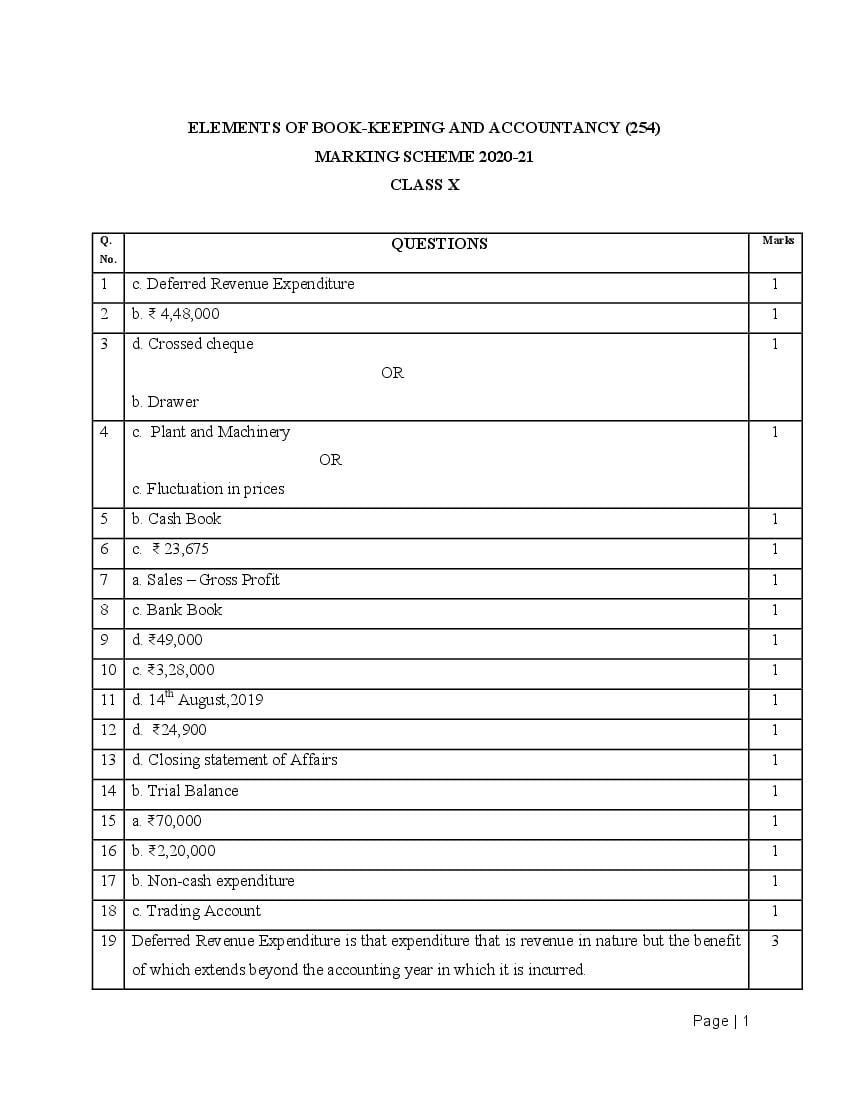
MARKING SCHEME 2020-21
CLASS X
Q. QUESTIONS Marks
No.
1 c. Deferred Revenue Expenditure 1
2 b. ₹ 4,48,000 1
3 d. Crossed cheque 1
OR
b. Drawer
4 c. Plant and Machinery 1
OR
c. Fluctuation in prices
5 b. Cash Book 1
6 c. ₹ 23,675 1
7 a. Sales – Gross Profit 1
8 c. Bank Book 1
9 d. ₹49,000 1
10 c. ₹3,28,000 1
11 d. 14th August,2019 1
12 d. ₹24,900 1
13 d. Closing statement of Affairs 1
14 b. Trial Balance 1
15 a. ₹70,000 1
16 b. ₹2,20,000 1
17 b. Non-cash expenditure 1
18 c. Trading Account 1
19 Deferred Revenue Expenditure is that expenditure that is revenue in nature but the benefit 3
of which extends beyond the accounting year in which it is incurred.
Page | 1
Page 2
OR
(a) Purchase of a fixed asset 1
(b) Construction of building 1
(c) Custom duty paid on import of a machinery 1
20 Causes of differences between balance as per the Cash book and as per Pass book:
(a) Cheques issued but not yet presented for payment. 1
(b) Interest received by the bank 1
(c) Cheque deposited into the bank but not yet collected by the bank. 1
21 Books of Hemant
Journal
Date Particulars L.F Dr. Cr.
2019
March,25 Purchases A/c 10,000 1
Dr. 10,000
March,25 To Samarth
( Being goods purchased from Samarth) 10,000
Samarth’sA/c 10,000 1
Dr.
To Bills Payable A/c
(Being acceptance given to Samarth) 1
May, BillsPayableA/c 10,000
28 Dr. 10,000
To Bank A/c
(Being acceptance met on maturity)
OR
The bills of exchange as instruments of credit are used frequently in business because of
the following advantages:
(a) Framework for relationships: 1x3
A bill of exchange represents an instrument, which provides a framework for
Page | 2
Page 3
agreed basis.
(b) Certainty of terms and conditions:
The creditor knows the time when (s)he would receive the money so also debtor is
fully aware of the date by which (s)he has to pay the money. This is due to the fact
that terms and conditions of the relationships between debtor and creditor such as
amount required to be paid; date of payment; interest to be paid, if any, place of
payment are clearly mentioned in the bill of exchange.
(c) Convenient means of credit:
A bill of exchange enables the buyer to buy the goods on credit and pay after the
period of credit. However, the seller of goods even after extension of credit can get
payment immediately either by discounting the bill with the bank or by endorsing it
in favour of a third party.
22 Following are the limitations of incomplete records:
a) As double entry system is not followed, a trial balance cannot be prepared. 1½
b) Correct ascertainment and evaluation of financial result of business operations 1½
cannot be made.
23 Books of Suraj
Journal
Date Particulars L.F Dr Cr
2019
July 1 Bills Receivable A/c Dr 60,000 1
To Kartik’s A/c 60,000
(Received Kartik’s acceptance
payable after three months)
July 1 Bank A/c Dr 58,200
Discount A/c Dr 1,800
To Bills Receivable A/c 60,000 1
(Kartik’s acceptance discounted
with the bank @12% p.a.)
Page | 3
Page 4
Journal
Date Particulars L.F Dr Cr
July Suraj’s A/c Dr 60,000
1, To Bills Payable A/c 60,000 1
2019 (Accepted Suraj’s bill )
Oct 4, Bills Payable A/c Dr 60,000
2019 To Bank A/c 60,000
( Met acceptance of Suraj’s bill) 1
24 Following points of distinction between capital expenditure and revenue expenditure : 4
(a) Capital expenditure increases earning capacity of business whereas revenue
expenditure is incurred to maintain the earning capacity.
(b) Capital expenditure is incurred to acquire fixed assets for operation of business
whereas revenue expenditure is incurred on day-to-day
conduct of business.
(c) Revenue expenditure is generally recurring expenditure and capital expenditure is
non-recurring by nature.
(d) Capital expenditure benefits more than one accounting year whereas revenue
expenditure normally benefits one accounting year.
25
Basis of Difference Straight Line Written Down
Method Value Method
Basis of charging Original Cost Book Value i.e.
depreciation original cost less 1
depreciation charged
till date. In this
Page | 4
Page 5
declines year after
year
Annual depreciation Fixed (Constant) Declines year after
charge year year 1
Total charge against Unequal year after Almost equal every
profit and loss year. It increases in year 1
account respect of later years.
depreciation and
repairs
Recognition by Not recognised Recognised 1
Income Tax law
Or
Written down value method has the following advantages:
(a) This method is based on a more realistic assumption that the benefits from asset go
on diminishing (reducing) with the passage of time. Hence, it calls for proper
allocation of cost because higher depreciation is charged in earlier years when
asset’s utility is higher as compared to later years when it becomes less effective.
(b) It results into almost equal burden of depreciation and repair expenses taken
together every year on profit and loss account.
(c) Income Tax Act accepts this method for tax purposes.
(d) As a large portion of cost is written-off in earlier years, loss due to obsolescence
gets reduced.
26 Bank Reconciliation Statement of Misha Ice Cream Parlours
as on 31st March 2019
PARTICULARS PLUS ITEMS MINUS ITEMS
Debit balance as per Cash Book 40,000 ½
Cheque deposited but not cleared 10,000 1
Cheques issued but not cleared 700 1
Balance as per pass book 30,700 ½
40,700 40,700
Page | 5
Page 6
as at 31.03.2020
Liabilities Amount ( ₹) Assets Amount (₹)
Capital 16,50,000 Land and Building 4,80,000
+ Net profit1,00,000 17,50,000 Investment 1,20,000
Bank overdraft 2,50,000 Debtors 1,00,000
Stock 7,00,000
Cash in hand 2,00,000
Cash at bank 4,00,000
20,00,000 20,00,000
28 Bank Reconciliation statement of Vansh Brothers, as on March 31,2019
Particulars PLUS ITEMS MINUS ITEMS
Overdraft as per passbook 25,200 ½
Insurance premium paid by the bank 2,500 1
Interest on overdraft 1,500 1
Cheque deposited but not yet cleared 8,100 1
Amount wrongly debited by bank 2,000 1
Overdraft as per cash book 11,100 ½
25,200 25,200
Page | 6
Page 7
29 Date Particulars Amt (₹) Date Particulars Amt (₹)
1.1.10 To Bank A/c 1,60,000 31.12.10 By Depreciation A/c 16,000
31.12.10 By Balance c/d 1,44,000 1½
1,60,000 1,60,000
1.1.11 To Balance b/d 1,44,000 31.12.11 By Depreciation 16,000
31.12.11 By Balance c/d 1,28,000
1½
1,44,000 144,000
1.1.12 To Balance b/d 1,28,000 31.12.12 By Depreciation 16,000
1½
31.12.12 By Balance c/d 1,12,000
½
1,28,000 1,28,000
30 Statement of Affairs (as on 31-03-19)
LIABILITIES Amount ASSETS Amount
Sundry Creditors 29,000 Cash 20,000 1½
Bills Payable 5,000 Sundry Debtors 78,000
Opening Capital
(Bal. Figure) 2,72,000 Stock 68,000
Machinery 1,40,000
3,06,000 3,06,000
Statement of Affairs (as on 31-03-20)
LIABILITIES Amount ASSETS Amount
Sundry Creditors 29,000 Cash 18,000
Bills Payable 10,000 Sundry Debtors 90,000
Closing Capital
(Bal. Figure) 2,63,000 Stock 64,000
1½
Page | 7
Page 8
3,02,000 3,02,000
Statement of Profit and Loss
As on 31-03-2020
Particulars Amount
Closing Capital 2,63,000 2
add: Drawings (4,000x12) 48,000
less: Additional Capital 15,000
less: Opening Capital 2,72,000
Profit Earned During The Year 24,000
OR
BASIS FOR SINGLE ENTRY SYSTEM DOUBLE ENTRY SYSTEM
COMPARISON
Meaning The system of accounting in The accounting system, in which every
which only one sided entry transaction affects two accounts
is required to record simultaneously, is known as the Double
financial transactions is Entry System.
Single Entry System.
Nature Simple Complex
Type of recording Incomplete Complete 1x5
Errors Hard to identify Easy to locate
Ledger Personal and Cash Account Personal, Real and Nominal Account
Preferable for Small Enterprises Big Enterprises
Suitable for tax No Yes
purposes
Page | 8
Page 9
31 Trading A/c
Cr. Dr. as on 31.03.2018 Cr.
Particulars Amount
Par(₹) Particulars Amount (₹)
Opening Inventory 50,000 Sales 12,03,700 12,03,000
Less l (-) Return (700)
Purchase 8,15,000 8,10,000 Closing Stock 20,000
Less Returns (5,000)
1½
Gross profit transferred to Profit 3,63,000
and loss account
12,23,000 12,23,000
Profit and Loss A/c
Dr as on 31.03.2018 Cr
Particulars Amount (₹) Particulars Amount (₹)
Salaries 35,000 Gross rofit 363,000
and Wages transferred from
Trading Account
Bad Debt 7,800 Rent received 13,400
Net Profit transferred to 3,33,600
Capital account
1½
3,76,400 3,76,400
Page | 9
Page 10
as on 31.03.2018
Liabilities Amount (₹) Assets Amount (₹)
Capital 2,40,000 573,600 Debtors 1,28,000
Net Profit+333,600
Creditors 3,44,800
Patent Patents 35,000
Bank Loan 2,00,000
Land Machinery 4,50,000
Cash at Bank 485,400
Closing Stock 20,000
2
11,18,400 11,18,400
Page | 10
Document Details
| Board / Org | CBSE |
| Exam | Class 10 |
| Type | Marking Scheme |
| Pages | 10 |
| Updated | 30 Apr 2026 |