CBSE Class 10 Marking Scheme 2021 for Maths Basic
Finished viewing? Save it for later —
Download CBSE Class 10 Marking Scheme 2021 for Maths Basic (PDF · 16 pages)About CBSE Class 10 Marking Scheme 2021 for Maths Basic
CBSE Class 10 Marking Scheme 2021 for Maths Basic is available here for free download. Published by CBSE for Class 10, this sample paper can be viewed online or downloaded as a PDF (16 pages). Candidates preparing for Class 10 can use CBSE Class 10 Marking Scheme 2021 for Maths Basic to understand the exam pattern, the type of questions asked, and the overall difficulty level.
Frequently Asked Questions
How can I download CBSE Class 10 Marking Scheme 2021 for Maths Basic?
Open this page and click the Download button to save CBSE Class 10 Marking Scheme 2021 for Maths Basic as a PDF. It is completely free on AglaSem Docs.
Is CBSE Class 10 Marking Scheme 2021 for Maths Basic free to download?
Yes. CBSE Class 10 Marking Scheme 2021 for Maths Basic can be viewed online and downloaded as a PDF free of cost on AglaSem Docs.
How many pages does CBSE Class 10 Marking Scheme 2021 for Maths Basic have?
CBSE Class 10 Marking Scheme 2021 for Maths Basic contains 16 pages, which you can read online or download together as a single PDF.
Where can I find more Class 10 study material?
You can find more Class 10 question papers, sample papers, syllabus, and answer keys on AglaSem Docs.
CBSE Class 10 Marking Scheme 2021 for Maths Basic – Text
Read the full text of this sample paper below — useful to quickly search, copy and reference the content online without downloading the PDF.
📄 View text version (16 pages)
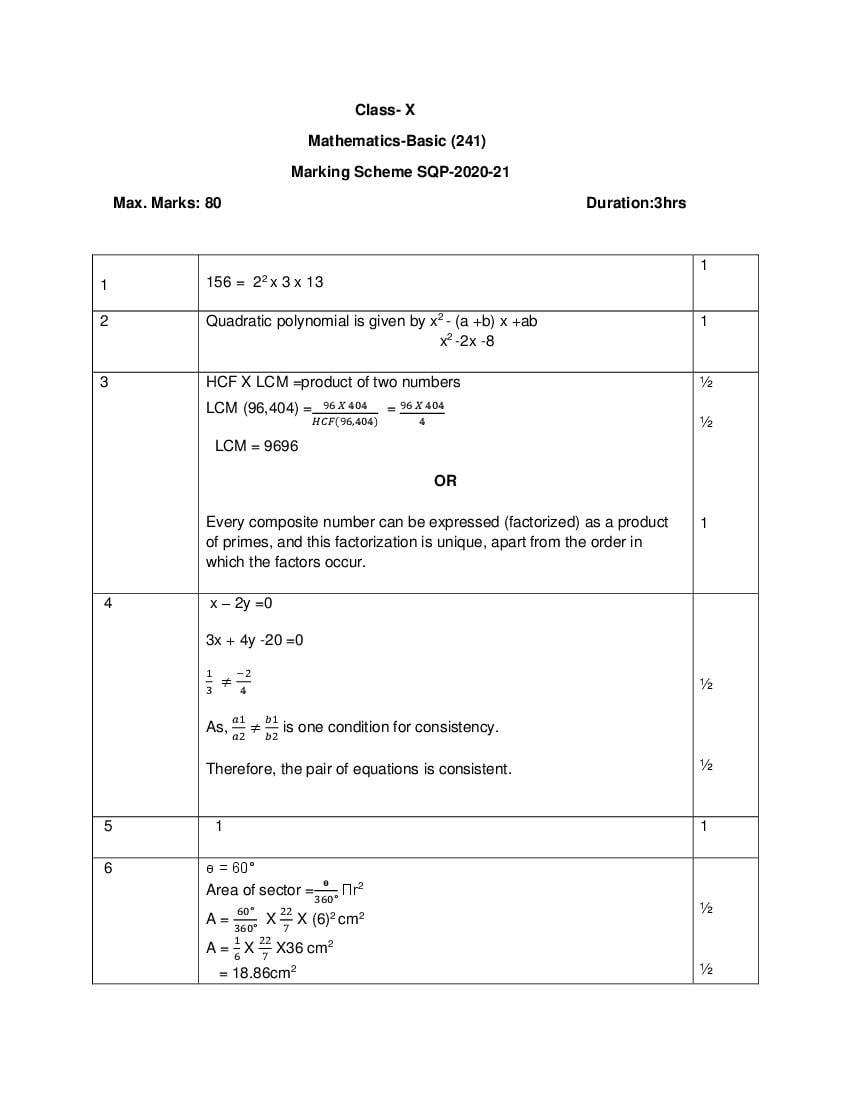
Page 1
Mathematics-Basic (241)
Marking Scheme SQP-2020-21
Max. Marks: 80 Duration:3hrs
1
1 156 = 22 x 3 x 13
2 Quadratic polynomial is given by x2 - (a +b) x +ab 1
x2 -2x -8
3 HCF X LCM =product of two numbers ½
LCM (96,404) = 96 𝑋 404 = 96 𝑋 404
𝐻𝐶𝐹(96,404) 4 ½
LCM = 9696
OR
Every composite number can be expressed (factorized) as a product 1
of primes, and this factorization is unique, apart from the order in
which the factors occur.
4 x – 2y =0
3x + 4y -20 =0
1 −2
≠ ½
3 4
𝑎1 𝑏1
As, 𝑎2 ≠ 𝑏2 is one condition for consistency.
Therefore, the pair of equations is consistent. ½
5 1 1
6 ɵ = 60°
ɵ
Area of sector =360° Πr2
60° 22 ½
A = 360° X 7 X (6)2 cm2
1 22
A = 6 X 7 X36 cm2
= 18.86cm2 ½
Page 2
Another method-
Horse can graze in the field which is a circle of radius 28 cm. ½
So, required perimeter = 2Πr= 2.Π(28) cm
22
=2 x X (28)cm
7
½
= 176 cm
7 By converse of Thale’s theorem DE II BC
∟ADE = ∟ABC = 70° ½
Given ∟BAC = 50°
∟ABC + ∟BAC +∟BCA =180° (Angle sum prop of triangles)
700 + 500 + ∟BCA = 180°
∟BCA = 180° - 120° = 60° ½
OR
EC = AC – AE = (7- 3.5) cm = 3.5 cm
𝐴𝐷 2 𝐴𝐸 3.5 1 ½
𝐵𝐷
= 3 and 𝐸𝐶 =3.5 = 1
𝐴𝐷 𝐴𝐸
So, ≠
𝐵𝐷 𝐸𝐶
Hence, By converse of Thale’s Theorem, DE is not Parallel to BC. ½
8 𝑇𝑜𝑡𝑎𝑙 𝑐𝑜𝑠𝑡
Length of the fence = 𝑅𝑎𝑡𝑒
𝑅𝑠.5280
= 𝑅𝑠 24/𝑚𝑒𝑡𝑟𝑒 = 220 m ½
So, length of fence = Circumference of the field
22
∴ 220m= 2 Π r=2 X xr
7
220 𝑥 7
So, r = 2 𝑥 22 m =35 m
½
9
𝐴𝐵
Sol: tan 30 ° =𝐵𝐶 ½
𝐴𝐵
1/√3 = 8
AB = 8 / √3 metres
½
Height from where it is broken is 8/√3 metres
Page 3
2Πr = Πr2
r = 2 units
11 3 median = mode + 2 mean 1
12 8 1
13 𝑎1 𝑏1 ½
𝑎2
≠ 𝑏2 is the condition for the given pair of equations to have unique
solution.
4 𝑝
≠
2 2
p ≠4
½
Therefore, for all real values of p except 4, the given pair of equations
will have a unique solution.
OR
𝑎1 2 1
Here, = =
𝑎2 4 2
𝑏1 3 1 𝑐1 5
= = and =
𝑏2 6 2 𝑐2 7
1 1 5
= ≠
2 2 7
𝑎1 𝑏1 𝑐1
½
= ≠ is the condition for which the given system of equations
𝑎2 𝑏2 𝑐2
will represent parallel lines.
So, the given system of linear equations will represent a pair of parallel ½
lines.
14 No. of red balls = 3, No.black balls =5 ½
Total number of balls = 5 + 3 =8
3 ½
Probability of red balls =
8
OR
Total no of possible outcomes = 6
½
There are 3 Prime numbers, 2,3,5.
3 1 ½
So, Probability of getting a prime number is 6 = 2
Page 4
½
ℎ
tan 60° = 15
ℎ
√3 =
15
h = 15√3 m ½
16 1 1
17 i) Ans : b) 1
Cloth material required = 2X S A of hemispherical dome
= 2 x 2Π r2
22
= 2 x 2x 7 x (2.5)2 m2
= 78.57 m2
ii) a) Volume of a cylindrical pillar = Π r2h 1
iii) b) Lateral surface area = 2x 2Πrh 1
22
=4x x 1.4 x 7 m2
7
= 123.2 m2
iv) 2 1
d) Volume of hemisphere =3 Π r3
2 22
= 3 7 (3.5)3 m3
= 89.83 m3
v)
b)
2
Sum of the volumes of two hemispheres of radius 1cm each= 2 x 3 Π13
4 ½
Volume of sphere of radius 2cm = 3 Π 23
2
2 x 3 Π 13
So, required ratio is 4 = 1:8 ½
3
Π 23
Page 5
ii) a) (4,6) 1
iii) a) (6,5) 1
iv) a) (16,0) 1
v) b) (-12,6) 1
19 i) c) 90° 1
ii) b) SAS 1
iii) b) 4 : 9 1
iv) d) Converse of Pythagoras theorem 1
v) a) 48 cm2 1
20 i) d) parabola 1
ii) a) 2 1
iii) b) -1, 3 1
iv) c) 𝑥 2 − 2𝑥 − 3 1
v) d) 0 1
21 Let P(x,y) be the required point. Using section formula
𝑚 1𝑥2+𝑚2𝑥1 𝑚1𝑦2+𝑚2𝑦1 1
{ , } = (x, y)
𝑚1+𝑚2 𝑚1+𝑚2
3(8)+1(4) 3(5)+1(−3)
x = 3+1 , y= 3+1
x=7 y= 3 1
(7,3) is the required point
Page 6
Let P(x, y) be equidistant from the points A(7,1) and B(3,5) 1
Given AP =BP. So, AP2 = BP2
(x-7)2 + (y-1)2 = (x-3)2 + (y-5)2
X2 -14x+49 +y2-2y +1 = x2 -6x +9+y2 -10y+25
1
x – y =2
22 By BPT, ½
𝐴𝑀 𝐴𝐿
= ............(1)
𝑀𝐵 𝐿𝐶
𝐴𝑁 𝐴𝐿 ½
Also, 𝑁𝐷 =𝐿𝐶 .................(2)
𝐴𝑀 𝐴𝑁
By Equating (1) and (2) 𝑀𝐵 =𝑁𝐷 1
23 To prove: AB + CD = AD + BC.
1
Proof: AS = AP ( Length of tangents from an external point to a circle
are equal)
1
BQ = BP
CQ = CR
DS = DR
AS + BQ + CQ + DS = AP + BP + CR + DR
(AS+ DS) + ( BQ + CQ) = ( AP + BP) + (CR + DR)
AD + BC = AB +CD
24 For the correct construction 2
Page 7
Cot A =8/15 1
𝐴𝑑𝑗
=8/15
𝑂𝑝𝑝𝑜
By Pythagoras Theorem
AC2 =AB2 +BC2
½
AC =√(8𝑥)2 + (15𝑥)2
AC= 17x
½
Sin A = 15/17
Cos A =8/17
OR
By Pythagoras Theorem
QR = √(13)2 − (12)2 cm 1
QR = 5cm
Tan P =5/12
Cot R =5/12 1
Tan P -Cot R =5/12 -5/12
=0
26 9,17,25, .......
Sn = 636
a=9 ½
d = a2 -a1
= 17 – 9 = 8
𝑛
Sn = 2 [ 2a + (n-1) d]
𝑛
Sn = [ 2a + (n-1) d]
2 ½
Page 8
636 = [ 2x 9 + (n-1) 8]
2
1272 = n [ 18 + 8n -8]
1272 = n [10 +8n]
8n2 +10n -1272 =0
4n2 + 5n -636 =0
−𝑏±√𝑏2 −4𝑎𝑐
½
n= 2𝑎
−5±√52 −4𝑥 4𝑥(−636)
n=
2𝑥4
−5±101
n =- 8
96 −106
n= 8 n= 8
−53
n=12 n=- 4
½
n=12 (since n cannot be negative)
27 Let √3 be a rational number.
Then √3 = p/q HCF (p,q) =1 1
Squaring both sides
(√3)2 = (p/q)2
3 = p2/ q2
3q2 = p2
3 divides p2 » 3 divides p
3 is a factor of p
Take p = 3C ½
3q2 = (3c)2
3q2 = 9C2
3 divides q2 » 3 divides q ½
3 is a factor of q
Therefore 3 is a common factor of p and q
It is a contradiction to our assumption that p/q is rational. 1
Hence √3 is an irrational number.
28
Page 9
Sol :- Let ∟PTQ = ɵ
Now by the theorem TP = TQ. So, TPQ is an isosceles triangle
∟TPQ = ∟TQP = ½ (180° -ɵ) 1
= 90° - ½ ɵ
∟OPT = 90° ½
∟OPQ =∟OPT -∟TPQ =90° -(90° - ½ ɵ)
=½ɵ
= ½ ∟PTQ ½
∟PTQ = 2∟OPQ
29 Let Meena has received x no. of 50 re notes and y no. of 100 re 1
notes.So,
50 x + 100 y =2000
x + y =25
multiply by 50
1
50x + 100y =2000
50 x + 50 y = 1250
- - -
50y =750
Y= 15
1
Putting value of y=15 in equation (2)
x+ 15 =25
x = 10
Meena has received 10 pieces 50 re notes and 15 pieces of 100 re
notes
30 (i) 10,11,12…90 are two digit numbers. There are 81
numbers.So,Probability of getting a two-digit number 1
= 81/90 =9/10
(ii) 1, 4, 9,16,25,36,49,64,81 are perfect squares. So, 1
Probability of getting a perfect square number.
= 9/90 =1/10
(iii) 5, 10,15….90 are divisible by 5. There are 18 outcomes.. 1
So,Probability of getting a number divisible by 5.
= 18/90 =1/5
Page 10
(i) Probability of getting A king of red colour. 1
P (King of red colour) = 2/52 =1/26
(ii) Probability of getting A spade 1
P ( a spade) = 13/52 = 1/4
(iii) Probability of getting The queen of diamonds 1
P ( a the queen of diamonds) = 1/52
31 r1 = 6cm
r2 = 8cm
r3 = 10cm
1
Volume of sphere = 4/3 Π r3
Volume of the resulting sphere = Sum of the volumes of the smaller
spheres.
3Π r = 4/3 Π r 13 + 4/3 Π r 23 +4/3 Π r 3 3
4/ 3
1
3Π r = 4/3 Π (r 13 + r23 + r3 3)
4/ 3
r 3 = 63 + 83 + 103
r3 = 1728
3
r = √1728
r = 12 cm
1
Therefore, the radius of the resulting sphere is 12cm.
32 (sin A-cos A+1)/ (sin A+cosA-1) = 1/(sec A-tan A)
L.H.S. divide numerator and denominator by cos A
1
= (tan A-1+secA)/ (tan A+1-sec A)
= (tan A-1+secA)/(1-sec A + tan A)
We know that 1+tan2 A=sec 2A 1
Or 1=sec2 A-tan2 A = (sec A + tan A)(sec A – tan A)
=( sec A + tan A-1)/[(sec A + tan A)(sec A-tan A)-(sec A-tan A)]
=( sec A + tan A-1)/(sec A-tan A)(sec A + tan A-1)
1
Page 11
33 Given:-
Speed of boat =18km/hr
Distance =24km
Let x be the speed of stream. ½
Let t1 and t2 be the time for upstream and downstream.
As we know that,
speed= distance / time
⇒time= distance / speed
½
For upstream,
Speed =(18−x) km/hr
Distance =24km
Time =t1
Therefore,
24
t1 =
18−𝑥
For downstream,
Speed =(18+x)km/hr
Distance =24km
Time =t2
Therefore,
24
t2 =
18+𝑥
Now according to the question-
t1=t2+1
24 24
= +1
18−𝑥 18+𝑥
½
24(18+𝑥)− 24 (18−𝑥 )
⇒ =1
(18−𝑥)(18+𝑥)
⇒48x=(18−x)(18+x)
⇒48x=324+18x−18x− x2
⇒ x2 +48x−324=0
⇒ x2+54x−6x−324=0
⇒x(x+54)−6(x+54)=0
⇒(x+54)(x−6)=0
Page 12
⇒x=−54 or x=6
Since speed cannot be negative.
⇒x=−54 will be rejected
∴x=6
Thus, the speed of stream is 6km/hr. 1
OR
Let one of the odd positive integer be x
then the other odd positive integer is x+2 1
their sum of squares = x² +(x+2)²
= x² + x² + 4x +4
= 2x² + 4x + 4
Given that their sum of squares = 290
⇒ 2x² +4x + 4 = 290
⇒ 2x² +4x = 290-4 = 286
⇒ 2x² + 4x -286 = 0 1
⇒ 2(x² + 2x - 143) = 0
⇒ x² + 2x - 143 = 0
⇒ x² + 13x - 11x -143 = 0
⇒ x(x+13) - 11(x+13) = 0
⇒ (x -11)(x+13) = 0
⇒ (x-11) = 0 , (x+13) = 0
Therefore , x = 11 or -13
According to question, x is a positive odd integer.
Hence, We take positive value of x 1
So , x = 11 and (x+2) = 11 + 2 = 13
Therefore , the odd positive integers are 11 and 13 .
Page 13
1
Let AB and CD be the multi-storeyed building and the building
respectively.
Let the height of the multi-storeyed building= h m and
the distance between the two buildings = x m.
AE = CD = 8 m [Given]
BE = AB – AE = (h – 8) m
and
AC = DE = x m [Given]
Also,
∠FBD = ∠BDE = 30° ( Alternate angles)
∠FBC = ∠BCA = 45° (Alternate angles) ½
Now,
In Δ ACB,
1
In Δ BDE,
Page 14
From (i) and (ii), we get,
h =√3h -8√3
√3h – h =8√3
h (√3 -1) =8√3
8√3
h = 3−1
√
8√3 √3+1 1
h= 3−1 x 3+1
√ √
h-= 4√3 (√3 +1)
h = 12 +4√3 m
Distance between the two building
½
OR
E C
D
A B
From the figure, the angle of elevation for the first position of the
balloon ∟EAD = 60° and for second position ∟BAC = 30°.The 1
vertical distance
ED = CB = 88.2-1.2 =87m.
Page 15
𝐷𝐸
Then in right Δ ADE, tan60° = 𝐴𝐷
87
√3 = 𝑋 1
87
X =√3 ……….(i)
𝐵𝐶
In right ΔABC, tan 30° = 𝐴𝐵
1 87
=
√3 𝑦
Y = 87√3 ……….(ii)
1
Subtracting(i) and (ii)
87
y-x =87√3 -- -√3
1
87 .2.√3
y-x = √3.√3
y-x = 58√3 m
Hence, the distance travelled by the balloon is equal to BD
y-x =58√3 m.
1
35 Let A be the first term and D the common difference of A.P.
Tp=a=A+(p−1)D=(A−D)+pD (1)
½
Tq=b=A+(q−1)D=(A−D)+qD ..(2) ½
Tr=c=A+(r−1)D=(A−D)+rD ..(3) ½
Here we have got two unknowns A and D which are to be eliminated.
We multiply (1),(2) and (3) by q−r,r−p and p−q respectively and add:
a (q-r) = (A – D )(q-r) + D p(q-r) ½
b(r-p) = (A-D) (r-p) + Dq (r-p) ½
c(p-q) = (A-D) (p-q) + Dr (p-q) ½
a(q−r)+b(r−p)+c(p−q)
1
=(A−D)[q−r+r−p+p−q]+D[p(q−r)+q(r−p)+r(p−q)]
= (A – D ) ( 0 ) + D [ pq-pr + qr – pq + rp – rq ) 1
=0
Page 16
below 140 4 4
140-145 7 11 1
145-150 18 29
150-155 11 40
155-160 6 46
160-165 5 51
N=51⇒
N/2=51/2=25.5
As 29 is just greater than 25.5, therefore median class is 145-150.
𝑁
( −𝐶)
2
Median= l + 𝑓
Xh
Here, l= lower limit of median class =145
½
C=C.F. of the class preceding the median class =11
h= higher limit - lower limit =150−145=5
f= frequency of median class =18
∴median=
( 25.5−11)
= 145 + X5 ½
18
=149.03
Mean by direct method
1
f xi fxi
Height (in cm)
below 140 4 137.5 550
140-145 7 142.5 997.5
145-150 18 147.5 2655
150-155 11 152.5 1677.5
155-160 6 157.5 945 1
5 162.5 812.5
160-165
∑ 𝑓𝑥
Mean = ________
N
=7637.5/51
= 149.75 1
Document Details
| Board / Org | CBSE |
| Exam | Class 10 |
| Type | Marking Scheme |
| Pages | 16 |
| Updated | 30 Apr 2026 |